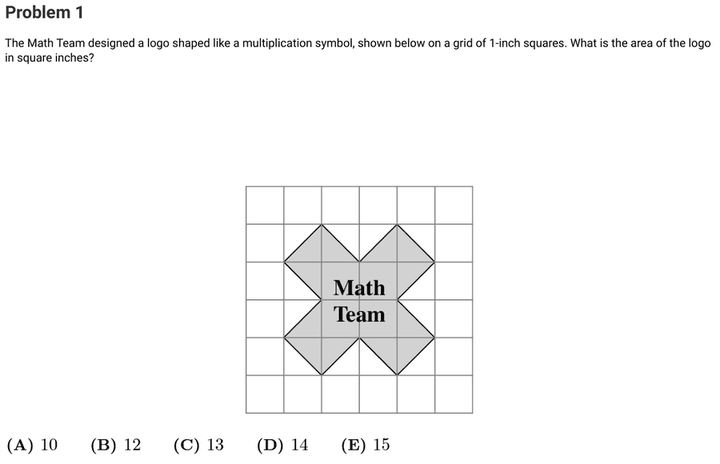
The shape is slanted, but the grid behind it isn't — don't measure tilted lengths, let the grid count the area for you.
Still stuck? Show hint 2 →
Hint 2 of 2
Slice the gray region along the grid lines: every piece becomes a whole unit square (area 1) or a half-square triangle (area ½). Count each kind and add.
Show solution
Approach: let the grid count the area for you (whole squares + half-squares)
Insight: a slanted shape on a grid is hard to eyeball, but it's easy to count. Slice the gray region along the grid lines and every piece becomes either a whole unit square or a triangular half-square — areas you know instantly (1 and ½).
There are 4 whole gray squares in the middle; the surrounding gray triangles are twelve half-squares, adding 12 × ½ = 6 more.
Total area: 4 + 6 = 10 square inches.
You'll see this again: whenever a tilted figure sits on a grid, don't reach for slant-length formulas — chop it into unit squares and half-squares and just add.
Another way — spot five identical tilted unit-squares (MAA):
The logo is made of five small tilted squares whose sides go diagonally across one grid cell, so each side is √(12 + 12) = √2.
A strange symbol like ◆ or ★ isn't new math — it's just a made-up recipe. Replace each symbol with its rule and it becomes ordinary arithmetic.
Still stuck? Show hint 2 →
Hint 2 of 2
Same rule as always: do the parentheses first. Compute the ◆ inside, then drop that number into the ★ recipe.
Show solution
Approach: a made-up symbol is just a recipe — replace it with its rule, parentheses first
Don't be thrown by the unusual symbols: ◆ and ★ are just nicknames for recipes. Wherever you see one, swap in its definition. Same as always, the parentheses go first.
Inside first: 5 ◆ 3 = 52 − 32 = 25 − 9 = 16.
Now feed 16 into the ★ recipe: 16 ★ 6 = (16 − 6)2 = 102 = 100.
Shortcut to notice: 5 ◆ 3 = 52 − 32 is a difference of squares = (5+3)(5−3) = 8 × 2 = 16, so you never even need to square 5 and 3.
When three positive integers a, b, and c are multiplied together, their product is 100. Suppose a < b < c. In how many ways can the numbers be chosen?
Show answer
Answer: E — 4 ways.
Show hints
Hint 1 of 2
Because a < b < c, the smallest factor can't be big — if all three were that size the product would blow past 100. So fix a first; it has very few options.
Still stuck? Show hint 2 →
Hint 2 of 2
a must be a small factor of 100 (it's the least of three, so a³ < 100 ⇒ a ≤ 4). For each such a, split the leftover product into b < c.
Show solution
Approach: fix the smallest factor and list outward
Insight: since a < b < c, the smallest factor a is the natural thing to pin down — it's tiny (if all three were as big as a, the product a³ would already exceed 100). So a can only be a small factor of 100.
a = 1: then bc = 100 with b < c — (1,2,50), (1,4,25), (1,5,20).
a = 2: then bc = 50 with 2 < b < c — only (2,5,10).
Bigger a leaves no room (e.g. a = 4 would need bc = 25 with 4 < b < c, impossible). That gives 4 valid triples.
Why fix the smallest: in any “a < b < c, fixed product” problem, the smallest is squeezed into a short list, so looping over it is the fast, miss-nothing path.
Another way — bound the smallest factor first (MAA):
Since a < b < c and abc = 100, we get a3 < 100, so a ≤ 4. And a must be a factor of 100, so a ∈ {1, 2, 4}.
For each: a = 1 gives (1,2,50), (1,4,25), (1,5,20); a = 2 gives (2,5,10); a = 4 gives nothing (would need bc = 25 with 4 < b < c).
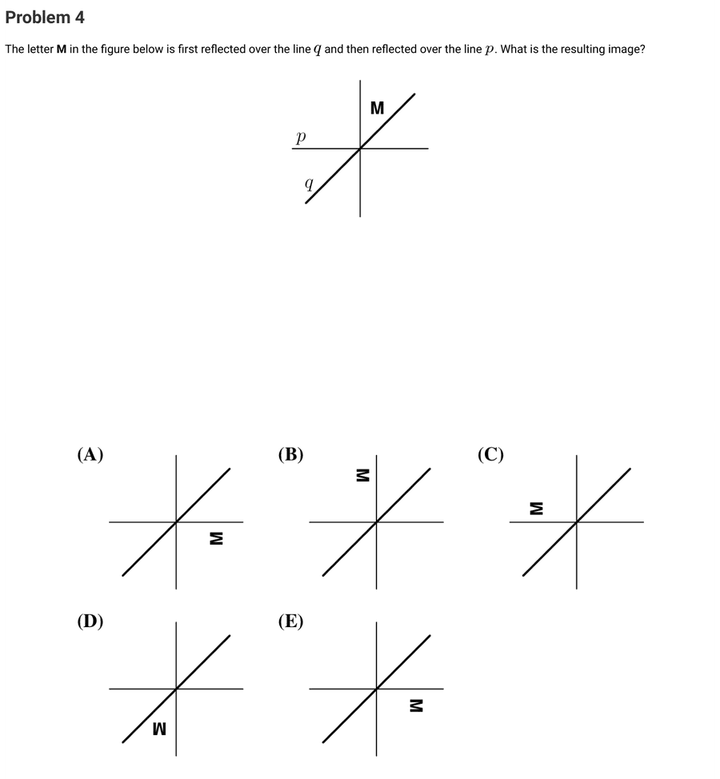
Don't trace the M through each flip separately — ask what single, simpler motion the two flips add up to.
Still stuck? Show hint 2 →
Hint 2 of 2
Two reflections across lines that cross equal one rotation about the crossing point (by twice the angle between the lines). Spin the M instead of flipping it twice.
Show solution
Approach: two reflections across crossing lines = one rotation
Insight: doing two flips in a row feels fiddly, but the combined effect is one clean motion. Reflecting across two lines that cross at a point is exactly a rotation about that point.
The rotation angle is twice the angle between the lines, in the direction from the first line (q) toward the second (p). So instead of tracking each flip, just spin the M about the crossing point.
Carrying M through both flips lands it in the position shown in figure (E).
You'll see this again: two reflections always collapse into a single motion — a rotation if the mirror lines cross, or a translation if they're parallel. Spotting that turns a two-step transformation into one.
Another way — just do the two reflections in order (MAA):
Reflect M over line q: the M flips across that line, landing in its mirror image position.
Reflect that result over line p: a second flip across the other line.
Logic & Word Problemsageswork-backwardsum-constraint
Anna and Bella are celebrating their birthdays together. Five years ago, when Bella turned 6 years old, she received a newborn kitten as a birthday present. Today the sum of the ages of the two children and the kitten is 30. How many years older than Bella is Anna?
Show answer
Answer: C — 3 years older.
Show hints
Hint 1 of 2
The two ages you can actually pin down are Bella's and the kitten's — nail those today, and the total does the rest.
Still stuck? Show hint 2 →
Hint 2 of 2
Bella was 6 five years ago, so she's 11; the kitten was newborn, so it's 5. Subtract both from 30 to uncover Anna's age, then compare.
Show solution
Approach: pin down the ages you can know first, then let the total reveal the unknown
Insight: the kitten is the easy clue, not a distraction — “newborn five years ago” means it's exactly 5 today. And Bella, 6 five years ago, is 11 today. Both ages are now fixed.
Anna is the only mystery, and the total 30 hands her to us: Anna = 30 − 11 (Bella) − 5 (kitten) = 14.
Three positive integers are equally spaced on a number line. The middle number is 15 and the largest number is 4 times the smallest number. What is the smallest of these three numbers?
Show answer
Answer: C — 6.
Show hints
Hint 1 of 2
“Equally spaced” is the key word: the middle number sits exactly halfway between the other two, so it's their average.
Still stuck? Show hint 2 →
Hint 2 of 2
So smallest + largest = 2 × 15 = 30. And largest = 4 × smallest, so smallest + 4×smallest = 30.
Show solution
Approach: equally spaced ⇒ middle is the average of the outer two
Insight: “equally spaced” means the middle is the average of the outer two, so the two outer numbers add to 2 × 15 = 30 — no spacing variable needed.
The two outer numbers are the smallest and 4 times the smallest, which together make 5 of the smallest. So 5 × smallest = 30 ⇒ smallest = 6.
Sanity check: the three numbers are 6, 15, 24 — gaps 9 and 9, equally spaced, and 24 = 4 × 6. ✓
When the World Wide Web first became popular in the 1990s, download speeds reached a maximum of about 56 kilobits per second. Approximately how many minutes would the download of a 4.2-megabyte song have taken at that speed? (Note that there are 8000 kilobits in a megabyte.)
Show answer
Answer: B — 10 minutes.
Show hints
Hint 1 of 2
The speed is in kilobits per second but the song is in megabytes — the units don't match. Fix that first; everything else is one division.
Still stuck? Show hint 2 →
Hint 2 of 2
Convert the song to kilobits (4.2 × 8000), then time = size ÷ speed, and finish by turning seconds into minutes.
Show solution
Approach: make the units match the speed, then divide
Insight: don't divide yet — the answer choices span 0.6 to 36000, so a units slip is the whole danger. The speed is in kilobits/sec, so put the song in kilobits too: 4.2 × 8000 = 33,600 kilobits.
Time = 33,600 ÷ 56 = 600 seconds = 10 minutes.
Lighter path: avoid the big division by reshaping the size as 56 × (something): 33,600 = 56 × 600, so it's 600 seconds straight off — then ÷60 for minutes.
Never multiply all this out. Each fraction is (a number)/(that number + 2), so the lists of numerators and denominators are nearly the same — line them up and watch what cancels.
Still stuck? Show hint 2 →
Hint 2 of 2
Numerators: 1, 2, 3, …, 20. Denominators: 3, 4, …, 22. Everything from 3 to 20 appears in both and cancels — only the two ends survive.
Show solution
Approach: telescoping — the lists overlap, so almost everything cancels
Insight: don't compute — collect. Each factor is (k)/(k+2), so the numerators run 1, 2, 3, …, 20 and the denominators run 3, 4, 5, …, 22. Every number from 3 to 20 shows up in both lists, so it cancels.
Only the unmatched ends remain — 1 and 2 on top, 21 and 22 on the bottom: 1 · 221 · 22 = 2462 = 1231.
You'll see this again: a long product (or sum) where each term overlaps the next is a telescope — line up the lists and only the few leftover ends matter. The shift here is 2, so two terms survive on each end.
A cup of boiling water (212°F) is placed to cool in a room whose temperature remains constant at 68°F. Suppose the difference between the water temperature and the room temperature is halved every 5 minutes. What is the water temperature, in degrees Fahrenheit, after 15 minutes?
Show answer
Answer: B — 86°F.
Show hints
Hint 1 of 2
The temperature itself isn't what halves — the gap between the water and the room is. Track that gap, not the thermometer.
Still stuck? Show hint 2 →
Hint 2 of 2
Starting gap: 212 − 68 = 144. In 15 minutes it halves three times. Add the shrunken gap back onto room temperature.
Show solution
Approach: track the gap (it's what halves), then add room temp back
Insight: “halved” describes the difference from room temperature, not the reading itself. So work with the gap. Starting gap: 212 − 68 = 144°F.
15 minutes is three 5-minute steps, so halve the gap three times: 144 → 72 → 36 → 18.
The water is now 18° above the room: 68 + 18 = 86°F.
You'll see this again: whenever something decays “toward” a fixed level, shift your view to the gap from that level — the gap shrinks by a clean ratio while the raw quantity doesn't.
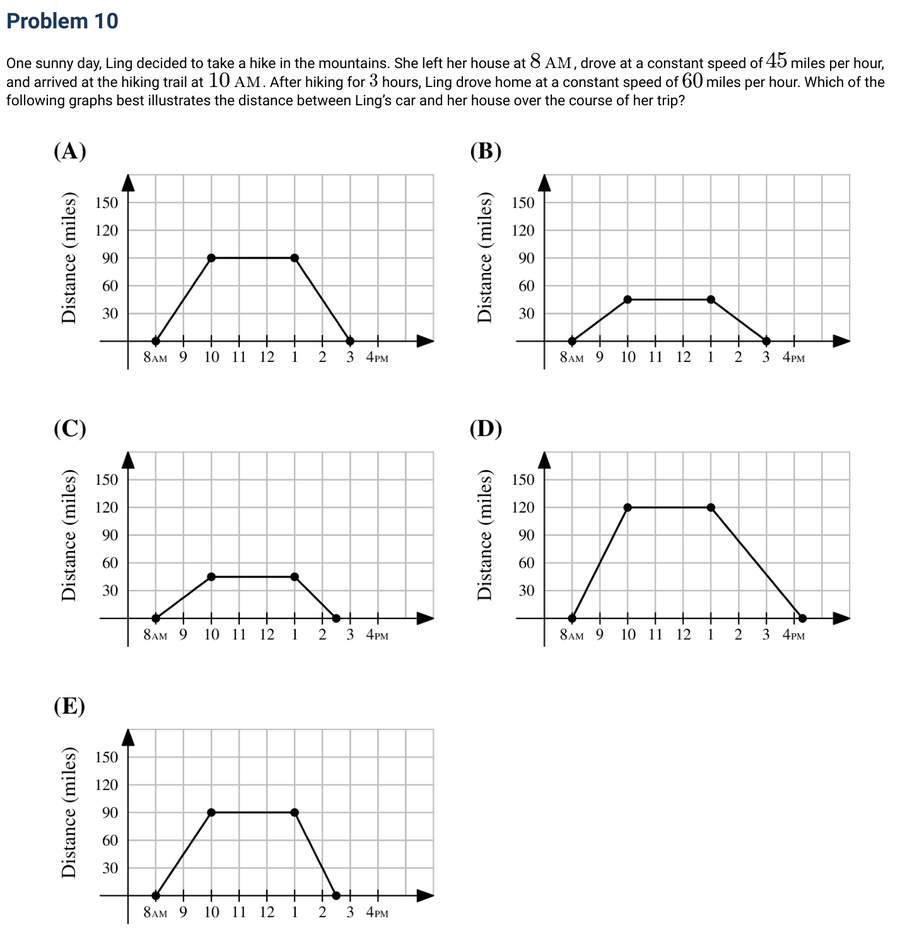
The trip has three phases — drive out, hike (not moving away), drive back. So the graph must go up, flat, then down. Match that shape first, then check the numbers.
Still stuck? Show hint 2 →
Hint 2 of 2
Out: 2 hr × 45 mph = 90 mi (the peak). Hiking is a flat stretch (distance from home unchanged). Return is faster (60 mph), so the down-slope is steeper than the up-slope.
Show solution
Approach: match the up-flat-down shape, then pin the peak and slopes
Insight: a graph problem is a matching problem — read the story as a shape before touching numbers. Drive out (rising), hike (flat, since her distance from home holds steady), drive back (falling): up → flat → down.
Peak height: 2 hr × 45 mph = 90 miles, reached at 10am — that alone rules out any graph not peaking at 90.
Slopes: the return is at 60 mph (faster than the 45 mph trip out), so the down-slope is steeper than the up-slope — 90 ÷ 60 = 1.5 hr home, arriving 2:30pm.
The up-flat-down graph peaking at 90 with a steeper descent is choice E.
You'll see this again: on distance-time graphs, steeper = faster, flat = stopped (or moving neither toward nor away). Reading slope as speed lets you eliminate most choices without arithmetic.
Henry the donkey has a very long piece of pasta. He takes a number of bites of pasta, each time eating 3 inches of pasta from the middle of one piece. In the end, he has 10 pieces of pasta whose total length is 17 inches. How long, in inches, was the piece of pasta he started with?
Show answer
Answer: D — 44 inches.
Show hints
Hint 1 of 2
Each bite takes one piece and leaves two behind — so every bite raises the piece-count by exactly 1. Work backward from 10 pieces to the number of bites.
Still stuck? Show hint 2 →
Hint 2 of 2
Going from 1 piece to 10 takes 9 bites. Each bite removes 3 inches, and the original = what's left + what was eaten.
Show solution
Approach: every bite adds one piece, so pieces − 1 = number of bites
Insight: don't think about lengths yet — count the bites. A bite from the middle splits one piece into two, so each bite raises the piece count by exactly 1. Starting at 1 piece and ending at 10 means 10 − 1 = 9 bites.
Original = what remains + what was eaten = 17 + 27 = 44 inches.
You'll see this again: this is the “fenceposts vs. gaps” idea — cutting a piece into N parts always takes N − 1 cuts. Count the separations, not the parts.
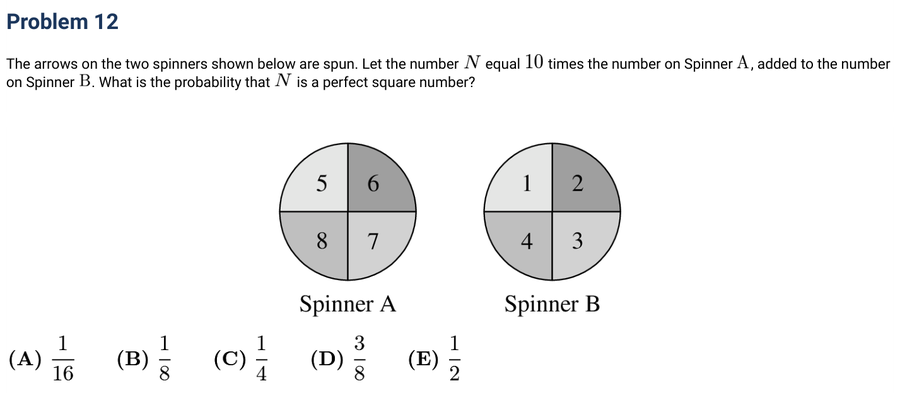
“10 times A plus B” is just sticking A in the tens place and B in the ones place — so N is a 2-digit number. Don't list spinner combos; list the perfect squares that could appear, since there are very few.
Still stuck? Show hint 2 →
Hint 2 of 2
Spinner A ∈ {5, 6, 7, 8} puts N in the 50s–80s, and B ∈ {1, 2, 3, 4} fixes the ones digit. Which perfect squares live in that window?
Show solution
Approach: count the rare outcomes (perfect squares), not the common ones
Insight: N = 10A + B just glues the two spinner numbers into a 2-digit number (A tens, B ones). Rather than checking all 16 spins, hunt the scarce target: perfect squares are rare, so list them.
With A ∈ {5,6,7,8} and B ∈ {1,2,3,4}, N runs 51 to 84. The only perfect squares there are 64 = 82 and 81 = 92. Check each is reachable: 64 needs A=6, B=4 ✓; 81 needs A=8, B=1 ✓.
So 2 of the 4 × 4 = 16 equally likely outcomes win: probability = 216 = 18.
You'll see this again: when favorable outcomes are rare, count them directly instead of sifting the whole sample space — far fewer cases to check.
How many positive integers can fill the blank in the sentence below?
"One positive integer is ___ more than twice another, and the sum of the two numbers is 28."
Show answer
Answer: D — 9 values.
Show hints
Hint 1 of 2
The blank isn't free to be anything — once you choose the smaller number, the sum of 28 forces the blank. So really you're counting how many smaller numbers are allowed.
Still stuck? Show hint 2 →
Hint 2 of 2
Smaller = a, larger = 2a + (blank). Their sum 28 gives blank = 28 − 3a. Now ask: which a keep both the blank and the numbers positive?
Show solution
Approach: the blank is determined by the smaller number, so count valid smaller numbers
Insight: don't search for blanks — each choice of the smaller number forces the blank. Let smaller = a; then larger = 2a + (blank), and the sum is 3a + (blank) = 28, so blank = 28 − 3a.
For the blank to be a positive integer, 28 − 3a ≥ 1, i.e. a ≤ 9; and a ≥ 1. Each such a gives a different blank, so the count of blanks equals the count of a.
a ∈ {1, 2, …, 9} ⇒ 9 values for the blank.
Sanity check:a = 1 gives blank 25 (numbers 1 and 27); a = 9 gives blank 1 (numbers 9 and 19) — both endpoints valid. ✓
In how many ways can the letters in BEEKEEPER be rearranged so that two or more E's do not appear together?
Show answer
Answer: D — 24 ways.
Show hints
Hint 1 of 2
BEEKEEPER is 5 E's and just 4 other letters in 9 slots. With so many E's crammed into 9 spots and none allowed to touch, the E placement is almost forced — figure out where they have to go.
Still stuck? Show hint 2 →
Hint 2 of 2
To keep 5 E's all apart in a row of 9, picture them with a non-E in each gap between them: E _ E _ E _ E _ E. That uses all 9 slots one way only. Then the 4 leftover letters fill the gaps.
Show solution
Approach: place the crowded letter first — it's forced — then permute the rest
Insight: the 5 E's are the constraint, so place them first. To keep all 5 apart you need a non-E between every pair: E _ E _ E _ E _ E. That's 5 E's plus 4 separators = 9 slots — it fits with zero room to spare, so the E's must sit in positions 1, 3, 5, 7, 9.
That leaves positions 2, 4, 6, 8 for B, K, P, R in any order: 4! = 24 arrangements.
You'll see this again: in “keep these apart” problems, set down the troublesome items first as a frame (gaps between them), then slot the others into the gaps. When the items barely fit, their pattern is forced.
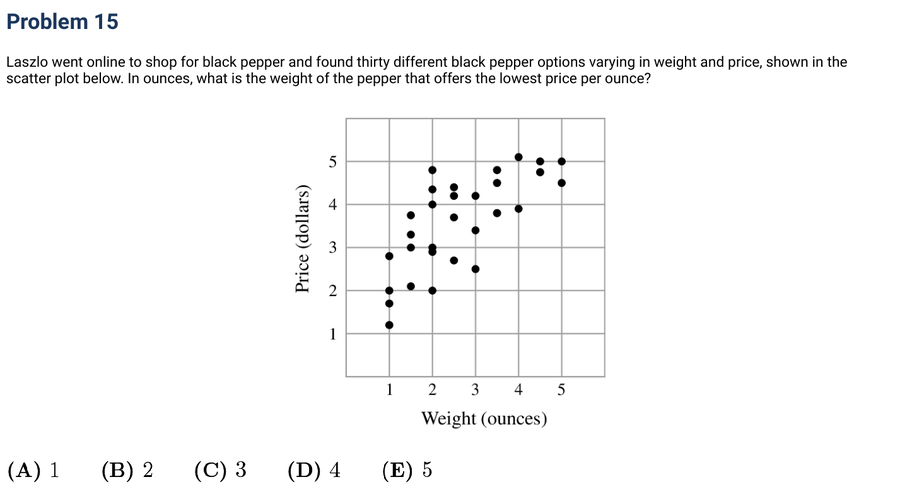
You want the cheapest per ounce, not the cheapest sticker price. So at each weight only the lowest dot can possibly win — ignore every dot above it.
Still stuck? Show hint 2 →
Hint 2 of 2
Price ÷ weight is the slope of the line from the origin to a dot — flatter line = better deal. So find the dot you could draw the most gently-sloped line to. Then check just the five lowest dots by dividing.
Show solution
Approach: only the lowest dot per weight matters; smallest price÷weight wins
Insight: a higher dot at the same weight is strictly worse, so for each weight keep only the lowest dot — that trims 30 points down to 5 candidates.
Now compare price ÷ weight for those 5. Reading the plot: 1 oz ≈ $1.25 → 1.25; 2 oz ≈ $2 → 1.00; 3 oz ≈ $2.5 → ≈0.83; 4 oz ≈ $3.9 → ≈0.97; 5 oz ≈ $4.5 → ≈0.90.
The 3-ounce option is cheapest per ounce (≈$0.83/oz). Answer: 3 ounces.
You'll see this again: price-per-ounce is the slope of the line from the origin to a dot — the best deal is the dot you can reach with the flattest such line, which you can often spot by eye before dividing.
Four numbers are written in a row. The average of the first two is 21, the average of the middle two is 26, and the average of the last two is 30. What is the average of the first and last of the numbers?
Show answer
Answer: B — 25.
Show hints
Hint 1 of 2
You can't pin down the four numbers from three clues — but you don't have to. The question asks only about the combinationa + d, and that one combination is findable. Turn each average into a sum first.
Still stuck? Show hint 2 →
Hint 2 of 2
The pairs are a+b, b+c, c+d. You want a+d — which two should you add, and which should you subtract, so the b's and c's vanish?
Show solution
Approach: combine the pair-sums so the middle terms cancel
Insight: three clues can't fix four numbers, but the target a+d is a special combination that is determined. Turn each average into a sum: a+b = 42, b+c = 52, c+d = 60.
Add the outer two and subtract the inner one — the b and c cancel cleanly: (a+b) + (c+d) − (b+c) = a+d = 42 + 60 − 52 = 50.
Average of first and last = 50 ÷ 2 = 25.
You'll see this again: when a problem gives you sums and asks for a particular combination, don't solve for the individual unknowns — add and subtract the given sums so the unwanted variables cancel.
If n is an even positive integer, the double-factorial notation n!! represents the product of all the even integers from 2 to n. For example: 8!! = 2 × 4 × 6 × 8. What is the units digit of the following sum?
2!! + 4!! + 6!! + … + 2022!!
Show answer
Answer: B — Units digit 2.
Show hints
Hint 1 of 2
“Units digit” means you never need the actual huge values. The moment a product includes 10 as a factor, it ends in 0 — so most of these 1000+ terms are silently zero.
Still stuck? Show hint 2 →
Hint 2 of 2
Every term from 10!! onward has a factor of 10 (ends in 0), contributing nothing. Only 2!!, 4!!, 6!!, 8!! touch the ones digit.
Show solution
Approach: kill the terms ending in 0, keep only the ones digits of the rest
Insight: the sum runs all the way to 2022!!, but “units digit” lets you ignore almost everything. Any n!! with n ≥ 10 multiplies in a 10, so it ends in 0 and adds nothing to the ones place.
Add just those ones digits: 2 + 8 + 8 + 4 = 22, so the final units digit is 2.
You'll see this again: for a units-digit question, work mod 10 the whole way — only ones digits feed into ones digits, and a factor of 10 (or 2 and 5 together) zeroes a term out.
The midpoints of the four sides of a rectangle are (−3, 0), (2, 0), (5, 4), and (0, 4). What is the area of the rectangle?
Show answer
Answer: C — 40.
Show hints
Hint 1 of 2
You're handed the midpoints, not the corners — so reach for the fact about midpoints. Joining the midpoints of any quadrilateral's sides makes a parallelogram, and it always has exactly half the area of the original.
Still stuck? Show hint 2 →
Hint 2 of 2
Plot the four midpoints and find that inner parallelogram's area (base × height), then double it to recover the rectangle.
Show solution
Approach: Varignon — the midpoint parallelogram has half the parent's area
Insight: don't hunt for the rectangle's corners. Connecting the midpoints of any quadrilateral gives a parallelogram (Varignon's theorem) whose area is always half the original — intuitively, each corner triangle you slice off to go from quadrilateral to inner parallelogram removes a quarter of the area, and the four removed quarters total half.
Plot the midpoints: the base from (−3,0) to (2,0) has length 5, and the height (y from 0 to 4) is 4, so the inner parallelogram has area 5 × 4 = 20.
Double it: rectangle area = 2 × 20 = 40.
Another way — the segments joining opposite midpoints ARE the rectangle's sides:
A segment connecting the midpoints of two opposite sides of a rectangle runs straight across and has the same length as the pair of sides it's parallel to — so the two such segments give the rectangle's width and height directly.
Opposite midpoints: (−3,0)–(5,4) gives a segment of length √(82 + 42) = √80; (2,0)–(0,4) gives √(22 + 42) = √20.
These are perpendicular (a rectangle's adjacent sides), so area = √80 × √20 = √1600 = 40.
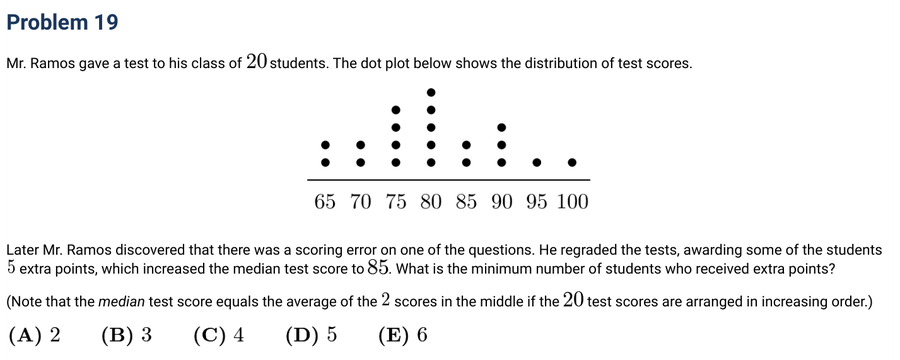
Median isn't about the whole class — with 20 scores it's just the average of the 10th and 11th from the top. So the question really only cares about the scores sitting right at those two middle spots.
Still stuck? Show hint 2 →
Hint 2 of 2
To make that middle average 85, you need the 11th-highest score to reach 85. Count how many already sit at ≥ 85, and the gap up to 11 is how many you must push up.
Show solution
Approach: the median only depends on the 11th-from-top score — push that to 85
Insight: with 20 students the median is the average of the 10th and 11th scores, so forget the rest of the class — the median becomes 85 exactly when the 11th-highest score climbs to 85 (then the 10th, already ≥ that, makes both middles 85).
From the dot plot, 7 students already score ≥ 85 (the 85, 90, 95, 100 columns). Adding 5 points turns an 80 into an 85.
To have 11 students at ≥ 85 (so the 11th-highest is 85), raise 11 − 7 = 4 of the 80-scorers. Fewer than 4 leaves the 11th spot below 85.
You'll see this again: a median is a positional statistic — it depends only on the middle item(s), not on how high or low the extremes are. To move a median, move scores across that middle position.
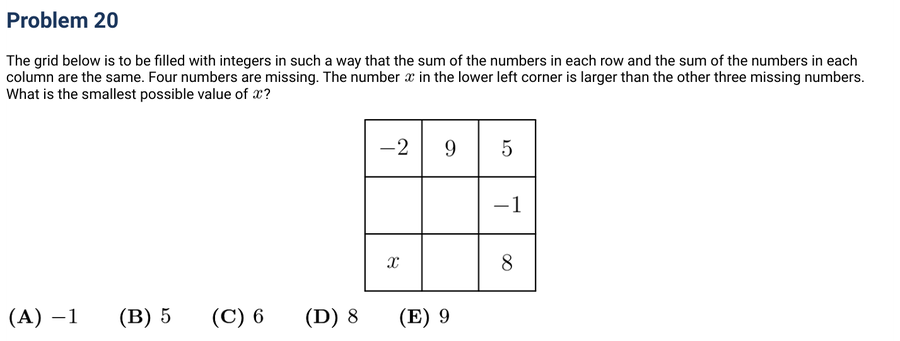
One row is completely filled in — that quietly tells you the shared sum, which unlocks every blank.
Still stuck? Show hint 2 →
Hint 2 of 2
The common sum is −2 + 9 + 5 = 12. Use that to write each of the three other missing cells in terms of x; then “x is the largest” turns into a few inequalities.
Show solution
Approach: the full top row gives the common sum; express every blank in terms of x
Insight: the top row is fully known, so it hands you the magic sum for free: −2 + 9 + 5 = 12. Every row and column must total 12, so each blank is forced once you write it against that 12.
Cell above x (first column): −2 + ? + x = 12 ⇒ ? = 14 − x.
Center (middle row): (14−x) + ? + (−1) = 12 ⇒ ? = x − 1.
Now “x beats all three”: x > 14−x ⇒ x > 7 (the binding one); x > 4−x and x > x−1 are easier. Smallest integer with x > 7 is 8.
Sanity check at x = 8: blanks become 6, −4, 7; the grid reads [−2, 9, 5 / 6, 7, −1 / 8, −4, 8] — every row and column sums to 12, and 8 is the largest of {6, −4, 7, 8}. ✓
Steph scored 15 baskets out of 20 attempts in the first half of a game, and 10 baskets out of 10 attempts in the second half. Candace took 12 attempts in the first half and 18 attempts in the second. In each half, Steph scored a higher percentage of baskets than Candace. Surprisingly they ended with the same overall percentage of baskets scored. How many more baskets did Candace score in the second half than in the first?
Show answer
Answer: C — 9 more baskets.
Show hints
Hint 1 of 2
Both players took the same number of total attempts (30). If two people with equal attempts finish at the same overall percentage, what must be equal about their makes? That collapses the “surprising” clue into a hard number.
Still stuck? Show hint 2 →
Hint 2 of 2
Candace also made 25 baskets. Now her per-half percentages are each strictly below Steph's, which caps her first-half and second-half makes — and only one split of 25 fits both caps.
Show solution
Approach: equal attempts + equal overall % forces equal total makes; then squeeze the split
Insight: turn the “surprising” tie into arithmetic. Both shot 30 total (Steph 20+10, Candace 12+18). Equal attempts and equal overall percentage means equal makes — Steph made 15 + 10 = 25, so Candace made 25 too.
Let Candace's makes be f (of 12) and s (of 18), with f + s = 25. Beating-by-Steph in each half caps her: f/12 < 15/20 = ¾ forces f ≤ 8, and s/18 < 1 forces s ≤ 17.
Those caps add to exactly 8 + 17 = 25, so the only split is f = 8, s = 17 — any less in one half can't be made up in the other.
s − f = 17 − 8 = 9.
Why the caps pin it down: when two upper bounds sum to exactly the required total, each variable is pinned to its max — no slack to trade. (This is also the resolution of the classic “Simpson's paradox” setup: losing both halves yet tying overall.)
A bus takes 2 minutes to drive from one stop to the next, and waits 1 minute at each stop to let passengers board. Zia takes 5 minutes to walk from one bus stop to the next. As Zia reaches a bus stop, if the bus is at the previous stop or has already left the previous stop, then she will wait for the bus. Otherwise she will start walking toward the next stop. Suppose the bus and Zia start at the same time toward the library, with the bus 3 stops behind. After how many minutes will Zia board the bus?
Show answer
Answer: A — 17 minutes.
Show hints
Hint 1 of 2
Zia only makes a decision at the instants she reaches a stop — every 5 minutes. So you don't need a continuous chase; just check the situation at t = 5, 10, 15, … and see where the bus is each time.
Still stuck? Show hint 2 →
Hint 2 of 2
The bus's rhythm is 2 min driving + 1 min waiting = 3 min per stop. Track which stop each of them is at on Zia's 5-minute marks.
Show solution
Approach: only check the few moments Zia can act — her 5-minute arrivals
Insight: a step-by-step chase looks messy, but Zia only chooses to wait-or-walk when she arrives at a stop — at t = 5, 10, 15. Sampling just those moments (the bus runs on a tidy 3-min-per-stop cycle: 2 driving + 1 waiting) makes it a 3-line simulation. Number the stops from the bus's start (stop 0); at t = 0, Zia is at stop 3, bus at stop 0.
t = 5: Zia at stop 4. Bus took 5 min → finished stop 1 (arrived at 2 min, left at 3 min, arrived at stop 2 at 5 min). Bus is at stop 2 — not yet at the previous stop (3), so Zia walks on.
t = 10: Zia at stop 5. Bus: from t = 5 (at stop 2) waits 1 min (leaves at 6), drives 2 min to stop 3 (arrives at 8), waits till 9, drives to stop 4 (arrives at 11). So at t = 10, bus is mid-drive between stops 3 and 4 — not at the previous stop (4), so Zia walks on.
t = 15: Zia at stop 6. Bus: arrives at stop 4 at 11, waits till 12, drives to stop 5 (arrives 14, waits till 15). At t = 15, bus is at stop 5 — the previous stop. Zia waits.
Bus leaves stop 5 at t = 15 and drives 2 min to stop 6: arrives at t = 17.
You'll see this again: when one mover only acts at fixed intervals, you don't have to track time continuously — jump straight to those decision instants and read off the other mover's state. Discretizing turns a chase into a short table.
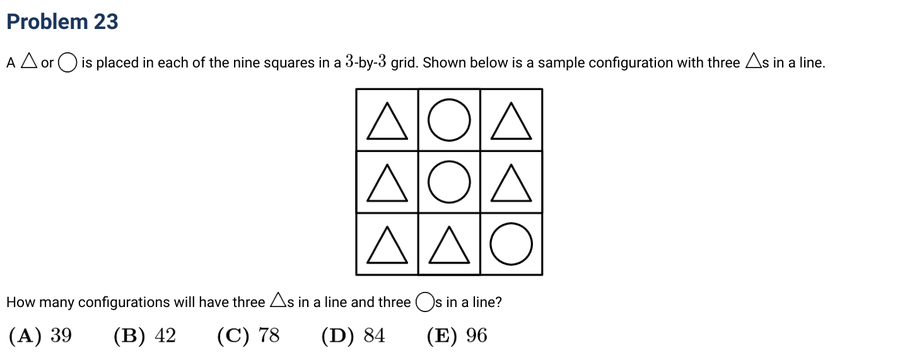
Key observation: a ▵ line and a ○ line can't cross — the crossing cell would have to be both shapes. So the two lines can't be perpendicular: either both run across (rows) or both run down (columns). That splits the whole problem into two mirror-image halves.
Still stuck? Show hint 2 →
Hint 2 of 2
By that left-right/up-down symmetry, count only the “both vertical” configurations and double. Then case on how many full columns are monochromatic: all 3, or exactly 2.
Show solution
Approach: perpendicular lines are impossible ⇒ count one orientation and double, then casework
Insight: where would a ▵-row and a ○-column meet? That cell can't be both shapes, so a horizontal line and a vertical line can't coexist. Hence both lines are horizontal OR both vertical — two symmetric worlds. Count the vertical world and multiply by 2.
Vertical: case 3 lines — each of the 3 columns is monochromatic. 2³ = 8 colorings, minus the 2 all-same colorings (only one shape gets a line) → 6.
Vertical: case 2 lines — one ▵ column, one ○ column, one mixed. 3 ways to pick the ▵ column × 2 remaining for ○ × 6 mixed configurations for the leftover column (2³ minus the two all-same = 6) = 36.
Vertical total: 6 + 36 = 42. By symmetry, horizontal also = 42. Total: 42 + 42 = 84.
You'll see this again: an impossibility (the lines can't be perpendicular) is what splits the count into clean, non-overlapping cases — and a symmetry then lets you count one case and double. Always check that the cases can't overlap (a config with both a vertical and horizontal monochrome line would be double-counted — here that's exactly what the impossibility rules out).
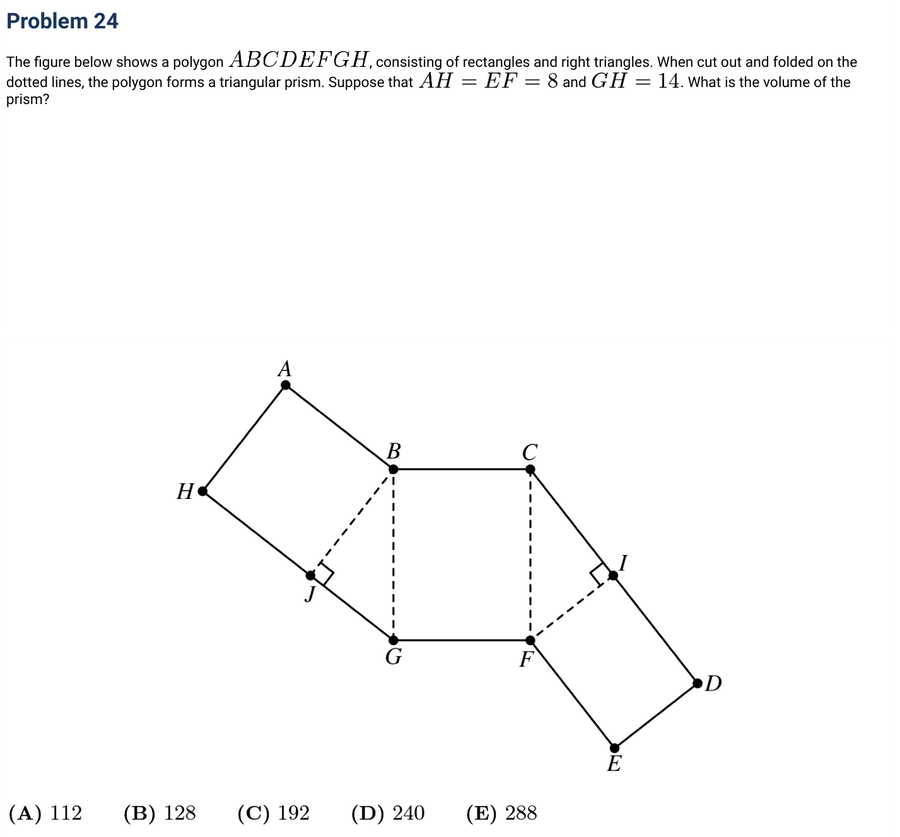
Don't get lost in the flat net — it folds into a triangular prism, whose volume is just (triangle base area) × (prism length). So you only need two things: the right-triangle's two legs and how long the prism is.
Still stuck? Show hint 2 →
Hint 2 of 2
Edges that fold to meet must be equal: AH = EF = 8 makes the rectangular faces 8 wide (the prism length). The triangle's legs are the prism length (8) and GJ = GH − HJ = 14 − 8 = 6.
Show solution
Approach: recognize the solid (triangular prism), then volume = base × length
Insight: a net is a fold-up plan for a solid you already know — here a triangular prism. So skip the clutter and chase only two ingredients: the triangular base and the prism's length. Volume = (base area) × length.
Edges that come together in the fold are equal. The rectangular faces are all 8 across (AB = BC = HJ = GF = 8, and BJ = AH = 8), so the prism length is 8.
The triangular base is right triangle BJG. One leg is HJ = 8; the other is GJ = GH − HJ = 14 − 8 = 6. Base area = (6 × 8)/2 = 24.
Volume = 24 × 8 = 192.
You'll see this again: for any net problem, first name the 3-D shape it folds into, then track only the few lengths its volume formula needs — using “edges that meet are equal” to recover the ones not labeled.
A cricket randomly hops between 4 leaves, on each turn hopping to one of the other 3 leaves with equal probability. After 4 hops, what is the probability that the cricket has returned to the leaf where it started?
Show answer
Answer: E — 7/27.
Show hints
Hint 1 of 2
Don't track which of the four leaves — the three non-start leaves all behave identically. Collapse the whole thing to one number: pn = the chance of being on the start leaf after n hops.
Still stuck? Show hint 2 →
Hint 2 of 2
Build a one-step rule. If you're on start, you must leave (so you got there only from a non-start leaf); from any non-start leaf, exactly 1 of the 3 hops returns to start. So pn+1 = (1 − pn) · 13.
Show solution
Approach: collapse 4 states to 1 by symmetry, then step a recursion
Insight: the three leaves that aren't the start are interchangeable, so you never need to know which one the cricket is on — only whether it's home. Track a single number pn = P(on starting leaf after n hops).
One-step rule: to be on start next hop, the cricket must currently be off-start (probability 1 − pn) and then pick the one returning hop out of 3. So pn+1 = (1 − pn) · 13.
You'll see this again: when many states behave the same, merge them into one tracked quantity (here “home vs. away”) — a multi-state random walk becomes a single tidy recursion.
Another way — just count the paths (all are equally likely):
Each hop is 1 of 3 equally likely choices, so the 4 hops give 34 = 81 equally likely paths. Count how many end back at the start.
Such a return path must use the start as a “stepping point” an even number of times in the middle. Counting the closed length-4 walks gives 21 of them.
Probability = 2181 = 727 — matching the recursion, a good cross-check.