Luka is making lemonade to sell at a school fundraiser. His recipe requires 4 times as much water as sugar and twice as much sugar as lemon juice. He uses 3 cups of lemon juice. How many cups of water does he need?
Show answer
Answer: E — 24 cups.
Show hints
Hint 1 of 2
Lemon juice is the “smallest” ingredient and everything is measured against it. So instead of two separate steps, ask: how many times bigger is water than lemon juice?
Still stuck? Show hint 2 →
Hint 2 of 2
When one thing scales another which scales a third, the scale factors multiply. Water is 4× sugar and sugar is 2× lemon, so water is 4 × 2 = 8 times the lemon juice.
Show solution
Approach: multiply the scale factors into one jump
Chained scalings multiply: water is 4× sugar and sugar is 2× lemon, so water is 4 × 2 = 8 times the lemon juice — one jump instead of two.
With 3 cups of lemon juice, water = 8 × 3 = 24 cups.
You'll see this again as: any “A is k times B, B is m times C” chain collapses to “A is k·m times C.” Gear ratios and unit conversions work the same way.
Another way — one step at a time: lemon → sugar → water (MAA):
Four friends do yardwork for their neighbors over the weekend, earning $15, $20, $25, and $40, respectively. They decide to split their earnings equally among themselves. In total how much will the friend who earned $40 give to the others?
Show answer
Answer: C — $15.
Show hints
Hint 1 of 2
“Splitting equally” means everyone ends at the average. The $40 friend only gives away the part that's above average — you don't need to track who receives it.
Still stuck? Show hint 2 →
Hint 2 of 2
Find the fair share (the average), then the $40 friend hands over exactly the amount they sit above it.
Show solution
Approach: everyone ends at the average; give away the surplus
Equal split means each friend ends with the average: (15 + 20 + 25 + 40) ÷ 4 = 100 ÷ 4 = $25.
The $40 friend keeps $25 and gives away the surplus above average: $40 − $25 = $15.
Why this transfers: in any “pool and share equally” problem, only the gaps from the average move — people above the average pay exactly their surplus, people below receive their shortfall. (Sanity check: those below average, $15 and $20, are short by $10 and $5 — together $15, matching what the $40 friend gives.)
Carrie has a rectangular garden that measures 6 feet by 8 feet. She plants the entire garden with strawberry plants. Carrie is able to plant 4 strawberry plants per square foot, and she harvests an average of 10 strawberries per plant. How many strawberries can she expect to harvest?
Show answer
Answer: D — 1920 strawberries.
Show hint
Hint 1
Follow the units like a relay: square feet → plants → strawberries. Each “per” is just a multiply, and the units hand off cleanly down the chain.
You'll see this again as: chained “per” rates just multiply, and the units cancel like a relay baton (sq ft → plants → berries). Tracking the words stops you from dividing when you should multiply.
Another way — regroup the easy factors first:
4 plants/sq ft × 10 berries/plant = 40 berries per square foot.
48 sq ft × 40 = 1920. Multiplying the small numbers together first keeps the arithmetic light.
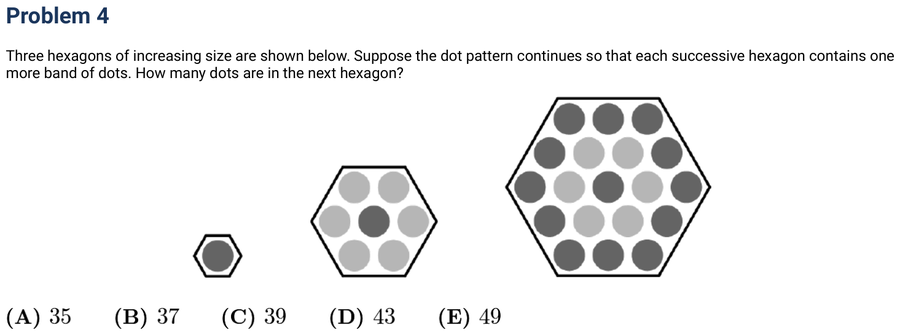
Three hexagons of increasing size are shown below. Suppose the dot pattern continues so that each successive hexagon contains one more band of dots. How many dots are in the next hexagon?
Show answer
Answer: B — 37 dots.
Show hints
Hint 1 of 2
Don't redraw the next hexagon — just figure out how many dots the new outer ring adds. A hexagon ring has 6 corners, so its count grows by 6 each time.
Still stuck? Show hint 2 →
Hint 2 of 2
The bands go 1, then 6, 12, 18, … (each adds 6 more than the last). You already have 1 + 6 + 12 = 19 in hexagon 3; add the next band of 18.
Show solution
Approach: count only the new ring; the rings grow by 6 each time
A hexagon has 6 sides, so each new outer ring adds 6 more dots than the ring before it: the bands are 1, 6, 12, 18, … (a center dot, then rings stepping up by 6).
Hexagon 3 already has 1 + 6 + 12 = 19 dots (matches the picture).
The 4th hexagon just tacks on the next ring of 18: 19 + 18 = 37.
You'll see this again as: “centered hexagonal” growth — when a shape grows by adding a border, count only the border. Its size usually climbs by a fixed step tied to the number of sides (hexagon → +6, square → +8, triangle → +3).
Another way — closed form for centered hexagonal numbers:
Three fourths of a pitcher is filled with pineapple juice. The pitcher is emptied by pouring an equal amount of juice into each of 5 cups. What percent of the total capacity of the pitcher did each cup receive?
Show answer
Answer: C — 15%.
Show hints
Hint 1 of 2
The question asks for a percent of the whole pitcher, not of the juice. So divide the 34 that's there among 5 cups — each share is still measured against the full pitcher.
Still stuck? Show hint 2 →
Hint 2 of 2
Each cup gets 34 ÷ 5 = 320 of the pitcher. To make a percent, rewrite it with denominator 100.
Show solution
Approach: split the fraction, then scale to /100
Each cup gets 34 ÷ 5 = 320 of the whole pitcher (the “of the pitcher” never goes away).
Percent means “out of 100,” so scale the denominator to 100: 320 = 15100 = 15%.
Sanity check: 5 cups × 15% = 75%, exactly the 34 we poured. The shares add back to the whole.
Aaron, Darren, Karen, Maren, and Sharon rode on a small train that has five cars that seat one person each. Maren sat in the last car. Aaron sat directly behind Sharon. Darren sat in one of the cars in front of Aaron. At least one person sat between Karen and Darren. Who sat in the middle car?
Show answer
Answer: A — Aaron.
Show hints
Hint 1 of 2
Lock down the rigid clue first: “Aaron directly behind Sharon” glues them into a single block (Sharon then Aaron). A block of 2 has very few places it can sit, so that's your lever.
Still stuck? Show hint 2 →
Hint 2 of 2
Slide the Sharon–Aaron block across the cars and keep only the spot that still leaves room for Darren ahead of Aaron and Karen at least one car from Darren.
Show solution
Approach: glue the rigid pair into a block, then slide it
Start with the strictest clue: “directly behind” glues Sharon–Aaron into one block (S then A). Maren is fixed in car 5. A glued block of 2 only fits a handful of ways — test each.
S, A in cars 1, 2: Darren needs a car ahead of car 2, but car 1 is taken. Fail.
S, A in cars 3, 4: Darren and Karen must fill cars 1 and 2 — adjacent, with nobody between them. Breaks the spacing rule. Fail.
S, A in cars 2, 3: Darren in car 1, Karen in car 4 — three cars apart, fine. The row is Darren, Sharon, Aaron, Karen, Maren.
Only that arrangement survives, so Aaron is in the middle car.
You'll see this again as: in seating/ordering logic, attack the most restrictive clue first (a fixed seat, or two people who must be adjacent). It chops the possibilities fastest, so you test a few cases instead of all 120 orderings.
How many integers between 2020 and 2400 have four distinct digits arranged in increasing order? (For example, 2347 is one integer.)
Show answer
Answer: C — 15 integers.
Show hints
Hint 1 of 2
“Increasing order” is a gift: once you pick which digits to use, there's only one way to arrange them. So you're choosing a set of digits, never ordering them.
Still stuck? Show hint 2 →
Hint 2 of 2
The first two digits are forced (2, then 3, to stay between 2020 and 2400 while increasing). So just count how many ways to pick the last two digits from {4, 5, 6, 7, 8, 9}.
Show solution
Approach: increasing ⇒ choosing a set, not arranging
Increasing means strictly ascending, so once the four digits are chosen, the order is automatic. The thousands digit is 2 (number is 2020–2400), and the next digit must beat 2 yet keep the number ≤ 2400, so it's 3.
That leaves the last two digits: any 2 distinct values from {4, 5, 6, 7, 8, 9}. Each pair makes exactly one valid number (smaller digit first), so just count the pairs: C(6, 2) = 15.
Why this transfers: whenever an arrangement is forced to be increasing (or decreasing), counting collapses from permutations to combinations — you pick the values and the order takes care of itself. That's the difference between C(6,2) = 15 and the larger 6×5 = 30 of ordered pairs.
Another way — list the pairs to see C(6,2):
Last two digits from {4,5,6,7,8,9}: pick the smaller, then a larger partner. 4 with {5,6,7,8,9}=5; 5 with {6,7,8,9}=4; 6→3; 7→2; 8→1.
5 + 4 + 3 + 2 + 1 = 15 — the triangular-number shape that always shows up when you count unordered pairs.
Ricardo has 2020 coins, some of which are pennies (1-cent coins) and the rest of which are nickels (5-cent coins). He has at least one penny and at least one nickel. What is the difference in cents between the greatest possible and least possible amounts of money that Ricardo can have?
Show answer
Answer: C — 8072 cents.
Show hints
Hint 1 of 2
Don't compute the max and min money separately. Picture turning one penny into a nickel: the coin count stays 2020 but the value jumps by 4 cents. So the difference is just 4 cents per swap, times how many swaps are possible.
Still stuck? Show hint 2 →
Hint 2 of 2
Total = p + 5n = (p+n) + 4n = 2020 + 4n. The fixed 2020 cancels in the difference, leaving 4 × (range of n).
Show solution
Approach: the difference is just (extra value per swap) × (number of swaps)
Every coin is worth at least 1 cent, so write Total = p + 5n = (p + n) + 4n = 2020 + 4n. The 2020 is fixed; only the 4n changes.
Constraints “at least one of each” with p + n = 2020 give n from 1 up to 2019.
Max total has n = 2019, min has n = 1. The fixed 2020 cancels, so the difference is 4(2019 − 1) = 4 × 2018 = 8072.
You'll see this again as: for “max minus min” questions, peel off the constant part — the spread depends only on what varies. Here each penny→nickel swap adds a constant 4 cents, so the answer is (per-swap gain) × (allowed swaps).
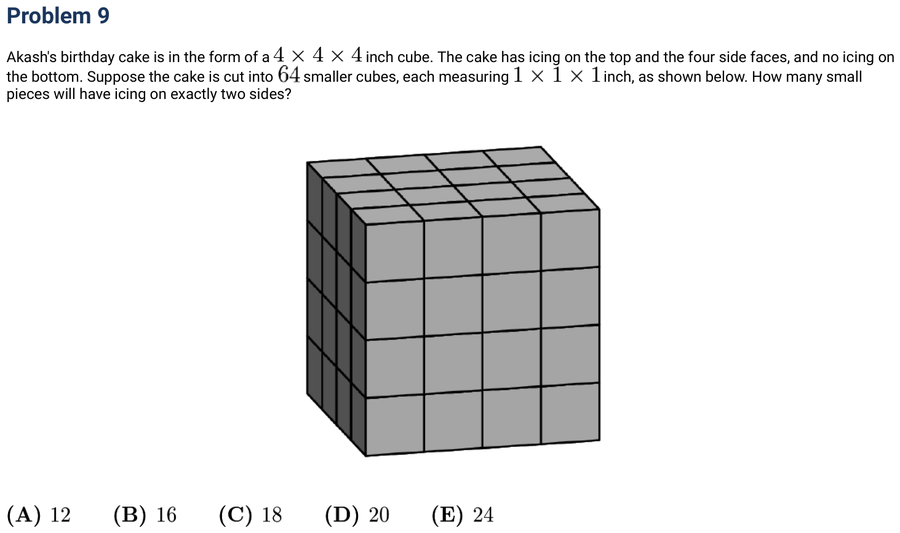
Two iced faces can only meet along an edge, so hunt along the cake's edges, not the flat faces. But beware: the bottom has no icing, which breaks the usual up-down symmetry — treat top edges and bottom edges differently.
Still stuck? Show hint 2 →
Hint 2 of 2
Sort the edges into kinds: 4 top edges (top + a side), 4 vertical corner edges (side + side), and 4 bottom edges (a side + the un-iced bottom = only 1 iced face, so they don't count). Subtract the top corners, which have 3 iced sides.
Show solution
Approach: classify cubes by exposed faces; respect the missing bottom icing
A cube has two iced sides only where two iced faces meet — an edge. Top corners touch three iced faces (top + two sides), and the bottom face has no icing, so the bottom edges only ever touch one iced face. That leaves two qualifying edge types.
Top edges (top + one side): each of the 4 has 4 cubes; the 2 ends are top corners (3 iced) → 2 good per edge → 4 × 2 = 8.
Vertical corner edges (side + side): each of the 4 has 4 cubes; the top one is a top corner already counted, and the bottom 3 each touch 2 sides (bottom un-iced doesn't add a face) → 4 × 3 = 12.
Total: 8 + 12 = 20 pieces.
Why this transfers: “painted cube” problems are all about classifying small cubes by how many faces are exposed (corner = 3, edge = 2, face = 1). The trick here is that removing one face's icing destroys the top–bottom symmetry, so you can't just double the top — always recheck which faces actually count.
Zara has a collection of 4 marbles: an Aggie, a Bumblebee, a Steelie, and a Tiger. She wants to display them in a row on a shelf, but does not want to put the Steelie and the Tiger next to one another. In how many ways can she do this?
Show answer
Answer: C — 12 ways.
Show hints
Hint 1 of 2
“Not next to each other” is awkward to count head-on. Flip it: count everything, then subtract the arrangements where they are next to each other.
Still stuck? Show hint 2 →
Hint 2 of 2
To count the bad ones, glue Steelie and Tiger into a single block (they're forced together): 3 items arrange 3! = 6 ways, and the block flips 2 ways → 12 bad. Subtract from 4! = 24.
Show solution
Approach: complementary counting with the glue trick
All arrangements of 4 distinct marbles: 4! = 24.
Bad ones (Steelie–Tiger touching): glue them into one block, leaving 3 items → 3! = 6 orders; the block itself is ST or TS → ×2 = 12 bad.
Good = 24 − 12 = 12.
You'll see this again as: for a “must be adjacent” condition, glue them into one unit; for “must not be adjacent,” count the total and subtract the glued case. Two tools that pair up on almost every seating problem.
Another way — gap method (place the others first):
Place the Aggie and Bumblebee first: 2! = 2 orders. They create 3 gaps: _ A _ B _.
Drop Steelie and Tiger into two different gaps so they can't touch: choose 2 of the 3 gaps and order them, 3 × 2 = 6 ways.
2 × 6 = 12. The gap method builds only the good arrangements directly — no subtracting.
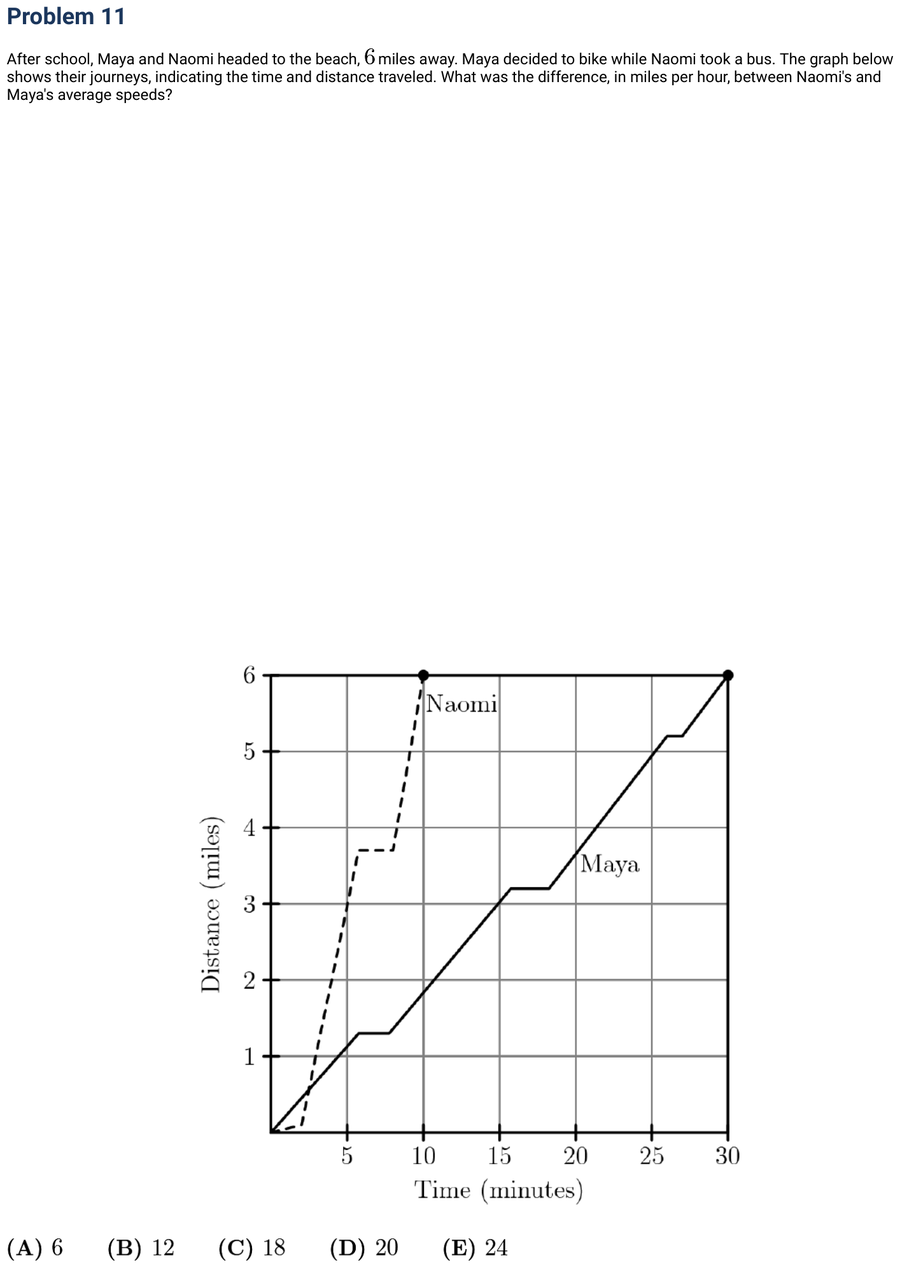
Average speed ignores every stop, wiggle, and flat spot in the graph — it only looks at the two endpoints. So all you need is each girl's finishing time at 6 miles.
Still stuck? Show hint 2 →
Hint 2 of 2
Read where each line hits 6 miles: Naomi at 10 min, Maya at 30 min. Convert each to miles per hour, then subtract.
Show solution
Approach: average speed depends only on start and finish
Average speed = total distance ÷ total time, so the bumps in the graph don't matter — only the endpoint times do. Read them off: Naomi hits 6 miles at 10 min, Maya at 30 min.
Naomi: 6 miles in 10 min = 16 hr → 6 ÷ 16 = 36 mph.
Maya: 6 miles in 30 min = 12 hr → 6 ÷ 12 = 12 mph.
Difference: 36 − 12 = 24 mph.
Why this transfers: on a distance–time graph, average speed is just the slope of the straight line from start to finish — the actual path's twists are irrelevant. Don't get baited into measuring individual segments.
Another way — same distance → compare the times:
Both travel the same 6 miles, so their speeds are in reverse ratio to their times: Naomi (10 min) is 3 times faster than Maya (30 min).
Maya is 12 mph, so Naomi is 36 mph, and the gap is 36 − 12 = 24 mph — no need to recompute from scratch.
For a positive integer n, the factorial notation n! represents the product of the integers from n to 1. For example: 6! = 6 × 5 × 4 × 3 × 2 × 1. What value of N satisfies the following equation?
5! × 9! = 12 × N!
Show answer
Answer: A — N = 10.
Show hints
Hint 1 of 2
Don't expand 9! into a giant number. The right side has a 9! sitting in it — so leave the 9! alone and shape the left side to match it.
Still stuck? Show hint 2 →
Hint 2 of 2
The key identity is 10! = 10 × 9!. So if you can turn 5! into 12 × 10, the whole left side becomes 12 × 10 × 9! = 12 × 10!.
Show solution
Approach: reassemble a factorial instead of multiplying it out
Factorials “telescope”: n! = n × (n−1)!. So a leftover factor times 9! can rebuild into 10!, 11!, … — keep the 9! intact rather than expanding it.
You'll see this again as: when factorials appear in an equation, never compute the big ones — peel digits off one factorial and absorb them into another using n! = n(n−1)!. The arithmetic stays tiny.
Jamal has a drawer containing 6 green socks, 18 purple socks, and 12 orange socks. After adding more purple socks, Jamal noticed that there is now a 60% chance that a sock randomly selected from the drawer is purple. How many purple socks did Jamal add?
Show answer
Answer: B — 9 purple socks added.
Show hints
Hint 1 of 2
Adding purple socks changes the purple count and the total — two moving numbers. Look for what doesn't move: the green and orange socks. Anchor everything to them.
Still stuck? Show hint 2 →
Hint 2 of 2
The 6 + 12 = 18 non-purple socks never change. If purple is now 60%, then those 18 are exactly the other 40%. That one fact gives the new total directly.
Show solution
Approach: anchor to the part that never changes (non-purple = 40%)
Only purple socks are added, so the 6 green + 12 orange = 18 non-purple socks stay fixed. After the change, purple is 60%, so the unchanged 18 must be the remaining 40%.
New total = 18 ÷ 0.4 = 45 socks. He started with 36, so he added 45 − 36 = 9 purple socks.
Why this transfers: when one group grows and you're given the other group's percentage, pin your work to the unchanging group. “18 socks = 40%” pins the whole down in one step — far lighter than introducing a variable and cross-multiplying.
Another way — set up the new probability and solve (MAA):
If s purple are added, (18 + s) / (36 + s) = 0.6.
Cross-multiply: 18 + s = 21.6 + 0.6s, so 0.4s = 3.6 and s = 9.
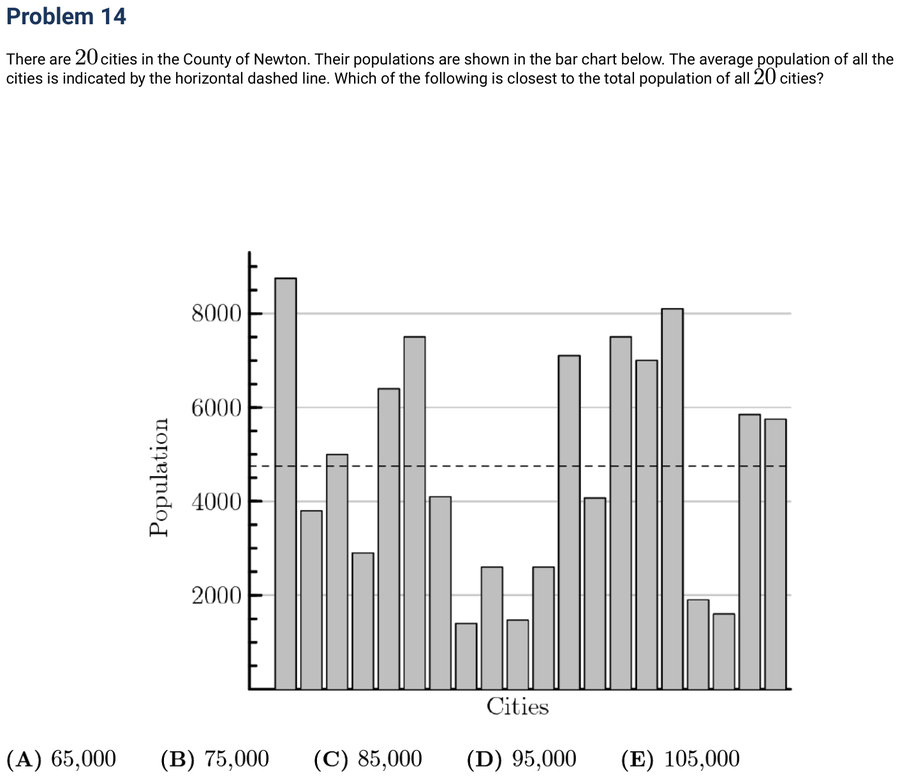
Don't add up 20 bars — the dashed average line already does that work for you. The average is the total spread evenly, so the total is just the average put back across all the cities.
Still stuck? Show hint 2 →
Hint 2 of 2
Read the dashed line (~4,750) and multiply by the 20 cities.
Show solution
Approach: total = average × count (read the line, don't sum the bars)
The definition of average rearranges to total = average × count, so a single read of the dashed line replaces adding 20 bars. The line sits just below 5,000, around 4,750.
Total ≈ 4,750 × 20 = 95,000.
Sanity check: the bars hover roughly in the 4,000–5,000 range, and 5,000 × 20 = 100,000, so an answer near 95,000 is exactly the right size — 65,000 or 105,000 would be too far off.
Suppose 15% of x equals 20% of y. What percentage of x is y?
Show answer
Answer: C — 75%.
Show hints
Hint 1 of 2
“What percent of x is y?” is asking for y ÷ x. So your goal is to get y alone in terms of x — watch the direction so you don't flip them.
Still stuck? Show hint 2 →
Hint 2 of 2
Turn the percents into decimals: 0.15x = 0.20y. Solving for y gives y as a multiple of x, and that multiple is the answer.
Show solution
Approach: rearrange to y = (something) × x
“What percent of x is y?” means find y ÷ x — so isolate y in terms of x.
0.15x = 0.20y ⇒ y = 0.150.20x = 0.75x, so y is 75% of x.
Watch the direction: the question fixes x as the base (“percent ofx”), so the answer is y/x. Flipping it would give 133⅓%, which is the trap choice. Always reread which quantity is the ‘of’.
Another way — pick a concrete number:
Let 15% of x = 20% of y = 60 (any shared value works). Then x = 60 ÷ 0.15 = 400 and y = 60 ÷ 0.20 = 300.
y as a percent of x: 300/400 = 75%. Plugging in real numbers makes ‘percent of which one’ impossible to flip by accident.
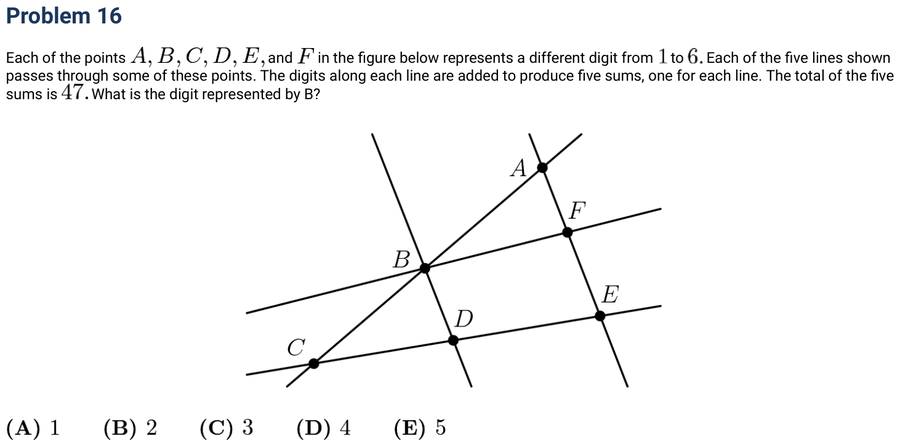
Don't chase individual line-sums. When you add all five sums together, each digit gets counted once for every line it sits on. So ask: how many lines pass through each point?
Still stuck? Show hint 2 →
Hint 2 of 2
Every point is on 2 lines except B, which is the busy crossing on 3. So the grand total counts each digit twice, plus B one extra time: 2(A+B+C+D+E+F) + B = 47.
Show solution
Approach: count incidences — each digit appears once per line it's on
Adding all five line-sums counts each point once per line through it. Reading the figure, A, C, D, E, F lie on 2 lines each, and B (the busy crossing) lies on 3. So the grand total is 2(A+B+C+D+E+F) + B = 47.
The digits 1–6 are used once each, so A+B+C+D+E+F = 1+2+3+4+5+6 = 21. Then 2(21) + B = 42 + B = 47.
B = 5.
Why this transfers: for “sum of all the line totals” problems, count incidences — a point on k lines contributes its value k times. The whole figure collapses to one equation, no casework on which digit goes where.
How many factors of 2020 have more than 3 factors? (As an example, 12 has 6 factors, namely 1, 2, 3, 4, 6, and 12.)
Show answer
Answer: B — 7 factors.
Show hints
Hint 1 of 2
“More than 3 factors” is hard to spot one by one. Flip it: which numbers have 3 or fewer factors? There are only three types — and they're easy to recognize.
Still stuck? Show hint 2 →
Hint 2 of 2
A number has ≤3 factors only if it's 1 (one factor), a prime (two), or a prime squared (three). Count those among the divisors of 2020, then subtract from the total.
Show solution
Approach: complementary — subtract the three ‘small’ types
2020 = 22 · 5 · 101, so the total factor count is (2+1)(1+1)(1+1) = 12.
The divisors with ≤3 factors fall into exactly three recognizable types: 1 (one factor); the primes 2, 5, 101 (two each); and the prime square 4 = 22 (three). That's 1 + 3 + 1 = 5.
Remaining: 12 − 5 = 7 divisors with more than 3 factors.
You'll see this again as: the number of divisors a number has is fixed by its prime exponents — exactly 1 factor ⇒ the number is 1; exactly 2 ⇒ prime; exactly 3 ⇒ prime squared. Memorize those three and ‘count the small ones, subtract’ becomes routine.
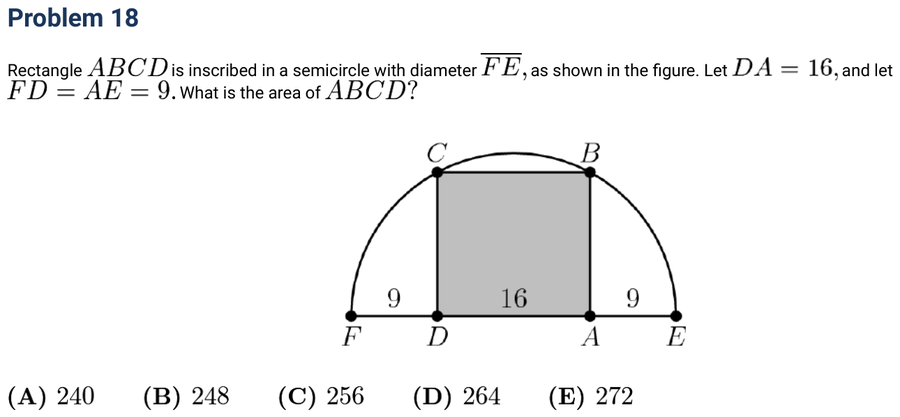
The height DC is hidden — but any corner on the arc sits exactly one radius from the center. So draw the line from the center O to a top corner C: that segment is a known length (the radius).
Still stuck? Show hint 2 →
Hint 2 of 2
FE = 9 + 16 + 9 = 34, so the radius is 17. By symmetry the center O sits at the midpoint of DA, so OD = 8. Now OC = 17 is the hypotenuse of right triangle ODC — Pythagoras gives the height DC.
Show solution
Approach: draw a radius to a corner on the arc
The whole diameter is FE = 9 + 16 + 9 = 34, so the radius is 17 and the center O is the midpoint of FE.
By symmetry O is also the midpoint of the rectangle's base DA, so OD = 16 ÷ 2 = 8. The key move: C lies on the arc, so OC = radius = 17.
Right triangle ODC has legs OD = 8 and DC (the rectangle's height) with hypotenuse OC = 17: DC2 = 172 − 82 = 289 − 64 = 225, so DC = 15 (the 8–15–17 triple).
Area = DA · DC = 16 · 15 = 240.
Why this transfers: whenever a point sits on a circle, the radius to it is a free known length — drawing it turns a vague distance into the hypotenuse of a right triangle. Recognizing 8–15–17 (a Pythagorean triple) then skips the square-root arithmetic.
A number is called flippy if its digits alternate between two distinct digits. For example, 2020 and 37373 are flippy, but 3883 and 123123 are not. How many five-digit flippy numbers are divisible by 15?
Show answer
Answer: B — 4 numbers.
Show hints
Hint 1 of 2
Break the scary ‘divisible by 15’ into two friendly tests: divisible by 5 (look at the last digit) and divisible by 3 (look at the digit sum). Handle them one at a time.
Still stuck? Show hint 2 →
Hint 2 of 2
A 5-digit flippy looks like ababa, so the first and last digit are the same a. Div-by-5 wants the last digit to be 0 or 5 — but it's also the first digit, which can't be 0. That forcesa = 5; then chase div-by-3 on what's left.
Show solution
Approach: split 15 = 3 × 5, and let the ‘same first/last digit’ force a
Divisible by 15 means divisible by both 5 and 3 — two simple digit tests instead of one hard division.
A flippy 5-digit number is ababa, so its first and last digits are both a. Div-by-5 needs the last digit 0 or 5; since it's also the leading digit it can't be 0, so a = 5. The number is 5b5b5.
Div-by-3 looks at the digit sum: 5+b+5+b+5 = 15 + 2b. Since 15 is already a multiple of 3, we just need 2b (hence b) divisible by 3: b ∈ {0, 3, 6, 9}, all different from 5.
That's 4 flippy numbers.
You'll see this again as: to test divisibility by a composite, split it into coprime factors and apply each rule separately (15 → 3 and 5; 12 → 3 and 4; 6 → 2 and 3). And in ‘flippy’-style patterns, the repeated-digit structure often pins a digit before you do any real work.
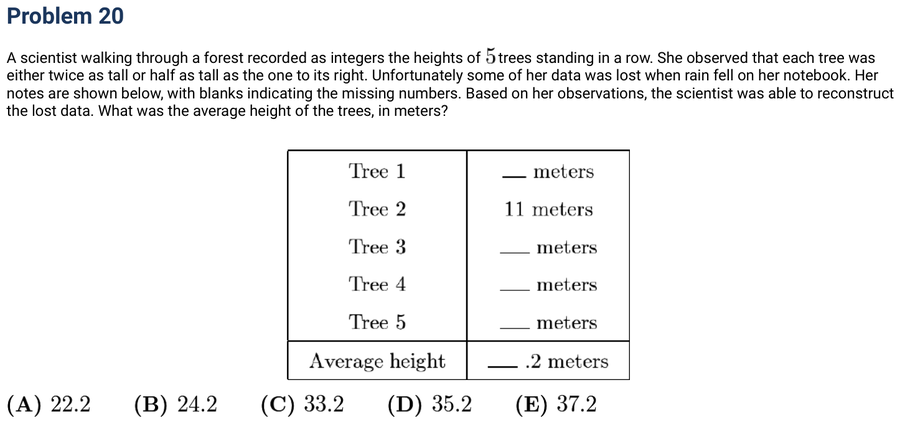
The only number you're handed is 11 — an odd one. Since every height is a whole number, no neighbor can be ‘half of 11’ (that's 5.5). So the trees touching Tree 2 are forced upward, not down.
Still stuck? Show hint 2 →
Hint 2 of 2
Once the integer rule fixes Tree 1 and Tree 3, only a couple of branches remain for Trees 4 and 5. Don't compute all the averages — the answer must end in ‘.2’, so use that to pick the right branch.
Show solution
Approach: let the odd value 11 force integers, then filter by the ‘.2’ ending
The doubling/halving rule says each neighbor is twice or half of 11. Half of 11 is 5.5 — not a whole number — so Tree 1 and Tree 3 are both forced to 22.
Tree 4 is twice or half of Tree 3 (22), so 44 or 11; Tree 5 then doubles or halves Tree 4.
Rather than grinding every average, lean on the clue that it ends in ‘.2’: (44, 88) → 37.4; (44, 22) → 121/5 = 24.2; (11, 22) → 17.6; (11, 5.5) is rejected (not an integer).
Only (44, 22) ends in .2, giving average = 24.2 meters.
Why this transfers: an integer constraint is a powerful filter — start from the value that can't be halved (here the odd 11) and it forces its neighbors, collapsing a tree of possibilities to a handful. Then use a second clue (the ‘.2’) to finish without exhausting every case.
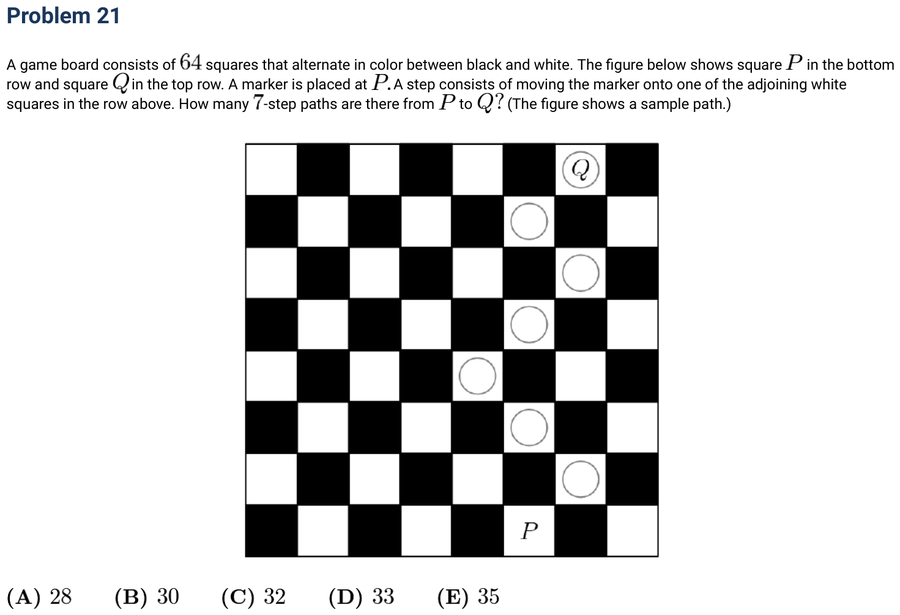
Don't trace individual zig-zag paths. Instead label each reachable square with how many paths reach it. Since you arrive at a square only from the two squares diagonally below, that count is the sum of those two — the marker can't be in two places, so paths just add.
Still stuck? Show hint 2 →
Hint 2 of 2
This is Pascal's triangle. Write 1 on P, then fill each square above as the sum of its two lower neighbors — but whenever a square is missing (the board edge cuts it off), treat it as 0. Read the number that lands on Q.
Show solution
Approach: label squares with path-counts (Pascal's triangle), respecting the edge
Each step moves up one row to a diagonally-adjacent square, so the number of paths to a square is the sum of the paths to the two squares just below it. Start by writing 1 on P.
Build upward row by row. Near the right edge of the board one of the two lower neighbors is missing, so it contributes 0 — this is what bends the answer away from a clean power of 2.
The counts grow 1; 1, 1; 1, 2, 1; 1, 3, 3; 4, 6, 4; … and feeding them up through the 7 rows, the value landing on Q is 28.
Why this transfers: any ‘count the lattice paths’ problem yields to this add-the-two-below labeling — it's Pascal's triangle in disguise. The edge of the board simply zeroes out the off-board neighbor, which is why the count is 28 instead of the unrestricted 27.
When a positive integer N is fed into a machine, the output is calculated by the rule: if N is even, output N/2; if N is odd, output 3N + 1. Example: 7 → 22 → 11 → 34 → 17 → 52 → 26. When the same 6-step process is applied to a different starting N, the final output is 1. What is the sum of all such integers N?
Show answer
Answer: E — Sum is 83.
Show hints
Hint 1 of 2
Going forward you'd have to guess starting values and test each one. Flip the arrows: start at the known endpoint 1 and ask ‘what could come right before this?’ six times.
Still stuck? Show hint 2 →
Hint 2 of 2
Reverse each rule. A value k can come from 2k (undo the halving — always works) or from (k−1)/3 (undo the 3n+1 — but only when that's an odd whole number). Build the tree of possibilities 6 levels back from 1.
Show solution
Approach: invert the machine and grow the tree backward from 1
Forward the rule is: even → halve, odd → 3n+1. Run it backward from a value k: a predecessor is 2k (always valid, since doubling lands on an even number that halves back to k), and also (k−1)/3 — but only if that comes out an odd whole number (so the odd rule really applied).
Grow the tree 6 steps back from 1: 1 → {2} → {4} → {8, 1} → {16, 2} → {32, 5, 4} → {64, 10, 8, 1}. (At each value, double it, and divide-minus-one-by-three when that's an odd integer.)
The four level-6 values are the starting numbers; their sum is 64 + 10 + 8 + 1 = 83.
Why this transfers: when a process is easy to run forward but you're told the output, work backward and invert each rule — the branches that fail the ‘is it a valid integer / right parity’ check simply die off, pruning the tree to a small set you can sum.
Five different awards are to be given to three students. Each student will receive at least one award. In how many different ways can the awards be distributed?
Show answer
Answer: B — 150 ways.
Show hints
Hint 1 of 2
‘Each student gets at least one’ is the awkward part. Counting without that rule is easy — each of the 5 distinct awards independently goes to one of 3 students. So count freely, then remove the bad cases where someone is shut out.
Still stuck? Show hint 2 →
Hint 2 of 2
Total = 35. To remove the bad cases, use inclusion–exclusion: subtract the ‘a chosen student gets nothing’ cases (3 × 25), but you double-removed the ‘two students get nothing’ cases, so add those back (3 × 15).
Show solution
Approach: inclusion–exclusion on ‘someone is empty-handed’
Awards are distinct and students are distinct, so without the ‘at least one’ rule each award has 3 independent choices: 35 = 243 total.
Subtract the assignments where one named student gets nothing (the other two share all 5): C(3,1) × 25 = 3 × 32 = 96.
Those subtractions double-counted the assignments where two named students get nothing (one student hogs everything), so add them back: C(3,2) × 15 = 3.
243 − 96 + 3 = 150.
Why this transfers: ‘onto’ / ‘everyone gets something’ distributions are the home turf of inclusion–exclusion: count everything, subtract single exclusions, add back double exclusions. The alternating −, + pattern fixes the over-removal automatically.
Another way — split by the shape of the distribution:
With 5 awards into 3 nonempty piles, the pile sizes are either 3-1-1 or 2-2-1 — the only ways to break 5 into three positive parts.
Shape 3-1-1: pick who gets 3 (3 ways), choose their 3 awards C(5,3)=10, then the last 2 awards go one each to the other two students (2 ways): 3 × 10 × 2 = 60.
Shape 2-2-1: pick who gets the single award (3 ways) and which award C(5,1)=5, then split the remaining 4 into two pairs for the two named students C(4,2)=6: 3 × 5 × 6 = 90.
60 + 90 = 150 — same answer, built directly with no subtracting.
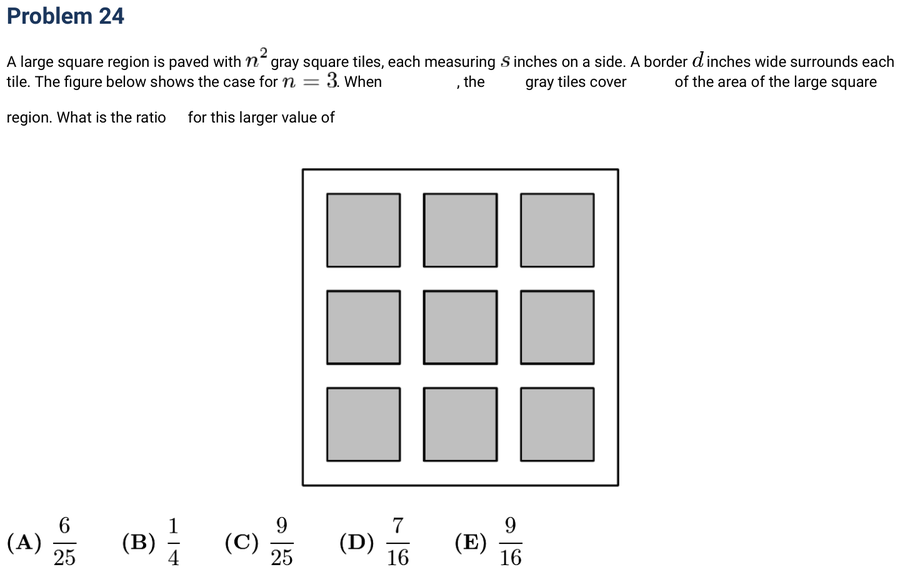
No real measurements are given, only ratios — so set the big square's side to 1 and work in fractions. The single most useful move: 64% is a perfect square, 64% = (4/5)2, so areas turn into lengths cleanly.
Still stuck? Show hint 2 →
Hint 2 of 2
Gray covers (4/5)2 of the area split among 242 tiles, so each tile's side is (4/5)/24 = 1/30. Then the side of the big square = 24 tiles + 25 borders, which solves for d.
Show solution
Approach: normalize the big square to side 1; turn the % into a length
Only ratios matter, so let the large square have side 1. The gray fraction 64% = (4/5)2, and it's shared by 576 = 242 equal tiles, so each tile has area (4/5)2 / 242 = (1/30)2.
Take the square root to get the tile's side: s = 1/30.
Lay out one side: 24 tile widths and 25 border widths (a border on each side of every tile) fill the unit length: 24·(1/30) + 25d = 1 ⇒ 25d = 1 − 4/5 = 1/5 ⇒ d = 1/125.
d/s = (1/125) ÷ (1/30) = 30/125 = 6/25.
Why this transfers: when a problem gives only proportions, fix the overall size to 1 so everything becomes a fraction. And a percentage that's a perfect square (64% → 4/5) is a strong hint to bridge from area to length by taking a square root.
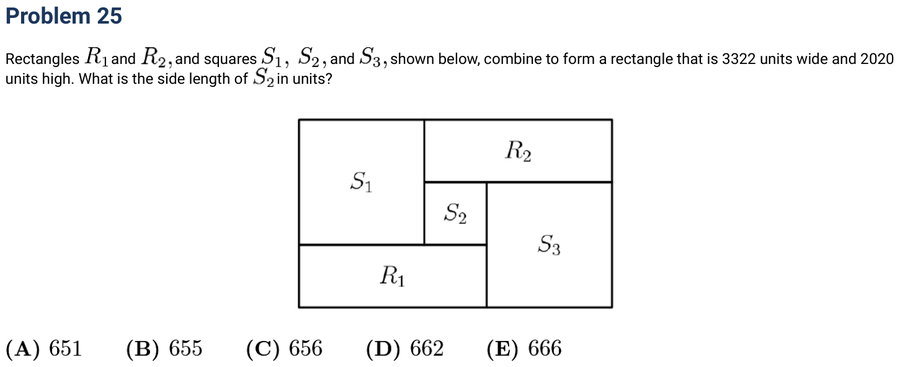
You have three unknown side lengths but only want s2. Don't try to solve for all three — look for two expressions (the width and the height) where the other two unknowns will cancel when you subtract.
Still stuck? Show hint 2 →
Hint 2 of 2
Width = s1 + s2 + s3. The height threads through R2 and S3; since R2's height is s1 − s2, the height = s1 − s2 + s3. Notice s2 appears with opposite signs in the two.
Show solution
Approach: build width and height so subtracting kills s1 and s3
Across the top, the three squares span the full width: s1 + s2 + s3 = 3322.
Down the right side, the height is R2's height plus s3. From the figure, R2's height equals s1 − s2, so the height is s1 − s2 + s3 = 2020.
Subtract the second from the first: the s1 and s3 vanish and the two s2 terms add: 2s2 = 3322 − 2020 = 1302, so s2 = 651.
Why this transfers: with more unknowns than you care about, don't solve the whole system — combine equations so the unwanted variables cancel. Here width and height were engineered so that subtracting wiped out s1 and s3 in one stroke, leaving only the target.