Ike and Mike go into a sandwich shop with a total of $30.00 to spend. Sandwiches cost $4.50 each and soft drinks cost $1.00 each. Ike and Mike plan to buy as many sandwiches as they can and use the remaining money to buy soft drinks. Counting both soft drinks and sandwiches, how many items will they buy?
Show answer
Answer: D — 9 items.
Show hints
Hint 1 of 2
The plan is greedy: buy the expensive item until you can't, then the change becomes cheap items. So really only one question matters — how many sandwiches fit in $30?
Still stuck? Show hint 2 →
Hint 2 of 2
Sandwiches are the bottleneck; the leftover dollars convert 1-to-1 into sodas. Find the most sandwiches, then count whatever's left.
Show solution
Approach: greedy: max the expensive item, change becomes cheap items
Sandwiches are the only limiting purchase, so ask how many fit: $30 ÷ $4.50 = 6 with $3 left (a 7th would need $31.50 — too much).
Each soda is exactly $1, so the $3 leftover turns straight into 3 sodas — no arithmetic, just read it off.
Total items: 6 + 3 = 9.
Why this transfers: any "buy as many of A as possible, then fill with B" problem is a division-with-remainder — the quotient is the A count, the remainder funds the B's.
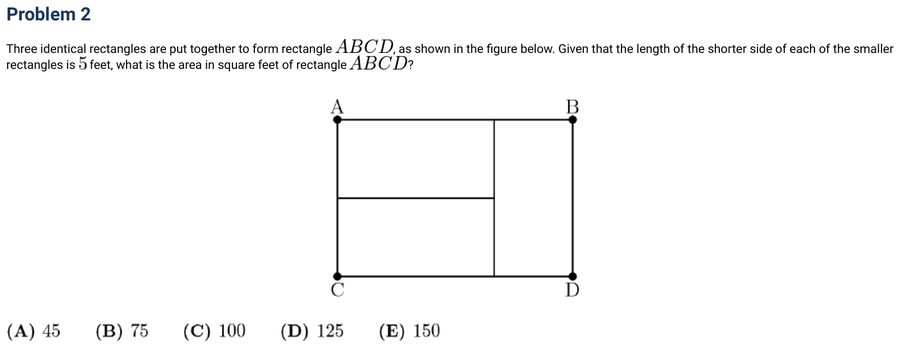
You're only told the short side is 5 — the long side is hidden. Look for a place in the picture where short sides line up against a long side; that shared edge tells you the long side for free.
Still stuck? Show hint 2 →
Hint 2 of 2
Two short sides stacked equal one long side standing beside them: long = 2 × short. That's the key equation; everything else is one multiplication.
Show solution
Approach: let the shared seam set the unknown long side
Each small rectangle has short side 5. In the picture two rectangles lie stacked on the left while one stands upright on the right — their edges share the same height. Two stacked shorts equal one standing long, so the long side = 2 × 5 = 10.
Now the big rectangle ABCD has height 10 and width 10 + 5 = 15, so area = 15 × 10 = 150 square feet.
Why this transfers: in "identical pieces tiled together" figures, a single missing length is almost always pinned by a seam where one orientation lines up flush against another — hunt for that matched edge before reaching for algebra.
Another way — count small rectangles:
Each small rectangle is 5 by 10, area 50. Three identical pieces tile ABCD with no gaps, so the total is 3 × 50 = 150 square feet — a quick check that matches the 15 × 10 answer.
Which of the following is the correct order of the fractions 1511, 1915, and 1713, from least to greatest?
Show answer
Answer: E — 19/15 < 17/13 < 15/11.
Show hints
Hint 1 of 2
Don't cross-multiply three times — first notice each fraction sits just barely above 1. The whole question is really "which one sticks up the most past 1?"
Still stuck? Show hint 2 →
Hint 2 of 2
In every fraction the top is exactly 4 bigger than the bottom, so each equals 1 + 4denominator. Same numerator, so the comparison collapses to comparing denominators.
Show solution
Approach: split off the whole 1, compare the leftover
Every fraction has top − bottom = 4, so write each as 1 + 4denom. The "1" is shared, so only the leftover 4denom decides the order.
Same numerator 4 with a bigger denominator gives a smaller piece: 415 < 413 < 411.
Adding back the shared 1 keeps that order, so least to greatest is 1915 < 1713 < 1511 (choice E).
Why this transfers: when fractions cluster near a round number, subtract that number off and compare the tiny remainders — far easier than cross-multiplying, and the rule "same top, bigger bottom = smaller" does the rest.
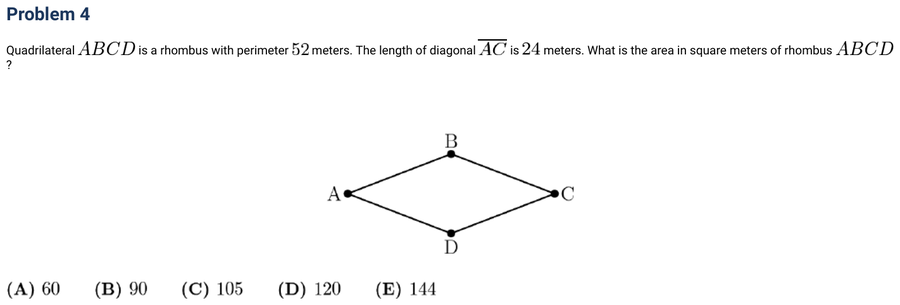
A rhombus only gives you a perimeter and one diagonal — so the hidden tool must be the special fact about a rhombus's diagonals: they meet at right angles and bisect each other. That instantly hands you a right triangle.
Still stuck? Show hint 2 →
Hint 2 of 2
The side (52÷4 = 13) is the hypotenuse and half of AC (24÷2 = 12) is a leg. Recognize 12-13-? — it's the 5-12-13 triple, so the missing leg is 5.
Show solution
Approach: perpendicular bisecting diagonals make a 5-12-13 right triangle
Perimeter gives side = 52 ÷ 4 = 13; half of diagonal AC = 24 ÷ 2 = 12.
The diagonals cut each other at right angles, so the center splits the rhombus into four identical right triangles with hypotenuse 13 (the side) and one leg 12 (half of AC). That's the 5-12-13 triple — no Pythagorean computation needed — so the other half-diagonal is 5 and the full diagonal BD = 10.
Area of a rhombus = d1 × d22 = 24 × 102 = 120 sq m.
You'll see it again as: whenever a problem hands you a rhombus (or a kite), reach first for "diagonals perpendicular" — it converts the figure into right triangles, and recognizing a Pythagorean triple (3-4-5, 5-12-13, 8-15-17) skips the square roots.
Another way — four little triangles:
Each of the four right triangles has legs 12 and 5, so area 12 × 52 = 30.
Four of them: 4 × 30 = 120 sq m — same answer, confirming the diagonal-product formula.
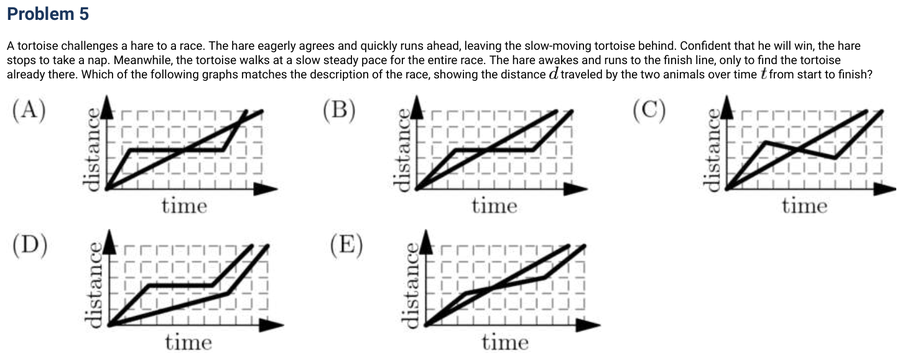
On a distance-vs-time graph, steepness is speed and a flat stretch means "not moving." Translate the story into two shapes, then find the graph that has both.
Still stuck? Show hint 2 →
Hint 2 of 2
Two clues must both show up: the hare's line has a flat middle (the nap), and the tortoise's line hits the finish height at an earlier time than the hare's. Use these to eliminate, not to eyeball.
Show solution
Approach: read slopes as speeds, then use two distinguishing features
Slope = speed. The hare runs (steep), naps (flat), then runs again (steep) — so the hare's curve is the one with a horizontal plateau in the middle.
The tortoise moves at one steady slow pace, a single straight gentle line. The crucial detail: "the tortoise was already there," so the tortoise's line reaches the top (finish distance) at a smaller time than the hare's.
Only graph (B) shows the napping plateau AND the tortoise finishing first.
Why this transfers: match graphs to stories by listing 2–3 testable features (a flat part, who reaches the top first, where lines cross) and eliminate — trying to read the whole picture at once is where mistakes sneak in.
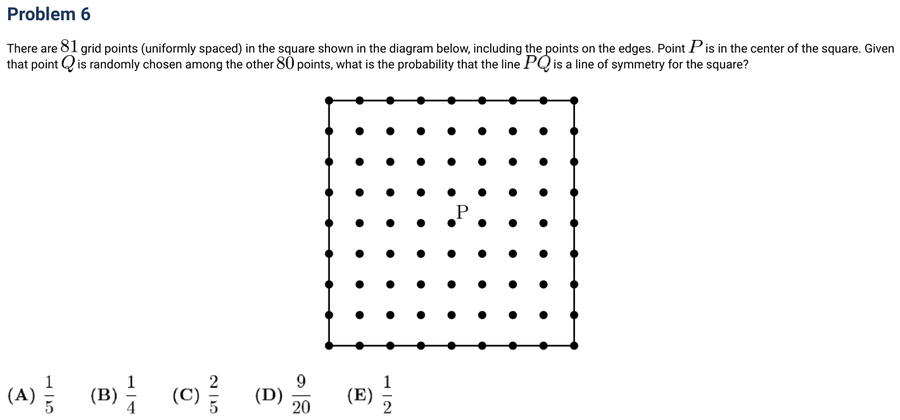
"Line PQ is a line of symmetry" sounds open-ended, but a square has only four symmetry lines, period. So the real question is just: how many grid points sit on those four lines (other than P)?
Still stuck? Show hint 2 →
Hint 2 of 2
The four axes all pass through center P. Count points per line, multiply by 4 — then watch the double-count: P is shared by all four lines and isn't allowed as Q.
Show solution
Approach: Q must land on one of the square's 4 symmetry lines
A square has exactly 4 axes of symmetry, and every one passes through its center P: the two diagonals and the two midline (perpendicular-bisector) lines. For PQ to be an axis, Q must lie on one of these 4 lines.
Each axis runs across the 9×9 grid through 9 points (including P). Across 4 lines that's 4 × 9 = 36, but P is on all four and Q can't equal P, so subtract those 4 copies of P: 36 − 4 = 32 valid points for Q.
Probability = 32 / 80 = 2/5.
Watch the overlap: the only reason this isn't simply 4×9 is that the lines share the center point — whenever you count points spread over several lines through a common point, subtract the shared point's repeats.
Shauna takes five tests, each worth a maximum of 100 points. Her scores on the first three tests are 76, 94, and 87. In order to average 81 for all five tests, what is the lowest score she could earn on one of the other two tests?
Show answer
Answer: A — 48.
Show hints
Hint 1 of 2
The two unknown scores must add to a fixed total. If a fixed amount is split between two scores, making one as small as possible means making the other as large as possible — push the partner to its ceiling of 100.
Still stuck? Show hint 2 →
Hint 2 of 2
Average 81 over 5 tests means the scores total 5 × 81 = 405. Subtract the three known scores to see what the last two must add to, then give one of them the maximum 100.
Show solution
Approach: fixed sum — shove one score to its max so the other is smallest
An average of 81 across 5 tests means a total of 5 × 81 = 405. The first three give 76 + 94 + 87 = 257, so the last two must sum to 405 − 257 = 148.
Those two scores share a fixed 148. To make one as low as possible, make its partner as high as possible: 100 (the test maximum).
Lowest possible = 148 − 100 = 48.
Why this transfers: "minimize one of several things whose total is fixed" is always solved by maxing out everything else — here the cap of 100 is what makes 48 reachable rather than going lower.
Gilda has a bag of marbles. She gives 20% of them to her friend Pedro. Then Gilda gives 10% of what is left to another friend, Ebony. Finally, Gilda gives 25% of what is now left in the bag to her brother Jimmy. What percentage of her original bag of marbles does Gilda have left for herself?
Show answer
Answer: E — 54%.
Show hints
Hint 1 of 2
Each "gives away X%" is the same as "keeps (100−X)%." Don't track what leaves — track the fraction that stays, because those just multiply.
Still stuck? Show hint 2 →
Hint 2 of 2
Keeps in order: 80%, then 90% of that, then 75% of that. Multiply 0.8 × 0.9 × 0.75 — no need to ever pick an actual number of marbles.
Show solution
Approach: multiply the surviving fractions
Flip each gift into what's kept: after Pedro she keeps 80%, after Ebony she keeps 90% of that, after Jimmy she keeps 75% of what's left.
Percentages of percentages just multiply: 0.8 × 0.9 × 0.75 = 0.54 = 54%.
Why this transfers: for a chain of successive percentage changes, convert each to its multiplier (a 20% loss = ×0.8) and multiply them — you never need the starting amount, and order doesn't matter.
Another way — pretend she started with 100:
Start with 100 marbles. Pedro takes 20 → 80 left. Ebony takes 10% of 80 = 8 → 72 left. Jimmy takes 25% of 72 = 18 → 54 left.
54 out of 100 = 54% — same result, and picking 100 keeps every step a whole number.
Alex and Felicia each have cats as pets. Alex buys cat food in cylindrical cans that are 6 cm in diameter and 12 cm high. Felicia buys cat food in cylindrical cans that are 12 cm in diameter and 6 cm high. What is the ratio of the volume of one of Alex's cans to the volume of one of Felicia's cans?
Show answer
Answer: B — 1:2.
Show hints
Hint 1 of 2
Don't plug into πr2h and crunch — a ratio only cares about how each dimension changes. Notice the diameter doubles and the height halves between the two cans.
Still stuck? Show hint 2 →
Hint 2 of 2
Radius appears squared, so doubling it multiplies volume by 4; halving the height multiplies by ½. The π cancels in any ratio — just combine the scale factors.
Show solution
Approach: scale factors, not actual volumes
From Alex's can to Felicia's: the radius doubles and the height halves. In πr2h, radius is squared, so doubling it gives ×4; halving the height gives ×½.
Felicia's volume = Alex's × 4 × ½ = Alex's × 2. So Alex : Felicia = 1 : 2.
The trap: a length that's doubled changes area by 4 and volume by 8 — squared and cubed dimensions amplify. Track exponents when scaling, and let π cancel itself out in any ratio.
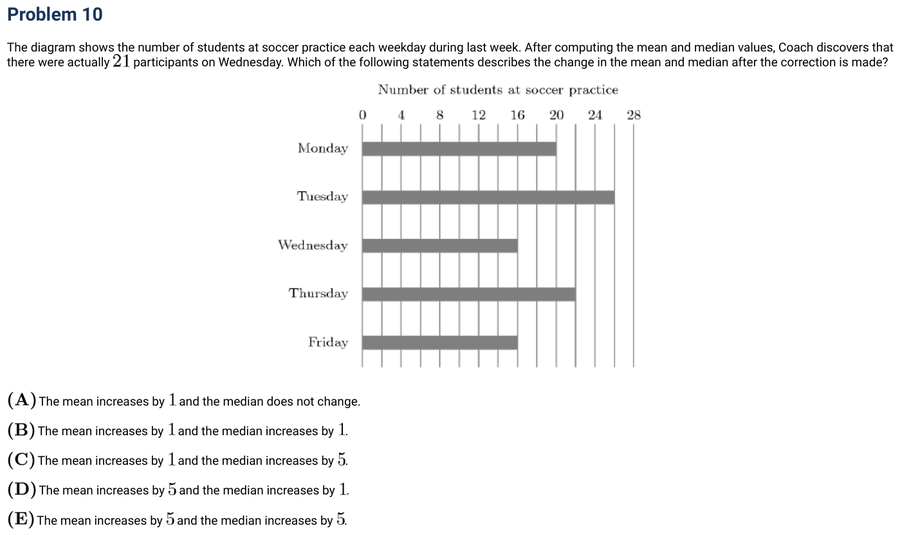
You don't need to recompute either statistic from scratch — just track the change. Only one number moved, so what does adding to it do to the average, and where does it land in the sorted order?
Still stuck? Show hint 2 →
Hint 2 of 2
Mean: a bump of +5 spread over 5 days raises the average by 5÷5 = 1. Median: re-sort and watch whether the bumped value jumps past the old middle value.
Show solution
Approach: measure the shift in each statistic, don't recompute
Only Wednesday changes, 16 → 21, so the total goes up by 5. Mean of 5 days rises by 5÷5 = 1 — no need to add the whole column.
For the median, sort instead of recomputing. Originally 12, 16, 20, 24, 26, median 20. Raising 16 to 21 slides that value rightward past 20: new order 12, 20, 21, 24, 26, median 21. Median rises by 1.
So both increase by 1.
Why this transfers: changing one data value shifts the mean by (change ÷ count), but the median only moves if the changed value crosses the old middle — always re-sort to check, since the median can stay put even when the mean jumps.
The eighth grade class at Lincoln Middle School has 93 students. Each student takes a math class or a foreign language class or both. There are 70 eighth graders taking a math class, and there are 54 eighth graders taking a foreign language class. How many eighth graders take only a math class and not a foreign language class?
Show answer
Answer: D — 39 students.
Show hints
Hint 1 of 2
Add the two class sizes: 70 + 54 = 124, but there are only 93 students. The extra 124 − 93 = 31 isn't a mistake — it's the kids counted twice because they're in both classes.
Still stuck? Show hint 2 →
Hint 2 of 2
Once you know how many take both, "math only" is just the math total minus the both-takers (subtract off the shared slice of the Venn diagram).
Show solution
Approach: the overcount equals the overlap
Every student is in at least one class, so the two lists together should cover all 93 people — yet 70 + 54 = 124. The 124 − 93 = 31 surplus is exactly the students counted in both lists, so Both = 31.
"Math only" peels off the shared part: 70 − 31 = 39.
Why this transfers: whenever two groups together exceed the whole, the excess is the overlap — that's inclusion-exclusion (|M| + |F| − |both| = total), and a two-circle Venn diagram makes the "only" regions obvious.
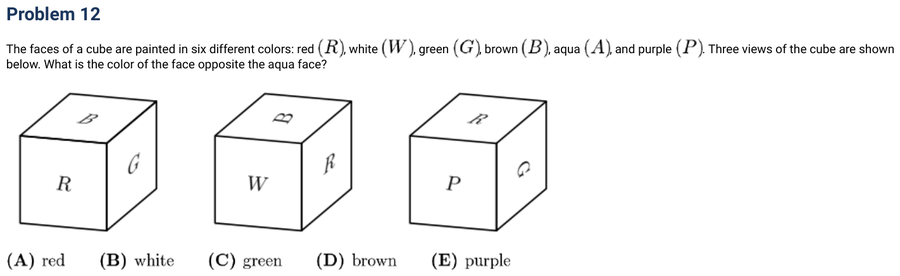
Key fact about a cube: two faces are opposite exactly when they can never show up together in one view (you'd have to see through the cube). So the opposite of aqua is whichever color shares no view with it.
Still stuck? Show hint 2 →
Hint 2 of 2
Easier to chase the other way: list every color that does appear alongside red. Red touches four colors — the one it's missing must be its opposite.
Show solution
Approach: opposite faces never appear in the same view
Two faces sharing a view are adjacent; opposite faces can never both be seen at once. Track what red is adjacent to across the three pictures.
Red appears with brown and green in one view, with brown and white in another, and with purple and green in the third — so red sits next to brown, green, white, and purple.
Red is adjacent to four of the five other colors; the one it never meets is aqua. So aqua and red are opposite, and the face opposite aqua is red.
Why this transfers: for any "net or views of a cube" puzzle, find a face and rule out its four neighbors — the single color it never shares a view with is forced to be its opposite.
A palindrome is a number that has the same value when read from left to right or from right to left. (For example, 12321 is a palindrome.) Let N be the least three-digit integer which is not a palindrome but which is the sum of three distinct two-digit palindromes. What is the sum of the digits of N?
Show answer
Answer: A — 2.
Show hints
Hint 1 of 2
List the two-digit palindromes: 11, 22, 33, …, 99. They're all just 11 times something — every one is a multiple of 11. That single fact pins down what N can be.
Still stuck? Show hint 2 →
Hint 2 of 2
If N is a sum of three multiples of 11, then N is a multiple of 11 too. So scan the 3-digit multiples of 11 in order and grab the first that isn't itself a palindrome — then just confirm it's reachable.
Show solution
Approach: every 2-digit palindrome is a multiple of 11
A two-digit palindrome has equal digits (11, 22, …, 99), which means it equals 11 × (that digit) — always a multiple of 11. A sum of three of them is therefore also a multiple of 11, so N must be a multiple of 11.
Walk the 3-digit multiples of 11: 110, 121, 132, … The very first, 110, already isn't a palindrome (110 reversed is 011). So N = 110 is the candidate — just check it's actually buildable.
110 = 11 + 22 + 77 ✓ three distinct two-digit palindromes, so it qualifies.
Digit sum of 110 = 1 + 1 + 0 = 2.
Why this transfers: spotting a hidden divisibility (here, "repeated-digit number = multiple of 11") shrinks an open search into a short ordered list — always ask what number property all the building blocks share.
Isabella has 6 coupons that can be redeemed for free ice cream cones at Pete's Sweet Treats. In order to make the coupons last, she decides that she will redeem one every 10 days until she has used them all. She knows that Pete's is closed on Sundays, but as she circles the 6 dates on her calendar, she realizes that no circled date falls on a Sunday. On what day of the week does Isabella redeem her first coupon?
Show answer
Answer: C — Wednesday.
Show hints
Hint 1 of 2
A 10-day jump is the same as a 3-day jump on the weekly cycle (10 = 7 + 3, and a full week of 7 lands on the same weekday). So each coupon is 3 weekdays after the last.
Still stuck? Show hint 2 →
Hint 2 of 2
Stepping +3 six times lands on six different weekdays — they cover six of the seven, skipping exactly one. That skipped day has to be Sunday, which tells you where to start.
Show solution
Approach: 10 days = +3 weekdays; find the one weekday left untouched
Adding 10 days moves the weekday forward by 10 − 7 = 3 each time (a full week doesn't change the weekday). So from the start day the six redemptions land at +0, +3, +6, +9, +12, +15 weekdays = +0, +3, +6, +2, +5, +1 after reducing by 7s.
Those six offsets are all different and cover every weekday except +4. Since none of the six is a Sunday, Sunday is precisely the missing +4 day.
So the start is 4 weekdays before Sunday: counting back Sat, Fri, Thu, Wed.
Why this transfers: repeated equal steps around a 7-day cycle reduce to stepping by the remainder mod 7; because 3 shares no factor with 7, six steps hit six distinct days — so the single avoided day fixes everything.
Another way — just test the start days:
Try starting Wednesday and step +3 weekdays each time: Wed, Sat, Tue, Fri, Mon, Thu — six dates, none on Sunday. It works.
Any earlier choice (Mon, Tue) lands on a Sunday within the six steps, so the answer is Wednesday.
On a beach 50 people are wearing sunglasses and 35 people are wearing caps. Some people are wearing both sunglasses and caps. If one of the people wearing a cap is selected at random, the probability that this person is also wearing sunglasses is 25. If instead, someone wearing sunglasses is selected at random, what is the probability that this person is also wearing a cap?
Show answer
Answer: B — 7/25.
Show hints
Hint 1 of 2
Both probabilities are about the same group — the people wearing both. So nail down that one number first; it's the bridge between the two questions.
Still stuck? Show hint 2 →
Hint 2 of 2
"2/5 of cap-wearers also wear sunglasses" means both = (2/5) of 35. Once you have a head-count for both, each probability is just both ÷ (the group you're conditioning on).
Show solution
Approach: find the both-count, then re-divide
The given probability is a fraction of the 35 cap-wearers: people wearing both = (2/5) × 35 = 14.
The reversed question keeps the same 14 in both, now as a fraction of the 50 sunglasses-wearers: P(cap | sunglasses) = 14 / 50 = 7/25.
Why this transfers: a conditional probability is always (overlap) ÷ (the condition group). Convert one conditional into the raw overlap count, and you can flip it onto any other group — the overlap doesn't change, only the denominator does.
Qiang drives 15 miles at an average speed of 30 miles per hour. How many additional miles will he have to drive at 55 miles per hour to average 50 miles per hour for the entire trip?
Show answer
Answer: D — 110 miles.
Show hints
Hint 1 of 2
Average speed is NOT the average of 30 and 55 — it's total distance ÷ total time. Time is the quantity you can actually add up across the two legs, so make time your handle.
Still stuck? Show hint 2 →
Hint 2 of 2
First leg takes 15÷30 = ½ hour. Let the extra distance be x (time x/55). Then set (total distance)÷(total time) = 50 and solve.
Show solution
Approach: total distance ÷ total time = 50
The first leg takes 15 ÷ 30 = ½ hour. Driving x more miles at 55 adds x/55 hours, so total distance = 15 + x and total time = ½ + x/55.
Average speed is the ratio: 15 + x½ + x/55 = 50, i.e. 15 + x = 25 + 10x/11.
Multiply through by 11: 165 + 11x = 275 + 10x ⇒ x = 110.
Why this transfers — and a sanity check: the answer 110 is far bigger than the 15-mile first leg because he must drive a long way at 55 to drag the average all the way up to 50 (just shy of 55). Never average speeds directly; only times and distances add.
Another way — fix the total time first:
Driving 15 miles at 30 used ½ hour. Suppose the second leg also takes t hours; then total distance = 50(½ + t) and the second leg covers 55t miles.
So 15 + 55t = 25 + 50t ⇒ 5t = 10 ⇒ t = 2 hours, and the extra distance is 55 × 2 = 110 miles.
98 factors is a signal: this is meant to collapse, not be multiplied out. Each fraction is k(k+2) over (k+1)2 — numbers one apart, top and bottom — which begs to be split so neighbors cancel.
Still stuck? Show hint 2 →
Hint 2 of 2
Each factor k(k+2)(k+1)(k+1) breaks into kk+1 × k+2k+1; collect all the first pieces in one chain and all the second pieces in another.
Show solution
Approach: split each factor into two telescoping chains
Every factor is k(k+2)(k+1)(k+1) = kk+1 × k+2k+1, for k = 1 to 98.
Chain 1 (the kk+1 pieces): 12 × 23 × … × 9899. Each top cancels the next bottom, leaving 199.
Chain 2 (the k+2k+1 pieces): 32 × 43 × … × 10099, which cancels down to 1002 = 50.
Multiply the two leftovers: 199 × 50 = 5099.
Why this transfers: a long product or sum that looks hopeless is usually telescoping — each piece cancels part of its neighbor. Factor every term into simple pieces, line them up, and almost everything collapses, leaving just the two ends.
The faces of each of two fair dice are numbered 1, 2, 3, 5, 7, and 8. When the two dice are tossed, what is the probability that their sum will be an even number?
Show answer
Answer: C — 5/9.
Show hints
Hint 1 of 2
Don't list all 36 pairs — a sum is even only when the two numbers match in parity (odd+odd or even+even). So all that matters is how many faces are odd vs even.
Still stuck? Show hint 2 →
Hint 2 of 2
These dice are unusual: faces 1, 3, 5, 7 are odd (4 of them) and only 2, 8 are even (2 of them). Find P(both odd) and P(both even), then add.
Show solution
Approach: even sum means matching parity
A sum is even exactly when both dice are odd or both are even — the actual values don't matter, only odd/even. On this die: odd faces {1, 3, 5, 7} = 4 of 6; even faces {2, 8} = 2 of 6, so P(odd) = 2/3 and P(even) = 1/3.
Both odd: (2/3)(2/3) = 4/9. Both even: (1/3)(1/3) = 1/9. These can't both happen, so add: 4/9 + 1/9 = 5/9.
Why this transfers: for parity-of-a-sum questions, throw away the numbers and keep only odd/even — the problem shrinks to a coin-flip count. (Sanity check: a normal 3-odd-3-even die gives exactly 1/2; tilting to 4 odds nudges "both-odd" up, so 5/9 just over 1/2 fits.)
In a tournament there are six teams that play each other twice. A team earns 3 points for a win, 1 point for a draw, and 0 points for a loss. After all the games have been played it turns out that the top three teams earned the same number of total points. What is the greatest possible number of total points for each of the top three teams?
Show answer
Answer: C — 24 points each.
Show hints
Hint 1 of 2
To push the top three as high as possible, give them every point that's "free" — let all three crush the bottom three in every game. The only points in question are the ones they fight over among themselves.
Still stuck? Show hint 2 →
Hint 2 of 2
A win-then-loss split between two teams yields 3 + 0 = 3 points total, but a draw-draw yields only 1 + 1 = 2. So to maximize and keep the trio tied, settle their head-to-heads with decisive wins, not draws.
Show solution
Approach: sweep the bottom, split decisively among the tied top
Each top team plays the bottom three twice each = 6 games. Winning all of them gives 6 × 3 = 18 points — the maximum any team can grab from outside the trio.
Within the top three, the three pairs play twice each. To keep all three level, give each pair a 1-win, 1-loss split. A win is worth 3 and a loss 0 (better than two draws at 1 each), and the splits cancel out so the trio stays tied.
Each top team sits in 2 of those pairs and wins one game in each: +3 + 3 = 6 more.
Maximum each = 18 + 6 = 24.
Why this transfers: in "maximize a tied group" problems, hand the group all the outside wins, then realize that 3-for-a-win beats splitting points via draws — symmetry keeps the tie while decisive results keep the total high.
How many different real numbers x satisfy the equation
(x2 − 5)2 = 16 ?
Show answer
Answer: D — 4 real numbers.
Show hints
Hint 1 of 2
The question asks how many solutions — so peel the equation one square at a time. Something squared equals 16 means that something is +4 or −4. Don't lose the negative branch.
Still stuck? Show hint 2 →
Hint 2 of 2
Each branch leaves x2 = (a positive number), and a positive x2 always gives two values of x. Count the branches that stay positive.
Show solution
Approach: undo each square, keeping both signs
(x2 − 5)2 = 16 means x2 − 5 = +4 or −4 — both, since either squares to 16.
Branch +4: x2 = 9 ⇒ x = ±3 (two reals).
Branch −4: x2 = 1 ⇒ x = ±1 (two more).
Both branches gave a positivex2, so each yields 2 real roots: 4 total.
Why this transfers: each square you undo can double the solution count — but only when the inside is positive (a negative x2 would give zero real roots). Track the ± at every layer.
What is the area of the triangle formed by the lines y = 5, y = 1 + x, and y = 1 − x?
Show answer
Answer: E — 16.
Show hints
Hint 1 of 2
Before computing, notice the two slanted lines are mirror images: slopes +1 and −1, both crossing at the same apex. That symmetry makes the horizontal line y = 5 a perfect flat base.
Still stuck? Show hint 2 →
Hint 2 of 2
Pick the horizontal side as the base — its length is just the gap between two x-values at y = 5, and the height is the straight vertical drop to the apex. No slant distances needed.
Show solution
Approach: use the horizontal line as base; exploit the ±1 symmetry
Find the corners. On y = 5: 5 = 1 + x gives (4, 5), and 5 = 1 − x gives (−4, 5). The two slanted lines meet where 1 + x = 1 − x, i.e. x = 0, the apex (0, 1).
Take the flat top as base: from (−4, 5) to (4, 5) is length 8 (and it's centered on the y-axis, confirming the triangle is isosceles). Height is the vertical distance 5 − 1 = 4.
Area = ½ × 8 × 4 = 16.
Why this transfers: when a triangle has a horizontal or vertical side, use that side as the base — its length and the perpendicular height are both just coordinate differences, sidestepping the distance formula entirely.
A store increased the original price of a shirt by a certain percent and then decreased the new price by the same amount. Given that the resulting price was 84% of the original price, by what percent was the price increased and decreased?
Show answer
Answer: E — 40%.
Show hints
Hint 1 of 2
Up then down by the same percent does NOT return to the start — the decrease acts on a bigger price. Write it as multipliers: ×(1+p) then ×(1−p), and let difference-of-squares simplify the product.
Still stuck? Show hint 2 →
Hint 2 of 2
(1+p)(1−p) = 1 − p2. Set that equal to 0.84 and the percent pops right out.
Show solution
Approach: the two changes multiply to 1 − p²
Raising by p then lowering by p multiplies the price by (1 + p)(1 − p) = 1 − p2 — a difference of squares, neatly collapsing the two steps into one.
Set 1 − p2 = 0.84, so p2 = 0.16 and p = 0.4 = 40%.
Why this transfers: a percent up and the same percent down always leaves 1 − p2 — strictly less than the original, since the drop applies to a larger amount. Recognizing (1+p)(1−p) as a difference of squares is the shortcut.
After Euclid High School's last basketball game, it was determined that 14 of the team's points were scored by Alexa and 27 were scored by Brittany. Chelsea scored 15 points. None of the other 7 team members scored more than 2 points. What was the total number of points scored by the other 7 team members?
Show answer
Answer: B — 11 points.
Show hints
Hint 1 of 2
Scores are whole numbers, so T/4 and 2T/7 must be integers. That forces T to be a multiple of both 4 and 7 — i.e. a multiple of 28. Suddenly only a few totals are possible.
Still stuck? Show hint 2 →
Hint 2 of 2
The 7 others score at most 2 each, so their total is between 0 and 14. Write "others" in terms of T, then test T = 28, 56, … until it lands in that window.
Show solution
Approach: divisibility narrows T to multiples of 28, then bound it
Let T be the team total. Alexa's T/4 and Brittany's 2T/7 must both be whole numbers, so T is a multiple of lcm(4, 7) = 28.
Others' points = T − T4 − 2T7 − 15 = 13T28 − 15, and this must sit in [0, 14] since 7 players score ≤ 2 each.
Test multiples of 28: T = 28 gives 13 − 15 = −2 (impossible); T = 56 gives 26 − 15 = 11 ✓ (in range); T = 84 gives 39 − 15 = 24 (too big). Only T = 56 works.
Why this transfers: when unknowns are split by fractions, the denominators force the total to be a multiple of their lcm — combine that with a realistic bound (here, ≤14) and the candidate list is tiny.
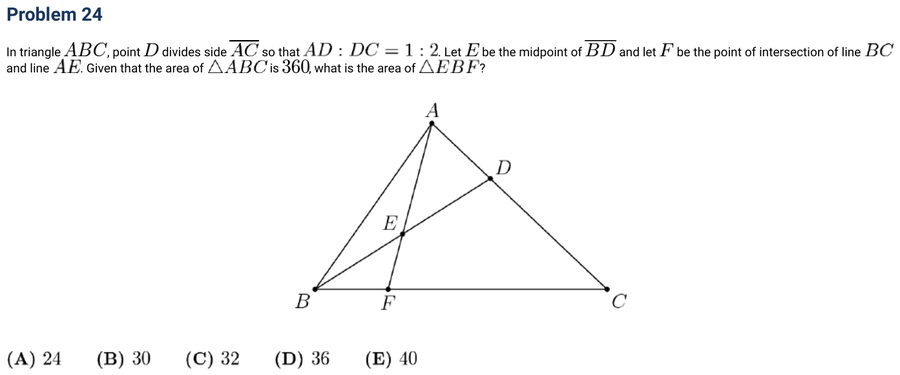
Every quantity here is a ratio (1:2, midpoint, an area of 360), and area ratios don't care about the exact shape. So either chase the ratios directly with the "same height → areas split like the bases" rule, or drop in convenient coordinates and let the numbers do the work.
Still stuck? Show hint 2 →
Hint 2 of 2
If you go coordinate: place the triangle with easy numbers honoring AD:DC = 1:2, find E as a midpoint and F as the intersection of lines AE and BC, then compare area(EBF) to area(ABC).
Show solution
Approach: convenient coordinates, then compare to the whole
Ratios are shape-independent, so pick easy coordinates honoring AD:DC = 1:2: A = (0, 0), B = (0, 1), C = (3, 0). Then D = (1, 0) and E = midpoint of BD = (0.5, 0.5).
Line AE has slope 1, so y = x; line BC runs (0,1) to (3,0), so y = 1 − x/3. Setting equal: x = 1 − x/3 ⇒ x = 3/4, giving F = (3/4, 3/4).
Shoelace on E(0.5, 0.5), B(0, 1), F(0.75, 0.75) gives area 1/8; area ABC = 3/2. So ▵EBF is (1/8) ÷ (3/2) = 1/12 of the whole.
Therefore ▵EBF = (1/12) × 360 = 30.
Why this transfers: when a problem gives only ratios and one total area, the answer is a fixed fraction of that total — computing on any convenient triangle gives the same fraction, so choose coordinates that make the arithmetic trivial.
Another way — pure area-ratio chain (no coordinates):
Since AD:DC = 1:2, triangles ABD and CBD share the height from B and split as their bases: [ABD] = (1/3)(360) = 120.
E is the midpoint of BD, so the median AE halves ▵ABD: [ABE] = 60.
F lies on line BC, so ▵BEF and ▵ABF share base BF; their areas are in the ratio of the heights of E and A above line BC. Because E is the midpoint of BD and D is 2/3 of the way along CA, E's height above BC is 1/3 of A's, giving [BEF] : [ABF] = 1 : 3.
Alice has 24 apples. In how many ways can she share them with Becky and Chris so that each of the three people has at least two apples?
Show answer
Answer: C — 190 ways.
Show hints
Hint 1 of 2
The "at least 2 each" rule is the only obstacle — so satisfy it up front. Hand everyone their 2 apples first; whatever's left can be split with no rules at all.
Still stuck? Show hint 2 →
Hint 2 of 2
Now it's "split N identical apples among 3 people, zero allowed." That's stars and bars: lay out the apples in a row and choose where 2 dividers go.
Show solution
Approach: give the minimum first, then unrestricted stars and bars
Pre-give 2 apples to each person (6 used), so the floor is automatically met. That leaves 18 apples to hand out among the three with no lower limit — the hard constraint is gone.
Picture the 18 apples in a row; placing 2 dividers among them splits them into the three shares (a person can get 0). Choosing 2 divider slots out of 18 + 2 = 20 positions gives C(20, 2) = 190.
Why this transfers: a "each gets at least k" condition is removed by pre-allotting k to everyone, converting it to the standard zero-allowed stars-and-bars count C(n + r − 1, r − 1).