An amusement park has a collection of scale models, with a ratio of 1 : 20, of buildings and other sights from around the country. The height of the United States Capitol is 289 feet. What is the height in feet of its replica at this park, rounded to the nearest whole number?
Show answer
Answer: A — 14 feet.
Show hints
Hint 1 of 2
A scale of 1 : 20 means "the model is the smaller one." The real building is the big side (20), the replica is the small side (1) — so which way does 289 go, up or down?
Still stuck? Show hint 2 →
Hint 2 of 2
The technique: a ratio 1 : k shrinks the real size by dividing by k. Map the bigger number to the bigger part of the ratio so you never flip it by accident.
Show solution
Approach: divide by the scale factor
The replica is the "1" side and the real Capitol is the "20" side, so the replica is 1/20 of 289 — smaller, which is the sanity check that we're dividing (a model should be tiny).
289 ÷ 20 = 14.45, which rounds to 14 feet.
You'll see it again: any scale-model or map problem is just multiply or divide by the scale factor — the only decision is which way, and matching big-to-big settles it.
Before multiplying anything, turn each "1 + a fraction" into a single fraction. Notice each one becomes a fraction whose top is exactly one more than its bottom — that's a pattern begging to chain.
Still stuck? Show hint 2 →
Hint 2 of 2
The technique is telescoping: when you line up fractions where each numerator matches the next denominator, almost everything cancels and only the very first bottom and very last top survive.
Show solution
Approach: rewrite and telescope
First combine each factor: 1 + 1/n = (n+1)/n. So the product becomes 21 · 32 · 43 · 54 · 65 · 76 — a neat staircase of consecutive numbers.
Each top cancels the next bottom (the 2 on top kills the 2 below, the 3 kills the 3…), leaving only the first denominator (1) and the last numerator (7): the answer is 7.
You'll see it again: whenever a long product or sum has terms that pass a piece to their neighbor, look for telescoping — you almost never compute the whole chain, just the two surviving ends.
Students Arn, Bob, Cyd, Dan, Eve, and Fon are arranged in that order in a circle. They start counting: Arn first, then Bob, and so forth. When the number contains a 7 as a digit (such as 47) or is a multiple of 7 that person leaves the circle and the counting continues. Who is the last one present in the circle?
Show answer
Answer: D — Dan.
Show hints
Hint 1 of 2
The work isn't in the counting — it's in writing the "danger" numbers first: 7, 14, 17, 21, 27… Once you have that short list, you only care about who says those numbers, not the boring ones in between.
Still stuck? Show hint 2 →
Hint 2 of 2
The technique is a simulation: keep a shrinking list of who's still in, and remember the count keeps climbing while the people loop — restart from whoever is next, never from 1.
Show solution
Approach: step through the counting, eliminating people
Step 1 is the setup that makes everything easy: list the eliminating counts in order — 7, 14, 17, 21, 27, … (multiples of 7, or any number containing the digit 7). Now you only have to find who says each of these.
You'll see it again: "person leaves the circle, counting continues" problems are simulations — resist hunting for a formula and just bookkeep carefully; the only trap is forgetting the count keeps rising as people drop out.
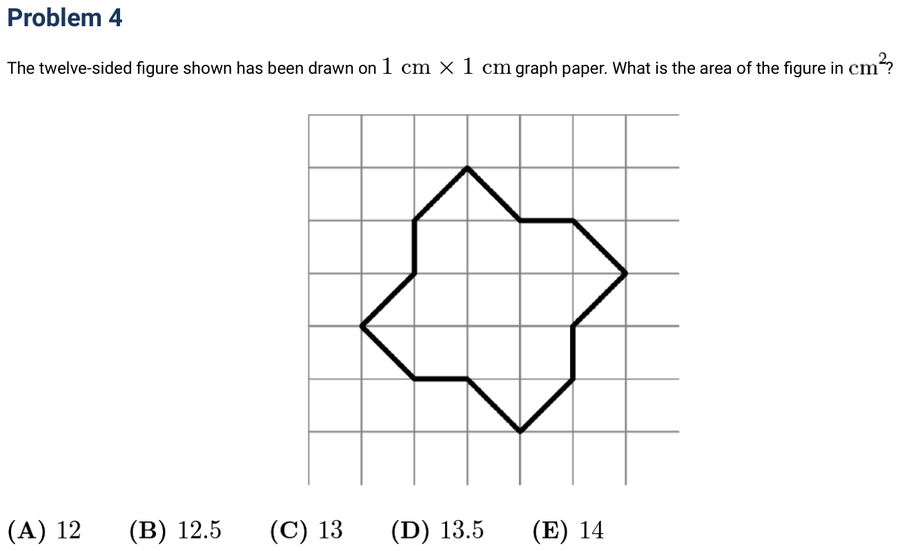
Don't try to measure the whole jagged outline at once. Look for the "calm" piece in the middle — there's a plain square hiding in there, and the rest is just four matching points sticking out.
Still stuck? Show hint 2 →
Hint 2 of 2
The technique for any weird grid shape: cut it into pieces you already know (squares and right triangles), find each area, and add. The symmetry here means you only compute one triangle and multiply by four.
Show solution
Approach: split into a square + 4 triangles
Spot the structure: a calm 3 × 3 square in the center, with one identical triangular point poking out of each of its four sides.
Square area: 3 × 3 = 9. Each point is a triangle with base 2 and height 1, so area (1/2)(2)(1) = 1; four of them give 4.
Total: 9 + 4 = 13 cm2. Sanity check: the figure is clearly bigger than the 9 square but doesn't fill its 5×5 bounding box, so 13 feels right.
You'll see it again: spotting a symmetric core plus repeated identical flaps turns a 12-sided monster into "one square + 4 copies of one triangle."
Another way — Pick's Theorem (lattice points):
Here's a power tool for any polygon whose corners sit on grid points: area = (interior dots) + (boundary dots)/2 − 1.
Count the grid dots strictly inside the figure (the interior count) and the dots lying on its outline, plug into the formula, and you get 13 — no slicing into triangles needed. Worth knowing for any "shape drawn on graph paper" question.
Don't add hundreds of numbers. Notice the odds and evens almost interleave: pair each even with the odd just above it (3 with 2, 5 with 4…) and every pair collapses to the same tiny number.
Still stuck? Show hint 2 →
Hint 2 of 2
The technique is pairing for a constant difference: line up the two lists so neighbors differ by 1, count the pairs, and the leftover term is what's sticking out at the start.
Show solution
Approach: pair adjacent odd/even terms
Regroup as 1 + (3 − 2) + (5 − 4) + … + (2019 − 2018). The 1 at the front has no even partner; every other odd pairs with the even just below it, and each pair equals 1.
The evens run 2, 4, …, 2018, which is 1009 numbers, so there are 1009 pairs — each contributing 1.
Total: 1 + 1009 = 1010. Sanity check: there are 1010 odds and 1009 evens, so one extra positive term survives — a positive answer near 1000, ruling out the negative choices instantly.
You'll see it again: when two long sequences are subtracted term-by-term, pairing turns the whole thing into "(how many pairs) × (the per-pair value)."
On a trip to the beach, Anh traveled 50 miles on the highway and 10 miles on a coastal access road. He drove three times as fast on the highway as on the coastal road. If Anh spent 30 minutes driving on the coastal road, how many minutes did his entire trip take?
Show answer
Answer: C — 80 minutes.
Show hints
Hint 1 of 2
The one fact you're handed (10 miles in 30 minutes) is secretly a speed. Pin that down and the highway speed comes free — it's just three times bigger.
Still stuck? Show hint 2 →
Hint 2 of 2
The technique: when given distance and time for one stretch, get a speed, then use that speed (or a scaled version) to find the missing time on the other stretch. Time = distance ÷ speed.
Show solution
Approach: find each leg's time separately
Coastal leg: 10 miles in 30 min, so his coastal speed is 1/3 mile per minute. Highway is 3× faster: 1 mile per minute.
Highway time: 50 miles ÷ 1 mile/min = 50 min.
Total trip: 30 + 50 = 80 minutes.
Another way — compare the legs directly (no speeds needed):
Going 3× faster on the highway means each highway mile takes 1/3 the time of a coastal mile. The highway is 5× longer (50 vs 10 miles) but 3× quicker per mile, so the highway takes 5/3 of the coastal time.
Coastal took 30 min, so highway takes (5/3)(30) = 50 min, and the total is 30 + 50 = 80 minutes — reached entirely by scaling the one known time.
The 5-digit number 2018U is divisible by 9. What is the remainder when this number is divided by 8?
Show answer
Answer: B — Remainder 3.
Show hints
Hint 1 of 2
The mystery digit isn't really free. The divisible-by-9 rule keys off the digit sum, and a single missing digit can only nudge that sum into one nearby multiple of 9 — so U is pinned down before you do anything else.
Still stuck? Show hint 2 →
Hint 2 of 2
The technique: use a divisibility rule to solve for the unknown digit first, then treat the now-known number as a plain division problem.
Show solution
Approach: use the divisibility-by-9 rule
Add the known digits: 2 + 0 + 1 + 8 = 11. The full sum 11 + U must be a multiple of 9, and since U is a single digit (0–9) the only reachable multiple is 18, forcing U = 7.
Now the number is 20187. Divide by 8: 2523 × 8 = 20184, leaving a remainder of 3.
You'll see it again: "unknown digit makes it divisible by 9 (or 3)" problems always start with the digit-sum rule — it converts an unknown digit into a forced one.
Another way — remainder mod 8 uses only the last three digits:
A divisibility shortcut for 8: a number's remainder when divided by 8 depends only on its last three digits, because 1000 is a multiple of 8.
So instead of dividing 20187, just look at 187: 187 = 23×8 + 3, giving remainder 3 — the same answer with much smaller arithmetic.
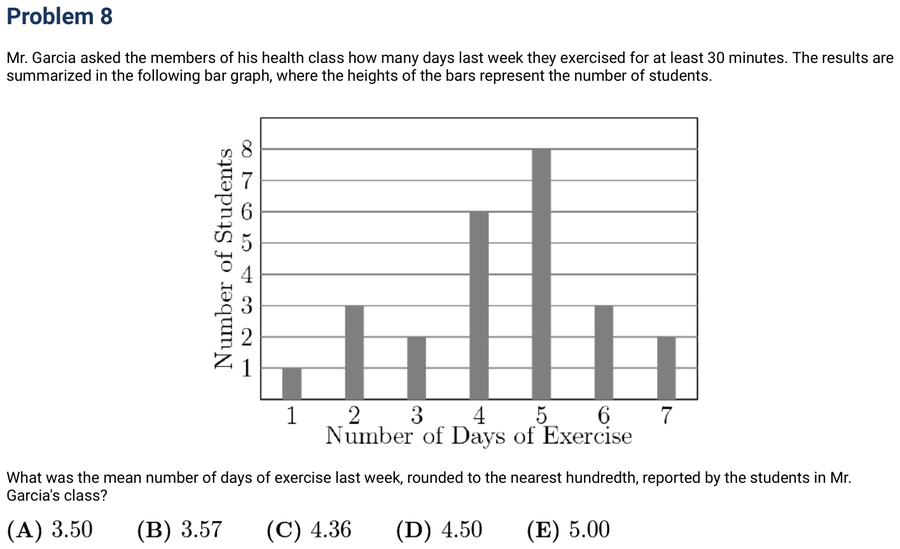
The big trap: those bars are not seven numbers to average. Each bar's height is how many students reported that many days — so a tall bar should count much more heavily than a short one.
Still stuck? Show hint 2 →
Hint 2 of 2
The technique is a weighted average: total up (day-value × how many students), then divide by the total number of students — never just average the labels 1 through 7.
Show solution
Approach: weighted mean from the bar heights
Read the bar heights as student counts for 1 through 7 days: 1, 3, 2, 6, 8, 3, 2. Add them: 1+3+2+6+8+3+2 = 25 students total.
Mean = 109 ÷ 25 = 4.36. Sanity check: the data piles up around 4–5 days, so an average near 4.4 fits — and the naive (wrong) average of 1–7 would be 4.00, which isn't even an option.
You'll see it again: any "mean from a frequency table or bar graph" is a weighted average — sum of (value × frequency) over total frequency.
Tyler is tiling the floor of his 12 foot by 16 foot living room. He plans to place one-foot by one-foot square tiles to form a border along the edges of the room and to fill in the rest of the floor with two-foot by two-foot square tiles. How many tiles will he use?
Show answer
Answer: B — 87 tiles.
Show hints
Hint 1 of 2
Two different tile sizes means two different regions: a one-foot-wide picture frame around the edge, and the rectangle left inside it. Handle them separately, and watch the corners — that's where over-counting hides.
Still stuck? Show hint 2 →
Hint 2 of 2
The technique: for a one-wide border, "walk the perimeter" but subtract the 4 corner squares you'd otherwise count twice; then the interior is just the room minus 1 foot off every side.
Show solution
Approach: border + interior
Border (1×1 tiles): the four sides total 12 + 16 + 12 + 16 = 56, but each of the 4 corner squares sits on two sides and got counted twice, so subtract 4: 56 − 4 = 52 border tiles.
Interior: peeling off the 1-foot border shrinks the room by 1 foot on each side, leaving 10 ft × 14 ft = 140 sq ft. Each 2×2 tile covers 4 sq ft, so 140 ÷ 4 = 35 tiles.
Total: 52 + 35 = 87.
You'll see it again: the corner double-count (subtract 4) shows up in every "border around a rectangle" problem — sidewalks, picture frames, fence posts.
Another way — count border tiles by the inner rectangle:
Another clean way to size the border: total room area minus the interior area, all in unit squares. The room is 12×16 = 192 sq ft and the interior is 10×14 = 140 sq ft, so the border is 192 − 140 = 52 sq ft = 52 unit tiles — no corner bookkeeping at all.
Then add the 35 big tiles for the interior: 52 + 35 = 87.
The harmonic mean of a set of non-zero numbers is the reciprocal of the average of the reciprocals of the numbers. What is the harmonic mean of 1, 2, and 4?
Show answer
Answer: C — 12/7.
Show hints
Hint 1 of 2
The scary name is just a recipe. Read the definition backwards from the answer: it's the "reciprocal of the average of the reciprocals" — so peel it off in the forward order: flip, average, flip.
Still stuck? Show hint 2 →
Hint 2 of 2
The technique for any unfamiliar definition: execute it as literal instructions, one verb at a time, and don't skip the last step — here the final "reciprocal" is exactly the step people forget.
Show solution
Approach: follow the definition
Flip each number: the reciprocals of 1, 2, 4 are 1, 1/2, 1/4, which sum to 7/4.
Average the three reciprocals: (7/4) ÷ 3 = 7/12.
Now do the final flip the name demands — the reciprocal of 7/12 is 12/7. Sanity check: the harmonic mean always lands below the ordinary average (here (1+2+4)/3 ≈ 2.33) and pulls toward the small numbers, and 12/7 ≈ 1.71 does exactly that.
Abby, Bridget, and four of their classmates will be seated in two rows of three for a group picture. If the seating positions are assigned randomly, what is the probability that Abby and Bridget are adjacent to each other in the same row or the same column?
Show answer
Answer: C — 7/15.
Show hints
Hint 1 of 2
The other four classmates are a distraction. The only thing that matters is which two of the six seats Abby and Bridget land in — so think about seat-pairs, not full seatings.
Still stuck? Show hint 2 →
Hint 2 of 2
The technique: when an event depends only on the relative position of two items, make the sample space the set of unordered seat-pairs: probability = (adjacent pairs) ÷ (all pairs). Then you just count adjacencies on the grid.
Show solution
Approach: count adjacent seat-pairs out of all seat-pairs
All the randomness boils down to which two of the six seats hold Abby and Bridget: C(6,2) = 15 equally likely unordered pairs.
Now count the adjacent pairs directly on the 2×3 grid: within a row the 3 seats give 2 side-by-side pairs, × 2 rows = 4 horizontal; each of the 3 columns has one top-bottom pair = 3 vertical. Total 4 + 3 = 7.
Probability = 7/15 — that's 7/15.
You'll see it again: reducing "random arrangement" to "random pair of positions for the two people I care about" sidesteps all the irrelevant orderings of everyone else.
Another way — fix Abby, place Bridget:
Seat Abby first; by symmetry split into where she lands. If Abby takes a middle seat (probability 2/6 = 1/3), it has 3 neighbors among the 5 remaining seats, so Bridget is adjacent with probability 3/5.
If Abby takes a corner/edge seat (probability 4/6 = 2/3), it has only 2 neighbors, so adjacency probability is 2/5.
Combine: (1/3)(3/5) + (2/3)(2/5) = 3/15 + 4/15 = 7/15 — same answer, built from Abby's viewpoint.
The clock in Sri's car, which is not accurate, gains time at a constant rate. One day as he begins shopping he notes that his car clock and his watch (which is accurate) both say 12:00 noon. When he is done shopping, his watch says 12:30 and his car clock says 12:35. Later that day, Sri loses his watch. He looks at his car clock and it says 7:00. What is the actual time?
Show answer
Answer: B — 6:00.
Show hints
Hint 1 of 2
The first 30-minute shopping trip is a free calibration: it tells you that whenever the car clock ticks 35, only 30 real minutes have passed. The clock runs fast, so the true time is always less than what the car shows.
Still stuck? Show hint 2 →
Hint 2 of 2
The technique is a conversion factor: real time = car time × (30/35). Build the fraction so the fast clock's bigger number is on the bottom, guaranteeing you shrink it.
Show solution
Approach: convert car-time to actual via the rate
Calibrate from the shopping trip: 30 real minutes per 35 car minutes, so real = (30/35) × car = (6/7) × car.
The car shows 7:00, i.e. 420 minutes past noon. Real elapsed = 420 × 6/7 = 360 minutes = 6 hours.
Six real hours after noon is 6:00. Sanity check: the clock gains, so real time must be earlier than 7:00 — 6:00 is, while traps like 8:10 are not.
You'll see it again: any "broken clock running at a steady wrong rate" is a unit-conversion problem — find the real-per-fake ratio once, then scale.
Laila took five math tests, each worth a maximum of 100 points. Laila's score on each test was an integer between 0 and 100, inclusive. Laila received the same score on the first four tests, and she received a higher score on the last test. Her average score on the five tests was 82. How many values are possible for Laila's score on the last test?
Show answer
Answer: A — 4 values.
Show hints
Hint 1 of 2
The average is 82, but the last test is higher than the other four — so the four equal tests must drag below 82 and the last test makes up the whole shortfall. Picture starting everyone at 82 and then shifting points onto the last test.
Still stuck? Show hint 2 →
Hint 2 of 2
The technique is a modular constraint plus a range: write the total as 4f + l = 410, get bounds on l, then notice the four identical scores force a step-size on l.
Show solution
Approach: modular constraint + range
Average 82 over 5 tests means the five scores total 5×82 = 410. Let f be the repeated first-four score and l the last, so 4f + l = 410 with f < l ≤ 100.
Lower bound on l: if all five were 82 the total is exactly 410, but the last must be strictly higher than the others, so l > 82 and f < 82.
Why l jumps by 4: each point you move off the last test has to be split equally among the four equal tests, but a whole point on each of the four costs 4 points from the last. Concretely, to keep f a whole number, lowering all four from 82 by 1 (to 81) frees 4 points that pile onto the last test — so l climbs 86, 90, 94, 98 in steps of 4.
(Same fact in modular language: 4f is a multiple of 4 and 410 leaves remainder 2 mod 4, so l ≡ 2 mod 4.) In the window 82 < l ≤ 100 that gives l ∈ {86, 90, 94, 98}.
4 values. (Check the top: l = 98 pairs with f = 78 — valid; the next step 102 exceeds 100, so we stop.)
Let N be the greatest five-digit number whose digits have a product of 120. What is the sum of the digits of N?
Show answer
Answer: D — 18.
Show hints
Hint 1 of 2
"Greatest number" is decided left to right: a bigger digit in the ten-thousands place beats anything happening later. So your only goal at each step is to make the current leftmost digit as large as possible.
Still stuck? Show hint 2 →
Hint 2 of 2
The technique is a greedy choice: at each slot, grab the biggest single digit (1–9) that still divides what's left of the product, then pass the remaining product to the next slot.
Show solution
Approach: greedy left-to-right factorization
First digit: the largest digit dividing 120 is 8 (9 doesn't divide 120, since 120/9 isn't whole). Take 8; remaining product 120/8 = 15.
Second digit: largest digit dividing 15 is 5; remaining 3. Third digit: largest dividing 3 is 3; remaining 1. The last two slots must each be 1 (their product has to be 1).
So N = 85311, and the digit sum is 8 + 5 + 3 + 1 + 1 = 18.
Why greedy is safe here: a larger leftmost digit raises the number more than any improvement further right ever could, so locking in the biggest legal digit at each step can't be beaten.
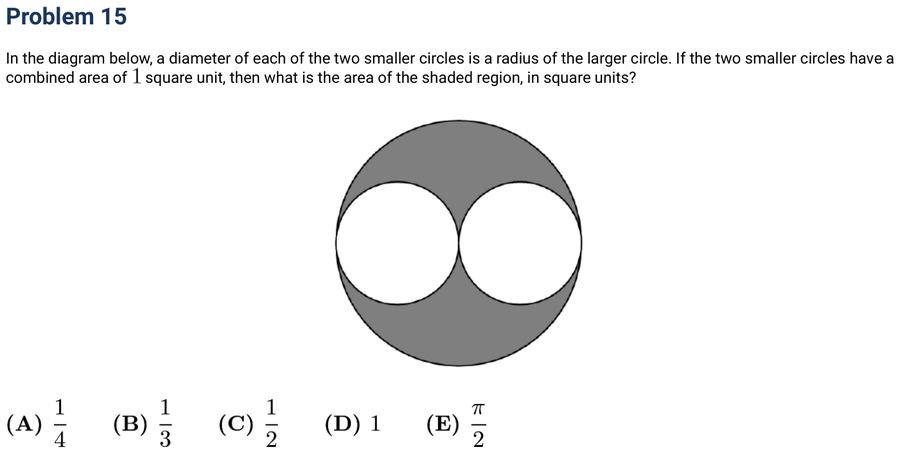
"Diameter of small = radius of big" secretly says the small circle's radius is half the big one's. And halving a radius doesn't halve the area — notice it does something stronger.
Still stuck? Show hint 2 →
Hint 2 of 2
The technique: area scales as the square of the radius. Half the radius means one-quarter the area. Once you have that, you never need π or the actual radius — just compare.
Show solution
Approach: areas scale as radius squared
Each small radius is half the big radius, so each small area is (1/2)2 = 1/4 of the big circle's area. Two smalls together are 2×(1/4) = 1/2 of the big.
We're told the two smalls total 1 square unit, and that's half the big, so the big circle is 2 square units.
Shaded = big − the two white smalls = 2 − 1 = 1.
You'll see it again: the "half the radius ⇒ quarter the area" jump (and its cousin "triple radius ⇒ nine times area") lets you compare circles without ever touching π.
Professor Chang has nine different language books lined up on a bookshelf: two Arabic, three German, and four Spanish. How many ways are there to arrange the nine books on the shelf keeping the Arabic books together and keeping the Spanish books together?
Show answer
Answer: C — 5760 ways.
Show hints
Hint 1 of 2
"Must stay together" is a gift: tape each must-stick group into a single fat book. Now you're arranging far fewer objects — but the German books aren't taped, so they each stay separate.
Still stuck? Show hint 2 →
Hint 2 of 2
The technique is the block / glue method: arrange the blocks-and-loose-items as one layer, then multiply by the internal arrangements inside each block (the books in a block can still shuffle among themselves).
Show solution
Approach: block-then-internal
Glue the 2 Arabic books into one block and the 4 Spanish books into another. The shelf now holds 5 movable objects: [Arabic block], [Spanish block], and the 3 separate German books — arranged in 5! = 120 ways.
Don't forget the books can rearrange inside their blocks: the Arabic block has 2! = 2 internal orders, the Spanish block has 4! = 24.
Total: 120 × 2 × 24 = 5760.
You'll see it again: every "these items must be adjacent" problem is glue-the-group-into-one, arrange, then × the internal orderings — and items that aren't required to be together simply stay as their own objects.
Bella begins to walk from her house toward her friend Ella's house. At the same time, Ella begins to ride her bicycle toward Bella's house. They each maintain a constant speed, and Ella rides 5 times as fast as Bella walks. The distance between their houses is 2 miles, which is 10,560 feet, and Bella covers 2½ feet with each step. How many steps will Bella take by the time she meets Ella?
Show answer
Answer: A — 704 steps.
Show hints
Hint 1 of 2
They walk for the same amount of time until they meet, so the distances they cover split in the same ratio as their speeds — 1 to 5. Bella does the small share, Ella eats up the rest.
Still stuck? Show hint 2 →
Hint 2 of 2
The technique: for two movers closing a gap, "same time" means distance is shared in the speed ratio. Out of 1 + 5 = 6 equal parts, Bella covers 1 part — then convert her distance to steps.
Show solution
Approach: ratio of distances, then divide by step length
In the equal time before they meet, Bella and Ella cover distances in their speed ratio 1 : 5. Together those parts make up the whole 10,560 feet, so Bella covers 1 of 6 parts.
Bella's distance: 10,560 ÷ 6 = 1,760 feet.
Each step is 2.5 ft, so steps = 1,760 ÷ 2.5 = 704. (The fact that 10,560 = 2 miles is just there to confirm the feet conversion.)
You'll see it again: two objects meeting after starting at the same instant always divide the distance in their speed ratio — no need to find the meeting time at all.
Listing all the divisors by hand would be miserable. The escape: every factor is built by choosing how many of each prime to include — so the real question is about the exponents in the prime factorization, not the divisors themselves.
Still stuck? Show hint 2 →
Hint 2 of 2
The technique — the divisor-counting formula: factor the number as primes to powers, then multiply (each exponent + 1). The "+1" is the option of using that prime zero times.
Show solution
Approach: prime factorize, multiply (exponent + 1) per prime
Strip out 2's: 23,232 halves six times down to 363, so 23,232 = 26 · 363. Then 363 = 3 · 121 = 3 · 112. So 23,232 = 26 · 3 · 112.
Each divisor picks 0–6 copies of 2 (7 choices), 0–1 copies of 3 (2 choices), and 0–2 copies of 11 (3 choices). Multiply the independent choices: 7 · 2 · 3 = 42.
You'll see it again: "how many factors" is always (exponent+1) multiplied across the primes — and the same choice-counting idea gives the sum of factors too.
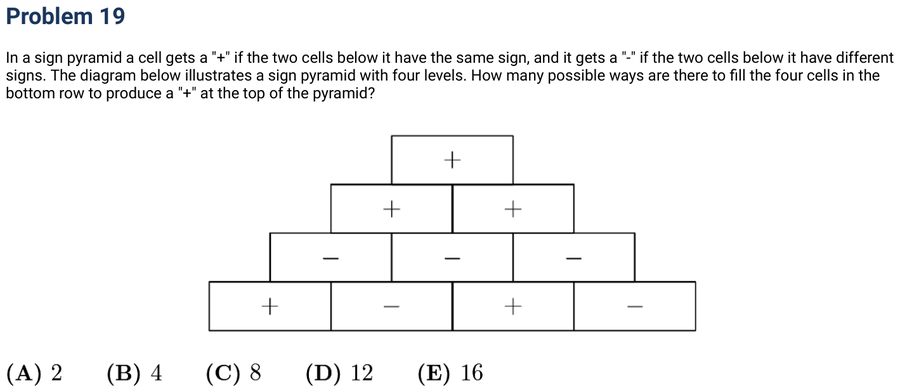
Instead of testing all 16 bottom rows, notice the pyramid is reversible: if you know a cell and the cell to its bottom-left, the bottom-right cell is forced. So a whole row plus one free corner choice determines the row beneath it.
Still stuck? Show hint 2 →
Hint 2 of 2
The technique is counting free choices: building downward, each new row is pinned down by the row above plus exactly one free sign at the left. Three rows get built below the fixed top, so the count is 2 × 2 × 2.
Show solution
Approach: count the free choices building downward
Key reversibility: given a cell's sign and its bottom-left neighbor, the rule forces the bottom-right neighbor (if the top is +, the two bottoms match; if −, they differ). So a known row plus one free leftmost choice determines the entire row below it.
Start from the fixed + at the apex and build down. Row 2 (2 cells): pick its left cell freely (2 ways), the right is forced — 2 choices. Row 3 is then determined by row 2 plus one free left cell — another 2. Row 4 (the bottom) similarly — another 2.
Total = 2 × 2 × 2 = 8.
You'll see it again: when a structure is "reversible with one free knob per level," the answer is 2 to the power of the number of free knobs — far faster than brute-forcing all configurations.
Another way — XOR / parity of the bottom row:
Encode + as 0 and − as 1; then "+ when the two below match" is exactly addition mod 2 (XOR): each cell is the XOR of the two beneath it.
Stacking three layers, the top equals bottom1 ⊕ bottom2 ⊕ bottom3 ⊕ bottom4, because the weights are the row-3 binomial coefficients 1, 3, 3, 1 — all odd, so all four corners count.
Top = + means an even number of −'s in the bottom row. Of the 16 bottom rows, exactly half have even parity: 8.
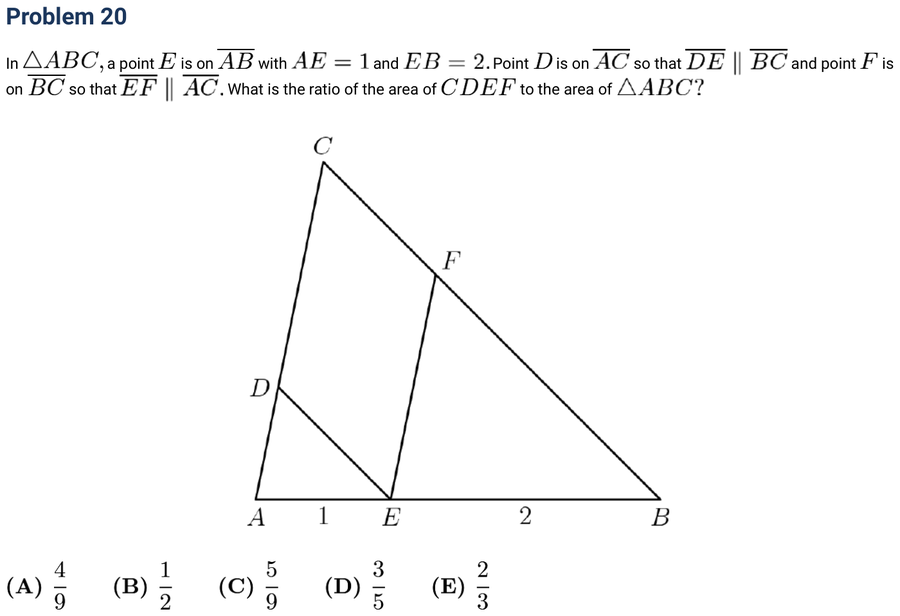
A line parallel to a side of a triangle slices off a smaller triangle that's a scaled copy of the whole. Each parallel cut here (DE and EF) does exactly that, lopping off a similar triangle at a corner. The quadrilateral is just what's left.
Still stuck? Show hint 2 →
Hint 2 of 2
The technique: similar-triangle area scales as the square of the side ratio. AE : AB = 1 : 3, so ▵ADE is 1/9 of the whole; EB : AB = 2 : 3, so ▵EFB is 4/9. Subtract both from 1.
Show solution
Approach: carve away two similar triangles
Set the whole ▵ABC = 1. Because DE ∥ BC, ▵ADE is a shrunken copy of ▵ABC with ratio AE/AB = 1/3 — so its area is (1/3)2 = 1/9.
Because EF ∥ AC, ▵EFB is a copy with ratio EB/AB = 2/3, area (2/3)2 = 4/9.
Those two triangles sit at corners A and B and don't overlap, so the leftover quadrilateral CDEF = 1 − 1/9 − 4/9 = 4/9.
You'll see it again: "line parallel to a side" instantly gives a similar triangle, and area ratio = (side ratio)2 — the squaring is the part people forget.
Another way — recognize CDEF as a parallelogram:
Since DE ∥ CB (i.e. ∥ CF) and EF ∥ AC (i.e. ∥ DC), quadrilateral DCFE has both pairs of opposite sides parallel — it's a parallelogram.
Its area can be read as base × height directly, or just confirmed by the subtraction above; either way the ratio to ▵ABC is 4/9. Spotting the parallelogram also explains why the two carved triangles exactly fill the rest.
How many positive three-digit integers have a remainder of 2 when divided by 6, a remainder of 5 when divided by 9, and a remainder of 7 when divided by 11?
Show answer
Answer: E — 5 integers.
Show hints
Hint 1 of 2
Three separate remainder conditions look like a mess — until you notice each remainder is exactly 4 short of its divisor (2 = 6−4, 5 = 9−4, 7 = 11−4). That shared "4 short" is the whole problem.
Still stuck? Show hint 2 →
Hint 2 of 2
The technique: if x is 4 short of a multiple of 6, of 9, and of 11, then x + 4 is a common multiple of all three — so it's a multiple of their lcm. Three conditions collapse into one.
Show solution
Approach: spot the common shift, then use lcm
Rewrite each condition as "4 short": remainder 2 mod 6 means x + 4 is divisible by 6; remainder 5 mod 9 means x + 4 divisible by 9; remainder 7 mod 11 means x + 4 divisible by 11.
So x + 4 is a multiple of lcm(6, 9, 11) = 2 · 32 · 11 = 198.
Three-digit x means 100 ≤ x ≤ 999, so 104 ≤ x + 4 ≤ 1003. The multiples of 198 there are 198, 396, 594, 792, 990 — 5 values.
You'll see it again: when every remainder is the same fixed amount below its divisor, shift the variable by that amount and the simultaneous system becomes a single lcm divisibility — the cleanest route past full Chinese Remainder Theorem casework.
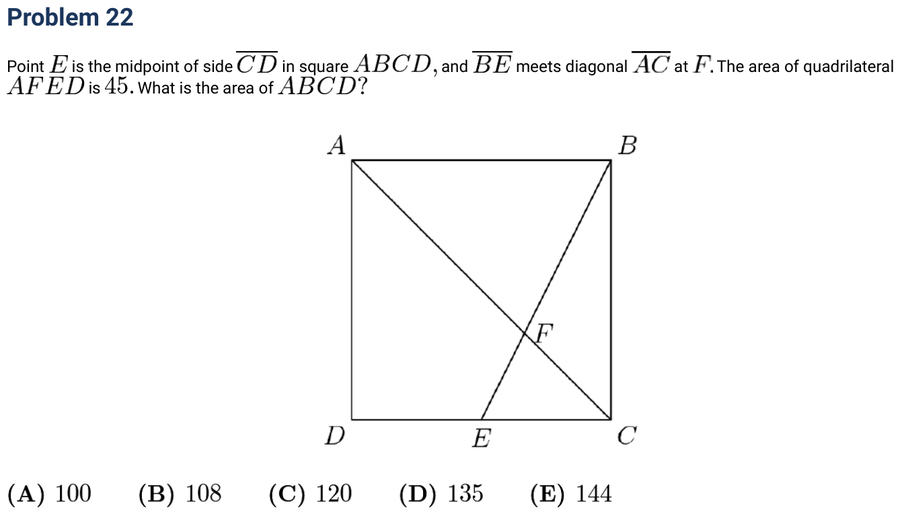
The crossing point F looks awkward, but AB (the full top side) is parallel to EC (half the bottom side). Parallel lines being crossed means the two triangles meeting at F are similar — and that similarity, with its 2 : 1 size ratio, locks down exactly where F sits on the diagonal.
Still stuck? Show hint 2 →
Hint 2 of 2
The technique: find the key ratio from an X-shaped pair of similar triangles, then chase areas as fractions of the square. Don't solve for the side length until the very end — carry s symbolically and let the 45 finish it.
Show solution
Approach: use the AF:FC ratio from similar triangles
Let the square's side be s. Then AB = s and EC = s/2 (E is the midpoint of DC).
Lines BE and AC cross at F, forming ▵AFB and ▵CFE as a bow-tie. Since AB ∥ EC, these triangles are similar with ratio AB : EC = 2 : 1, so AF : FC = 2 : 1 — F is 2/3 of the way from A down to C.
That fixes F's height: being 2/3 of the way down the diagonal, F is 1/3 of the side above the base DC. So ▵CEF has base EC = s/2 and height s/3, giving area (1/2)(s/2)(s/3) = s2/12.
AFED is the lower-left triangle ▵ACD minus ▵CEF: s2/2 − s2/12 = 5s2/12. Set equal to the given 45: 5s2/12 = 45.
s2 = 108 — and s2is the square's area, so no separate final step.
Another way — coordinates (let the side be 1, scale at the end):
Place D = (0, 0), C = (1, 0), B = (1, 1), A = (0, 1) for a unit square, with E = (1/2, 0). Line AC goes from (0,1) to (1,0): y = 1 − x. Line BE goes from (1,1) to (1/2,0): solving, the two meet at F = (2/3, 1/3).
Quadrilateral AFED has vertices A(0,1), F(2/3,1/3), E(1/2,0), D(0,0). The shoelace formula gives area 5/12 of the unit square.
So AFED is 5/12 of the whole square. Since 5/12 of the area = 45, the area is 45 × 12/5 = 108 — the same ratio, reached with pure coordinates instead of similar triangles.
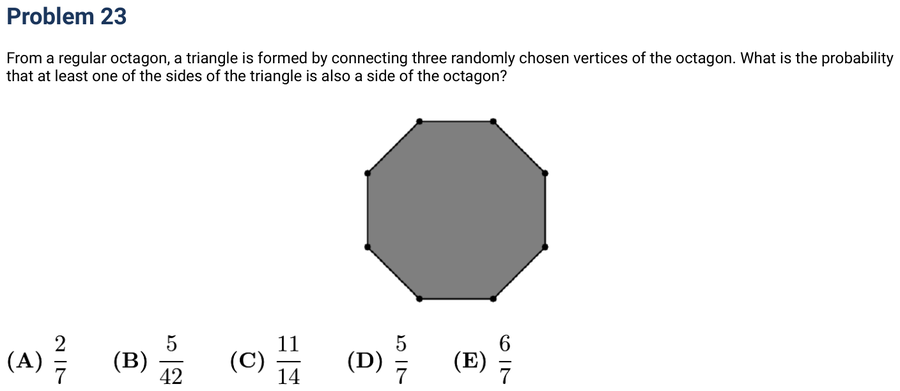
"At least one" is the classic flag to flip the question: counting triangles that touch a side splits into messy cases, but triangles with no octagon-side are one clean family — their three vertices are all spread apart. Find that, then subtract from 1.
Still stuck? Show hint 2 →
Hint 2 of 2
The technique pairs complementary counting with gaps / stars-and-bars: a no-side triangle means every gap between chosen vertices is ≥ 1. Counting solutions to gap1+gap2+gap3 = 5 with all gaps ≥ 1 is a stars-and-bars count.
Show solution
Approach: complementary counting with gap variables
Flip to the easier event: triangles with NO side on the octagon. Fix one vertex A; the three chosen vertices split the remaining 5 vertices into three gaps x, y, z (skipped vertices between consecutive chosen ones), with x + y + z = 5.
Total triangles through A: choose the other 2 vertices from the remaining 7, C(7, 2) = 21.
"No octagon-side" means no two chosen vertices are adjacent, i.e. every gap ≥ 1. Stars-and-bars for x, y, z ≥ 1 summing to 5 gives C(4, 2) = 6.
P(no side) = 6/21 = 2/7, so P(at least one side) = 1 − 2/7 = 5/7.
You'll see it again: "at least one" almost always wants complementary counting, and "keep chosen things non-adjacent around a ring" is a gap/stars-and-bars setup.
Another way — count the favorable triangles directly:
Total triangles from 8 vertices: C(8, 3) = 56. Now count those using at least one octagon side directly.
Exactly-one-side triangles: pick one of the 8 sides as an edge (8 ways), then a third vertex not adjacent to that side (to avoid a second side): 4 choices each, giving 8 × 4 = 32.
Exactly-two-side triangles: these use two adjacent sides sharing a vertex — one per vertex, so 8 of them.
Favorable = 32 + 8 = 40, and 40/56 = 5/7 — matching the complement, a good cross-check.
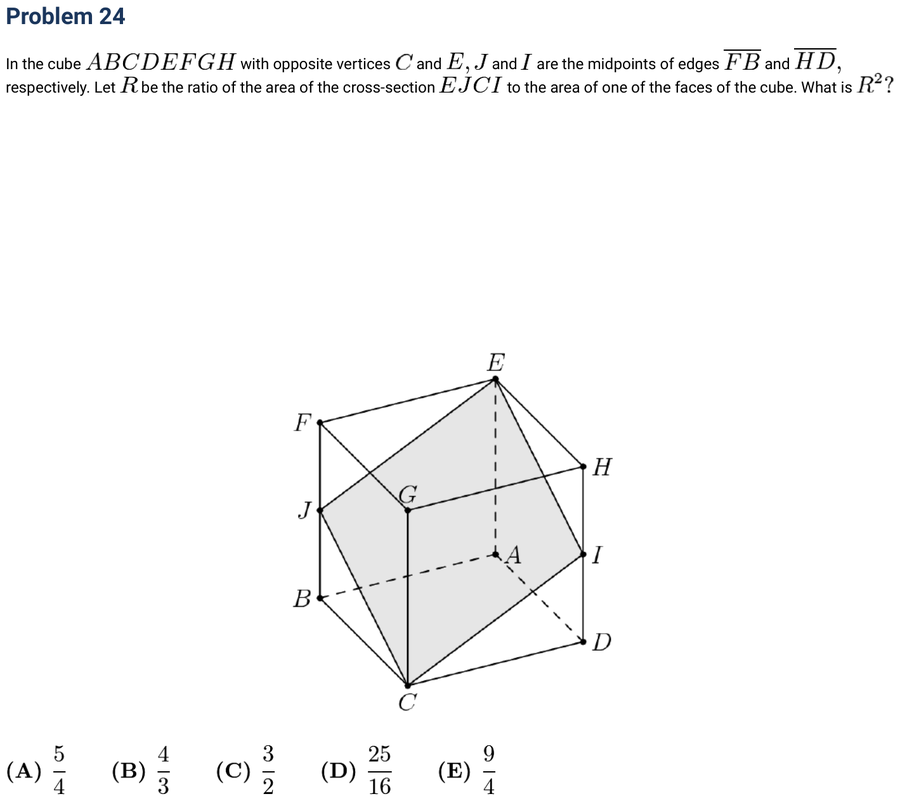
Don't fight the slanted quadrilateral head-on. Each of its four sides runs from a corner of the cube to a midpoint of an edge the same distance away — so all four sides are equal length. That single observation tells you the cross-section is a rhombus.
Still stuck? Show hint 2 →
Hint 2 of 2
The technique: for a rhombus, area = (1/2) × (one diagonal) × (other diagonal). Here the diagonals are familiar cube distances — a face diagonal and the space diagonal — so Pythagoras hands you both, and the side s cancels out at the end.
Show solution
Approach: compute rhombus area via diagonals
Each side of EJCI joins a cube corner to a midpoint of an edge; by symmetry all four are equal, so EJCI is a rhombus. Its two diagonals are IJ and CE.
Diagonal IJ connects the midpoints of two parallel edges, so it equals a face diagonal: IJ = s√2 (Pythagoras on a face). Diagonal CE joins opposite corners of the cube: the space diagonal CE = s√3.
Rhombus area = (1/2)(s√2)(s√3) = s2√6 / 2.
R = (cross-section) / (face) = (s2√6 / 2) ÷ s2 = √6 / 2 — the s2 cancels, so the answer doesn't depend on the cube's size.
R2 = 6/4 = 3/2. (The question asks for R2 precisely to dodge the messy square roots — squaring at the end is cleaner.)
You'll see it again: recognizing a rhombus (or kite) lets you swap the hard base×height for the easy half-product-of-diagonals; the diagonals of a cube cross-section are almost always a face diagonal (√2) or space diagonal (√3).
How many perfect cubes lie between 28 + 1 and 218 + 1, inclusive?
Show answer
Answer: E — 58 cubes.
Show hints
Hint 1 of 2
Counting cubes is really counting their cube-roots: a cube n3 is in range exactly when n is. So the whole game is finding the smallest and largest allowed n. Look hard at 218 — that exponent 18 is begging to be split as 6×3.
Still stuck? Show hint 2 →
Hint 2 of 2
The technique: take cube roots of the boundaries to turn a range of cubes into a range of integers, then count integers with "last − first + 1." The "+1" on each bound (the +1's in 28+1 and 218+1) only nudges the endpoints — check whether each endpoint is itself a cube.
Show solution
Approach: bracket the cube-root bounds
Upper end: 218 = (26)3 = 643, which is ≤ 218 + 1, so base 64 counts but base 65 (= 653) blows past the limit. Largest base: 64.
Lower end: 28 + 1 = 257. Bracket it between cubes: 63 = 216 < 257 but 73 = 343 ≥ 257, so the smallest cube in range has base 7.
Count the integer bases from 7 to 64 inclusive: 64 − 7 + 1 = 58.
You'll see it again: "how many cubes (or squares) in a range" collapses to "how many integers between the cube roots" — and recognizing a power like 218 as a perfect cube is the move that makes the top bound exact instead of approximate.