The longest professional tennis match lasted a total of 11 hours and 5 minutes. How many minutes is that?
Show answer
Answer: C — 665 minutes.
Show hints
Hint 1 of 2
You can't just smush "11" and "5" together — hours and minutes are different-sized units. Convert everything to the SAME unit (minutes) before combining.
Still stuck? Show hint 2 →
Hint 2 of 2
Each hour is worth 60 minutes, so the hours become 11 × 60; the 5 loose minutes are already in the right unit and just get added on.
Show solution
Approach: convert to one common unit, then add
Rewrite the hours as minutes: 11 hours = 11 × 60 = 660 minutes.
Sanity check: the answer must be a bit more than 11 × 60 = 660, which rules out 605 and 655 instantly — whenever you convert a big-to-small unit, expect the number to grow.
You'll see this again as: any "mixed unit" problem (feet + inches, dollars + cents, weeks + days) — pick the smallest unit and convert the rest down to it.
In rectangle ABCD, AB = 6 and AD = 8. Point M is the midpoint of AD. What is the area of ▵AMC?
Show answer
Answer: A — Area 12.
Show hints
Hint 1 of 2
A triangle's area doesn't care WHICH side you call the base — so pick the base that makes the height free. Is there a side of this triangle that lies right along an edge of the rectangle?
Still stuck? Show hint 2 →
Hint 2 of 2
Use AM (part of side AD) as the base. Then the height is the perpendicular distance from C across to that side — which is just the width AB, no extra work.
Show solution
Approach: choose the base along a rectangle edge so the height is free
M is the midpoint of AD, so the base AM = AD/2 = 8/2 = 4.
Because AM lies along side AD, the height to it is the full width across the rectangle: the perpendicular distance from C to line AD equals AB = 6.
Area = (1/2)(base)(height) = (1/2)(4)(6) = 12.
Why this transfers: when a triangle shares a side with a rectangle, choose that shared side as the base — the height collapses to a known rectangle dimension and you skip the Pythagorean theorem entirely.
Another way — coordinates (the shoelace / base-height made explicit):
Place A = (0, 0), D = (8, 0), so M = (4, 0), and C = (8, 6).
Triangle AMC has a horizontal base AM from x = 0 to x = 4 (length 4) on the line y = 0; vertex C sits at height 6.
Four students take an exam. Three of their scores are 70, 80, and 90. If the average of their four scores is 70, then what is the remaining score?
Show answer
Answer: A — 40.
Show hints
Hint 1 of 2
An average is just the total shared out equally — so multiplying the average back by the count un-shares it and hands you the TOTAL of all four scores.
Still stuck? Show hint 2 →
Hint 2 of 2
Once you know what all four must add to, the missing score is whatever's left after subtracting the three you already know.
Show solution
Approach: average × count rebuilds the total; the unknown is the leftover
The average is the total split 4 ways, so the total = average × count = 70 × 4 = 280.
Three scores are 70 + 80 + 90 = 240, so the missing score is 280 − 240 = 40.
Sanity check: two of the known scores (80, 90) sit ABOVE the average of 70, so something must sit well below to pull it back — a low score like 40 fits, an answer of 70 wouldn't.
You'll see this again as: "find the missing value given the mean" — always convert the average into a total first, then the unknown is just total minus the rest.
Another way — balance around the average:
Measure each score as a deviation from the target average 70: 70 is 0, 80 is +10, 90 is +20. The known scores are +30 total above 70.
For the average to land exactly on 70, the deviations must cancel, so the last score must be 30 BELOW 70: 70 − 30 = 40.
When Cheenu was a boy he could run 15 miles in 3 hours and 30 minutes. As an old man he can now walk 10 miles in 4 hours. How many minutes longer does it take for him to travel a mile now compared to when he was a boy?
Show answer
Answer: B — 10 minutes longer.
Show hints
Hint 1 of 2
The question asks about ONE mile, but the two trips are different lengths — comparing the raw trip times would be unfair. Shrink each trip down to a per-mile rate so they're on equal footing.
Still stuck? Show hint 2 →
Hint 2 of 2
The unit that matches the question is minutes-per-mile: divide each trip's total minutes by its miles, then the answer is just the gap between the two paces.
Show solution
Approach: reduce each trip to minutes-per-mile, then subtract
Boy: 3 h 30 min = 210 minutes for 15 miles ⇒ 210 ÷ 15 = 14 minutes per mile.
Old man: 4 h = 240 minutes for 10 miles ⇒ 240 ÷ 10 = 24 minutes per mile.
He's slower now, so it takes 24 − 14 = 10 extra minutes per mile.
Sanity check: he covers fewer miles in more time as an old man, so the pace MUST be slower — a positive difference is expected, and 10 is small enough to be one mile's worth (not the whole trip).
You'll see this again as: any rate comparison — convert both to the SAME unit the question asks about (here, minutes per mile) before comparing; never compare totals of different sizes.
The cheapest clue to use is the ÷10 one: a leftover of 3 when you divide by 10 simply means N ends in the digit 3. That single fact shrinks the whole list to {13, 23, 33, …, 93}.
Still stuck? Show hint 2 →
Hint 2 of 3
Now apply the ÷9 clue. Handy shortcut: a number's leftover when divided by 9 equals the leftover of its DIGIT SUM — so just look for the candidate whose digits add to something 1-more-than-a-multiple-of-9.
Still stuck? Show hint 3 →
Hint 3 of 3
Find N first; only THEN divide it by 11. Don't try to juggle all three divisors at once — pin down the number, then answer the actual question.
Show solution
Approach: let the easy clue filter the list, then test with the digit-sum trick
"Leftover 3 when divided by 10" means the units digit is 3, so N ∈ {13, 23, 33, 43, 53, 63, 73, 83, 93}.
Digit-sum test for division by 9 (a number and its digit sum leave the same leftover): 13→4, 23→5, …, 73→10 which leaves 1. Only 73 leaves a leftover of 1. So N = 73.
Now answer the real question: 73 = 11 × 6 + 7, so the leftover when divided by 11 is 7.
Why this transfers: when several remainder conditions overlap, start with the one that fixes the most (divide-by-10 fixes a whole digit), then sieve the short list — far faster than algebra.
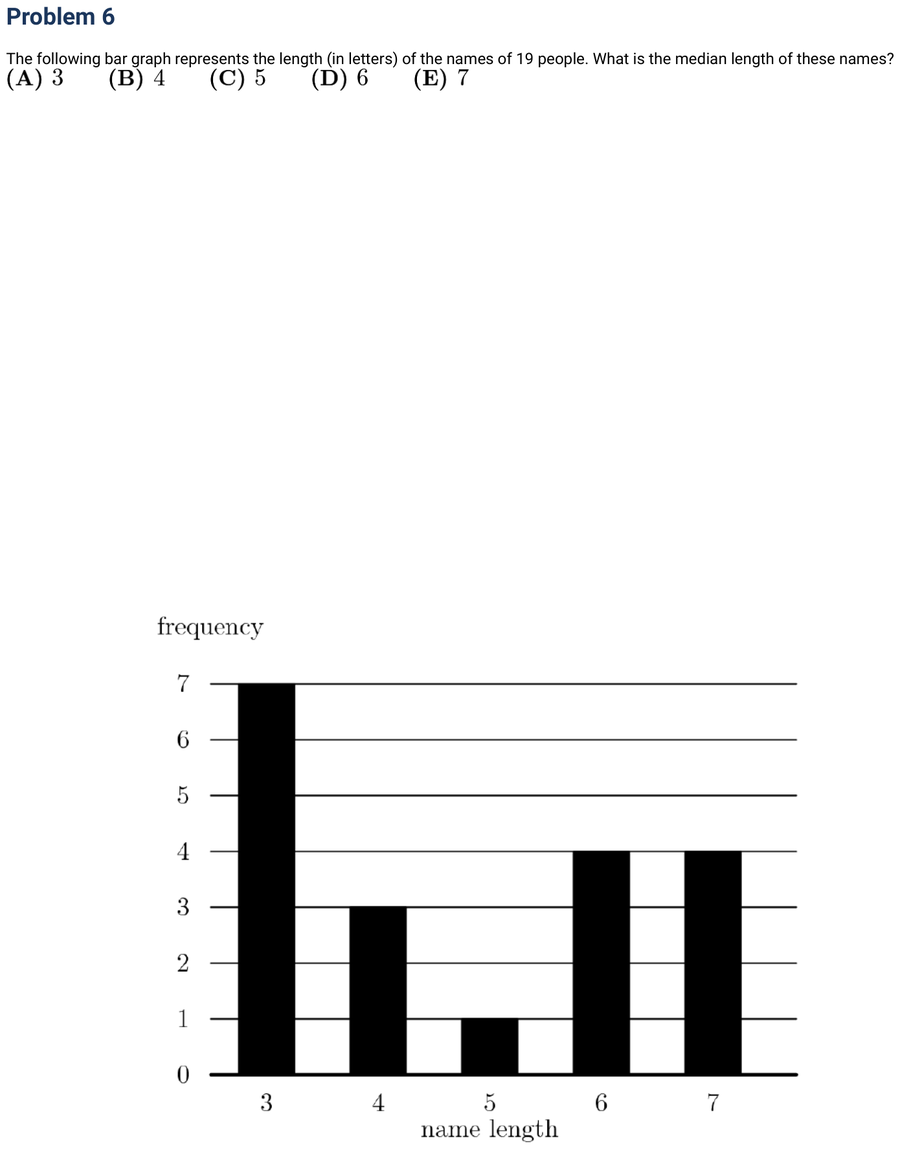
The median isn't an average here — it's the value sitting in the MIDDLE position once everything is lined up in order. With 19 names, which single position is the exact middle?
Still stuck? Show hint 2 →
Hint 2 of 2
A bar graph already has the data sorted by length, so just walk the bars left-to-right adding up their heights until your running total reaches that middle position — whatever bar you land on is the answer. You can stop the moment you pass it.
Show solution
Approach: locate the middle position by a running count of the bars
With 19 values, the middle is the 10th one (9 below it, 9 above), so the median is whatever the 10th name's length is.
Walk the bars in order and keep a running total: length 3 holds 7 names (covers positions 1–7); length 4 holds 3 names (covers positions 8, 9, 10).
Position 10 falls inside the length-4 bar, so the median is 4.
Why this transfers: for a median you never need to add the bars on the FAR side — just count inward until the running total reaches the middle position, then stop.
Which of the following numbers is not a perfect square?
Show answer
Answer: B — 2^2017.
Show hints
Hint 1 of 3
A perfect square is something split into two identical halves. A power like 32018 is a perfect square exactly when you can break it into two equal piles — so what does that say about its exponent?
Still stuck? Show hint 2 →
Hint 2 of 3
Two tests catch every square here: (1) an EVEN exponent on any base means you can halve it, e.g. 32018 = (31009)2; (2) a base that's already a perfect square (like 4 = 22) stays a square no matter the exponent. Hunt for the ONE choice that passes neither.
Still stuck? Show hint 3 →
Hint 3 of 3
Watch the trap: 4 is not prime — rewrite it as 22 before judging its exponent, or you'll mis-count.
Show solution
Approach: rewrite each as a single prime power and check if the exponent is even
Reduce each base to a prime: 12016 = 1 = a square trivially; 32018 and 52020 have EVEN exponents on a prime, so they split into equal halves — squares.
42019 = (22)2019 = 24038, an even exponent — also a square.
22017 is a prime with an ODD exponent (2017): you can't split it into two equal prime-power piles, so it's NOT a perfect square.
Why this transfers: a number is a perfect square exactly when EVERY prime in its factorization has an even exponent — reduce to primes first, then the parity of each exponent settles it.
Don't add 50 numbers one by one. The + − + − pattern is begging you to GROUP — bracket each plus-number with the minus-number right after it and watch what each little bracket becomes.
Still stuck? Show hint 2 →
Hint 2 of 2
Each bracket (like 100 − 98) is a pair of evens 2 apart, so every bracket equals 2. Now the only real work is counting how many brackets there are.
Show solution
Approach: group consecutive terms into constant pairs
Bracket the terms: (100 − 98) + (96 − 94) + … + (4 − 2). Each bracket is two consecutive evens, so each one equals 2.
Count the brackets: 100, 98, …, 2 are the 50 even numbers up to 100, and they pair up into 50 ÷ 2 = 25 brackets.
Total = 25 × 2 = 50.
Why this transfers: an alternating +−+− sum almost always collapses when you pair neighbors — the answer becomes (number of pairs) × (constant pair value) instead of a long slog.
What is the sum of the distinct prime integer divisors of 2016?
Show answer
Answer: B — 12.
Show hints
Hint 1 of 2
The word that matters is DISTINCT — you only care WHICH primes appear, not how many times. So you don't need the full exponents, just the list of different prime factors.
Still stuck? Show hint 2 →
Hint 2 of 2
Peel small primes off 2016 one at a time: it's even (keep halving), then the digits sum to a multiple of 3, and what's left will reveal the rest. Each new prime you meet goes on your list once.
Show solution
Approach: strip out each prime once; only the distinct ones count
Halve repeatedly: 2016 → 1008 → 504 → 252 → 126 → 63, pulling out 2 (five times). The prime 2 is now on the list.
63 = 9 × 7 = 32 · 7, adding the primes 3 and 7. So 2016 = 25 · 32 · 7.
Distinct primes are 2, 3, 7 (ignore the exponents — "distinct" means count each prime once). Sum = 2 + 3 + 7 = 12.
Watch the trap: answer E = 63 is what you'd get by adding leftover factors, and 49 = 7² baits you into squaring — the question wants the PRIMES themselves, added once each.
Suppose that a ∗ b means 3a − b. What is the value of x if
2 ∗ (5 ∗ x) = 1 ?
Show answer
Answer: D — x = 10.
Show hints
Hint 1 of 2
The ∗ symbol is just a made-up RECIPE: "triple the first thing, then subtract the second." It's not scary new math — treat it like a function and obey the recipe.
Still stuck? Show hint 2 →
Hint 2 of 2
Just like ordinary nested parentheses, do the INSIDE ∗ first: 5 ∗ x = 3(5) − x = 15 − x. Then feed that result into the outer ∗.
Why this transfers: any invented operator (∗, ⊕, ⊗) is just a substitution rule; replace the symbol with its definition and work the innermost piece outward exactly like nested parentheses.
Determine how many two-digit numbers satisfy the following property: when the number is added to the number obtained by reversing its digits, the sum is 132.
Show answer
Answer: B — 7 numbers.
Show hints
Hint 1 of 3
Reversing swaps the tens digit and the ones digit. So when you ADD a number to its reversal, each digit lands once in the tens place and once in the ones place — the two digits end up playing perfectly equal roles. Write both numbers with place value and watch that symmetry.
Still stuck? Show hint 2 →
Hint 2 of 3
That symmetry forces the sum to be 11 × (digit sum). So 132 = 11 × (something) instantly pins the digit sum, and the whole problem becomes "count the digit pairs that add to it."
Still stuck? Show hint 3 →
Hint 3 of 3
Counting trap: the tens digit can't be 0 (it must stay a two-digit number), so a pair like (0, 12) is out — and a digit can't exceed 9 anyway.
Show solution
Approach: place value turns number + reversal into 11 × (digit sum)
Write the number as 10a + b and its reversal as 10b + a. Adding: (10a + b) + (10b + a) = 11a + 11b = 11(a + b).
So 11(a + b) = 132, giving a + b = 12. The reversal trick converted the whole condition into one tidy digit-sum equation.
Count digit pairs with a from 1–9 (leading digit, can't be 0) and b a single digit: (3,9), (4,8), (5,7), (6,6), (7,5), (8,4), (9,3) — that's 7 numbers.
Why this transfers: "number plus its reversal" is ALWAYS a multiple of 11, and "number minus its reversal" is always a multiple of 9 — remembering these two facts collapses a whole family of digit problems.
Jefferson Middle School has the same number of boys and girls. 34 of the girls and 23 of the boys went on a field trip. What fraction of the students on the field trip were girls?
Show answer
Answer: B — 9/17.
Show hints
Hint 1 of 2
No actual count of students is given — so pick a convenient one. Since the fractions are fourths and thirds, imagine 12 girls and 12 boys (12 makes both fractions come out as whole people), then literally count who goes.
Still stuck? Show hint 2 →
Hint 2 of 2
Out of 12 girls, 3/4 go = 9 girls; out of 12 boys, 2/3 go = 8 boys. Now the answer is just (girls on trip) over (everyone on trip).
Show solution
Approach: pick a friendly common size and count actual heads
Equal numbers of boys and girls, so let there be 12 of each (12 is divisible by both 4 and 3, so no fractional people).
Girls on the trip: 3/4 of 12 = 9. Boys on the trip: 2/3 of 12 = 8. Trip total = 9 + 8 = 17.
Fraction that are girls = 9/17 = 9/17.
Sanity check: more than half the trip is girls (9 of 17), which fits — the girls' fraction 3/4 beats the boys' 2/3, so girls should be the majority. That alone rules out the 1/2 and below choices.
Why this transfers: when a problem gives only fractions/percents and no totals, invent a total that clears every denominator (here, 12) — counting real objects beats juggling abstract fractions.
Another way — compare via a common denominator (no chosen number):
With equal group sizes, line up the trip fractions over a common denominator: 3/4 = 9/12 and 2/3 = 8/12.
So girls : boys on the trip = 9 : 8, and the fraction of girls is 9 / (9 + 8) = 9/17.
Two different numbers are randomly selected from the set {−2, −1, 0, 3, 4, 5} and multiplied together. What is the probability that the product is 0?
Show answer
Answer: D — 1/3.
Show hints
Hint 1 of 2
A product is 0 ONLY when one of its factors is 0. The minus signs and the size of the numbers are pure distraction — the only chip that matters is the 0. So really the question is: how often does 0 get picked?
Still stuck? Show hint 2 →
Hint 2 of 2
Count the pairs that include 0 versus all pairs. There are 6 numbers; pairing 0 with each of the other 5 gives the favorable pairs.
Show solution
Approach: a product is zero only when 0 is one of the two picks
The product is 0 exactly when 0 is one of the two chosen numbers — the negatives and the spread of values don't matter at all.
Total ways to choose 2 of the 6 numbers: C(6, 2) = 15. Pairs that contain 0: pair 0 with each of the other 5 numbers → 5 pairs.
Probability = 5 / 15 = 1/3.
Why this transfers: a "product equals 0" question always reduces to "is the special factor 0 chosen?" — ignore everything else and just count how often 0 appears.
Another way — probability the FIRST pick already settles it:
Think of drawing one number, then a second. The chance 0 is NOT picked first is 5/6; given that, the chance 0 is not picked second is 4/5.
So neither is 0 with probability (5/6)(4/5) = 4/6 = 2/3. The product is 0 the rest of the time: 1 − 2/3 = 1/3.
Karl's car uses a gallon of gas every 35 miles, and his gas tank holds 14 gallons when it is full. One day, Karl started with a full tank of gas, drove 350 miles, bought 8 gallons of gas, and continued driving to his destination. When he arrived, his gas tank was half full. How many miles did Karl drive that day?
Show answer
Answer: A — 525 miles.
Show hints
Hint 1 of 2
The miles after the gas stop aren't given directly — but the GAS is. Stop chasing miles; instead bookkeep the tank's gallons at every stage, and the unknown miles fall out of the gallons burned.
Still stuck? Show hint 2 →
Hint 2 of 2
March the gauge forward: full → (drive 350) → (buy 8) → half-full at the end. The only mystery leg is the last one; the gallons burned there = (gallons after buying) − (gallons left), and gallons × 35 gives those miles.
Show solution
Approach: bookkeep gallons stage by stage; convert gallons burned to miles
Buy 8 gal → tank now holds 4 + 8 = 12 gal. He arrives half full = 7 gal, so the last leg burned 12 − 7 = 5 gal = 5 × 35 = 175 miles.
Total distance = 350 + 175 = 525 miles.
Why this transfers: in any "resource used up over a journey" problem (fuel, battery, money), track the level of the RESOURCE step by step — the hidden distance/time pops out of the amount consumed.
What is the largest power of 2 that is a divisor of 134 − 114?
Show answer
Answer: C — 32.
Show hints
Hint 1 of 3
Resist computing 134 − 114 (that's 28561 − 14641 — a big number you'd then have to factor). Counting factors of 2 only needs the number in FACTORED form, so factor it BEFORE you multiply anything out.
Still stuck? Show hint 2 →
Hint 2 of 3
It's a difference of two fourth powers, which is a difference of squares: a4 − b4 = (a2 + b2)(a2 − b2). That breaks it into small numbers you can factor by eye.
Still stuck? Show hint 3 →
Hint 3 of 3
Then just tally the 2s: the largest power of 2 dividing a product is found by adding up the factors of 2 in each piece.
Show solution
Approach: factor first (difference of squares), then count factors of 2
134 − 114 = (132 + 112)(132 − 112) = (169 + 121)(169 − 121) = 290 · 48 — two small numbers instead of one huge one.
Count 2s in each: 290 = 2 · 145 contributes one factor of 2; 48 = 24 · 3 contributes four.
Add the exponents: 21+4 = 25 = 32.
Why this transfers: to find the highest power of a prime dividing a product, never multiply it out — factor each piece and ADD the exponents of that prime. Difference-of-squares (and its repeat) is the standard tool for cracking an − bn open.
Annie and Bonnie are running laps around a 400-meter oval track. They started together, but Annie has pulled ahead because she runs 25% faster than Bonnie. How many laps will Annie have run when she first passes Bonnie?
Show answer
Answer: D — 5 laps.
Show hints
Hint 1 of 2
"First passes" on a loop track doesn't mean catching up — they started together, so Annie passes Bonnie when she's a WHOLE LAP ahead. The question is really about the GAP between them growing to 400 m, not their absolute positions.
Still stuck? Show hint 2 →
Hint 2 of 2
25% faster means speeds are in ratio 5 : 4, so Annie gains 1/4 of a lap on Bonnie for each lap Bonnie runs. Ask: how many of Bonnie's laps until that gain reaches one full lap?
Show solution
Approach: track the GAP: Annie gains a quarter-lap per Bonnie-lap until it's a full lap
Annie : Bonnie speeds = 125 : 100 = 5 : 4, so while Bonnie runs 1 lap, Annie runs 5/4 laps — Annie's lead grows by 1/4 lap each Bonnie-lap.
To pull a full lap ahead (the moment she "passes"), the lead must reach 1 lap: that takes 4 quarter-laps, i.e. Bonnie runs 4 laps.
In that same stretch of time Annie runs 5/4 × 4 = 5 laps.
Watch the trap: answer 4 is Bonnie's lap count, not Annie's — the question asks how far ANNIE has run. Track whose laps you're reporting.
Why this transfers: for two bodies moving the same direction, work with the RELATIVE speed (the gap's growth rate); "lapping" happens when the gap equals one full lap.
An ATM password at Fred's Bank is composed of four digits from 0 to 9, with repeated digits allowable. If no password may begin with the sequence 9, 1, 1, then how many passwords are possible?
Show answer
Answer: D — 9990 passwords.
Show hints
Hint 1 of 2
"How many are ALLOWED" is awkward to count head-on. But the FORBIDDEN ones are super easy to count — so count everything, then subtract the bad ones. (Total − bad = good.)
Still stuck? Show hint 2 →
Hint 2 of 2
A forbidden password has its first three digits locked as 9, 1, 1; only the fourth digit is free. So there are very few bad ones — count those, not the good ones.
Show solution
Approach: complementary counting (total minus forbidden)
Count everything first: 4 digits, each 0–9, gives 104 = 10,000 possible passwords.
Count the forbidden ones: they must read 9, 1, 1, _ — first three digits fixed, last digit any of 10. That's only 10 bad passwords.
Good = total − bad = 10,000 − 10 = 9990.
Why this transfers: when a rule says "everything EXCEPT a small forbidden set," counting the small forbidden set and subtracting is almost always faster than counting the survivors directly.
In an All-Area track meet, 216 sprinters enter a 100-meter dash competition. The track has 6 lanes, so only 6 sprinters can compete at a time. At the end of each race, the five non-winners are eliminated, and the winner will compete again in a later race. How many races are needed to determine the champion sprinter?
Show answer
Answer: C — 43 races.
Show hints
Hint 1 of 2
Flip the question. Instead of asking "how many races happen?" (which means tracking winners through messy rounds), ask "how many sprinters must DISAPPEAR?" That number is fixed, no matter how the bracket is arranged.
Still stuck? Show hint 2 →
Hint 2 of 2
This is the single-elimination principle: to crown ONE champion out of N, exactly N − 1 competitors must be eliminated — and here each race removes a fixed 5 of them. So races = (eliminations needed) ÷ (eliminated per race).
Show solution
Approach: count what must be eliminated, not the races themselves
There's exactly one champion, so 216 − 1 = 215 sprinters must be eliminated — this total never changes, however the heats are organized.
Each race eliminates exactly 5 (the non-winners), so the number of races = 215 ÷ 5 = 43.
Worth keeping: any "games needed to find one winner" equals (players − 1) ÷ (losers per game). A 64-team single-elimination bracket needs 64 − 1 = 63 games, no bracket-drawing required.
Sanity check: 215 isn't a multiple of 5? It is (215 = 5 × 43), and the final race must end with 1 winner from however many remain — the arithmetic working out cleanly confirms the setup.
The sum of 25 consecutive even integers is 10,000. What is the largest of these 25 consecutive integers?
Show answer
Answer: E — 424.
Show hints
Hint 1 of 2
Evenly-spaced numbers are symmetric: every term below the center is balanced by an equal-sized term above it. So the AVERAGE of the whole list sits exactly on the MIDDLE term — you never have to write out all 25 numbers.
Still stuck? Show hint 2 →
Hint 2 of 2
Get the middle term as total ÷ count, then climb from the center to the largest: the top term is 12 steps of 2 above the middle.
Show solution
Approach: the middle term IS the average; then step out to the largest
For 25 evenly-spaced numbers, the average equals the middle (13th) term: 10,000 ÷ 25 = 400.
From the 13th term up to the 25th is 12 steps, each of size 2, so the largest = 400 + 12 × 2 = 424.
Why this transfers: for any arithmetic sequence with an ODD number of terms, average = middle term — turning a sum problem into a one-line lookup. (With an even count, the average lands halfway between the two middle terms.)
The least common multiple of a and b is 12, and the least common multiple of b and c is 15. What is the least possible value of the least common multiple of a and c?
Show answer
Answer: A — 20.
Show hints
Hint 1 of 2
b is the hinge between the two conditions, so pin it down first. Since b is a factor of lcm(a,b) = 12 AND of lcm(b,c) = 15, it must divide BOTH 12 and 15 — so b divides gcd(12, 15) = 3.
Still stuck? Show hint 2 →
Hint 2 of 2
To make lcm(a, c) as small as possible, you want a and c to share as much as they can with b and carry no extra junk. Take b = 3, then pick the SMALLEST a and c that still satisfy each lcm condition.
Show solution
Approach: pin down the shared value b, then minimize a and c
b divides both lcms, so b | gcd(12, 15) = 3 — meaning b is 1 or 3. To let b absorb shared factors, try b = 3.
Smallest a with lcm(a, 3) = 12 is a = 4 (since 4 supplies the 2² and 3 supplies the 3). Smallest c with lcm(c, 3) = 15 is c = 5.
lcm(4, 5) = 20 — and 4 and 5 share no factors, so this is as small as it gets: 20.
Watch the trap: the lazy choice b = 1 forces a = 12, c = 15, giving lcm = 60 (answer C). Letting b carry the common 3 is what shrinks the answer to 20.
Why this transfers: a value shared across two lcm/gcd conditions must divide the gcd of the two results — nail that shared value first, then minimize the leftovers.
A top hat contains 3 red chips and 2 green chips. Chips are drawn randomly, one at a time without replacement, until all 3 of the reds are drawn or until both green chips are drawn. What is the probability that the 3 reds are drawn?
Show answer
Answer: B — 2/5.
Show hints
Hint 1 of 3
The real reframe: pretend you keep drawing until ALL 5 chips are out, ignoring the stop. Whoever's color finishes "first" (gets its full set out earliest) is decided entirely by the VERY LAST chip — because the last chip is the one color that didn't finish first.
Still stuck? Show hint 2 →
Hint 2 of 3
So "the 3 reds come out before both greens" is the same event as "the last chip in the full random order is green." Now you just need the chance a random one of the 5 positions — the last — is green.
Still stuck? Show hint 3 →
Hint 3 of 3
Each of the 5 chips is equally likely to be the last one drawn, so the probability the last is green is simply (number of greens) / (total chips).
Show solution
Approach: reframe as 'which color is last in a full shuffle'
Imagine shuffling all 5 chips and revealing them one by one (ignore the early stop — it doesn't change the order). The reds are all out before the greens are all out exactly when the LAST chip revealed is green.
Why: if the last chip is green, then both greens were NOT out before that point, so the reds must have completed first; if the last chip is red, the greens finished first.
Every chip is equally likely to occupy the last position, so P(last is green) = 2 greens / 5 chips = 2/5.
Why this transfers: "which group finishes drawing first" usually hinges only on the single LAST element of a full random order — a powerful shortcut that dodges casework entirely.
Another way — direct: reds win means the 5th-position chip is green:
List which chip sits in the final (5th) position of a random arrangement: it's R, R, R, G, or G — 5 equally likely outcomes, 2 of them green.
The reds-first event is exactly those 2 green-last outcomes, giving 2/5 = 2/5. (You can also enumerate all arrangements and count, landing on the same 2/5.)
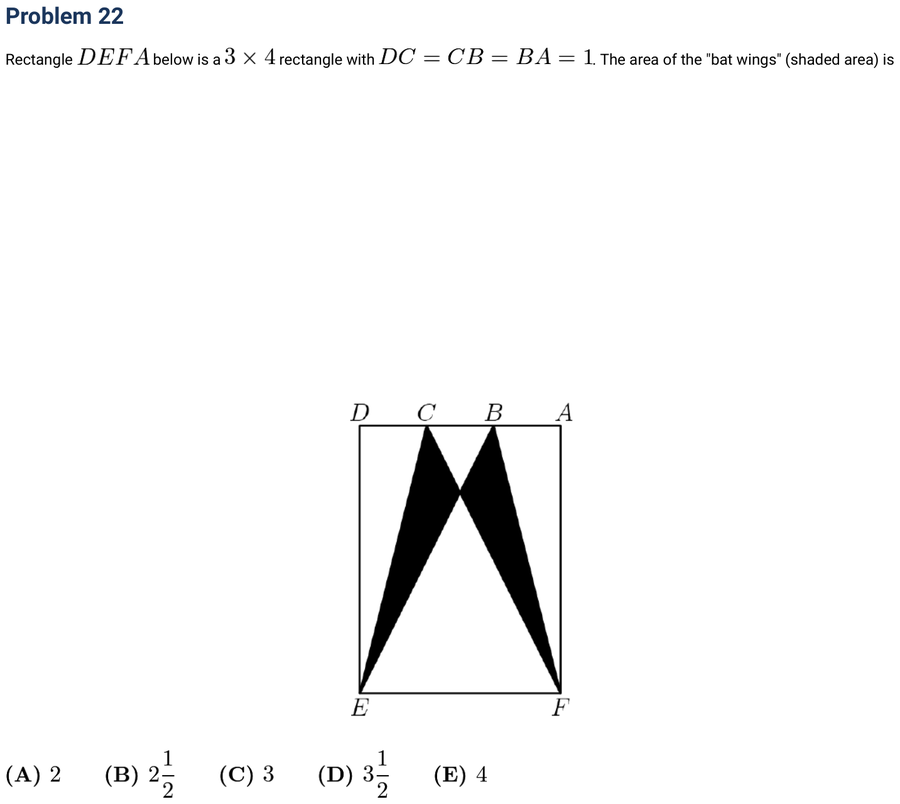
The figure is left-right symmetric, so the two wings have equal area — find ONE wing and double. The wing isn't a clean triangle, but it's a big triangle with a small triangle bitten out where the two slant lines cross.
Still stuck? Show hint 2 →
Hint 2 of 3
The crossing point H comes from similar triangles: ▵BCH and ▵EFH share the vertical angle at H and have parallel bases BC = 1 (top) and EF = 3 (bottom), so they're similar in ratio 1 : 3. Their heights split the rectangle's height 4 in that same 1 : 3 ratio.
Still stuck? Show hint 3 →
Hint 3 of 3
Once H's height is known, one wing = (a triangle with base on the top edge) minus (the little triangle above H).
Show solution
Approach: use the symmetry, find the crossing height by similar triangles, compute one wing and double
Let H be where the two inner slants CF and BE cross. ▵BCH ~ ▵EFH (vertical angle at H; parallel bases BC = 1 and EF = 3), so their heights are in ratio 1 : 3 and together span the height 4 — giving ▵BCH a height of 1.
Area ▵BCH = (1/2)(BC)(height) = (1/2)(1)(1) = 1/2.
▵BCE has base BC = 1 along the top and reaches the full height 4 down to E, so its area = (1/2)(1)(4) = 2.
One wing = ▵BCE − the bitten-out ▵BCH = 2 − 1/2 = 3/2. By symmetry the two wings total 2 × 3/2 = 3.
Why this transfers: when two cevians/slants cross, the crossing point's position comes free from a similar-triangle ratio of the two parallel bases — no coordinates needed.
Another way — coordinates + shoelace (trust-the-arithmetic check):
Put E = (0, 0), F = (3, 0), D = (0, 4), A = (3, 4); then C = (1, 4) and B = (2, 4). Inner slants: line BE is y = 2x, line CF is y = −2x + 6, crossing at H = (1.5, 3).
Left wing is ▵ with vertices C(1, 4), E(0, 0), H(1.5, 3). Shoelace area = (1/2)|1(0 − 3) + 0(3 − 4) + 1.5(4 − 0)| = (1/2)|−3 + 6| = 3/2.
Two congruent circles centered at points A and B each pass through the other circle's center. The line containing both A and B is extended to intersect the circles at points C and D. The circles intersect at two points, one of which is E. What is the degree measure of ∠CED?
Show answer
Answer: C — 120°.
Show hints
Hint 1 of 3
Mark every segment that is a radius. Each circle passes through the other's center, so AB, AE, and BE are ALL radii of equal length — that makes ▵AEB equilateral, handing you a free 60° at E.
Still stuck? Show hint 2 →
Hint 2 of 3
C and D are the far ends of the line through both centers, so CA and BD are full DIAMETERS. The key fact: an angle inscribed in a semicircle (standing on a diameter) is a right angle — so ∠CEA = 90° and ∠BED = 90°.
Still stuck? Show hint 3 →
Hint 3 of 3
Now ∠CED isn't just one of those angles — the two right angles OVERLAP in the middle (∠AEB), so combine them carefully rather than adding blindly.
Show solution
Approach: equilateral triangle for the middle angle + Thales' right angles on the diameters
AE = EB = AB (all radii of the two congruent circles, each through the other's center), so ▵AEB is equilateral and ∠AEB = 60°.
CA is a diameter of A's circle, so by Thales' theorem (angle in a semicircle) ∠CEA = 90°; likewise BD is a diameter of B's circle, so ∠BED = 90°.
Going from ray EC to ray ED, the two 90° angles share the overlap ∠AEB, so ∠CED = ∠CEA + ∠BED − ∠AEB = 90 + 90 − 60 = 120°.
Why this transfers: two facts unlock most circle-angle problems — equal radii build equilateral/isosceles triangles, and any angle subtending a DIAMETER is exactly 90° (Thales). Spot the diameter, get a right angle for free.
The digits 1, 2, 3, 4, and 5 are each used once to write a five-digit number PQRST. The three-digit number PQR is divisible by 4, the three-digit number QRS is divisible by 5, and the three-digit number RST is divisible by 3. What is P?
Show answer
Answer: A — P = 1.
Show hints
Hint 1 of 3
Attack the TIGHTEST rule first. Divisible-by-5 is the strictest: the last digit must be 0 or 5, and the only one of {1,2,3,4,5} available is 5 — so QRS divisible by 5 instantly forces S = 5. One clue, one digit pinned.
Still stuck? Show hint 2 →
Hint 2 of 3
Next-tightest: PQR divisible by 4 means its last two digits QR form a multiple of 4. With 5 used up, QR is a two-digit number from {1, 2, 3, 4} that's a multiple of 4 — only 12, 24, 32 qualify. Just three cases left.
Still stuck? Show hint 3 →
Hint 3 of 3
Finish with the gentlest rule (divisible by 3 = digit sum divisible by 3) to test the survivors. Notice R is shared by all three numbers, so it's heavily constrained — track it.
Show solution
Approach: apply the divisibility rules from most-restrictive to least, then test the few survivors
Divisible-by-5 is strictest: QRS ends in S, which must be 0 or 5, so S = 5.
Divisible-by-4: QR (the last two digits of PQR) must be a multiple of 4 built from {1, 2, 3, 4} — only 12, 24, 32 work. Three cases.
QR = 12: leftovers {3, 4} for P, T; RST = 25T has digit sum 7 + T, and T ∈ {3, 4} gives 10 or 11 — not divisible by 3. Out.
QR = 24: leftovers {1, 3}; RST = 45T has digit sum 9 + T, and T = 3 gives 12, divisible by 3. ✓ That forces P = 1, so PQRST = 12435 and P = 1.
QR = 32: leftovers {1, 4}; RST = 25T sum 7 + T with T ∈ {1, 4} gives 8 or 11 — not divisible by 3. Out. Only one solution survives.
Why this transfers: for digit puzzles with several divisibility rules, always resolve the most restrictive constraint first (it pins digits outright), which shrinks the casework before the looser rules ever come up.
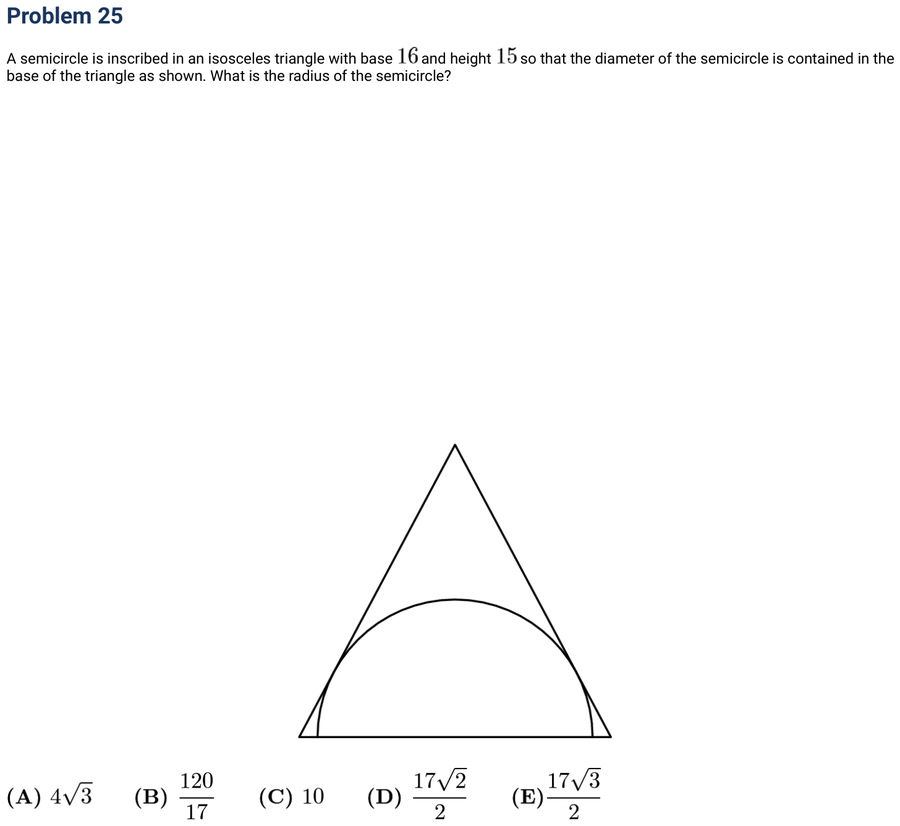
The big idea: a radius drawn to the point where the semicircle touches a slant side is PERPENDICULAR to that side (radius ⊥ tangent). So the radius is just the perpendicular distance from the semicircle's center to the slant — and that perpendicular is an altitude of a triangle hiding inside the figure.
Still stuck? Show hint 2 →
Hint 2 of 3
Isolate the triangle made by the center O (midpoint of the base), a base corner, and the apex. Its area can be written TWO ways — using the base×height you know, and using the slant side with the unknown radius as its height. Setting them equal frees the radius.
Still stuck? Show hint 3 →
Hint 3 of 3
You'll need the slant length: half the base is 8 and the height is 15, so the slant is the hypotenuse of an 8-15-17 right triangle — a clean 17, no square roots.
Show solution
Approach: area of a sub-triangle computed two ways (radius = its altitude to the slant)
Let O be the midpoint of the base (the semicircle's center). The semicircle is tangent to the slant side, and a radius to a tangent point is perpendicular to it — so the radius equals the perpendicular distance from O to that slant, i.e. the altitude of ▵BOC dropped onto side BC.
Compute ▵BOC's area the easy way: base OB = 8 (half the base) and height 15 (the full triangle height), so area = (1/2)(8)(15) = 60.
Find the slant BC: with legs 8 and 15 it's an 8-15-17 right triangle, so BC = 17. Now write the SAME area using BC as base and the radius as height: 60 = (1/2)(17)(radius).
Solve: radius = 120/17 = 120/17.
Why this transfers: "area two ways" turns any perpendicular-distance-to-a-side into algebra — compute a triangle's area with the convenient base, then re-express it with the side you care about, and the unknown height drops out. (Tangent ⊥ radius is the standard hook for inscribed-circle problems.)
Another way — perpendicular distance via coordinates:
Put the base's midpoint at (0, 0), apex at (0, 15), right base corner at (8, 0). The right slant has equation 15x + 8y = 120.
The radius is the distance from (0, 0) to that line: 120 / √(152 + 82) = 120/17.