Rachelle uses 3 pounds of meat to make 8 hamburgers for her family. How many pounds of meat does she need to make 24 hamburgers for a neighborhood picnic?
Show answer
Answer: E — 9 pounds.
Show hints
Hint 1 of 2
Don't reach for a formula — just compare the two orders. How many times bigger is 24 hamburgers than 8?
Still stuck? Show hint 2 →
Hint 2 of 2
This is scaling a recipe: if everything in the recipe grows by the same factor, the meat grows by that factor too.
Show solution
Approach: scale the recipe by the same factor
Notice 24 is exactly 3 batches of 8 (24 / 8 = 3) — she's making the same recipe 3 times over.
So everything triples, including the meat: 3 × 3 = 9 pounds.
Why this works & transfers: in any rate/recipe problem, scale both sides by the same factor — spotting the whole-number multiplier (here, ×3) beats setting up a cross-multiplication.
In the country of East Westmore, statisticians estimate there is a baby born every 8 hours and a death every day. To the nearest hundred, how many people are added to the population of East Westmore each year?
Show answer
Answer: B — About 700.
Show hints
Hint 1 of 2
Births and deaths are quoted on different clocks (every 8 hours vs. every day). Find a single day's net change first — then a year is just many copies of that day.
Still stuck? Show hint 2 →
Hint 2 of 2
This is find the per-day net, then scale: get one clean daily number, multiply by 365. Don't track births and deaths separately all the way out.
Show solution
Approach: net change per day, then scale to a year
Put both on a one-day clock: a birth every 8 hours means 24 / 8 = 3 births a day, against 1 death a day.
Net per day = 3 − 1 = 2 people. (Working with the net now means one multiplication later, not two.)
Over a year: 2 × 365 = 730, which rounds to 700.
Sanity check: ≈2 a day for a year should be in the high hundreds — 700 fits, 70 or 7000 would not.
On February 13 The Oshkosh Northwester listed the length of daylight as 10 hours and 24 minutes, the sunrise was 6:57 AM, and the sunset as 8:15 PM. The length of daylight and sunrise were correct, but the sunset was wrong. When did the sun really set?
Show answer
Answer: B — 5:21 PM.
Show hints
Hint 1 of 2
The wrong sunset (8:15 PM) is a trap — ignore it completely. Daylight is just the gap between sunrise and sunset, so sunset = sunrise + daylight.
Still stuck? Show hint 2 →
Hint 2 of 2
Add time in two clean stages: whole hours first, then the leftover minutes. Adding 10 h 24 min all at once invites a carrying mistake.
Show solution
Approach: sunset = sunrise + daylight, added in stages
Daylight is the stretch from sunrise to sunset, so just add 10 h 24 min to the 6:57 AM sunrise (the listed 8:15 PM is a decoy).
Add the 10 whole hours first: 6:57 AM + 10 h lands at 4:57 PM.
Now add the 24 minutes: 4:57 + 24 min = 5:21 PM.
Splitting hours from minutes is the reusable trick for any clock arithmetic — it keeps the carry into the next hour easy to see.
Peter's family ordered a 12-slice pizza for dinner. Peter ate one slice and shared another slice equally with his brother Paul. What fraction of the pizza did Peter eat?
Show answer
Answer: C — 1/8.
Show hints
Hint 1 of 2
The whole pizza is already cut into 12 equal slices — that's your natural unit. Count Peter's share in slices first, before turning it into a fraction of the pizza.
Still stuck? Show hint 2 →
Hint 2 of 2
"Shared equally" means he got half a slice, not a whole one. So count in halves: how many half-slices did he eat?
Show solution
Approach: count the share in slices, then over 12
Peter ate 1 whole slice plus half of another — that's 1½ slices out of the 12.
A clean way to avoid the ½: count in half-slices. Peter ate 3 half-slices, and the pizza holds 24 half-slices, so his share is 3/24 = 1/8.
Sanity check: one slice alone is 1/12, and he ate a bit more than one slice, so the answer should be a little bigger than 1/12 — 1/8 is.
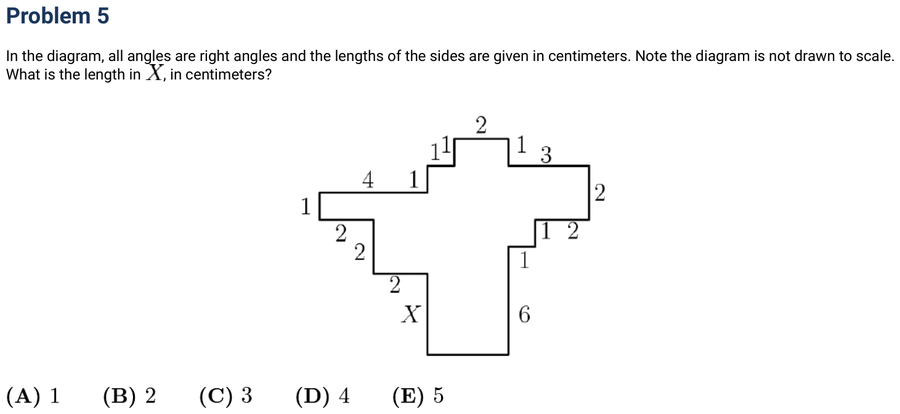
In the diagram, all angles are right angles and the lengths of the sides are given in centimeters. Note the diagram is not drawn to scale. What is X, in centimeters?
Show answer
Answer: E — X = 5.
Show hints
Hint 1 of 2
Don't try to find every coordinate. In any all-right-angle figure, the vertical segments going up must total the same as the segments going down — otherwise the outline wouldn't close back to where it started.
Still stuck? Show hint 2 →
Hint 2 of 2
This is the closed-loop balance for staircase figures: sum of upward steps = sum of downward steps (and likewise left = right). Add up the verticals on each path and set them equal.
Show solution
Approach: vertical segments up = vertical segments down (closed loop)
Walk the outline: every bit you climb up has to be undone coming down, since the figure closes. So total "up" height = total "down" height.
The verticals on one side add to 1 + 2 + 1 + 6 = 10.
The verticals on the other side add to 1 + 1 + 1 + 2 + X = 5 + X.
Set them equal: 5 + X = 10 ⇒ X = 5.
You'll reuse this on every "find the missing length in a right-angled figure": the up-segments and down-segments balance, and so do left and right — no need to chase individual corners.
A rectangular photograph is placed in a frame that forms a border two inches wide on all sides of the photograph. The photograph measures 8 inches high and 10 inches wide. What is the area of the border, in square inches?
Show answer
Answer: E — 88 square inches.
Show hints
Hint 1 of 2
The border is an awkward picture-frame shape. Don't measure it directly — it's a big rectangle (frame + photo) with the photo punched out of the middle.
Still stuck? Show hint 2 →
Hint 2 of 2
This is complementary area: outer area − inner area. The only trap is the width — a 2-inch border adds 2 on the left and 2 on the right, so each dimension grows by 4, not 2.
Show solution
Approach: outer rectangle minus the photo (complementary area)
The border is everything in the outer rectangle except the photo, so its area = outer area − photo area. That sidesteps adding up four separate strips.
The 2-inch border hits both sides, so each dimension gains 2 + 2 = 4: the outer rectangle is 12 × 14 = 168.
Subtract the photo: 8 × 10 = 80, so border = 168 − 80 = 88 sq in.
Watch the doubling — a border/margin of width w always adds 2w to each side length, the classic slip in frame and walkway problems.
Isabella must take four 100-point tests in her math class. Her goal is to achieve an average grade of 95 on the tests. Her first two test scores were 97 and 91. After seeing her score on the third test, she realized she can still reach her goal. What is the lowest possible score she could have made on the third test?
Show answer
Answer: B — 92.
Show hints
Hint 1 of 2
Averages are slippery to push around — convert the goal into a fixed total. An average of 95 over 4 tests is the same as needing a certain number of total points.
Still stuck? Show hint 2 →
Hint 2 of 2
To make ONE score as small as possible, give the other score as much as it can take. The 4th test is the helper here, and it's capped at 100 — this "push the other to its limit" idea is the heart of every min/max problem.
Show solution
Approach: turn the average into a point budget, then max the helper
Average 95 over 4 tests means a total of 4 × 95 = 380 points — a fixed budget is far easier to reason about than a moving average.
She's already used 97 + 91 = 188, leaving 380 − 188 = 192 to split between tests 3 and 4.
To make test 3 smallest, let test 4 grab the most it can: 100. Then test 3 = 192 − 100 = 92.
The transferable move: to minimize one quantity in a fixed total, maximize the others (and vice versa). The cap (here, 100 points) is what makes the answer finite.
A shop advertises everything is "half price in today's sale." In addition, a coupon gives a 20% discount on sale prices. Using the coupon, the price today represents what percentage off the original price?
Show answer
Answer: D — 60%.
Show hints
Hint 1 of 2
Don't add 50% + 20% — the 20% comes off the already-halved price, not the original. Track what survives each step, not what's taken off.
Still stuck? Show hint 2 →
Hint 2 of 2
This is chaining percentages by multiplying: a discount of d leaves the fraction (1 − d), and successive discounts multiply. Always work with the surviving fraction.
Show solution
Approach: multiply the surviving fractions, then subtract from 1
Half price means you still pay 1/2 of the original. The 20%-off coupon then leaves 80% = 0.8 of that, so discounts chain by multiplying.
What you actually pay: 0.5 × 0.8 = 0.4 of the original price.
So the total discount is 1 − 0.4 = 60% — not the 70% you'd get by wrongly adding 50 + 20.
Why multiply, not add: each percent acts on the price left after the previous one. Multiplying the "keep" fractions is the safe path for any stacked discount or tax.
The Fort Worth Zoo has a number of two-legged birds and a number of four-legged mammals. On one visit to the zoo, Margie counted 200 heads and 522 legs. How many of the animals that Margie counted were two-legged birds?
Show answer
Answer: C — 139 birds.
Show hints
Hint 1 of 2
Before reaching for two equations, try a what-if: pretend every animal is a 4-legged mammal. You'd over-count the legs — and the over-count is caused entirely by the birds.
Still stuck? Show hint 2 →
Hint 2 of 2
This is the assume-then-fix trick (a.k.a. the chicken-and-rabbit method): assume the extreme case, see the gap from reality, and let each swapped animal explain a fixed chunk of the gap.
Show solution
Approach: assume all 4-legged, then account for the shortage
Imagine all 200 animals are 4-legged: that would be 200 × 4 = 800 legs — one easy multiplication instead of solving a system.
Reality shows only 522 legs, a shortage of 800 − 522 = 278.
Every bird counted as a mammal hides 2 legs (it has 2, not 4), so each bird explains exactly 2 of the missing legs: birds = 278 / 2 = 139.
Let t = birds, f = mammals. Heads: t + f = 200. Legs: 2t + 4f = 522.
Double the head equation: 2t + 2f = 400, and subtract it from the leg equation to clear t... or subtract from the legs to clear f: 2f = 122, so f = 61.
Then t = 200 − 61 = 139 birds. The shortcut above is just this subtraction done in your head.
How many 4-digit numbers greater than 1000 are there that use the four digits of 2012?
Show answer
Answer: D — 9.
Show hints
Hint 1 of 2
Two of the four digits are identical (two 2's), and the 0 can't lead. The cleanest plan: handle the picky positions first — decide where the 0 goes, then where the 1 goes, and the two 2's fill the rest with no further choice.
Still stuck? Show hint 2 →
Hint 2 of 2
This is place the constrained items first. Because the two 2's are interchangeable, once 0 and 1 are placed there's exactly one way to finish — so just multiply the number of choices.
Show solution
Approach: place the 0 (restricted) and the 1, the 2's fall in automatically
The digits are {0, 1, 2, 2}. The 0 is the troublemaker — it can't be the leading digit, so it has only 3 legal spots (not 4).
After the 0 is down, the 1 takes any of the 3 remaining spots.
The last two spots must both be 2's — identical, so there's nothing left to decide. Total = 3 × 3 = 9 numbers.
The reusable idea: when something is restricted (a digit that can't lead, a person who must sit at the end), place it first — you count the easy cases and never over- or under-count.
Another way — all arrangements, then remove the bad ones:
Arrange 4 digits where two are identical: 4! / 2! = 12 total orderings.
Toss out the ones that start with 0: fix 0 in front and arrange {1, 2, 2}, giving 3! / 2! = 3 bad cases.
Good numbers = 12 − 3 = 9. (The 2! divides out the swap of the two identical 2's.)
The mean, median, and unique mode of the positive integers 3, 4, 5, 6, 6, 7, and x are all equal. What is the value of x?
Show answer
Answer: D — 11.
Show hints
Hint 1 of 2
Three things must be equal, but one of them is already pinned down no matter what x is. Which one? The mode — 6 is the only value that already repeats, and x can't be allowed to create a tie.
Still stuck? Show hint 2 →
Hint 2 of 2
Once you know the common value, the rest is bookkeeping: mean = that value turns the whole thing into one equation, since mean fixes the total.
Show solution
Approach: pin the mode first — it forces the common value, then mean gives x
Start with the most rigid clue. "Unique mode" means exactly one value repeats; only 6 does, so the mode is locked at 6 (and x must avoid 3, 4, 5, 7 or there'd be a tie). So all three equal 6.
Now mean = 6 pins the total: 7 numbers averaging 6 must sum to 7 × 6 = 42.
The six known values sum to 31, so x = 42 − 31 = 11.
Check the median: sorted, the list is 3, 4, 5, 6, 6, 7, 11 — the middle (4th) value is 6 ✓. Lesson: in mean/median/mode puzzles, attack the most-constrained statistic first; it usually reveals the target number.
You'll never compute 132012 — and you don't have to. When you multiply, only the units digit of each factor affects the units digit of the answer, so 132012 ends in the same digit as 32012.
Still stuck? Show hint 2 →
Hint 2 of 2
Now list a few powers of 3 and watch the last digit: 3, 9, 7, 1, then 3 again. It cycles with period 4 — so the answer depends only on where 2012 lands in that cycle of 4.
Show solution
Approach: units digits repeat in a short cycle — find the position
The units digit of a product depends only on the units digits being multiplied, so 132012 ends in the same digit as 32012. The big base is irrelevant.
List the last digits of powers of 3: 31→3, 32→9, 33→7, 34→1, 35→3… They loop every 4 powers: (3, 9, 7, 1).
So divide the exponent by 4 and look at the leftover: 2012 = 4 × 503 with leftover 0, meaning we land exactly on the end of a cycle — the 4th spot, which is 1.
This transfers to every units-digit problem: last digits always cycle (period 1, 2, or 4 for single digits); find the cycle length, then reduce the exponent by that length. A leftover of 0 lands on the last entry, not the first.
Jamar bought some pencils costing more than a penny each at the school bookstore and paid $1.43. Sharona bought some of the same pencils and paid $1.87. How many more pencils did Sharona buy than Jamar?
Show answer
Answer: C — 4 more pencils.
Show hints
Hint 1 of 2
Switch to whole cents (143 and 187) so you're working with integers. A whole number of pencils at a whole-cent price means that price divides each total exactly — so the price is a common factor of 143 and 187.
Still stuck? Show hint 2 →
Hint 2 of 2
This is a shared divisor hunt: the price divides both amounts, so it divides their gcd. Factor each amount and the price has to fall out (the "more than a penny" rules out the trivial 1¢).
Show solution
Approach: the price is a common factor of both totals
Some whole number of pencils times the (whole-cent) price gives 143¢, and likewise 187¢. So the price divides both 143 and 187 — it's a common factor.
Factor them: 143 = 11 × 13 and 187 = 11 × 17. Their only shared factor above 1 is 11, and "more than a penny" forbids 1¢, so each pencil costs 11¢.
The clean finish: Sharona paid 187 − 143 = 44¢ more, which is 44 / 11 = 4 extra pencils — no need to find each kid's count.
The transferable idea: "same whole-number price buys both totals" means the price is a common divisor; factoring or gcd pins it down. Subtracting the totals before dividing skips the individual counts.
In the BIG N, a middle school football conference, each team plays every other team exactly once. If a total of 21 conference games were played during the 2012 season, how many teams were members of the BIG N conference?
Show answer
Answer: B — 7 teams.
Show hints
Hint 1 of 2
Each team plays every other one, so a team plays N − 1 games. Multiply by the N teams — but careful, that counts each game from both sides, so you've double-counted.
Still stuck? Show hint 2 →
Hint 2 of 2
This is the handshake count: games (or handshakes) = N(N − 1)/2. The ÷2 fixes the double-count. Set it equal to 21 and find N.
Show solution
Approach: handshake count, then solve for N
Each of the N teams faces the other N − 1 teams. Counting N × (N − 1) tallies every game twice (once for each team in it), so the real total is N(N − 1)/2.
Set that to 21: N(N − 1)/2 = 21, so N(N − 1) = 42.
Find two consecutive numbers multiplying to 42 — that's 7 × 6, so N = 7. (Faster than a formula: just scan products of neighbors.)
Same pattern everywhere: handshakes in a room, diagonals plus sides of a polygon, pairs from a group — all are N(N − 1)/2 because every pair is counted from both ends.
The smallest number greater than 2 that leaves a remainder of 2 when divided by 3, 4, 5, or 6 lies between what numbers?
Show answer
Answer: D — Between 61 and 65.
Show hints
Hint 1 of 2
"Leaves 2 left over" every time is the clue: if you remove those 2 leftover, the number divides evenly by 3, 4, 5, and 6. So x − 2 is a common multiple of all four.
Still stuck? Show hint 2 →
Hint 2 of 2
This is the subtract-the-leftover shift: turn "remainder 2" into "exact multiple", then the number you need is the LCM of 3, 4, 5, 6. (Notice 3 and 6 are covered once you handle 4 and... well, 6 needs both 2 and 3.)
Show solution
Approach: shift off the leftover, then use the LCM
Strip away the 2 leftover: x − 2 must divide evenly by 3, 4, 5, and 6 at once — so it's a common multiple of all four.
The smallest common multiple is LCM(3, 4, 5, 6). Build it from prime needs: 4 = 2², 5, and a 3 (which also covers 6) ⇒ LCM = 2² × 3 × 5 = 60.
So the smallest x − 2 above 0 is 60, giving x = 62 — which lands between 61 and 65.
The reusable move: "same remainder r for several divisors" ⇒ subtract r, find the LCM, add r back. Don't list multiples one by one.
Each of the digits 0, 1, 2, 3, 4, 5, 6, 7, 8, and 9 is used only once to make two five-digit numbers so that they have the largest possible sum. Which of the following could be one of the numbers?
Show answer
Answer: C — 87431.
Show hints
Hint 1 of 2
A digit in the ten-thousands place is worth far more than the same digit in the ones place. So to make the sum biggest, the biggest digits must sit in the highest places — greed wins here.
Still stuck? Show hint 2 →
Hint 2 of 2
This is a place-value greedy argument: the two ten-thousands digits should be 9 and 8, the two thousands digits 7 and 6, and so on down. That forces each position to use a known pair — then just check which answer fits.
Show solution
Approach: biggest digits to biggest places (greedy), then match the pairs
Since a higher place multiplies a digit by more, dropping a big digit into a high place adds the most to the sum. So assign greedily from the top: the two leading digits use {9, 8}, the next pair {7, 6}, then {5, 4}, then {3, 2}, then {1, 0}.
That means whichever number you look at, its digits left-to-right must come one from each pair: position 1 from {9,8}, position 2 from {7,6}, position 3 from {5,4}, position 4 from {3,2}, position 5 from {1,0}.
Test the choices against this stencil — only 87431 fits: 8∈{9,8}, 7∈{7,6}, 4∈{5,4}, 3∈{3,2}, 1∈{1,0}. ✓
Why greedy is safe here: moving a larger digit to a higher place never hurts the sum, so the maximum must look exactly like this. The same "big digits to big places" logic handles most digit-arrangement extremes.
A square with an integer side length is cut into 10 squares, all of which have integer side length and at least 8 of which have area 1. What is the smallest possible value of the length of the side of the original square?
Show answer
Answer: B — Side 4.
Show hints
Hint 1 of 2
"Smallest possible" problems are squeezed from two directions. First squeeze from below: 10 pieces, each with integer side, so each has area at least 1 — what does that force about the big square's area?
Still stuck? Show hint 2 →
Hint 2 of 2
A lower bound only says "no smaller than". To prove the bound is actually reached, you must build an example at that size — here, an explicit way to cut a 4×4 into the right 10 squares.
Show solution
Approach: trap the answer: area lower bound, then a real construction
Lower bound (rule out smaller): each of the 10 squares has integer side ≥ 1, so area ≥ 1, making the total area ≥ 10. A side-3 square has area only 9 < 10, so side ≥ 4.
Upper bound (show 4 works): a bound is only believable if you can build it. Take the 4×4 square; fill the top 4×2 strip with two 2×2 squares, and the bottom 4×2 strip with 8 unit squares. That's 2 + 8 = 10 squares, exactly 8 of area 1. ✓
Since side 3 is impossible and side 4 is achievable, the smallest is 4.
The reusable habit: for any "smallest/largest that works" problem, prove a bound and exhibit an example hitting it — one half alone never settles the question.
What is the smallest positive integer that is neither prime nor square and that has no prime factor less than 50?
Show answer
Answer: A — 3127.
Show hints
Hint 1 of 2
Don't search numbers — decode the three conditions into a recipe for what the number must be built from. Translate each phrase: "not prime", "no prime factor < 50", "not a square."
Still stuck? Show hint 2 →
Hint 2 of 2
"Not prime" + "every prime factor ≥ 50" ⇒ it's a product of at least two primes, all ≥ 50. "Not a square" ⇒ those primes must be different. So: smallest two different primes above 50.
Show solution
Approach: translate each condition, then take the smallest legal build
Read the conditions as a blueprint. "Not prime" means it factors into ≥ 2 primes; "no prime factor below 50" means every one of those primes is ≥ 50; "not a square" means we can't repeat a prime (like p²). So the number = a product of distinct primes ≥ 50.
To make it smallest, use the two smallest primes above 50. Checking 51 = 3×17 (no), 52, 53 is prime; next prime is 59.
Smallest such product: 53 × 59 = 3127.
The skill: turn each word-condition into a structural fact about the prime factorization first — then "smallest" just means "use the smallest allowed ingredients."
In a jar of red, green, and blue marbles, all but 6 are red marbles, all but 8 are green, and all but 4 are blue. How many marbles are in the jar?
Show answer
Answer: C — 9 marbles.
Show hints
Hint 1 of 2
Flip each statement around. "All but 6 are red" isn't about red — it says the non-red marbles (green + blue) number 6. Rewrite all three the same way.
Still stuck? Show hint 2 →
Hint 2 of 2
Now add your three equations and watch what happens: each color shows up in exactly two of them. The technique is add-them-all and exploit the symmetry.
Show solution
Approach: rephrase as two-color sums, then add
Reverse each clue into a count of the other two colors: green + blue = 6, red + blue = 8, red + green = 4.
Add all three. Every color appears in exactly two equations, so the left side is 2(red + green + blue): 2 × Total = 6 + 8 + 4 = 18.
Therefore Total = 18 / 2 = 9 marbles.
Why the ÷2: summing "all but" statements double-counts every marble, so the total is half the sum of the three given numbers — a handy shortcut for any "all but" puzzle.
Another way — find each color, then total:
From green + blue = 6 and red + blue = 8, subtract: red − green = 2. Combine with red + green = 4 to get red = 3, green = 1.
Then blue = 6 − green = 5. Total = 3 + 1 + 5 = 9, matching the shortcut.
What is the correct ordering of the three numbers 519, 721, and 923, in increasing order?
Show answer
Answer: B — 5/19 < 7/21 < 9/23.
Show hints
Hint 1 of 2
Look at each fraction's gap between top and bottom: 19 − 5, 21 − 7, 23 − 9 — all 14! Every fraction is exactly 14 short of being 1, so compare how far each falls below 1.
Still stuck? Show hint 2 →
Hint 2 of 2
Rewrite each as 1 − (the missing piece): the bigger the piece you subtract, the smaller the fraction. This compare-against-1 trick beats finding a common denominator of 19, 21, 23.
Show solution
Approach: every fraction is 1 minus a piece — compare the pieces
Spot the shared structure: each numerator is 14 below its denominator, so each fraction equals 1 − 14/(denominator). Concretely 5/19 = 1 − 14/19, 7/21 = 1 − 14/21, 9/23 = 1 − 14/23.
Now compare the subtracted pieces: 14/19 > 14/21 > 14/23 (same top 14, so the smallest bottom gives the biggest piece).
Subtracting a bigger piece leaves a smaller fraction, so 5/19 is smallest and 9/23 largest: 5/19 < 7/21 < 9/23.
Intuition / sanity check: all three sit just under 1; the one closest to 1 (smallest leftover gap) is biggest. Reusable when a batch of fractions share a constant top−bottom difference — rewrite as 1 − (piece) and rank the pieces.
Another way — cross-multiply pairwise:
Compare 5/19 vs 7/21 by cross-multiplying: 5×21 = 105 vs 7×19 = 133. Since 105 < 133, 5/19 < 7/21.
Compare 7/21 vs 9/23: 7×23 = 161 vs 9×21 = 189, so 7/21 < 9/23.
Chaining gives 5/19 < 7/21 < 9/23 — more arithmetic, but no clever rewrite needed.
Marla has a large white cube that has an edge of 10 feet. She also has enough green paint to cover 300 square feet. Marla uses all the paint to create a white square centered on each face, surrounded by a green border. What is the area of one of the white squares, in square feet?
Show answer
Answer: D — 50 square feet.
Show hints
Hint 1 of 2
You never need the size or shape of the green border — just areas. Every bit of the cube's surface is either green paint or white square, so white = total surface − green.
Still stuck? Show hint 2 →
Hint 2 of 2
This is whole minus the part you know. Find the cube's total surface, subtract the 300 of green, then split the remaining white equally among the 6 identical faces. (The √2 answer choices are bait for finding a side length you don't need.)
Show solution
Approach: total surface area, subtract green, divide by 6
A cube has 6 faces, each 10 × 10, so total surface = 6 × 100 = 600 sq ft.
Green covers 300 of it, so the white squares together cover 600 − 300 = 300 sq ft.
The 6 faces are identical, so each white square is 300 / 6 = 50 sq ft.
Note: the question asks for the white area, so stop here — no need to take a square root to find the side. Watching what's actually asked saves the √2 traps.
Let R be a set of nine distinct integers. Six of the elements are 2, 3, 4, 6, 9, and 14. What is the number of possible values of the median of R?
Show answer
Answer: D — 7 possible values.
Show hints
Hint 1 of 2
With 9 distinct integers, the median is just the 5th smallest — the one with exactly 4 below it and 4 above. You get to add 3 free integers, so you can shove the "window" left or right. Ask: which values can't be reached no matter how you place those 3?
Still stuck? Show hint 2 →
Hint 2 of 2
Find the boundaries by counting what's already forced. A candidate median needs 4 below and 4 above; if too many of the six known values are already stuck on one side, you can't balance it. The technique is to find the largest and smallest reachable median, then count the integers between.
Show solution
Approach: find the median's reachable range, then count integers in it
Median = 5th smallest of the 9. To make a value m the median, the final set must have 4 elements below m and 4 above. You control only 3 new integers, so check whether the six knowns (2, 3, 4, 6, 9, 14) can be balanced around m.
Too small fails: if m < 3, then 3, 4, 6, 9, 14 — five knowns — already sit above m, more than the 4 allowed. So m ≥ 3.
Too big fails: if m > 9, then 2, 3, 4, 6, 9 — five knowns — already sit below, again too many. So m ≤ 9.
Every integer from 3 to 9 does work: place enough of your 3 spare integers below or above to even the count to 4 and 4. That's the integers 3, 4, 5, 6, 7, 8, 9 — 9 − 3 + 1 = 7 possible medians.
The reusable idea: when you control some of the data, find the extreme positions the answer can reach (the boundaries) and count between them — don't test every value blindly.
An equilateral triangle and a regular hexagon have equal perimeters. If the triangle's area is 4, what is the area of the hexagon?
Show answer
Answer: C — Area 6.
Show hints
Hint 1 of 2
A regular hexagon is secretly 6 little equilateral triangles meeting at its center — so the whole problem is about comparing those small triangles to the big one. First find the hexagon's side from the equal-perimeter clue.
Still stuck? Show hint 2 →
Hint 2 of 2
Equal perimeters: the triangle's 3 sides equal the hexagon's 6 sides, so each hexagon side is half the triangle's side. Key fact: when you halve a length, area shrinks by the square — to 1/4, not 1/2.
Show solution
Approach: hexagon = six equilateral triangles; area scales as (length)²
Equal perimeters means 3 × (triangle side) = 6 × (hexagon side), so the hexagon's side is half the triangle's side.
Cut the hexagon into its 6 natural equilateral triangles (from center to the corners) — each has that half-length side.
Halving the side scales area by (1/2)² = 1/4 (area always scales as the square of length), so each mini-triangle has area 4 × 1/4 = 1.
Six of them: hexagon area = 6 × 1 = 6.
The big takeaway: area scales like the square of the length ratio — double the side, 4× the area; half the side, 1/4 the area. This single fact handles most "similar figures" comparisons without any formula for the area itself.
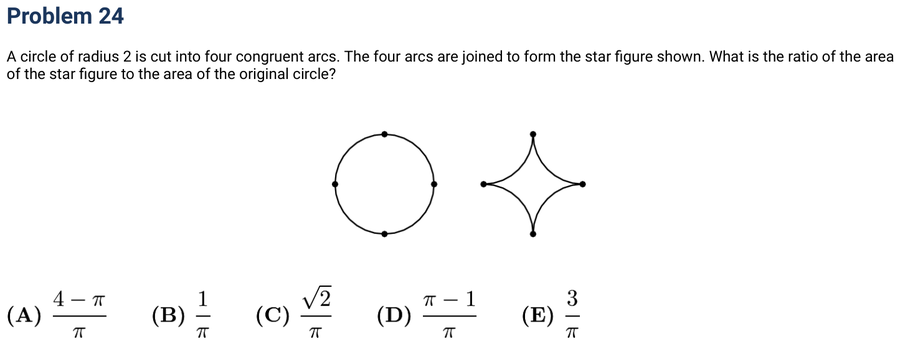
A circle of radius 2 is cut into four congruent arcs. The four arcs are joined to form the star figure shown. What is the ratio of the area of the star figure to the area of the original circle?
Show answer
Answer: A — (4 − π)/π.
Show hints
Hint 1 of 2
Nothing was added or removed — the star is the same four arcs as the circle, just flipped to curve inward instead of outward. So the star and circle are made of identical pieces; the trick is to find a clean container.
Still stuck? Show hint 2 →
Hint 2 of 2
Drop the star inside a square that its 4 points just touch. The 4 leftover corner "bites" are exactly the 4 arc-pieces — flipped back out, they rebuild the circle. So square = star + circle. This is a rearrangement / conservation-of-pieces argument.
Show solution
Approach: same arcs rearranged: bounding square = star + circle
The four arcs that bulged outward to make the circle are now curved inward to make the star — same pieces, no area gained or lost. We just need a shape we can measure.
Inscribe the star in a square whose sides its four points touch. Each star point reaches one radius (2) past center on each side, so the square is 4 × 4 = 16.
Look at the 4 corner regions outside the star but inside the square: each is one of the original arc bites. Flipped outward they reassemble the whole circle, so those 4 regions total the circle's area π(2)² = 4π.
Thus star = square − those corners = 16 − 4π, and the ratio star : circle = (16 − 4π) / 4π = (4 − π)/π.
The transferable move: when a figure is built by rearranging pieces of another, look for a simple shape (here a square) that the pieces tile exactly — then areas come from subtraction, not integration or arcs.
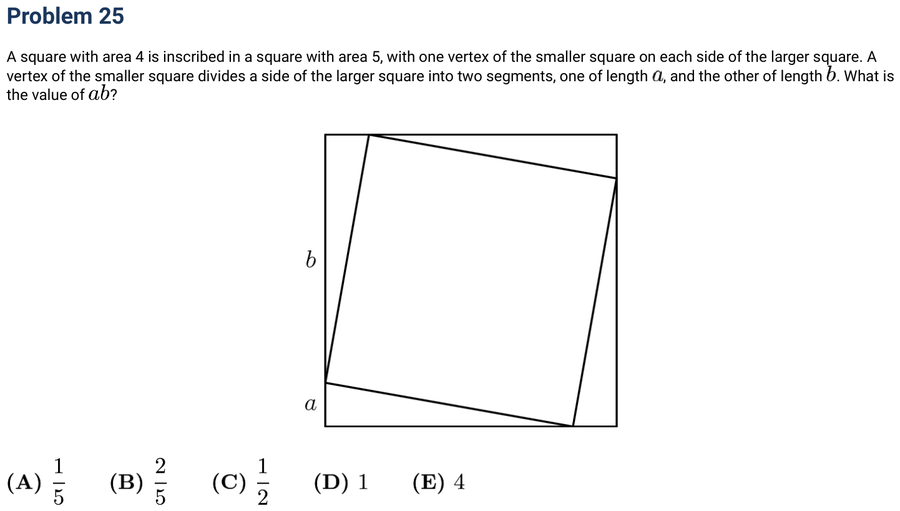
A square with area 4 is inscribed in a square with area 5, with one vertex of the smaller square on each side of the larger square. A vertex of the smaller square divides a side of the larger square into two segments, one of length a, and the other of length b. What is the value of ab?
Show answer
Answer: C — 1/2.
Show hints
Hint 1 of 2
Don't hunt for a and b separately — the question only wants their product. The tilted small square cuts the big square into itself plus 4 corner triangles, and each triangle's area is exactly (1/2)ab. So chase the total triangle area.
Still stuck? Show hint 2 →
Hint 2 of 2
The 4 corner triangles are congruent (the picture is symmetric), and together they're just the part of the big square not covered by the small one: 5 − 4 = 1. That's the whole problem — no need for side lengths.
Show solution
Approach: leftover area equals the four corner triangles → ab
The small square sits inside the big one, leaving 4 right triangles in the corners. Their total area is the difference of squares: 5 − 4 = 1.
Those 4 triangles are congruent by the symmetry of the figure, so each has area 1/4.
Each corner triangle has legs a and b, so its area is (1/2)ab. Set (1/2)ab = 1/4, giving ab = 1/2.
Why it's quick: the target is a product, and (1/2)ab is exactly a triangle's area — so an area equation hands you ab directly, no need to solve for a or b alone.
Another way — two Pythagorean relations:
The small square's side is √4 = 2, and it's the hypotenuse of a corner right triangle with legs a, b: so a² + b² = 4.
The big square's side is √5, and that side is split into a + b: so (a + b)² = 5, i.e. a² + 2ab + b² = 5.
Subtract the first from the second: 2ab = 5 − 4 = 1, so ab = 1/2. (The (a+b)² − (a²+b²) = 2ab identity is the engine here.)