Karl's rectangular vegetable garden is 20 feet by 45 feet, and Makenna's is 25 feet by 40 feet. Which of the following statements are true?
Show answer
Answer: E — Makenna's garden is larger by 100 square feet.
Show hints
Hint 1 of 2
Don't compare the shapes — compare their areas. Area of a rectangle is length × width, so find both and subtract.
Still stuck? Show hint 2 →
Hint 2 of 2
Notice both gardens have the same half-perimeter (20+45 = 25+40 = 65). For a fixed perimeter, the rectangle whose sides are closer together holds more area — that hints Makenna (25 by 40) wins before you even multiply.
Show solution
Approach: multiply each area, then subtract
Karl: 20 × 45 = 900 sq ft.
Makenna: 25 × 40 = 1000 sq ft.
Difference: 1000 − 900 = 100 ⇒ Makenna's is larger by 100 sq ft.
Worth keeping: with the same perimeter, the "rounder" (squarer) rectangle always has more area — 25 by 40 is closer to a square than 20 by 45, so it had to be the bigger one.
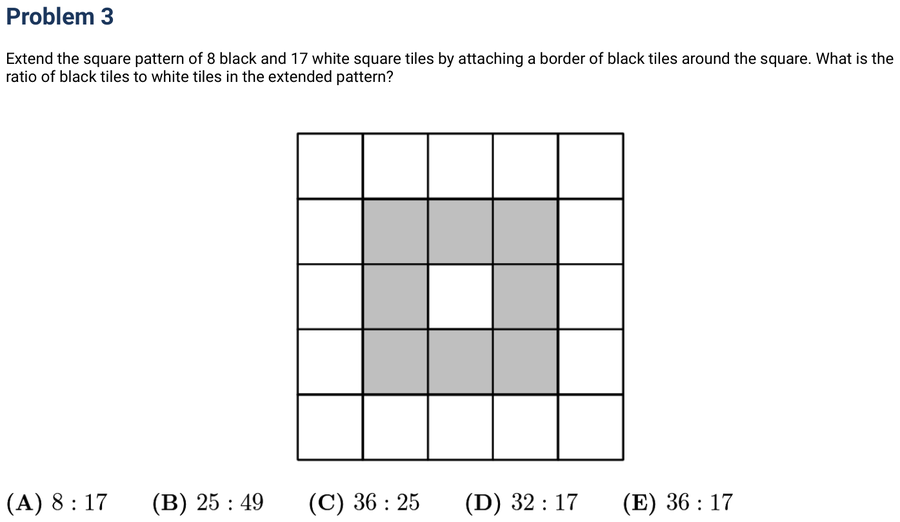
Extend the square pattern of 8 black and 17 white square tiles by attaching a border of black tiles around the square. What is the ratio of black tiles to white tiles in the extended pattern?
Show answer
Answer: D — 32 : 17.
Show hints
Hint 1 of 2
The border only adds black tiles — the 17 white tiles never change. So the only thing to find is how many black tiles the new ring adds.
Still stuck? Show hint 2 →
Hint 2 of 2
Find the new total by squaring: a square of 25 tiles is 5 × 5, and wrapping one ring around it makes it 7 × 7. New tiles = big square − old square.
Show solution
Approach: the white count is frozen; only count the new black ring
The original 25 tiles form a 5 × 5 square. Adding one ring all around makes it 7 × 7 = 49 tiles (each side grows by 2: one tile at each end).
The 49 − 25 = 24 new tiles are all black, so black becomes 8 + 24 = 32; white stays 17.
Ratio: 32 : 17.
Worth keeping: wrapping one ring around an n × n square turns it into (n+2) × (n+2), adding (n+2)2 − n2 = 4n + 4 tiles — here 4·5 + 4 = 24.
Here is a list of the numbers of fish that Tyler caught in nine outings last summer: 2, 0, 1, 3, 0, 3, 3, 1, 2. Which statement about the mean, median, and mode is true?
Show answer
Answer: C — mean < median < mode.
Show hints
Hint 1 of 2
Sorting the list does all three jobs at once: it puts the middle value (median) in plain sight, makes the repeated value (mode) easy to spot, and the mean is just the total split 9 ways.
Still stuck? Show hint 2 →
Hint 2 of 2
Mode = the value that appears most, median = the middle one (the 5th of 9), mean = sum ÷ 9 — three different ways to say "a typical value."
Show solution
Approach: sort once, then read off all three
Sorted: 0, 0, 1, 1, 2, 2, 3, 3, 3.
Mode = 3 (it shows up three times). Median = the 5th value = 2. Mean = 15/9 = 5/3 ≈ 1.67.
So 5/3 < 2 < 3 ⇒ mean < median < mode.
Intuition: the two zero-fish days drag the mean down below the middle value, which is why the mean ends up smallest here.
What time was it 2011 minutes after midnight on January 1, 2011?
Show answer
Answer: D — January 2 at 9:31 AM.
Show hints
Hint 1 of 2
2011 minutes is more than one day — a full day is only 24×60 = 1440 minutes. Peel off one whole day first, and the leftover tells you the clock time.
Still stuck? Show hint 2 →
Hint 2 of 2
Convert minutes to hours-and-minutes by dividing by 60: the quotient is hours, the remainder is the minutes.
Show solution
Approach: peel off a full day, then convert the leftover
One day = 1440 minutes. 2011 − 1440 = 571 minutes into the next day, January 2.
571 ÷ 60 = 9 remainder 31, so that's 9 hours 31 minutes after midnight = 9:31 AM on January 2.
Worth keeping: clock and calendar questions are all about remainders — throw away whole days (1440 min) or whole 12-hour blocks, and only the remainder decides the answer.
In a town of 351 adults, every adult owns a car, motorcycle, or both. If 331 adults own cars and 45 adults own motorcycles, how many of the car owners do not own a motorcycle?
Show answer
Answer: D — 306.
Show hints
Hint 1 of 2
Flip the question: instead of "car owners without a motorcycle," ask "who has no motorcycle at all?" Since everyone owns at least one vehicle, anyone without a motorcycle must own a car — so those two groups are the same people.
Still stuck? Show hint 2 →
Hint 2 of 2
The 331 car-owners is a decoy here — complementary counting (total minus the unwanted group) sidesteps it entirely.
Show solution
Approach: complementary counting — car-only = everyone who lacks a motorcycle
Every adult owns at least one vehicle, so an adult without a motorcycle owns a car and nothing else — exactly the "car but no motorcycle" group we want.
Count the non-motorcycle owners: 351 − 45 = 306.
Why this transfers: when every item is in "A or B or both," the "A only" group is just everyone minus the B group — counting the complement beats wrestling with the overlap.
Another way — inclusion-exclusion as a check:
Both = cars + motorcycles − total = 331 + 45 − 351 = 25 own both.
Car owners without a motorcycle = 331 − 25 = 306, matching above.
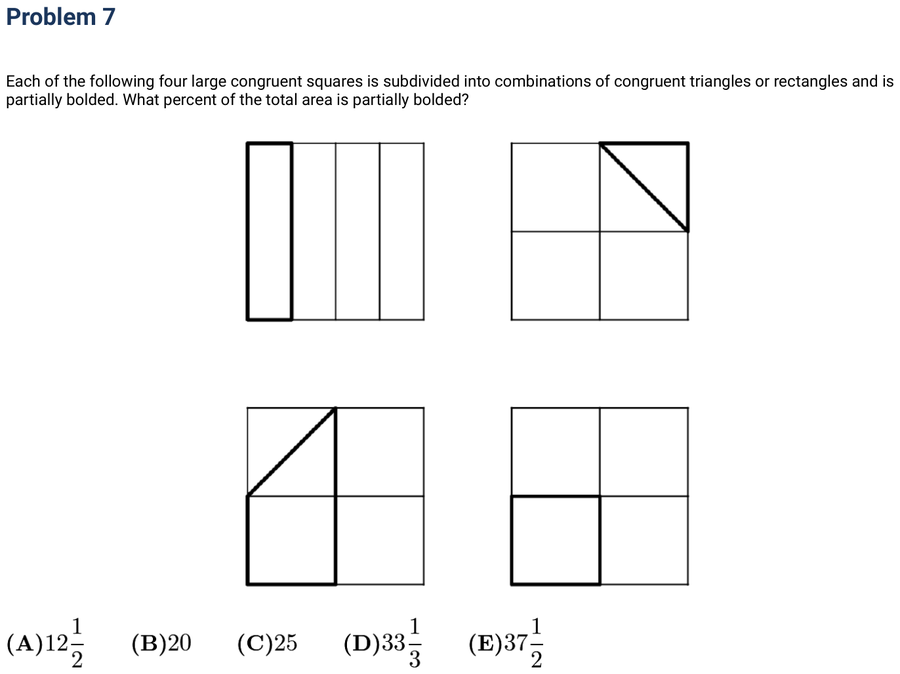
Each of the following four large congruent squares is subdivided into combinations of congruent triangles or rectangles and is partially bolded. What percent of the total area is partially bolded?
Show answer
Answer: C — 25%.
Show hints
Hint 1 of 2
You don't need real measurements — just read each square as a fraction of itself: one of four equal columns is 1/4, a triangle filling half of a quarter is 1/8, and so on.
Still stuck? Show hint 2 →
Hint 2 of 2
Since all four squares are the same size, the answer is the average of the four shaded fractions: add them up and divide by 4.
Show solution
Approach: read each square as a fraction, then average the four
Read the shaded part of each square: one of four columns = 1/4; a triangle that's half of one quarter = 1/8; a full quarter plus that triangle = 3/8; one full quarter = 1/4.
These four fractions add to 1/4 + 1/8 + 3/8 + 1/4 = 2/8 + 1/8 + 3/8 + 2/8 = 8/8 = 1 — together they fill exactly one whole square.
One whole square out of four equal squares is 1/4 = 25%.
Intuition: the four shaded pieces, rearranged, would tile one complete square — that "they add to a whole" is what makes 25% pop out cleanly.
Bag A has three chips labeled 1, 3, and 5. Bag B has three chips labeled 2, 4, and 6. If one chip is drawn from each bag, how many different values are possible for the sum of the two numbers on the chips?
Show answer
Answer: B — 5 different values.
Show hints
Hint 1 of 2
Bag A is all odd, Bag B is all even, so every sum is odd + even = odd. That instantly rules out even totals — you only need to count which odd numbers are reachable.
Still stuck? Show hint 2 →
Hint 2 of 2
Find the smallest and largest possible sum; every odd number in between turns out to be reachable, so just count the odds in that range.
Show solution
Approach: all sums are odd — count the odds from smallest to largest
Smallest sum: 1 + 2 = 3. Largest: 5 + 6 = 11. Every sum is odd, so the only candidates are 3, 5, 7, 9, 11.
Each of those is achievable (e.g. 5 = 1+4 or 3+2, 7 = 1+6 = 3+4 = 5+2, etc.), so all 5 occur.
That's 5 distinct values.
Worth keeping: spotting that odd + even is always odd cuts the candidate list in half before you compute anything — check the parity of a sum first.
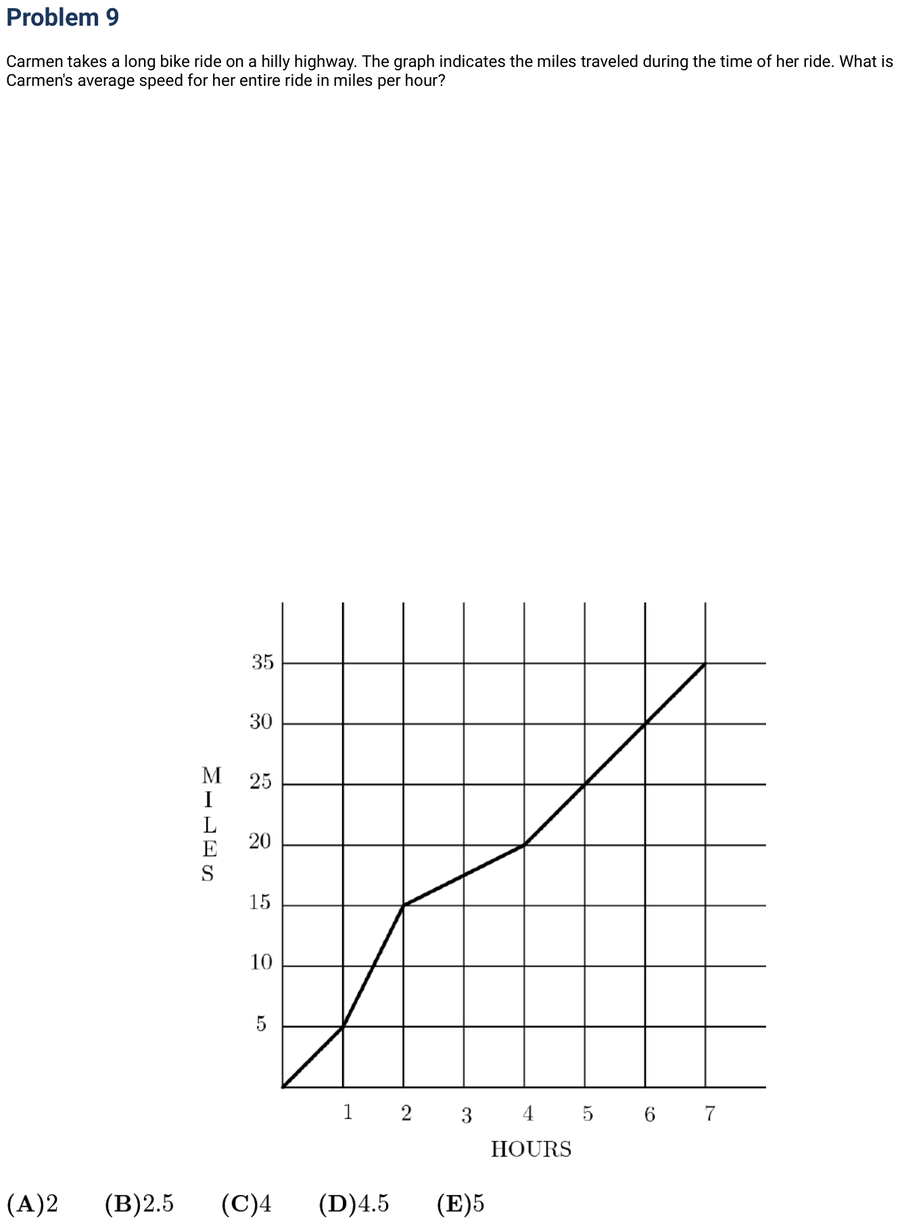
Carmen takes a long bike ride on a hilly highway. The graph indicates the miles traveled during the time of her ride. What is Carmen's average speed for her entire ride in miles per hour?
Show answer
Answer: E — 5 mph.
Show hints
Hint 1 of 2
Average speed doesn't care about the hills, the slow stretches, or the bends in the graph — only where the ride started and where it ended. Read just the final point.
Still stuck? Show hint 2 →
Hint 2 of 2
Average speed = total distance ÷ total time. The far-right end of the curve gives you both at once.
Show solution
Approach: average speed depends only on the endpoints
The curve ends at 35 miles after 7 hours — that's the whole ride: 35 miles in 7 hours.
Average speed = total distance ÷ total time = 35 ÷ 7 = 5 mph.
Why this transfers: "average speed" is always end-distance over end-time. The wiggly middle of a distance-time graph is a distraction — never average the steeper and flatter parts.
The taxi fare in Gotham City is $2.40 for the first 12 mile and additional mileage charged at the rate $0.20 for each additional 0.1 mile. You plan to give the driver a $2 tip. How many miles can you ride for $10?
Show answer
Answer: C — 3.3 miles.
Show hints
Hint 1 of 2
Strip away the costs that don't depend on distance first: the $2 tip and the $2.40 flat charge for the first half-mile. Whatever's left is the only money that buys extra distance.
Still stuck? Show hint 2 →
Hint 2 of 2
Simplify the awkward rate before dividing: $0.20 per 0.1 mile is the same as $2 per whole mile — much friendlier numbers.
Show solution
Approach: peel off the fixed costs, then divide the leftover by the per-mile rate
Take out the fixed pieces: $10 − $2 tip − $2.40 for the first half-mile = $5.60 left for extra distance.
Turn the rate into per-mile: $0.20 per 0.1 mile = $2 per mile. So $5.60 ÷ $2 = 2.8 extra miles.
Add back the half-mile you already paid for: 0.5 + 2.8 = 3.3 miles.
Worth keeping: in any "flat fee plus a per-unit rate" problem, subtract every fixed charge first — only the remainder gets divided by the rate.
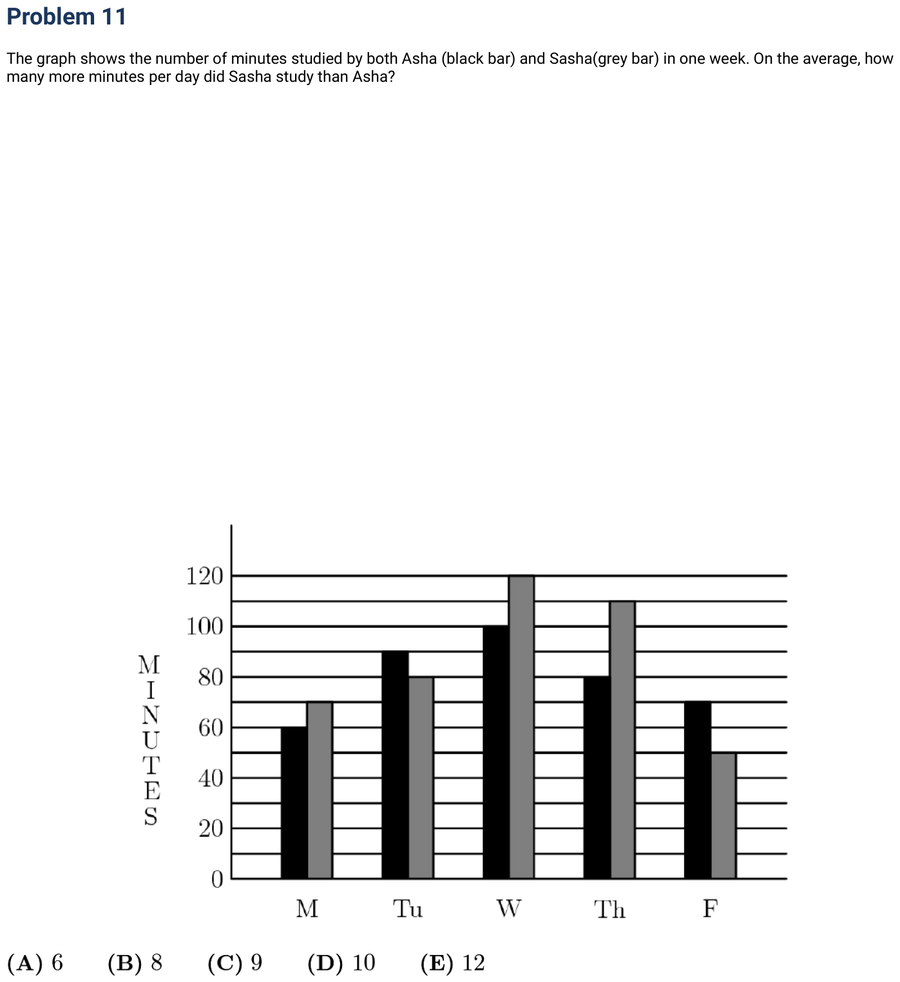
The graph shows the number of minutes studied by both Asha (black bar) and Sasha (grey bar) in one week. On the average, how many more minutes per day did Sasha study than Asha?
Show answer
Answer: A — 6 minutes.
Show hints
Hint 1 of 2
The average difference equals the difference of the totals, so you can just compare the two weekly totals — the days some days are negative is fine, they cancel in the total.
Still stuck? Show hint 2 →
Hint 2 of 2
Average daily gap = (Sasha's total for the week − Asha's total) ÷ 5 days.
Show solution
Approach: compare weekly totals, then divide by the number of days
Read each day's gap (Sasha − Asha): +10, −10, +20, +30, −20. They add to +30 for the week — the negatives (days Asha studied more) correctly subtract.
Spread that over 5 days: 30 ÷ 5 = 6 minutes per day.
Why this works: averaging the daily differences is the same as (sum of differences)÷5, which equals (Sasha's weekly total − Asha's weekly total)÷5 — you never have to average each person separately.
Angie, Bridget, Carlos, and Diego are seated at random around a square table, one person to a side. What is the probability that Angie and Carlos are seated opposite each other?
Show answer
Answer: B — 1/3.
Show hints
Hint 1 of 2
Don't track all four people — only the relationship between Angie and Carlos matters. Plant Angie in a seat and ask: where does Carlos land?
Still stuck? Show hint 2 →
Hint 2 of 2
Once Angie is fixed, Carlos is equally likely in each of the 3 remaining seats. The question becomes "how many of those 3 are opposite her?"
Show solution
Approach: fix one person as a reference, then place the other
Pin Angie in any one seat — this throws away the seating's overall symmetry so we only watch Carlos.
Carlos is equally likely to take any of the 3 leftover seats, and exactly one of them is directly across from Angie.
So the probability is 1 out of 3 = 1/3.
Why this transfers: in seating/circular problems, fixing one object as an anchor turns a messy 4! = 24 count into a simple "where does the one I care about go?"
Another way — count all arrangements:
Total ways to seat 4 people = 4! = 24.
Favorable: choose Angie's seat (4 ways), Carlos takes the opposite seat (1 way), the other two fill the rest (2! = 2). That's 4 × 1 × 2 = 8.
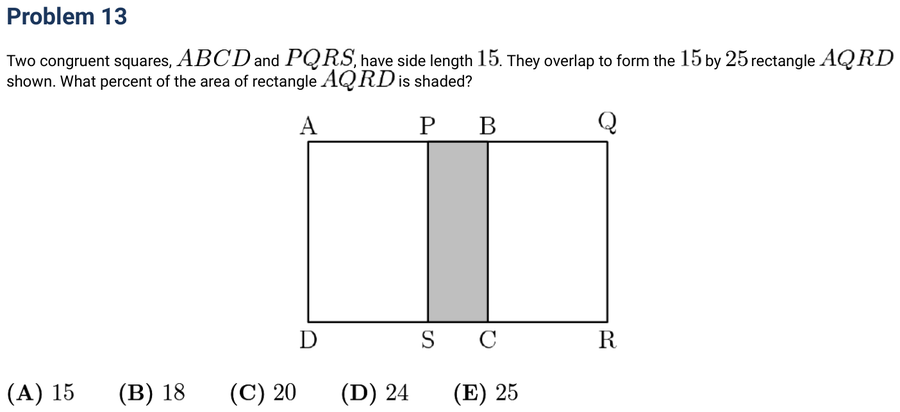
Two congruent squares, ABCD and PQRS, have side length 15. They overlap to form the 15 by 25 rectangle AQRD shown. What percent of the area of rectangle AQRD is shaded?
Show answer
Answer: C — 20%.
Show hints
Hint 1 of 2
The shaded piece is where the two squares overlap. You don't need its dimensions — just notice that adding both squares' areas covers the overlap twice, while the rectangle covers everything exactly once.
Still stuck? Show hint 2 →
Hint 2 of 2
Overlap = (area of both squares added) − (area of the rectangle they fill). This is inclusion-exclusion: the "extra" from double-counting is exactly the shared region.
Show solution
Approach: inclusion-exclusion — the overlap is the double-counted area
Each square is 15 × 15 = 225, so the two together account for 225 + 225 = 450 of area — but the overlap got counted in both, i.e. twice.
The rectangle they actually fill is 25 × 15 = 375 (each point counted once). The difference is the part that was double-counted: overlap = 450 − 375 = 75.
Shaded fraction of the rectangle: 75 / 375 = 1/5 = 20%.
Worth keeping: for any two overlapping regions, (sum of the two areas) − (area of their union) = area of the overlap — no need to measure the overlap directly.
Another way — find the overlap's dimensions directly:
The union is 25 wide; the two 15-wide squares stick out 25 − 15 = 10 on each side, so they share a strip of width 15 − 10 = 5.
There are 270 students at Colfax Middle School, where the ratio of boys to girls is 5 : 4. There are 180 students at Winthrop Middle School, where the ratio of boys to girls is 4 : 5. The two schools hold a dance and all students from both schools attend. What fraction of the students at the dance are girls?
Show answer
Answer: C — 22/45.
Show hints
Hint 1 of 2
You can't just average the two fractions of girls — the schools have different sizes. You need actual head counts of girls, then pool everyone together.
Still stuck? Show hint 2 →
Hint 2 of 2
Both ratios split a school into 9 equal parts (5+4 and 4+5). Conveniently 270 and 180 are both multiples of 9, so each part is a whole number of students.
Show solution
Approach: convert each ratio to real counts, then pool
Colfax has 9 parts: girls are 4 of them, so girls = (4/9)(270) = 120.
Winthrop has 9 parts: girls are 5 of them, so girls = (5/9)(180) = 100.
Pool everyone: 120 + 100 = 220 girls out of 270 + 180 = 450 students ⇒ 220/450 = 22/45.
Common trap: averaging 4/9 and 5/9 gives 1/2 (choice D) — wrong, because the bigger school (Colfax, mostly boys) pulls the combined fraction below 1/2. Always weight by size.
Let A be the area of the triangle with sides of length 25, 25, and 30. Let B be the area of the triangle with sides of length 25, 25, and 40. What is the relationship between A and B?
Show answer
Answer: C — A = B.
Show hints
Hint 1 of 2
Both triangles are isosceles with the same equal sides (25). Drop the altitude to the odd side — it splits each into two right triangles whose hypotenuse is 25.
Still stuck? Show hint 2 →
Hint 2 of 2
Watch what the Pythagorean theorem produces: both right triangles are the 15-20-25 triangle (a 3-4-5 scaled by 5). They're the same triangle — the 15 and 20 just swap between ‘half-base’ and ‘height.’
Show solution
Approach: drop altitudes — both triangles are built from the identical 15-20-25 right triangle
Base 30 (half-base 15, slant 25): height = √(252 − 152) = 20, so A = (1/2)(30)(20) = 300.
Base 40 (half-base 20, slant 25): height = √(252 − 202) = 15, so B = (1/2)(40)(15) = 300.
A = B.
The deep reason: each triangle is two copies of the same 15-20-25 right triangle. In one, the ‘15’ leg is the half-base and ‘20’ is the height; in the other they trade places. Since area only uses the product of base-half and height, swapping them changes nothing — so the areas had to match.
Let w, x, y, and z be whole numbers. If 2w · 3x · 5y · 7z = 588, then what does 2w + 3x + 5y + 7z equal?
Show answer
Answer: A — 21.
Show hints
Hint 1 of 2
The bases 2, 3, 5, 7 are all prime, so a number's prime factorization tells you each exponent directly — just factor 588.
Still stuck? Show hint 2 →
Hint 2 of 2
Pull out the small primes one at a time (is it even? divisible by 3? by 7?) to find how many of each it contains.
Show solution
Approach: match prime powers — a prime factorization is unique, so the exponents are forced
Factor 588 by peeling off small primes: 588 = 2 · 294 = 2 · 2 · 147 = 4 · 3 · 49 = 22 · 31 · 72.
Match exponents on each prime: w = 2, x = 1, z = 2. There's no factor of 5, so y = 0 (and 50 = 1 contributes nothing — the easy slip is to forget this term).
2w + 3x + 5y + 7z = 4 + 3 + 0 + 14 = 21.
Why this works: every whole number has exactly one prime factorization, so once both sides are written as products of primes, the exponents must match up one-for-one.
A fair 6-sided die is rolled twice. What is the probability that the first number that comes up is greater than or equal to the second number?
Show answer
Answer: D — 7/12.
Show hints
Hint 1 of 2
≥ means ‘greater OR equal,’ so handle the tie separately. The 6 tie outcomes are easy; then use symmetry for the rest.
Still stuck? Show hint 2 →
Hint 2 of 2
‘First > second’ and ‘first < second’ are mirror images — relabel the two dice and one becomes the other — so they have equal probability and split the non-tie outcomes evenly.
Show solution
Approach: use the symmetry between ‘greater’ and ‘less,’ handle ties separately
Ties: 36 equally likely (first, second) pairs, and 6 of them are doubles, so P(equal) = 6/36 = 1/6.
The remaining 30 non-tie outcomes split evenly between ‘first > second’ and ‘first < second’ (swapping the dice turns one into the other), so each is 15/36 = 5/12.
We want ≥, which is ‘greater’ plus ‘equal’: 5/12 + 1/6 = 5/12 + 2/12 = 7/12.
Worth keeping: when two events are mirror images, they share a probability — so you only compute the ‘extra’ (the ties) and split the rest.
Another way — count favorable cells in the 6×6 grid:
For first = 1 there's 1 winning second (just 1); for first = 2 there are 2; … up to first = 6 giving 6.
Total favorable = 1+2+3+4+5+6 = 21, out of 36, so 21/36 = 7/12.
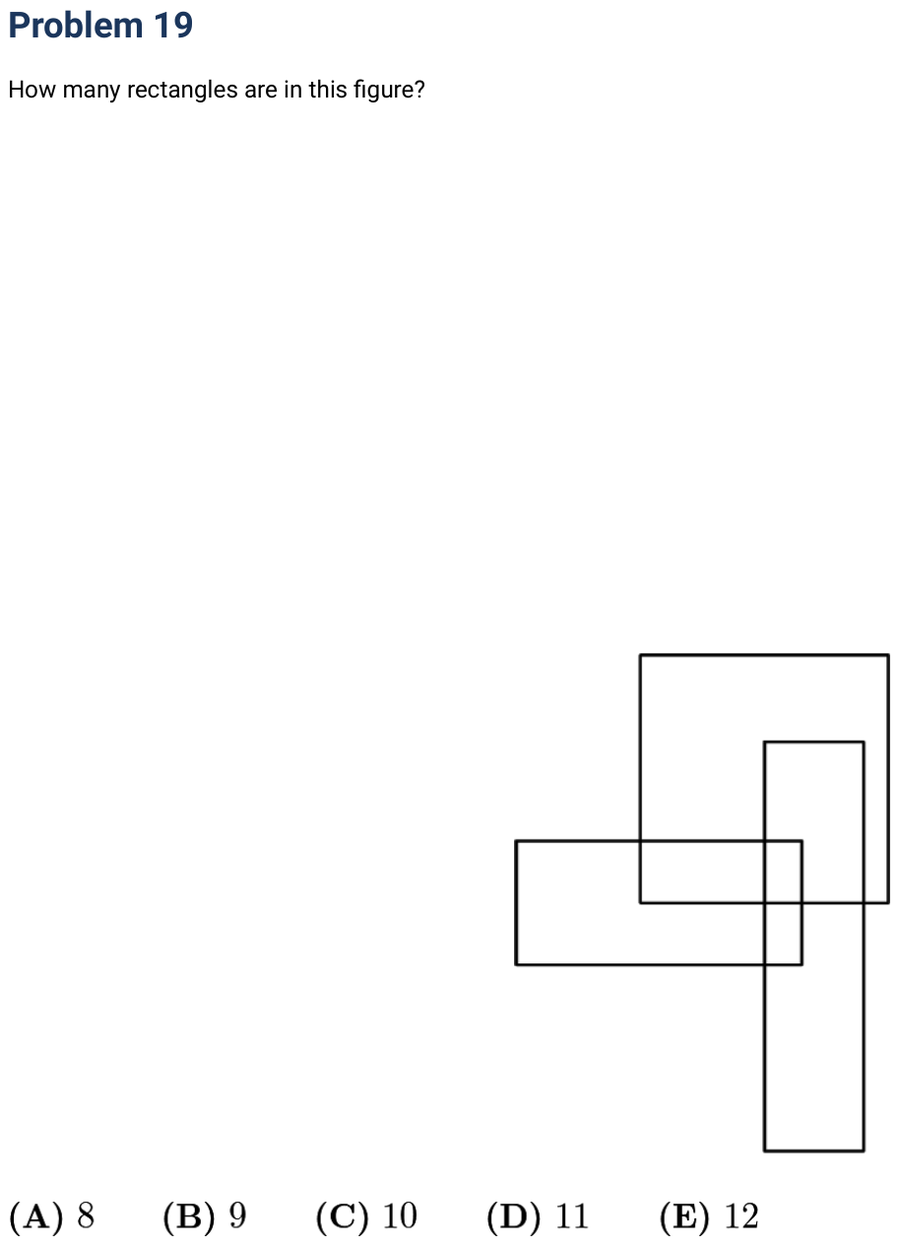
Eyeballing always under- or over-counts. Give every little region its own letter, then count by building rectangles out of those pieces — that way each one is found exactly once.
Still stuck? Show hint 2 →
Hint 2 of 2
Sweep by size: first the single-piece rectangles, then two-piece ones, then larger blocks. A group of pieces counts only if its outline is a true rectangle (four right-angle corners, no notches).
Show solution
Approach: label the pieces, then sweep size-by-size so nothing is missed or double-counted
Cut the figure into its smallest regions and letter them. Now every rectangle in the picture is some block of these pieces, and you can list them in order of how many pieces they use.
Single pieces that are themselves rectangles, then pairs that combine into a rectangle, then larger blocks — checking each candidate has a clean rectangular outline (no jagged edge).
This organized sweep turns up exactly 11 rectangles in all.
Worth keeping: ‘how many rectangles’ problems are won by a fixed order of counting (by size, by position), never by hunting at random — an order is what guarantees you hit each one once.
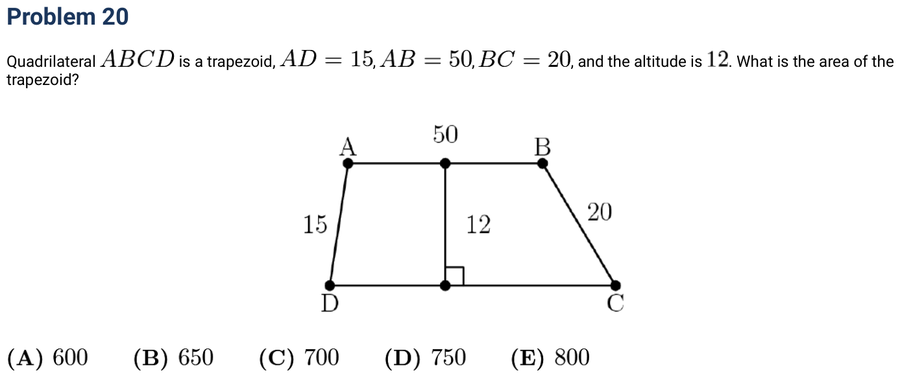
Quadrilateral ABCD is a trapezoid, AD = 15, AB = 50, BC = 20, and the altitude is 12. What is the area of the trapezoid?
Show answer
Answer: D — 750.
Show hints
Hint 1 of 2
Trapezoid area needs both parallel sides. You have the short one (50), the height (12), and the two slanted legs — so the only missing piece is how far each leg sticks out sideways. Drop a vertical from each top corner to split off two right triangles.
Still stuck? Show hint 2 →
Hint 2 of 2
Each leg is now the hypotenuse of a height-12 right triangle. Recognize the 3-4-5 family: 12-15 forces leg 9 (a 9-12-15 = 3-4-5×3), and 12-20 forces leg 16 (a 12-16-20 = 3-4-5×4) — no square roots needed.
Show solution
Approach: drop altitudes to extend the short base into the long one
Drop verticals from the two top corners. They cut off a right triangle at each end, both of height 12. Left triangle: legs 12 and ?, hypotenuse 15 ⇒ ? = 9 (a 9-12-15 triangle). Right triangle: hypotenuse 20 ⇒ the other leg is 16 (a 12-16-20 triangle).
The long base spans those two overhangs plus the rectangle in the middle: 9 + 50 + 16 = 75.
Worth keeping: spotting 3-4-5 multiples (9-12-15, 12-16-20) lets you skip the Pythagorean square-root every time a known hypotenuse pairs with a leg of 12.
Students guess that Norb's age is 24, 28, 30, 32, 36, 38, 41, 44, 47, and 49. Norb says, "At least half of you guessed too low, two of you are off by one, and my age is a prime number." How old is Norb?
Show answer
Answer: C — 37.
Show hints
Hint 1 of 2
Turn each sentence into a numeric filter, then apply them one at a time — the first clue alone slices the list nearly in half.
Still stuck? Show hint 2 →
Hint 2 of 2
‘At least half of 10 guessed too low’ means at least 5 guesses are below his age, so his age beats the 5th-smallest guess. ‘Two are off by one’ means his age has a guess just below and just above it — it's wedged inside a pair of guesses differing by 2.
Show solution
Approach: translate each clue into a constraint and filter in order
Sort: 24, 28, 30, 32, 36, 38, 41, 44, 47, 49. ‘At least half too low’ needs ≥5 guesses below his age, so age > the 5th value, 36.
‘Two off by one’ means a guess sits 1 below and 1 above his age — so his age is the middle of a pair 2 apart. Above 36 the only such pairs are (36, 38) giving 37, and (47, 49) giving 48.
‘Prime’ decides it: 37 is prime, 48 is not.
Norb is 37.
Worth keeping: logic puzzles are just translation — rewrite every clue as ‘age > 36,’ ‘age between two close guesses,’ ‘age prime,’ and intersect the survivors.
Computing 72011 is hopeless — but the tens digit only depends on the last two digits, and those depend only on the last two digits of the previous power. So track just the last two digits as you multiply by 7.
Still stuck? Show hint 2 →
Hint 2 of 2
List the last-two-digit patterns: 07, 49, 43, 01, then it returns to 07. A repeating cycle of length 4 — now the only question is where 2011 lands in the cycle.
Show solution
Approach: only the last two digits matter, and they cycle with period 4
Multiply keeping just the last two digits: 7, then 49, then 7×49 = 343 → 43, then 7×43 = 301 → 01, then 7×01 = 07 — back to the start. The cycle 07, 49, 43, 01 repeats every 4 powers.
Find 2011's spot: 2011 = 4·502 + 3, a remainder of 3, so 72011 ends like the 3rd entry, 73 = 43.
The tens digit of …43 is 4.
Worth keeping: to get the last k digits of a big power, work ‘mod 10k’ (here mod 100) — last digits always settle into a short repeating cycle, so you only need the exponent's remainder.
Another way — shortcut via 74 ≡ 1 (mod 100):
74 = 2401 ends in 01, i.e. 74 ≡ 1 (mod 100), so any 74 block can be dropped.
How many 4-digit positive integers have four different digits, where the leading digit is not zero, the integer is a multiple of 5, and 5 is the largest digit?
Show answer
Answer: D — 84.
Show hints
Hint 1 of 2
Decode the constraints into a digit pool first: ‘5 is the largest digit’ means no digit exceeds 5 (pool is {0,1,2,3,4,5}) and 5 must actually appear. ‘Multiple of 5’ pins the units digit to 0 or 5.
Still stuck? Show hint 2 →
Hint 2 of 2
The two units choices (0 vs 5) behave very differently for the leading-zero rule, so split into those two cases — that's the natural fault line.
Show solution
Approach: casework on the units digit, after fixing the digit pool
Case units = 0: the 5 must live in one of the three front slots, plus two more distinct digits from {1,2,3,4}. Pick those two: C(4,2) = 6 ways; arrange the three front digits (5 and the two picks): 3! = 6 ways. That's 6×6 = 36, and a leading 0 is impossible here since 0 is parked at the end.
Case units = 5: the front three are distinct digits from {0,1,2,3,4}. All arrangements: 5·4·3 = 60; subtract the bad ones with 0 in front (0 _ _ with the other two from the remaining 4: 4·3 = 12). That's 60 − 12 = 48.
Total: 36 + 48 = 84.
Worth keeping: with several restrictions, translate each into ‘which digits are allowed’ and ‘which must appear’ before counting — then case-split on the rule (divisibility) that controls a single position.
In how many ways can 10001 be written as the sum of two primes?
Show answer
Answer: A — 0 ways.
Show hints
Hint 1 of 2
The target 10001 is odd, and odd = even + odd. Two odd primes always sum to an even number, so to hit an odd total one prime must be even — and the only even prime is 2. That leaves just one candidate pair to check.
Still stuck? Show hint 2 →
Hint 2 of 2
So everything hinges on a single question: is 10001 − 2 = 9999 prime?
Show solution
Approach: parity forces one prime to be 2, leaving one pair to test
10001 is odd. A sum is odd only when one part is even and one is odd, so one of the two primes must be even — the only even prime is 2.
That fixes the other prime as 10001 − 2 = 9999. Check it: its digits 9+9+9+9 = 36 is divisible by 3, so 9999 = 3·3333 is not prime.
The one possible pair fails, so there are 0 ways.
Worth keeping: writing an odd number as prime + prime is only possible if 2 is one of them — parity collapses the whole search to a single primality check.
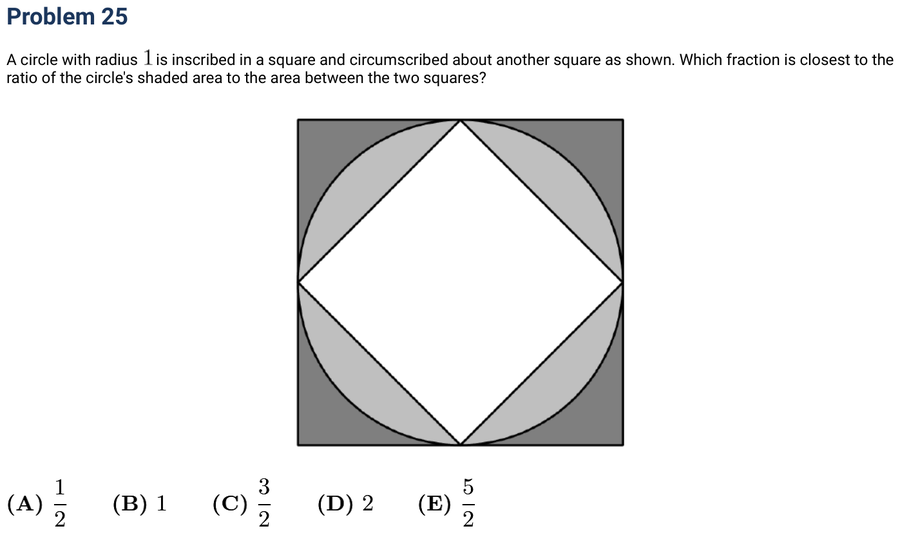
A circle with radius 1 is inscribed in a square and circumscribed about another square as shown. Which fraction is closest to the ratio of the circle's shaded area to the area between the two squares?
Show answer
Answer: A — Closest to 1/2.
Show hints
Hint 1 of 2
The two key fits: the circle sits inside the outer square, so the outer square's side equals the diameter; the inner square sits inside the circle with its corners on it, so the inner square's diagonal equals the diameter. Both are pinned to the diameter = 2.
Still stuck? Show hint 2 →
Hint 2 of 2
From a square's diagonal you get its area fast: area = (diagonal)2÷2. So the inner square's area is 22÷2 = 2 — no need for the √2 side length at all.
Show solution
Approach: tie every length to the diameter, then form the ratio
Diameter = 2. Outer square (circle inscribed in it): side 2, area 4. Inner square (inscribed in the circle): diagonal 2, so area = 22÷2 = 2.
Shaded part = inside the circle but outside the inner square = π(1)2 − 2 = π − 2.
Area between the squares = outer − inner = 4 − 2 = 2.
Ratio = (π − 2)÷2 ≈ (3.14 − 2)÷2 ≈ 0.57, closest to 1/2.
Sanity check: π − 2 ≈ 1.14 is just over half of 2, so the ratio is just over 1/2 — 1/2 is clearly the nearest choice (the next option, 1, would need the shaded area to equal the full gap of 2).