The ten-letter code "BEST OF LUCK" represents the ten digits 0–9, in order. What 4-digit number is represented by the code word "CLUE"?
Show answer
Answer: A — 8671.
Show hints
Hint 1 of 2
The code is a one-to-one key: the 1st letter stands for 0, not 1 — counting starts at zero.
Still stuck? Show hint 2 →
Hint 2 of 2
Build the lookup table once, then read off the answer; this is just decoding with a substitution cipher.
Show solution
Approach: map letter position to digit
Number the letters from 0: B=0, E=1, S=2, T=3, O=4, F=5, L=6, U=7, C=8, K=9. The trap is starting at 1 — the ten letters cover 0–9, so the first letter is 0.
Read C-L-U-E off the table: 8-6-7-1 = 8671.
Shortcut: the choices already start 8… or 9…, so finding just C=8 eliminates two answers instantly.
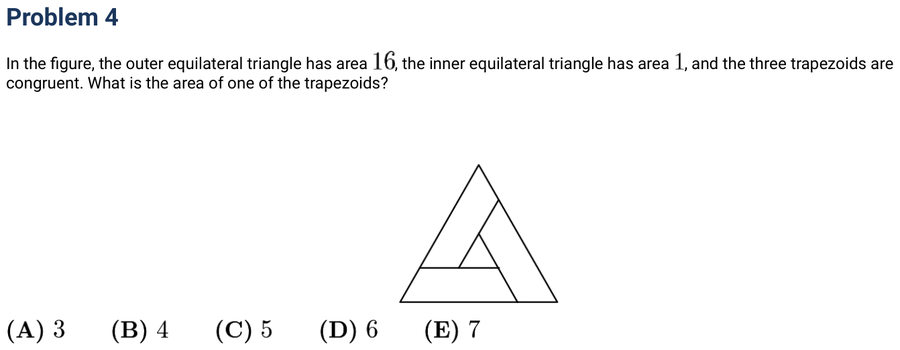
In the figure, the outer equilateral triangle has area 16, the inner equilateral triangle has area 1, and the three trapezoids are congruent. What is the area of one of the trapezoids?
Show answer
Answer: C — 5.
Show hints
Hint 1 of 2
The three trapezoids are exactly what's left when you cut the little triangle out of the big one — you don't need any side lengths.
Still stuck? Show hint 2 →
Hint 2 of 2
"Congruent" is the key word: equal pieces means just divide the leftover evenly.
Show solution
Approach: subtract the hole, split the rest evenly
The big triangle is the small triangle plus the three trapezoids, so the trapezoids together cover 16 − 1 = 15. No measuring needed — the area you can't see is simply "total minus the hole."
They're congruent (identical), so each is 15 ÷ 3 = 5.
Sanity check: the choices run 3–7, and 15 split three ways must be 5 — only one choice fits.
Another way — scale-factor intuition:
Area 16 vs area 1 means the big triangle is 4× the small one in side length (since area scales as the square, √16 = 4).
The whole figure is 16 small-triangle-areas worth; the center hole is 1, leaving 15 for the three trapezoids, so each is 5.
Barney Schwinn notices that the odometer on his bicycle reads 1441, a palindrome, because it reads the same forward and backward. After riding 4 more hours that day and 6 the next, he notices that the odometer shows another palindrome, 1661. What was his average speed in miles per hour?
Show answer
Answer: E — 22 mph.
Show hints
Hint 1 of 2
"Palindrome" is just flavor — all you need is the two odometer readings and the total hours.
Still stuck? Show hint 2 →
Hint 2 of 2
Average speed always means total distance ÷ total time, no matter how the trip was split up.
Show solution
Approach: total distance ÷ total time
Distance is just how far the odometer moved: 1661 − 1441 = 220 miles. Don't be distracted by the palindrome story.
Total time is 4 + 6 = 10 hours, so average speed = 220 ÷ 10 = 22 mph.
Why this transfers: average speed is never the average of two speeds — it's always all the miles over all the hours.
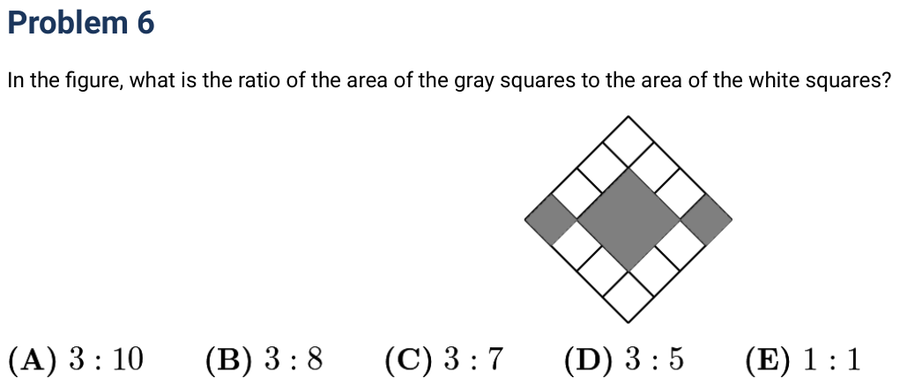
In the figure, what is the ratio of the area of the gray squares to the area of the white squares?
Show answer
Answer: D — 3 : 5.
Show hints
Hint 1 of 2
Every little square is the same size, so "area" just means "how many squares" — you can count instead of measure.
Still stuck? Show hint 2 →
Hint 2 of 2
The question asks gray-to-white, not gray-to-total — watch which two amounts you're comparing.
Show solution
Approach: count squares, then compare the right two groups
All 16 squares are congruent, so area becomes a counting problem. Gray: the central 2×2 block (4) plus 2 gray corners = 6. White: the other 16 − 6 = 10.
The ratio asked is gray : white = 6 : 10 = 3 : 5. (If you wrongly used gray : total = 6 : 16 = 3 : 8 you'd pick the trap answer B.)
Why this transfers: a ratio compares two specific quantities — always reread which is named before simplifying.
In 2005 Tycoon Tammy invested 100 dollars for two years. During the first year her investment suffered a 15% loss, but during the second year the remaining investment showed a 20% gain. Over the two-year period, what was the change in Tammy's investment?
Show answer
Answer: D — 2% gain.
Show hints
Hint 1 of 2
The 20% gain is on the shrunken $85, not the original $100 — so −15% then +20% does NOT cancel to +5%.
Still stuck? Show hint 2 →
Hint 2 of 2
Turn each change into a multiplier (lose 15% = ×0.85, gain 20% = ×1.20) and multiply them in a row.
Show solution
Approach: chain the percentage multipliers
Each year scales the money: a 15% loss is ×0.85, a 20% gain is ×1.20. Doing them in sequence means multiplying: 0.85 × 1.20 = 1.02.
1.02 means the money ended at 102% of the start — a 2% gain. The starting $100 never even matters.
Why this transfers: percent changes compound (multiply), they never add — that's why the +20% can't undo the −15% to give +5%.
Another way — track the actual dollars:
After year 1: 100 − 15% = $85. After year 2: 85 + 20% of 85 = 85 + 17 = $102.
The average age of the 6 people in Room A is 40. The average age of the 4 people in Room B is 25. If the two groups are combined, what is the average age of all the people?
Show answer
Answer: D — 34.
Show hints
Hint 1 of 2
You can't just average 40 and 25 — Room A has more people, so it pulls the result toward 40.
Still stuck? Show hint 2 →
Hint 2 of 2
Rebuild each total with total = average × count, then pool everything: combined average = all ages ÷ all people.
Show solution
Approach: recover totals, then pool
An average hides a total: Room A is 6 · 40 = 240 years, Room B is 4 · 25 = 100 years. Now you have real piles you can combine.
Pool them: 340 years across 10 people = 340 ÷ 10 = 34.
Why this transfers: the naive midpoint (40+25)÷2 = 32.5 is the trap answer A — a combined average leans toward the bigger group, so it lands at 34, closer to 40.
Each of the 39 students in the eighth grade at Lincoln Middle School has one dog or one cat or both a dog and a cat. Twenty students have a dog and 26 students have a cat. How many students have both a dog and a cat?
Show answer
Answer: A — 7.
Show hints
Hint 1 of 2
Add 20 dog-owners + 26 cat-owners and you get 46 — but only 39 kids exist, so somebody got counted twice.
Still stuck? Show hint 2 →
Hint 2 of 2
Anyone counted twice owns both pets. The overcount itself is the answer.
Show solution
Approach: the overcount is the overlap
Counting dog-owners (20) and cat-owners (26) separately gives 20 + 26 = 46 "pet slots," but there are only 39 kids. The extra 46 − 39 = 7 came from kids who got tallied in both groups.
Those double-counted kids are exactly the ones with both a dog and a cat: 7.
Why this transfers: this is inclusion–exclusion — |A| + |B| counts the overlap twice, so |both| = |A| + |B| − |either|. You'll reuse it for any "how many in both groups" question.
A ball is dropped from a height of 3 meters. On its first bounce it rises to a height of 2 meters. It keeps falling and bouncing to 23 of the height it reached in the previous bounce. On which bounce will it rise to a height less than 0.5 meters?
Show answer
Answer: C — 5th bounce.
Show hints
Hint 1 of 2
Each bounce just keeps two-thirds of the last height — so don't restart from 3 each time, multiply the height you already have by 2/3.
Still stuck? Show hint 2 →
Hint 2 of 2
Walk the heights down one bounce at a time and stop the moment you cross below 0.5; with only a few bounces, listing beats any formula.
Bounce 4 is still above 0.5; bounce 5 is the first below 0.5, so the answer is 5.
Why this transfers: a sequence where each term is a fixed multiple of the last is geometric — for "when does it cross a threshold" just iterate; for far-off terms use height = 2·(2/3)n−1.
Another way — closed-form check:
Measuring from the drop, height after bounce n is 3·(2/3)n.
Mr. Harman needs to know the combined weight in pounds of three boxes he wants to mail. However, the only available scale is not accurate for weights less than 100 pounds or more than 150 pounds. So the boxes are weighed in pairs in every possible way. The results are 122, 125 and 127 pounds. What is the combined weight in pounds of the three boxes?
Show answer
Answer: C — 187 pounds.
Show hints
Hint 1 of 2
Don't solve for the three weights separately — you only need their total. Add all three pair-readings and see what you've actually counted.
Still stuck? Show hint 2 →
Hint 2 of 2
With three boxes, every box sits in exactly 2 of the 3 pairs, so adding the pair-sums counts each box twice.
Show solution
Approach: add the pair-sums, then halve
Each box (a, b, c) appears in two of the three pairings, so 122 + 125 + 127 = (a+b) + (a+c) + (b+c) = 2(a+b+c). The grand total double-counts everyone.
So 374 = 2·(total), giving total = 374 ÷ 2 = 187. No need to untangle the individual weights.
Why this transfers: when items are summed in overlapping groups, add all the group-sums and divide by how many times each item was counted — a clean shortcut to the grand total.
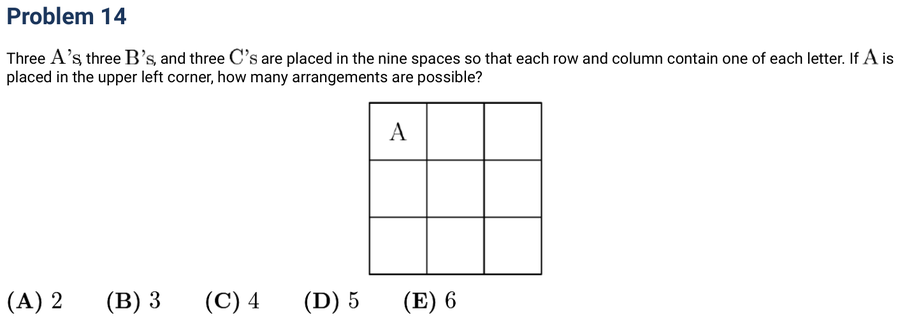
Three A's, three B's, and three C's are placed in the nine spaces so that each row and column contain one of each letter. If A is placed in the upper left corner, how many arrangements are possible?
Show answer
Answer: C — 4 arrangements.
Show hints
Hint 1 of 2
"One of each per row and column" means once you commit a couple of cells, the rest are forced — so just count the genuinely free choices.
Still stuck? Show hint 2 →
Hint 2 of 2
Use the multiplication principle: multiply the number of choices at each free decision point.
Show solution
Approach: count only the free choices, let the rest cascade
A sits top-left. The rest of row 1 is B, C in some order — 2 ways. Now look at the cell below A (start of row 2): it can't be A, so it's B or C — 2 ways.
After those two picks, every remaining cell is forced (each row and column still needs its missing letter). So the count is just 2 × 2 = 4.
Why this transfers: in tight grid/arrangement puzzles, find the few cells you freely choose and multiply — the constraints fill in the rest for free, so you never enumerate all the boards.
Another way — list them:
Fixing row 1 as A B C, the two valid completions are (B C A / C A B) and (C A B / B C A). Fixing row 1 as A C B gives two more.
In Theresa's first 8 basketball games, she scored 7, 4, 3, 6, 8, 3, 1 and 5 points. In her ninth game, she scored fewer than 10 points and her points-per-game average for the nine games was an integer. Similarly in her tenth game, she scored fewer than 10 points and her points-per-game average for the 10 games was also an integer. What is the product of the number of points she scored in the ninth and tenth games?
Show answer
Answer: B — 40.
Show hints
Hint 1 of 2
"Average is a whole number" is a divisibility clue in disguise: the running total must be a multiple of the number of games.
Still stuck? Show hint 2 →
Hint 2 of 2
Each new score is under 10, so the total can only land in a tiny window — usually just one multiple fits, pinning the score exactly.
Show solution
Approach: turn "integer average" into "total is a multiple"
First 8 scores sum to 37. Adding game 9 (1–9 points) lands the 9-game total between 38 and 46, and it must be a multiple of 9. Only 45 fits — so game 9 = 45 − 37 = 8.
Adding game 10 (under 10) lands the 10-game total between 46 and 54, and it must be a multiple of 10. Only 50 fits — so game 10 = 50 − 45 = 5.
Product: 8 · 5 = 40.
Why this transfers: "the average is an integer" always means "the sum is divisible by the count" — pair that with a bounded range and the value is usually forced.
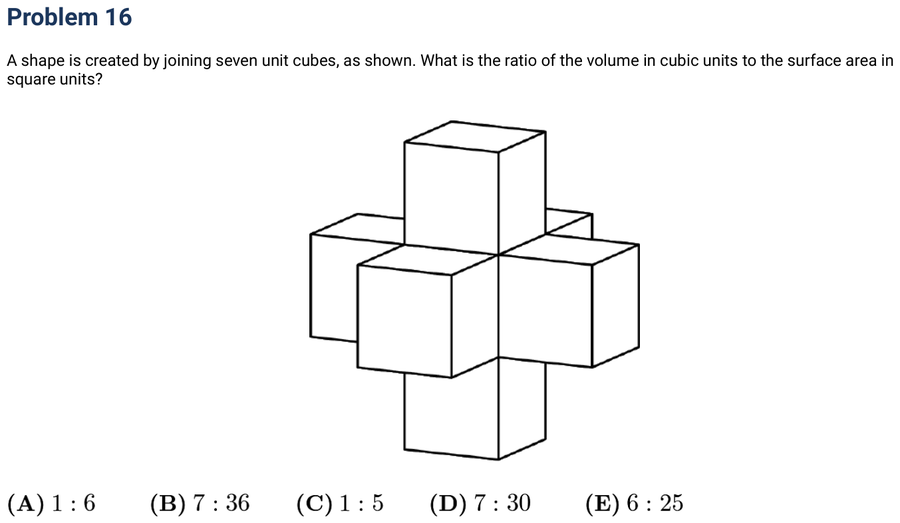
A shape is created by joining seven unit cubes, as shown. What is the ratio of the volume in cubic units to the surface area in square units?
Show answer
Answer: D — 7 : 30.
Show hints
Hint 1 of 2
See the shape as one center cube with a cube glued to each of its 6 faces — the center is buried with nothing showing.
Still stuck? Show hint 2 →
Hint 2 of 2
Don't count all 42 faces and then subtract; count what's actually exposed: each outer cube hides exactly the one face that touches the center.
Show solution
Approach: count only the exposed faces
Volume is easy: 7 unit cubes = 7. For surface area, notice each of the 6 outer cubes touches the center on one face, so it shows 6 − 1 = 5 faces; the center cube shows nothing.
Exposed faces: 6 × 5 = 30, and the center adds 0. So volume : surface = 7 : 30.
Why this transfers: for glued-cube surface area, every shared face hides 2 unit squares (one on each cube) — counting exposed faces directly is faster than total-minus-hidden.
Another way — total faces minus hidden:
7 cubes have 7 × 6 = 42 faces. There are 6 glued joints, each hiding 2 faces, so 12 faces vanish.
Ms. Osborne asks each student in her class to draw a rectangle with integer side lengths and a perimeter of 50 units. All of her students calculate the area of the rectangle they draw. What is the difference between the largest and smallest possible areas of the rectangles?
Show answer
Answer: D — 132.
Show hints
Hint 1 of 2
Perimeter 50 fixes l + w = 25 — the two sides always add to 25, you only get to choose how to split it.
Still stuck? Show hint 2 →
Hint 2 of 2
For a fixed sum, the product (area) is biggest when the two sides are nearly equal and smallest when they're as lopsided as allowed.
Show solution
Approach: fixed sum ⇒ balanced is biggest, lopsided is smallest
Half the perimeter is l + w = 25. With that sum fixed, area l·w is largest when the sides are as close as possible: 12 × 13 = 156.
It's smallest when the sides are most lopsided. Sides must be positive integers, so the extreme is 1 × 24 = 24.
Difference: 156 − 24 = 132.
Why this transfers: for any fixed perimeter, "square-ish" rectangles enclose the most area — the same reason a square beats every other rectangle of equal perimeter.
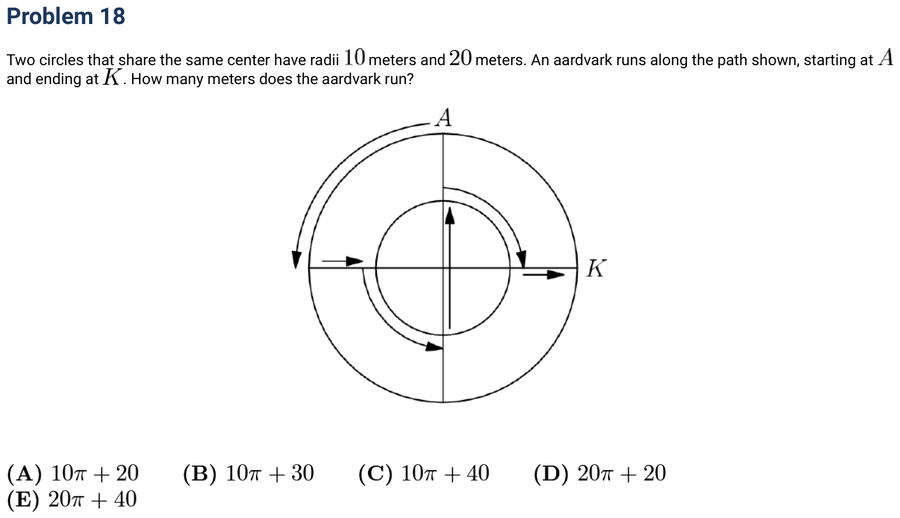
Two circles that share the same center have radii 10 meters and 20 meters. An aardvark runs along the path shown, starting at A and ending at K. How many meters does the aardvark run?
Show answer
Answer: E — 20π + 40.
Show hints
Hint 1 of 2
A curvy path looks scary, but it's only two kinds of pieces — circular arcs and straight segments. Sort every piece into one bin or the other and the π's stay separate from the plain numbers.
Still stuck? Show hint 2 →
Hint 2 of 2
For an arc, ask "what fraction of the full circle is it?" then take that fraction of the circumference 2πr; each curved corner here is a quarter-turn.
Show solution
Approach: split the path into arcs (the π part) and straight segments (the plain part)
Arcs first: the path curves a quarter-way around the big circle (radius 20) — that's ¼ · 2π · 20 = 10π — and a quarter-way around the small circle (radius 10) twice, each ¼ · 2π · 10 = 5π. Arc total: 10π + 5π + 5π = 20π.
Now the straight pieces: two radial hops crossing the ring (each 20 − 10 = 10) plus one straight run across the small circle's diameter (2 · 10 = 20). Straight total: 10 + 10 + 20 = 40.
Add the bins: 20π + 40. Keeping π-terms apart from whole numbers means there's nothing to combine — just stack them.
Why this transfers: any "length of a curvy track" problem yields to the same split — arcs become (fraction)×2πr, straights are ordinary distances, and the answer is a tidy (multiple of π) + (whole number).
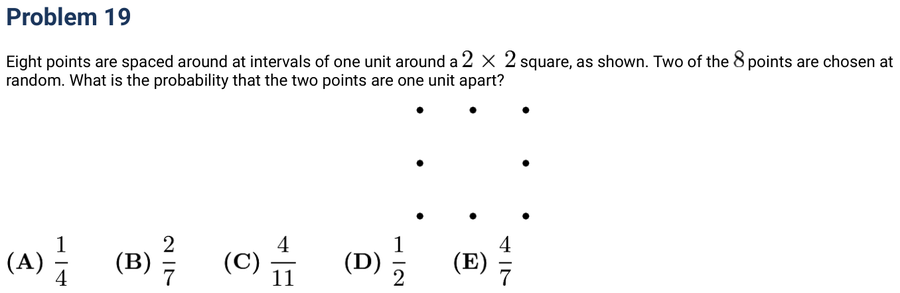
Eight points are spaced around at intervals of one unit around a 2 × 2 square, as shown. Two of the 8 points are chosen at random. What is the probability that the two points are one unit apart?
Show answer
Answer: B — 2/7.
Show hints
Hint 1 of 2
The 8 points sit evenly around the square's edge, so every point looks the same — whichever you pick first, it has the same number of 1-unit neighbors.
Still stuck? Show hint 2 →
Hint 2 of 2
Once you fix the first point, the question collapses to: of the other 7 points, how many are exactly 1 unit away?
Show solution
Approach: use symmetry — fix the first point, count favorable seconds
By symmetry every point is interchangeable, so just pick any first point. Walking around the perimeter, exactly its two immediate neighbors are 1 unit away.
That leaves 2 good choices out of the remaining 7 points, so the probability is 2/7.
Why this transfers: when all starting choices are symmetric, condition on one of them — the messy "choose 2" count becomes a simple "favorable out of the rest."
Another way — count pairs directly:
Total pairs of points: C(8,2) = 28. Adjacent (1-unit) pairs: the 8 points form a loop, so there are 8 neighboring pairs.
The students in Mr. Neatkin's class took a penmanship test. Two-thirds of the boys and 3/4 of the girls passed the test, and an equal number of boys and girls passed the test. What is the minimum possible number of students in the class?
Show answer
Answer: B — 17.
Show hints
Hint 1 of 2
The phrase "an equal number of boys and girls passed" is the hinge — name that shared count and build everything from it.
Still stuck? Show hint 2 →
Hint 2 of 2
Both the boy-count and girl-count must be whole numbers, so the shared passing count has to be divisible by the right denominators; take the smallest one that works.
Show solution
Approach: name the shared passing count, then make the head-counts whole
Let p = the number who passed in each group. Since 2/3 of boys passed, boys = p ÷ (2/3) = (3/2)p; since 3/4 of girls passed, girls = p ÷ (3/4) = (4/3)p.
For both head-counts to be whole numbers, p must be divisible by 2 (for the boys) and by 3 (for the girls) — smallest such p is 6. Then boys = 9, girls = 8.
Total = 9 + 8 = 17.
Why this transfers: when fractions of two groups must come out whole, the unknown has to clear every denominator at once — the smallest case is their LCM.
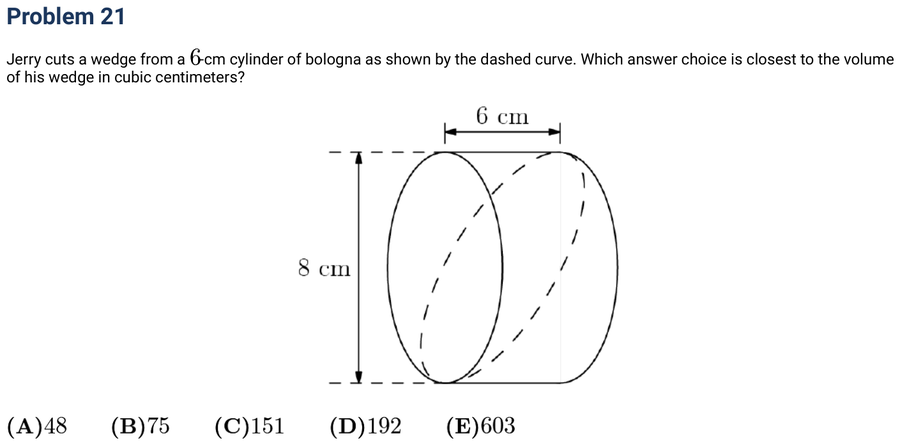
Jerry cuts a wedge from a 6-cm cylinder of bologna as shown by the dashed curve. Which answer choice is closest to the volume of his wedge in cubic centimeters?
Show answer
Answer: C — About 151.
Show hints
Hint 1 of 2
The dashed cut is a tilted plane that passes through the center axis — a slice through the middle splits any cylinder into two equal halves.
Still stuck? Show hint 2 →
Hint 2 of 2
So skip the wedge shape entirely: find the whole cylinder's volume and halve it.
Show solution
Approach: the cut through the center halves the cylinder
The slicing plane goes through the cylinder's central axis, so the wedge is exactly half — no need to model the slanted face. Diameter 8 means radius 4, and the length is 6, so the full cylinder is π · 4² · 6 = 96π.
Half of that is 48π. Estimate: 48π ≈ 48 · 3.14 ≈ 151.
Sanity check: the answer choices are spread out (48, 75, 151, 192, 603), so even a rough π ≈ 3 gives 144 — clearly closest to 151, not its neighbors.
Why this transfers: any cut passing through a solid's center of symmetry divides it into equal halves — spotting symmetry beats integrating the odd shape.
For how many positive integer values of n are both n3 and 3n three-digit whole numbers?
Show answer
Answer: A — 12.
Show hints
Hint 1 of 2
For n/3 to even be a whole number, n must be a multiple of 3 — so write n = 3x and both conditions become conditions on x.
Still stuck? Show hint 2 →
Hint 2 of 2
Two range conditions overlap; you only need the tighter (binding) one on each end, then count the integers in the survivor range.
Show solution
Approach: substitute n = 3x, then find the binding range
Since n/3 must be a whole number, let n = 3x. Then n/3 = x and 3n = 9x, so we need both x and 9x to be three-digit: 100 ≤ x ≤ 999 and 100 ≤ 9x ≤ 999.
The big number 9x is the squeeze: 9x ≤ 999 forces x ≤ 111, far tighter than x ≤ 999. The lower end is just x ≥ 100.
So x runs 100, 101, …, 111 — that's 111 − 100 + 1 = 12 values.
Why this transfers: when several inequalities pin a variable, keep only the strictest on each side; and counting integers from a to b inclusive is b − a + 1 (don't forget the +1).
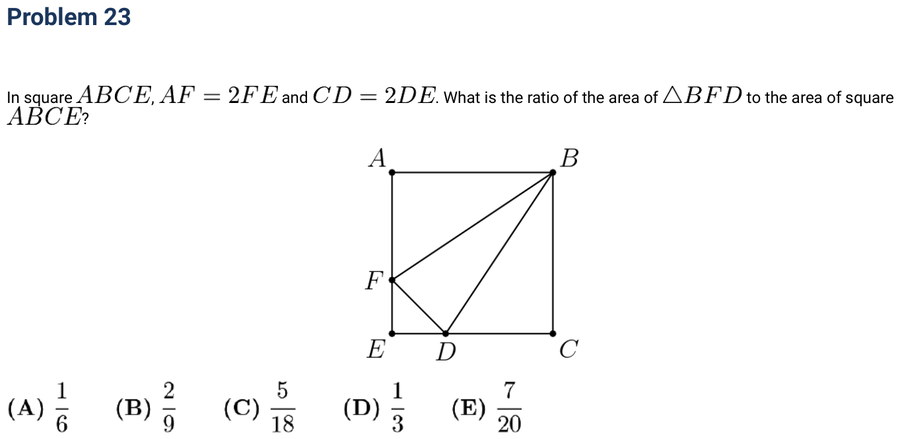
In square ABCE, AF = 2FE and CD = 2DE. What is the ratio of the area of ▵BFD to the area of square ABCE?
Show answer
Answer: C — 5/18.
Show hints
Hint 1 of 2
△BFD has no horizontal or vertical side, so it's awkward to measure head-on — but the three pieces left over (one at each used corner) are right triangles with easy legs.
Still stuck? Show hint 2 →
Hint 2 of 2
Subtract instead of build: △BFD = whole square − the three right triangles cut off in the corners. Pick side length 1 to make every leg a simple fraction.
Show solution
Approach: subtract three corner right triangles from the square
Take side 1, so AF = 2/3, FE = 1/3, CD = 2/3, DE = 1/3. The three corner triangles cut off around △BFD are △ABF (legs 1, 2/3, area 1/3), △BCD (legs 1, 2/3, area 1/3), and △FED (legs 1/3, 1/3, area 1/18).
Why this transfers: a slanted triangle inside a rectangle is almost always easier as "rectangle minus the right triangles in the corners" — each corner triangle has axis-aligned legs you can read straight off the figure.
Another way — shoelace:
Place E at the origin, side s. B = (s, s), F = (0, s/3), D = (s/3, 0).
Area △BFD = ½ |s(s/3 − 0) + 0(0 − s) + (s/3)(s − s/3)| = ½(s²/3 + 2s²/9) = 5s²/18, so the ratio is 5/18.
Ten tiles numbered 1 through 10 are turned face down. One tile is turned up at random, and a die is rolled. What is the probability that the product of the numbers on the tile and the die will be a square?
Show answer
Answer: C — 11/60.
Show hints
Hint 1 of 2
The die only shows 1–6, so loop over its six values — fewer cases than looping over the ten tiles.
Still stuck? Show hint 2 →
Hint 2 of 2
For each die value d, ask which tiles make d·t a perfect square: the tile must supply exactly the prime factors d is missing to make every exponent even.
Show solution
Approach: case on the die value (only six cases)
Total outcomes: 10 tiles × 6 die faces = 60. Now scan the die. d = 1 is already a square, so any square tile works: t = 1, 4, 9 ⇒ 3.
d = 2 needs the tile to contribute another factor of 2 (and otherwise be square): t = 2, 8 ⇒ 2. d = 3 needs another 3: only t = 3 ⇒ 1.
d = 4 is itself a square, so again the square tiles: t = 1, 4, 9 ⇒ 3. d = 5: only t = 5 ⇒ 1. d = 6: only t = 6 ⇒ 1.
Successes: 3 + 2 + 1 + 3 + 1 + 1 = 11, so the probability is 11/60.
Why this transfers: a number is a perfect square exactly when every prime appears an even number of times — so "make this product square" means the other factor must fill in the odd-power primes.
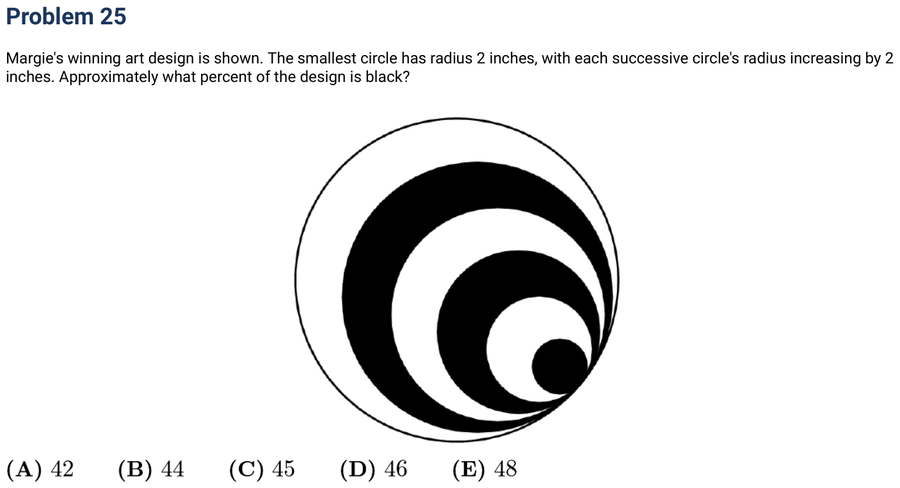
Margie's winning art design is shown. The smallest circle has radius 2 inches, with each successive circle's radius increasing by 2 inches. Approximately what percent of the design is black?
Show answer
Answer: A — About 42%.
Show hints
Hint 1 of 2
A ring (annulus) is just the big disk with the smaller disk punched out, so its area is πR² − πr² — never measure the ring directly.
Still stuck? Show hint 2 →
Hint 2 of 2
You want a ratio, so the π will cancel — work with the radius-squares and only deal with whole numbers.
Show solution
Approach: rings as differences of disks, then take the ratio (π cancels)
The radii are 2, 4, 6, 8, 10, 12. Each black region is a ring = outer disk − inner disk, so use π(R² − r²): the center black disk is π·2² = 4π, the ring from 4 to 6 is π(36 − 16) = 20π, and the ring from 8 to 10 is π(100 − 64) = 36π.
Ratio: 60π / 144π = 60/144 = 5/12 ≈ 41.7%, closest to 42%. The π cancels, so you're just comparing radius-squares.
Why this transfers: any "ring" or "washer" area is one disk minus another, and in a fraction-of-the-whole question every π divides out — track only the squared radii.