Connie multiplies a number by 2 and gets 60 as her answer. However, she should have divided the number by 2 to get the correct answer. What is the correct answer?
Show answer
Answer: B — 15.
Show hints
Hint 1 of 2
The 60 isn't the answer — it's a clue about the hidden starting number. What number, doubled, gives 60?
Still stuck? Show hint 2 →
Hint 2 of 2
Two stages: first undo the wrong operation to recover the original, then do the right one. Don't skip straight to the answer.
Show solution
Approach: undo the mistake, then redo correctly
The number 60 is the result of multiplying by 2, so the original number is 60 ÷ 2 = 30. (Undo the wrong step.)
Now do what she should have done to that original: 30 ÷ 2 = 15.
Why this transfers: in any 'someone did the wrong operation' puzzle, run the wrong operation backward to find the true input first — never apply the correct operation to the wrong answer (240 and 120 are the traps for doing exactly that).
Karl bought five folders from Pay-A-Lot at a cost of $2.50 each. Pay-A-Lot had a 20%-off sale the following day. How much could Karl have saved on the purchase by waiting a day?
Show answer
Answer: C — $2.50.
Show hints
Hint 1 of 2
The savings is just the discount — 20% of what he actually spent. You only need that piece, not the new price.
Still stuck? Show hint 2 →
Hint 2 of 2
20% means 'one fifth.' Taking a fraction is often faster than multiplying by a decimal.
Show solution
Approach: savings = the discount itself
He spent 5 · $2.50 = $12.50 on the folders.
Saving 20% means saving one fifth: $12.50 ÷ 5 = $2.50.
Shortcut worth keeping: 'percent off' is a fraction in disguise — 20% = 1/5, 25% = 1/4, 50% = 1/2. Dividing by the fraction's denominator beats reaching for the calculator.
Another way — discount per folder, then scale:
Each folder's discount is 20% of $2.50 = $0.50.
Five folders: 5 · $0.50 = $2.50. Same answer, and you never need the $12.50 total at all.
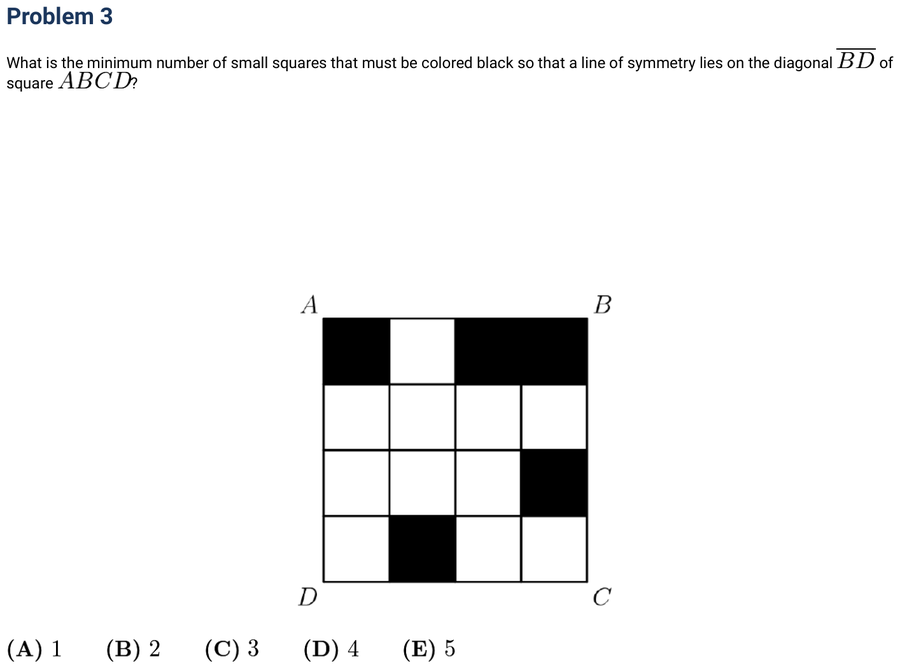
What is the minimum number of small squares that must be colored black so that a line of symmetry lies on the diagonal BD of square ABCD?
Show answer
Answer: D — 4.
Show hints
Hint 1 of 2
A fold along BD must land black on black. So look only at the black squares off the diagonal — each one needs a twin on the other side.
Still stuck? Show hint 2 →
Hint 2 of 2
Symmetry means 'reflect and match.' Go black square by black square, find its mirror across BD, and check whether that mirror is already black.
Show solution
Approach: every off-diagonal black square needs its mirror twin
Picture folding the square along diagonal BD. For the picture to match itself, every black square must fold onto another black square.
Black squares already on the diagonal are fine — they map to themselves. The work is only with the black squares off the diagonal.
There are 4 such off-diagonal black squares, and each one's mirror image across BD is still white. Coloring those 4 mirrors makes the picture symmetric ⇒ 4 squares.
Why this transfers: for any reflection-symmetry counting problem, ignore whatever lies on the mirror line itself and just pair up the rest — the answer is the number of unmatched partners.
A square and a triangle have equal perimeters. The lengths of the three sides of the triangle are 6.1 cm, 8.2 cm and 9.7 cm. What is the area of the square in square centimeters?
Show answer
Answer: C — 36.
Show hints
Hint 1 of 2
'Equal perimeters' is the bridge: the triangle hands you a total length, and a square splits that same length into 4 equal sides.
Still stuck? Show hint 2 →
Hint 2 of 2
The decimals are a distraction. Add the three sides first — they're chosen to land on a clean whole number.
Show solution
Approach: share the perimeter, then build the square
Triangle's perimeter: 6.1 + 8.2 + 9.7 = 24 cm. (The ugly decimals add to a tidy 24 — a hint you're on track.)
The square has this same perimeter, so one side is 24 ÷ 4 = 6 cm.
Area = side² = 6² = 36 sq cm.
Sanity check: don't grab a side length and square it without dividing — 24² or 6·4 are the traps. Perimeter → side → area is the chain.
Soda is sold in packs of 6, 12 and 24 cans. What is the minimum number of packs needed to buy exactly 90 cans of soda?
Show answer
Answer: B — 5 packs.
Show hints
Hint 1 of 2
Fewest packs means each pack should carry as many cans as possible — so reach for the biggest box first.
Still stuck? Show hint 2 →
Hint 2 of 2
This is the 'greedy' idea: grab the largest unit that still fits, then fill the leftover with the next size down.
Show solution
Approach: greedy — biggest packs first
Start with the 24-packs: three of them give 72 cans, leaving 90 − 72 = 18 to cover.
Fill 18 with the next sizes: one 12-pack and one 6-pack.
Total packs: 3 + 1 + 1 = 5.
Why greedy is safe here: 6, 12, and 24 each divide the next, so loading up on the biggest box never leaves a remainder you can't fill. (With odd sizes like 5 and 7, greedy can fail — worth remembering.)
Suppose d is a digit. For how many values of d is 2.00d5 > 2.005?
Show answer
Answer: C — 5 values.
Show hints
Hint 1 of 2
Both numbers start 2.00…, so everything up to there is a tie. Only the digits after that point can break it.
Still stuck? Show hint 2 →
Hint 2 of 2
When numbers share a long matching prefix, peel it off — compare just the part where they actually differ.
Show solution
Approach: strip the matching prefix, then compare
Write the right side as 2.0050 so both have the same length. They agree through 2.00, so subtract that common part away — the contest is now 0.00d5 vs 0.0050.
The first place they can differ is the thousandths: d vs 5. If d > 5, left wins. If d < 5, right wins. If d = 5, they're still tied (0.0055 vs 0.0050) — and the next place, 5 vs 0, tips it to the left. So d = 5 works too.
Conclusion: d ≥ 5, i.e. d = 5, 6, 7, 8, 9 ⇒ 5 values.
Why this transfers: to compare decimals, ignore the shared leading digits and judge at the first place they split — matching length first (pad with a 0) keeps you from misreading place values.
Another way — algebra on the gap:
Subtract 2.005 from both sides: the inequality becomes 0.00d5 − 0.0050 > 0, i.e. (d − 5)·0.001 + 0.00005 > 0.
That holds exactly when d − 5 ≥ 0, so d ≥ 5 — the 5 digits 5 through 9.
Bill walks 12 mile south, then 34 mile east, and finally 12 mile south. How many miles is he, in a direct line, from his starting point?
Show answer
Answer: B — 1¼.
Show hints
Hint 1 of 2
A wiggly path, but only the net displacement matters. Add up all the south moves into one south distance; the east move stands alone.
Still stuck? Show hint 2 →
Hint 2 of 2
Net south and net east are perpendicular — the straight-line distance home is the hypotenuse of that right triangle (Pythagoras).
Show solution
Approach: collapse the path to net legs, then Pythagoras
The two south stretches (½ + ½) combine to 1 mile south; the single east stretch is ¾ mile. The direction the moves came in doesn't matter — only the totals.
Start and finish are corners of a right triangle with legs 1 and ¾. Distance = √(1² + (¾)²) = √(1 + 9/16) = √(25/16) = 5/4 = 1¼.
Spot the 3-4-5: legs ¾ and 1 are 3 and 4 scaled by ¼, so the hypotenuse is 5 scaled by ¼ = &frac54;. Recognizing the triple skips the square-root work entirely.
Suppose m and n are positive odd integers. Which of the following must also be an odd integer?
Show answer
Answer: E — 3mn.
Show hints
Hint 1 of 2
Don't plug in numbers and test — track only whether each piece is odd or even. The one rule that does all the work: odd + odd = even, and odd − odd = even.
Still stuck? Show hint 2 →
Hint 2 of 2
A product is odd only when every factor is odd; the moment a sum of two odds appears, it turns even. Scan for which choice avoids any 'odd + odd.'
Show solution
Approach: track parity, not values
Replace each variable with its parity. Note 3 is odd, and odd×odd stays odd, so 3n, 3m, 3mn are all odd.
(E) odd·odd·odd = odd — the only one with no addition of two odds to spoil it.
The big idea: adding or subtracting two odds always makes an even; multiplying odds keeps them odd. Choices A–D each smuggle in an odd±odd, so only the pure product survives.
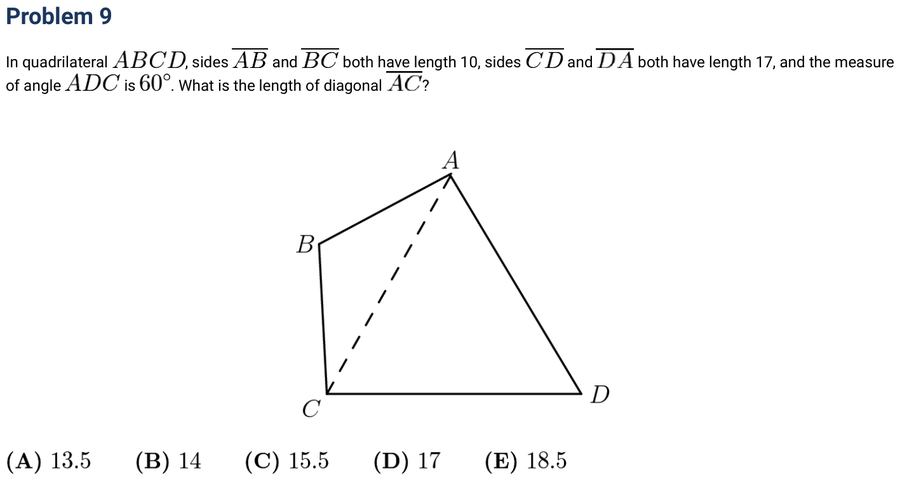
In quadrilateral ABCD, sides AB and BC both have length 10, sides CD and DA both have length 17, and the measure of angle ADC is 60°. What is the length of diagonal AC?
Show answer
Answer: D — 17.
Show hints
Hint 1 of 2
The 10-10 sides are a distraction. The diagonal AC lives inside triangle ADC, which has two equal sides (17, 17) and the 60° angle between them. That's all you need.
Still stuck? Show hint 2 →
Hint 2 of 2
Watch what happens to an isosceles triangle when the apex angle is exactly 60° — check what the other two angles must be.
Show solution
Approach: isosceles + a 60° angle forces equilateral
Look only at triangle ADC: DA = DC = 17, so its base angles are equal. They share the leftover 180 − 60 = 120°, giving 60° each.
All three angles are 60° — the triangle is equilateral, so every side equals 17. Thus AC = 17.
Worth keeping: isosceles + one 60° angle = equilateral, every time. Spotting it beats hauling out the Law of Cosines. (Choice D, 17, is no coincidence — AC matches the equal sides.)
Another way — Law of Cosines (the unenlightened route):
AC² = 17² + 17² − 2·17·17·cos 60°. Since cos 60° = ½, the last term is 17², leaving AC² = 17².
So AC = 17 — the same result, the long way. The cos 60° = ½ collapse is exactly why the triangle came out equilateral.
Joe had walked half way from home to school when he realized he was late. He ran the rest of the way to school. He ran 3 times as fast as he walked. Joe took 6 minutes to walk half way to school. How many minutes did it take Joe to get from home to school?
Show answer
Answer: D — 8 minutes.
Show hints
Hint 1 of 2
Both halves cover the same distance, so you can compare them directly — no need to know the actual distance or speed.
Still stuck? Show hint 2 →
Hint 2 of 2
For a fixed distance, speed and time are flip sides: triple the speed means a third of the time.
Show solution
Approach: same distance ⇒ time scales by 1/speed
The two halves are equal distances, so walking and running can be compared head-to-head. Walking the first half took 6 min.
Running is 3× as fast over the same distance, so it takes ⅓ the time: 6 ÷ 3 = 2 min.
Total: 6 + 2 = 8 min.
Why this transfers: over a fixed distance, time is inversely proportional to speed — double speed → half time, triple speed → third the time. No distance value needed. (The decimal traps 7.3, 7.7, 8.3 punish anyone who fumbles the 'a third' step.)
The sales tax rate in Bergville is 6%. During a sale at the Bergville Coat Closet, the price of a coat is discounted 20% from its $90.00 price. Two clerks, Jack and Jill, calculate the bill independently. Jack rings up $90.00 and adds 6% sales tax, then subtracts 20% from this total. Jill rings up $90.00, subtracts 20% of the price, then adds 6% of the discounted price for sales tax. What is Jack's total minus Jill's total?
Show answer
Answer: C — $0.
Show hints
Hint 1 of 2
Resist computing the two bills. Instead, write each as 90 times some multipliers — 'add 6%' is ×1.06, 'take 20% off' is ×0.80. Then just compare.
Still stuck? Show hint 2 →
Hint 2 of 2
Both clerks multiply by the same three numbers, only in a different order. What do you know about how order affects a product?
Show solution
Approach: see them as the same product reordered
Translate each step into a multiplier: 'add 6% tax' is ×1.06, 'discount 20%' is ×0.80.
Jack does 90 · 1.06 · 0.80; Jill does 90 · 0.80 · 1.06. Same three factors, swapped order.
Multiplication doesn't care about order, so the totals are identical — the difference is $0.
Why this transfers: stacked percentage changes are just multipliers, and multipliers commute. 'Discount then tax' always equals 'tax then discount' — recognizing this saves you from grinding out two dollar amounts (and from the ±$1.06 traps).
Big Al the ape ate 100 delicious yellow bananas from May 1 through May 5. Each day he ate six more bananas than on the previous day. How many delicious bananas did Big Al eat on May 5?
Show answer
Answer: D — 32.
Show hints
Hint 1 of 2
Five days, each 6 more than the last — the amounts step up evenly. In any such evenly-stepping list, the middle day equals the average. So don't set up a big equation; find the average first.
Still stuck? Show hint 2 →
Hint 2 of 2
The middle term of an odd-length arithmetic sequence is its mean. From the middle, count steps of 6 outward to any day you want.
Show solution
Approach: the middle day is the average
Total is 100 over 5 days, so the average per day is 100 ÷ 5 = 20. Because the increase is steady, that average lands exactly on the middle day, May 3.
May 5 is two days past the middle, each day +6: 20 + 2·6 = 32.
Why this transfers: for any arithmetic sequence with an odd count of terms, sum ÷ count gives the center term instantly — far faster than solving for the first term. (Note 30, choice C, is the trap for stopping one step short.)
Another way — name the middle day x:
Let May 3 = x. The five days are x−12, x−6, x, x+6, x+12; the ±12 and ±6 cancel, so the sum is just 5x.
5x = 100 ⇒ x = 20, and May 5 = x+12 = 32. Centering the variable makes the symmetric terms cancel cleanly.
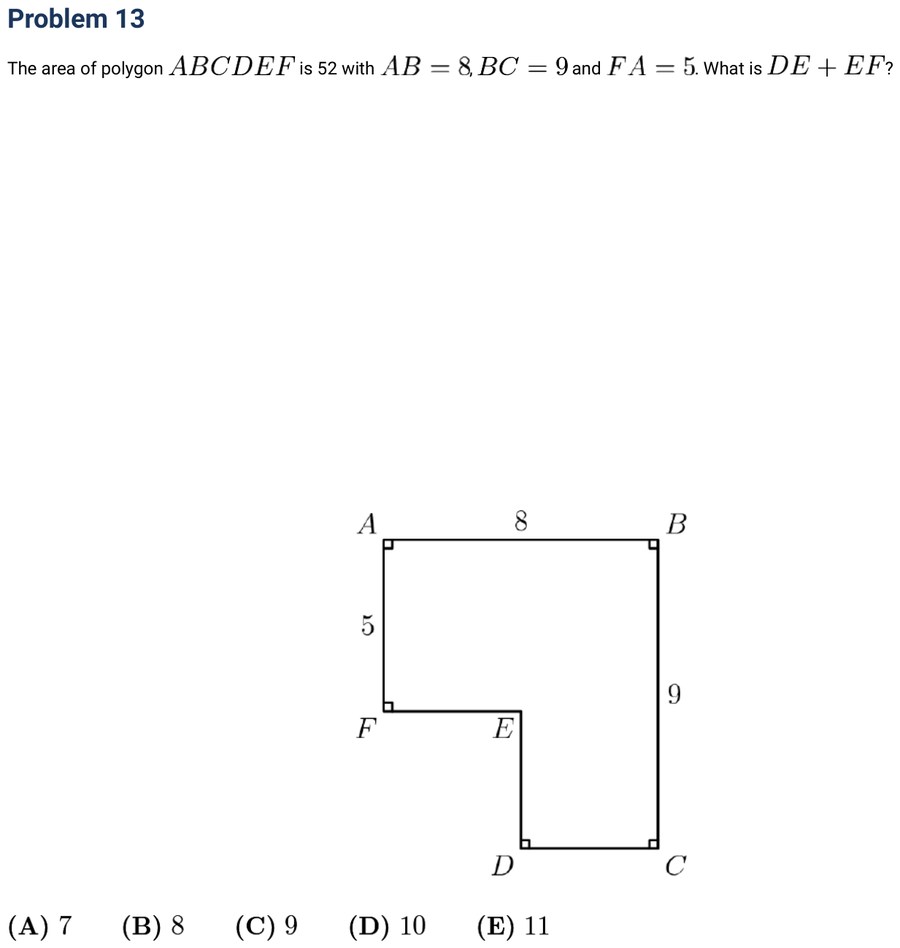
The area of polygon ABCDEF is 52 with AB = 8, BC = 9 and FA = 5. What is DE + EF?
Show answer
Answer: C — 9.
Show hints
Hint 1 of 2
This L-shape is a full rectangle with a smaller rectangle bitten out of the corner. Fill the bite back in — the big rectangle is easy, and the bite carries the unknowns DE and EF.
Still stuck? Show hint 2 →
Hint 2 of 2
The missing bite's area = (big rectangle) − (given area). One side of the bite is forced by the two side lengths you already know — that hands you the other side.
Show solution
Approach: complete the L to a rectangle, subtract the bite
Extend the short edges to close off the corner. The full bounding rectangle is 8 × 9 = 72. The L has area 52, so the bitten-out rectangle has area 72 − 52 = 20.
The bite's vertical side is the gap between the two sides BC = 9 and FA = 5, namely ED = 9 − 5 = 4.
So its horizontal side is EF = 20 ÷ 4 = 5, and DE + EF = 4 + 5 = 9.
Why this transfers: any rectilinear (right-angle-only) polygon is a rectangle plus or minus smaller rectangles — 'complete to the bounding box and subtract' turns a scary shape into easy arithmetic.
Another way — edges close around, not just area:
In a closed rectilinear path, the horizontal edges going right must equal those going left: AB = FE + DC, and the vertical edges balance the same way.
Combined with area 52, the same numbers fall out: ED = 4, EF = 5, giving 9. Useful when you're handed perimeters instead of an area.
The Little Twelve Basketball League has two divisions, with six teams in each division. Each team plays each of the other teams in its own division twice and every team in the other division once. How many games are scheduled?
Show answer
Answer: B — 96.
Show hints
Hint 1 of 2
Two kinds of games behave differently — same-division (played twice) and cross-division (played once). Count each kind on its own, then add.
Still stuck? Show hint 2 →
Hint 2 of 2
Count matchups, not games-per-team, to dodge double counting: a same-division pair is C(6,2), and each plays 2 games.
Show solution
Approach: split into same-division and cross-division matchups
Same-division: each division has C(6,2) = 15 pairs, each pair plays twice ⇒ 15·2 = 30 games per division. Two divisions: 60.
Cross-division: every team in one division plays every team in the other once — 6·6 = 36 games (no pair is counted twice here, since the two teams are in different divisions).
Total: 60 + 36 = 96.
The key safeguard: a 'game' is one unordered pair, so count pairs once, not each team's schedule — that's how you avoid the doubling trap (192, choice E, is exactly that error).
Another way — one team's games, then halve:
Pick any team: it plays its 5 division-mates twice (10 games) and all 6 cross-division teams once (6 games) — 16 games.
All 12 teams: 12·16 = 192, but every game was counted by both its teams, so divide by 2: 192 ÷ 2 = 96.
How many different isosceles triangles have integer side lengths and perimeter 23?
Show answer
Answer: C — 6 triangles.
Show hints
Hint 1 of 2
An isosceles triangle is pinned down by just one number — the leg length y — because the base is then forced to be 23 − 2y. So you're really counting valid leg lengths, not triples.
Still stuck? Show hint 2 →
Hint 2 of 2
Two fences bound y: the base must be positive (so y isn't too big) and the triangle inequality 2·leg > base must hold (so y isn't too small). Count the integers between.
Show solution
Approach: one variable (the leg), bounded both ways
Let the two legs be y and the base x, so 2y + x = 23. The base is whatever's left: x = 23 − 2y — one number controls everything.
Lower fence (triangle inequality): the two legs must beat the base, 2y > x = 23 − 2y, giving y > 5.75, so y ≥ 6.
Upper fence (base positive): x = 23 − 2y ≥ 1 gives y ≤ 11.
So y = 6, 7, 8, 9, 10, 11 — 6 triangles.
Why this transfers: reduce a 'count the shapes' problem to one free variable, then squeeze it between two inequalities and count integers. Here, conveniently, the odd perimeter 23 makes the base 23 − 2y always odd, so it can never tie a leg — no equilateral or degenerate cases to worry about.
A five-legged Martian has a drawer full of socks, each of which is red, white or blue, and there are at least five socks of each color. The Martian pulls out one sock at a time without looking. How many socks must the Martian remove from the drawer to be certain there will be 5 socks of the same color?
Show answer
Answer: D — 13.
Show hints
Hint 1 of 2
'To be certain' means plan for the unluckiest draw possible. Ask: what's the most socks you could hold and still not have 5 of any one color?
Still stuck? Show hint 2 →
Hint 2 of 2
This is the pigeonhole idea: pile each color as high as it can go without hitting the target (4 each), then the very next sock is forced to push some color over.
Show solution
Approach: pigeonhole — build the worst case, then add one
Imagine the meanest possible luck: 4 red, 4 white, 4 blue. That's 12 socks and still no color has reached 5.
There's nowhere left to hide — the 13th sock must be a 4th color's... no, must be the 5th of some color. So 13 guarantees it.
Why this transfers: for 'how many to guarantee' problems, find the largest haul that fails the goal (here 3×4 = 12), then add 1. The five legs in the story are pure distraction — only the three colors matter.
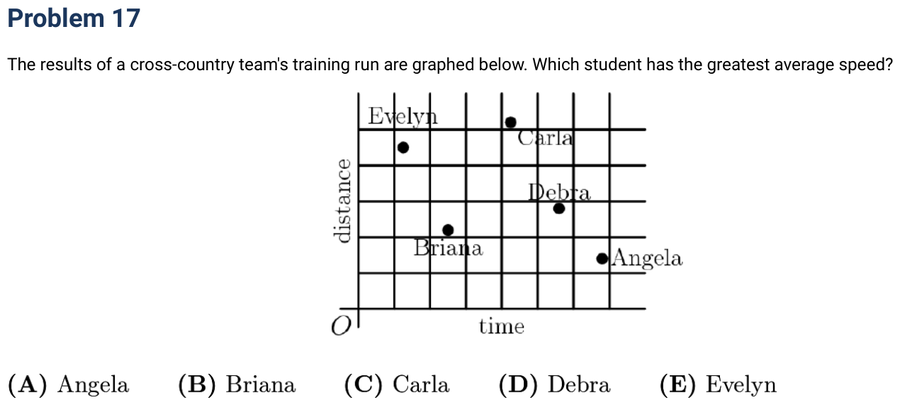
The results of a cross-country team's training run are graphed below. Which student has the greatest average speed?
Show answer
Answer: E — Evelyn.
Show hints
Hint 1 of 2
Speed = distance ÷ time. On a distance-vs-time graph, that ratio for each runner is the steepness of the line from the origin O out to their dot.
Still stuck? Show hint 2 →
Hint 2 of 2
You don't need numbers off the axes. Just eyeball which dot's line from O tilts up most steeply — high distance for little time.
Show solution
Approach: fastest = steepest line from the origin
Average speed is distance ÷ time, which is exactly the slope of the segment joining O to a runner's dot. Steeper line = more distance per unit time = faster.
Evelyn's dot sits high (large distance) and far left (small time), so her line from O is the steepest ⇒ Evelyn.
Watch the trap: Carla is the highest dot, but she took the most time, so she isn't fastest — 'farthest' is not 'fastest.' Only the slope from the origin tells you speed.
Every multiple of 13 is 13·k. Instead of hunting the multiples, hunt the multipliers k that keep 13k in the 100–999 range — they form a tidy run of consecutive whole numbers.
Still stuck? Show hint 2 →
Hint 2 of 2
Find the first k with 13k ≥ 100 and the last with 13k ≤ 999. Then count the integers between, inclusive.
Show solution
Approach: count the multipliers, not the multiples
Write each multiple as 13k. Smallest 3-digit one: 100 ÷ 13 ≈ 7.7, so k = 8 gives 13·8 = 104. Largest: 999 ÷ 13 ≈ 76.8, so k = 76 gives 13·76 = 988.
So k runs through 8, 9, …, 76 — a block of consecutive integers. Count them: 76 − 8 + 1 = 69.
The two things people botch: remember the +1 (counting endpoints, not gaps — that's why it's 69, not 68), and translate the problem into counting k's rather than the multiples themselves. This 'count the index' trick works for any 'how many multiples in a range' question.
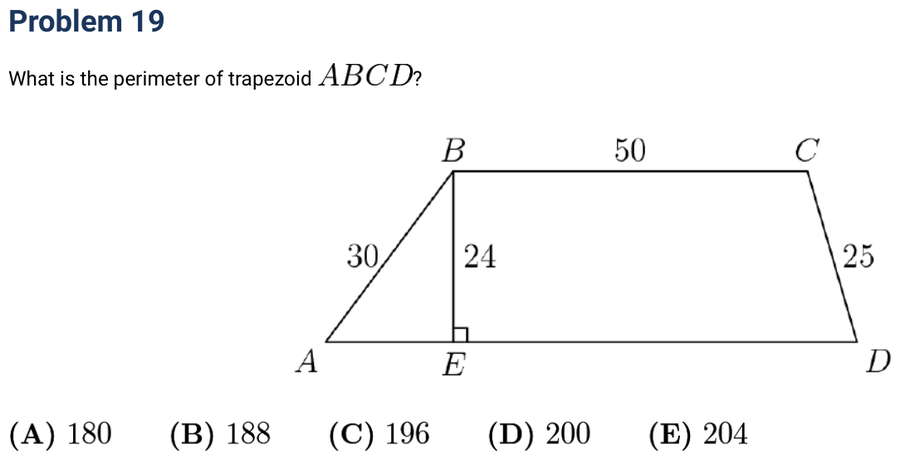
The only mystery side is the long bottom, AD. Drop a vertical from each top corner (B and C) to the base — that carves the trapezoid into a rectangle in the middle and a right triangle on each end.
Still stuck? Show hint 2 →
Hint 2 of 2
Each slanted leg becomes the hypotenuse of a right triangle whose other leg is the height 24. Look for friendly Pythagorean triples instead of grinding square roots.
Show solution
Approach: slice into a rectangle plus two right triangles
Drop verticals from B and C down to base AD, with feet E and F. Both have height 24, and the middle piece EF equals the top BC = 50.
Left triangle: hypotenuse 30, one leg 24 ⇒ the other leg is 18 (it's a 3-4-5 triple scaled by 6: 18-24-30). So AE = 18.
Right triangle: hypotenuse 25, leg 24 ⇒ other leg 7 (the 7-24-25 triple). So FD = 7.
Why this transfers: any trapezoid splits into a rectangle plus two right triangles by dropping the two heights — and recognizing 18-24-30 and 7-24-25 as scaled triples turns the Pythagorean step into instant recall.
Alice and Bob play a game involving a circle whose circumference is divided by 12 equally-spaced points. The points are numbered clockwise, from 1 to 12. Both start on point 12. Alice moves clockwise and Bob, counterclockwise. In a turn of the game, Alice moves 5 points clockwise and Bob moves 9 points counterclockwise. The game ends when they stop on the same point. How many turns will this take?
Show answer
Answer: A — 6 turns.
Show hints
Hint 1 of 2
They walk toward each other around the loop. Each turn they close the gap by 5 + 9 = 14 points. They land together once that closing distance is a whole number of full laps — a multiple of 12.
Still stuck? Show hint 2 →
Hint 2 of 2
So you need the smallest k with 14k a multiple of 12 — that's the least common multiple of 14 and 12, divided by 14.
Show solution
Approach: relative motion — close the gap by a whole lap
Going opposite directions, Alice and Bob eat up 5 + 9 = 14 points of separation each turn. They start together, so they reunite exactly when their combined motion is a whole number of laps of 12.
Need 14k = multiple of 12. The smallest such total is lcm(14, 12) = 84, so k = 84 ÷ 14 = 6 turns.
Why this transfers: two bodies moving in opposite directions around a loop have their speeds add (relative speed), and they meet when the combined travel equals a full circuit — far cleaner than tracking each position separately.
Another way — track positions with modular arithmetic:
After k turns Alice sits at +5k and Bob at −9k (mod 12). They coincide when 5k ≡ −9k, i.e. 14k ≡ 0 (mod 12).
Divide through by 2: 7k ≡ 0 (mod 6). Since 7 and 6 share no factor, k must be a multiple of 6 ⇒ smallest is 6.
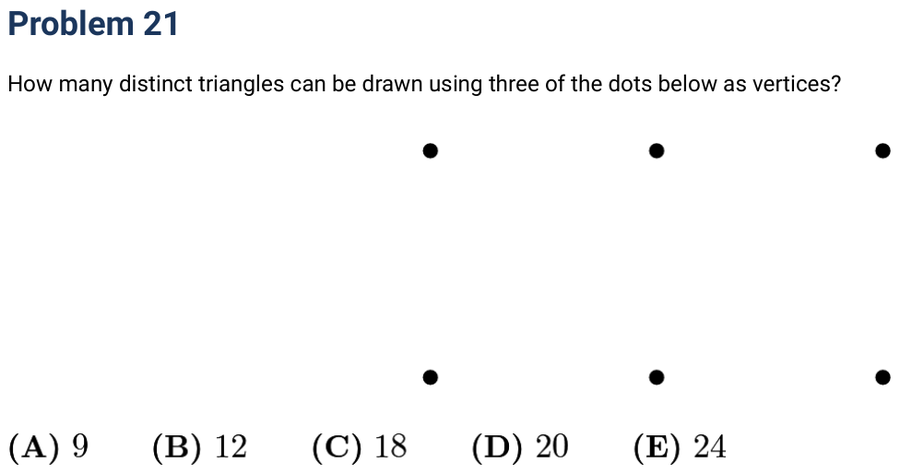
How many distinct triangles can be drawn using three of the dots below as vertices?
Show answer
Answer: C — 18.
Show hints
Hint 1 of 2
Count generously first: every choice of 3 dots gives a triangle — unless the 3 happen to lie on one straight line. So count all triples, then throw out the flat ones.
Still stuck? Show hint 2 →
Hint 2 of 2
The only way 3 of these 6 dots line up is if all three sit in the same row. How many all-in-one-row triples are there?
Show solution
Approach: count all triples, subtract the collinear ones
Choosing 3 dots from 6 in any way: C(6,3) = 20 triples.
Three dots fail to make a triangle only when they're collinear. Here the dots form two rows of 3, so the lone collinear triples are the full top row and the full bottom row — just 2 of them.
Triangles: 20 − 2 = 18.
Why this 'count all, subtract bad' works: it's far easier to count every selection and remove the few degenerate ones than to count valid triangles directly. The trap answer 20 (choice D) is forgetting that collinear triples aren't triangles.
A company sells detergent in three different sized boxes: small (S), medium (M) and large (L). The medium size costs 50% more than the small size and contains 20% less detergent than the large size. The large size contains twice as much detergent as the small size and costs 30% more than the medium size. Rank the three sizes from best to worst buy.
Show answer
Answer: E — MLS (best M, then L, then S).
Show hints
Hint 1 of 2
'Best buy' only depends on price per ounce, never on the actual prices. Since everything is relative percentages, you're free to pin down two convenient anchor numbers and let the rest follow.
Still stuck? Show hint 2 →
Hint 2 of 2
Pick numbers that make the percentages clean — small price = $1, large size = 10 oz — then build the others and compare dollars per ounce. Lowest $/oz wins.
Show solution
Approach: anchor convenient values, then compare $ per oz
Only ratios matter, so set Small = $1 and Large = 10 oz. Now derive the rest from the clues.
Small size: large is twice the small, so Small = 5 oz. Medium: 50% more than small ⇒ $1.50; 20% less than large ⇒ 8 oz. Large price: 30% more than medium ⇒ 1.5·1.30 = $1.95.
Unit prices ($/oz): S = 1/5 = 0.200, M = 1.50/8 = 0.1875, L = 1.95/10 = 0.195.
Cheapest per ounce to priciest: M, L, S.
Why this transfers: when a problem gives only relative sizes and prices, the answer can't depend on your starting numbers — so anchor the ones that make the arithmetic painless. And 'best deal' always means the lowest unit price, not the lowest sticker price.
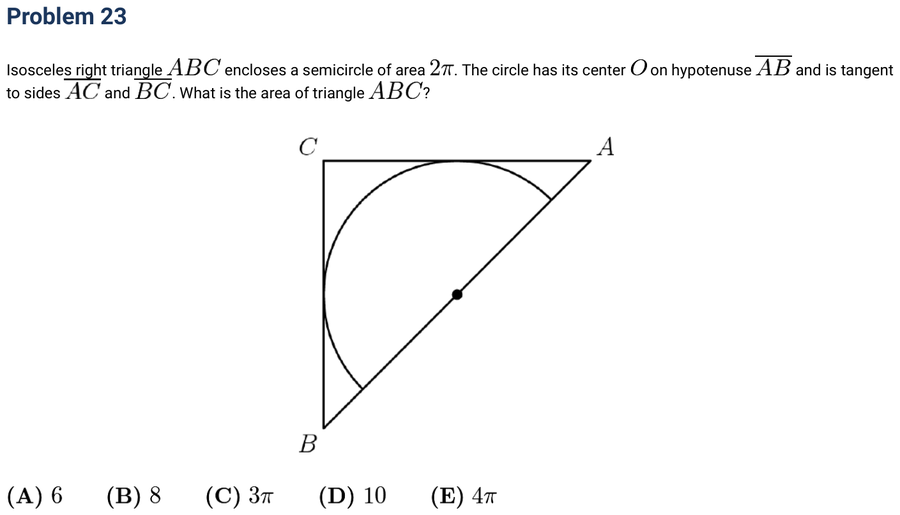
Isosceles right triangle ABC encloses a semicircle of area 2π. The circle has its center O on hypotenuse AB and is tangent to sides AC and BC. What is the area of triangle ABC?
Show answer
Answer: B — 8.
Show hints
Hint 1 of 2
A semicircle is half a circle — so double its area to recover a full circle, and that gives you the radius. The radius is the secret length connecting the circle to the triangle.
Still stuck? Show hint 2 →
Hint 2 of 2
The center O sits at the midpoint of the hypotenuse, and the distance from O to each tangent leg is the radius. Use the symmetry of the 45-45-90 to turn that radius into the leg length.
Show solution
Approach: semicircle → radius → leg via tangency
The semicircle's area is 2π, so a full circle would be 4π = πr², giving r = 2.
O is the midpoint of hypotenuse AB, and the perpendicular distance from O to each leg is the radius 2. In the 45-45-90, the foot of that perpendicular hits each leg at its midpoint, so the full leg is 2·2 = 4.
Area = ½·leg·leg = ½·4·4 = 8.
The reusable move: a tangent radius meets the side at a right angle, and a center on the hypotenuse of a 45-45-90 sits dead center — together these pin the leg to exactly twice the radius.
Another way — radius via the half-leg:
Let each leg be s. The center O is the hypotenuse midpoint, so its horizontal and vertical distances to the right-angle vertex C are each s/2 — and those distances are the tangent radii.
So r = s/2. With r = 2 we get s = 4 and area ½·4² = 8.
A certain calculator has only two keys [+1] and [×2]. When you press one of the keys, the calculator automatically displays the result. For instance, if the calculator originally displayed "9" and you pressed [+1], it would display "10." If you then pressed [×2], it would display "20." Starting with the display "1," what is the fewest number of keystrokes you would need to reach "200"?
Show answer
Answer: B — 9 keystrokes.
Show hints
Hint 1 of 2
Going forward from 1 you'd face two choices at every step — a branching mess. Going backward from 200, each step is forced, so there's nothing to guess.
Still stuck? Show hint 2 →
Hint 2 of 2
Reverse the keys: undoing ×2 is ÷2, undoing +1 is −1. At an even number, halving is the bigger leap toward 1, so prefer it; only subtract 1 when the number is odd and you have no choice.
Show solution
Approach: run the keys in reverse from 200 to 1
Work down from the target. Halve whenever you can (the powerful move), and subtract 1 only when forced by an odd number:
That's 9 steps, and each reverse step is one forward keystroke.
Why backward is optimal here: at an even number, halving always reaches 1 in fewer moves than peeling off 1's, and at an odd number you're forced to subtract 1 anyway — so this greedy reverse path can't be beaten. Working from the goal is the go-to trick whenever the forward direction branches but the backward one is determined.
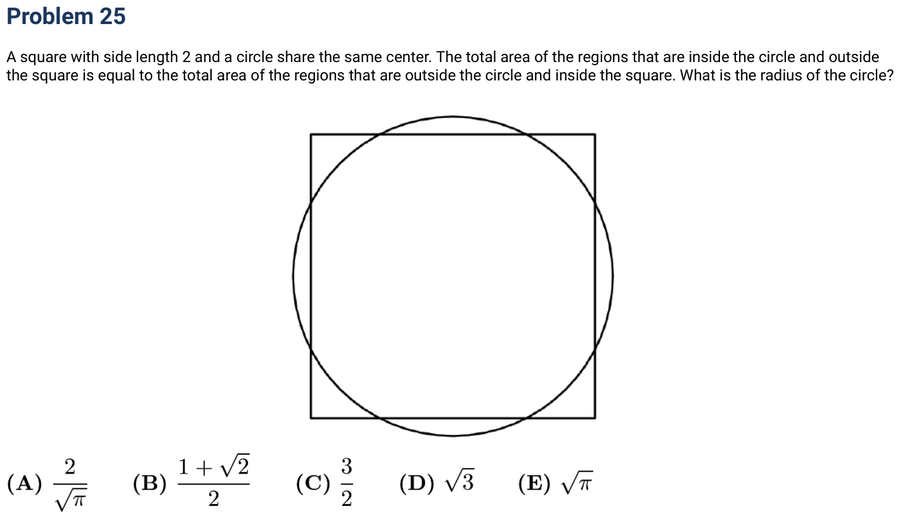
A square with side length 2 and a circle share the same center. The total area of the regions that are inside the circle and outside the square is equal to the total area of the regions that are outside the circle and inside the square. What is the radius of the circle?
Show answer
Answer: A — 2/√π.
Show hints
Hint 1 of 2
The overlap region (inside both) belongs to neither of the two 'sticking-out' areas. Both shapes share that exact same overlap — so when you set the two leftover bits equal, the overlap simply cancels.
Still stuck? Show hint 2 →
Hint 2 of 2
Don't try to find the messy crescent and corner pieces. Add the shared overlap back to both sides: the condition collapses to 'circle area = square area.'
Show solution
Approach: the shared overlap cancels ⇒ equal total areas
Call the overlap (inside both shapes) I. Then inside-circle-but-outside-square = πr² − I, and outside-circle-but-inside-square = 4 − I (the square's area is 2² = 4).
Setting them equal: πr² − I = 4 − I. The unknown overlap I cancels, leaving πr² = 4.
So r² = 4/π and r = 2/√π = 2/√π.
The big idea: 'sticking-out area on one side = sticking-out area on the other' is just a disguised way of saying the two whole shapes have equal area — because both share the same overlap, it never needs to be computed. Spotting that you can add the common piece back to both sides is the whole problem.