On a map, a 12-centimeter length represents 72 kilometers. How many kilometers does a 17-centimeter length represent?
Show answer
Answer: B — 102 km.
Show hints
Hint 1 of 2
Before reaching for 17, find what just one centimeter is worth. Once you know the value of a single unit, any length is just a multiplication away.
Still stuck? Show hint 2 →
Hint 2 of 2
This is the unit-rate idea: collapse any proportion to a 'per one' value, then scale. It beats cross-multiplying because the 'per one' number is reusable.
Show solution
Approach: unit rate (value of one cm)
Shrink the scale to one unit: 72 km spread over 12 cm means each cm is worth 72 ÷ 12 = 6 km. That single number is the whole problem.
Now any length scales instantly: 17 cm × 6 km/cm = 102 km.
Sanity check: 17 cm is a bit more than 12 cm, so the answer should be a bit more than 72 — and 102 is. You'll see this 'find the per-one value first' move in every map, recipe, and speed problem.
How many different four-digit numbers can be formed by rearranging the four digits in 2004?
Show answer
Answer: B — 6.
Show hints
Hint 1 of 2
There are really only two 'interesting' digits here — the 2 and the 4. The two zeros are interchangeable, and a number can't start with 0. What position can each non-zero digit take?
Still stuck? Show hint 2 →
Hint 2 of 2
Whenever a digit repeats, ordinary 4! over-counts; and a 'no leading zero' rule trims more. Naming both traps — identical-item over-count and the leading-zero restriction — is the whole skill.
Show solution
Approach: place the non-zero digits first
The slick view: a valid number is fixed once you decide where the 2 and 4 sit, because the leftover slots must be the two zeros. The thousands place must be 2 or 4 (no leading 0) — 2 choices — and the other non-zero digit then has 3 open slots — 3 choices. That's 2 × 3 = 6.
Why this beats brute force: you never list anything; the two zeros take care of themselves once the 'real' digits are placed.
You'll meet this again any time a number has repeated digits and a 'first digit can't be 0' rule — place the restricted/distinct items first, let the duplicates fall into the gaps.
Another way — count all, then subtract leading zeros:
All arrangements of {2, 0, 0, 4}: 4!/2! = 12 (divide by 2! because the two 0s are identical).
Bad ones put a 0 in front: the remaining three slots hold {2, 0, 4}, giving 3! = 6 arrangements.
Twelve friends met for dinner at Oscar's Overstuffed Oyster House, and each ordered one meal. The portions were so large, there was enough food for 18 people. If they shared, how many meals should they have ordered to have just enough food for the 12 of them?
Show answer
Answer: A — 8 meals.
Show hints
Hint 1 of 2
The 12 friends are a distraction — the real fact is 'this much food'. How many people does a single meal actually feed?
Still stuck? Show hint 2 →
Hint 2 of 2
This is a capacity / unit-rate setup: turn the deal into 'people fed per meal', then ask how many meals reach your target. Same skill as 'miles per gallon' or 'words per minute'.
Show solution
Approach: people-fed-per-meal rate
Find what one meal is worth: 12 meals stretched to feed 18 people means each meal feeds 18 ÷ 12 = 1.5 people. That's the insight — the meals are 50% bigger than one person needs.
To feed exactly 12 people: 12 ÷ 1.5 = 8 meals.
Sanity check: meals feed more than one person each, so we should need fewer than 12 meals — and 8 < 12. Good.
Another way — ratio scaling:
Meals-to-people stays fixed at 12 : 18, which reduces to 2 : 3.
Scale the 'people' side down to 12: that's 12 / 3 = 4 groups, so meals = 2 × 4 = 8.
Ms. Hamilton's eighth-grade class wants to participate in the annual three-person-team basketball tournament. Lance, Sally, Joy, and Fred are chosen for the team. In how many ways can the three starters be chosen?
Show answer
Answer: B — 4.
Show hints
Hint 1 of 2
Choosing who plays is hard to picture, but flip it: picking 3 starters out of 4 is the same as picking the one person who sits out. How many ways to choose the one bench-warmer?
Still stuck? Show hint 2 →
Hint 2 of 2
This is complementary counting: count the small leftover group instead of the big chosen group. Choosing 3-of-4 and choosing 1-of-4 are the same count — that's the symmetry C(n, k) = C(n, n−k).
Show solution
Approach: count the one left out (complement)
Each starting trio leaves exactly one person on the bench, so 'how many trios?' = 'how many ways to pick the one who sits?' There are 4 people, so 4 ways.
Why this transfers: whenever you're choosing almost all of a group, count the tiny excluded part instead — far less work. Choosing 18 of 20, for instance, is just choosing the 2 to drop.
Ms. Hamilton's eighth-grade class wants to participate in the annual three-person-team basketball tournament. The losing team of each game is eliminated from the tournament. If sixteen teams compete, how many games will be played to determine the winner?
Show answer
Answer: D — 15 games.
Show hints
Hint 1 of 2
Don't try to draw the bracket round by round. Flip the question: instead of 'how many games?', ask 'how many teams must disappear?' Each game removes exactly one team.
Still stuck? Show hint 2 →
Hint 2 of 2
This is the single-elimination principle: to crown one champion out of N teams, exactly N − 1 teams must lose — and each game produces exactly one loser, so games = N − 1. The bracket's shape never matters.
Show solution
Approach: count losers, not games
Every game knocks out exactly one team. The tournament ends with 1 champion, so 16 − 1 = 15 teams had to be eliminated.
One game per elimination ⇒ 15 games — no bracket-drawing needed.
Worth keeping: any 'games to find a single winner in single-elimination' = (teams − 1). A 64-team bracket takes 63 games; a 128-team draw takes 127. The answer never depends on byes or how the rounds line up.
Another way — add up the rounds (the long way):
16 teams → 8 games → 8 teams → 4 games → 4 teams → 2 games → 2 teams → 1 game.
8 + 4 + 2 + 1 = 15. Same answer — and notice it equals 16 − 1, confirming the shortcut.
After Sally takes 20 shots, she has made 55% of her shots. After she takes 5 more shots, she raises her percentage to 56%. How many of the last 5 shots did she make?
Show answer
Answer: C — 3.
Show hints
Hint 1 of 2
Percentages are slippery, but made shots are whole numbers. Convert each percentage into an actual count of baskets — then the answer is just the difference between the two counts.
Still stuck? Show hint 2 →
Hint 2 of 2
The technique is turn rates into counts: a percent of a known total is a concrete number you can subtract. Don't manipulate the percents; manipulate the makes.
Show solution
Approach: convert percents to make-counts, then subtract
Before: 55% of 20 = 11 made. After: 56% of 25 = 14 made. Both must be whole numbers — baskets don't come in fractions — which is the quiet reason the percents were chosen to land cleanly.
The last 5 shots added 14 − 11 = 3 made baskets.
Sanity check: she made 3 of 5 new shots (60%), which is higher than her old 55% — consistent with her average creeping up to 56%.
Another way — solve for the unknown makes:
Let x be the new makes. Then (11 + x) / 25 = 0.56.
An athlete's target heart rate, in beats per minute, is 80% of the theoretical maximum heart rate. The maximum heart rate is found by subtracting the athlete's age, in years, from 220. To the nearest whole number, what is the target heart rate of an athlete who is 26 years old?
Show answer
Answer: B — 155 bpm.
Show hints
Hint 1 of 2
Read the recipe in order, and resist the tempting shortcut. The 80% applies to the maximum — which you must build first — not to 220. Doing the steps out of order is the trap the problem is testing.
Still stuck? Show hint 2 →
Hint 2 of 2
The skill is respecting operation order in word problems: build each quantity the sentence describes before combining. 'Percent of (something you compute)' — compute the something first.
Show solution
Approach: build the max, then take 80%
Step 1 — the maximum: 220 − 26 = 194. This must come first; 80% of 194 is a very different number from 80% of 220.
Step 2 — the target: 0.80 × 194 = 155.2, which rounds to 155.
Why eliminate 176? That's 80% of 220 — the classic 'skipped the subtraction' answer the test bakes in to catch the rush.
Find the number of two-digit positive integers whose digits total 7.
Show answer
Answer: B — 7.
Show hints
Hint 1 of 2
You don't need to track two digits at once. Once you pick the tens digit, the units digit is forced (it has to finish the sum to 7). So the only real question is: how many legal tens digits are there?
Still stuck? Show hint 2 →
Hint 2 of 2
The principle is one free choice fixes the rest: count only the variable you're actually free to choose. Here a two-digit number can't start with 0, so the tens digit runs 1 to 7 — that's the entire count.
Show solution
Approach: count only the free digit
Pick the tens digit a; the units digit is then forced to 7 − a. So the count equals the number of valid a.
a can be 1, 2, 3, 4, 5, 6, or 7 — it can't be 0 (no leading zero) and can't exceed 7 (then the units digit would go negative). That's 7 values: 16, 25, 34, 43, 52, 61, 70.
You'll reuse this whenever one choice locks in the others — count the driver, not the whole pair.
The average of the five numbers in a list is 54. The average of the first two numbers is 48. What is the average of the last three numbers?
Show answer
Answer: D — 58.
Show hints
Hint 1 of 2
An average hides a total inside it (average × count = sum). Convert each average back into its sum — sums you can add and subtract, averages you cannot.
Still stuck? Show hint 2 →
Hint 2 of 2
The key move is the average ↔ sum conversion: never combine averages directly. Turn them into totals, do the arithmetic, then convert back at the very end.
Show solution
Approach: work in totals, convert back at the end
Recover the totals: all five sum to 5 × 54 = 270; the first two sum to 2 × 48 = 96. This is the whole trick — averages can't be subtracted, but the sums behind them can.
So the last three sum to 270 − 96 = 174, and their average is 174 ÷ 3 = 58.
Sanity check: the first two pulled the average down (48 < 54), so the last three must pull it back up — above 54, and 58 is. Common slip: averaging 54 and 48 gives 51, which is wrong because the groups have different sizes.
Another way — balance around the mean:
The two low numbers each sit 54 − 48 = 6 below the overall mean, a deficit of 2 × 6 = 12.
The three remaining numbers must cover that deficit, so together they sit 12 above the mean, i.e. 12 / 3 = 4 above each. Their average is 54 + 4 = 58.
Handy Aaron helped a neighbor 114 hours on Monday, 50 minutes on Tuesday, from 8:20 to 10:45 on Wednesday morning, and a half-hour on Friday. He is paid $3 per hour. How much did he earn for the week?
Show answer
Answer: E — $15.
Show hints
Hint 1 of 2
Everything is in different units (hours, minutes, a clock span). Pick one currency — minutes — and convert every day into it before adding anything. Mixing units is the only thing that makes this problem hard.
Still stuck? Show hint 2 →
Hint 2 of 2
The discipline is convert to a common unit first: get all times into minutes, total them, convert once to hours, then apply the rate. One conversion at the end beats four fiddly fraction additions.
Show solution
Approach: total the minutes, then pay
Convert each day to minutes: Mon 1¼ hr = 75, Tue = 50, Wed 8:20–10:45 = 2 hr 25 min = 145, Fri ½ hr = 30.
Add: 75 + 50 + 145 + 30 = 300 minutes = exactly 5 hours. Working in minutes keeps everything a whole number — no common denominators needed.
Pay: 5 hr × $3/hr = $15.
Sanity check: the four chunks are each roughly an hour, summing to about 5 hours × $3 ≈ $15 — the largest choice, which fits.
The numbers −2, 4, 6, 9 and 12 are rearranged according to these rules: The largest isn't first, but it is in one of the first three places. The smallest isn't last, but it is in one of the last three places. The median isn't first or last. What is the average of the first and last numbers?
Show answer
Answer: C — 6.5.
Show hints
Hint 1 of 2
The question only asks about the endpoints, so don't solve the full ordering — just figure out which numbers are banned from the ends. Each rule kicks one specific number off at least one end.
Still stuck? Show hint 2 →
Hint 2 of 2
The strategy is answer only what's asked via elimination: rather than placing all five numbers, rule out who can't be on the ends. Whoever's left must be on the ends — and you never needed the middle three.
Show solution
Approach: rule out the ends, ignore the middle
Identify the three special values: largest 12, smallest −2, median 6. Now read the rules as bans on the endpoints: the largest 'isn't first' and lives in the first three (so not last either) → 12 is off both ends; the smallest 'isn't last' and lives in the last three (so not first) → −2 is off both ends; the median 'isn't first or last' → 6 is off both ends.
Three of the five numbers are forbidden from both endpoints, so the two endpoints must be the survivors: 4 and 9.
Average of the ends: (4 + 9) ÷ 2 = 6.5.
The transferable lesson: when a puzzle asks for one feature, attack that feature directly. We never determined whether 4 or 9 is first — and we never had to, because their average is the same either way.
Niki usually leaves her cell phone on. If her cell phone is on but she is not actually using it, the battery will last for 24 hours. If she is using it constantly, the battery will last for only 3 hours. Since the last recharge, her phone has been on 9 hours, and during that time she has used it for 60 minutes. If she doesn't talk any more but leaves the phone on, how many more hours will the battery last?
Show answer
Answer: B — 8 more hours.
Show hints
Hint 1 of 2
Think of the battery as one whole tank, and each mode as a different drain speed. 'Lasts 24 hours idle' means idling drains 1/24 of the tank per hour; 'lasts 3 hours in use' means using drains 1/3 per hour. Split the 9 hours into how much was each mode.
Still stuck? Show hint 2 →
Hint 2 of 2
The technique is fraction-of-the-job per hour (the same as combined-work-rate problems): convert each 'lasts T hours' into a rate of 1/T per hour, add up what's been spent, and see what's left.
Show solution
Approach: track the tank as fractions
The 9 hours split as 1 hour of talking + 8 hours idle (60 min used). Battery spent = 1 × 1/3 (talking) + 8 × 1/24 (idle) = 1/3 + 1/3 = 2/3 of the tank.
So 1/3 of the battery remains, and from here on she's idle only, draining 1/24 per hour. Time left = (1/3) ÷ (1/24) = (1/3) × 24 = 8 more hours.
Intuition check: that one hour of talking ate 1/3 of the battery — as much as 8 whole hours of idling. That's why a single hour of use is so costly here, and a clean way to feel the 1/3-vs-1/24 gap.
Amy, Bill and Celine are friends with different ages. Exactly one of the following statements is true. I. Bill is the oldest. II. Amy is not the oldest. III. Celine is not the youngest. Rank the friends from the oldest to the youngest.
Show answer
Answer: E — Amy, Celine, Bill.
Show hints
Hint 1 of 3
The hidden lever is 'exactly one is true', which means two are false. Hunt for statements that drag each other along: if assuming one true forces a second to be true, that pair can't be the single true one — so that assumption is dead.
Still stuck? Show hint 2 →
Hint 2 of 3
This is the exactly-one-true elimination: test each statement as 'the true one' and reject any that would make a second statement true as well. Watch for one claim logically implying another — that's what cracks it.
Still stuck? Show hint 3 →
Hint 3 of 3
Once a statement is known false, flip it to its opposite — a false 'Amy is not oldest' means Amy is oldest. The two falsehoods, read backwards, pin the whole order.
Show solution
Approach: test each statement as the lone truth
Try I (Bill oldest) as the true one: but Bill being oldest also makes II (Amy not oldest) true. Two trues — forbidden ⇒ I is false.
Try II (Amy not oldest) as the true one: with Bill already not oldest, the oldest would have to be Celine — but that makes III (Celine not youngest) true as well. Two trues again ⇒ II is false.
By elimination III is the lone truth, so I and II are false. Negate them: I false ⇒ Bill is not oldest; II false ⇒ Amy is the oldest. III true ⇒ Celine is not the youngest, so Celine is in the middle and Bill is youngest.
Order oldest→youngest: Amy, Celine, Bill.
The reusable idea: in 'exactly one true' puzzles, look for statements that force another to be true — those can never be the unique truth, and ruling them out usually leaves a single survivor.
Another way — check the answer choices directly:
For each ordering, count how many of I, II, III come out true; keep the one with exactly one true.
Amy, Celine, Bill: I (Bill oldest)? No. II (Amy not oldest)? No. III (Celine not youngest)? Yes — exactly one true.
Every other listed order makes zero or two statements true, so the answer is Amy, Celine, Bill.
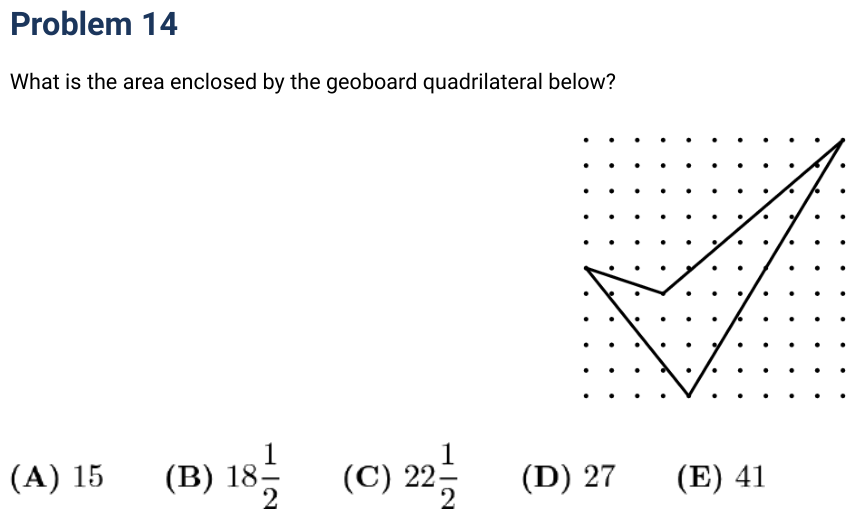
What is the area enclosed by the geoboard quadrilateral below?
Show answer
Answer: C — 22½.
Show hints
Hint 1 of 2
The shape is a slanted 'arrow' on dots — awkward to slice into clean triangles. When every corner sits on a grid point, you have a special tool that turns area into counting dots instead of measuring.
Still stuck? Show hint 2 →
Hint 2 of 2
That tool is Pick's Theorem: A = I + B/2 − 1, where I = dots strictly inside the shape and B = dots on the boundary. It works for any lattice polygon, no matter how jagged — that's its power.
Show solution
Approach: Pick's theorem (count the dots)
Because all four corners are lattice points, skip slicing — just count dots. Boundary dots: the 4 corners plus 1 grid point an edge passes through, so B = 5. Interior dots: I = 21.
Why this transfers: Pick's Theorem reduces any geoboard-area problem to two careful counts — inside dots and edge dots — and the half-integer answer (the ½) is itself a hint that an even number of boundary dots wasn't in play.
Another way — box minus surrounding triangles (decomposition):
Enclose the dart in the smallest grid rectangle that contains all four vertices.
Subtract the right triangles (and any rectangles) trapped between the dart's slanted edges and the box's sides — each such triangle has area ½ · base · height with whole-number legs.
What remains is the dart's area, 22½ — a good independent check on the dot-counting, which is easy to slip on.
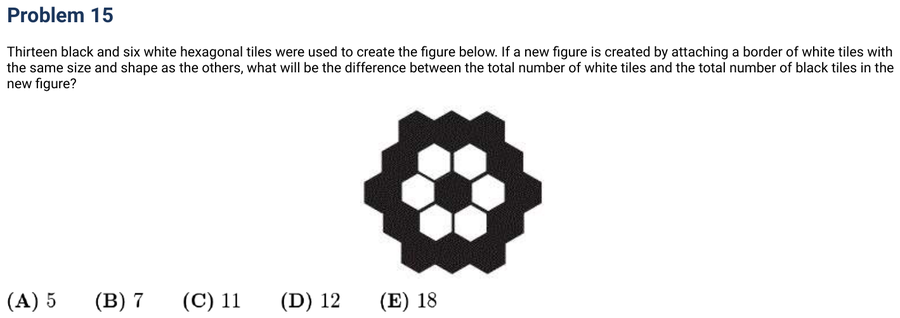
Thirteen black and six white hexagonal tiles were used to create the figure below. If a new figure is created by attaching a border of white tiles with the same size and shape as the others, what will be the difference between the total number of white tiles and the total number of black tiles in the new figure?
Show answer
Answer: C — 11.
Show hints
Hint 1 of 2
Don't recount the picture — look for the ring pattern. A center hex is surrounded by a ring of 6, then a ring of 12, and so on. Spot the rule for how big the next ring is, and you've solved it.
Still stuck? Show hint 2 →
Hint 2 of 2
The pattern is ring n holds 6n hexagons (6, 12, 18, …). The new border is the next ring out, so you only need its size — the inner tiles don't change.
Show solution
Approach: hexagonal ring counts
The figure is rings around a center hex: ring 1 has 6, ring 2 has 12 — the rule is 6n. The new white border is ring 3, so it adds 6 × 3 = 18 tiles.
Black stays put at 13. White becomes the old 6 plus the new 18 = 24.
Difference: 24 − 13 = 11.
Sanity check via the change: nothing black was added, and 18 new white tiles arrived, so the white-minus-black gap should jump by 18 from its old value. Old gap was 6 − 13 = −7; +18 gives −7 + 18 = 11. The two routes agree.
This 6n ring idea reappears in hex-grid and honeycomb problems — concentric rings grow by a fixed step.
Two 600 mL pitchers contain orange juice. One pitcher is 1/3 full and the other pitcher is 2/5 full. Water is added to fill each pitcher completely, then both pitchers are poured into one large container. What fraction of the mixture in the large container is orange juice?
Show answer
Answer: C — 11/30.
Show hints
Hint 1 of 2
The water is a red herring — adding water tops each pitcher to 600 mL but adds zero juice. So just track two numbers: how much juice total, and how much liquid total. Fraction = juice ÷ everything.
Still stuck? Show hint 2 →
Hint 2 of 2
The principle is track the part that matters, ignore the filler: the answer is (amount of OJ) / (total volume). Don't average the fractions 1/3 and 2/5 — that's the trap, since both pitchers end up the same final size only by coincidence of being equal.
Show solution
Approach: total juice over total volume
Juice in: pitcher 1 has 600 × 1/3 = 200 mL, pitcher 2 has 600 × 2/5 = 240 mL. Total juice = 440 mL.
Total liquid: both pitchers are filled, so 600 + 600 = 1200 mL.
Fraction juice = 440 / 1200 = 11/30.
Quick check: the two juice fractions 1/3 (≈ 0.33) and 2/5 (= 0.40) should blend to something between them, and 11/30 ≈ 0.367 sits right in the middle — here a plain average works only because the pitchers are equal-sized.
Another way — average the concentrations (equal pitchers only):
Because both pitchers hold the same 600 mL, the mixture's juice fraction is the plain average of the two: (1/3 + 2/5) / 2.
1/3 + 2/5 = 5/15 + 6/15 = 11/15; halve it: 11/30.
Caution: this shortcut only works when the containers are equal in size — otherwise you must weight by volume.
Three friends have a total of 6 identical pencils, and each one has at least one pencil. In how many ways can this happen?
Show answer
Answer: D — 10 ways.
Show hints
Hint 1 of 2
Picture the 6 pencils in a row. To split them among 3 friends, you just need to drop 2 'dividers' into the gaps between pencils — the dividers cut the row into three piles. Counting splits becomes counting where the dividers go.
Still stuck? Show hint 2 →
Hint 2 of 2
This is stars and bars. With the 'each person ≥ 1' rule, there are 5 gaps between the 6 pencils, and you choose 2 of them for dividers: C(5, 2). (No gap gets two dividers, so nobody is left empty.)
Show solution
Approach: stars and bars (dividers in the gaps)
Line up the 6 pencils. The 'at least one each' rule means each divider must land in a different gap between pencils — there are 5 such gaps, and we place 2 dividers.
Choose 2 of the 5 gaps: C(5, 2) = 10. So there are 10 ways.
The general tool: distributing n identical items into k groups with at least one each is C(n − 1, k − 1) — here C(6 − 1, 3 − 1) = C(5, 2) = 10.
Another way — give one away first, then distribute freely:
Hand each friend 1 pencil up front (satisfying the rule); 3 pencils remain to share with no restriction.
Five friends compete in a dart-throwing contest. Each one has two darts to throw at the same circular target, and each individual's score is the sum of the scores in the target regions that are hit. The scores for the target regions are the whole numbers 1 through 10. Each throw hits the target in a region with a different value. The scores are: Alice 16, Ben 4, Cindy 7, Dave 11, Ellen 17. Who hits the region worth 6 points?
Show answer
Answer: A — Alice.
Show hints
Hint 1 of 2
Every region 1–10 is hit exactly once across all ten darts — so once a number is 'claimed', it's gone for everyone else. Attack the score with the fewest possible pairs first: that's the smallest total, Ben = 4.
Still stuck? Show hint 2 →
Hint 2 of 2
The technique is most-constrained-first (like solving a Sudoku): handle the score that has only one possible pair, lock those numbers away, and the next score usually collapses to a single option too — a chain reaction.
Show solution
Approach: most-constrained-first chain
Ben = 4 with two different regions: the only option is 1 + 3 (2 + 2 isn't allowed). Lock away 1 and 3.
Cindy = 7 could be 1+6, 2+5, or 3+4 — but 1 and 3 are now gone, leaving only 2 + 5. Lock away 2 and 5.
Dave = 11 from what's left {4,6,7,8,9,10}: only 4 + 7 survives (5+6 and 2+9 use claimed numbers). Lock away 4 and 7.
Alice and Ellen must split the remaining {6, 8, 9, 10}. Alice = 16 forces 6 + 10 (since 7+9 uses a gone 7), and Ellen = 17 = 8 + 9.
So Alice is the one who hits 6.
Why start small: the smallest and largest totals have the fewest valid pairs, so they're the safest place to begin — each forced pair removes numbers and tightens the next one. You'll use this 'pin the most-restricted thing first' habit in every logic-grid puzzle.
A whole number larger than 2 leaves a remainder of 2 when divided by each of the numbers 3, 4, 5, and 6. The smallest such number lies between which two numbers?
Show answer
Answer: B — Between 60 and 79.
Show hints
Hint 1 of 2
A remainder of 2 every time is suspicious — it means if you set aside that constant 2, the leftover divides evenly by all four numbers. So look at x − 2 instead of x.
Still stuck? Show hint 2 →
Hint 2 of 2
The move is shift away the common remainder: x − 2 must be a common multiple of 3, 4, 5, 6, so the smallest is their LCM. (And note 6 = 2×3 is already covered by 4 and 3, so really LCM(3,4,5).)
Show solution
Approach: subtract the remainder, then LCM
Same remainder 2 for all divisors means x − 2 is divisible by 3, 4, 5, and 6 at once — so x − 2 is a common multiple.
The smallest positive common multiple is LCM(3, 4, 5, 6) = 60 (the 4 supplies 2×2, the 3 and 5 the rest; 6 adds nothing new).
So the smallest x − 2 = 60, giving x = 62, which lies between 60 and 79.
This 'remove the remainder' trick turns any 'leaves remainder r for several divisors' question into a clean LCM problem — a staple of number-theory contests.
Two-thirds of the people in a room are seated in three-fourths of the chairs. The rest of the people are standing. If there are 6 empty chairs, how many people are in the room?
Show answer
Answer: D — 27 people.
Show hints
Hint 1 of 2
The one concrete number you're given is '6 empty chairs'. Find what fraction of the chairs is empty — that fraction equals 6, which unlocks the total number of chairs. Start from the fact that ties to a real count.
Still stuck? Show hint 2 →
Hint 2 of 2
The strategy is start from the known quantity and work outward: 3/4 of chairs are filled, so 1/4 are empty → chairs → seated people → (that's 2/3 of everyone) → total people. Each fraction is a stepping stone, not a thing to combine all at once.
Show solution
Approach: anchor on the empty chairs, then chain
3/4 of the chairs are filled, so 1/4 are empty — and that 1/4 is the 6 empty chairs we're told about. So 1/4 of chairs = 6 ⇒ total chairs = 24.
Filled chairs = 3/4 × 24 = 18 people seated. But seated people are 2/3 of everyone in the room.
So 2/3 of the people = 18 ⇒ total people = 18 ÷ (2/3) = 18 × 3/2 = 27.
Sanity check: 27 people — 18 seated (2/3) and 9 standing (1/3); 9 is indeed a third, so it's consistent. The habit that transfers: grab the lone numerical fact, convert it into a count, then let each fraction pull you to the next quantity.
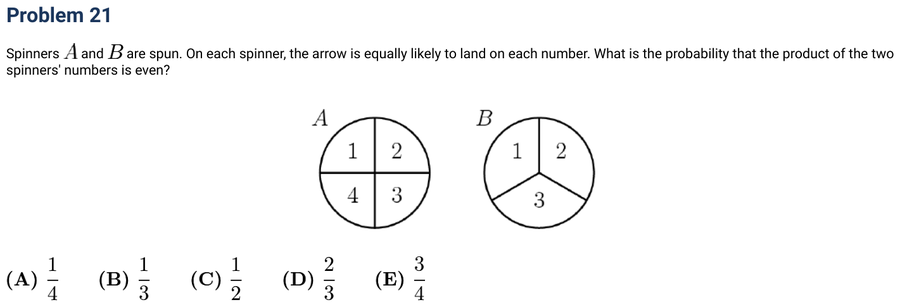
Spinners A and B are spun. On each spinner, the arrow is equally likely to land on each number. What is the probability that the product of the two spinners' numbers is even?
Show answer
Answer: D — 2/3.
Show hints
Hint 1 of 2
'Even product' can happen lots of ways (this even, that even, both even) — messy to count. But the opposite is razor-simple: a product is odd only when both spinners are odd. Count that one easy case and subtract.
Still stuck? Show hint 2 →
Hint 2 of 2
The technique is complementary counting: P(even) = 1 − P(odd), and a product is odd exactly when every factor is odd. Whenever 'at least one even' shows up, flip to 'all odd'.
Show solution
Approach: complement (1 minus all-odd)
Spinner A shows 1, 2, 4, 3 — odds are {1, 3}, so P(A odd) = 2/4 = 1/2. Spinner B shows 1, 2, 3 — odds are {1, 3}, so P(B odd) = 2/3.
Product is odd only if both are odd: P(odd) = (1/2)(2/3) = 1/3.
Therefore P(even) = 1 − 1/3 = 2/3.
Why the complement wins: the direct count needs three even-cases, but 'both odd' is a single product — one multiplication instead of several additions. Odd × odd = odd is the only way to dodge an even factor.
Another way — count favorable outcomes directly:
There are 4 × 3 = 12 equally likely (A, B) outcomes.
Odd products come only from A ∈ {1,3} and B ∈ {1,3}: that's 2 × 2 = 4 odd outcomes, so 12 − 4 = 8 even outcomes.
At a party there are only single women and married men with their wives. The probability that a randomly selected woman is single is 2/5. What fraction of the people in the room are married men?
Show answer
Answer: B — 3/8.
Show hints
Hint 1 of 2
The fraction 2/5 is begging you to pick a friendly number of women — choose 5, so 2 are single and 3 are married, with no ugly fractions. The hidden link: every married woman comes with exactly one husband, so married men = married women.
Still stuck? Show hint 2 →
Hint 2 of 2
The technique is plug in a convenient total (pick the denominator) plus spotting the pairing: married men and married women come in couples, so their counts are equal. Then it's just a head-count.
Show solution
Approach: pick 5 women, count heads
Let there be 5 women (matches the /5). Then 2/5 × 5 = 2 are single and the other 3 are married.
Key link: married couples pair up, so the 3 married women bring 3 married men — and the room has only single women and married couples, no one else.
Total people = 5 women + 3 men = 8. Married men out of everyone = 3/8.
Sanity check on the trap: 'single women = 2/5' is the fraction of women, not of people; the married-men fraction (3/8) uses the bigger people-total, so it should be smaller than a naive 3/5 — and it is. Picking a concrete total turns abstract-fraction problems into plain counting.
Another way — algebra with a variable:
Let women = w. Single women = (2/5)w, married women = (3/5)w = married men.
Total people = w + (3/5)w = (8/5)w.
Married men / people = (3/5)w ÷ (8/5)w = 3/8 — the w cancels, confirming the choice of 5 didn't matter.
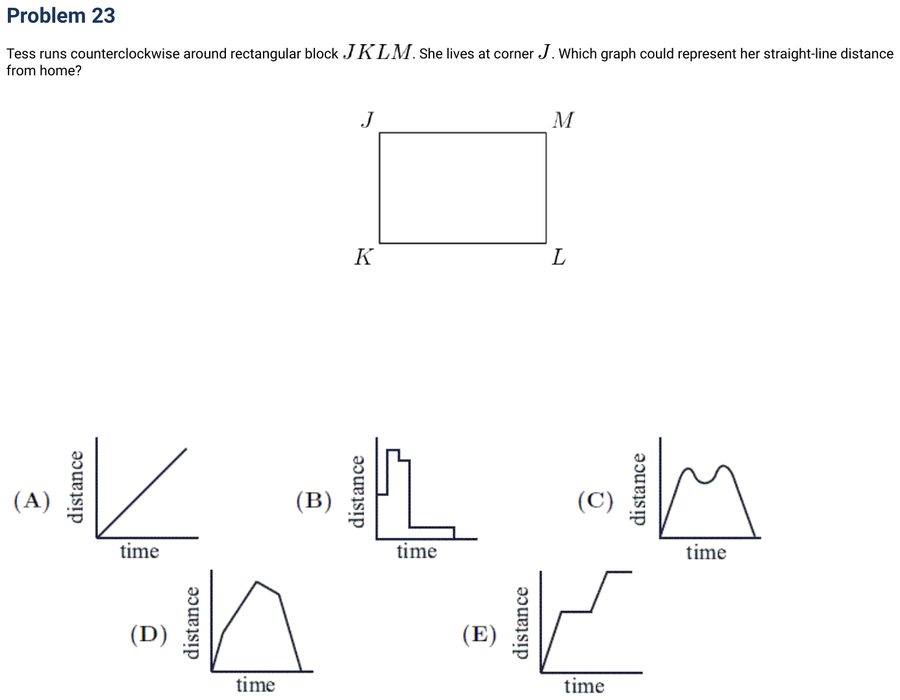
Tess runs counterclockwise around rectangular block JKLM. She lives at corner J. Which graph could represent her straight-line distance from home?
Show answer
Answer: D — Graph D.
Show hints
Hint 1 of 2
Don't compute — tell the story of the distance and match its shape. Tess leaves home (J), gets steadily farther, is farthest when she's diagonally across at L, then comes home. Where does the graph start, where does it peak, where does it end?
Still stuck? Show hint 2 →
Hint 2 of 2
The skill is reading a graph by its qualitative features: check three things — start value, number of peaks, end value — and eliminate. Here: starts at 0, exactly one peak (at L), ends back at 0.
Show solution
Approach: match the shape, eliminate the rest
Trace the trip J→K→L→M→J. Distance from home starts at 0, grows as she heads to K, keeps growing to the diagonally-opposite corner L (the farthest point), then shrinks back through M to 0 at J. So the graph must start at 0, rise to a single maximum, and fall back to 0.
Eliminate with those checkpoints: (A) only rises and never returns — out. (B) starts high and decreases — out. (C) has two peaks — out. (E) rises to a plateau and stays — out.
Only D shows the one-hump 'leave and return' shape.
The transferable habit: for 'which graph' problems, narrate the situation and pin down start, peaks/valleys, and end — those three features alone usually kill four of the five choices. Bonus insight: the curve is gently bowed, not made of straight segments, because straight-line distance grows like a hypotenuse — quickly at first, then leveling near the peak.
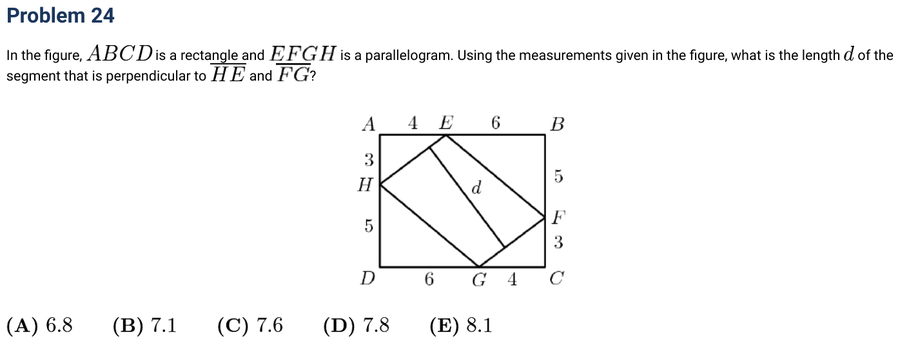
In the figure, ABCD is a rectangle and EFGH is a parallelogram. Using the measurements given in the figure, what is the length d of the segment that is perpendicular to HE and FG?
Show answer
Answer: C — 7.6.
Show hints
Hint 1 of 3
There's no direct way to measure that slanted height d. But d is the parallelogram's height on base HE, so if you knew the parallelogram's area, you'd get d = area ÷ base. So the real task is: find the parallelogram's area.
Still stuck? Show hint 2 →
Hint 2 of 3
The strategy is area two ways: get the parallelogram's area the easy way (whole rectangle minus the four corner right-triangles), then set it equal to base × height to solve for the height you actually want.
Still stuck? Show hint 3 →
Hint 3 of 3
The base HE is the hypotenuse of a 3-4 right triangle in the corner, so HE = 5 — a clean Pythagorean leg-up before you divide.
Show solution
Approach: area two ways → height = area / base
Find the parallelogram's area by subtraction. The rectangle is 10 wide (4 + 6) by 8 tall (3 + 5), area 80. The four corner triangles cut off are right triangles: top-left legs 4×3 (area 6), top-right 6×5 (area 15), bottom-right 4×3 (area 6), bottom-left 6×5 (area 15) — total 6 + 15 + 6 + 15 = 42.
So parallelogram EFGH has area 80 − 42 = 38.
Now use area = base × height with base HE = √(3² + 4²) = 5: 38 = 5d, so d = 38 ÷ 5 = 7.6.
Why this transfers: when a length is awkward to measure directly, compute the same area by an easy route, then back the length out of area = base × height. Sanity check: the height should be shorter than the rectangle's 8, and 7.6 < 8.
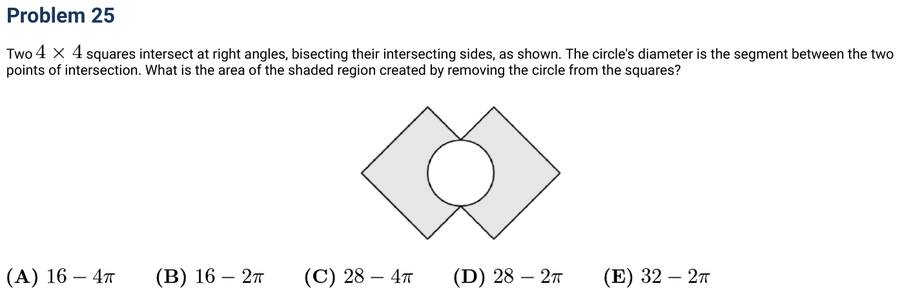
Two 4 × 4 squares intersect at right angles, bisecting their intersecting sides, as shown. The circle's diameter is the segment between the two points of intersection. What is the area of the shaded region created by removing the circle from the squares?
Show answer
Answer: D — 28 − 2π.
Show hints
Hint 1 of 3
The shaded area is 'both squares, minus the circle'. The trap is double-counting the overlap, so first nail the combined area of the two squares using inclusion–exclusion: square + square − the piece they share.
Still stuck? Show hint 2 →
Hint 2 of 3
The shared piece is the small square where they cross. 'Bisecting their intersecting sides' means each square is cut at the midpoints of those sides, so the overlap is a 2×2 square (area 4).
Still stuck? Show hint 3 →
Hint 3 of 3
For the circle, the diameter is the segment joining the two crossing points — that's the diagonal of the 2×2 overlap square. Diagonal = 2√2, so radius = √2.
Show solution
Approach: inclusion–exclusion, then subtract the circle
Combined area of the two squares (avoid double-counting the middle): 16 + 16 − (overlap). The overlap is a 2×2 square because the squares meet at the midpoints of the crossed sides, so overlap = 4. Combined region = 16 + 16 − 4 = 28.
Circle: its diameter is the diagonal of that 2×2 overlap square = 2√2, so radius = √2 and area = π(√2)² = 2π.
Shaded = combined region − circle = 28 − 2π.
Why these two ideas pair up so often: inclusion–exclusion (add the parts, subtract the shared piece once) handles the overlapping squares, and the √2 comes from a square's diagonal — both are workhorses you'll reuse constantly. Estimate check: 2π ≈ 6.3, so the shaded area is about 28 − 6.3 ≈ 21.7, comfortably less than the 28 of squares alone.