Jamie counted the number of edges of a cube, Jimmy counted the corners, and Judy counted the faces. They then added the three numbers. What was the resulting sum?
Show answer
Answer: E — 26.
Show hints
Hint 1 of 2
Picture a die or a box in your hand and count the three kinds of parts separately: pointy corners, line edges, flat faces.
Still stuck? Show hint 2 →
Hint 2 of 2
A cube's part-counts are worth memorizing: 8 corners, 12 edges, 6 faces.
Show solution
Approach: count the three kinds of cube parts and add
Count each kind separately so nothing gets mixed up. Corners (the points): 8. Edges (the lines): 12. Faces (the flat sides): 6.
8 + 12 + 6 = 26.
Worth keeping: for any cube or box these never change — 8 corners, 12 edges, 6 faces. (They even fit Euler's rule: corners − edges + faces = 8 − 12 + 6 = 2 for any solid like this.)
Which of the following numbers has the smallest prime factor?
Show answer
Answer: C — 58 (its smallest prime factor is 2).
Show hints
Hint 1 of 2
Don't factor all five numbers — ask what the smallest possible prime factor even is, then look for it.
Still stuck? Show hint 2 →
Hint 2 of 2
The smallest prime is 2, and only even numbers own a factor of 2. Scan for the even one.
Show solution
Approach: chase the smallest prime (2) instead of factoring everything
The winner needs the tiniest prime factor, and no prime beats 2. So the real question is: which choice is even? An even number automatically has 2 as its smallest prime factor.
58 is the only even number on the list, so its smallest prime factor is 2 — smaller than any odd number can manage. Answer 58.
You'll see this again: 'smallest/largest prime factor' problems reward looking for the small primes (2, then 3, then 5) first rather than fully factoring every option.
A burger at Ricky C's weighs 120 grams, of which 30 grams are filler. What percent of the burger is not filler?
Show answer
Answer: D — 75%.
Show hints
Hint 1 of 2
"Percent that is NOT filler" means the non-filler part compared to the whole burger — find that part first.
Still stuck? Show hint 2 →
Hint 2 of 2
Percent of a whole = part ÷ whole, written out of 100.
Show solution
Approach: part over whole
The question asks for the non-filler part, so peel it off first: 120 − 30 = 90 grams are not filler.
Now compare that part to the whole burger: 90/120. This simplifies to 3/4 = 75%.
Shortcut check: the filler is 30/120 = 1/4 = 25%, and the rest must make 100%, so 100% − 25% = 75% — same answer, faster. Finding one part and subtracting from 100% often beats computing the other part directly.
Another way — filler percent, then subtract from 100%:
A group of children riding on bicycles and tricycles rode past Billy Bob's house. Billy Bob counted 7 children and 19 wheels. How many tricycles were there?
Show answer
Answer: C — 5 tricycles.
Show hints
Hint 1 of 2
Don't set up two equations — pretend every child is on a bicycle first and watch what's missing.
Still stuck? Show hint 2 →
Hint 2 of 2
Each tricycle is just a bicycle with one extra wheel, so the leftover wheels count the tricycles directly.
Show solution
Approach: assume all bicycles, then the leftover wheels count the tricycles
Suppose all 7 children rode bicycles. That would be 7 × 2 = 14 wheels — but only counts as a starting guess.
We actually see 19 wheels, so 19 − 14 = 5 wheels are unaccounted for. A tricycle is just a bicycle with one extra wheel, so each leftover wheel marks one tricycle: 5 tricycles.
You'll see this again: the "assume the cheapest option, then spend the surplus" trick cracks chickens-and-rabbits, coins, and stamp problems without any algebra.
Another way — solve the system:
With b bicycles and t tricycles: b + t = 7 and 2b + 3t = 19.
Subtract twice the first from the second: t = 19 − 14 = 5.
If 20% of a number is 12, what is 30% of the same number?
Show answer
Answer: B — 18.
Show hints
Hint 1 of 2
The mystery number never has to be found — 30% and 20% of the SAME number are themselves in a fixed ratio.
Still stuck? Show hint 2 →
Hint 2 of 2
30% is 1.5 times as much as 20%, so the answer is 1.5 times the 12.
Show solution
Approach: scale the known percentage up directly
Both percentages sit on the same number, so 30% relates to 20% the same way 30 relates to 20: it's 1.5 times as big.
Whatever 20% is worth (12), 30% is 1.5 of that: 1.5 × 12 = 18.
Why this is faster: a handier unit here is 10%, which is 12 ÷ 2 = 6. Then 30% = three of those tens = 6 × 3 = 18. Working in 10%-chunks skips finding the whole number entirely.
Another way — find the whole first:
20% of the number is 12, so the number is 12 ÷ 0.2 = 60.
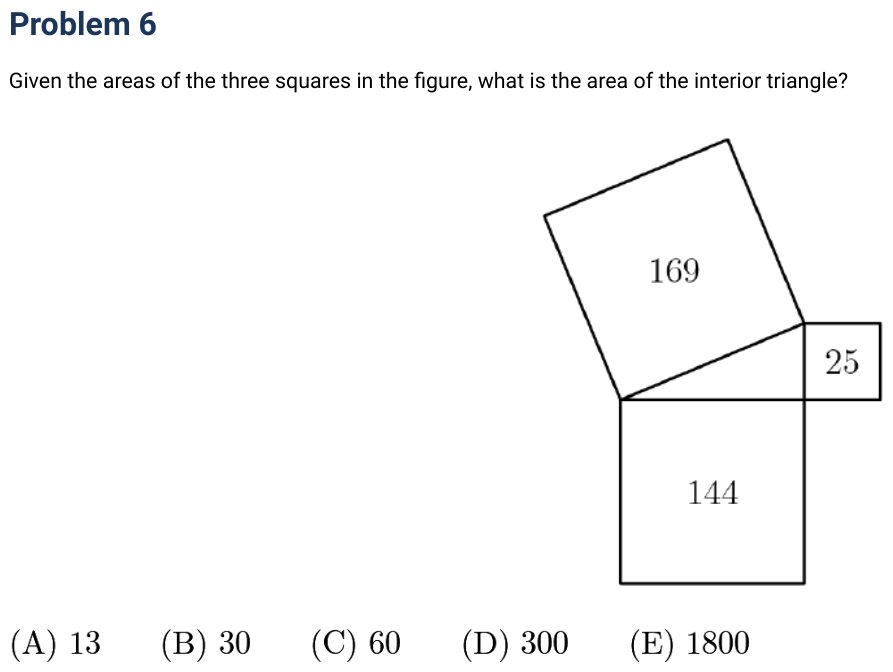
Each square is built on a side of the triangle, so the side of a square IS a side of the triangle — square-root each area.
Still stuck? Show hint 2 →
Hint 2 of 2
5, 12, 13 is a famous Pythagorean triple, so the triangle has a right angle and the two shorter sides are its legs.
Show solution
Approach: areas give the side lengths; recognize the right triangle
A square's side length is the square root of its area, and each square shares a side with the triangle. So the triangle's sides are √169 = 13, √144 = 12, and √25 = 5.
Check 5² + 12² = 25 + 144 = 169 = 13²: the sides fit the Pythagorean rule, so the angle between the two short sides is a right angle. That makes 5 and 12 the perpendicular legs — the base and height.
Area of a right triangle = ½ × leg × leg = ½ × 5 × 12 = 30.
Worth keeping: 5-12-13 and 3-4-5 (and its scalings) are the triples to memorize — spotting one instantly tells you a triangle is right-angled, no slow Pythagorean computation needed.
Blake and Jenny each took four 100-point tests. Blake averaged 78 on the four tests. Compared with Blake, Jenny scored 10 points higher on the first test, 10 points lower on the second, and 20 points higher on each of the third and fourth. By how much does Jenny's average exceed Blake's on these four tests?
Show answer
Answer: A — 10 points.
Show hints
Hint 1 of 2
The number 78 is a decoy — the question only asks how far apart the two averages are, so work with the gaps, not the actual scores.
Still stuck? Show hint 2 →
Hint 2 of 2
The gap between two averages equals the average of the test-by-test gaps.
Show solution
Approach: average the differences, not the scores
Ignore Blake's 78 — it cancels out of any difference. Just track how far ahead Jenny is each test: +10, −10, +20, +20.
Add the gaps: 10 − 10 + 20 + 20 = +40 total points ahead over four tests. The difference of the averages is the average of those gaps: 40 ÷ 4 = 10 points.
Why this works (and transfers): averages are linear — (Jenny's avg) − (Blake's avg) always equals the average of (Jenny − Blake) per test. Comparing two data sets? Subtract first, average second, and the shared baseline disappears.
Art, Roger, Paul, and Trisha bake cookies that are all the same thickness, in the shapes shown below (dimensions in inches). Each friend uses the same amount of dough, and Art's batch makes exactly 12 cookies.
Who makes the fewest cookies from one batch of dough?
Show answer
Answer: A — Art.
Show hints
Hint 1 of 2
Flip the question: the SAME pile of dough splits into fewer cookies exactly when each cookie is bigger — so you're really hunting for the largest single shape.
Still stuck? Show hint 2 →
Hint 2 of 2
Just compare the four areas; the biggest area means the fewest cookies.
Show solution
Approach: same dough, so biggest cookie means fewest cookies
Everyone starts with the same amount of dough, so cookies = dough ÷ (one cookie's size). Bigger cookie, fewer of them. So you only need to find the largest shape — no need to know how much dough there is.
Areas (square inches): Art is a trapezoid, ½(3 + 5)(3) = 12; Roger's rectangle 2 × 4 = 8; Paul's parallelogram 3 × 2 = 6; Trisha's triangle ½(3)(4) = 6.
Art's 12 in² cookie is the biggest, so Art makes the fewest.
Worth keeping: a trapezoid's area is ½(top + bottom) × height — the average of the two parallel sides times the distance between them.
Art, Roger, Paul, and Trisha bake cookies that are all the same thickness, in the shapes shown below (dimensions in inches). Each friend uses the same amount of dough, and Art's batch makes exactly 12 cookies.
Art's cookies sell for 60 cents each. To bring in the same total from one batch, how much should one of Roger's cookies cost, in cents?
Show answer
Answer: C — 40 cents.
Show hints
Hint 1 of 2
Both bakers earn the same total from the same dough, so every square inch of cookie is worth the same money — a small cookie should cost proportionally less.
Still stuck? Show hint 2 →
Hint 2 of 2
Price per cookie scales with cookie area: take Roger's area ÷ Art's area, then apply that fraction to 60¢.
Show solution
Approach: price per cookie scales with cookie area
Same dough and same total revenue means the price is really being charged per square inch of cookie. So a cookie's price is proportional to its area — you can scale straight from area to price.
Roger's cookie is 8 in², Art's is 12 in²: Roger's is 8/12 = 2/3 the size.
So Roger charges 2/3 of Art's price: 60 × 2/3 = 40 cents.
You'll see this again: spotting the hidden constant rate (here, cents per in²) turns a multi-step count into one proportion.
Another way — count the cookies:
Art: 12 cookies at 60¢ = 720¢ per batch, using 12 × 12 = 144 in² of dough.
Art, Roger, Paul, and Trisha bake cookies that are all the same thickness, in the shapes shown below (dimensions in inches). Each friend uses the same amount of dough, and Art's batch makes exactly 12 cookies.
How many cookies will be in one batch of Trisha's cookies?
Show answer
Answer: E — 24 cookies.
Show hints
Hint 1 of 2
Skip computing the dough total — just compare cookie sizes: Trisha's vs. Art's.
Still stuck? Show hint 2 →
Hint 2 of 2
Half the size means double the count, because the same dough is being split into pieces.
Show solution
Approach: compare Trisha's cookie to Art's directly
Art makes 12 cookies of 12 in² each. Trisha's triangle is ½(3)(4) = 6 in² — exactly half of Art's.
Same dough split into half-size pieces makes twice as many pieces: 12 × 2 = 24.
Worth keeping: for a fixed total, count and size are inversely proportional — halve the size, double the count; third the size, triple the count. Reaching for the "144 in² total" works too, but the size comparison is one step.
Another way — through the dough total:
A batch is 12 of Art's 12 in² cookies = 144 in² of dough.
Business is a little slow at Lou's Fine Shoes, so Lou decides to have a sale. On Friday, Lou increases all of Thursday's prices by 10%. Over the weekend, Lou advertises the sale: "Ten percent off the listed price. Sale starts Monday." How much does a pair of shoes cost on Monday that cost $40 on Thursday?
Show answer
Answer: B — $39.60.
Show hints
Hint 1 of 2
Tempting to say up 10% then down 10% cancels — but the 10% cut comes off the new, larger price, so it removes more than the increase added.
Still stuck? Show hint 2 →
Hint 2 of 2
Turn each percent change into a multiplier and chain them: ×1.1 (up 10%) then ×0.9 (down 10%).
Show solution
Approach: turn each change into a multiplier and chain them
Each percent change is a multiplier: a 10% raise is ×1.1, a 10% cut is ×0.9. Apply them in order: Friday 40 × 1.1 = 44, then Monday 44 × 0.9 = 39.60.
The order doesn't even matter, since multipliers just combine: 1.1 × 0.9 = 0.99, so the price ends at 40 × 0.99 = 39.60 — below the start, not back to it.
Worth keeping: +x% then −x% always lands a little low, because 0.99 < 1 (in general (1+r)(1−r) = 1 − r²). Percent changes multiply, they don't add — so they never simply cancel.
When a fair six-sided die is tossed on a table top, the bottom face cannot be seen. What is the probability that the product of the numbers on the five faces that can be seen is divisible by 6?
Show answer
Answer: E — 1 (it always happens).
Show hints
Hint 1 of 2
Don't multiply anything — 6 = 2 × 3, so you only need a 2 and a 3 to BOTH be among the faces you can see.
Still stuck? Show hint 2 →
Hint 2 of 2
Only one face hides at a time. Ask the worst case: even if the hidden face is the 6, is a 2 and a 3 still showing?
Show solution
Approach: prove the event is certain (probability 1)
A product is divisible by 6 the moment it contains a factor of 2 and a factor of 3 (since 6 = 2 × 3). So we just need both a 2 and a 3 visible — no multiplying required.
Test the worst case: only one face hides. If the hidden face is the 6, the 2 and 3 are still both up, so the product has 2 × 3. If the hidden face is anything else, then the 6 itself is showing, which already supplies the factor of 6.
There is no roll that fails, so the event always happens — probability 1.
You'll see this again: when every outcome works, the probability is exactly 1 (a certain event). Checking the single worst case is enough to prove "always."
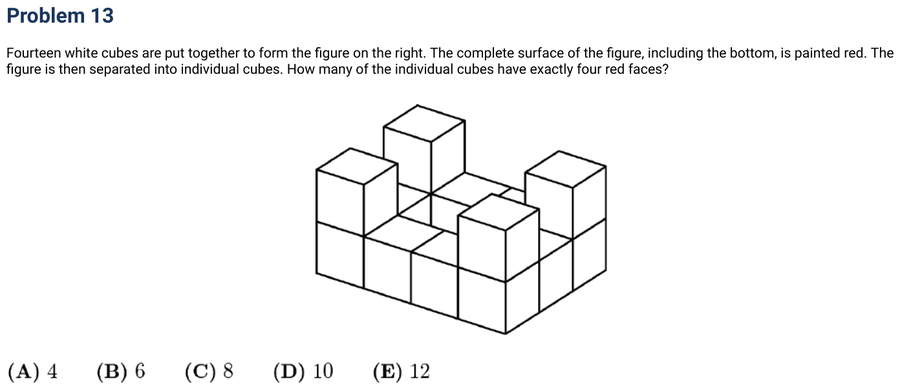
"Painted faces" just means "exposed faces", so reword the question: which cubes have exactly four sides touching the outside air?
Still stuck? Show hint 2 →
Hint 2 of 2
Don't paint every cube — instead find the misfits. Sort the 14 cubes by exposure: the perched-on-top ones are too open, the buried bottom corners too hidden, and what's left must be the fours.
Show solution
Approach: count exposed faces per cube, then subtract the misfits
Paint reaches a cube's face only if that face is exposed, and the bottom counts as exposed too. So "exactly four painted faces" means "exactly four exposed sides." Rather than tally all 14, find the cubes that are too exposed or too hidden and subtract.
The 4 cubes perched on top of the base are open on all 4 sides plus the top — that's 5 painted faces, too many.
The 4 corner cubes of the bottom layer touch neighbors on two sides, leaving only 3 faces (two sides + bottom) exposed — too few.
Everything else has exactly four exposed sides. So 14 − 4 (tops) − 4 (bottom corners) = 6 cubes.
You'll see this again: for "how many cubes have exactly k painted faces," count by a cube's position (corner / edge / face-center / hidden) instead of inspecting cubes one at a time — position fixes the exposure.
In this addition problem, each letter stands for a different digit.
    T W O
  + T W O
  -------
  F O U R
If T = 7 and the letter O represents an even number, what is the only possible value for W?
Show answer
Answer: D — W = 3.
Show hints
Hint 1 of 2
TWO + TWO is just TWO doubled, so every column is a digit being doubled (maybe plus a carry) — that's a strong constraint.
Still stuck? Show hint 2 →
Hint 2 of 2
Start at the most-constrained column. With T = 7, the hundreds give 14 (+ carry), forcing the leading F = 1 and pinning O; then "O is even" finishes it.
Show solution
Approach: double TWO column by column, starting where it's pinned
TWO + TWO = 2 × TWO, and doubling a 3-digit number can only push it to 4 digits by carrying a 1 — so F = 1, the only digit a carry can produce.
Hundreds column is the most pinned: 7 + 7 = 14, plus a possible carry from the tens, lands the hundreds digit O at 4 or 5. Since O is even, O = 4 — and that means nothing carried in, so the tens column did not overflow.
Units: O + O = 4 + 4 = 8, so R = 8 with no carry. The tens column is therefore just W + W = U, with no carry either way.
Now place W: 2W = U must stay under 10 (no overflow) and U must avoid the used digits 7, 1, 4, 8. W = 0→U = 0 (clashes with W and is reused), W = 1, 4 taken, W = 2→U = 4 (taken). Only W = 3 works, giving U = 6. W = 3.
You'll see this again: in cryptarithms, attack the column with the fewest unknowns first (often the leading carry, which is almost always 1), and let each forced digit cascade into the next column.
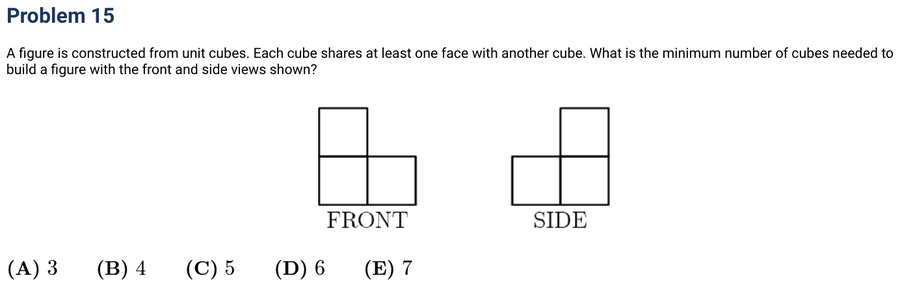
For a MINIMUM, make each cube do double duty — one cube can show up in both the front view and the side view at once.
Still stuck? Show hint 2 →
Hint 2 of 2
Build the L-shaped front view with 3 cubes first, then add only what the side view still demands.
Show solution
Approach: reuse cubes across both views; add only what's missing
Minimizing means letting cubes count toward both pictures. Start with the front view, an L of 3 squares — that needs at least 3 cubes, sitting in one flat plane.
Now check the side view: it's also an L with depth, meaning something must sit behind the front row. Those 3 cubes alone give a side view only 1 cube deep, which is wrong. Adding one cube behind the corner fixes the side view — and that 4th cube touches the others, so the "every cube shares a face" rule holds.
No fewer than 4 can cover both an L front and an L side, so the minimum is 4 cubes.
You'll see this again: in "fewest cubes for these views" problems, the answer is driven by where the two views disagree — build the bigger view, then patch only the parts the other view still forces.
Ali, Bonnie, Carlo, and Dianna are going to drive together to a nearby theme park. The car they are using has four seats: one driver's seat, one front passenger seat, and two back passenger seats. Bonnie and Carlo are the only ones who know how to drive the car. How many possible seating arrangements are there?
Show answer
Answer: D — 12 arrangements.
Show hints
Hint 1 of 2
Handle the seat with a rule attached FIRST — the driver's seat — before the free-for-all of the other seats.
Still stuck? Show hint 2 →
Hint 2 of 2
Once the driver is locked in, the remaining three people just fill three seats with no restrictions.
Show solution
Approach: fill the restricted seat first (the constrained-choice rule)
The driver's seat is the only one with a rule: just Bonnie or Carlo can sit there, so 2 choices. Settling the restriction first keeps it from tangling the rest.
With the driver seated, the other 3 people drop into the 3 remaining seats freely: 3! = 3 × 2 × 1 = 6 ways.
Multiply the independent stages: 2 × 6 = 12 arrangements.
Worth keeping: in counting problems, fill the most restricted slot first — if you save it for last, the count for the "free" slots changes depending on earlier picks and the multiplication breaks down.
The six children listed below are from two families of three siblings each. Each child has blue or brown eyes and black or blond hair. Children from the same family have at least one of these characteristics in common. Which two children are Jim's siblings?
Child
Eye Color
Hair Color
Benjamin
Blue
Black
Jim
Brown
Blond
Nadeen
Brown
Black
Austin
Blue
Blond
Tevyn
Blue
Black
Sue
Blue
Blond
Show answer
Answer: E — Austin and Sue.
Show hints
Hint 1 of 2
A sibling of Jim must MATCH Jim on eyes or hair — cross off anyone who shares neither of his traits.
Still stuck? Show hint 2 →
Hint 2 of 2
Look for three children who share a single trait among themselves; if they make one valid family, the leftovers must be the other.
Show solution
Approach: shortlist by Jim's traits, then split the six into two valid families
Jim has brown eyes and blond hair. A sibling must match at least one, so anyone with blue eyes and black hair is out. That leaves only Nadeen (brown eyes), Austin (blond), and Sue (blond) as possible siblings — and Jim has exactly 2 siblings, so two of these three are his.
Now use the "other family" to break the tie. Benjamin, Nadeen, and Tevyn all have black hair — they form a complete, valid family of three on their own. That uses up Nadeen.
The remaining three — Jim, Austin, Sue — are all blond, a valid family too. So Jim's siblings are Austin and Sue.
You'll see this again: when a group must split into valid sub-groups, finding one forced sub-group (the three black-haired kids) automatically determines the other — you rarely have to test every option.
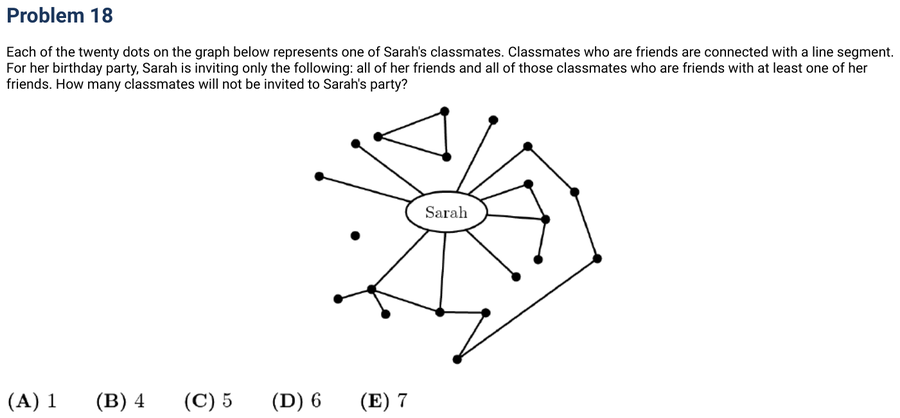
Translate the words into distance: "friends" are 1 link from Sarah, "friends of friends" are 2 links — so she invites everyone within 2 links.
Still stuck? Show hint 2 →
Hint 2 of 2
It's faster to count who's NOT invited: the dots that are 3+ links away or not connected to Sarah at all.
Show solution
Approach: measure each dot's link-distance from Sarah, then count the far ones
Rephrase the rule as distance. Sarah's friends are 1 segment away; their friends are 2 segments away. So an invitation reaches everyone at most 2 links from Sarah.
Sweep outward from Sarah in layers: layer 1 (direct friends), then layer 2 (their friends). Anyone left over — 3+ links away, or in a separate clump with no path to her — is not invited.
Reading the graph that way: 4 dots sit in disconnected clusters (no path to Sarah), and 2 more are reachable only after 3 links. Those are the uninvited ones.
4 + 2 = 6 classmates not invited.
You'll see this again: "friends within k steps" is a graph-distance question — spreading outward layer by layer (1 link, 2 links, 3 links…) is exactly how you find everything reachable within a fixed number of hops.
What is the measure of the acute angle formed by the hands of the clock at 4:20 PM?
Show answer
Answer: D — 10°.
Show hints
Hint 1 of 2
The trap is assuming the hour hand sits right on the 4 — it has crept toward 5. Pin down each hand's exact spot before measuring the gap.
Still stuck? Show hint 2 →
Hint 2 of 2
At :20 the minute hand lands exactly on the 4, so the whole gap is just how far the hour hand has drifted past the 4.
Show solution
Approach: pin each hand's exact position, then take the gap
Minute hand first: 20 minutes is 20/60 = 1/3 of the way around, which lands it exactly on the 4 (since the 4 marks 20 minutes). So both hands are near the 4 — convenient.
Hour hand next, and here's the catch: by 4:20 it has slid 1/3 of the way from 4 toward 5. Each number-to-number gap is 360° ÷ 12 = 30°, so the hour hand sits 30° ÷ 3 = 10° past the 4.
The minute hand is right on the 4, the hour hand 10° beyond it, so they're 10° apart.
Worth keeping: the hour hand moves 30° per hour = 0.5° per minute; the minute hand moves 6° per minute. Knowing both speeds lets you place either hand at any time — and remembering the hour hand keeps drifting is what saves you from the 0° trap.
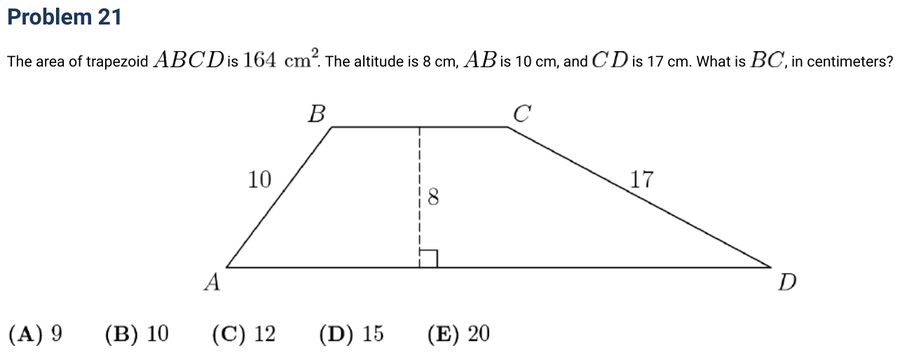
The slanted legs hide right triangles — drop a vertical from each top corner to the bottom side and the 8-cm altitude becomes a shared leg.
Still stuck? Show hint 2 →
Hint 2 of 2
A leg of 10 with height 8 is a 6-8-10 triangle; a leg of 17 with height 8 is an 8-15-17 triangle. Those triples hand you the horizontal overhangs for free.
Show solution
Approach: drop the legs into right triangles, then let the area equation finish it
Drop perpendiculars from B and C straight down to the long side AD; both have length 8 (the altitude). Each slanted leg is now the hypotenuse of a right triangle. AB = 10 with a vertical leg of 8 is a 6-8-10 triangle, so its base is 6. CD = 17 with a vertical leg of 8 is an 8-15-17 triangle, so its base is 15.
The bottom AD is the top BC plus those two overhangs: AD = BC + 6 + 15 = BC + 21.
The area gives the second relation. Trapezoid area = ½(sum of parallel sides)(height): ½(BC + AD)(8) = 164, so BC + AD = 41.
Substitute: BC + (BC + 21) = 41 → 2·BC = 20 → BC = 10.
You'll see this again: recognizing 6-8-10 and 8-15-17 turns "find the missing horizontal piece" into instant recall — no Pythagorean square-rooting. The trapezoid then becomes one length equation plus one area equation.
Another way — average-of-parallel-sides shortcut:
The two overhangs (6 and 15) total 21, so AD is exactly 21 longer than BC. Their average — the trapezoid's "midline" — is BC + 10.5.
Area = midline × height = (BC + 10.5) × 8 = 164, so BC + 10.5 = 20.5.
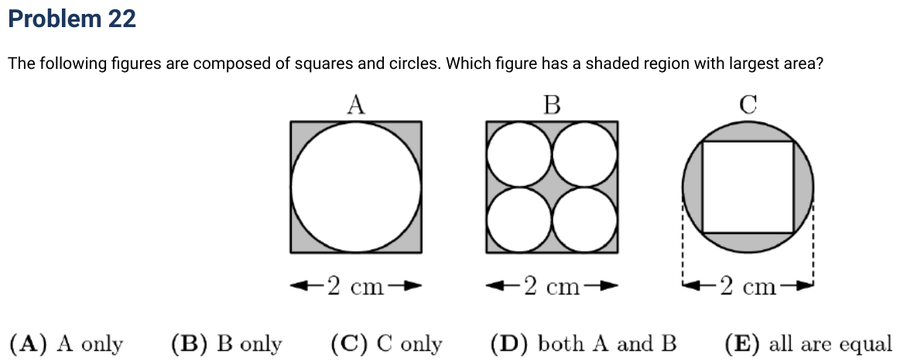
Before computing, notice A's one circle and B's four circles cover the SAME total area in the same square — so A and B must tie, and the real contest is C.
Still stuck? Show hint 2 →
Hint 2 of 2
In C the square is inscribed in the circle, so the square's diagonal equals the circle's diameter — that's how you get the square's size.
Show solution
Approach: compare the three shaded areas (each is "whole minus a circle/square")
A: a 2×2 square (area 4) minus its inscribed circle (radius 1, area π) = 4 − π ≈ 0.86.
B: the same 2×2 square minus four circles of radius ½. Each has area π/4, so four total π — the same circle area as in A. Shaded = 4 − π ≈ 0.86, tied with A. (Shrinking one circle into four smaller ones that fill the same span doesn't change the leftover.)
C: a circle minus an inscribed square. The square's diagonal equals the diameter, 2, and a square's area is ½(diagonal)² = ½(2)² = 2. The circle has radius 1, area π. Shaded = π − 2 ≈ 1.14.
0.86, 0.86, 1.14 — C wins, so the answer is C only.
Worth keeping: a square's area straight from its diagonal d is ½d² (no need to find the side first). And spotting that A and B share the same circle area kills two of three computations before you start.
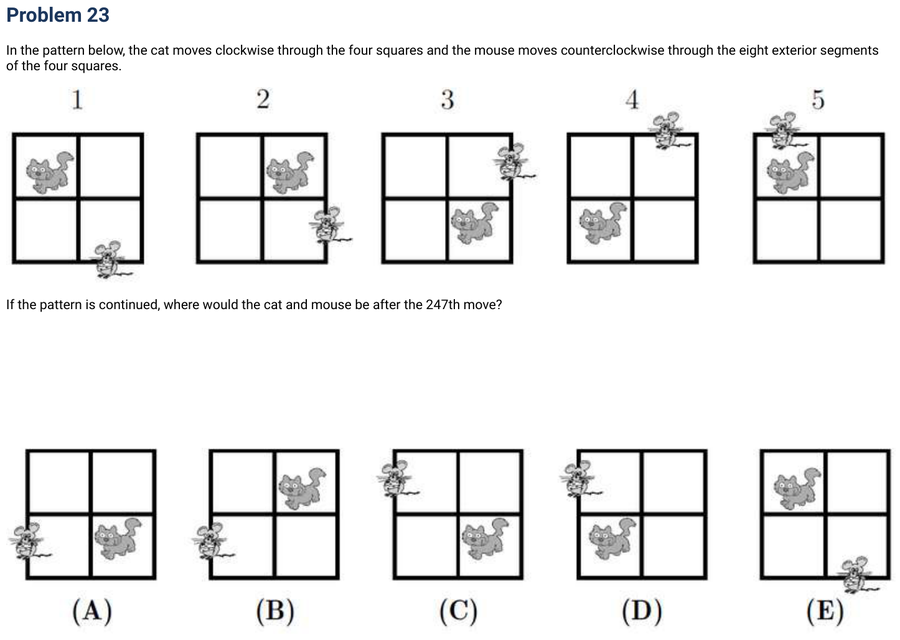
Answer: A — the cat in the bottom-right square, the mouse on the bottom-left segment.
Show hints
Hint 1 of 2
247 is huge, but each animal just loops — so don't trace 247 steps, find each one's cycle length and use only the remainder.
Still stuck? Show hint 2 →
Hint 2 of 2
The cat returns home every 4 moves (4 squares); the mouse every 8 (8 segments). Divide 247 by each and keep the remainder.
Show solution
Approach: reduce 247 by each cycle length separately
Both animals repeat, so after a full loop they're back to start — only the remainder of 247 matters, and the two can be handled independently.
Cat: 4 squares per loop. 247 = 4·61 + 3, remainder 3, so the cat sits where it is after move 3 — the bottom-right square.
Mouse: 8 segments per loop. 247 = 8·30 + 7, remainder 7, so the mouse sits where it is after move 7 — the bottom-left segment.
The only picture with the cat bottom-right and mouse bottom-left is A.
You'll see this again: for two things cycling at different rates, reduce the big move count mod each cycle separately — remainder by 4 for the cat, by 8 for the mouse — rather than tracking them together.
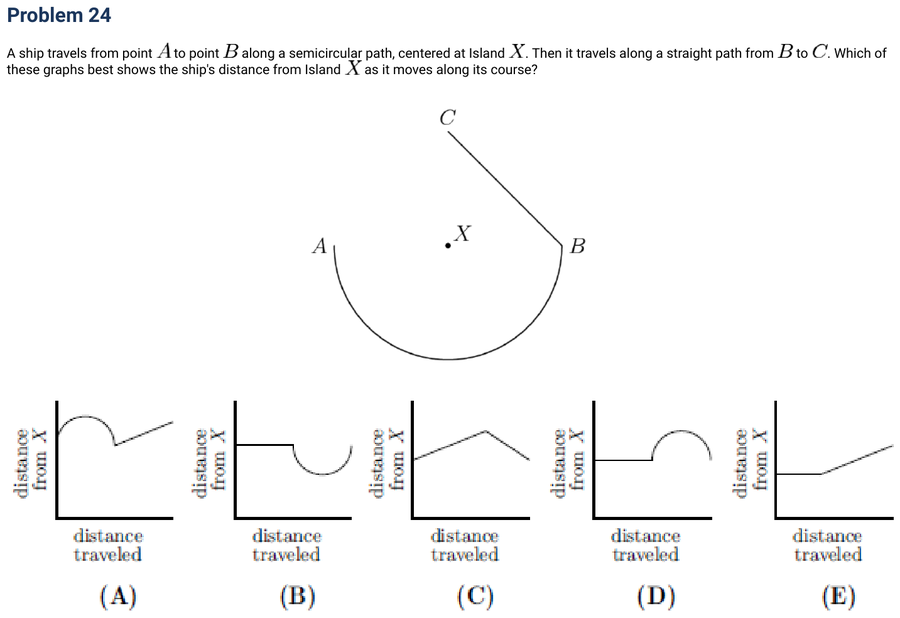
Don't read the graph as the ship's position — it's the ship's distance from X. Track only how that one distance rises and falls on each leg.
Still stuck? Show hint 2 →
Hint 2 of 2
On a circle centered at X every point is the same distance away (a flat line); on a straight line the distance to an off-line point falls to a minimum, then rises.
Show solution
Approach: read the graph as distance-from-X, leg by leg
Leg 1, A to B along the semicircle centered at X: every point of a circle is exactly one radius from the center, so the distance to X never changes — a flat horizontal segment.
Leg 2, B to C in a straight line: the ship's distance to the off-line point X drops as it approaches the closest point on the line (the foot of the perpendicular from X), reaches a minimum there, then climbs again — a smooth dip down and back up.
A flat stretch followed by a dip matches graph B.
Worth keeping: "distance vs. time" graphs reward checking each segment's shape separately — constant on an arc around the center, and a single minimum (never a corner) as you pass nearest a fixed point on a straight path.
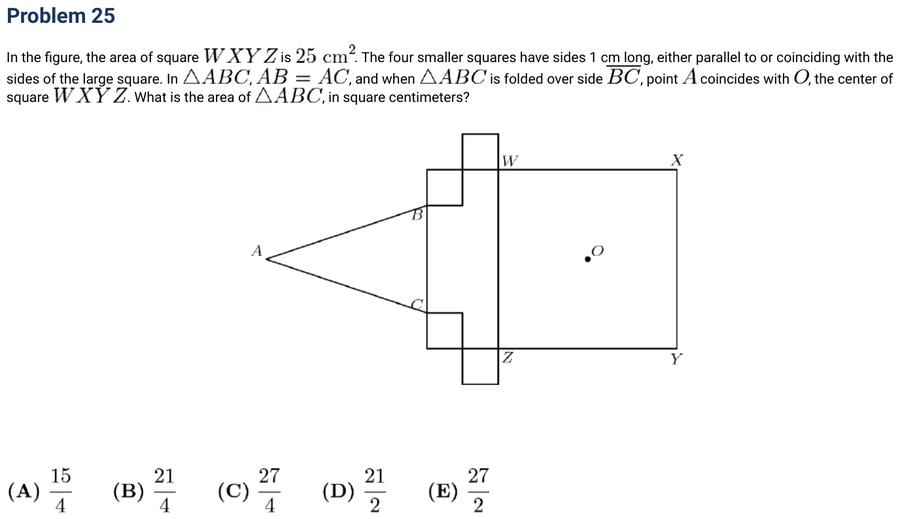
The whole problem is area = ½ × base × height — the base is BC and the height is A's distance from line BC. Find those two lengths.
Still stuck? Show hint 2 →
Hint 2 of 3
"Fold across BC and A lands on O" is the key: folding is a mirror reflection over line BC, so A and O are equally far from BC on opposite sides. That hands you the height.
Still stuck? Show hint 3 →
Hint 3 of 3
Set the side of the big square (from area 25) and use the unit squares to locate BC.
Show solution
Approach: turn the fold into a reflection to get the height
Square WXYZ has area 25, so its side is √25 = 5 and its center O lies 5/2 = 2.5 cm in from side WZ.
The base BC sits 2 cm outside WZ (the two stacked 1-cm squares), and it spans the gap between them, so BC = 5 − 2 = 3 cm. The distance from BC across to O is 2 + 2.5 = 9/2 cm.
Here's the unlock: folding the triangle over line BC sends A exactly onto O, and a fold is a mirror reflection across that line. A mirror keeps distances, so A starts as far from BC as O ends up — both 9/2 cm. That 9/2 is the triangle's height (A is the apex, BC the base).
Area = ½ × base × height = ½ × 3 × 9/2 = 27/4 cm².
You'll see this again: a fold = a reflection across the fold line, and reflections preserve distance. So "folds onto point P" instantly tells you the original point is the mirror image of P — same perpendicular distance, opposite side.