A circle and two distinct lines are drawn on a sheet of paper. What is the largest possible number of points of intersection of these figures?
Show answer
Answer: D — 5.
Show hints
Hint 1 of 2
Don't try to draw the whole messy picture — every crossing belongs to exactly one *pair* of figures, so count the pairs.
Still stuck? Show hint 2 →
Hint 2 of 2
Ask the maximum for each shape-pair: line-with-circle, and line-with-line. Add the maxes — that's the most you can ever reach.
Show solution
Approach: max crossings = sum over every pair of figures
Here's the key move: a crossing always happens between *two* figures, so total it pair by pair instead of staring at the tangle. The pairs are line1-circle, line2-circle, and line1-line2.
A straight line meets a circle in at most 2 points, so the two line-circle pairs give up to 2 + 2 = 4.
Two lines meet in at most 1 point, adding 1 more. Total: 4 + 1 = 5.
*You'll see this again:* the most intersections among any set of figures is just the sum of each pair's maximum — count pairs, never the whole picture at once.
How many different combinations of $5 bills and $2 bills can be used to make a total of $17? Order does not matter.
Show answer
Answer: A — 2.
Show hints
Hint 1 of 2
$17 is *odd*, but stacking $2 bills can only ever build an even amount. Where does the odd part have to come from?
Still stuck? Show hint 2 →
Hint 2 of 2
That's a **parity** lock: the $5 bills must supply the oddness, so their count must be odd. Now you only have to try odd numbers of fives.
Show solution
Approach: use parity to pin down the number of $5 bills
Start by noticing the odd/even clash: any pile of $2 bills totals an even number, yet the target $17 is odd. The only odd ingredient is the $5 bill, so the number of fives must be odd.
Odd counts of fives that fit under $17: one ($5, leaving $12 = six twos) or three ($15, leaving $2 = one two). Five fives would already be $25 — too much.
That's exactly 2 combinations.
*Why this transfers:* whenever a total's parity doesn't match one of your building blocks, the *other* block's count is forced odd or even — parity slashes the cases before you start listing.
The year 2002 is a palindrome (a number that reads the same from left to right as it does from right to left). What is the product of the digits of the next year after 2002 that is a palindrome?
Show answer
Answer: B — 4.
Show hints
Hint 1 of 2
To stay as close to 2002 as you can, leave the thousands digit at 2 — bumping it would jump you all the way past 3000. So the year looks like 2 ? ? 2.
Still stuck? Show hint 2 →
Hint 2 of 2
A palindrome is locked by its *front half*: the mirror forces the two middle digits to match. Pick the smallest matching pair that still lands you above 2002.
Show solution
Approach: build the next palindrome from the outside in
Key idea: you only get to *choose* the first half of a palindrome — the back half is its mirror. Keep the leading 2 (raising it overshoots wildly), so the year is 2 ? ? 2.
The middle two digits must be equal. "00" gives 2002 (not *after*), so the next-smallest equal pair is "11" → 2112. Its digit product is 2 × 1 × 1 × 2 = 4.
*This transfers:* to find the next palindrome, only nudge the first half upward and mirror it — you never have to scan years one by one.
Carlos Montado was born on Saturday, November 9, 2002. On what day of the week will Carlos be 706 days old?
Show answer
Answer: C — Friday.
Show hints
Hint 1 of 2
Whole weeks change nothing — 7 days later is the same weekday. So toss out the full weeks and only the *leftover* days matter.
Still stuck? Show hint 2 →
Hint 2 of 2
Split 706 cleverly: 706 = 700 + 6, and 700 is a clean stack of weeks (7 × 100). That leaves just 6 days to walk forward.
Show solution
Approach: strip off the whole weeks (multiples of 7)
The weekday repeats every 7 days, so anything that's a multiple of 7 is invisible. Peel 706 into 700 + 6: those 700 days are exactly 100 weeks and land you right back on Saturday.
Now just step 6 days past Saturday: Sun, Mon, Tue, Wed, Thu, Friday.
*The reusable trick:* for any "what day/position after N steps" question with a cycle of length 7, only the *leftover* of N after pulling out whole cycles matters — break N into (multiple of 7) + (small remainder).
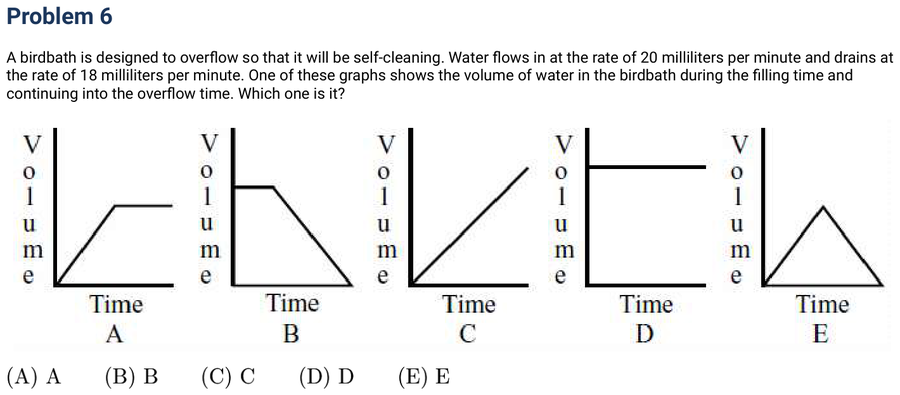
Answer: A — Graph A — the volume rises steadily, then stays constant once the bath overflows.
Show hints
Hint 1 of 2
Don't match numbers — match the *story shape*. The bath has two chapters: filling up, then full-and-overflowing. Picture each chapter's slope.
Still stuck? Show hint 2 →
Hint 2 of 2
While filling, the net gain (in minus out) is the *same* every minute, so the line is straight and rising. Once it overflows, what goes in spills out, so the amount inside stops changing — flat.
Show solution
Approach: net inflow until full, then constant
Read the graph from the story, not the arithmetic. Chapter 1: water arrives faster than it leaves, by a *constant* 20 − 18 = 2 mL each minute. A constant rate of change means a *straight line* tilting up.
Chapter 2: the bath is full and overflowing — every mL in is a mL out, so the volume inside holds steady: a *flat* line.
A straight rise that then levels off is graph A.
*The transferable skill:* turn a rate story into a graph by reading its *slopes*. Constant rate → straight segment; no change → flat segment; faster/slower → steeper/shallower. You never need exact values to pick the right shape.
The students in Mrs. Sawyer's class each chose one of five kinds of candy in a taste test. The bar graph shows their preferences. What percent of her class chose candy E?
Show answer
Answer: E — 20%.
Show hints
Hint 1 of 2
A percent needs a *whole* — and the bars don't tell you the class size, so build it first by adding every bar.
Still stuck? Show hint 2 →
Hint 2 of 2
The total comes out to a friendly 25. Since 25 × 4 = 100, each single student is worth 4% — a tiny conversion you can do in your head.
Show solution
Approach: part over whole, then turn into a percent
Percent always means "out of 100," so you need the whole class first: 6 + 8 + 4 + 2 + 5 = 25 students.
Candy E got 5 of them. With 25 in the class, each student is 100 ÷ 25 = 4%, so 5 students = 5 × 4% = 20%. (Same as 5/25 = 1/5.)
*Handy to remember:* when the total is a divisor of 100 (25, 20, 50, …), find the worth of *one* item once, then just multiply — beats fiddling with fractions for every part.
Juan organizes the stamps in his collection by country and by the decade in which they were issued. He paid these prices at the stamp shop: Brazil and France, 6¢ each; Peru, 4¢ each; and Spain, 5¢ each. (Brazil and Peru are South American countries; France and Spain are European.) The table shows how many stamps he has from each country and decade.
How many of his European stamps were issued in the 1980s?
Number of Stamps by Decade
Country
'50s
'60s
'70s
'80s
Brazil
4
7
12
8
France
8
4
12
15
Peru
6
4
6
10
Spain
3
9
13
9
Show answer
Answer: D — 24.
Show hints
Hint 1 of 2
The prices are a trap here — the question asks *how many* stamps, not their cost. Ignore the cents entirely.
Still stuck? Show hint 2 →
Hint 2 of 2
Pin down the right cells before adding: "European" picks the France and Spain rows, "1980s" picks one column. You only need the two numbers where those meet.
Show solution
Approach: read the European rows in the 1980s column
First filter, then add. "European" = France and Spain rows; "1980s" = the '80s column. That isolates exactly two cells: 15 and 9.
15 + 9 = 24 stamps. (The prices in the problem are bait — a count question never needs them.)
*The habit:* on a table problem, translate each describing word into a row-filter or column-filter *first*, grab only the cells that survive, then compute. It stops you from summing the wrong block.
Juan organizes the stamps in his collection by country and by the decade in which they were issued. He paid these prices at the stamp shop: Brazil and France, 6¢ each; Peru, 4¢ each; and Spain, 5¢ each. (Brazil and Peru are South American countries; France and Spain are European.) The table shows how many stamps he has from each country and decade.
His South American stamps issued before the 1970s cost him how much?
Number of Stamps by Decade
Country
'50s
'60s
'70s
'80s
Brazil
4
7
12
8
France
8
4
12
15
Peru
6
4
6
10
Spain
3
9
13
9
Show answer
Answer: B — $1.06.
Show hints
Hint 1 of 2
Turn each phrase into a filter before touching numbers: "South American" = Brazil & Peru rows; "before the 1970s" = the '50s and '60s columns (the '70s is *not* before itself).
Still stuck? Show hint 2 →
Hint 2 of 2
Brazil and Peru cost *different* amounts, so keep them separate: count each country's stamps, multiply by *its own* price, then add the two costs.
Show solution
Approach: count the right cells, then multiply by price
Filter first: rows Brazil & Peru, columns '50s & '60s. That's a 2-by-2 block of four cells.
*Watch-out worth keeping:* don't add stamp counts across rows that have *different* unit prices — total each price group on its own, then combine. Mixing them is the classic table-problem slip.
Juan organizes the stamps in his collection by country and by the decade in which they were issued. He paid these prices at the stamp shop: Brazil and France, 6¢ each; Peru, 4¢ each; and Spain, 5¢ each. (Brazil and Peru are South American countries; France and Spain are European.) The table shows how many stamps he has from each country and decade.
The average price of his 1970s stamps is closest to which value?
Number of Stamps by Decade
Country
'50s
'60s
'70s
'80s
Brazil
4
7
12
8
France
8
4
12
15
Peru
6
4
6
10
Spain
3
9
13
9
Show answer
Answer: E — About 5.4 cents.
Show hints
Hint 1 of 2
Tempting trap: averaging the four prices (6, 6, 4, 5) gives 5.25 — but that pretends each country sent the same number of stamps. They didn't.
Still stuck? Show hint 2 →
Hint 2 of 2
Real average price = (total money spent on '70s stamps) ÷ (total '70s stamps). The counts *weight* the average, so the prices with more stamps pull harder.
Show solution
Approach: weighted average over the 1970s column
The average price is total cost over total count — *not* the average of the listed prices, because the four countries contribute different numbers of stamps (that's a weighted average).
'70s column: Brazil 12 & France 12 at 6¢, Peru 6 at 4¢, Spain 13 at 5¢. Cost = 12×6 + 12×6 + 6×4 + 13×5 = 72 + 72 + 24 + 65 = 233¢, over 12 + 12 + 6 + 13 = 43 stamps.
233 ÷ 43 ≈ 5.4 cents.
*Sanity check:* most of these stamps cost 5¢ or 6¢ and only a handful cost 4¢, so the average should sit high in that 4-to-6 range — 5.4 fits; a naive 5.25 would have under-counted the many 6¢ stamps.
A sequence of squares is made of identical square tiles. Each square's edge is one tile longer than the edge of the previous square. The first three squares are shown. How many more tiles does the seventh square require than the sixth?
Show answer
Answer: C — 13.
Show hints
Hint 1 of 2
Don't build the whole 7×7 square — think about what you *add* when growing a square by one. You glue tiles along two sides and one corner.
Still stuck? Show hint 2 →
Hint 2 of 2
Going from side 6 to side 7, you add a strip down one side (6), a strip across the top (6), plus 1 corner tile: 6 + 6 + 1.
Show solution
Approach: the nth square uses n² tiles
A square n tiles on a side uses n² tiles, so the seventh needs 7² = 49 and the sixth needs 6² = 36. The extra tiles: 49 − 36 = 13.
*The pattern to keep:* growing a square from side n to n+1 always adds an L-shaped border of (n) + (n) + 1 = 2n + 1 tiles — an odd number. Here that's 2·6 + 1 = 13, no squaring needed.
Another way — difference of squares:
The gap between consecutive squares factors instantly: 7² − 6² = (7 + 6)(7 − 6) = 13 × 1 = 13.
*Reusable:* any a² − b² = (a + b)(a − b), which turns a scary subtraction of big squares into one easy product.
A board game spinner is divided into three regions labeled A, B, and C. The probability the arrow stops on region A is 13 and on region B is 12. What is the probability the arrow stops on region C?
Show answer
Answer: B — 1/6.
Show hints
Hint 1 of 2
The arrow has to land *somewhere*, and A, B, C are the only options — so their three chances can't add up to anything but a whole 1.
Still stuck? Show hint 2 →
Hint 2 of 2
That makes C the leftover: don't solve for it, just subtract A and B from 1.
Show solution
Approach: probabilities of all regions sum to 1
The three regions cover every outcome with no overlap, so P(A) + P(B) + P(C) = 1. The unknown is just the leftover: P(C) = 1 − 13 − 12.
Use a common denominator of 6: 66 − 26 − 36 = 16.
*The principle:* when outcomes split a situation completely (nothing left out, nothing double-counted), their probabilities sum to 1 — so the last unknown piece is always "1 minus the rest."
For his birthday, Bert gets a box that holds 125 jellybeans when filled to capacity. A few weeks later, Carrie gets a larger box full of jellybeans. Her box is twice as high, twice as wide, and twice as long as Bert's. Approximately how many jellybeans did Carrie get?
Show answer
Answer: E — About 1000.
Show hints
Hint 1 of 2
"Twice as big" tricks the eye — picture how many of Bert's small boxes actually pack inside Carrie's. Imagine a 2-by-2-by-2 stack of them.
Still stuck? Show hint 2 →
Hint 2 of 2
That stack is 2 across, 2 deep, 2 tall: the volume (and the jellybeans) multiplies by 2 × 2 × 2, not by 2.
Show solution
Approach: scaling all three dimensions cubes the factor
Visualize Carrie's box as a 2×2×2 stack of Bert's boxes — 8 of them fit inside. Doubling all three dimensions multiplies volume by 2 × 2 × 2 = 8.
So Carrie gets about 8 × 125 = 1000 jellybeans.
*Why this transfers:* when every length scales by k, area scales by k² and volume by k³. "Double" never means double for area or volume — and a quick gut-check, 250 (×2), would be the classic wrong trap.
A merchant offers a large group of items at 30% off. Later, the merchant takes 20% off these sale prices and claims that the final price of these items is 50% off the original price. The total discount is
Show answer
Answer: B — 44%.
Show hints
Hint 1 of 2
The merchant's "30 + 20 = 50% off" is the trap. The second discount comes off the *already-shrunk* price, not the original — so the cuts compound, they don't add.
Still stuck? Show hint 2 →
Hint 2 of 2
Flip from "how much off" to "how much you still pay." After 30% off you pay 0.70; the next 20% off leaves 0.80 *of that*. Chain the survivors by multiplying.
Show solution
Approach: multiply the fractions of price still paid
Track what *survives* each cut, not what's removed. 30% off leaves you paying 0.70 of the original; another 20% off leaves 0.80 of *that*.
Multiply the survivors: 0.70 × 0.80 = 0.56. You pay 56%, so the real discount is 100% − 56% = 44% — less than the claimed 50%.
*Why this transfers:* successive percent changes *multiply* their keep-factors; they never add. The second 20% is only 20% of the smaller 70%, which is why two discounts always total *less* than their sum.
Another way — add the pieces removed:
First cut removes 30%, leaving 70%. The second cut removes 20% of that 70%, i.e. 0.20 × 70% = 14%.
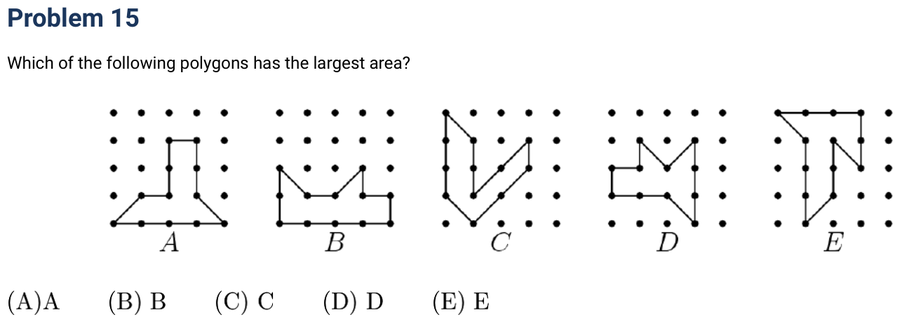
Slanted edges scare people off — but every tilted piece here is just *half of a grid square*. So you never measure a slant, you only count squares and half-squares.
Still stuck? Show hint 2 →
Hint 2 of 2
Tally inside each shape: a full grid square is worth 1, a corner-to-corner triangle is worth ½. Add them up per polygon and compare the totals.
Show solution
Approach: count whole squares and half-squares
On a grid you don't need any area formulas: chop each polygon into pieces you can count — whole unit squares (area 1) and half-square triangles (area ½) — then add.
Doing that for all five gives areas 5, 5, 5, 4.5, and 5.5. The biggest is polygon E at 5.5.
*The transferable move:* break a messy shape into easy standard pieces and sum them. Counting squares-and-half-squares turns any grid polygon into simple addition.
Another way — box-and-subtract:
Trap each polygon in the smallest grid rectangle that surrounds it, then subtract the right-triangle corners poking outside the polygon.
Rectangle area minus the cut-off corners gives the same totals — handy when a shape has few inside squares but many slanted edges.
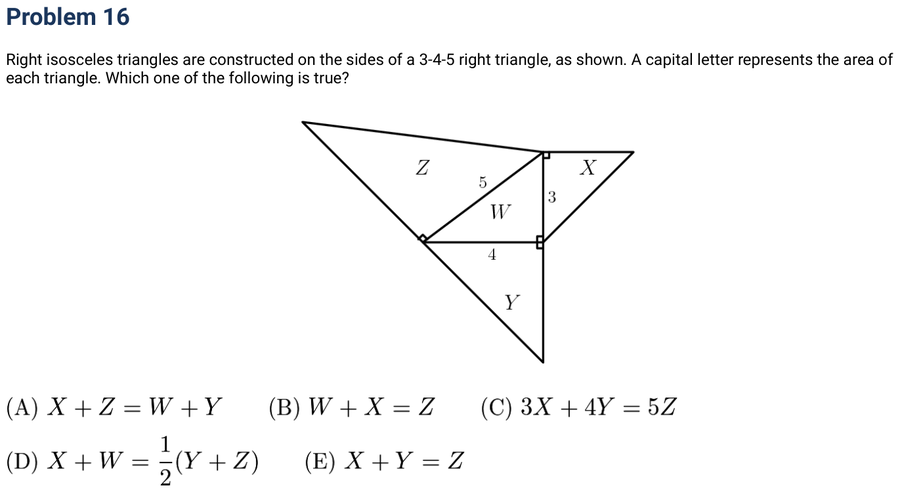
Each outer triangle is right *isosceles*, so its two legs equal the 3-4-5 side it's built on. That makes its area a clean ½·(side)² — area depends only on which side it sits on.
Still stuck? Show hint 2 →
Hint 2 of 2
So X, Y, Z scale like 3², 4², 5². You already know a famous fact linking those three squares.
Show solution
Approach: each isosceles right triangle's area is half the square on its side
A right isosceles triangle with legs s has area ½·s². Since each one sits on a 3-4-5 side, X = ½·3² = 4.5, Y = ½·4² = 8, Z = ½·5² = 12.5.
Now the Pythagorean fact 3² + 4² = 5² is hiding here: halve every term and you get 4.5 + 8 = 12.5, i.e. X + Y = Z, choice E.
*The big idea worth keeping:* build *any* matching shape on the three sides of a right triangle — triangles here, but squares, semicircles, anything similar — and the two smaller areas always sum to the largest. It's the Pythagorean theorem dressed in areas, because every such area is (some fixed constant)·(side)².
In a mathematics contest with ten problems, a student gains 5 points for a correct answer and loses 2 points for an incorrect answer. If Olivia answered every problem and her score was 29, how many correct answers did she have?
Show answer
Answer: C — 7.
Show hints
Hint 1 of 2
Skip the algebra: pretend she aced all 10, then ask what flipping one answer to *wrong* costs her.
Still stuck? Show hint 2 →
Hint 2 of 2
Flipping right→wrong is a double hit — you *lose* the 5 you'd have earned *and* drop 2 more, a swing of 5 + 2 = 7 per wrong answer.
Show solution
Approach: start from a perfect score and subtract
Anchor at a perfect paper: all 10 right scores 5 × 10 = 50.
Each answer flipped to wrong costs 7 (the 5 forgone *plus* the 2 penalty). She's 50 − 29 = 21 below perfect, and 21 = 3 × 7.
So 3 were wrong, leaving 7 correct.
*Why this transfers:* anchoring at an extreme (all right, all wrong, all zero) and counting the cost of each swap turns many "right vs. wrong" point problems into a single division — no equation needed.
Another way — set up an equation:
Let x = number correct, so 10 − x are wrong: 5x − 2(10 − x) = 29.
Gage skated 1 hr 15 min each day for 5 days and 1 hr 30 min each day for 3 days. How long would he have to skate the ninth day in order to average 85 minutes of skating each day for the entire time?
Show answer
Answer: E — 2 hours.
Show hints
Hint 1 of 2
An average is a target everyone must *balance out* to. So measure each day as how far above or below 85 it lands, not its raw minutes.
Still stuck? Show hint 2 →
Hint 2 of 2
Days below 85 owe minutes; days above 85 pay them back. Net the surplus against the shortfall — day 9 must cover whatever's still owed (on top of its own 85).
Show solution
Approach: measure each day against the 85-minute target
Read every day as a *deviation* from the 85-min target. The 5 days at 75 are each 10 short → −50; the 3 days at 90 are each 5 over → +15.
Running balance: −50 + 15 = −35, a 35-minute shortfall. Day 9 must hit the target *and* erase it: 85 + 35 = 120 min = 2 hours.
*The transferable trick:* to hit a target average, track only the ± gaps from the target — they must cancel to zero. The last value just absorbs the leftover gap, far lighter than summing everything.
Another way — totals:
Skated so far: 5·75 + 3·90 = 645 min. Needed for the average: 9·85 = 765 min.
How many whole numbers between 99 and 999 contain exactly one 0?
Show answer
Answer: D — 162.
Show hints
Hint 1 of 2
"Between 99 and 999" just means three-digit numbers — and a 3-digit number can't *start* with 0. So the lone 0 is barred from the hundreds place before you count anything.
Still stuck? Show hint 2 →
Hint 2 of 2
Place the special digit first: the one 0 must be in the tens or units spot (2 choices), and then make sure the *other* two digits are nonzero so you don't accidentally get a second 0.
Show solution
Approach: place the lone 0, then fill the rest with nonzero digits
Deal with the *restricted* digit first — that's the habit. The hundreds digit can't be 0, so the single 0 lives in the tens or units place: 2 spots for it.
The remaining two digits must each be 1–9 (zero would either repeat the 0 or land where it can't): 9 × 9 ways.
Total: 2 × 9 × 9 = 162.
*Why this transfers:* in digit-counting, place the most-constrained slot first (here, where the 0 may go) and keep the "exactly one" rule honest by forbidding the special digit everywhere else — that's what blocks both the leading-zero and the double-counting traps.
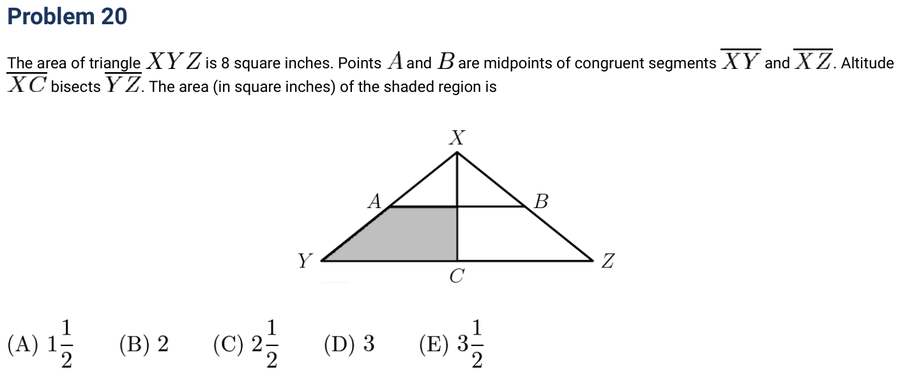
Don't chase exact lengths — work in *fractions of the whole 8*. The altitude XC bisects YZ, so it cuts the triangle into two equal halves; focus on the left half only.
Still stuck? Show hint 2 →
Hint 2 of 2
The little corner triangle cut off near X is a *half-scale* copy of that half (its sides are midpoint-halved). Half the lengths means a quarter of the area — so the shaded trapezoid is the half minus that quarter-of-a-half.
Show solution
Approach: halve the triangle, then remove the midpoint triangle
Think in fractions, not measurements. Altitude XC bisects YZ, so triangle XYC is exactly half of XYZ: area 8 ÷ 2 = 4.
Inside that half, the unshaded top triangle is built on midpoints, so it's a half-scale copy — and half the side lengths gives (½)² = ¼ the area, i.e. ¼ × 4 = 1.
Shaded = 4 − 1 = 3 square inches.
*The reusable idea:* you can find an area as a *fraction* of a known one without any side lengths — halving by a median, and the length²-to-area rule (half the sides → quarter the area) — then add and subtract the fractions.
Harold tosses a nickel four times. The probability that he gets at least as many heads as tails is
Show answer
Answer: E — 11/16.
Show hints
Hint 1 of 2
A coin has no preference for heads over tails, so "heads ≥ tails" must be exactly as likely as "tails ≥ heads." Those two cases together cover *everything* — but they double-count something.
Still stuck? Show hint 2 →
Hint 2 of 2
The only outcome that fits both is a 2–2 tie. So the two equal halves overlap precisely on the tie: 2·(what you want) = 1 + P(tie). Find the tie, and you're done.
Show solution
Approach: use heads–tails symmetry
Heads and tails are interchangeable, so P(heads ≥ tails) = P(tails ≥ heads). Together these events cover all outcomes, overlapping only on the 2–2 tie.
By inclusion-exclusion, P(H≥T) + P(T≥H) = 1 + P(tie), i.e. 2·P(H≥T) = 1 + P(tie). The tie has C(4,2) = 6 of the 16 equally likely outcomes, so P(tie) = 6/16 = 3/8.
Then P(heads ≥ tails) = (1 + 3/8) ÷ 2 = 11/16.
*Why this transfers:* when two symmetric events together fill the whole sample space, you don't count both — you write 2·P = 1 + P(overlap) and only the small overlap needs counting.
Another way — just count the winning outcomes:
"At least as many heads as tails" over 4 flips means 2, 3, or 4 heads.
Ways: C(4,2) + C(4,3) + C(4,4) = 6 + 4 + 1 = 11, out of 2⁴ = 16 outcomes.
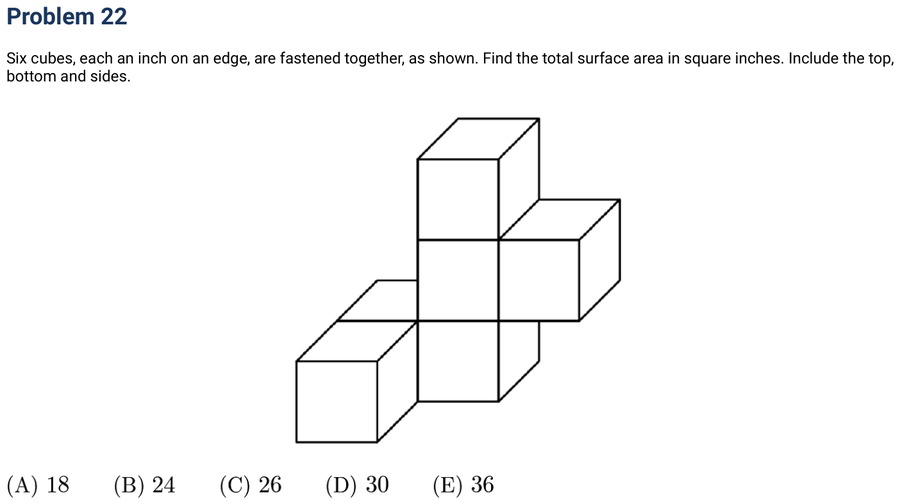
Start from the easy over-count: 6 loose cubes show 6 × 6 = 36 little faces. Gluing them together can only *hide* faces, never add any.
Still stuck? Show hint 2 →
Hint 2 of 2
Look at the *glue joints*, not the cubes. Every place two cubes are pressed together buries exactly 2 faces (one off each cube). Count the joints, double it, subtract.
Show solution
Approach: total faces minus the hidden (touching) faces
Six separate unit cubes would show 6 × 6 = 36 unit faces.
Now subtract for contact. Each spot where two cubes touch hides 2 faces. Tracing the figure, the cubes are joined at 5 places, so 5 × 2 = 10 faces are buried.
*The reusable idea:* for any blob of glued cubes, surface area = 6·(number of cubes) − 2·(number of touching pairs). Counting joints is faster and less error-prone than checking each cube's hidden sides one at a time.
Another way — tally per cube:
Go cube by cube and count buried faces: three cubes hide 1 face each, two hide 2, one hides 3 → 3 + 4 + 3 = 10 hidden.
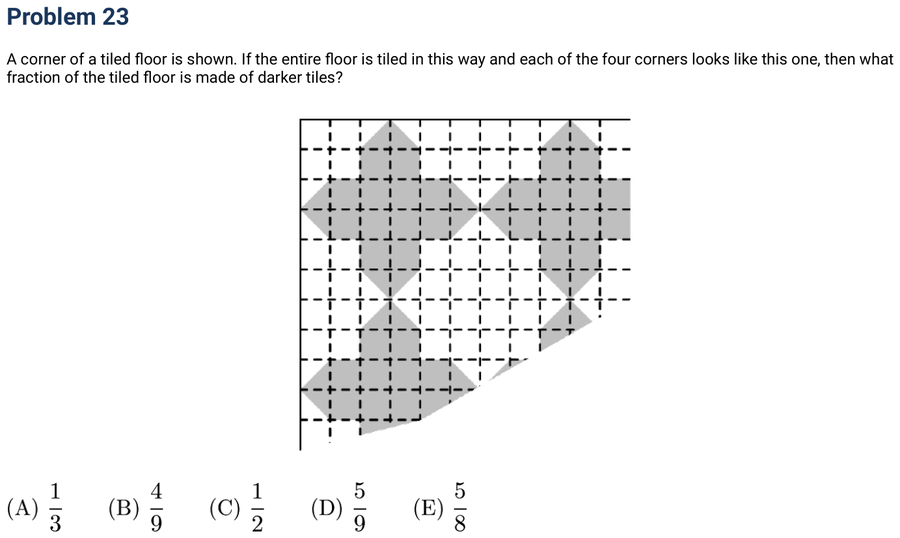
You'd never count the whole floor — and you don't have to. A pattern that repeats has a single *tile of repetition*; find the smallest block that, stamped over and over, rebuilds the floor.
Still stuck? Show hint 2 →
Hint 2 of 2
The whole floor's dark fraction equals the dark fraction inside that *one* block. Inside it, count dark area as whole squares plus triangles (two half-square triangles glue into one square).
Show solution
Approach: find the repeating block, then the dark fraction inside it
Since the design tiles the plane, the dark fraction of the *whole* floor is the same as the dark fraction of one repeating block. The block here is 3 × 3 = 9 unit squares.
Dark area in that block: 3 full squares, plus two corner triangles that together make a 4th square — 4 dark out of 9.
Fraction dark = 4/9.
*Why this transfers:* for any repeating pattern, shrink the question to its fundamental tile. One block's ratio *is* the whole floor's ratio — and edge bits that look like halves often pair up into whole units.
Miki has a dozen oranges of the same size and a dozen pears of the same size. Miki uses her juicer to extract 8 ounces of pear juice from 3 pears and 8 ounces of orange juice from 2 oranges. She makes a pear-orange juice blend from an equal number of pears and oranges. What percent of the blend is pear juice?
Show answer
Answer: B — 40%.
Show hints
Hint 1 of 2
The "dozen" is pure bait — she uses an *equal* number of each fruit, so however many that is divides out. All that matters is the juice from *one* pear versus *one* orange.
Still stuck? Show hint 2 →
Hint 2 of 2
Pears: 8 oz from 3, so 8/3 oz each. Oranges: 8 oz from 2, so 4 oz each. The blend's pear share is just one pear's juice over (one pear + one orange).
Show solution
Approach: compare juice per fruit
Since she blends *equal counts* of each fruit, the common count cancels — work per fruit. One pear yields 8/3 oz; one orange yields 8/2 = 4 oz.
Pear-to-orange juice is 8/3 : 4, and clearing the 3 gives 8 : 12 = 2 : 3.
Pear's share = 2 ÷ (2 + 3) = 2/5 = 40%.
*Worth keeping:* when two things are mixed in equal *counts*, the actual count is irrelevant — reduce to one of each and compare. Chasing the dozen (32 oz vs 48 oz) gives the same answer with bigger numbers.
Another way — scale up to the full dozen:
12 pears give 12 × 8/3 = 32 oz; 12 oranges give 12 × 4 = 48 oz.
Pear fraction = 32 ÷ (32 + 48) = 32/80 = 2/5 = 40% — same ratio, just unscaled.
Loki, Moe, Nick, and Ott are good friends. Ott had no money, but the others did. Moe gave Ott one-fifth of his money, Loki gave Ott one-fourth of his money, and Nick gave Ott one-third of his money. Each gave Ott the same amount of money. What fractional part of the group's money does Ott now have?
Show answer
Answer: B — 1/4.
Show hints
Hint 1 of 2
The fractions 1/5, 1/4, 1/3 look mismatched, but the problem hands you a gift: all three gifts are the *same dollar amount*. Name that shared amount — say $1 — and everything else falls out.
Still stuck? Show hint 2 →
Hint 2 of 2
If $1 is one-fifth of Moe's money, Moe had $5; likewise Loki $4, Nick $3. And notice money only moves *around* — the group total never changes.
Show solution
Approach: set the equal gift to a convenient $1
Anchor on the equal gift: let each be $1. Then $1 = ⅕ of Moe → $5, = ¼ of Loki → $4, = ⅓ of Nick → $3.
Giving money away doesn't create or destroy any: the group total stays $5 + $4 + $3 = $12. Ott now holds the three $1 gifts = $3.
Ott's share = 3/12 = 1/4.
*Two ideas worth keeping:* (1) when several quantities share a common value, set *that* value to a friendly number and back out the rest; (2) money passed within a group conserves the total — so a "fraction of the whole" question only needs the unchanged grand total as its denominator.