Casey's shop class is making a golf trophy. He has to paint 300 dimples on a golf ball. If it takes him 2 seconds to paint one dimple, how many minutes will he need to do his job?
Show answer
Answer: D — 10 minutes.
Show hints
Hint 1 of 2
The question asks for minutes, but everything is given in seconds — that's two jobs: find the time, then switch the unit.
Still stuck? Show hint 2 →
Hint 2 of 2
Total seconds = (seconds per dimple) × (dimples); minutes = seconds ÷ 60.
Watch the units the question wants. Here it asks for minutes, so an answer of 600 would be a trap — you'll see this trick again whenever a problem feeds you one unit and asks for another.
Another way — convert the rate first:
2 seconds per dimple means he paints 30 dimples per minute (60 ÷ 2).
300 dimples ÷ 30 per minute = 10 minutes — no big numbers needed.
I'm thinking of two whole numbers. Their product is 24 and their sum is 11. What is the larger number?
Show answer
Answer: D — 8.
Show hints
Hint 1 of 2
The product 24 is the strong clue — it only has a few factor pairs, so list those first and the sum filters them.
Still stuck? Show hint 2 →
Hint 2 of 2
"Two numbers with a known product and sum" is a classic setup; scanning factor pairs beats setting up algebra here.
Show solution
Approach: scan the factor pairs of 24
Start from the product, because 24 has only four factor pairs: 1·24, 2·12, 3·8, 4·6.
Now apply the sum filter — which pair adds to 11? Only 3 + 8 = 11.
The larger of the two is 8. Whenever you know two numbers' product AND sum, list the factor pairs first; you'll meet the same idea later as factoring x² − 11x + 24.
Granny Smith has $63. Elberta has $2 more than Anjou, and Anjou has one-third as much as Granny Smith. How many dollars does Elberta have?
Show answer
Answer: E — $23.
Show hints
Hint 1 of 2
Only one person's amount is given outright (Granny, $63). Start from the one you fully know and let each clue point to the next.
Still stuck? Show hint 2 →
Hint 2 of 2
Anjou is tied to Granny, and Elberta is tied to Anjou — so solve them in that order, not the order the sentence lists them.
Show solution
Approach: follow the chain of clues
Granny's $63 is the only fixed number, so begin there. Anjou has one-third of it: $63 ÷ 3 = $21.
Elberta has $2 more than Anjou: $21 + $2 = $23.
The trap is adding the $2 to Granny's $63; "more than Anjou" means build on Anjou. With a chain of comparisons, find the anchor that's stated directly, then step along the links.
On a dark and stormy night Snoopy suddenly saw a flash of lightning. Ten seconds later he heard the sound of thunder. The speed of sound is 1088 feet per second and one mile is 5280 feet. Estimate, to the nearest half-mile, how far Snoopy was from the flash of lightning.
Show answer
Answer: C — 2 miles.
Show hints
Hint 1 of 2
The words "estimate" and "to the nearest half-mile" are permission to round — don't chase exact decimals.
Still stuck? Show hint 2 →
Hint 2 of 2
Find the distance the sound covered (speed × time) in feet, then ask which whole number of miles it's nearest.
Show solution
Approach: distance in feet, then convert to miles
Sound travels distance = speed × time = 1088 × 10 = 10,880 feet during those 10 seconds.
Now compare to miles: 2 miles = 2 × 5280 = 10,560 feet, which is the closest landmark — so the distance is about 2 miles.
Worth keeping: sound covers roughly a mile every 5 seconds (≈5280 ÷ 1088). So "divide the delay by 5" gives miles — 10 seconds → ~2 miles, instantly.
Another way — the 5-seconds-per-mile rule:
Each mile of sound takes about 5280 ÷ 1088 ≈ 5 seconds.
A 10-second gap is two of those 5-second miles, so the lightning is about 2 miles away.
Six trees are equally spaced along one side of a straight road. The distance from the first tree to the fourth is 60 feet. What is the distance in feet between the first and last trees?
Show answer
Answer: B — 100 feet.
Show hints
Hint 1 of 2
Distance lives in the spaces between trees, not the trees — so don't divide 60 by 4.
Still stuck? Show hint 2 →
Hint 2 of 2
This is the fencepost idea: between n trees there are n − 1 gaps. First-to-fourth = 3 gaps; first-to-last = 5 gaps.
Show solution
Approach: count gaps, not trees
The 60 feet is split among the gaps between tree 1 and tree 4 — and there are 3 gaps, not 4 (the fencepost rule). So each gap = 60 ÷ 3 = 20 feet.
First to last (tree 1 to tree 6) spans 5 gaps: 5 × 20 = 100 feet.
The fencepost principle (n posts → n − 1 gaps) returns everywhere: floors between landings, fence rails, ringing-clock chimes. Always count the spaces.
To promote her school's annual Kite Olympics, Genevieve makes a small kite and a large kite for a bulletin board display. The kites look like the one in the diagram. For her small kite Genevieve draws the kite on a one-inch grid (shown below). For the large kite she triples both the height and width of the entire grid.
What is the number of square inches in the area of the small kite?
Show answer
Answer: A — 21 square inches.
Show hints
Hint 1 of 2
The kite's diagonals cross at a right angle (one across, one up-and-down on the grid) — that perpendicular crossing is what unlocks an easy area.
Still stuck? Show hint 2 →
Hint 2 of 2
When a quadrilateral has perpendicular diagonals, its area is ½ × (one diagonal) × (other diagonal). Read both lengths off the grid.
Show solution
Approach: area of a kite = half the product of the diagonals
Count along the grid: the horizontal diagonal is 6 inches and the vertical diagonal is 7 inches, and they meet at a right angle.
For perpendicular diagonals, Area = ½ × d₁ × d₂ = ½ × 6 × 7 = 21 square inches.
Why it works: the two diagonals slice the kite into four right triangles, and gathering their areas always gives ½·d₁·d₂. The same formula handles any rhombus or square (just diagonals) — keep it in your toolkit.
Another way — two triangles sharing the horizontal diagonal:
The horizontal diagonal (length 6) splits the kite into a top triangle and a bottom triangle.
Their heights are the two pieces of the vertical diagonal, totaling 7, so area = ½ × 6 × 7 = 21 square inches.
To promote her school's annual Kite Olympics, Genevieve makes a small kite and a large kite for a bulletin board display. The kites look like the one in the diagram. For her small kite Genevieve draws the kite on a one-inch grid (shown below). For the large kite she triples both the height and width of the entire grid.
Genevieve puts bracing on her large kite in the form of a cross connecting opposite corners of the kite. How many inches of bracing material does she need?
Show answer
Answer: E — 39 inches.
Show hints
Hint 1 of 2
"A cross connecting opposite corners" is just the kite's two diagonals — you already know their grid lengths from before.
Still stuck? Show hint 2 →
Hint 2 of 2
Tripling the grid is a scale factor of 3. Lengths scale by 3 (not 9 — that's areas), so each diagonal triples.
Show solution
Approach: the cross is the two diagonals, scaled up ×3
The bracing follows the two diagonals. On the small grid they're 6 and 7 units.
Tripling every length multiplies each diagonal by 3: 6 → 18 and 7 → 21 inches.
Total bracing = 18 + 21 = 39 inches. Key idea: under a scale factor k, lengths multiply by k while areas multiply by k² — so triple the grid means ×3 for bracing but ×9 for any area.
Another way — scale the small total at the end:
On the small kite the two diagonals total 6 + 7 = 13 units.
Tripling all lengths multiplies that total by 3: 13 × 3 = 39 inches.
To promote her school's annual Kite Olympics, Genevieve makes a small kite and a large kite for a bulletin board display. The kites look like the one in the diagram. For her small kite Genevieve draws the kite on a one-inch grid (shown below). For the large kite she triples both the height and width of the entire grid.
The large kite is covered with gold foil. The foil is cut from a rectangular piece that just covers the entire grid. How many square inches of waste material are cut off from the four corners?
Show answer
Answer: D — 189 square inches.
Show hints
Hint 1 of 2
The kite's diagonals are exactly the rectangle's width and height — so kite area is ½ × width × height, which is half the rectangle. No need to measure the four corners separately.
Still stuck? Show hint 2 →
Hint 2 of 2
Waste = rectangle − kite, but since the kite IS half the rectangle, the waste is just the other half.
Show solution
Approach: waste = rectangle − kite, and the kite is half the rectangle
The large rectangle covers the whole grid: 18 × 21 = 378 square inches.
Here's the shortcut: the kite's diagonals span the full 18 and 21, so its area is ½ × 18 × 21 — exactly half the rectangle. The cut-off corners are therefore the other half: 378 ÷ 2 = 189 square inches.
Spotting that a shape is a clean fraction of its bounding box saves the messier work of computing four corner triangles one by one — look for that whenever a figure sits snugly inside a rectangle.
Another way — subtract the kite explicitly:
Kite area = ½ × 18 × 21 = 189 square inches.
Waste = rectangle − kite = 378 − 189 = 189 square inches — confirming the two halves match.
A collector offers to buy state quarters for 2000% of their face value. At that rate, how much will Bryden get for his four state quarters?
Show answer
Answer: A — $20.
Show hints
Hint 1 of 2
The scary-looking 2000% is really just a multiplier — "percent" literally means "per hundred," so divide by 100.
Still stuck? Show hint 2 →
Hint 2 of 2
First nail the face value: four quarters = $1. Then multiply by the converted percent.
Show solution
Approach: percent as a multiplier
Turn the percent into a number: 2000% = 2000 ÷ 100 = 20. So the collector pays 20 times face value.
Four quarters have a face value of $1, so Bryden gets 20 × $1 = $20.
Sanity check: 100% would be face value ($1), 200% would double it ($2), so 2000% is twenty times — $20, not $2000. "Percent" always means ÷ 100, which deflates big-looking percentages fast.
Points A, B, C, and D have these coordinates: A(3, 2), B(3, −2), C(−3, −2), and D(−3, 0). What is the area of quadrilateral ABCD?
Show answer
Answer: C — 18.
Show hints
Hint 1 of 2
Always plot the points first — the picture tells you the shape. Notice A,B share x = 3 and C,D share x = −3, so two sides are vertical (parallel).
Still stuck? Show hint 2 →
Hint 2 of 2
Two parallel sides means trapezoid: use ½(b₁ + b₂)·h, treating the vertical sides as the bases and the horizontal distance between them as the height.
Show solution
Approach: trapezoid with two vertical sides
Plotting reveals the parallel pair: AB is vertical (x = 3) and DC is vertical (x = −3). So ABCD is a trapezoid lying on its side.
Base lengths: AB from y = 2 down to y = −2 has length 4; DC from y = 0 down to y = −2 has length 2. The "height" is the horizontal gap between the two verticals: 3 − (−3) = 6.
Area = ½(b₁ + b₂)·h = ½(4 + 2)·6 = 18. The trapezoid formula works whichever way the parallel sides point — just measure the perpendicular distance between them.
Another way — Shoelace formula (works for any polygon):
List the vertices in order A(3,2), B(3,−2), C(−3,−2), D(−3,0) and apply Shoelace: ½|Σ(xᵢyᵢ₊₁ − xᵢ₊₁yᵢ)|.
Sum of x·(next y): 3·(−2)+3·(−2)+(−3)·0+(−3)·2 = −6−6+0−6 = −18; sum of y·(next x): 2·3+(−2)·(−3)+(−2)·(−3)+0·3 = 6+6+6+0 = 18.
Area = ½|−18 − 18| = ½·36 = 18. Shoelace is your fallback when a coordinate shape isn't a tidy trapezoid.
Of the 36 students in Richelle's class, 12 prefer chocolate pie, 8 prefer apple, and 6 prefer blueberry. Half of the remaining students prefer cherry pie and half prefer lemon. For Richelle's pie graph showing this data, how many degrees should she use for cherry pie?
Show answer
Answer: D — 50 degrees.
Show hints
Hint 1 of 2
A pie slice's angle is just that group's share of the full circle — students and degrees rise together in lockstep.
Still stuck? Show hint 2 →
Hint 2 of 2
With 36 students splitting 360°, each student is worth 360 ÷ 36 = 10° — a clean conversion factor that turns the whole problem into easy counting.
Show solution
Approach: students → fraction of 360°
First find the cherry count. The leftover after the named pies is 36 − 12 − 8 − 6 = 10 students, and half of those pick cherry, so 5 students.
Set up the "per-student" rate once: 360° ÷ 36 students = 10° each. Cherry's 5 students take 5 × 10° = 50°.
The slick part is the 10°-per-student rate: with 36 students in 360°, the numbers are tailor-made to cancel. Whenever a count divides 360 evenly, find the degrees-per-item first and the rest is multiplication.
Another way — fraction of the whole circle:
Cherry is 5 of 36 students, a fraction 5/36 of the class.
Apply that same fraction to the full circle: (5/36) × 360° = 50°.
Tyler has entered a buffet line in which he chooses one kind of meat, two different vegetables, and one dessert. If the order of food items is not important, how many different meals might he choose?
Each food slot is chosen independently, so multiply the choices — but the vegetables need care because you pick TWO and order doesn't matter.
Still stuck? Show hint 2 →
Hint 2 of 2
Picking 2 of 4 vegetables where order is irrelevant is a combination, C(4,2) = 6 — not 4 × 3, which would double-count corn-then-beans vs beans-then-corn.
Show solution
Approach: multiply the independent choices
Handle the tricky slot first. "Two different vegetables, order doesn't matter": there are 4 × 3 = 12 ordered ways, but each pair (like beans+corn) got counted twice, so divide by 2 → 6 pairs. That's exactly C(4,2) = 6.
The other slots are single picks: meat 3 ways, dessert 4 ways, all independent.
Multiply independent choices: 3 × 6 × 4 = 72 meals. The reusable move: when a selection ignores order, count it as ordered then divide by the number of rearrangements (here, 2).
Homer began peeling a pile of 44 potatoes at the rate of 3 potatoes per minute. Four minutes later Christen joined him and peeled at the rate of 5 potatoes per minute. When they finished, how many potatoes had Christen peeled?
Show answer
Answer: A — 20.
Show hints
Hint 1 of 2
Christen's count depends on how LONG she works, so the real target is the shared time — peel away Homer's head start first.
Still stuck? Show hint 2 →
Hint 2 of 2
After the head start, the two work together at a combined rate; that combined rate tells you how long the rest takes.
Show solution
Approach: head start, then combined rate
Account for the head start: in 4 minutes alone Homer peels 3 × 4 = 12, leaving 44 − 12 = 32 potatoes.
Now they work side by side at 3 + 5 = 8 potatoes per minute, so finishing 32 takes 32 ÷ 8 = 4 minutes. (Combine rates by adding when people work at the same time.)
Christen worked all 4 of those minutes at 5 per minute: 5 × 4 = 20 potatoes. The key was finding the shared time first — counts follow once you know how long someone worked.
Another way — split the remaining work by rate share:
After the head start, 32 potatoes remain and the pair peels in a 3 : 5 ratio (Homer : Christen), 8 parts total.
Christen does 5/8 of the remaining 32 = 20 potatoes — no need to find the time at all.
A square piece of paper, 4 inches on a side, is folded in half vertically. Both layers are then cut in half parallel to the fold. Three new rectangles are formed, a large one and two small ones. What is the ratio of the perimeter of one of the small rectangles to the perimeter of the large rectangle?
Show answer
Answer: E — 5/6.
Show hints
Hint 1 of 2
Don't picture it abstractly — sketch the paper at each step and just track length × width. The fold turns 4×4 into a 4×2 stack.
Still stuck? Show hint 2 →
Hint 2 of 2
The cut goes through both folded layers parallel to the fold; unfolding gives one large rectangle and two small ones. Find their dimensions, then compare perimeters.
Show solution
Approach: find each rectangle's dimensions, then compare perimeters
Fold the 4×4 square in half vertically → a 4-tall by 2-wide stack (two layers). Cut that stack in half parallel to the fold: the half nearest the fold stays joined when unfolded (a 4×2 piece), while the outer half is two loose layers (two 4×1 pieces).
So one large 4×2 rectangle and two small 4×1 rectangles. Their perimeters: small = 2(4 + 1) = 10, large = 2(4 + 2) = 12.
Ratio = 10 : 12 = 5/6. The reusable habit: in fold-and-cut problems, forget the picture's drama and just bookkeep each piece's length and width.
For the game show Who Wants To Be a Millionaire?, the dollar values of each question are shown in the following table (where K = 1000). Between which two questions is the percent increase of the value the smallest?
Question values (K = 1000)
Question
1
2
3
4
5
6
7
8
Value
100
200
300
500
1K
2K
4K
8K
Question
9
10
11
12
13
14
15
Value
16K
32K
64K
125K
250K
500K
1000K
Show answer
Answer: B — From 2 to 3.
Show hints
Hint 1 of 2
Don't compute every percent — scan the pattern. A value that doubles is exactly a +100% increase, and most steps in this table double.
Still stuck? Show hint 2 →
Hint 2 of 2
So you can throw out every doubling and only compare the few steps that grow by less than double: 2→3, 3→4, and 11→12.
Show solution
Approach: ignore the doublings, compare the exceptions
Recognize the pattern: doubling = +100%. Almost every step here doubles, so it can't be the smallest. Only three steps break the pattern: 2→3, 3→4, and 11→12 (and 11→12 is nearly a double, so it's large).
Smallest is from question 2 to 3 at 50%. The transferable insight: percent change compares the rise to the STARTING value, so spotting which steps grow proportionally least beats grinding every number.
Two dice are thrown. What is the probability that the product of the two numbers is a multiple of 5?
Show answer
Answer: D — 11/36.
Show hints
Hint 1 of 2
A product carries a factor of 5 only if one of the dice supplies it — and the only multiple of 5 on a die is 5 itself. So the event is really "at least one die shows a 5."
Still stuck? Show hint 2 →
Hint 2 of 2
"At least one" is the cue to flip to the complement: count the chance that NEITHER die is a 5, which is one clean multiplication.
Show solution
Approach: complementary counting
Where can the factor of 5 come from? Only the face 5 (since 10, 15, … aren't on a die). So a multiple-of-5 product means at least one die is a 5.
Counting "at least one" directly is messy, so count the opposite: P(neither is 5) = (5/6)(5/6) = 25/36. Then P(at least one 5) = 1 − 25/36 = 11/36.
Whenever you see "at least one," reach for the complement — "none" is usually a single product instead of a pile of overlapping cases.
Another way — count the favorable cells directly:
Of 36 equally likely (die1, die2) outcomes, a 5 appears in row 5 (6 cells) or column 5 (6 cells).
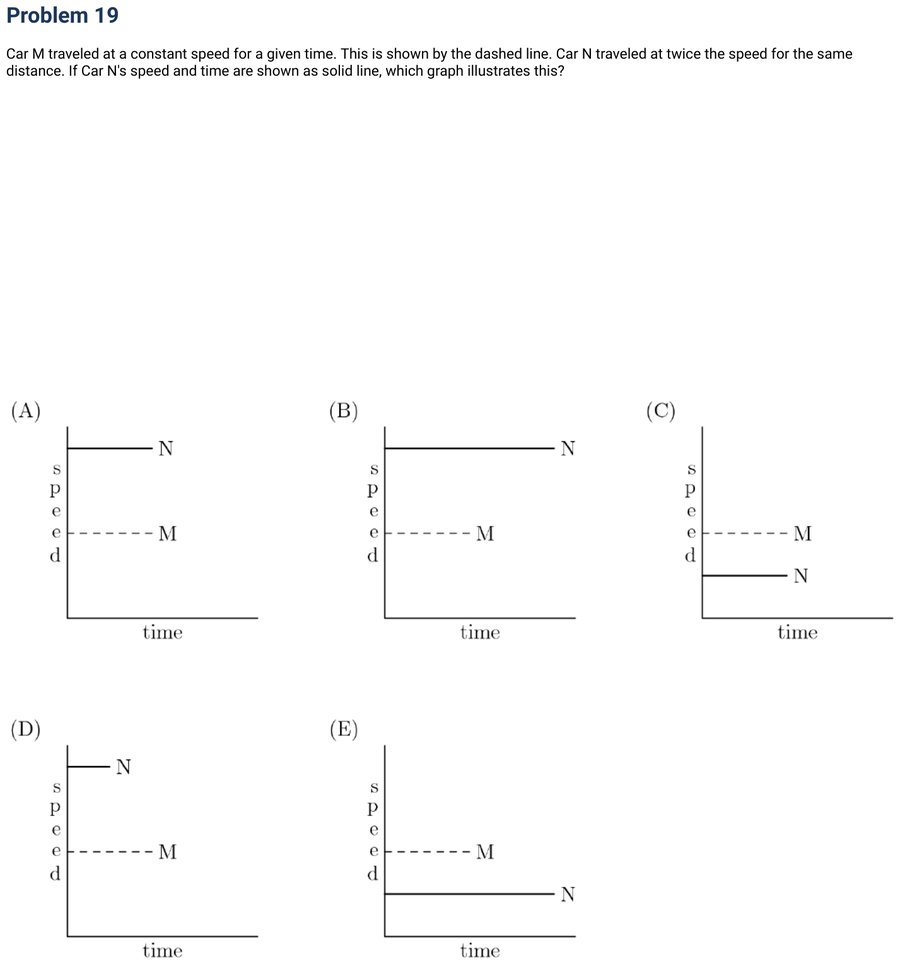
On a speed-vs-time graph, the distance traveled is the AREA of the rectangle under the line (speed × time). Both cars cover the same distance, so both rectangles have the same area.
Still stuck? Show hint 2 →
Hint 2 of 2
Double the height (speed) with the same area forces half the width (time) — so look for N's line drawn twice as high but half as long as M's.
Show solution
Approach: twice the speed over the same distance halves the time
Read the axes: speed is vertical, time horizontal, and a constant speed is a horizontal line. Distance = speed × time = the area under that line.
Car N is twice as fast, so its line sits at twice M's height. Same distance means same area, so doubling the height must halve the width — N's line runs only half as long in time.
The graph with N higher AND shorter than M is D. The takeaway: on speed-time graphs, area = distance, so trading height for width keeps distance fixed.
Kaleana shows her test score to Quay, Marty, and Shana, but the others keep theirs hidden. Quay thinks, "At least two of us have the same score." Marty thinks, "I didn't get the lowest score." Shana thinks, "I didn't get the highest score." List the scores from lowest to highest for Marty (M), Quay (Q), and Shana (S).
Show answer
Answer: A — S, Q, M.
Show hints
Hint 1 of 2
The crucial detail is what each person can SEE. Quay only saw Kaleana's score, yet he's CERTAIN two scores match — how could he be certain knowing just one other score?
Still stuck? Show hint 2 →
Hint 2 of 2
He can only be sure if his own score equals the one he saw: Q = K. Once that's locked, turn Marty's and Shana's thoughts into comparisons with K.
Show solution
Approach: turn each statement into an inequality
Quay is certain two scores are equal but has seen only Kaleana's — the sole way to be sure is if HIS score matches it. So Q = K.
Marty knows he's not lowest, and the only score he's seen is Kaleana's, so M > K. Shana knows she's not highest, so S < K. Swap K for Q: S < Q < M.
Lowest to highest: S, Q, M. The transferable move in "who-knows-what" logic: a person's certainty is built only from what they can actually observe — that constraint is what pins everything down.
The mean of a set of five different positive integers is 15. The median is 18. The maximum possible value of the largest of these five integers is
Show answer
Answer: D — 35.
Show hints
Hint 1 of 2
The mean turns into a fixed total: five numbers averaging 15 must sum to 75. That total is a budget shared among all five.
Still stuck? Show hint 2 →
Hint 2 of 2
To make ONE number as big as possible, you have to starve the other four down to the smallest values the rules (distinct, positive, median 18) permit.
Show solution
Approach: fix the total, minimize the others
Convert the mean to a total: the five numbers sum to 5 × 15 = 75. This is the budget — making the largest big means making everyone else small.
Order them a < b < 18 < d < e. Below the median, the smallest distinct positives are b = 2 and a = 1. Just above the median, d must be a distinct integer > 18, so the smallest allowed is d = 19.
Whatever's left of the budget goes to e: e = 75 − 1 − 2 − 18 − 19 = 35. (Check: 1, 2, 18, 19, 35 are five distinct positives, median 18, sum 75. ✓) The strategy — fix the total, then minimize everything except your target — maximizes any single value.
Why must d be 19 and not 18? The integers are different, so d can't tie the median; the next integer up is 19.
On a twenty-question test, each correct answer is worth 5 points, each unanswered question is worth 1 point, and each incorrect answer is worth 0 points. Which of the following scores is NOT possible?
Show answer
Answer: E — 97.
Show hints
Hint 1 of 2
Scores bunch up near the top in a jagged way — so test the high choices first by asking "what's the most you can score without getting everything right?"
Still stuck? Show hint 2 →
Hint 2 of 2
Turning one correct (5 pts) into one unanswered (1 pt) drops your score by 4, which creates a gap just below the perfect 100.
Show solution
Approach: find the gap just below the maximum
The ceiling is all 20 correct: 20 × 5 = 100. To score less you must give up a correct answer, and the gentlest downgrade is correct (5) → unanswered (1), a loss of 4. So the very next attainable score is 100 − 4 = 96 (= 19 right + 1 unanswered).
That leaves 97, 98, 99 stranded with no way to reach them. Among the choices, 97 is the impossible one.
Quick check that the rest work: 95 = 19 right (the last as wrong); 90 = 18 right; 91 = 18 right + 1 unanswered; 92 = 18 right + 2 unanswered. The lesson: scoring systems with unequal point values leave "holes," and the biggest holes sit right under the maximum.
Points R, S, and T are vertices of an equilateral triangle, and points X, Y, and Z are midpoints of its sides. How many noncongruent triangles can be drawn using any three of these six points as vertices?
Show answer
Answer: D — 4.
Show hints
Hint 1 of 2
"Noncongruent" is the whole trap — you're counting distinct SHAPES, not positions. The figure's threefold symmetry means many triangles are rotated/reflected copies.
Still stuck? Show hint 2 →
Hint 2 of 2
Sort triangles by their ingredients: how many corners (R,S,T) versus midpoints (X,Y,Z) each one uses. Triangles with the same recipe come out congruent.
Show solution
Approach: count shapes up to congruence using symmetry
Picking any 3 of the 6 points gives C(6,3) = 20 triangles — that's why 20 is offered as a tempting wrong answer. But the equilateral symmetry rotates and reflects most of them onto each other, so we count shape types, not all 20.
Classify by makeup. 3 corners: only RST (big equilateral). 3 midpoints: only XYZ (small equilateral). 2 corners + 1 midpoint: e.g. R-T-Z, a 30-60-90 right triangle. 1 corner + 2 midpoints: e.g. R-Y-Z, an obtuse isosceles. (Three collinear points like R-X-T form no triangle.)
That's exactly 4 distinct shapes. The reusable trick: when a figure is highly symmetric, group your choices by their structural "recipe" — copies under rotation/reflection collapse together.
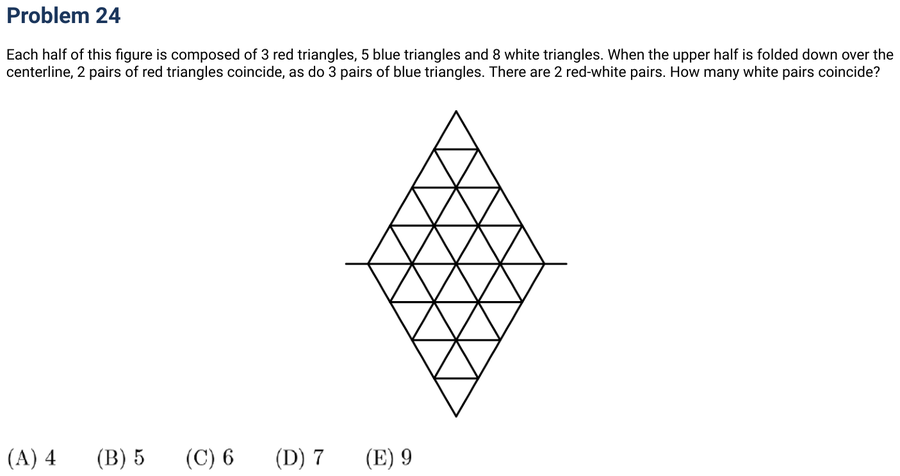
Every triangle on the top half lands on exactly one on the bottom — nothing vanishes. So just track one half and watch each color get used up.
Still stuck? Show hint 2 →
Hint 2 of 2
Work color by color: count how many reds and blues are "spent" by the given pairs, see what's forced to pair with white, and the leftover whites pair with each other.
Show solution
Approach: account for each color on one half (conservation)
One half has 3 red, 5 blue, 8 white. The 2 red-red pairs spend 2 reds, leaving 1 red; the 3 blue-blue pairs spend 3 blues, leaving 2 blue.
Now the leftovers must pair with whites. The 2 red-white pairs spend that last red and 1 white. The 2 leftover blues can't make a 4th blue-blue pair (only 3 are allowed), so each pairs with a white — using 2 more whites.
Whites spent: 1 (with red) + 2 (with blue) = 3, leaving 8 − 3 = 5 whites per half. Those face each other as 5 white-white pairs.
The engine here is conservation: a folded figure pairs everything one-to-one, so once you know how each "colored" piece is consumed, the remainder of any one color is forced.
There are 24 four-digit whole numbers that use each of the four digits 2, 4, 5, and 7 exactly once. Only one of these four-digit numbers is a multiple of another one. Which of the following is it?
Show answer
Answer: D — 7425.
Show hints
Hint 1 of 2
Both the number and its factor-partner are built from the same four digits, so both live in the narrow window 2457 to 7542 — that squeezes the possible multiplier down to almost nothing.
Still stuck? Show hint 2 →
Hint 2 of 2
Since even 2457 × 4 ≈ 9828 already escapes the window, the factor can only be 2 or 3. Test small.
Show solution
Approach: the only feasible factor is 3
Both numbers use exactly {2, 4, 5, 7}, so each lies between 2457 and 7542. For one to be a multiple of the other, the ratio must keep the product inside that window — and 2457 × 4 ≈ 9828 already overshoots, so the multiplier is just 2 or 3.
Doubling never lands back in the set, so try ×3: 2475 × 3 = 7425, which uses exactly 2, 4, 5, 7. ✓
So the answer is 7425 (= 3 × 2475). Neat confirmation: every arrangement of 2,4,5,7 has digit sum 2+4+5+7 = 18, a multiple of 9 — so all 24 numbers are multiples of 9, and 7425 = 9 × 825 fits right in.
The reusable idea: when a multiple must reuse a fixed digit set, the size window pins the factor to a tiny range — bounding before searching turns 24 candidates into one quick test.