(6 ? 3) + 4 − (2 − 1) = 5. To make this statement true, the question mark between the 6 and the 3 should be replaced by
Show answer
Answer: A — ÷ (division).
Show hints
Hint 1 of 2
Don't test all four operations from the front — clean up the part that has no mystery in it first, and see what the 6 ? 3 must equal.
Still stuck? Show hint 2 →
Hint 2 of 2
This is work backward: when one slot is unknown, simplify everything else so the unknown stands alone on one side.
Show solution
Approach: isolate the unknown operation by simplifying the rest
Start with the certain part. 4 − (2 − 1) = 4 − 1 = 3 — no operation choice touches it, so settle it first.
Now the equation reads (6 ? 3) + 3 = 5, so 6 ? 3 must be 2. Only division does that: 6 ÷ 3 = 2, the sign is ÷.
Why this transfers: in any "fill the blank" equation, evaluate every known piece first so the unknown is left alone — then you solve one tiny question instead of testing every option.
What is the degree measure of the smaller angle formed by the hands of a clock at 10 o'clock?
Show answer
Answer: C — 60°.
Show hints
Hint 1 of 2
A clock face is just a circle cut into 12 equal slices. Forget degrees for a moment — how many slices sit between the 10 and the 12?
Still stuck? Show hint 2 →
Hint 2 of 2
Each hour-slice is the same size: 360° ÷ 12 = 30°. Count the slices, then multiply.
Show solution
Approach: the clock is 12 equal 30° slices — count slices
At exactly 10 o'clock the hour hand is on the 10 and the minute hand is on the 12. There are two number-gaps between them (10→11→12).
Each gap is one-twelfth of the full turn: 360° ÷ 12 = 30°. Two gaps give 2 × 30° = 60°.
You'll see it again: any "angle between clock hands on the hour" is just (number of gaps) × 30°. Knowing the 30°-per-hour grid makes every on-the-hour clock angle instant.
Which triplet of numbers has a sum NOT equal to 1?
Show answer
Answer: D — (1.1, −2.1, 1.0).
Show hints
Hint 1 of 2
The question wants the ODD one out, so you don't need every exact sum — scan for a triplet whose pieces pair up suspiciously. In D, the two positives 1.1 and 1.0 add to 2.1, the very number being subtracted.
Still stuck? Show hint 2 →
Hint 2 of 2
Look for cancellation before you add: matching a positive and a negative that erase each other tells you the answer faster than full arithmetic.
Show solution
Approach: hunt for the cancellation instead of adding all five
Glance for pieces that cancel. In D, 1.1 + 1.0 = 2.1, exactly the amount subtracted, so 1.1 − 2.1 + 1.0 = 0 — not 1.
A quick check confirms the rest land on 1 (½ + ⅓ + ⅙ = 1, 2 − 2 + 1 = 1, .1 + .3 + .6 = 1, −1.5 − 2.5 + 5 = 1).
The odd one out is (1.1, −2.1, 1.0). Why this transfers: on "which is different" problems, scan for the special structure (a perfect cancellation) before grinding every option — the outlier usually announces itself.
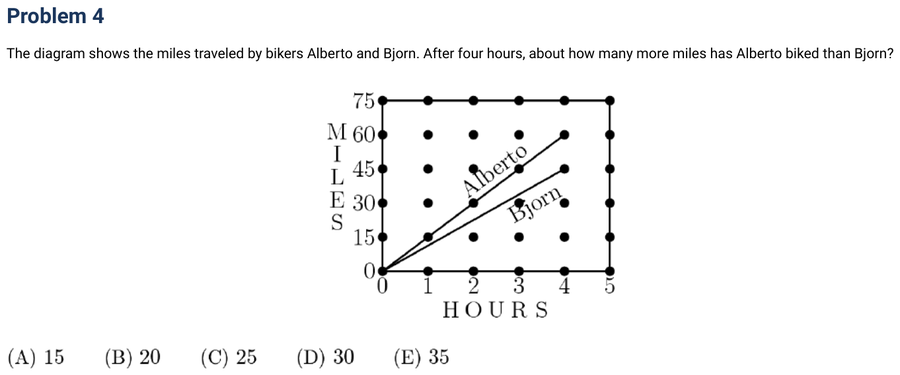
The word "more" means a gap, and a gap on a graph is a vertical distance. Go to Hours = 4 and look at how far apart the two lines sit there.
Still stuck? Show hint 2 →
Hint 2 of 2
Read each line's height at the 4-hour line, then subtract — you don't need the actual mileages anywhere else.
Show solution
Approach: the 'how much more' is the vertical gap at 4 hours
Slide up the vertical line at Hours = 4. Alberto's line is at about 60 miles, Bjorn's at about 45.
"How many more" is the gap between them: 60 − 45 = 15 miles.
Reading tip you'll reuse: a difference question on a graph is always a vertical gap at one chosen x-value — find that x, then measure straight up between the curves. Steeper line = faster rider, which is why Alberto pulls ahead.
A rectangular garden 50 feet long and 10 feet wide is enclosed by a fence. To make the garden larger, while using the same fence, its shape is changed to a square. By how many square feet does this enlarge the garden?
Show answer
Answer: D — 400 square feet.
Show hints
Hint 1 of 2
The fence never changes length, so the perimeter is the thing that stays fixed — the area is free to grow. Find that fixed perimeter first.
Still stuck? Show hint 2 →
Hint 2 of 2
The shape that holds the most area for a given perimeter is the most "square" one. Compute the square's side from the fence, then its area.
Show solution
Approach: perimeter is fixed; the rounder shape holds more area
The fence length is locked: 2(50 + 10) = 120 ft. Reshaping can't change that, so the square has side 120 ÷ 4 = 30 ft and area 30² = 900 sq ft.
The old long-thin rectangle held 50 × 10 = 500 sq ft, so the gain is 900 − 500 = 400 square feet.
The principle: for a fixed perimeter, the more equal the sides, the more area — a square always beats a stretched-out rectangle. That's why squaring up a 50×10 sliver buys so much extra room.
Bo, Coe, Flo, Jo, and Moe have different amounts of money. Neither Jo nor Bo has as much money as Flo. Both Bo and Coe have more than Moe. Jo has more than Moe, but less than Bo. Who has the least amount of money?
Show answer
Answer: E — Moe.
Show hints
Hint 1 of 2
The question only asks for the least, so you don't need to sort all five — you just need the one person nobody falls below. Watch which name keeps showing up on the small side of every comparison.
Still stuck? Show hint 2 →
Hint 2 of 2
Scan the clues for the name that is always "more than" someone else. The person who never appears as the bigger one is your answer.
Show solution
Approach: look only for the bottom, not the full order
Sweep the clues for who loses each comparison. Moe is beaten by Bo, by Coe, and by Jo directly. And since Flo > Bo > Moe, Flo beats Moe too.
Every other person sits above Moe, so Moe has the least.
Why this transfers: for a "who is least/greatest" question you only need the extreme, not the whole ranking — find the name that's on the losing side of every clue and stop. Chaining Flo > Bo > Moe shows you can hop across people you were never directly told to compare.
The third exit on a highway is located at milepost 40 and the tenth exit is at milepost 160. There is a service center on the highway located three-fourths of the way from the third exit to the tenth exit. At what milepost would you expect to find this service center?
Show answer
Answer: E — Milepost 130.
Show hints
Hint 1 of 2
"Three-fourths of the way" is a fraction of the gap between the exits, not three-fourths of 160. First find the gap.
Still stuck? Show hint 2 →
Hint 2 of 2
A fraction-of-the-way point = start + fraction × (gap). Don't forget to add it back onto the starting milepost.
Show solution
Approach: start + fraction of the gap (not fraction of the endpoint)
The trap is multiplying ¾ × 160. The fraction applies to the gap: 160 − 40 = 120 miles, and ¾ of 120 is 90.
Now add that distance onto where you started: 40 + 90 = 130.
The reusable move: a "fraction of the way from A to B" point is A + fraction × (B − A). The exit numbers (third, tenth) are a distraction — only the mileposts matter.
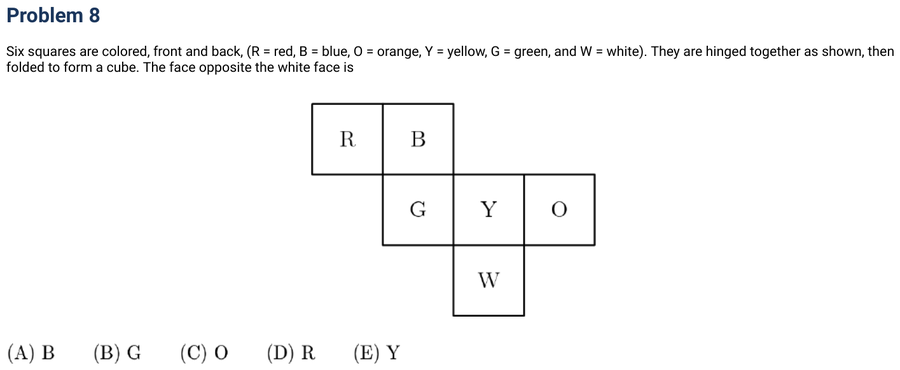
On a cube, two faces are opposite exactly when they are NOT neighbors — they never share an edge or a fold-corner in the net. Pick the white square and rule out everything it touches as it folds.
Still stuck? Show hint 2 →
Hint 2 of 2
Faces that are edge-adjacent in the net, OR sit in an L (one step over, one step up), end up next to each other. The one square that can't reach white either way is its opposite.
Show solution
Approach: opposite = the face white can never sit beside
Anchor the yellow square as the bottom and fold the rest up around it. White (directly below yellow) folds to become one side wall.
Now eliminate white's neighbors: white shares the fold with yellow, and yellow's straight-strip partner is orange — those wrap around white's column. Red and green attach along the other edges. The only face left, sitting across the cube from white, is blue.
The rule to keep: on any cube net, opposite faces are the pair that are neither edge-adjacent nor one-corner-apart. A quick test: in a straight run of three squares the two ends are opposite — here yellow's straight neighbors pin down what's beside white, leaving blue as the lone face across from it.
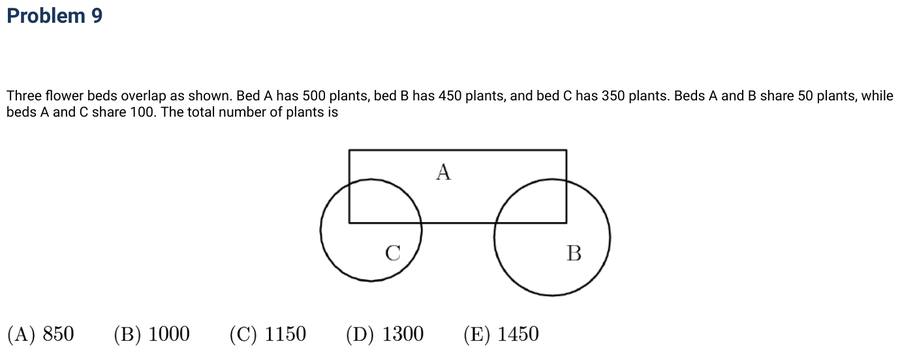
If you just add 500 + 450 + 350, every plant in an overlap gets counted in two beds — so the sum is too big. By how much?
Still stuck? Show hint 2 →
Hint 2 of 2
A plant shared by two beds is counted twice but should count once, so it's an extra +1. Subtract each overlap once to undo the double-count.
Show solution
Approach: inclusion–exclusion: add all, subtract the double-counted overlaps once
Add the beds: 500 + 450 + 350 = 1300. But a plant in two beds was tallied in both, so each overlap plant is counted one time too many.
There are 50 + 100 = 150 such doubly-counted plants (and none in all three). Remove the extra copy: 1300 − 150 = 1150 plants.
This is inclusion–exclusion, and you'll meet it everywhere: |A ∪ B ∪ C| = (sum of parts) − (pairwise overlaps) + (triple overlap). Here the triple overlap is 0, so you only subtract the pairs.
A complete cycle of a traffic light takes 60 seconds. During each cycle the light is green for 25 seconds, yellow for 5 seconds, and red for 30 seconds. At a randomly chosen time, what is the probability that the light will NOT be green?
Show answer
Answer: E — 7/12.
Show hints
Hint 1 of 2
Probability over time = (favorable seconds) ÷ (total seconds). The favorable event is "not green" — so which seconds count?
Still stuck? Show hint 2 →
Hint 2 of 2
"Not green" is the opposite of green. You can add up yellow + red, or just take the whole cycle minus the green time — the complement trick.
Show solution
Approach: favorable time over total — or 1 minus the green probability
A random instant is equally likely anywhere in the 60-second cycle, so probability = (matching seconds) ÷ 60.
Complement shortcut: green is 25/60, so not-green is 1 − 25/60 = 35/60 = 7/12 — same answer. Whenever the "not" event has fewer pieces to add, subtract from 1 instead.
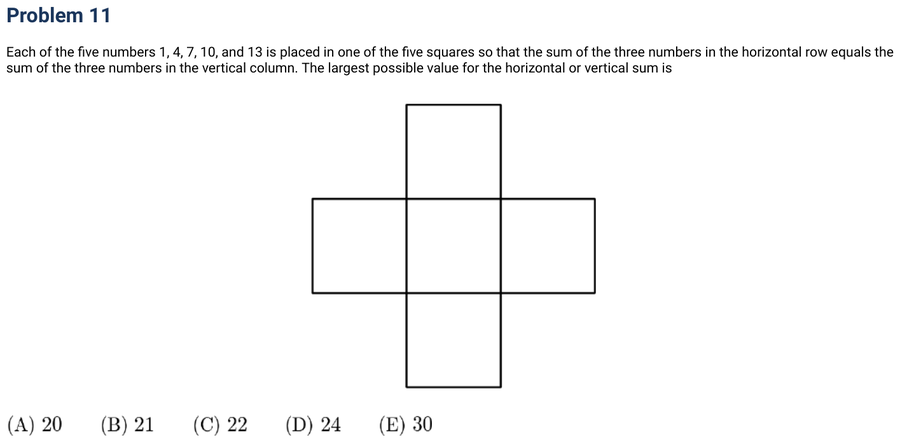
The plus shape overlaps at the center square — that one number belongs to BOTH the row and the column. So if you add the row-sum and the column-sum together, the center gets counted twice while everyone else is counted once.
Still stuck? Show hint 2 →
Hint 2 of 2
Equal sums means each line is exactly half of (row + column). To make that half as big as possible, you want the doubled number — the center — to be the largest. Name this the 'shared-cell counts twice' idea.
Show solution
Approach: the overlap cell is counted twice — load it to maximize
Add the row total and the column total. Every number appears once except the center, which sits in both lines, so the grand total is (1+4+7+10+13) + center = 35 + center.
The two lines are equal, so each equals half of 35 + center. To push that as high as possible, put the biggest number, 13, in the center: (35 + 13) ÷ 2 = 48 ÷ 2 = 24.
Worth keeping: whenever a cell is shared by two groups whose sums you're combining, it gets double-counted — and that's a lever. Want the largest equal sums? Maximize the shared cell. (Sanity check: 24 must be achievable — center 13, then pair the rest as 1+10 and 4+7, each making 11, and 11+13 = 24. ✓)
The ratio of the number of games won to the number of games lost (no ties) by the Middle School Middies is 114. To the nearest whole percent, what percent of its games did the team lose?
Show answer
Answer: B — 27%.
Show hints
Hint 1 of 2
A ratio of 11 to 4 isn't 11 games and 4 games — it's 11 parts to 4 parts. The whole is the parts added: 11 + 4 = 15. Percent-lost is the lost parts over the whole.
Still stuck? Show hint 2 →
Hint 2 of 2
Percent-of-the-whole always needs the WHOLE in the denominator. The ratio's denominator (4 lost) is not the total — add the parts to get it.
Show solution
Approach: ratio → parts → fraction of the whole → percent
Read the ratio as parts: 11 won-parts and 4 lost-parts, so the whole is 11 + 4 = 15 parts. Losses are 4 of those 15.
4/15 = 0.2666… ≈ 26.7%, which rounds to 27%.
The classic trap this dodges: the answer is NOT 4/11 (lost vs won) — percent of games requires lost over total games, so you must sum the parts first. Choice A (24% ≈ 4/16.7) and E (73%, the win rate) are there to catch that slip.
The average age of the 40 members of a computer science camp is 17 years. There are 20 girls, 15 boys, and 5 adults. If the average age of the girls is 15 and the average age of the boys is 16, what is the average age of the adults?
Show answer
Answer: C — 28 years.
Show hints
Hint 1 of 2
You can't average the averages — averages of different-sized groups don't combine directly. Convert each average back into a TOTAL (average × count), because totals do add.
Still stuck? Show hint 2 →
Hint 2 of 2
Find the whole camp's total age, subtract the girls' and boys' totals, and what's left is the adults' total. Then divide by 5.
Show solution
Approach: averages → totals (totals are what's allowed to add)
Adults' total age = 680 − 300 − 240 = 140, so their average is 140 ÷ 5 = 28.
Why this transfers: the golden rule for averages is "un-average into totals first." Sums combine and split cleanly; averages don't, because they hide how many people are behind each number.
Another way — balance the deviations from 17:
Measure each group against the overall average of 17. Girls are 2 below (×20 = −40 total), boys are 1 below (×15 = −15), so the camp is 55 'age-years' short of 17-each.
The 5 adults must carry that whole +55 surplus above 17: 55 ÷ 5 = 11 above, so 17 + 11 = 28.
This 'see-saw around the mean' view is fast and shows the adults pulling the average up to balance the younger campers.
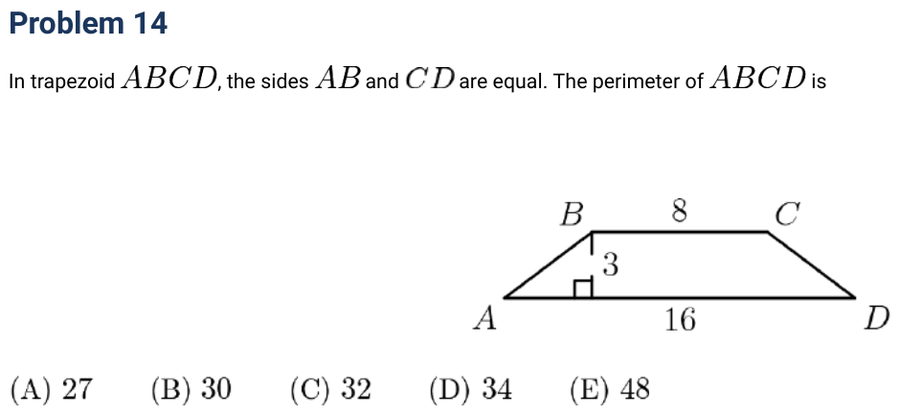
The slant sides AB and CD are equal, so the trapezoid is symmetric — drop a vertical from B and from C and the bottom splits into the middle (equal to the top, 8) plus two equal overhangs. The two overhangs share the leftover 16 − 8.
Still stuck? Show hint 2 →
Hint 2 of 2
Each slant side is now the hypotenuse of a right triangle with legs = height and overhang. Watch for a friendly Pythagorean triple.
Show solution
Approach: use symmetry to find the overhang, then a 3-4-5 triangle
Because AB = CD, the figure is symmetric: dropping verticals from B and C carves a rectangle of width 8 in the middle, leaving 16 − 8 = 8 split evenly into two overhangs of 4 each.
Each slant side is the hypotenuse of a right triangle with legs 3 (height) and 4 (overhang): √(3² + 4²) = 5 — a 3-4-5 triangle, no messy square root.
Perimeter = 16 + 8 + 5 + 5 = 34. Two transferable habits: exploit symmetry to find the overhang for free, and recognize 3-4-5 (and 5-12-13) so you spot the hypotenuse on sight.
Bicycle license plates in Flatville each contain three letters. The first is chosen from the set {C, H, L, P, R}, the second from {A, I, O}, and the third from {D, M, N, T}. When Flatville needed more license plates, they added two new letters. The new letters may both be added to one set, or one letter may be added to one set and one to another. What is the largest possible number of additional license plates that can be made by adding two letters?
Show answer
Answer: D — 40 more plates.
Show hints
Hint 1 of 2
Each plate is one choice from each set, so the count is the PRODUCT of the three set sizes: 5 × 3 × 4 = 60. Adding a letter bumps one factor up by 1.
Still stuck? Show hint 2 →
Hint 2 of 2
Adding to a set multiplies the whole product by that factor's growth — going 3→4 multiplies by 4/3, going 5→6 only by 6/5. So push your new letters into the smallest sets to get the biggest multiplier.
Show solution
Approach: count = product of set sizes; feed the smallest factors
Plates = (size 1)×(size 2)×(size 3) = 5 × 3 × 4 = 60. Two new letters add 2 total across the three factors.
A letter helps most where the factor is smallest, because it multiplies by the larger ratio. The size-3 set is smallest: putting both there gives 5 × 5 × 4 = 100; splitting one into the 3-set and one into the 4-set gives 5 × 4 × 5 = 100 as well.
Either way that's 100 plates, an extra 100 − 60 = 40. The principle: to grow a product of fixed total "+1 bumps," feed your increments to the smallest factors — they give the steepest percentage jump.
Another way — just test every placement (brute force, when in doubt):
Six ways to place the two letters; compute each product. Both into set 1: 7×3×4 = 84. Both into set 2: 5×5×4 = 100. Both into set 3: 5×3×6 = 90.
Tori's mathematics test had 75 problems: 10 arithmetic, 30 algebra, and 35 geometry problems. Although she answered 70% of the arithmetic, 40% of the algebra, and 60% of the geometry problems correctly, she did not pass the test because she got less than 60% of the problems right. How many more problems would she have needed to answer correctly to earn a 60% passing grade?
Show answer
Answer: B — 5 more.
Show hints
Hint 1 of 2
The percentages are of each subject, so first turn them into actual counts of correct problems — 70% of 10 is a number, not a percent.
Still stuck? Show hint 2 →
Hint 2 of 2
The question is a gap: (problems needed for 60%) − (problems she got). Find each piece as a count, then subtract.
Show solution
Approach: convert percents to counts, then close the gap to the target
Counts correct: 70% of 10 = 7, 40% of 30 = 12, 60% of 35 = 21. Total = 7 + 12 + 21 = 40.
Passing needs 60% of 75 = 45 correct. She's short by 45 − 40 = 5.
The careful move: a percent of one group can't be added to a percent of another (different sizes), so cash every percent into a head-count first, then the totals add and subtract cleanly.
Cookies for a Crowd. At a school, 108 students eat an average of 2 cookies apiece. The recipe makes a pan of 15 cookies and uses 2 eggs per pan, and only full recipes are made. Walter buys eggs by the half-dozen. How many half-dozens should he buy to make enough cookies?
Show answer
Answer: C — 5 half-dozens.
Show hints
Hint 1 of 2
Walk the chain of units: cookies needed → pans (round UP, since only whole recipes are baked) → eggs → half-dozens (round up again). The two round-ups are where this kind of problem traps people.
Still stuck? Show hint 2 →
Hint 2 of 2
When a quantity must come in whole units (pans, half-dozens), you always round UP — "enough" means never short, never exactly the leftover.
Show solution
Approach: unit-conversion chain, rounding up at every whole-unit step
Cookies needed: 108 × 2 = 216. Pans: 216 ÷ 15 = 14.4, but you can't bake 0.4 of a pan, so round up to 15 pans.
The reusable rule: whenever you buy/bake in fixed bundles, divide then round UP (ceiling) — rounding down would leave the crowd short. Here 14.4 → 15 pans is the make-or-break step; treating it as 14 undercounts the eggs.
Cookies for a Crowd. The recipe makes a pan of 15 cookies, and only full recipes are made. Normally 108 students each eat 2 cookies, but a concert cuts attendance by 25%. How many recipes should Walter and Gretel make for the smaller party?
Show answer
Answer: E — 11 recipes.
Show hints
Hint 1 of 2
"Down 25%" means keep the other 75% — so multiply by ¾ instead of finding the 25% and subtracting. One step, not two.
Still stuck? Show hint 2 →
Hint 2 of 2
Get their cookies, divide by 15, then round UP to whole recipes (you can't bake a fraction of a pan).
Show solution
Approach: keep ¾ of the crowd → cookies → round up pans
A 25% drop leaves ¾ of the students: ¾ × 108 = 81 students, eating 81 × 2 = 162 cookies.
Recipes: 162 ÷ 15 = 10.8, round up to 11 full recipes.
The handy reframe: "down 25%" → ×0.75 directly (and "up 25%" → ×1.25). And as always with whole pans, round up — 10 recipes (150 cookies) would leave 12 students cookieless.
Cookies for a Crowd. The recipe makes a pan of 15 cookies using 3 tablespoons of butter, and only full recipes are made. Walter and Gretel must supply 216 cookies. There are 8 tablespoons in a stick of butter. How many sticks of butter are needed?
Show answer
Answer: B — 6 sticks.
Show hints
Hint 1 of 2
Same chain as before: cookies → pans (round up) → tablespoons → sticks (round up). Two whole-unit steps means two round-ups.
Still stuck? Show hint 2 →
Hint 2 of 2
Don't round the pans down: 216 ÷ 15 isn't a whole number, so it takes 15 full pans — and that drives the butter total.
Show solution
Approach: cookies → pans → tablespoons → sticks, rounding up each whole-unit step
Pans for 216 cookies: 216 ÷ 15 = 14.4 → round up to 15 pans. Butter: 15 × 3 = 45 tablespoons.
Sticks: 45 ÷ 8 = 5.625 → round up to 6 sticks.
The recurring trap: rounding 14.4 down to 14 pans gives 42 tbsp and the wrong stick count. Whole supplies always round UP — and a leftover ⅜ of a stick is fine, the problem even says "some butter may be left over."
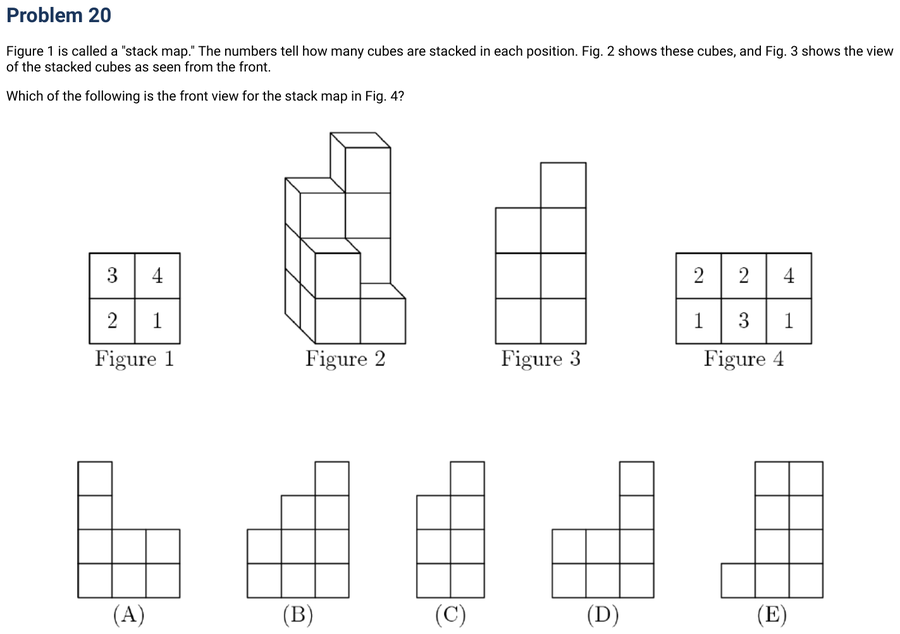
From the front you look along the depth direction, so a tall stack hides any shorter stack behind it. Each column's front height is just its TALLEST stack — the back-to-front numbers collapse to their maximum.
Still stuck? Show hint 2 →
Hint 2 of 2
Read the map column by column (front and back number in each), keep the bigger one, and you've built the front silhouette.
Show solution
Approach: a front view is the max-height projection of each column
Looking from the front, depth disappears — within a column, the taller stack blocks the view of the shorter one, so the column's height is the maximum of its two numbers.
Column by column: max(2,1) = 2, max(2,3) = 3, max(4,1) = 4. So the silhouette rises 2, 3, 4 left to right, matching figure B.
The principle to keep: any single-direction view of a 3-D pile is a projection — collapse the hidden direction by taking the maximum height in each visible column. (Side view would instead take the max across each row.)
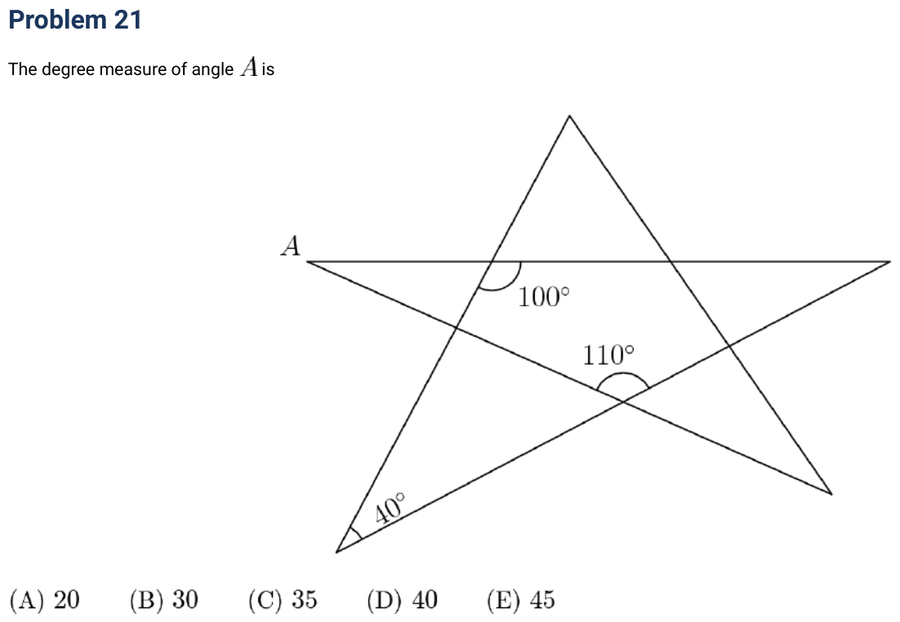
The 100° and 110° marks sit at crossing points, so each has a partner angle: its supplement (straight line) and its vertical angle (the X across the crossing). Convert the marked angles into the angles that actually live inside the small triangles.
Still stuck? Show hint 2 →
Hint 2 of 2
The cleanest tool here is the exterior-angle theorem: in any triangle, an exterior angle equals the sum of the two non-adjacent interior angles. Chase from the known tips toward A.
Show solution
Approach: exterior-angle theorem to chase toward A
First turn the marks into triangle angles. The 100° has supplement 80° on the line through A; the 110° has supplement 70°.
Look at the triangle with the 40° tip and the 70° angle: its third angle is 180° − 40° − 70° = 70°. The vertical angle at that same crossing (on A's triangle) is also 70°.
Now A's triangle has the 80° and that 70°: ∠A = 180° − 80° − 70° = 30°.
Tools you'll reuse on every star/chase: at a crossing, the supplement (sums to 180° along a line) and the vertical angle (equal across the X) let you teleport a known angle into a neighboring triangle — then the 180° triangle sum finishes it.
Another way — the five star tips sum to 180°:
A famous fact: the five point-angles of a 5-pointed star always add to 180°. Two of the tips here can be read from the figure's marked angles.
Using the supplements, the tip angles work out so that the remaining tip A fills the gap to 180°, giving ∠A = 30°.
Knowing the 'star tips = 180°' result lets you skip most of the chase once you can identify the other tip angles — a handy shortcut to verify the answer.
In a far-off land three fish can be traded for two loaves of bread, and a loaf of bread can be traded for four bags of rice. How many bags of rice is one fish worth?
Show answer
Answer: D — 2⅔ bags.
Show hints
Hint 1 of 2
Bread is the middle-man currency. Pick one good to measure everything in — rice — and convert the bread in the fish trade into rice. Then the fish↔rice rate falls right out.
Still stuck? Show hint 2 →
Hint 2 of 2
Chain the rates so the middle unit (bread) cancels: fish→bread→rice. This is exactly how unit conversions work in science too.
Show solution
Approach: chain the trades through a common unit so bread cancels
Express the fish deal in rice. 3 fish = 2 loaves, and each loaf = 4 bags, so 2 loaves = 8 bags. Thus 3 fish = 8 bags of rice.
Divide to get one fish: 8 ÷ 3 = 2⅔ bags of rice.
The transferable move: when trades link A→B→C, convert through the shared item so it cancels — just like converting hours→minutes→seconds. (Sanity check: a fish is worth a bit more than half a loaf, and a loaf is 4 bags, so 2-and-a-bit bags per fish feels right.)
Another way — scale to whole pieces (avoid fractions of a fish):
To dodge thirds, work with 3 fish at once. 3 fish trade for 2 loaves, and 2 loaves = 8 bags of rice, so 3 fish ↔ 8 bags.
Reading the ratio 3 fish : 8 bags, one fish is 8/3 = 2⅔ bags.
Bundling to the smallest whole quantities (here 3 fish) keeps the arithmetic clean and only divides once at the very end.
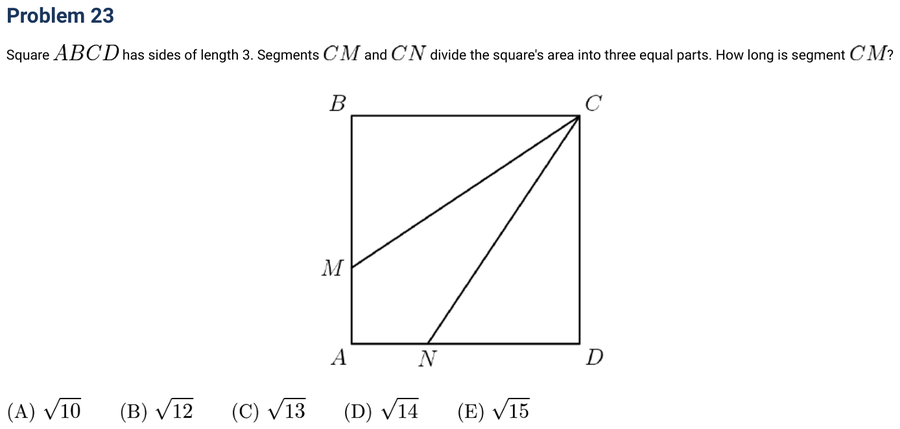
You want a length, but you're given an area — so use area to FIND the length first. Triangle BMC is right-angled at B with one leg the full side BC = 3; its area being one-third of the square pins down the other leg BM.
Still stuck? Show hint 2 →
Hint 2 of 2
Once you know both legs of the right triangle BMC, segment CM is just its hypotenuse — Pythagoras.
Show solution
Approach: let the equal-area condition solve for the missing leg, then Pythagoras
The square's area is 3² = 9, split into three equal parts of 3 each. Triangle BMC is right-angled at corner B, with legs BC = 3 (top side) and BM along the left side. Its area = ½ · 3 · BM = 3, so BM = 2.
Now CM is the hypotenuse of right triangle BMC: CM = √(BM² + BC²) = √(2² + 3²) = √(4 + 9) = √13.
Why this transfers: when a problem hands you an area but asks a length, run the area formula backward to recover the unknown side — then geometry (here Pythagoras) finishes it. The √13 answer also tells you it's between √9 = 3 and √16 = 4, a quick sanity check on the choices.
You'll never compute 1999²⁰⁰⁰ — and you don't have to. The remainder when dividing by 5 depends only on the units digit, and the units digit of a power depends only on the units digit of the base. So really you're asking: what does 9²⁰⁰⁰ end in?
Still stuck? Show hint 2 →
Hint 2 of 2
Units digits of powers always fall into a short repeating cycle. List a few powers of 9 and the pattern jumps out; then use whether the exponent is odd or even.
Show solution
Approach: the units digit cycles — find where the even exponent lands
Dividing by 5 only cares about the last digit (10, 20, 30, … are all multiples of 5), and the last digit of a power only depends on the base's last digit, 9.
Powers of 9 cycle in their units digit: 9, 81, 729, … → 9, 1, 9, 1, … Odd exponent → ends in 9, even exponent → ends in 1. Since 2000 is even, 1999²⁰⁰⁰ ends in 1.
A number ending in 1 is one more than a multiple of 10 (hence of 5), so the remainder is 1. The transferable idea: for last-digit or mod-5/mod-10 questions, ignore the giant number and ride the short repeating cycle of units digits.
Another way — reduce the base mod 5 first:
Modulo 5, 1999 leaves remainder 4 (since 2000 is a multiple of 5), so 1999²⁰⁰⁰ ≡ 4²⁰⁰⁰ (mod 5).
And 4 ≡ −1 (mod 5), so 4²⁰⁰⁰ ≡ (−1)²⁰⁰⁰ = 1 (mod 5).
The remainder is 1. Spotting that the base is −1 away from a multiple of 5 makes an even power collapse to 1 instantly — a clean trick once you've met modular arithmetic.
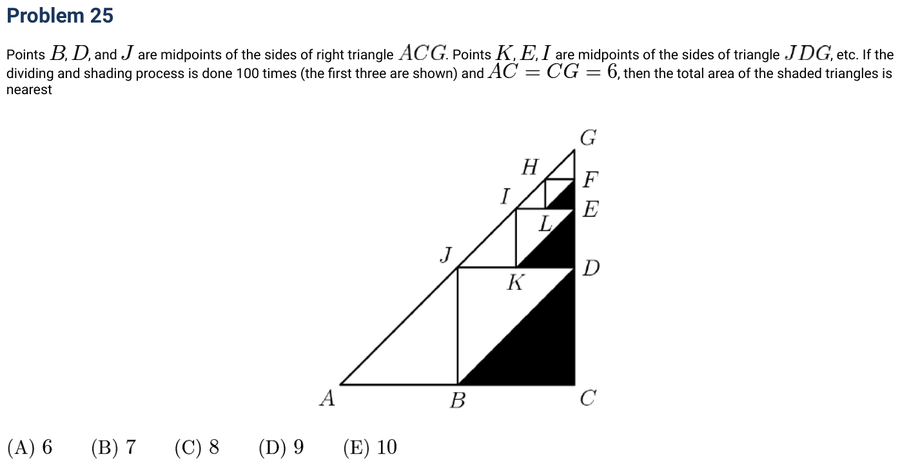
Each step takes midpoints, so every new triangle is a half-scale copy of the last one — and halving the sides quarters the area. The shaded triangles therefore shrink by a factor of ¼ each time: it's a geometric series.
Still stuck? Show hint 2 →
Hint 2 of 2
When the ratio is less than 1 and you're adding 100 terms, the tail is microscopic — treat it as the full infinite sum: first term ÷ (1 − ratio).
Show solution
Approach: self-similar figure → geometric series with ratio ¼
The whole right triangle ACG has legs 6, area ½·6·6 = 18. The midpoint construction makes each stage a half-size copy of the previous, and half the side length means one-quarter the area — so the shaded pieces run 9/2, 9/8, 9/32, …, each ¼ of the one before.
Sum the geometric series: first term ÷ (1 − ratio) = (9/2) ÷ (1 − ¼) = (9/2) ÷ (¾) = 6. Doing it 100 times instead of forever changes this by far less than the gap between answer choices.
So the total shaded area is nearest 6. The big idea: self-similar (midpoint/fractal) figures generate geometric series, and once the ratio < 1, a long-but-finite count is safely the infinite sum a/(1−r).
Another way — trap it between an under- and over-estimate:
If you don't trust the infinite-sum leap, bound it. The first three shaded triangles already total 9/2 + 9/8 + 9/32 ≈ 5.9, an underestimate.
All the remaining tiny triangles fit inside one small triangle of area 9/32 ≈ 0.28, so the true total is below 5.9 + 0.3 ≈ 6.2.
The answer is squeezed between 5.9 and 6.2, so it's nearest 6 — a rigorous check that doesn't assume the series is exactly infinite.