For x = 7, which of the following is the smallest?
Show answer
Answer: B — 6/(x+1).
Show hints
Hint 1 of 2
You don't have to rank all five — a fraction is smallest when it has the biggest bottom sitting under a small top. Which choice has the largest denominator?
Still stuck? Show hint 2 →
Hint 2 of 2
Sorting fractions: with the same small numerator (6), the one with the biggest denominator wins for smallest. Choices D and E are bigger than 1, so they can't be smallest — ignore them.
Show solution
Approach: biggest bottom under a small top = smallest fraction
Don't grind all five. First notice D = 7/6 and E = 8/6 are each more than 1, while A, B, C all have top 6 under a bottom of 6 or more, so they're at most 1 — the smallest must be among A, B, C.
Those three are 6/7, 6/8, 6/6. Same top of 6, so the biggest bottom makes the smallest fraction: that's 6/8, which is 6/(x+1).
Why this transfers: when fractions share a numerator, more in the denominator means a smaller value — you split the same 6 among more pieces. You'll reuse this to compare fractions on sight without finding a common denominator.
A made-up symbol can't trick you — it's just a recipe. Read off which numbers play the roles of a, b, c, d, then follow the recipe exactly.
Still stuck? Show hint 2 →
Hint 2 of 2
The rule a·d − b·c is a criss-cross: multiply the two corners on one diagonal, subtract the product of the other diagonal.
Show solution
Approach: follow the recipe (criss-cross of the corners)
Match the positions to the rule: a = 3 (top-left), b = 4 (top-right), c = 1 (bottom-left), d = 2 (bottom-right). The rule wants a·d − b·c.
So 3·2 − 4·1 = 6 − 4 = 2.
Why this transfers: contests love inventing a brand-new symbol just to see if you'll calmly substitute into the definition. There's nothing to memorize — locate the inputs, run the recipe. (This particular criss-cross is the 2×2 determinant you'll meet again later.)
A big fraction-over-a-fraction is just a division: (top) ÷ (bottom). Notice the two pieces on top already share the same denominator, so adding them is a freebie.
Still stuck? Show hint 2 →
Hint 2 of 2
Dividing by a fraction means flipping it and multiplying. Watch for the same fraction showing up twice.
Show solution
Approach: the bar means divide; flipping turns it into a square
The top adds easily because the bottoms match: 3/8 + 7/8 = 10/8 = 5/4.
The big bar means divide by 4/5, and dividing by a fraction means flip-and-multiply: (5/4) ÷ (4/5) = (5/4) × (5/4).
That's the same fraction times itself: (5/4)² = 25/16.
Why this transfers: a fraction stacked over a fraction is always a division in disguise — rewrite it as ÷, then flip the bottom. And a sanity check: 5/4 is a bit over 1, so its square should be a bit over 1; 25/16 ≈ 1.56 fits.
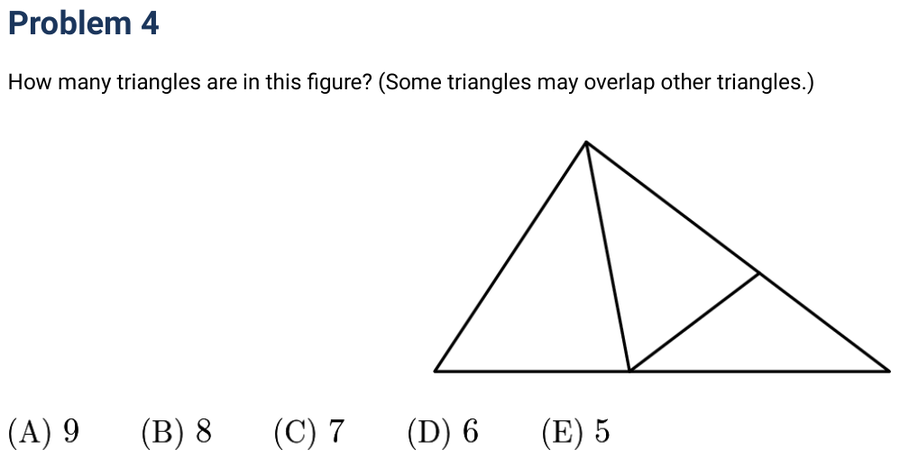
Counting by eye gives a guess; counting by SIZE gives the answer. Sort triangles into 'single smallest pieces' first, then ones made of two pieces, then the whole outline.
Still stuck? Show hint 2 →
Hint 2 of 2
Work small-to-big in layers so you never miss or double-count: how many 1-piece triangles? how many 2-piece? then the full outline.
Show solution
Approach: count in size layers (smallest pieces, then combinations)
Smallest pieces: the inner line cut the figure into 3 little triangles.
Made of 2 pieces: the two right-hand little triangles share a side and join into 1 bigger triangle.
Made of all the pieces: the whole outline is itself 1 triangle.
Total: 3 + 1 + 1 = 5.
Why this transfers: for any 'how many triangles' puzzle, count by size layer (1 piece, 2 pieces, 3 pieces, …) instead of randomly. The layered list is your guarantee against missing or repeating one.
Don't read the overline bars as 'long' — read them as 'what comes next.' Every choice opens 9.1234…, so line them up and find the first place where one digit beats the others.
Still stuck? Show hint 2 →
Hint 2 of 2
To compare decimals, scan left to right and stop at the first column where they differ — the bigger digit there wins, no matter how many digits trail behind.
Show solution
Approach: line them up and find the first column that differs
Write the bars out a few places: A 9.12344, B 9.12344̄ = 9.123444…, C 9.1234343…, D 9.1234234…, E 9.1234123…. All share 9.1234, so look at the 5th decimal place: it's 4 for A and B, but only 3, 2, 1 for C, D, E. The winner is A or B.
A and B agree through 9.12344. At the next place A has nothing (it stopped) — that's a 0 — while B keeps going with another 4. So B pulls ahead: B is largest.
Trap to remember: more digits does NOT mean bigger. A short number can beat a long one (0.9 > 0.12345). Compare position by position, left to right, and the first place that differs decides it.
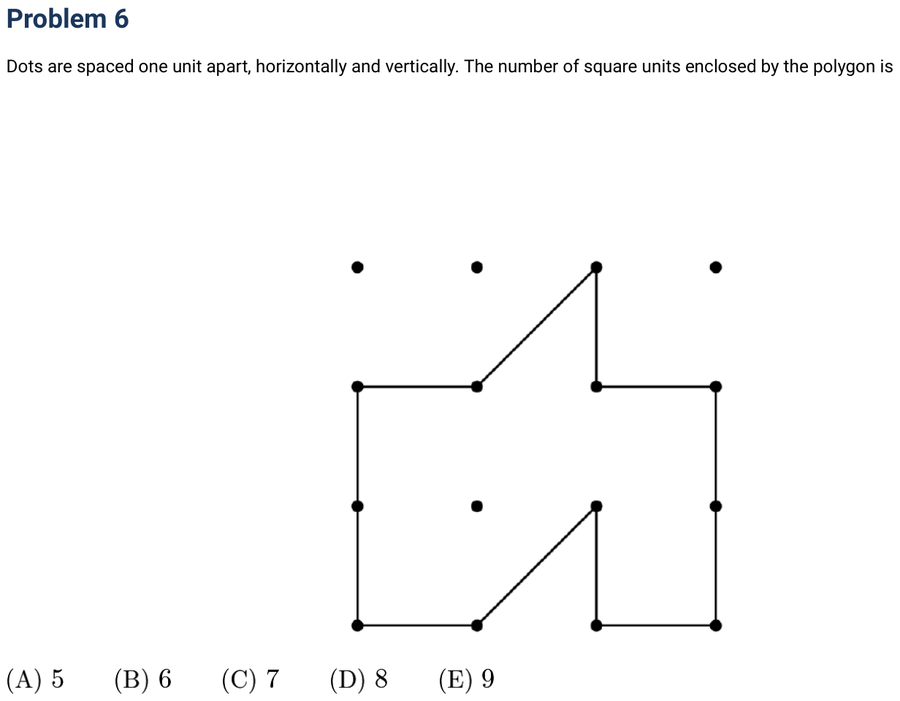
A slanted edge looks scary but it only TRADES area: whatever triangle it cuts off one side, it adds an equal triangle on the other. So nothing is really lost.
Still stuck? Show hint 2 →
Hint 2 of 2
Mentally straighten the slanted cuts into a tidy rectangle, then just count its width times height.
Show solution
Approach: slide the slanted pieces to make a clean rectangle
Each slanted edge cuts a little triangle off one place and pastes an identical triangle somewhere else — the area doesn't change, it just relocates. Picture sliding those triangles straight, and the wiggly shape becomes a flat 2 × 3 rectangle.
Its area is 2 × 3 = 6 square units.
Why this transfers: a diagonal cut between two dots one step apart always splits its unit square exactly in half, so cut-off and pasted-on pieces match. Reshaping an awkward region into a rectangle (or pair of rectangles) is the go-to move for dot-grid areas.
Another way — box-and-subtract (boxing method):
Box the whole figure in the smallest grid rectangle that contains it, then subtract the empty corner triangles the slanted edges leave outside the shape.
Each slanted edge carves off a half-unit triangle and adds one back, so the subtractions and additions cancel and you land back on 6 square units. Boxing-and-subtracting is the reliable fallback whenever a grid shape has slanted sides.
The answers are all perfect squares, so don't multiply blindly — the four factors are begging to be paired into two EQUAL numbers. Notice every factor is built from the digits 1998.
Still stuck? Show hint 2 →
Hint 2 of 2
Moving a decimal point is just multiplying or dividing by 10. Slide the points: 100 × 19.98 fattens 19.98 into 1998, and 1.998 × 1000 does the same.
Show solution
Approach: pair the factors so the decimal points cancel into 1998 × 1998
All the choices are squares, which hints the product should split into two identical factors. Pair the factors that 'undo' each other's decimal point: 100 × 19.98 = 1998, and 1.998 × 1000 = 1998.
So the product is 1998 × 1998 = (1998)².
Why this transfers: multiplying by a power of 10 only shuffles the decimal point — count how many places each factor moves the point. Pairing factors to cancel awkward decimals beats slogging through a giant multiplication.
A child's wading pool contains 200 gallons of water. If water evaporates at the rate of 0.5 gallons per day and no other water is added or removed, how many gallons of water will be in the pool after 30 days?
Show answer
Answer: C — 185 gallons.
Show hints
Hint 1 of 2
A steady rate over a stretch of time means total change = rate × time. Find the whole amount lost before touching the 200.
Still stuck? Show hint 2 →
Hint 2 of 2
Once you know the total lost, the pool just starts at 200 and gives that much back.
Show solution
Approach: rate × time gives the total loss, then subtract
Losing 0.5 gallon a day for 30 days is rate × time = 0.5 × 30 = 15 gallons gone.
Starting from 200, that leaves 200 − 15 = 185 gallons.
Trap check: the answer choices 198.5 and 199.85 are what you'd get if you forgot to multiply by all 30 days (subtracting only one day's loss, or mis-sliding the decimal). The phrase 'per day' for 30 days always means multiply first.
For a sale, a store owner reduces the price of a $10 scarf by 20%. Later the price is lowered again, this time by one-half of the reduced price. The price is now
Show answer
Answer: C — $4.00.
Show hints
Hint 1 of 2
Each markdown acts on the price standing right then, not the original. Take 20% off first, then apply the second cut to whatever's left.
Still stuck? Show hint 2 →
Hint 2 of 2
Read 'lowered by one-half of the reduced price' carefully: it removes half of the current price, so the price simply gets cut in half.
Show solution
Approach: apply each cut to the current price, in order
Start at $10. A 20% cut keeps 80%, so the price becomes $10 × 0.8 = $8.
The second cut removes one-half of that $8, leaving half: $8 ÷ 2 = $4.00.
Trap to dodge: the cuts stack on the running price, not on the original $10. Tempting wrong answers come from subtracting both 'off the start' (like 20% + 50% off $10). Always discount the price that exists at that moment.
Each of the letters W, X, Y, and Z represents a different integer in the set {1, 2, 3, 4}, but not necessarily in that order. If WX − YZ = 1, then the sum of W and Y is
Show answer
Answer: E — 7.
Show hints
Hint 1 of 2
The difference comes out to exactly 1 — a clean whole number with no leftover fraction. That's a big clue: the easiest way to get a whole number is for each fraction to already BE a whole number.
Still stuck? Show hint 2 →
Hint 2 of 2
From {1, 2, 3, 4}, which fractions are whole numbers? You need a denominator that divides its numerator. Only a 1 or a 2 on the bottom can do that here.
Show solution
Approach: force both fractions to be whole numbers
The result is the whole number 1, so chase the cleanest setup: make each fraction a whole number. From {1,2,3,4}, a fraction is whole only with bottom 1 (any top) or bottom 2 under top 4. To use both 1 and 2 as bottoms once each, the fractions must be 4/2 = 2 and (3 or odd)/1.
Take W/X = 3/1 = 3 and Y/Z = 4/2 = 2: then 3 − 2 = 1. Every letter is a different number from {1,2,3,4}, as required.
So W = 3 and Y = 4, giving W + Y = 7 — which is the largest choice, a nice confirmation we found the intended setup.
Why this transfers: when a messy expression must equal a clean whole number, look for the structure that forces it cleanly (here, integer fractions) instead of testing every arrangement at random.
Harry has 3 sisters and 5 brothers. His sister Harriet has S sisters and B brothers. What is the product of S and B?
Show answer
Answer: C — 12.
Show hints
Hint 1 of 2
The trap is counting from Harry's view and copying his numbers. Step back and count the whole family — total girls and total boys — then look at it fresh through Harriet's eyes.
Still stuck? Show hint 2 →
Hint 2 of 2
Nobody counts themselves as their own sibling. Harry is a boy (so he's one of the brothers from a sister's view); Harriet is a girl (so she's one of the sisters from a brother's view).
Show solution
Approach: tally the whole family, then re-count from Harriet
Build the family roster from Harry's view. Harry is a boy with 3 sisters and 5 brothers — but Harry himself is also a boy, so the family has 3 girls and 5 + 1 = 6 boys.
Now stand in Harriet's shoes. She's one of the 3 girls, so her sisters are the other 2 (she doesn't count herself): S = 2. All 6 boys are her brothers: B = 6.
So S × B = 2 × 6 = 12.
Why this transfers: in any sibling puzzle, count the family TOTAL once, then subtract the person you're asking about from their own same-gender group. The 'don't count yourself' slip is the whole point of these problems.
What is the value of 2(1 − 12) + 3(1 − 13) + 4(1 − 14) + … + 10(1 − 110)?
Show answer
Answer: A — 45.
Show hints
Hint 1 of 2
A long, repetitive sum is a hint to simplify ONE typical piece and find its pattern, rather than crunching the whole thing. Look hard at a single chunk like 4(1 − 1/4) — what does it collapse to?
Still stuck? Show hint 2 →
Hint 2 of 2
Spread the multiplication over one term: k·(1 − 1/k) = k − k·(1/k) = k − 1. Each term is just one less than its front number.
Show solution
Approach: collapse one term, reveal a running count
Crack open a single term: k(1 − 1/k) = k − 1 (the k times 1/k cancels to 1). So 2(1−½) = 1, 3(1−⅓) = 2, 4(1−¼) = 3, and so on — each term is just one less than its leading number.
The whole sum collapses to 1 + 2 + 3 + … + 9.
Add by pairing from the ends (Gauss's trick): 1+9, 2+8, 3+7, 4+6 each make 10, that's four 10s = 40, plus the lonely middle 5, totaling 45.
Why this transfers: when terms all share a shape, simplify the general term first — the messy sum almost always melts into something familiar like 1 + 2 + … + n.
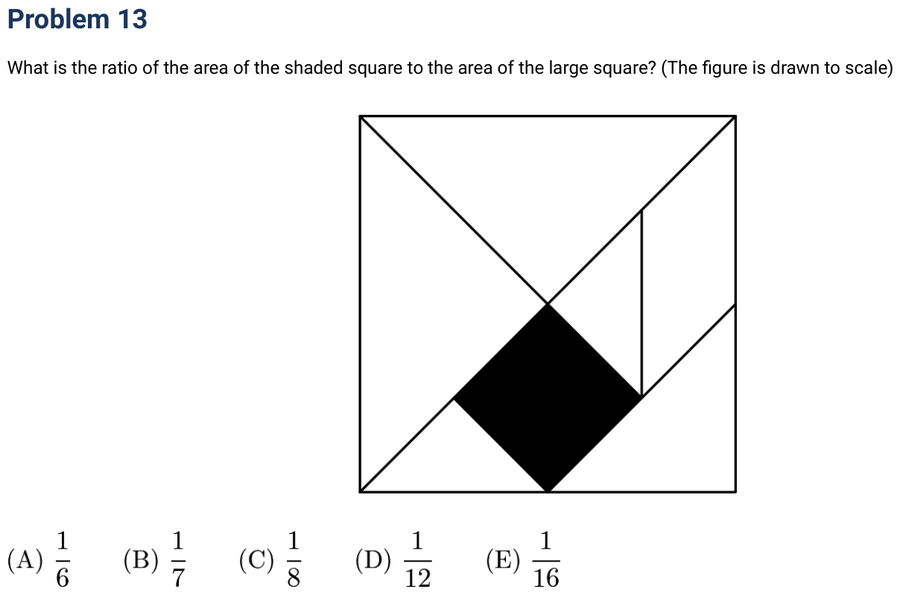
Don't measure the tilted square directly — relate it to easy pieces of the BIG square. The lines from the top corners meet at the center, carving the square into four matching triangles.
Still stuck? Show hint 2 →
Hint 2 of 2
Focus on the bottom quarter-triangle. What fraction of THAT triangle does the shaded square fill? Then 'fraction of a quarter' gives the fraction of the whole.
Show solution
Approach: compare the shaded square to one quarter of the big square
Lines run from the two top corners down to the center of the square, splitting it into four equal triangles (top, bottom, left, right) — each is one quarter of the whole.
The shaded tilted square sits inside the bottom quarter-triangle and covers exactly half of it (the extra vertical line marks the split).
So the shaded area = ½ of ¼ = 1/8 of the large square.
Why this transfers: for a tilted shape inside a square 'drawn to scale,' chop the big square into equal slices you trust, then express the target as a fraction of one slice — far safer than guessing lengths off a diagonal.
Another way — coordinates (pin the corners):
Put the big square on a grid with corners (0,0), (4,0), (4,4), (0,4) — area 16. The shaded square's corners land at the center (2,2), the base midpoint (2,0), and the two points (1,1) and (3,1) where the corner-lines cross.
That tilted square has diagonals of length 2 (from (2,0) to (2,2)) and 2 (from (1,1) to (3,1)); a square's area is ½·(diagonal)·(diagonal) = ½·2·2 = 2.
Ratio = 2/16 = 1/8, confirming the slice argument.
At Annville Junior High School, 30% of the students in the Math Club are in the Science Club, and 80% of the students in the Science Club are in the Math Club. There are 15 students in the Science Club. How many students are in the Math Club?
Show answer
Answer: E — 40 students.
Show hints
Hint 1 of 2
The 'in both clubs' group is the bridge between the two clubs — and you only know a real number for the Science Club (15). Count the overlap from the side you can actually compute.
Still stuck? Show hint 2 →
Hint 2 of 2
Once you have the overlap as a head count, it equals 30% of the Math Club. Going from 'a part and its percent' back to the whole means divide.
Show solution
Approach: pin the shared overlap as a number, then divide back to the whole
The overlap (students in both clubs) is described two ways, but only the Science side gives a number: 80% of the 15 Science Club students = 0.8 × 15 = 12 students are in both.
That same 12 is 30% of the Math Club. To recover the whole from a known part and its percent, divide: 12 ÷ 0.30 = 40 students.
Why this transfers: when two groups overlap, the shared piece links them — compute it from whichever side you have a concrete number for, then use 'part ÷ percent = whole' to unlock the other side. Sanity check: 30% of 40 is 12, matching.
Nisos Isles. In 1998 the islands have 200 people, and the population triples every 25 years. Estimate the population in the year 2050.
Show answer
Answer: D — About 2000.
Show hints
Hint 1 of 2
'Triples every 25 years' means the clock matters, not a formula. How many full 25-year steps fit between 1998 and 2050? Each step multiplies the people by 3.
Still stuck? Show hint 2 →
Hint 2 of 2
Two steps means multiply by 3, then by 3 again — don't add the steps, stack the triplings.
Show solution
Approach: count the 25-year steps, multiply by 3 for each
From 1998, the tripling moments land at 2023 (one step) and 2048 (two steps) — and 2048 is essentially 2050. So two full triplings have happened.
Each tripling is a ×3: 200 → 600 → 1800. (Growth multiplies, it doesn't add — that's the whole flavor of these problems.)
1800 is closest to 2000.
Why this transfers: for repeated-multiplying growth, count how many doubling/tripling periods have passed, then multiply that many times. Adding the periods instead of multiplying is the classic mistake.
Nisos Isles. In 1998 the islands have 200 people, and the population triples every 25 years. Estimate the year in which the population will be about 6000.
Show answer
Answer: B — About 2075.
Show hints
Hint 1 of 2
Flip the previous question around: instead of 'how big after N steps,' ask 'how many ×3 steps until 200 grows to 6000?' First find how many times bigger 6000 is than 200.
Still stuck? Show hint 2 →
Hint 2 of 2
Build up the powers of 3 (3, 9, 27, 81, …) and see which one lands near your target multiple — then turn that count of steps into years.
Show solution
Approach: find the growth factor, match it to a power of 3, convert steps to years
How many times the start is 6000? 6000 ÷ 200 = 30.
Now count triplings to reach about 30×: ×3, ×9, ×27 — three triplings give 27, close to 30. (A fourth would overshoot to 81.) So three 25-year steps.
Three steps = 3 × 25 = 75 years after 1998, landing on about 2075.
Why this transfers: to find WHEN growth reaches a target, divide target by start to get the multiple, then count how many ×3's (the powers of 3) reach it — the same skill as reading a logarithm, just by hand.
Nisos Isles. In 1998 the islands have 200 people, and the population triples every 25 years. The total area is 24,900 square miles, and the Queen requires at least 1.5 square miles per person. In about how many years from 1998 will the population reach the maximum the islands can support?
Show answer
Answer: C — About 100 years.
Show hints
Hint 1 of 2
Two stages here: first decide the target (the most people the land can hold), then count triplings to reach it. The cap comes from sharing the land: total area ÷ space-per-person.
Still stuck? Show hint 2 →
Hint 2 of 2
Once you have the cap, it's the same engine as before — divide by 200 to get the multiple, then count the ×3 steps (powers of 3) and turn them into years.
Show solution
Approach: compute the land's cap, then count triplings to reach it
Largest population the land allows = total area ÷ space each person needs = 24,900 ÷ 1.5 = 16,600 people.
That's 16,600 ÷ 200 = 83 times today's count. Walk up the powers of 3: 3, 9, 27, 81 — four triplings give 81, just shy of 83.
Four steps = 4 × 25 = 100 years after 1998.
Why this transfers: many word problems are a 'find the goal, then count steps to it' combo. Here the goal hides behind a sharing/division (area ÷ per-person), and the step-counting is the same powers-of-3 idea from the earlier parts.
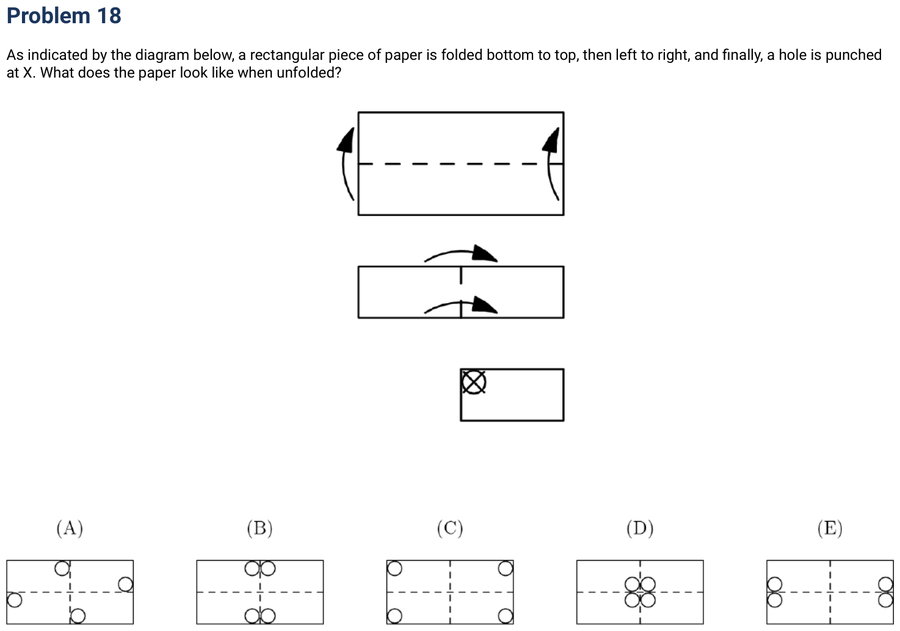
First settle how MANY holes appear: the paper was folded twice, so the punch went through 2 × 2 = 4 layers. The answer must show exactly 4 holes — that alone rules choices out.
Still stuck? Show hint 2 →
Hint 2 of 2
Unfold in reverse order, and each time you open a fold the holes copy across the crease line like a mirror. Undo the last fold first.
Show solution
Approach: count layers for the number of holes, then mirror across each crease
Two folds stack the paper into 2 × 2 = 4 layers, so the single punch pierces 4 spots — look only at choices with exactly four holes.
Unfold in reverse. Undo the last fold (left-to-right): the hole in the upper area mirrors across the vertical crease, making a left/right pair. Then undo the first fold (bottom-to-top): both holes mirror across the horizontal crease, making the bottom copies.
The result is four holes placed symmetrically — matching choice B.
Why this transfers: every fold-and-punch is two questions in one. Count holes = 2^(number of folds), and locate them by reflecting across each crease as you unfold in the opposite order you folded. Folding is just mirroring.
Tamika selects two different numbers at random from the set {8, 9, 10} and adds them. Carlos takes two different numbers at random from the set {3, 5, 6} and multiplies them. What is the probability that Tamika's result is greater than Carlos' result?
Show answer
Answer: A — 4/9.
Show hints
Hint 1 of 2
The two people act independently, so the real sample space is small: every one of Tamika's 3 possible results paired with every one of Carlos's 3 — only 9 equally likely matchups. List each person's possible outcomes first.
Still stuck? Show hint 2 →
Hint 2 of 2
Organize by Carlos's value: against his low number Tamika always wins, against his high number she always loses — only his middle value needs a closer look.
Show solution
Approach: list each person's outcomes, count winning matchups out of 9
Pinning down outcomes: Tamika picks two of {8,9,10} and adds → sums 17, 18, 19. Carlos picks two of {3,5,6} and multiplies → products 15, 18, 30. Each value is equally likely, and the two choices are independent, so there are 3 × 3 = 9 equally likely matchups.
Count Tamika's wins by Carlos's value: vs Carlos = 15, all 3 of her sums (17,18,19) win → 3; vs Carlos = 18, only 19 wins → 1; vs Carlos = 30, none win → 0.
That's 3 + 1 + 0 = 4 wins out of 9, so the probability is 4/9.
Why this transfers: for two independent random choices, the outcomes multiply (3 × 3 = 9 equally likely pairs), and a tidy table or 'sort by one person's value' keeps you from miscounting. Sanity check: 4 of 9 is just under half, which feels right since Carlos's products spread higher than Tamika's sums.
Let PQRS be a square piece of paper. P is folded onto R, and then Q is folded onto S. The area of the resulting figure is 9 square inches. Find the perimeter of square PQRS.
Show answer
Answer: D — 24 inches.
Show hints
Hint 1 of 2
Don't picture the exact shape after folding — track only the AREA. Each fold lays the paper onto itself, so the visible area halves every time.
Still stuck? Show hint 2 →
Hint 2 of 2
Two folds means the final area is the whole square's area cut in half twice — that's one quarter. Set that quarter equal to 9 and work back to the side.
Show solution
Approach: each fold halves the area; two folds leave a quarter
Folding a flat sheet onto itself doubles its thickness and halves its visible area. Fold P onto R: area halves. Fold Q onto S: it halves again. So the final figure is ¼ of the square.
That quarter is 9 in²: ¼·s² = 9, so the full square has area s² = 36, and its side is s = 6.
Perimeter = 4 × side = 4 × 6 = 24 inches.
Why this transfers: when a problem folds paper but only asks about area, skip the geometry of the resulting shape — just multiply the original area by ½ for each fold. Then a quick √ takes area back to side length.
A 4 × 4 × 4 cubical box contains 64 identical small cubes that exactly fill the box. How many of these small cubes touch a side or the bottom of the box?
Show answer
Answer: B — 52 cubes.
Show hints
Hint 1 of 2
Counting the cubes that touch a wall directly is a corner/edge nightmare (you'll double-count). Flip it: count the cubes that touch NOTHING — no wall, no floor — and subtract from 64.
Still stuck? Show hint 2 →
Hint 2 of 2
Read which surfaces matter: 4 side walls and the bottom, but NOT the top (the box is open up there). A 'safe' cube must dodge all four walls and the floor — but it's free to touch the top.
Show solution
Approach: complementary counting — subtract the cubes that touch nothing
Find the cubes touching no side and not the bottom. To miss all four walls, a cube must sit in the inner 2 × 2 of the 4 × 4 footprint (strip one cube off each of the four edges). To miss the bottom, it must be above the floor layer — but it CAN touch the top, since only sides and bottom count. That's the top 3 layers: 2 × 2 × 3 = 12 untouched cubes.
Everything else touches a side or the bottom: 64 − 12 = 52.
Why this transfers: 'touches at least one of several surfaces' is far easier counted backwards — count the few that touch NONE, then subtract. The untouched region is a clean little box (here 2×2×3), so it's quick to size up.
Terri builds a sequence of positive integers by these rules: if the integer is less than 10, multiply it by 9; if it is even and greater than 9, divide it by 2; if it is odd and greater than 9, subtract 5. Find the 98th term of the sequence that begins 98, 49, … .
Show answer
Answer: D — 27.
Show hints
Hint 1 of 2
Nobody computes 98 terms by hand. These rule-driven sequences always trap into a repeating loop — generate terms only until you SEE a number come back, and you've found the cycle.
Still stuck? Show hint 2 →
Hint 2 of 2
Once the loop's length is L, terms repeat every L steps. Find where the cycle starts, then use the leftover after dividing to jump straight to the 98th term.
Show solution
Approach: generate until it loops, then use the cycle length to skip ahead
Run the rules: 98 →(÷2) 49 →(−5) 44 →(÷2) 22 →(÷2) 11 →(−5) 6 →(×9) 54 →(÷2) 27 →(−5) 22 … The 22 has returned, so from term 4 on it cycles 22, 11, 6, 54, 27 — a loop of length 5.
Terms 4, 5, 6, 7, 8 are positions 0, 1, 2, 3, 4 of the cycle. For term 98, step in from term 4: that's 98 − 4 = 94 steps, and 94 leaves a leftover of 4 when shared into groups of 5. Position 4 of the cycle is 27.
Why this transfers: any 'find the very-far term' of a rule-based sequence is really 'find the cycle, then take the step-count's leftover (its remainder) as your position.' The big index 98 never needs all 98 terms.
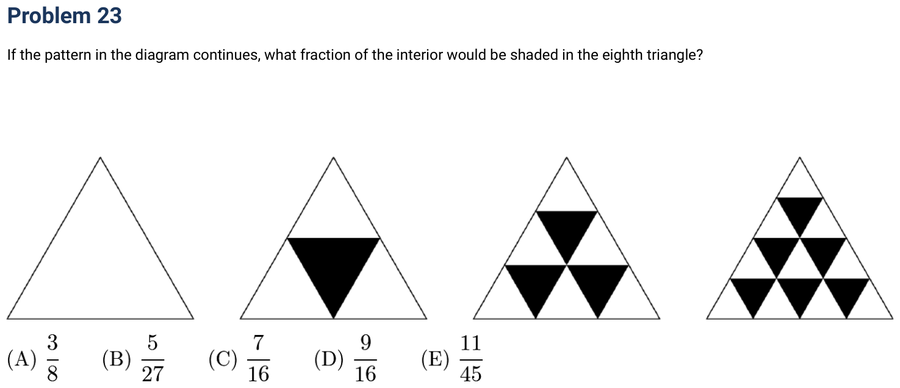
Don't try to draw the 8th figure. Make a tiny table of the first four and track two separate counts as they grow: how many little triangles total, and how many are shaded (the downward-pointing ones).
Still stuck? Show hint 2 →
Hint 2 of 2
Totals go 1, 4, 9, 16 — the perfect squares (n²). Shaded go 0, 1, 3, 6 — the triangular numbers (each adds one more than the last). Recognizing these named patterns lets you leap to the 8th figure without drawing.
Show solution
Approach: tabulate two patterns (squares and triangular numbers), jump to n = 8
Total little triangles in figures 1–4: 1, 4, 9, 16 — these are the squares, so the nth figure has n². The 8th has 8² = 64.
Shaded (downward) triangles: 0, 1, 3, 6 — the triangular numbers, each step adding the next whole number. By the 8th figure the shaded count is 1 + 2 + 3 + 4 + 5 + 6 + 7 = 28.
Shaded fraction = 28/64 = 7/16.
Why this transfers: 'what happens at the big nth step' problems are solved by naming the pattern in the small cases. Two of the most common are the squares (1,4,9,16…) and the triangular numbers (1,3,6,10…) — spot them and you can skip straight to any term.
A board of 8 columns has squares numbered left to right, top to bottom (row one is 1–8, row two is 9–16, and so on). A student shades square 1, then skips one and shades square 3, skips two and shades square 6, skips three and shades square 10, and continues this way until every column has at least one shaded square. What is the number of the shaded square that first achieves this?
Show answer
Answer: E — 120.
Show hints
Hint 1 of 2
Two patterns hide here. First, the shaded square numbers 1, 3, 6, 10, 15, … are the triangular numbers (add 2, then 3, then 4, …). Second, with 8 columns, a square's column is decided by its leftover when divided by 8 — so you're really asking 'when have all 8 leftovers shown up?'
Still stuck? Show hint 2 →
Hint 2 of 2
List the triangular numbers' leftovers mod 8 in order. Seven of the eight leftovers appear fast; the holdout is leftover 0 (a multiple of 8). Find the first triangular number that's a multiple of 8.
Show solution
Approach: triangular numbers, sorted by their leftover mod 8; wait for the missing column
The shaded squares jump 1, 3, 6, 10, 15, 21, … — the triangular numbers. Since the board is 8 wide, a square lands in column (its value's leftover after dividing by 8); column 8 means a leftover of 0, i.e. a multiple of 8.
Track the leftovers as they arrive: 1→col1, 3→col3, 6→col6, 10→col2, 15→col7, 21→col5, 28→col4. After just seven shaded squares, columns 1,2,3,4,5,6,7 are all hit — only column 8 (leftover 0) is still empty.
So we need the first triangular number divisible by 8. Checking on: 36, 45, 55, 66, 78, 91, 105 — none are multiples of 8 — until 120 = 8 × 15. The final column fills at square 120.
Why this transfers: when items wrap across a fixed number of columns, the column is just the value's remainder, and 'until every column is hit' becomes 'until every remainder appears.' Watching the remainders (not the raw numbers) keeps the search short. (Bonus: 120 is the biggest answer choice, so once it's forced, it must be the answer.)
Three generous friends redistribute their money as follows: Amy gives Jan and Toy enough to double each of their amounts; then Jan gives Amy and Toy enough to double theirs; finally Toy gives Amy and Jan enough to double theirs. Toy had $36 at the beginning and $36 at the end. What is the total amount the three friends have?
Show answer
Answer: D — $252.
Show hints
Hint 1 of 2
Money is only handed around, never created or destroyed — so the grand total is the SAME at every moment. You just need to catch it at one convenient instant.
Still stuck? Show hint 2 →
Hint 2 of 2
Watch Toy. In the first two rounds he's a receiver, and each time his amount is doubled. So follow Toy's pile from $36 up to the moment right before his own turn.
Show solution
Approach: use the unchanging total; track Toy through his two doublings
Key idea: the total never changes, since every step just moves dollars between people. So if we can pin the total at any single moment, we're done.
Toy receives (and doubles) in rounds 1 and 2: $36 → $72 → $144 just before his own turn.
On his turn Toy gives away enough to double Amy and Jan, and he ends at $36 — so he handed out 144 − 36 = $108. That $108 was exactly what it took to double Amy and Jan together, meaning they held $108 between them just before.
At that instant the total is Toy's 144 + the others' 108 = $252 — and since the total is constant, that's the answer.
Why this transfers: in any 'pass things around' puzzle, first ask what stays fixed (here, the total). An invariant lets you ignore the messy middle and read the answer off one clean snapshot.
Another way — work backward from the end:
Suppose the total is T. At the very end all three have whole amounts and Toy has $36. The last move (Toy doubling Amy and Jan) means just before it, Amy and Jan each had half their final amount, and Toy had everything else.
Peeling back each doubling step in reverse keeps the total T fixed at every stage. Using Toy's $36 start, the backward chain pins T = $252, matching the invariant method — a good check that working forward, backward, or by invariant must all agree.