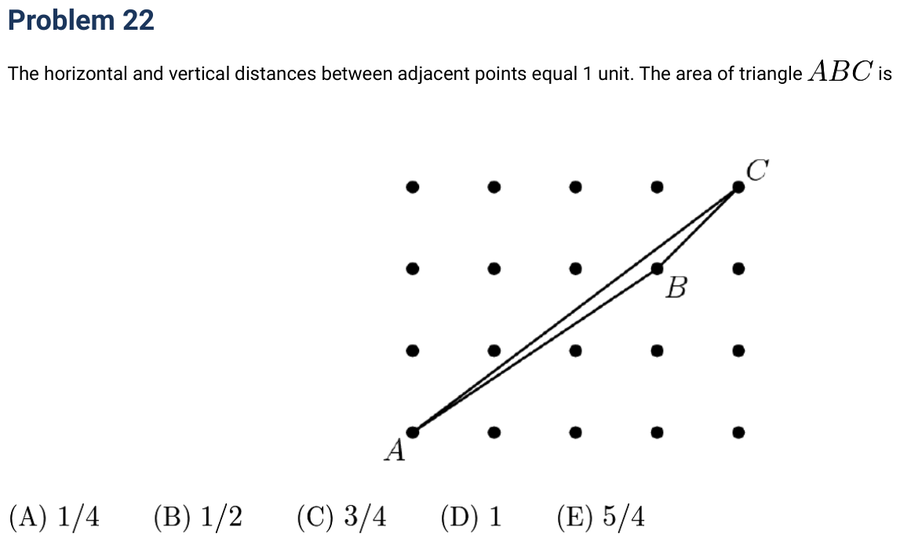
How many positive factors of 36 are also multiples of 4?
Show answer
Answer: B — 3.
Show hints
Hint 1 of 2
A number that is both a factor of 36 AND a multiple of 4 must already have the 4 built in. So write it as 4 × (something) — what does that 'something' have to be?
Still stuck? Show hint 2 →
Hint 2 of 2
Pull the 4 out front: the number is 4 × (a factor of 36 ÷ 4 = 9). Counting them becomes just counting the factors of 9 — a much smaller job.
Show solution
Approach: factor out the required 4
A multiple of 4 looks like 4 × k. For it to also divide 36, the leftover k must divide 36 ÷ 4 = 9. So instead of hunting through all of 36's factors, we just need the factors of 9.
9 has factors 1, 3, 9 — three of them. Multiplying each by 4 gives 4, 12, 36, so there are 3 such numbers.
Why this transfers: 'count the multiples of d that also divide N' always becomes 'count the factors of N ÷ d.' Pulling out the forced factor shrinks the problem every time.
Logic & Word ProblemsNumber Theorywork-backwardpattern-recognition
Two players take turns removing \(1\), \(2\), \(3\), or \(4\) counters from a pile that starts with \(27\) counters. The player who takes the very last counter wins. Should you go first or second, and what is your winning plan? (Give the number of counters to take on your first move.)
Show answer
Answer: Go first and take 2 (leaving 25)
Show hints
Hint 1 of 4
There are lots of ways to start, but only one way to finish (grab the last few counters). When the END is clearer than the start, work backward from the end.
Still stuck? Show hint 2 →
Hint 2 of 4
Ask: how many counters can I leave for my opponent so that no matter what they take (\(1\), \(2\), \(3\), or \(4\)), I can take the rest and grab the last one?
Still stuck? Show hint 3 →
Hint 3 of 4
If you leave exactly \(5\), you win: whatever they take, you take the rest of those \(5\). Now work back one more step. To be able to leave \(5\) next time, what should you leave now?
Show solution
Approach: Working backward from the finish to find the safe positions
To win you want to take the last counter, so after your final move there are \(0\) left. Work backward from there.
The magic numbers to leave for your opponent are the multiples of \(5\). Leaving \(5\) works: if they take \(k\) (one of \(1, 2, 3, 4\)), you take the remaining \(5 - k\) and grab the last counter.
So every turn you hand them a multiple of \(5\): \(25, 20, 15, 10, 5, 0\). Whatever they remove, you remove enough to land on the next multiple of \(5\).
Since \(27 = 25 + 2\), you go FIRST and take \(2\), leaving \(25\). After that always leave a multiple of \(5\); your last move leaves \(0\), so you took the last counter and win.
Square \(ABCD\) has side length \(1\). From two opposite corners, draw two quarter circles of radius \(1\). They overlap in a leaf-shaped (lens) region in the middle. Find the area of that shaded lens.
Show answer
Answer: \(\frac{\pi}{2}-1\) (about 0.57)
Show hints
Hint 1 of 4
Each quarter circle covers part of the square. What is the area of one quarter circle of radius \(1\)? (A full circle of radius \(1\) has area \(\pi\), so a quarter is \(\pi/4\).)
Still stuck? Show hint 2 →
Hint 2 of 4
Here is the key trick. Add the two quarter-circle areas together. Every point of the square gets covered, but the middle lens is the only part that sits inside BOTH quarter circles, so it gets counted twice.
Still stuck? Show hint 3 →
Hint 3 of 4
If you add the two quarter circles and then subtract the whole square once, the parts counted once cancel out and you are left with exactly the extra (doubly-counted) lens.
Show solution
Approach: Seeking complements — add the two quarter circles, then subtract the square once
Each quarter circle has area \(\frac{1}{4}\pi(1)^2 = \frac{\pi}{4}\). Together their areas add to \(\frac{\pi}{4}+\frac{\pi}{4} = \frac{\pi}{2}\).
When you lay both pieces on the square, they cover the whole square, but the leaf in the middle is covered TWICE (it belongs to both quarter circles). So the total \(\frac{\pi}{2}\) counts the square once plus the lens one extra time: \(\frac{\pi}{2} = (\text{square}) + (\text{lens}) = 1 + (\text{lens})\).
Therefore the lens area is \(\frac{\pi}{2} - 1 \approx 0.57\).
Number TheoryFractions, Decimals & Percentsbound-a-variablefind-factor-pairs
Find every pair of different positive whole numbers \(a\) and \(b\) (with \(a>b\)) so that \(\dfrac{1}{a}+\dfrac{1}{b}=\dfrac{1}{9}\).
Show answer
Answer: (a,b)=(90,10) and (36,12)
Show hints
Hint 1 of 4
Think about sizes first. If \(b\) were \(9\) or smaller, then \(\tfrac1b\) would already be \(\tfrac19\) or bigger, leaving nothing for \(\tfrac1a\). So both \(a\) and \(b\) must be bigger than \(9\).
Still stuck? Show hint 2 →
Hint 2 of 4
Clear the fractions. Multiply everything by \(9ab\) to get \(9b+9a=ab\). Rearrange to \(ab-9a-9b=0\).
Still stuck? Show hint 3 →
Hint 3 of 4
Here is the classic trick: add \(81\) to both sides so the left side factors. You get \(ab-9a-9b+81=81\), which is \((a-9)(b-9)=81\).
Show solution
Approach: Add 81 and factor (Simon's Favorite Factoring), then search factor pairs
Both numbers must be bigger than 9: if \(b\le 9\) then \(\tfrac1b\ge\tfrac19\), which already uses up all of \(\tfrac19\), leaving nothing for \(\tfrac1a\). So \(a>b>9\).
Clear fractions by multiplying \(\tfrac1a+\tfrac1b=\tfrac19\) by \(9ab\): \(9b+9a=ab\), so \(ab-9a-9b=0\).
Add \(81\) to both sides so the left factors: \(ab-9a-9b+81=81\), i.e. \((a-9)(b-9)=81\).
List factor pairs of \(81\) with the bigger factor going to \(a\): \(a-9=81, b-9=1\Rightarrow a=90, b=10\); and \(a-9=27, b-9=3\Rightarrow a=36, b=12\). (The split \(9\times9\) gives \(a=b=18\), but we need \(a>b\), so skip it.)
Check: \(\tfrac{1}{90}+\tfrac{1}{10}=\tfrac{1}{90}+\tfrac{9}{90}=\tfrac{10}{90}=\tfrac19\), and \(\tfrac{1}{36}+\tfrac{1}{12}=\tfrac{1}{36}+\tfrac{3}{36}=\tfrac{4}{36}=\tfrac19\). So the pairs are \((a,b)=(90,10)\) and \((36,12)\).
You flip a fair coin and get 5 heads in a row. (1) What is the probability that the very next flip is also heads? (2) Separately, before you start flipping at all, what is the probability of getting 6 heads in a row? To warm up, list all the outcomes of just 2 flips and find the probability of getting 2 heads in a row.
Show answer
Answer: Next flip: \(\frac{1}{2}\). A streak of 6 heads from the start: \(\frac{1}{64}\)
Show hints
Hint 1 of 4
These are two different questions! One asks about a single next flip; the other asks about a whole streak from the start. Don't let them blur together.
Still stuck? Show hint 2 →
Hint 2 of 4
A coin has no memory. It doesn't know it just landed on 5 heads. So for the single next flip, the past flips change nothing.
Still stuck? Show hint 3 →
Hint 3 of 4
For a streak, list the equally likely outcomes. Two flips give HH, HT, TH, TT — four equally likely cases, so 'two heads' happens 1 time out of 4.
Show solution
Approach: Accounting for all possibilities — independence vs. counting a whole streak
The single next flip: coin flips are independent, so nothing that already happened can change a future flip. The coin has no memory of those 5 heads. So the chance the next flip is heads is just \(\frac{1}{2}\), the same as always.
A streak from the start: warm up with 2 flips. The four equally likely outcomes are \(HH, HT, TH, TT\). Only 1 of these 4 is two-heads, so the probability is \(\frac{1}{4}=\frac{1}{2}\times\frac{1}{2}\).
Each extra flip multiplies by another \(\frac{1}{2}\). For 6 heads in a row, \(\left(\frac{1}{2}\right)^6=\frac{1}{64}\).
So both are true at once: a long streak really is unlikely as a whole, but that does NOT make the single next flip anything other than \(\frac{1}{2}\).
A common mistake is to 'break a square root apart' over a plus sign: \(\sqrt{a+b}=\sqrt{a}+\sqrt{b}\). Test it with \(a = 9, b = 16\): compute \(\sqrt{9}+\sqrt{16}\). (Compare it to the true value \(\sqrt{9+16}\) to see the rule is false.)
Show answer
Answer: 7 (while the true value is 5, so the rule is false)
Show hints
Hint 1 of 4
A 'rule' that is supposed to always work can be destroyed by a single example where it fails. Pick easy perfect squares so you can compute both sides in your head.
Still stuck? Show hint 2 →
Hint 2 of 4
Work out the RIGHT side: \(\sqrt{9}+\sqrt{16}=3+4\).
Still stuck? Show hint 3 →
Hint 3 of 4
Now the LEFT side: \(9+16=25\), and \(\sqrt{25}=5\). Are they equal?
Show solution
Approach: Disprove a false rule with one numerical counterexample
Compute the right side of the supposed rule: \(\sqrt{9}+\sqrt{16}=3+4=7\).
Compute the true left side: \(\sqrt{9+16}=\sqrt{25}=5\).
Since \(7 \neq 5\), the rule \(\sqrt{a+b}=\sqrt{a}+\sqrt{b}\) is FALSE — one counterexample is enough to kill it.
Same idea checks a claim like \(\sqrt{36}=\sqrt{30}+\sqrt{6}\): \(\sqrt{30} > 5\) and \(\sqrt{6} > 2\), so the right side exceeds \(7\), far more than \(\sqrt{36}=6\). A square root never splits over a plus sign.
Geometry & MeasurementLogic & Word Problemsaccount-for-all-possibilitiesconsider-extreme-cases
A cube has six faces (flat surfaces). Now cut a cube in half. How many faces does half a cube have? Try to think of all the different ways the cube might be cut in half.
Show answer
Answer: No single answer: 6 for a flat straight cut, 5 for a slanted cut, more for a staircase cut — the point is to define what 'half' means
Show hints
Hint 1 of 4
There is no single 'right' answer here! The number of faces depends on HOW you slice. Start by picturing the simplest cut you can imagine.
Still stuck? Show hint 2 →
Hint 2 of 4
Try a straight cut straight down through the middle, like slicing a block of cheese. You get a smaller box. Count its flat surfaces carefully — don't forget the brand-new face the knife made.
Still stuck? Show hint 3 →
Hint 3 of 4
Now try a slanted cut, going corner to corner. Count again. Did you get a different number? What does that tell you?
Show solution
Approach: Open-ended exploration: the answer depends on the cut
This problem is meant to be open-ended; its value is in the discussion, not in one magic number.
Straight cut down the middle: you get a smaller rectangular box, which has 6 flat faces — so this answer is 6 (one is the new face the knife made).
Slanted (corner-to-corner) cut: the piece is a wedge or triangular prism, and you count 5 faces. (Some people blurt out 3 before noticing the original faces are still partly there.)
Staircase cut: if the cut is a jagged staircase that still splits the cube into two equal-volume pieces, every step adds faces, so the count can be as big as you like.
The real lesson: 'half a cube' is ambiguous. Once you notice that, many answers become reasonable, and you start asking better questions: must the pieces match exactly? must the cut be flat?
Laura is training her pet white rabbit, Ghost, to climb a flight of 10 steps. Ghost can hop up 1 step or 2 steps at a time. He never hops down, only up. How many different ways can Ghost hop up the whole flight of 10 steps?
Show answer
Answer: 89 ways
Show hints
Hint 1 of 4
The number 10 is big and a little scary. Start tiny! How many ways can Ghost climb a staircase with just 1 step? With just 2 steps? Write out every possible hopping pattern for the small cases.
Still stuck? Show hint 2 →
Hint 2 of 4
Make a table. For 1, 2, 3, 4, 5 steps, list every sequence of 1-hops and 2-hops and count them. You should get 1, 2, 3, 5, 8. Careful: 1, 2, 3 looks like ordinary counting, but keep going — the next number is 5, not 4!
Still stuck? Show hint 3 →
Hint 3 of 4
Think about Ghost's very last hop. To land on step \(n\), he either came from step \(n-1\) (a 1-hop) or from step \(n-2\) (a 2-hop). So the number of ways to reach step \(n\) is the ways to reach step \(n-1\) PLUS the ways to reach step \(n-2\).
Show solution
Approach: Reduce and expand — shrink to tiny staircases, find the Fibonacci pattern, grow it back
Ghost's final hop onto step \(n\) came from step \(n-1\) (a 1-hop) or step \(n-2\) (a 2-hop), so ways(\(n\)) = ways(\(n-1\)) + ways(\(n-2\)).
Tiny cases by listing: a 1-step staircase has 1 way; a 2-step staircase has 2 ways ('1-1' or '2').
Now add the two previous each time to build the table:
Steps
Ways
1
1
2
2
3
3
4
5
5
8
6
13
7
21
8
34
9
55
10
89
These are the Fibonacci numbers. Reading the table at 10 steps gives the answer: Ghost can climb the flight in \(89\) different ways.
You pick 5 cards from a big pile of cards that are each either red or blue. Show that no matter which 5 you grab, you are guaranteed to have at least 3 cards of the same color. (How many of one color are you guaranteed?)
Show answer
Answer: at least 3 of one color
Show hints
Hint 1 of 3
There are only two colors. Imagine two boxes: a red box and a blue box. Drop each card into the box for its color.
Still stuck? Show hint 2 →
Hint 2 of 3
You have 5 cards going into only 2 boxes. Could both boxes have 2 or fewer cards?
Still stuck? Show hint 3 →
Hint 3 of 3
If each box had at most 2 cards, you'd have at most \(2+2 = 4\) cards. But you have 5! So some box must have 3 or more.
Show solution
Approach: Pigeonhole — 5 cards into 2 color-boxes
Make two boxes (the 'holes'): one for red cards, one for blue cards. Each of your 5 cards goes into the box matching its color.
Could you avoid having 3 of one color? That would mean each box holds at most 2 cards. But \(2+2 = 4\), and you have 5 cards.
So at least one box must hold 3 or more cards — giving 3 cards of the same color. You are guaranteed at least \(3\) of one color.
On a real national test, more than half of junior-high students missed this question: What is 75% of 12? That is surprising, because the numbers are so friendly! Show how to see the answer with a picture instead of just punching buttons. (Then try the deliberately unfriendly version: what is 74% of 13?)
Show answer
Answer: 9 (and 74% of 13 is about 9.6)
Show hints
Hint 1 of 4
The word 'percent' just means 'out of 100.' Is there a simple fraction that equals 75%?
Still stuck? Show hint 2 →
Hint 2 of 4
Draw 12 little squares. If you split them into 4 equal groups, how many squares are in each group?
Still stuck? Show hint 3 →
Hint 3 of 4
75% is the same as 3 out of every 4, which is the fraction \(\tfrac34\). Take \(\tfrac14\) of 12 first, then take 3 of those groups.
Show solution
Approach: See the percent as a friendly fraction and picture it
The trick is to see 75% as the friendly fraction \(\tfrac34\), not to reach for a percent rule.
Draw 12 squares in a 3-by-4 array and split them into 4 equal columns. Each column has 3 squares, so each column is \(\tfrac14\) of the whole.
\(\tfrac14\) of 12 = 3 squares (one column), so \(\tfrac34\) of 12 = three columns = 3 + 3 + 3 = 9.
So 75% of 12 = \(\tfrac34 \times 12 = 9\).
The unfriendly twin 74% of 13 looks almost the same on paper, but 74% is not a clean fraction and 13 won't split into equal small groups, so there is no neat picture — you would just estimate \(0.74 \times 13 \approx 9.6\). The real lesson: grab the easy picture when the numbers are friendly.
Arithmetic & OperationsLogic & Word Problemsidentifying-relevant-datatranslate-text-into-mathematics
A class from a town of 4,300 people takes a trip to a mountain 120 km away. The class has 500 dollars in its treasury. The whole trip cost 360 dollars. That 360 dollars paid for the bus (110 dollars) plus a rope-walk activity that costs the same amount for each of the 25 students. (a) How much did the rope-walk cost for one student? (b) Which numbers in the problem were NOT needed to answer part (a)?
Show answer
Answer: 10 dollars per student; population, distance, and treasury are not needed
Show hints
Hint 1 of 3
Before you compute, sort the numbers into two piles: ones that change the rope-walk price per student, and ones that are just background story.
Still stuck? Show hint 2 →
Hint 2 of 3
The 360 dollars total is made of two things: the one bus fee (110 dollars) plus the rope-walk paid once for each of the 25 students.
Still stuck? Show hint 3 →
Hint 3 of 3
Subtract the bus fee from the total to get just the rope-walk money. Then split that evenly among the 25 students.
Show solution
Approach: Strip the irrelevant data, then subtract and divide
The 360 dollars is the bus fee plus all the rope-walk fees. Take out the bus fee first: \(360 - 110 = 250\) dollars.
That 250 dollars is shared equally by 25 students, so each student's rope-walk costs \(250 \div 25 = 10\) dollars.
(a) The rope-walk costs 10 dollars per student.
(b) The town's population (4,300), the distance (120 km), and the 500-dollar treasury are never used — they are background story, not needed for part (a).
A man has 3 shirts and 4 ties. In how many ways can he choose a shirt and a tie?
Show answer
Answer: 12 outfits
Show hints
Hint 1 of 3
He makes the outfit in two steps: first pick a shirt, then pick a tie. The little word 'and' between the two steps is a big clue.
Still stuck? Show hint 2 →
Hint 2 of 3
When you do one thing AND then another, you multiply the number of choices at each step.
Still stuck? Show hint 3 →
Hint 3 of 3
Multiply (number of shirts) times (number of ties).
Show solution
Approach: AND process — multiply the choices at each step
Picking an outfit happens in two steps: choose a shirt AND then choose a tie. When you do one thing and then another, multiply.
There are 3 shirts and 4 ties, so the number of outfits is \(3 \times 4 = 12\).
You can see it with a tree: draw one branch for each shirt, and let each shirt branch split into 4 ties. Counting the 12 branch-ends gives the 12 outfits.
Two flagpoles stand on flat ground, 8 meters apart. The left pole is 6 m tall and the right pole is 4 m tall. A rope 10 m long is tied to the top of each pole. A ring slides freely on the rope and a weight hangs from it, so the two parts of the rope make equal angles with the vertical (a perfectly balanced clothesline). How high above the ground does the weight hang (in meters)?
Show answer
Answer: 2 meters
Show hints
Hint 1 of 4
Draw the picture: two poles, the rope, the weight. The rope makes equal angles with the vertical on both sides. Keep that word 'equal' in mind.
Still stuck? Show hint 2 →
Hint 2 of 4
Equal angles is exactly what a mirror does. Reflect the right pole (and its half of the rope) straight down across the horizontal line through the weight. The whole rope becomes one straight line of length 10 — the hypotenuse of a right triangle.
Still stuck? Show hint 3 →
Hint 3 of 4
The horizontal leg is the distance between the poles, 8 m. The vertical leg is how far the two tops are apart once one is flipped down: \((6 - h) + (4 - h)\), where \(h\) is the weight's height.
Show solution
Approach: Reflect to straighten the rope, then Pythagorean theorem
Let \(h\) be the weight's height. The rope makes equal angles with the vertical, which is the signature of a mirror reflection, so reflect the right pole and its rope half straight down across the horizontal line through the weight \(W\).
After reflecting, the right rope segment lines up with the left one and the whole 10 m rope becomes a single straight line — the hypotenuse of a right triangle.
The horizontal leg is the 8 m between the poles. The vertical leg: the left top is \((6 - h)\) above \(W\) and the reflected right top is \((4 - h)\) below \(W\), so the legs differ by \((6 - h) + (4 - h) = 10 - 2h\).
Pythagoras: \(10^2 = 8^2 + (10 - 2h)^2\), so \((10 - 2h)^2 = 36\), giving \(10 - 2h = 6\), so \(h = 2\). Check: \(6^2 + 8^2 = 100 = 10^2\). The weight hangs 2 meters above the ground.
Logic & Word ProblemsCounting & Probabilityconsider-extreme-casesaccount-for-all-possibilitiespattern-recognition
In a fairy tale, a hero must collect golden hairs from a devil's head. The devil's grandmother is blind, so she pulls hairs out at random. The devil has \(5\) hairs in all, and \(3\) of them are golden. How many hairs must the blind grandmother pull to be sure she has at least one golden hair? Then think bigger: the devil has \(x\) hairs, \(y\) of which are golden. How many hairs must be pulled to be sure of getting at least \(z\) golden hairs? (Here \(z \le y \le x\), and all are whole numbers.)
Show answer
Answer: 3 hairs in the small case; (x−y)+z hairs in general
Show hints
Hint 1 of 4
The word 'sure' is the key. You can't count on getting lucky. Ask yourself: what is the unluckiest possible order in which the hairs could come out?
Still stuck? Show hint 2 →
Hint 2 of 4
Pretend the grandmother has the worst luck in the world: she keeps grabbing only the non-golden hairs first. With \(5\) hairs and \(3\) golden, how many hairs are NOT golden?
Still stuck? Show hint 3 →
Hint 3 of 4
Once every non-golden hair is gone, the very next pull MUST be golden. There are \(5-3=2\) non-golden hairs, so after pulling those \(2\), the next pull (the 3rd) is guaranteed golden.
Show solution
Approach: Worst-case (pigeonhole-style) reasoning
'Sure' means it must work even with the worst luck: every non-golden hair comes out first. There are \(5-3=2\) non-golden hairs.
So in the worst case the first 2 pulls are both non-golden; then only golden hairs are left, so the 3rd pull must be golden. She must pull \(2+1=3\) hairs.
General case: there are \(x-y\) non-golden hairs. In the worst case she pulls all \(x-y\) of them first and gets no gold; after that every remaining hair is golden.
To collect \(z\) golden hairs she pulls \((x-y)+z\) hairs. Check with \(x=5, y=3, z=1\): \((5-3)+1=3\), which matches. (This is the same idea behind pigeonhole problems.)
Jose, Thuy, and Kareem each start with the number 10. Jose subtracts 1 from 10, doubles his answer, and then adds 2. Thuy doubles 10, subtracts 1 from her answer, and then adds 2. Kareem subtracts 1 from 10, adds 2 to his number, and then doubles the result. Who gets the largest final answer?
Show answer
Answer: C — Kareem.
Show hints
Hint 1 of 2
All three do the same three operations — double, subtract 1, add 2 — just in different orders. Notice WHO doubles last. Doubling magnifies whatever you've built up, so saving it for last should help.
Still stuck? Show hint 2 →
Hint 2 of 2
Multiplying last scales up the full amount you've accumulated; doing it early means the later +2 isn't doubled. So predict the person who multiplies last wins — then just confirm.
Show solution
Approach: spot who doubles last
Doubling is the only operation that scales the running total, so whoever doubles last gets their biggest number doubled. Kareem is the one who multiplies at the very end — so he should win.
Confirm with quick arithmetic: Jose (10 − 1)·2 + 2 = 20, Thuy 10·2 − 1 + 2 = 21, Kareem (10 − 1 + 2)·2 = 22. The largest is Kareem's 22.
Why this transfers: when the same steps run in different orders, ask which step amplifies — a ×2 or +2 done last lands on a bigger base. The order, not the operations, is the whole game.
Logic & Word ProblemsNumber Theorywork-backwardpattern-recognition
Same game as before: take \(1\), \(2\), \(3\), or \(4\) counters from a pile of \(27\). But now the player who takes the LAST counter LOSES. What is your winning plan? (Give the number of counters to take on your first move.)
Show answer
Answer: Go first and take 1 (leaving 26)
Show hints
Hint 1 of 4
Now losing means being forced to take the final counter. So you want to hand your opponent exactly \(1\) counter at the very end — then they must take it and lose.
Still stuck? Show hint 2 →
Hint 2 of 4
Work backward from leaving \(1\). What is the next safe number to leave below that?
Still stuck? Show hint 3 →
Hint 3 of 4
Just like the last game used multiples of \(5\), this game uses numbers that are \(1\) more than a multiple of \(5\): \(1, 6, 11, 16, 21, 26\).
Show solution
Approach: Working backward to force the opponent to take the last counter
You win by forcing your opponent to take the last counter, so on your final turn you want to leave exactly \(1\).
Leaving \(1\) is safe (they must take it and lose). Working backward, the safe numbers to leave are one more than a multiple of \(5\): \(1, 6, 11, 16, 21, 26\).
From any of these, whatever your opponent takes (\(k\)), you take \(5 - k\) to get back to the next safe number.
Since \(27 = 26 + 1\), you go FIRST and take \(1\), leaving \(26\). Then always leave a number that is \(1\) more than a multiple of \(5\); your last move leaves \(1\), your opponent must take it, and they lose.
Two numbers add up to \(12\), and when you multiply them you get \(4\). Without finding the two numbers, find the sum of their reciprocals (one over each number added together).
Show answer
Answer: 3
Show hints
Hint 1 of 3
You do NOT need to find the two numbers. Give them friendly names: call them \(x\) and \(y\). You are told \(x+y=12\) and \(x\cdot y=4\).
Still stuck? Show hint 2 →
Hint 2 of 3
You want \(\frac{1}{x}+\frac{1}{y}\). To add two fractions, put them over a common denominator. What single fraction do you get?
Still stuck? Show hint 3 →
Hint 3 of 3
Adding gives \(\frac{1}{x}+\frac{1}{y} = \frac{y}{xy}+\frac{x}{xy} = \frac{x+y}{xy}\). Now plug in the two numbers you already know.
Show solution
Approach: Asking key questions — combine the reciprocals into sum-over-product
Call the numbers \(x\) and \(y\). We are told the sum \(x+y=12\) and the product \(xy=4\).
We want \(\frac{1}{x}+\frac{1}{y}\). Adding fractions means a common denominator, which is \(xy\): \(\frac{1}{x}+\frac{1}{y} = \frac{y}{xy}+\frac{x}{xy} = \frac{x+y}{xy}\).
The top is the SUM and the bottom is the PRODUCT, both of which we already know, so \(\frac{1}{x}+\frac{1}{y} = \frac{12}{4} = 3\). We never had to find the two messy numbers themselves.
In the equation \(Ax^2+Bx+C=0\), the two solutions (roots) turn out to be exactly \(A\) and \(B\). Here \(A\), \(B\), \(C\) are nonzero whole numbers (they may be negative). Find \(A\), \(B\), and \(C\).
Show answer
Answer: A=-2, B=4, C=16
Show hints
Hint 1 of 4
Useful fact: for \(Ax^2+Bx+C=0\), the two roots add up to \(-\tfrac{B}{A}\) and multiply to \(\tfrac{C}{A}\). Here the roots are \(A\) and \(B\) themselves, so \(A+B=-\tfrac{B}{A}\).
Still stuck? Show hint 2 →
Hint 2 of 4
Multiply that by \(A\) to clear the fraction: \(A^2+AB=-B\). Get \(B\) alone: \(B(A+1)=-A^2\), so \(B=\dfrac{-A^2}{A+1}\).
Still stuck? Show hint 3 →
Hint 3 of 4
For \(B\) to be a whole number, \(A+1\) has to divide \(A^2\) evenly. A short division shows the only way is \(A+1=-1\), giving \(A=-2\). Plug in to find \(B\).
Show solution
Approach: Sum of roots equals -B/A, force the leftover to be a whole number
For \(Ax^2+Bx+C=0\) the roots add to \(-\tfrac{B}{A}\). Since the roots are \(A\) and \(B\), \(A+B=-\tfrac{B}{A}\).
Multiply both sides by \(A\): \(A^2+AB=-B\), so \(B(A+1)=-A^2\) and \(B=\dfrac{-A^2}{A+1}\).
Rewrite \(\dfrac{A^2}{A+1}=A-1+\dfrac{1}{A+1}\); the leftover \(\dfrac{1}{A+1}\) is a whole number only when \(A+1=\pm1\). Since \(A\ne0\), we can't use \(A+1=1\), so \(A+1=-1\), giving \(A=-2\).
Then \(B=\dfrac{-(-2)^2}{-2+1}=\dfrac{-4}{-1}=4\).
Use that \(B=4\) is a root of \(-2x^2+4x+C=0\): plug \(x=4\) to get \(-2(16)+4(4)+C=0\Rightarrow-32+16+C=0\Rightarrow C=16\).
Check: \(-2x^2+4x+16=-2(x-4)(x+2)\), whose roots are \(4\) and \(-2\) — exactly \(B\) and \(A\). So \(A=-2,\ B=4,\ C=16\).
Counting & ProbabilityLogic & Word Problemsconsidering-extreme-casesaccounting-for-all-possibilitieslogical-reasoning
A drawer has 7 blue socks and 7 red socks, all jumbled together. You reach in (in the dark) and pull out socks. (1) How many socks must you grab to be CERTAIN of getting a matching pair of some color? (2) Now a harder, different question: how many must you grab to be CERTAIN of getting two BLUE socks specifically? (Imagine the worst possible luck.)
Show answer
Answer: Any matching pair: 3 socks. Two blue socks specifically: 9 socks
Show hints
Hint 1 of 4
'A matching pair of some color' means two blues OR two reds. There are only two colors. Think about the worst case: what is the most socks you could grab and still NOT have a pair?
Still stuck? Show hint 2 →
Hint 2 of 4
If you grabbed 2 socks of different colors (one blue, one red), you have no pair yet. But the very next sock must match one of them!
Still stuck? Show hint 3 →
Hint 3 of 4
For part (2), 'two blue' is much pickier. Worst luck: you keep pulling out red socks. How many reds are in the drawer? You might pull every one of them before a blue shows up.
Show solution
Approach: Considering the worst case — pigeonhole vs. a specific color
Part 1, a matching pair of any color: with only two colors, after you grab 2 socks the unluckiest result is one blue and one red — no pair yet. But the 3rd sock has to be blue or red, so it MUST match one of the two you already hold. So 3 socks guarantee a matching pair. (You can also list the patterns of 3 socks: BBB, BBR, BRR, RRR — every one contains a pair.)
Part 2, two BLUE socks specifically: this is a pickier demand. Imagine pulling out reds again and again with terrible luck. There are 7 red socks, so you could pull all 7 reds before any blue appears. After those 7 reds you still need 2 blue socks, so in the worst case you need \(7+2=9\) socks.
The lesson: read the question carefully! 'A matching pair of any color' (3 socks) and 'two of a specific color' (9 socks) have completely different answers.
Reading a fraction as a COUNT of equal pieces, \(\frac{2}{3}\) means '2 thirds.' Using that idea (the bottom is the unit, the top is how many), what is \(\frac{2}{3}+\frac{5}{3}\)? Give your answer as a fraction.
Show answer
Answer: 7/3
Show hints
Hint 1 of 4
Think of '2 thirds' and '5 thirds' like '2 meters' and '5 meters.' When the unit (the bottom number) is the same, you just add how many you have.
Still stuck? Show hint 2 →
Hint 2 of 4
So add the tops and keep the bottom: \(2 + 5\) thirds.
Still stuck? Show hint 3 →
Hint 3 of 4
The fake rule 'add tops, add bottoms' would give \(\frac{1}{2}+\frac{1}{2}=\frac{2}{4}=\frac{1}{2}\), but two halves make a WHOLE — so that rule is wrong.
Show solution
Approach: Read the denominator as a fixed unit; add only the counts
Why you never add the bottoms: the fake rule turns \(\frac{1}{2}+\frac{1}{2}\) into \(\frac{2}{4}=\frac{1}{2}\), but two halves make a whole \(= 1\). So 'add the bottoms' is false.
Read the bottom as the NAME of the piece (the unit) and the top as HOW MANY. So \(\frac{2}{3}\) is '2 thirds' and \(\frac{5}{3}\) is '5 thirds.'
With the same unit, adding is like \(2\text{ m} + 5\text{ m} = 7\text{ m}\): \(2\text{ thirds} + 5\text{ thirds} = 7\text{ thirds}\).
So \(\frac{2}{3}+\frac{5}{3}=\frac{7}{3}\): add the tops, keep the bottom. Adding bottoms would secretly change the slice size mid-count.
A fly and a jogger start 12 km apart. The jogger runs straight toward the fly's starting spot at 4 km per hour. Meanwhile the fly zooms back and forth at 6 km per hour: it flies to the jogger, turns around, flies back, turns around again, and keeps doing this. The fly keeps flying until the jogger reaches the fly's starting spot. How far does the fly travel in total?
Show answer
Answer: 18 km
Show hints
Hint 1 of 4
The fly's back-and-forth path looks scary, but you only need the TOTAL distance it flies. And distance = speed multiplied by time. So the real question is: how long is the fly in the air?
Still stuck? Show hint 2 →
Hint 2 of 4
Stop trying to follow the fly. Watch the jogger instead. The flying stops the exact moment the jogger finishes the 12 km. So all you need is the jogger's travel time.
Still stuck? Show hint 3 →
Hint 3 of 4
How long does the jogger take to go 12 km at 4 km per hour? Divide: 12 divided by 4.
Show solution
Approach: Find the time, not the path
The trap is adding up all the tiny back-and-forth flights. The clever move is to think about TIME, not the fly's messy path.
The fly stops flying when the jogger covers the 12 km. At 4 km/hr that takes \(\dfrac{12}{4}=3\) hours.
The fly was flying that entire 3 hours at 6 km/hr, so it covers \(6\times3=18\) km.
The fly travels 18 km. (Notice the puzzle has to tell us when the flying stops, or the answer wouldn't be clear — spotting that hidden assumption is part of careful problem solving.)
At the end of the 7th inning of last night's baseball game, the score was tied 8–8. How many different scores were possible at the end of the 6th inning (the inning before)?
Show answer
Answer: 81 possible scores
Show hints
Hint 1 of 4
The tie 8–8 is a big number. Shrink it! How many scores could come before a 0–0 tie? A 1–1 tie? A 2–2 tie? Work out the tiny cases first.
Still stuck? Show hint 2 →
Hint 2 of 4
Before an \(n\)–\(n\) tie, each team's score could be anything from 0 up to \(n\). Make a little grid of (Team A score, Team B score) and count the boxes. For \(n = 0, 1, 2, 3\) you should get 1, 4, 9, 16.
Still stuck? Show hint 3 →
Hint 3 of 4
Those counts 1, 4, 9, 16 are the perfect squares! Each team has \(n+1\) possible scores (0, 1, ..., \(n\)), and the teams are independent, so multiply: \((n+1)\times(n+1)\).
Show solution
Approach: Reduce and expand — small ties reveal the perfect-square count
Reduce the tie to tiny cases. Tie 0–0: only 0–0 came before → 1 possibility.
Tie 1–1: each team had 0 or 1, a 2-by-2 grid → 4 possibilities. Tie 2–2: a 3-by-3 grid → 9. Tie 3–3: a 4-by-4 grid → 16.
The counts 1, 4, 9, 16 are the perfect squares. For a tie \(n\)–\(n\), Team A has \(n+1\) choices (0 to \(n\)) and so does Team B, and they are independent, so the count is \((n+1)^2\).
For the 8–8 tie, \(n = 8\), so the count is \((8+1)^2 = 9^2 = 81\) possible scores.
Counting & ProbabilityLogic & Word Problemspigeonholelogical-reasoning
At a party there are 6 people, and everyone knows at least one other person there. Show that at least 2 people know the exact same number of the others. (Knowing is mutual: if A knows B, then B knows A.)
Show answer
Answer: at least 2 people match
Show hints
Hint 1 of 4
Each person knows somewhere between 1 person (the smallest, since everyone knows at least one) and 5 people (everyone else).
Still stuck? Show hint 2 →
Hint 2 of 4
So each person's 'number of friends here' is one of the values 1, 2, 3, 4, or 5. How many choices is that?
Still stuck? Show hint 3 →
Hint 3 of 4
That's only 5 possible 'friend-count' labels, but there are 6 people. Make the 5 labels your boxes and drop each person into the box for their count.
Show solution
Approach: Pigeonhole — 6 people, only 5 possible friend-counts
Each of the 6 people knows at least 1 other and at most 5 others, so each person's number of acquaintances is one of \(1, 2, 3, 4, 5\).
That's only 5 possible values. Make those 5 values into 5 boxes ('knows 1', 'knows 2', ..., 'knows 5').
Put each of the 6 people into the box for how many people they know. With 6 people and only 5 boxes, some box holds at least 2 people.
Those 2 people know the same number of others, so at least \(2\) people must match.
Look at a six-pointed star (a Star of David) built from a triangular grid. Hidden inside are triangles of three different sizes — some point up and some point down. How many triangles are there in all? (This is a classic 'don't miss any!' counting puzzle.)
Show answer
Answer: 20 triangles
Show hints
Hint 1 of 4
First decide how many different SIZES of triangle you can find. There are three.
Still stuck? Show hint 2 →
Hint 2 of 4
For each size, count the up-pointing ones and the down-pointing ones separately. A great trick: cut a cardboard triangle of each size and slide it around so you don't miss any.
Still stuck? Show hint 3 →
Hint 3 of 4
The star looks the same flipped top-to-bottom, so for each size the number pointing up equals the number pointing down.
Show solution
Approach: Sort by size and direction, then add
Two skills are needed: seeing that there are three sizes, and counting carefully so none get missed.
Because the star looks the same flipped upside down, for each size the 'up' count equals the 'down' count.
Tally the three sizes:
Size
Up
Down
Total
Small
6
6
12
Medium
3
3
6
Large
1
1
2
Add the totals: 12 + 6 + 2 = 20.
So there are 20 triangles in all (12 small, 6 medium, 2 large). The big idea: when a puzzle says 'count them all,' get organized instead of randomly pointing and hoping.
Arithmetic & OperationsLogic & Word ProblemsRatios, Rates & Proportionsidentifying-relevant-datavisual-representationlogical-reasoning
A worker bikes to work. The trip is 3 km and he usually rides at 15 km/h. One day, after going 1 km, he gets a flat tire, so he pushes his bike the rest of the way, arriving 20 minutes late. At work he fixed the tire and rode all the way home as usual. Over the whole round trip (there and back), how many more kilometers did he ride than he walked?
Show answer
Answer: 2 km more by bike
Show hints
Hint 1 of 4
Draw the trip as a straight line: home to work, then work back home. Mark the flat (1 km from home). Shade the parts he rode and the parts he walked.
Still stuck? Show hint 2 →
Hint 2 of 4
Going to work: he rode the first 1 km, then walked the last 2 km. Coming home: he rode all 3 km. Now compare total riding to total walking.
Still stuck? Show hint 3 →
Hint 3 of 4
The 2 km from the flat to work was walked once (going) and ridden once (coming home), so those cancel. What part of the route did he ride but never walk?
Show solution
Approach: Picture the round trip and cancel the matching segments
Picture the round trip: home —(ride 1 km)— flat —(walk 2 km)— work, then work —(ride 3 km)— home.
He rode 1 km going + 3 km coming = 4 km. He walked 2 km. So he rode \(4 - 2 = 2\) km more than he walked.
A neat way to see it: the 2 km from the flat to work was walked once and ridden once, so it cancels. Only the first 1 km was ridden both directions and never walked, counting twice (\(2 \times 1 = 2\) km).
So he rode 2 km more than he walked. (Notice everything except that 1 km — even the speed and lateness — is unnecessary for this question.)
A pizza shop lets you start with plain cheese and then add any of these 6 toppings: peppers, onions, sausage, mushrooms, broccoli, anchovies. You may add none, some, or all of them. If you order a different pizza every day, how many days until you have tried every possible pizza?
Show answer
Answer: 64 days
Show hints
Hint 1 of 4
There is no word 'and' in the problem, but an AND process is hiding. Go through the toppings one at a time.
Still stuck? Show hint 2 →
Hint 2 of 4
For each single topping you make one decision: yes (add it) or no (skip it). That is 2 choices per topping.
Still stuck? Show hint 3 →
Hint 3 of 4
You decide about topping 1 AND topping 2 AND ... AND topping 6 — six yes/no decisions in a row. Multiply the choices.
Show solution
Approach: AND process — a yes/no choice for each topping
Walk through the toppings one at a time and ask: do I add this one? Each answer is Yes or No — that is 2 choices — and you do it for all 6 toppings.
Since you decide topping 1 AND topping 2 AND ... AND topping 6, you multiply: \(2 \times 2 \times 2 \times 2 \times 2 \times 2 = 2^6 = 64\).
The 'No to all six' outcome is just the plain cheese slice, so it is correctly included. There are 64 different pizzas, so it takes 64 days.
Logic & Word ProblemsGeometry & Measurementsymmetrylogical-reasoningconsidering-extreme-cases
A hunter leaves camp, walks 10 miles due north in a straight line, and stops for lunch. After lunch he again walks 10 miles due north in a straight line — and discovers he is back at camp! On a round Earth, where is the hunter's camp? ('North' always means 'toward the North Pole,' and his straight line follows the curve of the Earth like a taut string on a globe.)
Show answer
Answer: The South Pole
Show hints
Hint 1 of 3
On a globe, 'north' is not one fixed compass direction forever. It always means 'toward the North Pole.' Is there a special place where 'north' behaves strangely?
Still stuck? Show hint 2 →
Hint 2 of 3
Think about the South Pole. From the South Pole, which direction is north?
Still stuck? Show hint 3 →
Hint 3 of 3
From the South Pole, EVERY direction is north. So if the camp is at the South Pole, walking 'north' takes you out, and walking 'north' again along the same taut-string path on the far side brings you right back.
Show solution
Approach: Use the special symmetry of the pole
'North' means toward the North Pole. On a flat map that feels like one fixed direction, but on a round Earth it changes with where you stand. The trick is to find the one special spot where this matters.
Stand exactly at the South Pole. The North Pole is straight up and over the globe in every direction, so from the South Pole every direction you face is 'north.'
Put the camp at the South Pole. Walking 10 miles 'north' carries the hunter out along a great circle; walking 'north' again continues along that same circle, which loops back toward the pole on the far side and returns him to the South Pole.
Because all directions from the South Pole are identical (all 'north'), a 'north then north' walk can close on itself. No ordinary spot has that symmetry, so the camp is at the South Pole.
Logic & Word ProblemsCounting & ProbabilityNumber Theoryaccount-for-all-possibilitiesreduce-and-expandcounting-principle
How many \(2\)-digit whole numbers are there? Then generalize: how many \(n\)-digit whole numbers are there, where \(n\) is a whole number bigger than \(1\)? (Hint to start small: first try counting using only the digits \(0\) and \(1\), then using \(0,1,2,3\).)
Show answer
Answer: 90 two-digit numbers; in general 9 × 10^(n−1)
Show hints
Hint 1 of 4
There are two nice ways to do this. You can count a range of numbers, or you can count digit by digit using the multiplication (counting) principle.
Still stuck? Show hint 2 →
Hint 2 of 4
Range way: the smallest \(2\)-digit number is \(10\) and the biggest is \(99\). How many whole numbers are there from \(10\) to \(99\), counting both ends?
Still stuck? Show hint 3 →
Hint 3 of 4
Counting way: the first digit can't be \(0\) (or it wouldn't be a \(2\)-digit number), so how many choices does it have? The second digit can be anything \(0\) through \(9\). Multiply the two counts.
Show solution
Approach: Count a range, or use the multiplication counting principle
Way 1 (count a range): the whole numbers from \(a\) to \(b\) number \(b-a+1\). The 2-digit numbers go from 10 to 99, so there are \(99-10+1=90\).
Way 2 (counting principle): the first digit can be \(1,\dots,9\) (9 choices, no leading 0) and the second digit can be \(0,\dots,9\) (10 choices), giving \(9\times10=90\).
Generalizing to \(n\) digits: 9 choices for the leading digit and 10 for each of the other \(n-1\) digits, so \(9\times10^{\,n-1}\).
Check: \(n=2\) gives \(9\times10=90\); \(n=3\) gives \(9\times100=900\), matching the three-digit numbers from 100 to 999.
The 64 whole numbers from 1 through 64 are written, one per square, on a checkerboard (an 8 by 8 array). The first 8 numbers go in order across the first row, the next 8 across the second row, and so on. After all 64 numbers are written, the sum of the numbers in the four corners will be
Show answer
Answer: A — 130.
Show hints
Hint 1 of 2
You don't need to fill in all 64 squares — only the four corners. Figure out which numbers land in the corners of the top row and the bottom row.
Still stuck? Show hint 2 →
Hint 2 of 2
Top row is 1–8 (corners 1 and 8); bottom row is 57–64 (corners 57 and 64). Look for a pairing that lets you add them without four separate additions.
Show solution
Approach: pair the diagonal corners
Top row runs 1–8, so its corners are 1 and 8. The bottom row runs 57–64, so its corners are 57 and 64. Those four are all we need.
Pair the diagonally opposite corners: 1 + 64 = 65 and 8 + 57 = 65. The total is just 2 × 65 = 130.
Why this transfers: the smallest and largest of a balanced grid always pair to the same total — a 'sum from both ends' shortcut you'll reuse for arithmetic-series and symmetric-table problems.
Logic & Word ProblemsNumber Theorywork-backwardaccount-for-all-possibilities
Same take-away game (pile of \(27\), take \(1\) to \(4\) each turn). New rule: when all counters are gone, the player who has collected an EVEN number of counters wins. (This is harder — you must keep track of both how many you leave AND whether your own pile is even or odd.) What should your first move be?
Show answer
Answer: Go first and take 2
Show hints
Hint 1 of 4
This time your position depends on two things at once: how many counters you leave, and whether your own collected pile is even or odd. Track both.
Still stuck? Show hint 2 →
Hint 2 of 4
Start at the end. If you already hold an EVEN number and you can leave \(0\) or \(1\), you win. So aim to finish holding an even amount.
Still stuck? Show hint 3 →
Hint 3 of 4
If you hold an ODD number and leave \(5\), check all four replies: they take \(1\), you take \(3\); take \(2\), you take \(3\); take \(3\), you take \(1\); take \(4\), you take \(1\). In every case your pile flips to EVEN and you leave a deadly \(0\) or \(1\).
Show solution
Approach: Working backward while tracking two states (counters left and parity of your pile)
Here you win based on whether YOUR OWN pile is even at the end, so you track two things: the number you leave, and the even/odd state of what you hold.
When you hold an ODD number, leaving \(5\) wins. Check every reply: take \(1\) then you take \(3\); take \(2\) then you take \(3\); take \(3\) then you take \(1\); take \(4\) then you take \(1\). Each time you add enough so your pile becomes EVEN and you leave a fatal \(0\) or \(1\).
When you hold an EVEN number, the safe leaves come in pairs. The base pair is \(0, 1\) (you already won) and the next pair is \(6, 7\). Continuing by working backward gives — even pile: leave \(0, 1, 6, 7, 12, 13, 18, 19, 24, 25\); odd pile: leave \(5, 11, 17, 23\).
From \(27\), the one good first move is to take \(2\): now you hold \(2\) (even) and have left \(25\), which is on the even list. After that, always land on the list matching your current parity.
Logic & Word ProblemsArithmetic & Operationswork-backwardlogical-reasoning
You have only a \(5\)-liter bucket and an \(11\)-liter bucket and as much water as you want. How can you end up with exactly \(7\) liters in the big (\(11\)-liter) bucket?
Show answer
Answer: 7 liters (make 1 L, then top off the small bucket to pour off exactly 4 L)
Show hints
Hint 1 of 4
Work backward from the goal. You want \(7\) liters in the \(11\)-liter bucket. How much EMPTY space is left in that bucket when it holds \(7\)? (\(11-7\).)
Still stuck? Show hint 2 →
Hint 2 of 4
There are \(4\) liters of empty space. You could create exactly \(4\) empty liters by pouring from a full \(11\)-liter bucket into the small bucket — but only if the small bucket already had \(1\) liter in it (so it can take just \(4\) more).
Still stuck? Show hint 3 →
Hint 3 of 4
So now you only need to make exactly \(1\) liter. Try filling the big bucket and pouring out \(5\) liters twice: \(11-5-5=1\) liter is left over.
Show solution
Approach: Working backward, then doing the steps forward
Work backward: \(7\) liters in the big bucket leaves \(4\) liters of empty space. To pour off exactly \(4\) liters into the \(5\)-liter bucket, the small bucket must already hold \(1\) liter (so it only has room for \(4\) more). And to get exactly \(1\) liter, notice \(11-5-5=1\).
Now the forward steps. Fill the \(11\)-liter bucket. Pour into the \(5\)-liter bucket and dump it out; do this twice. After pouring out \(5+5=10\), the big bucket holds \(1\) liter.
Pour that \(1\) liter into the empty \(5\)-liter bucket. Fill the \(11\)-liter bucket again (now it holds \(11\)).
Pour from the big bucket to fill the small bucket the rest of the way. The small bucket had \(1\), so it takes \(4\) more. The big bucket now has \(11-4 = 7\) liters. Done!
Number TheoryFractions, Decimals & Percentsflip-and-divideuse-a-prime
A fraction is 'reducible' if its top and bottom share a common factor bigger than \(1\) (so it can be simplified). What is the smallest positive whole number \(n\) that makes \(\dfrac{n-12}{5n+23}\) a reducible fraction (and not equal to \(0\))?
Show answer
Answer: n=95
Show hints
Hint 1 of 4
A fraction reduces exactly when its flip reduces (same common factor on top and bottom). The flip \(\dfrac{5n+23}{n-12}\) is easier to study.
Still stuck? Show hint 2 →
Hint 2 of 4
Do the division: how many times does \(n-12\) go into \(5n+23\)? Five times \((n-12)\) is \(5n-60\), and \(5n+23-(5n-60)=83\). So \(\dfrac{5n+23}{n-12}=5+\dfrac{83}{n-12}\).
Still stuck? Show hint 3 →
Hint 3 of 4
So the only common factor that \(n-12\) can share with the top comes from the number \(83\). Since \(83\) is a prime number, \(n-12\) must be a multiple of \(83\).
Show solution
Approach: Flip the fraction, divide out the remainder, use that 83 is prime
A fraction reduces exactly when its flip reduces, so study \(\dfrac{5n+23}{n-12}\).
Divide: \(5\) copies of \((n-12)\) make \(5n-60\), and the leftover is \((5n+23)-(5n-60)=83\). So \(\dfrac{5n+23}{n-12}=5+\dfrac{83}{n-12}\).
The fraction reduces exactly when \(n-12\) and \(83\) share a common factor bigger than \(1\). But \(83\) is prime, so its only factor bigger than \(1\) is \(83\) itself, meaning \(n-12\) must be a multiple of \(83\).
The smallest positive \(n\) comes from \(n-12=83\), so \(n=95\).
Imagine a tiny 'year' with only 5 days, and a group of 3 people who each have a birthday on a random one of those 5 days. What is the probability that at least two of them share a birthday? (This is the same idea as the famous '30 students, 365 days' birthday problem, just with small numbers you can actually compute.)
Show answer
Answer: \(P(\text{shared})=1-0.48=0.52\)
Show hints
Hint 1 of 4
Finding 'at least two share' directly is messy (there are several ways it could happen). Ask the EASIER opposite question first: what is the probability that all 3 birthdays are different?
Still stuck? Show hint 2 →
Hint 2 of 4
Line the people up. Person 1 can be born on any day. Person 2 must avoid person 1's day. Person 3 must avoid both used days.
Still stuck? Show hint 3 →
Hint 3 of 4
All different: \(\frac{5}{5}\times\frac{4}{5}\times\frac{3}{5}\). (Each new person has fewer 'free' days.)
Show solution
Approach: Complementary counting — find P(all different) and subtract from 1
Computing 'at least two share' head-on is messy, so ask the easier opposite question: what is the chance all 3 birthdays are different? Then subtract from 1.
Line the people up. Person 1: any of the 5 days works, \(\frac{5}{5}\). Person 2: must avoid person 1's day, so 4 of 5 are safe, \(\frac{4}{5}\). Person 3: must avoid both used days, so 3 of 5 are safe, \(\frac{3}{5}\).
Since 'all different' and 'at least one shared' are opposite events that together are certain, \(P(\text{at least two share})=1-0.48=0.52\). Even with only 3 people a shared birthday is slightly more likely than not — the same reason the real 30-people, 365-day problem comes out to about 70%.
Three circles all touch a straight line, and each circle touches the other two. Two of the circles are the same size, and the third (smaller) circle has a radius of 3. All three circles sit on the same side of the line. What is the radius of the two matching circles?
Show answer
Answer: r = 12
Show hints
Hint 1 of 4
Everything depends on a clear picture. Draw the line flat (horizontal). A circle that touches the line sits with its center straight above the touching point, at a height equal to its radius.
Still stuck? Show hint 2 →
Hint 2 of 4
By symmetry, the little circle (radius 3) sits down low between the two big circles (call their radius r). Connect the center of a big circle to the center of the small circle. When two circles touch on the outside, the distance between their centers equals the SUM of the radii: here that is r + 3.
Still stuck? Show hint 3 →
Hint 3 of 4
Make a right triangle. From the big circle's center, the up-and-down leg is the difference in heights, r - 3. The slanted line connecting the two centers (the hypotenuse) is r + 3. You just need the flat (horizontal) leg.
Show solution
Approach: Place centers at height = radius, then use the Pythagorean theorem on the center triangle
Lay the line flat; each circle's center is directly above its touch point, at a height equal to its radius. Put the small circle (radius 3) in the middle at height 3, and the two matching circles (radius r) on either side at height r.
The two big circles touch each other with the small circle exactly between them, so the horizontal distance from a big center to the small center is r.
A big circle touches the small circle externally, so the distance between those centers is \(r+3\); that is the hypotenuse of a right triangle with horizontal leg \(r\) and vertical leg \(r-3\).
Check: legs 12 and 9 give hypotenuse \(\sqrt{12^2+9^2}=\sqrt{225}=15=12+3\). So \(r=12\). (The problem says all circles are on the same side of the line; that assumption is what makes the answer unique.)
There are 26 teams in the annual football draft. Each team's office has a direct phone line to every other team's office. How many phone lines are there in all?
Show answer
Answer: 325 telephone lines
Show hints
Hint 1 of 4
Drawing 26 offices at once is a mess. Start small. How many lines connect 1 office? 2 offices? 3? 4? Draw dots and connect every pair, then count the lines.
Still stuck? Show hint 2 →
Hint 2 of 4
Tabulate the line counts for 1, 2, 3, 4, 5 offices: you get 0, 1, 3, 6, 10. Now look at the JUMPS between them.
Still stuck? Show hint 3 →
Hint 3 of 4
The jumps are 1, 2, 3, 4, ... Each new office must connect to every office already there. So the \(n\)-th office adds \(n-1\) new lines, and the total is \(0 + 1 + 2 + \dots + (n-1)\).
Show solution
Approach: Reduce and expand — the handshake count \(\dfrac{n(n-1)}{2}\)
Reduce the number of offices and count the connecting lines:
Offices
Lines
1
0
2
1
3
3
4
6
5
10
The jumps between line-counts are 1, 2, 3, 4, ... — every new office joins to every office already present, so the \(n\)-th office adds \(n-1\) lines, giving a total of \(0+1+2+\dots+(n-1) = \dfrac{n(n-1)}{2}\).
Another view: each of the \(n\) offices needs a line to the other \(n-1\) offices, which is \(n(n-1)\) line-ends, but each line is counted twice, so divide by 2.
On graph paper, mark any 5 points that sit exactly on grid corners (their \(x\) and \(y\) coordinates are whole numbers). Show that 2 of your points have a midpoint that also sits exactly on a grid corner. Reminder: the midpoint of \((x_1,y_1)\) and \((x_2,y_2)\) is \(\left(\dfrac{x_1+x_2}{2},\dfrac{y_1+y_2}{2}\right)\); it lands on a grid corner exactly when \(x_1+x_2\) is even AND \(y_1+y_2\) is even.
Show answer
Answer: 2 points share a parity type
Show hints
Hint 1 of 4
When is the average of two whole numbers a whole number? Only when the two numbers are both even or both odd (same 'parity').
Still stuck? Show hint 2 →
Hint 2 of 4
So for each point, all that matters is whether its \(x\) is even or odd, and whether its \(y\) is even or odd. List the possible (even/odd, even/odd) types.
Still stuck? Show hint 3 →
Hint 3 of 4
There are exactly 4 types: (even,even), (even,odd), (odd,even), (odd,odd). Make these your 4 boxes.
The midpoint is a grid corner exactly when \(x_1+x_2\) and \(y_1+y_2\) are both even, which happens only when each pair of coordinates has the same parity. So all that matters is the even/odd status of each point's two coordinates.
Each point falls into one of 4 parity types (our boxes): (even,even), (even,odd), (odd,even), (odd,odd).
Drop your 5 points into these 4 boxes. Since \(5 > 4\), some box holds 2 points.
Those two points match in both coordinates' parity, so \(x_1+x_2\) and \(y_1+y_2\) are both even — the midpoint lands right on a grid corner.
Picture a flower with 6 triangular petals around a center. Each petal can be either OPEN or CLOSED, all on its own. How many different open/closed patterns are possible in all?
Show answer
Answer: 64 patterns
Show hints
Hint 1 of 4
Start small. If there were just 1 petal, how many patterns? If there were 2 petals?
Still stuck? Show hint 2 →
Hint 2 of 4
Each petal has exactly 2 choices (open or closed), and the petals don't affect each other.
Still stuck? Show hint 3 →
Hint 3 of 4
Multiply the choices: 2 for petal 1, times 2 for petal 2, and so on for all 6 petals.
Show solution
Approach: Multiplication (counting) principle
Go petal by petal. Petal 1 can be open or closed: 2 choices. For each of those, petal 2 has 2 choices, so 2 petals give \(2 \times 2 = 4\) patterns.
Three petals give \(2 \times 2 \times 2 = 8\), and so on — each new petal doubles the count.
For all 6 petals: \(2 \times 2 \times 2 \times 2 \times 2 \times 2 = 2^6 = 64\).
So there are 64 different open/closed patterns. (Fun aside: many of these look the SAME if you rotate or flip the flower; counting only the truly different shapes gives 13, but that uses symmetry ideas beyond this problem.)
Arithmetic & OperationsLogic & Word Problemslogical-reasoningwork-backwardidentifying-relevant-data
Mr. Mayer takes the 7:25 bus to his office in the morning, then walks home in the afternoon. The whole day's travel (bus there + walk back) takes 1 hour 10 minutes. If he walked BOTH ways, it would take 1 hour 50 minutes. How long would it take him to take the bus BOTH ways?
Show answer
Answer: 30 minutes by bus both ways
Show hints
Hint 1 of 4
Give names to the two one-way times: let \(W\) = time to walk one way, \(B\) = time to bus one way.
Still stuck? Show hint 2 →
Hint 2 of 4
Walking both ways means \(W + W = 1\) hour 50 minutes. So \(2W = 110\) minutes — find \(W\).
Still stuck? Show hint 3 →
Hint 3 of 4
Bus-then-walk means \(B + W = 1\) hour 10 minutes = 70 minutes. Once you know \(W\), subtract to get \(B\).
Show solution
Approach: Work backward to the one-way times, then double the bus time
Let \(W\) be the one-way walking time and \(B\) the one-way bus time, in minutes.
Walking both ways takes 1 h 50 min = 110 min, and that is \(W + W\): \(2W = 110\), so \(W = 55\) min.
Bus-then-walk takes 1 h 10 min = 70 min, and that is \(B + W\): \(B + 55 = 70\), so \(B = 15\) min.
Both ways by bus takes \(2B = 2 \times 15 = 30\) minutes. (The 7:25 start time is not needed for this; with it, he would arrive at 7:40.)
Ms. Smith wants to tip her doorman. Her purse holds exactly four different things: a quarter, a half dollar, a silver dollar, and a five-dollar bill. She will give him some of these as a tip. How many different tips are possible (she does give at least one item)?
Show answer
Answer: 15 tips
Show hints
Hint 1 of 4
Treat each piece of money like a pizza topping: decide give it or keep it.
Still stuck? Show hint 2 →
Hint 2 of 4
There are 4 different items, each a yes/no choice. Multiplying the yes/no choices gives all the possible groups.
Still stuck? Show hint 3 →
Hint 3 of 4
\(2 \times 2 \times 2 \times 2\) counts every group, including the 'give nothing' group. But she definitely tips, so that one group is not allowed.
Show solution
Approach: AND process, then subtract the empty case
Each of the 4 different items gets a give-it-or-not decision. That is a 4-step AND process: \(2 \times 2 \times 2 \times 2 = 2^4 = 16\).
Those 16 groups include the 'give nothing' group. Since she definitely gives a tip, throw that one out: \(16 - 1 = 15\).
Because all four items are different values, no two different groups are worth the same, so we are not over-counting. There are 15 possible tips.
Two friends want to buy a horse, but neither has enough alone. The first says, 'If you gave me half of your money, I'd have exactly enough to buy the horse.' The second says, 'And if you gave me a third of your money, I'd have exactly enough to buy the horse.' Find the smallest whole-number amounts each friend could have, and the price of the horse. (Give the horse's price.)
Show answer
Answer: First has 3, second has 4, horse costs 5
Show hints
Hint 1 of 4
Turn the sentences into equations. Let \(A\) and \(B\) be the friends' money and \(H\) the horse's price. 'I plus half of yours' gives \(A + \tfrac{B}{2} = H\); the second gives \(B + \tfrac{A}{3} = H\).
Still stuck? Show hint 2 →
Hint 2 of 4
Multiply the first equation by 2 and the second by 3 to clear fractions: \(2A + B = 2H\) and \(A + 3B = 3H\).
Still stuck? Show hint 3 →
Hint 3 of 4
Substitute to compare \(A\) and \(B\).
Show solution
Approach: Set up two equations, clear fractions, solve the ratio
Let \(A\) = first friend's money, \(B\) = second's, \(H\) = horse price. Then \(A + \tfrac{1}{2}B = H\) and \(B + \tfrac{1}{3}A = H\).
Clear fractions: \(2A + B = 2H\) and \(A + 3B = 3H\). From the first, \(B = 2H - 2A\).
Substitute: \(A + 3(2H - 2A) = 3H \Rightarrow A + 6H - 6A = 3H \Rightarrow -5A = -3H \Rightarrow A = \tfrac{3}{5}H\), and \(B = 2H - \tfrac{6}{5}H = \tfrac{4}{5}H\). So \(A : B : H = 3 : 4 : 5\).
Smallest whole numbers: \(A = 3, B = 4, H = 5\). Check: \(3 + \tfrac12(4) = 5\) and \(4 + \tfrac13(3) = 5\). The horse costs 5.
Logic & Word ProblemsCounting & ProbabilityArithmetic & Operationsaccount-for-all-possibilitiesorganizing-datareduce-and-expandpattern-recognition
A strip of \(15\) unit squares is cut into 'pieces.' Each piece is a run of \(1, 2, 3, 4,\) or \(5\) squares, and we use at most \(5\) pieces. List all the ways to write \(15\) as a sum of pieces under these rules (order of the pieces doesn't matter). Then connect to Gauss: one of the \(5\)-piece answers is \(5 + 4 + 3 + 2 + 1\), the numbers \(1\) through \(5\). Use this to find a quick formula for \(1 + 2 + 3 + \cdots + n\).
Show answer
Answer: 1 way with 3 pieces, 5 with 4 pieces, 12 with 5 pieces; and 1+2+…+n = n(n+1)/2
Show hints
Hint 1 of 4
Each piece is at most \(5\) squares and they must add to \(15\). What is the smallest number of pieces you could possibly use?
Still stuck? Show hint 2 →
Hint 2 of 4
Since \(5 + 5 + 5 = 15\), you can't do it in fewer than \(3\) pieces. So organize your search into \(3\)-piece, \(4\)-piece, and \(5\)-piece cases.
Still stuck? Show hint 3 →
Hint 3 of 4
In each case you're writing \(15\) as a sum of that many numbers, each between \(1\) and \(5\). Always list the biggest part first so you don't miss any or repeat any.
Show solution
Approach: Organized casework on number of pieces, then Gauss pairing
The total is 15, each piece is 1 to 5 squares, at most 5 pieces. Since the biggest piece is 5 and \(5\times3=15\), you need at least 3 pieces.
Gauss: in \(1+2+3+4+5\), pair \(1+5=6\), \(2+4=6\), middle 3; each pair adds to \(n+1\). For \(1+2+\cdots+n\), pairing the ends always gives \(n+1\), so \(1+2+\cdots+n=\dfrac{n(n+1)}{2}\). Check: \(1+2+3+4+5=\dfrac{5\times6}{2}=15\), and \(1+2+\cdots+100=\dfrac{100\times101}{2}=5050\).
What is the value of 2 + 4 + 6 + … + 343 + 6 + 9 + … + 51 ?
Show answer
Answer: B — 2/3.
Show hints
Hint 1 of 2
Don't add anything yet. Look at the top: 2, 4, 6, … are all even — they're 2 times 1, 2, 3, …. The bottom 3, 6, 9, … are 3 times 1, 2, 3, …. The same list is hiding in both.
Still stuck? Show hint 2 →
Hint 2 of 2
Factor the common multiple out of each: top = 2 × (1 + 2 + … + 17), bottom = 3 × (same sum). When the same thing sits top and bottom, it cancels — so don't waste time computing it.
Show solution
Approach: factor out the shared sum so it cancels
Each top term is 2 × something and each bottom term is 3 × something, with the same 'somethings' (1 through 17). So top = 2(1 + 2 + … + 17) and bottom = 3(1 + 2 + … + 17).
The big bracket appears in both, so it cancels — leaving just 2/3. The actual value of 1 + … + 17 never mattered.
Why this transfers: before grinding out a sum or product in a fraction, hunt for a common factor on top and bottom. Cancelling first turns scary arithmetic into a one-line answer.
Number TheoryLogic & Word Problemssolve-a-simpler-problempattern-recognition
People stand in a circle, numbered \(1, 2, 3, \dots, N\) clockwise. Person \(1\) says 'one' and stays. Person \(2\) says 'two' and steps OUT. Person \(3\) stays, person \(4\) steps out, and so on around and around: every other person leaves. The counting keeps going (it does NOT restart) until one person is left. Who survives when \(N = 100\)?
Show answer
Answer: Person 73
Show hints
Hint 1 of 4
One hundred is too many to act out. Solve smaller versions first! Make a table: for \(N = 1, 2, 3, 4, 5, 6, 7, 8\), who survives?
Still stuck? Show hint 2 →
Hint 2 of 4
Notice the rows where the survivor is person \(1\). They happen at \(N = 1, 2, 4, 8, 16, \dots\) — the powers of \(2\). What pattern do you see between those points?
Still stuck? Show hint 3 →
Hint 3 of 4
Write \(N\) as (a power of \(2\)) plus a leftover: \(N = 2^k + L\), where \(2^k\) is the biggest power of \(2\) that is not bigger than \(N\). The survivor turns out to be a simple formula in \(L\).
Show solution
Approach: Solve a simpler problem, find the pattern, then apply the formula
Build a table of survivors for small \(N\):
N
1
2
3
4
5
6
7
8
survivor
1
1
3
1
3
5
7
1
The survivor is person \(1\) exactly when \(N\) is a power of \(2\) (\(1, 2, 4, 8, 16, \dots\)). Between powers of \(2\), the survivor jumps up by \(2\) each time (\(1, 3, 5, 7, \dots\)) and then resets to \(1\).
So write \(N = 2^k + L\), where \(2^k\) is the biggest power of \(2\) that fits inside \(N\) and \(L\) is the leftover. The survivor's number is \(2L + 1\).
For \(N = 100\): the biggest power of \(2\) that is \(\le 100\) is \(64\), so \(L = 100 - 64 = 36\) and the survivor is \(2(36) + 1 = 73\).
Two circles share the same center. A chord \(AB\) of the big circle just touches (is tangent to) the small circle. If \(AB = 8\), find the area of the ring (the shaded region between the two circles).
Show answer
Answer: \(16\pi\)
Show hints
Hint 1 of 3
Notice that the problem never tells you the sizes of the circles, yet it expects one answer. That is a big clue: the answer must NOT depend on the sizes. So try an extreme case.
Still stuck? Show hint 2 →
Hint 2 of 3
Shrink the small circle down until it is just a tiny dot at the center. The chord still has to touch it, so now the chord passes right through the center — which makes \(AB\) a diameter of the big circle.
Still stuck? Show hint 3 →
Hint 3 of 3
If \(AB=8\) is a diameter, the big radius is \(4\). With the small circle gone, the ring is now the whole big circle. Find its area.
Show solution
Approach: Considering an extreme case — shrink the inner circle to a point
Because the problem gives no circle sizes but wants one answer, the answer cannot depend on the radii. So we are free to pick a convenient extreme case.
Extreme case: shrink the inner circle to a single point at the center. The chord \(AB\) still must touch it, so \(AB\) now goes straight through the center, meaning \(AB\) is a diameter of the big circle. Since \(AB=8\), the big radius is \(4\).
With the inner circle gone, the ring becomes the entire big circle: area \(= \pi r^2 = \pi (4)^2 = 16\pi\).
Check with the Pythagorean theorem: the radius to the touch point is perpendicular to \(AB\) and cuts it in half, giving half-chord \(4\), so \(R^2 - r^2 = 4^2 = 16\), and the ring area \(\pi R^2 - \pi r^2 = 16\pi\) — the same answer.
Number TheoryArithmetic & Operationsbe-greedywork-in-another-base
In the Unlucky Lottery, every prize is a power of 13 dollars — that is \(1\), \(13\), \(169\), \(2{,}197\) dollars, and so on. The total prize money handed out is exactly \(1{,}000{,}000\) dollars. What is the smallest possible number of prizes?
Show answer
Answer: 16 prizes
Show hints
Hint 1 of 4
To use as few prizes as possible, hand out the biggest prizes you can first. List the powers of 13 that are below a million.
Still stuck? Show hint 2 →
Hint 2 of 4
The powers are \(1\), \(13\), \(169\), \(2{,}197\), \(28{,}561\), and \(371{,}293\) dollars. Start by taking as many \(371{,}293\) prizes as fit, then move down to the next size.
Still stuck? Show hint 3 →
Hint 3 of 4
Keep subtracting and moving to the next-smaller power. Add up how many prizes you used in total.
Show solution
Approach: Greedy largest-first, which is exactly base-13 expansion
To use the fewest prizes, give out the largest prizes first. The powers of 13 up to a million are \(1\), \(13\), \(169\), \(2{,}197\), \(28{,}561\), \(371{,}293\) dollars.
Two \(371{,}293\) prizes use \(742{,}586\), leaving \(257{,}414\). Nine \(28{,}561\) prizes use \(257{,}049\), leaving \(365\). Zero \(2{,}197\) prizes (too big for \(365\)).
Two \(169\) prizes use \(338\), leaving \(27\). Two \(13\) prizes use \(26\), leaving \(1\). One \(1\) prize finishes it.
Total prizes: \(2+9+0+2+2+1=16\).
Shortcut: this is exactly writing \(1{,}000{,}000\) in base thirteen, namely \(290221_{13}\); the digit sum \(2+9+0+2+2+1=16\) is the minimum number of prizes.
You have 3 cards. Card A is red on both sides. Card B is blue on both sides. Card C is red on one side, blue on the other. You shuffle them in a bag, pull one out, and lay it down. The side facing up is RED. What is the probability that the hidden side (the bottom) is also red?
Show answer
Answer: \(\frac{2}{3}\)
Show hints
Hint 1 of 4
The tempting wrong answer is \(\frac{1}{2}\) ('it's either the red-red card or the red-blue card, 50-50'). But that ignores something. Count SIDES, not cards.
Still stuck? Show hint 2 →
Hint 2 of 4
Make a list of every individual face that could be the red one facing up. The red-red card has TWO red faces; the red-blue card has only ONE. So red faces aren't all on the same kind of card.
Still stuck? Show hint 3 →
Hint 3 of 4
List the equally likely red faces that could be up, and write what's underneath each: (A-side1 / A-side2 red), (A-side2 / A-side1 red), (C-red / C-blue).
Show solution
Approach: Accounting for all possibilities — count faces, not cards
The trap answer is \(\frac{1}{2}\): 'the card is either A (red-red) or C (red-blue), so 50-50.' That's wrong because it counts cards, but the right thing to count is faces.
There are three red faces in the whole set: Card A side 1 (other side red), Card A side 2 (other side red), and Card C red side (other side blue).
Seeing red means one of these three equally likely red faces is up. In 2 of those 3 cases (both faces of card A), the hidden side is also red; in only 1 case (card C) is it blue.
So \(P(\text{other side is red})=\frac{2}{3}\). The key move: condition on what you actually saw (a red face) and count faces, not cards.
Logic & Word ProblemsArithmetic & Operationswork-backwardintelligent-guessing-and-testing
Jim asks a classmate how old she is. She answers, 'I was 14 the day before yesterday, but I'll be 17 next year.' On what day is she talking, and when is her birthday?
Show answer
Answer: She is speaking on January 1, and her birthday is December 31
Show hints
Hint 1 of 4
This sounds impossible, but it isn't! The secret is that a few days near New Year's can touch several different calendar years at once.
Still stuck? Show hint 2 →
Hint 2 of 4
If she was 14 just a couple of days ago but turns 17 'next year,' her age has to climb 14, 15, 16, 17. That's a lot of birthdays squeezed close together — so her birthday must sit right at the edge of the year.
Still stuck? Show hint 3 →
Hint 3 of 4
Try guessing her birthday is December 31. Then try having the conversation on January 1. Walk through the days: the day before yesterday, yesterday, today, the next December 31, and the one after that.
Show solution
Approach: Guess a year-edge birthday, then test the timeline
This only seems like a paradox if you forget that 'next year' on the calendar can be just a day or two away. Let her birthday be December 31 and the conversation happen on January 1.
The day before yesterday = December 30: she hadn't yet had her Dec 31 birthday, so she was 14 (matches 'I was 14 the day before yesterday').
Yesterday = December 31: she turned 15. Today = January 1: she is 15.
This coming December 31 she turns 16; the December 31 after that she turns 17. Since today is January 1, that birthday lands in the NEXT calendar year (matches 'I'll be 17 next year').
Everything fits: she is speaking on January 1, and her birthday is December 31.
How many squares of all sizes are there on an \(8 \times 8\) checkerboard?
Show answer
Answer: 204 squares
Show hints
Hint 1 of 4
Careful — the answer is NOT just 64! Those are only the small 1×1 squares. There are also 2×2 squares, 3×3 squares, all the way up to the whole 8×8 board. Start with a tiny board to get the idea.
Still stuck? Show hint 2 →
Hint 2 of 4
Count all the squares on a 1×1 board, then a 2×2 board, then a 3×3. For example, a 2×2 board has four 1×1 squares plus one 2×2 square = 5 total. You should get totals 1, 5, 14, ...
Still stuck? Show hint 3 →
Hint 3 of 4
On the 8×8 board, count each size separately. A \(k\)-by-\(k\) square can slide into \((9-k)\) positions across and \((9-k)\) down, so there are \((9-k)^2\) of them. That gives \(8^2 + 7^2 + \dots + 1^2\).
Show solution
Approach: Reduce and expand — sum the per-size counts \((9-k)^2\)
There are squares of every size from 1×1 up to 8×8, not just the 64 unit squares.
How many \(k\)-by-\(k\) squares fit? Its left edge can start in any of \((9-k)\) columns and its top edge in any of \((9-k)\) rows, so there are \((9-k)^2\) of size \(k\):
Size \(k\)
Count \((9-k)^2\)
1
64
2
49
3
36
4
25
5
16
6
9
7
4
8
1
Add them all up: \(64 + 49 + 36 + 25 + 16 + 9 + 4 + 1 = 204\). This is \(1^2 + 2^2 + \dots + 8^2\); the formula \(\dfrac{n(n+1)(2n+1)}{6}\) for \(n = 8\) gives \(\dfrac{8 \times 9 \times 17}{6} = 204\) too.
Now do the same idea in 3-D space. Mark any 9 points whose coordinates \((x,y,z)\) are all whole numbers. Show that 2 of them have a midpoint with all whole-number coordinates.
Show answer
Answer: 2 points share a parity pattern
Show hints
Hint 1 of 4
Use the same trick as the flat (2-D) version, but now there are three coordinates, each even or odd.
Still stuck? Show hint 2 →
Hint 2 of 4
Count the even/odd patterns for a triple \((x,y,z)\): each of the 3 spots is even or odd, so multiply \(2\times2\times2\).
Still stuck? Show hint 3 →
Hint 3 of 4
That's 8 patterns — your 8 boxes. You have 9 points.
As in the flat version, the only thing that matters about a point is whether each coordinate is even or odd. With three coordinates each even or odd, the number of patterns is \(2\times2\times2 = 8\).
Make these 8 patterns your boxes and drop the 9 points in. Since \(9 > 8\), two points land in the same box.
They match in even/odd for \(x\), for \(y\), and for \(z\), so \(x_1+x_2\), \(y_1+y_2\), and \(z_1+z_2\) are all even.
Dividing each by 2 gives whole numbers, so the midpoint has all whole-number coordinates.
A flower has 6 petals. Each petal opens with probability \(\tfrac12\) (like a fair coin: heads = open, tails = closed), and the petals are independent. What is the probability that EXACTLY 2 of the 6 petals open?
Show answer
Answer: 15/64 (about 0.23)
Show hints
Hint 1 of 4
There are \(2^6 = 64\) equally likely open/closed patterns (each petal a fair coin). So you can find the probability by counting.
Still stuck? Show hint 2 →
Hint 2 of 4
You need patterns with exactly 2 petals open out of 6. That's the same as asking: in how many ways can you CHOOSE which 2 of the 6 petals are the open ones?
Still stuck? Show hint 3 →
Hint 3 of 4
Count the choices of 2 petals from 6: \(\tfrac{6 \times 5}{2} = 15\) ways.
Show solution
Approach: Count favorable patterns over all equally likely patterns
Because each petal is like a fair coin, all \(2^6 = 64\) open/closed patterns are equally likely, so \(P(\text{exactly 2 open}) = \dfrac{\text{patterns with exactly 2 open}}{64}\).
Patterns with exactly 2 open means choosing which 2 of the 6 petals are open. The number of ways to pick 2 of 6 is \(\tfrac{6 \times 5}{2} = 15\) (6 choices for the first, 5 for the second, divide by 2 since order doesn't matter).
So there are 15 good patterns out of 64: \(P(\text{exactly 2 open}) = \dfrac{15}{64} \approx 0.23\).
Forty-two birds sit on three trees. Then 3 birds fly from tree 1 to tree 2, and 7 birds fly from tree 2 to tree 3. Now there are twice as many birds on tree 2 as on tree 1, and twice as many on tree 3 as on tree 2. How many birds were on each tree at the start?
Show answer
Answer: 9, 16, and 17 birds on trees 1, 2, 3
Show hints
Hint 1 of 4
The nice moment is AFTER the birds move, when the counts come in the ratio 1 : 2 : 4.
Still stuck? Show hint 2 →
Hint 2 of 4
Call the number on tree 1 (after moving) one 'part'. Then tree 2 has 2 parts and tree 3 has 4 parts. How many parts total, and what do they add to?
Still stuck? Show hint 3 →
Hint 3 of 4
\(1 + 2 + 4 = 7\) parts make 42 birds, so one part is \(42 \div 7 = 6\). Now you know all three after-counts.
Show solution
Approach: Solve the easy after-state ratio, then work backward
After the move the three trees are in the ratio 1 : 2 : 4. Think of tree 1's count as one part, so the trees hold \(1 + 2 + 4 = 7\) parts totaling 42 birds: 1 part \(= 42 \div 7 = 6\). So after the move the trees hold 6, 12, and 24 birds.
Rewind: tree 1 lost 3 birds, so it started with \(6 + 3 = 9\). Tree 3 gained 7, so it started with \(24 - 7 = 17\). Tree 2 is the rest: \(42 - 9 - 17 = 16\).
Check: tree 2 received 3 and lost 7, a change of \(-4\), and \(16 - 4 = 12\). Correct!
Originally there were 9, 16, and 17 birds on trees 1, 2, and 3.
A traveler wants to tip a porter using coins from her pocket: 4 pennies, 1 nickel, 1 dime, and 6 quarters. She gives at least one coin. How many different tips are possible? (Pennies look alike, and quarters look alike, so only how many of each you give matters.)
Show answer
Answer: 139 tips
Show hints
Hint 1 of 4
Now some coins come in identical copies. Saying 'this exact penny or that exact penny' would double-count, because the pennies look the same.
Still stuck? Show hint 2 →
Hint 2 of 4
Instead, for each kind of coin, just decide HOW MANY to give.
Still stuck? Show hint 3 →
Hint 3 of 4
Pennies: you can give 0, 1, 2, 3, or 4 (that's 5 choices). Nickel: 2 choices. Dime: 2 choices. Quarters: 0 through 6 (that's 7 choices). It's an AND process, so multiply.
Show solution
Approach: AND process by quantity, then subtract the empty case
Because the pennies are identical and the quarters are identical, count by HOW MANY of each kind we give, not which exact coin. That makes it an AND process over the four kinds.
Pennies: 0, 1, 2, 3, or 4 gives 5 choices. Nickel: give it or not gives 2 choices. Dime: 2 choices. Quarters: 0 through 6 gives 7 choices.
Multiply: \(5 \times 2 \times 2 \times 7 = 140\).
This count includes giving nothing. Since she gives at least one coin, subtract that one case: \(140 - 1 = 139\).
Three friends sit in a circle, each holding some money. Going around, each says, 'If I doubled my money by taking what the next person has, I could buy the prize.' If the friends hold \(x_1, x_2, x_3\) and the prize costs \(h\), the three statements are \(x_1 + x_2 = h\), \(x_2 + x_3 = h\), \(x_3 + x_1 = h\). How much does each friend hold, in terms of \(h\)?
Show answer
Answer: each holds h/2
Show hints
Hint 1 of 4
All three equations look the same as you go around the circle — that's a symmetry. Try comparing two equations directly instead of grinding through substitution.
Still stuck? Show hint 2 →
Hint 2 of 4
Subtract the first equation from the second: \((x_2 + x_3) - (x_1 + x_2) = h - h\). The \(x_2\) cancels, leaving \(x_3 - x_1 = 0\), so \(x_3 = x_1\). Do this with another pair.
Still stuck? Show hint 3 →
Hint 3 of 4
Comparing pairs shows \(x_1 = x_2 = x_3\). Call it \(x\). Then any equation becomes \(x + x = h\).
Show solution
Approach: Exploit the rotational symmetry by subtracting equations
The three equations are identical in form around the circle, a strong hint the three amounts are equal.
Subtract the first from the second: \((x_2 + x_3) - (x_1 + x_2) = 0 \Rightarrow x_3 = x_1\). Subtract the second from the third: \((x_3 + x_1) - (x_2 + x_3) = 0 \Rightarrow x_1 = x_2\).
So \(x_1 = x_2 = x_3\). Call the common amount \(x\); any equation reads \(x + x = h\), so \(2x = h\) and \(x = \tfrac{h}{2}\).
Each friend holds exactly half the prize price, \(\tfrac{h}{2}\).
Logic & Word ProblemsCounting & Probabilityaccount-for-all-possibilitiesorganizing-datareduce-and-expandchoosing-vs-arranging
A captured hero must design a new flag with three vertical stripes, each stripe a different color. He can only use colors that already appear on these five real three-stripe flags, which together use \(6\) different colors: Belgium (black, yellow, red); France (blue, white, red); Ireland (green, white, yellow); Italy (green, white, red); Romania (blue, yellow, red). How many different three-stripe flags can be made from these \(6\) colors? How many of those are brand new (not one of the five that already exist)?
Show answer
Answer: 120 possible flags in all; 115 of them are new
Show hints
Hint 1 of 4
There are really two questions hiding here: WHICH three colors to use, and in WHAT order to put them left to right. Solve them one at a time.
Still stuck? Show hint 2 →
Hint 2 of 4
First count how many ways to choose \(3\) different colors out of \(6\) when order doesn't matter yet. List them carefully so you don't miss any.
Still stuck? Show hint 3 →
Hint 3 of 4
There are \(20\) ways to choose the three colors. Now take one set of three colors and count the left-to-right orders: ABC, ACB, BAC, BCA, CAB, CBA. How many is that?
Show solution
Approach: Separate choosing the colors from arranging them, then subtract existing flags
Step 1 — choose the three colors: pick 3 of the 6 with order not mattering yet; there are exactly 20 sets (\(\binom{6}{3}=\dfrac{6\times5\times4}{3\times2\times1}=20\)).
Step 2 — order each set: three chosen colors A, B, C arrange left-to-right as ABC, ACB, BAC, BCA, CAB, CBA — exactly 6 (\(3!=6\)). Since stripes are ordered, each order is a different flag.
Step 3 — total flags: \(20\times6=120\). (Directly: 6 choices for the first stripe, 5 for the second, 4 for the third, \(6\times5\times4=120\).)
Step 4 — new flags: remove the 5 that already exist: \(120-5=115\) brand-new flags.
Forget the exact values — you only need each expression's SIGN. First read off the signs from the line: P and Q sit left of 0 (negative), while R, S, T sit right of 0 (positive).
Still stuck? Show hint 2 →
Hint 2 of 2
For multiplying and dividing, a result is negative only with an ODD number of negative pieces. For subtracting, P − Q is negative only if P is the smaller (more-left) number. Scan the five choices for the one that lands negative.
Show solution
Approach: track signs, not values
Sort the signs from the line: P, Q are negative; R, S, T are positive. That's all the information we need.
Now count negatives in each choice. (B) P·Q = (−)(−) is positive. (C) (S/Q)·P has two negatives (Q and P) → positive. (D) R/(P·Q): the bottom P·Q is positive, so the whole thing is positive. (E) (S+T)/R is all positives → positive.
Only (A) P − Q is left, and it must be the negative one: P is farther left than Q, so subtracting the larger Q from the smaller P gives a negative (e.g. −2.7 − (−1.3) ≈ −1.4). Answer P − Q.
Why this transfers: for 'which is positive/negative' questions, never compute — just count negative factors (odd = negative) and check direction on subtractions. Sign-tracking beats arithmetic every time.
A hallway has \(100\) lockers, numbered \(1\) to \(100\), all closed. Student \(1\) opens every locker. Student \(2\) changes (opens if closed, closes if open) every \(2\)nd locker: \(2, 4, 6, \dots\). Student \(3\) changes every \(3\)rd locker: \(3, 6, 9, \dots\). This continues through student \(100\). After all \(100\) students go by, how many lockers are OPEN?
Show answer
Answer: 10 lockers (the perfect squares)
Show hints
Hint 1 of 4
Pick one locker, say number \(12\), and figure out exactly which students touch it. A student numbered \(n\) touches locker \(12\) only if \(n\) divides \(12\).
Still stuck? Show hint 2 →
Hint 2 of 4
So locker \(m\) gets touched once for each divisor of \(m\). A locker ends OPEN if it was touched an ODD number of times. So the question becomes: which numbers have an odd number of divisors?
Still stuck? Show hint 3 →
Hint 3 of 4
Divisors usually come in pairs. For \(12\): \((1, 12), (2, 6), (3, 4)\) — that is \(6\) divisors, an even number, so locker \(12\) ends closed. When does a divisor get paired with ITSELF?
Show solution
Approach: Count divisors; perfect squares have an odd number of divisors
Focus on one locker, number \(m\). Student \(n\) touches it exactly when \(n\) divides \(m\). So locker \(m\) gets touched once for every divisor of \(m\), and it ends OPEN when the number of divisors is ODD.
Divisors come in pairs \((d, m/d)\). For example \(12\) has the pairs \((1,12), (2,6), (3,4)\) — six divisors, an even number, so locker \(12\) ends closed.
The only way to get an ODD count is when one divisor pairs with itself, meaning \(d = m/d\), so \(m = d^2\). For example \(9\) has divisors \(1, 3, 9\): the pair \((3,3)\) is just one number, giving the odd count \(3\).
So the lockers that stay open are exactly the perfect squares \(1, 4, 9, 16, 25, 36, 49, 64, 81, 100\) — ten lockers.
Two circles share the same center. The gap between them (big radius minus small radius) is \(10\). How much bigger is the big circle's circumference than the small circle's?
Show answer
Answer: \(20\pi\)
Show hints
Hint 1 of 3
The actual radii are never given, so the answer must depend only on the gap of \(10\). That is a hint to try an extreme case.
Still stuck? Show hint 2 →
Hint 2 of 3
Shrink the small circle to a single point. Then the gap, \(10\), IS the radius of the one circle that is left.
Still stuck? Show hint 3 →
Hint 3 of 3
A point has circumference \(0\). So the difference is just the circumference of a circle of radius \(10\). Compute \(2\pi \times 10\).
Show solution
Approach: Considering an extreme case — shrink the inner circle to a point
Extreme case: shrink the inner circle to a point. Then the gap \(10\) becomes simply the radius of the surviving circle. Its circumference is \(2\pi(10) = 20\pi\), and the point has circumference \(0\), so the difference is \(20\pi\).
Why this always works: the difference of circumferences is \(2\pi R - 2\pi r = 2\pi(R - r) = 2\pi(10) = 20\pi\), which depends only on the gap \(R-r\), not on the individual sizes.
Find the sum \(7+77+777+7777+77777\) (five terms). Then describe the pattern for the sum of any number of such terms.
Show answer
Answer: 86415
Show hints
Hint 1 of 4
The 7's are awkward. Try the easier cousin first: \(9+99+999+\cdots\). A string of \(k\) nines is just \(10^k-1\) (for example \(999=1000-1\)).
Still stuck? Show hint 2 →
Hint 2 of 4
So \(9+99+999+9999+99999=(10-1)+(100-1)+(1000-1)+(10000-1)+(100000-1)\). Add the round numbers, then subtract the five 1's.
Still stuck? Show hint 3 →
Hint 3 of 4
Every digit 7 is exactly \(\tfrac79\) of a digit 9. So your 7's-sum is \(\tfrac79\) of the 9's-sum.
Show solution
Approach: Do the 9's first, then take 7/9
Start with the easier version using 9's, because a block of \(k\) nines equals \(10^k-1\): \(9+99+999+9999+99999=(10+100+1000+10000+100000)-5\).
The round numbers add to \(111110\), so the nines-sum is \(111110-5=111105\).
Now scale by \(\tfrac79\), since every 7 is \(\tfrac79\) of a 9: \(7+77+777+7777+77777=\tfrac{7}{9}\times111105=7\times12345=86415\).
Direct check by adding: \(7+77=84\), \(+777=861\), \(+7777=8638\), \(+77777=86415\).
Pattern: the sum of the first \(n\) such terms is \(\dfrac{7\,(10^{n+1}-9n-10)}{81}\); a neat fact is that for \(n\le 9\) the answer is \(7\) times \(123\ldots n\) (here \(7\times12345=86415\)).
A license plate starts with three digits, like \(N_1 N_2 N_3\), where each digit is chosen at random from 0 through 9 (so 007 and 000 are allowed). (1) What is the probability that the three digits are all different? (2) What is the probability that they are NOT all different (some repeat)?
Show answer
Answer: All different: 0.72. Not all different: 0.28
Show hints
Hint 1 of 4
First count ALL possible three-digit strings. Each of the 3 positions can be any of 10 digits, so use the multiplication principle.
Still stuck? Show hint 2 →
Hint 2 of 4
Now count the strings where all three digits are different. The first digit can be anything; each later digit must avoid the digits already used.
Approach: Multiplication principle plus complementary counting
Total strings: each of the 3 positions has 10 choices, so by the multiplication principle there are \(10\times 10\times 10=1000\) possible strings (000 through 999).
All three different: the first digit can be any of 10, the second must differ from the first (9 left), the third must differ from both (8 left): \(10\times 9\times 8=720\). So \(P(\text{all different})=\frac{720}{1000}=0.72\).
Not all different is the opposite event, so \(P(\text{not all different})=1-0.72=0.28\).
Check: exactly-two-equal gives \(3\times(10\times 9)=270\) and all-three-equal gives \(10\), total \(280\), which is \(0.28\). It matches!
Insisting the rule \(x^m\cdot x^n=x^{m+n}\) keeps working tells you what new exponents must mean. Multiplying \(x^{1/2}\) by itself gives \(x^{1/2}\cdot x^{1/2}=x^{1}=x\). So \(x^{1/2}\) equals which familiar expression in \(x\)? (Write it using a square root, e.g. sqrt(x).)
Show answer
Answer: the square root of x
Show hints
Hint 1 of 4
Don't try to picture a 'negative bag' or a 'half bag.' Instead demand that 'when you multiply, you add the exponents' still works.
Still stuck? Show hint 2 →
Hint 2 of 4
Multiply \(x^{1/2}\) by itself: the rule gives \(x^{1/2}\cdot x^{1/2}=x^{1/2+1/2}=x^{1}=x\).
Still stuck? Show hint 3 →
Hint 3 of 4
A number that, times itself, gives \(x\) is a square root of \(x\).
Show solution
Approach: Extend a pattern by requiring the exponent rule to keep holding
Throw away the 'bag of x's' picture for new exponents and REQUIRE \(x^m\cdot x^n=x^{m+n}\) to keep holding; the rule then forces the definitions.
Multiply \(x^{1/2}\) by itself: \(x^{1/2}\cdot x^{1/2}=x^{\frac12+\frac12}=x^{1}=x\).
So \(x^{1/2}\) is a number that times itself gives \(x\) — that is exactly the square root: \(x^{1/2}=\sqrt{x}\).
The same trick handles negatives: \(x^{-3}\cdot x^{3}=x^{0}=1\), so \(x^{-3}=\frac{1}{x^3}\). We keep the useful rule and let it define the new cases.
Arithmetic & OperationsLogic & Word Problemspattern-recognitionconsider-extreme-cases
A truck carries 4,000 crates. At its first stop it drops off half the crates. At the second stop it drops off half of what is left. At the third stop, half of the new remainder. If this pattern keeps going, at which stop will the LAST crate be dropped off?
Show answer
Answer: There is no last stop — half always remains, so the question has no answer (a peek at infinity)
Show hints
Hint 1 of 4
Don't track how many get dropped off. Track how many are still ON the truck after each stop.
Still stuck? Show hint 2 →
Hint 2 of 4
Start halving: 4000, then 2000, then 1000, ... What stays on the truck each time?
Still stuck? Show hint 3 →
Hint 3 of 4
After every single stop, exactly half of the crates remain on the truck. Ask yourself: can the truck ever hit zero this way?
Show solution
Approach: Track what stays, and realize it never reaches zero
Follow the crates left on the truck. Dropping off half means half stay: \(4000\to2000\to1000\to500\to250\to125\to\dots\)
After each stop, half of whatever is on the truck stays on the truck, so no matter how many stops happen, something is always still aboard.
(Once the number gets odd, like 125, you can't literally split it evenly — the problem ignores that on purpose, and arguing about it is part of the fun.)
So there is no last stop: the amount on the truck gets closer and closer to 0 but never reaches it. The 'success' here is realizing there is no answer — a neat doorway to thinking about infinity.
Number TheoryCounting & Probabilityreduce-and-expandpattern-recognitionorganizing-datadivisor-counting
A hallway has 100 lockers, all closed, and 100 students. Student 1 walks by and opens every locker. Student 2 toggles every 2nd locker (2, 4, 6, ...), closing each one. Student 3 toggles every 3rd locker (3, 6, 9, ...) — opening it if closed, closing it if open. In general, Student \(k\) toggles every \(k\)-th locker. After all 100 students have gone by, how many lockers are still open?
Show answer
Answer: 10 lockers (the perfect squares)
Show hints
Hint 1 of 4
One hundred lockers is too many to track in your head. Reduce! Just do the first 10 or 12 lockers by hand. Mark each locker O (open) or C (closed) after each student passes. Which ones end up open?
Still stuck? Show hint 2 →
Hint 2 of 4
Focus on one locker, say locker 12. Which students touch it? Only the ones whose number divides 12 evenly: students 1, 2, 3, 4, 6, 12. So a locker gets toggled once for each of its divisors (factors).
Still stuck? Show hint 3 →
Hint 3 of 4
A locker starts closed. Each toggle flips it. So it ends OPEN only if it was toggled an ODD number of times — that is, only if its locker number has an ODD number of divisors.
Show solution
Approach: Reduce and expand — a locker ends open iff it has an odd number of divisors (perfect squares)
Reduce the problem — trace just the first 12 lockers by hand, marking open (O) or closed (C). The lockers left open are 1, 4, 9: the perfect squares.
Who touches a locker? Student \(k\) toggles locker \(n\) exactly when \(k\) divides \(n\). So locker \(n\) is toggled once for each of its divisors. Locker 12 has divisors 1, 2, 3, 4, 6, 12 — six toggles.
Every locker starts closed and each toggle flips it, so a locker ends OPEN only if it is flipped an ODD number of times — its number must have an ODD number of divisors.
Divisors normally come in pairs \((d, n/d)\), giving an even count. The count is odd only when one divisor pairs with itself, \(d \times d = n\) — exactly when \(n\) is a perfect square (e.g. 16 has divisors 1, 2, 4, 8, 16, an odd 5, because \(4 \times 4 = 16\)).
The open lockers are the perfect squares up to 100: \(1, 4, 9, 16, 25, 36, 49, 64, 81, 100\) — that is \(1^2\) through \(10^2\), a total of \(10\) open lockers. (In the original 1000-locker version the answer is the perfect squares up to \(31^2 = 961\), so 31 open lockers.)
Number TheoryCounting & Probabilitypigeonholeorganizing-data
Pick any 27 different odd numbers, each less than 100. Show that two of them must add up to 102.
Show answer
Answer: two of them sum to 102
Show hints
Hint 1 of 4
First, how many odd numbers are below 100? They are \(1, 3, 5, \dots, 99\).
Still stuck? Show hint 2 →
Hint 2 of 4
Pair them up so each pair adds to 102: \(\{3,99\}, \{5,97\}, \dots, \{49,53\}\). Which numbers are left over with no partner?
Still stuck? Show hint 3 →
Hint 3 of 4
The leftovers are 1 (its partner 101 is too big) and 51 (its partner would be 51 again). Put those two alone in their own boxes. Count all the boxes.
Show solution
Approach: Pigeonhole — group odds below 100 into pairs summing to 102
The odd numbers below 100 are \(1, 3, 5, \dots, 99\) — that's 50 numbers.
Group them into boxes whose two numbers add to 102: \(\{3,99\}, \{5,97\}, \{7,95\}, \dots, \{49,53\}\). That's 24 pairs.
Two numbers have no partner: 1 (since \(102-1=101\) isn't under 100) and 51 (since \(102-51=51\) is itself). Give each its own box. Total boxes: \(24 + 2 = 26\).
Choose your 27 numbers and drop them in. Since \(27 > 26\), some box gets 2 numbers. A singleton box holds only 1, so the doubled box must be one of the 24 pairs — and that pair sums to \(102\).
Take regular hexagons cut from paper. (a) On one hexagon, fold two OPPOSITE corners in to the center. (b) On another, fold every OTHER corner (3 of them) in to the center. (c) On a third, fold ALL six corners in to the center. For each one, what fraction of the hexagon's area is left showing on top? (For part (b), what fraction is left showing?)
Show answer
Answer: (a) 2/3 left (rectangle); (b) 1/2 left (triangle); (c) 1/3 left (hexagon)
Show hints
Hint 1 of 4
Split the hexagon into 6 equal triangles, all meeting at the center point. This is the key picture!
Still stuck? Show hint 2 →
Hint 2 of 4
Folding one corner to the center exactly covers one of those 6 triangles. So folding k corners covers k of the 6 triangles.
Still stuck? Show hint 3 →
Hint 3 of 4
(a) Fold 2 corners: 2 of 6 triangles get covered. (b) Fold 3 corners. (c) Fold 6 corners.
Show solution
Approach: Cut the hexagon into 6 equal triangles and count what folds over
Cut the regular hexagon into 6 equal triangles that all meet at the center \(O\). Each triangle is \(\tfrac16\) of the hexagon, and folding a corner to the center folds exactly one of these triangles flat.
(a) Two opposite corners: two triangles fold over, so \(\tfrac26 = \tfrac13\) is covered and \(\tfrac23\) is left showing. The outline becomes a rectangle.
(b) Three alternate corners: three triangles fold over — half — so \(\tfrac12\) is left showing, and the outline is an equilateral triangle.
(c) All six corners: every corner flap folds in; the region still showing is \(\tfrac13\) of the original, and the outline is a smaller hexagon.
Just by counting how many of the 6 triangles fold, you get the area instantly: (a) \(\tfrac23\), (b) \(\tfrac12\), (c) \(\tfrac13\).
Ratios, Rates & ProportionsLogic & Word Problemslogical-reasoningvisual-representationpattern-recognition
Anton and Ben start running toward each other from the two ends of a long straight path (Anton from end A, Ben from end B). Each runs at his own steady speed. They first meet 800 m from Ben's end. They keep going, reach the far ends, instantly turn around, and meet a second time 400 m from Anton's end. How long is the path (in meters)?
Show answer
Answer: 2000 m
Show hints
Hint 1 of 4
Don't track each runner separately at first — track the TOTAL distance the two of them run together.
Still stuck? Show hint 2 →
Hint 2 of 4
At the FIRST meeting, the two of them together have covered the path exactly once (their two pieces fill it).
Still stuck? Show hint 3 →
Hint 3 of 4
At the SECOND meeting, together they have covered the path exactly three times. (Draw it: each one went to the far end and partway back.)
Show solution
Approach: Combined distance triples between the two meetings
Because both run steadily, their distances grow in the same proportion. At the first meeting they have together run one full path length; at the second meeting they have together run three path lengths (each finishes the path and comes partway back).
So the combined distance tripled, and since both run steadily, each runner's own distance also triples.
Ben ran 800 m to the first meeting (it was 800 m from his end B), so by the second meeting Ben has run \(3 \times 800 = 2400\) m. The second meeting is 400 m from Anton's end A, meaning Ben ran the whole path and came back 400 m, so path \(= 2400 - 400 = 2000\) m.
The path is 2000 m long. (Check Anton: he ran \(2000 - 800 = 1200\) m to the first meeting, then \(3 \times 1200 = 3600\) m by the second, which is one path plus 1600 m back, leaving him \(2000 - 1600 = 400\) m from end A. It fits.)
Ms. Streett will tip a coat-check helper using coins in her purse: 2 dimes, 2 quarters, and 1 nickel. She will definitely give at least one coin. In how many different ways can she choose which coins to give?
Show answer
Answer: 17 ways
Show hints
Hint 1 of 3
Count by how many of each kind you give, since the two dimes match and the two quarters match.
Still stuck? Show hint 2 →
Hint 2 of 3
Dimes: 0, 1, or 2 (3 choices). Quarters: 0, 1, or 2 (3 choices). Nickel: 0 or 1 (2 choices). Multiply.
Still stuck? Show hint 3 →
Hint 3 of 3
After multiplying, remember she gives at least one coin, so remove the 'give nothing' case.
Show solution
Approach: AND process by quantity, then subtract the empty case
Count by how many of each kind she gives (an AND process).
Dimes: 0, 1, or 2 gives 3 ways. Quarters: 0, 1, or 2 gives 3 ways. Nickel: 0 or 1 gives 2 ways.
Multiply: \(3 \times 3 \times 2 = 18\).
She definitely tips, so drop the 'give nothing' case: \(18 - 1 = 17\) ways.
Three children pool their pocket money. You are told only the pair totals: Anya and Ben together have 20 dollars; Ben and Carla together have 30 dollars; Carla and Anya together have 40 dollars. How much does Carla have?
Show answer
Answer: Carla has 25 dollars (Anya 15, Ben 5)
Show hints
Hint 1 of 4
Write the three facts as equations: \(A + B = 20\), \(B + C = 30\), \(C + A = 40\). Each child shows up more than once — a hint there's a slicker move than one variable at a time.
Still stuck? Show hint 2 →
Hint 2 of 4
Try ADDING all three pair-totals. Every child appears in exactly two of the pairs, so \(20 + 30 + 40\) counts everyone's money TWICE.
Still stuck? Show hint 3 →
Hint 3 of 4
\(20 + 30 + 40 = 90 = 2 \times (A + B + C)\), so all three together have \(90 \div 2 = 45\) dollars.
Show solution
Approach: Add all the equations to get the total, then subtract
Let \(A, B, C\) be Anya, Ben, Carla's money: \(A + B = 20\), \(B + C = 30\), \(C + A = 40\).
Add all three: \((A+B) + (B+C) + (C+A) = 90\). Each child appears in two pairs, so the left side is \(2(A+B+C)\), giving \(A + B + C = 45\).
Logic & Word ProblemsCounting & ProbabilityNumber Theoryaccount-for-all-possibilitiesorganizing-datapattern-recognitionvisual-representation
A knight starts on the bottom-left square of a standard \(8 \times 8\) chessboard. Each knight move always goes upward, climbing either \(1\) row or \(2\) rows (never going down). Call a move that climbs \(2\) rows 'long' and a move that climbs \(1\) row 'short.' (We don't care about left-or-right, only the rows.) (a) How many rows must the knight climb to reach the top row? (b) List every combination of long and short moves that does it. (c) Stretch: for each combination, how many different orders are there to make those moves? Add them up.
The board has \(8\) rows. If the knight starts on row \(1\) (the bottom) and must reach row \(8\) (the top), how many rows does it gain in total?
Still stuck? Show hint 2 →
Hint 2 of 4
Let \(a\) = number of long moves (2 rows each) and \(b\) = number of short moves (1 row each). The climb adds up to \(7\) rows. Write an equation connecting \(a\) and \(b\).
Still stuck? Show hint 3 →
Hint 3 of 4
From \(2a + b = 7\): since \(2a\) is even and \(7\) is odd, \(b\) must be odd. List the pairs \((a,b)\) where \(a\) and \(b\) are \(0\) or more.
Show solution
Approach: Set up 2a+b=7, list whole-number solutions, then count arrangements
(a) Going from row 1 to row 8 is a gain of \(8-1=7\) rows.
(b) Let \(a\) be long moves (2 rows) and \(b\) short moves (1 row), so \(2a+b=7\). Since \(2a\) is even and 7 is odd, \(b\) is odd. The solutions are \((a,b)=(3,1),(2,3),(1,5),(0,7)\) — 4 combinations.
(c) Count arrangements for each: \((3,1)\) has 4 moves, the single short in any of 4 spots → 4; \((2,3)\) has 5 moves, choose 2 long → \(\dfrac{5\times4}{2\times1}=10\); \((1,5)\) has 6 moves, single long in any of 6 spots → 6; \((0,7)\) → 1.
Adding: \(4+10+6+1=21\) different upward move-patterns.
What is the smallest result that can be obtained from the following process? Choose three different numbers from the set {3, 5, 7, 11, 13, 17}, add two of them, then multiply their sum by the third number.
Show answer
Answer: C — 36.
Show hints
Hint 1 of 2
The multiplier matters most — it scales the whole sum. To keep the product small, which of the three jobs should the smallest number do: be added, or be the multiplier?
Still stuck? Show hint 2 →
Hint 2 of 2
Give the smallest number (3) the multiplying job, since multiplying blows things up the fastest. Then make the two added numbers as small as possible too.
Show solution
Approach: make the smallest number the multiplier
The multiplier scales the entire sum, so it does the most 'damage' to keeping things small — give that role to the smallest number, 3. Then pick the next two smallest, 5 and 7, to add: (5 + 7) × 3 = 36.
Sanity-check against the tempting alternative: swapping so 5 multiplies, (3 + 7) × 5 = 50 — bigger. Any other split is larger still, so the smallest is 36.
Why this transfers: in (sum) × (factor), the factor controls the scale. To minimize, give the smallest value the most powerful role; to maximize, give it the weakest. Spot which slot amplifies.
Number Theoryadopt-a-different-point-of-viewpattern-recognition
Every entry below is a way to write the SAME number, but each in a different counting base, and the bases go DOWN by one each step. Find the rule and fill in the missing entry: \[10,\ 11,\ 12,\ 13,\ 14,\ \underline{\ \ },\ 100.\]
Show answer
Answer: 21 (the number 9 written in base 4)
Show hints
Hint 1 of 4
Don't read these as ordinary base-ten numbers. Try the idea that every entry stands for the SAME number, just written in a different base.
Still stuck? Show hint 2 →
Hint 2 of 4
Remember what a numeral means: '12' in base \(b\) means \(1 \times b + 2\). And '100' in base \(b\) means \(b \times b\).
Still stuck? Show hint 3 →
Hint 3 of 4
The last entry is \(100\). If \(100\) in some base equals our secret number, then the number is a perfect square. Try: the secret number is \(9\), and \(100\) is written in base \(3\) (since \(3 \times 3 = 9\)).
Show solution
Approach: Adopt a different point of view — every entry is one fixed number in shrinking bases
Change your point of view: every entry is the SAME number, \(9\), just written in a different base, and the bases count DOWN by one each step (base \(9\), then \(8\), then \(7\), and so on).
Check, going down in base: \(10\) in base \(9\) is \(1 \times 9 + 0 = 9\); \(11\) in base \(8\) is \(8 + 1 = 9\); \(12\) in base \(7\) is \(7 + 2 = 9\); \(13\) in base \(6\) is \(6 + 3 = 9\); \(14\) in base \(5\) is \(5 + 4 = 9\); and \(100\) in base \(3\) is \(3 \times 3 = 9\).
The blank sits where the base is \(4\), so write \(9\) in base \(4\): \(9 = 2 \times 4 + 1\), which is the numeral \(21\).
So the missing entry is \(21\) — the number \(9\) written in base \(4\).
A rope is wrapped tightly around the Earth's equator. Now you add just \(1\) extra meter of rope and spread the slack evenly so the rope floats at the same height all the way around. Could a mouse fit underneath it?
Show answer
Answer: Yes — the rope rises about \(\frac{1}{2\pi}\approx 0.159\) m \(\approx 16\) cm everywhere
Show hints
Hint 1 of 3
The rope and the Earth's surface are two circles with the same center. When a circle's circumference grows by some amount, how much does its radius grow?
Still stuck? Show hint 2 →
Hint 2 of 3
If the circumference grows by \(1\) meter, the radius grows by \(\frac{1}{2\pi}\) meters. (From \(C = 2\pi r\), a change in \(C\) of \(1\) means a change in \(r\) of \(\frac{1}{2\pi}\).) Surprisingly, this gap is the same no matter how big the planet is!
Still stuck? Show hint 3 →
Hint 3 of 3
Work out \(\frac{1}{2\pi}\) in meters, then convert to centimeters and decide if a mouse fits.
Show solution
Approach: Considering an extreme case — the gap is independent of the planet's size
The rope circle and the Earth circle share a center, so the rope's height above the ground is the difference in their radii.
When a circumference grows by \(1\) meter, the radius grows by \(\Delta r = \frac{\Delta C}{2\pi} = \frac{1}{2\pi} \approx 0.159\) m \(\approx 16\) cm.
This gap does not depend on the Earth's size at all (the same \(1\) meter of slack on a basketball would lift the rope by the same \(16\) cm).
A gap of about \(16\) centimeters all the way around is easily enough room for a mouse, so yes — a mouse can fit.
Find the pair of numbers \((x,y)\) that makes both equations true: \(123x+321y=345\) and \(321x+123y=543\).
Show answer
Answer: (x,y)=(3/2, 1/2)
Show hints
Hint 1 of 4
Don't panic at the big numbers. Notice the coefficients are mirror images: 123 and 321 just swap places. That's a hint to add and subtract the equations instead of substituting.
Still stuck? Show hint 2 →
Hint 2 of 4
Add the two equations. The \(x\)-coefficient becomes \(123+321=444\) and so does the \(y\)-coefficient, giving \(444x+444y=888\). Divide by 444.
Still stuck? Show hint 3 →
Hint 3 of 4
Subtract the first equation from the second. The \(x\)-coefficient becomes \(321-123=198\) and the \(y\)-coefficient becomes \(-198\), giving \(198x-198y=198\). Divide by 198.
Show solution
Approach: Use the mirror-image symmetry: add and subtract the equations
The coefficients are mirror images, so add and subtract.
Add the equations: \((123+321)x+(321+123)y=345+543\Rightarrow 444x+444y=888\Rightarrow x+y=2\).
Subtract the first from the second: \((321-123)x+(123-321)y=543-345\Rightarrow 198x-198y=198\Rightarrow x-y=1\).
Solve \(x+y=2\) and \(x-y=1\): adding gives \(2x=3\), so \(x=\tfrac32\), and then \(y=\tfrac12\). So \((x,y)=\left(\tfrac32,\tfrac12\right)\).
A plate has the form \(N_1 N_2 N_3 - L_1 L_2 L_3\): three digits (0-9) then three letters (A-Z). The total number of possible plates is \(10^3\times 26^3 = 17{,}576{,}000\). How many plates have all three digits different AND all three letters different? What is the probability of getting one?
Show answer
Answer: 11,232,000 plates; probability about 0.0639 (about 1 in 16)
Show hints
Hint 1 of 3
Handle the digit part and the letter part separately, then multiply, because the digits and letters are chosen independently.
Still stuck? Show hint 2 →
Hint 2 of 3
All-different digits: \(10\times 9\times 8\). All-different letters: \(26\times 25\times 24\) (each new letter avoids the ones already used).
Still stuck? Show hint 3 →
Hint 3 of 3
Multiply those two counts for the number of favorable plates, then divide by \(17{,}576{,}000\) for the probability.
Show solution
Approach: Multiplication principle — count digits and letters separately
The digits and letters are picked independently, so count each part and multiply.
Three different digits: \(10\times 9\times 8=720\). Three different letters: \(26\times 25\times 24=15{,}600\).
Many students freeze on \(5x=3x\) because there seems to be 'nothing' on the right. Solve \(5x=3x\) using the same first step you would use for \(5x=3x+6\).
Show answer
Answer: x = 0
Show hints
Hint 1 of 4
Do the very same first step you would do for \(5x=3x+6\): get all the \(x\)'s onto one side. Don't be thrown off by the missing number.
Still stuck? Show hint 2 →
Hint 2 of 4
Subtract \(3x\) from both sides. What is left on the left? What is left on the right?
Still stuck? Show hint 3 →
Hint 3 of 4
You get \(2x=0\). The right side is the NUMBER zero — a real number you can work with, not 'nothing.'
Show solution
Approach: Treat zero as a number and solve normally
Use the same move as for \(5x=3x+6\): subtract \(3x\) from both sides.
\(5x-3x=3x-3x\) gives \(2x=0\). The right side is the NUMBER zero, not 'nothing.'
Divide both sides by \(2\): \(x=0\).
So \(x=0\). The equation was never harder than the first one — it only felt that way because \(0\) can look like 'nothing.'
Counting & ProbabilityLogic & Word Problemscount-the-complementconsider-extreme-cases
A tennis tournament has 61 players. In any round with an odd number of players, one player gets a 'bye' (they skip that round and advance without playing). Every match is played until someone wins; the loser is knocked out. How many matches are played in all before one champion is left undefeated?
Show answer
Answer: 60 matches
Show hints
Hint 1 of 4
First make sure you understand a 'bye': it just means a player moves on to the next round without playing, because there was an odd number of players.
Still stuck? Show hint 2 →
Hint 2 of 4
You COULD draw the whole bracket round by round and add up the matches. That works, but it's a lot of bookkeeping.
Still stuck? Show hint 3 →
Hint 3 of 4
Try a smarter idea: instead of counting winners, count LOSERS. Every match knocks out exactly one player.
Show solution
Approach: Count losers, not winners
Bracket way (the long way): Round 1 has 61 players (one bye), 30 matches, 31 left; Round 2: 15 matches, 16 left; Round 3: 8 matches, 8 left; Round 4: 4 matches; Round 5: 2 matches; Round 6: 1 match. Total \(30+15+8+4+2+1=60\).
The clever way: the champion is the only player who never loses, and everyone loses exactly once, by being knocked out in one match.
A bye is not a match and knocks no one out. Each match knocks out exactly one player, and we must knock out everyone except the champion.
So the number of matches is \(61-1=60\). Counting losers skips all the messy bye bookkeeping.
Number TheoryCounting & Probabilitypigeonholeorganizing-data
Pick any 51 numbers from \(1, 2, 3, \dots, 100\). Show that two of them must have the property that one is a multiple of the other.
Show answer
Answer: one of the two is a multiple of the other
Show hints
Hint 1 of 4
When is one number a multiple of another? Doubling is a clue: \(6\) is a multiple of \(3\), and \(12\) is a multiple of both. Try grouping numbers linked by repeated doubling.
Still stuck? Show hint 2 →
Hint 2 of 4
Every whole number is an odd number times a power of 2 (its 'odd part'). Group the numbers 1 to 100 by their odd part — for example, odd part 3 gives \(\{3, 6, 12, 24, 48, 96\}\). How many different odd parts are possible?
Still stuck? Show hint 3 →
Hint 3 of 4
The odd parts are \(1, 3, 5, \dots, 99\) — exactly 50 of them. So there are 50 groups (boxes). You're picking 51 numbers.
Show solution
Approach: Pigeonhole on 'odd part' — 51 numbers, 50 odd parts
Any whole number can be written as (an odd number) \(\times\) (a power of 2); call the odd factor its 'odd part'. For instance \(40 = 5\times 2^3\).
Group the numbers 1 to 100 by odd part, e.g. \(\{1,2,4,8,16,32,64\}\), \(\{3,6,12,24,48,96\}\), \(\{5,10,20,40,80\}, \dots\). The possible odd parts are \(1,3,5,\dots,99\), which is 50, so there are 50 boxes.
Drop your 51 chosen numbers into the 50 boxes. Since \(51 > 50\), two of them, say \(a < b\), share a box.
In one box every number is a power of 2 times the same odd part, so \(b\) equals \(a\) times some power of 2 — making \(b\) a multiple of \(a\).
A 9-inch piece of wire is bent at two of the inch marks so its two ends meet, forming a triangle. The two bends must land exactly on inch marks. How many different choices of bending points are possible?
Show answer
Answer: 10 choices
Show hints
Hint 1 of 4
The three sides are whole numbers that add to 9. Which whole-number triples can actually form a triangle? (Triangle rule: the two shorter sides together must be LONGER than the longest side.)
Still stuck? Show hint 2 →
Hint 2 of 4
List the valid shapes: 3-3-3, 1-4-4, and 2-3-4. But careful — the question asks for bending-POINT choices, not just shapes.
Still stuck? Show hint 3 →
Hint 3 of 4
Organize by the first (smaller) bend. If you bend first at 1, then 2, then 3, then 4, how many valid second bends does each allow?
Show solution
Approach: Organize the bending-point pairs by the smaller bend
Whole-number sides adding to 9 that obey the triangle rule are only three shapes: 3-3-3 (equilateral), 1-4-4 (isosceles), and 2-3-4 (scalene). Many people stop and answer '3' — but the question asks for bending-point choices.
Lay the wire out as marks 1 through 8; picking two bends fixes where each side falls. List by the smaller bend: bend at 1 and 5 (1 way); bend at 2 and {5 or 6} (2 ways); bend at 3 and {5,6,7} (3 ways); bend at 4 and {5,6,7,8} (4 ways).
Total: \(1 + 2 + 3 + 4 = 10\) choices.
So there are 10 choices of bending points. (Notice 10 is the 4th triangular number.)
Logic & Word ProblemsCounting & ProbabilityArithmetic & Operationsorganizing-datalogical-reasoning
Six patients A, B, C, D, E, F wait at a dentist. Their treatment times are A = 15 min, B = 30 min, C = 10 min, D = 10 min, E = 20 min, F = 5 min. The dentist wants the total waiting time of all patients added together to be as small as possible. What is that smallest possible total waiting time (in minutes)?
Show answer
Answer: 145 minutes (treat shortest first: F, C, D, A, E, B)
Show hints
Hint 1 of 4
The first patient seen waits 0 minutes. The second waits through the first one's treatment. Everyone waits through everyone seen before them.
Still stuck? Show hint 2 →
Hint 2 of 4
Whoever goes FIRST makes all 5 others wait through their treatment. So a long treatment early on is very costly.
Still stuck? Show hint 3 →
Hint 3 of 4
To keep the total small, put the shortest treatments first and the longest last.
Show solution
Approach: Shortest-job-first scheduling
The first patient's time is waited through by all 5 others, the second's by 4, then 3, 2, 1, 0. To make the total small, the biggest counts should multiply the smallest times — so treat the shortest patient first.
The times in order are 5, 10, 10, 15, 20, 30, which is F, C, D, A, E, B.
A club has 4 married couples (8 people total). A 3-person committee is chosen, but a husband and wife may NOT both be on it. How many committees are possible?
Show answer
Answer: 32 committees
Show hints
Hint 1 of 4
Since no two members can be a married pair, the 3 members must come from 3 DIFFERENT couples.
Still stuck? Show hint 2 →
Hint 2 of 4
Step 1: choose which 3 of the 4 couples will be represented. Step 2: from each chosen couple, pick the one person who serves (2 ways each).
Still stuck? Show hint 3 →
Hint 3 of 4
Choosing 3 couples out of 4 can be done in 4 ways (you leave out 1 couple). Then \(2 \times 2 \times 2\) for the one person from each. Multiply.
Show solution
Approach: Build in steps — choose the couples, then a person from each
No two members can be spouses, so the 3 members come from 3 different couples. Build the committee in steps.
Step 1: pick the 3 couples to be represented. With 4 couples, choosing 3 is the same as choosing the 1 couple to leave out, so there are 4 ways.
Step 2: from each of the 3 chosen couples, pick which spouse serves — 2 ways each.
Multiply: \(4 \times (2 \times 2 \times 2) = 4 \times 8 = 32\). There are 32 possible committees.
Two hikers need to reach a village 12 km away as fast as possible. They walk at 4 km/h and ride a bike at 12 km/h, but they have only one bike, carrying one rider. Using the smartest plan, what is the shortest time (in hours) for BOTH of them to arrive?
Show answer
Answer: 2 hours (average speed 6 km/h)
Show hints
Hint 1 of 4
The two hikers are identical, so the fair, symmetric plan is to share the bike equally and have both arrive at the same moment.
Still stuck? Show hint 2 →
Hint 2 of 4
Hiker 1 rides, then leaves the bike on the road and walks the rest. Hiker 2 walks until he reaches the parked bike, then rides. Where should the bike be dropped so they tie?
Still stuck? Show hint 3 →
Hint 3 of 4
Drop the bike exactly at the halfway point, 6 km. Then each rides 6 km and walks 6 km. Compute the time for one hiker: \(\tfrac{\text{riding}}{12} + \tfrac{\text{walking}}{4}\).
Show solution
Approach: Symmetric bike-sharing: each rides half, walks half
Since both hikers have the same speeds, the smartest plan is symmetric: split the biking equally so they arrive together.
Hiker 1 rides the first 6 km, leaves the bike, and walks the last 6 km. Hiker 2 walks the first 6 km, finds the parked bike, and rides the last 6 km. Each rides 6 km and walks 6 km, so by symmetry they arrive together.
For either hiker: \(T = \tfrac{6}{12} + \tfrac{6}{4} = 0.5 + 1.5 = 2\) hours.
So both arrive in 2 hours. (Average speed \(= \tfrac{12}{2} = 6\) km/h, the harmonic mean of 4 and 12.)
Brent has goldfish that quadruple (become four times as many) every month, and Gretel has goldfish that double every month. If Brent has 4 goldfish at the same time that Gretel has 128 goldfish, in how many months from that time will they have the same number of goldfish?
Show answer
Answer: B — 5 months.
Show hints
Hint 1 of 2
Brent starts at 4, way behind Gretel's 128 — but each month Brent multiplies by 4 while Gretel only doubles. So every month Brent's count gains an extra ×2 on Gretel's. Track how fast that closes the gap.
Still stuck? Show hint 2 →
Hint 2 of 2
Brent starts at 4 = Gretel ÷ 32, and each month Brent's ratio to Gretel doubles (×4 vs ×2). Step both forward — or count how many doublings turn 1/32 into 1.
Show solution
Approach: step both counts forward until they meet
Each month Brent's ×4 outruns Gretel's ×2 by a factor of 2, so the ratio Brent:Gretel doubles every month. He starts at 4 vs 128 (a ratio of 1/32), and 32 is 2⁵ — so it takes 5 doublings to catch up.
Run the counts to confirm. Brent quadruples: 4, 16, 64, 256, 1024, 4096. Gretel doubles: 128, 256, 512, 1024, 2048, 4096. They first match at 4096, after 5 months.
Another way — match powers of 2:
As powers of 2: Brent has 4·4m = 22m+2, Gretel has 128·2m = 2m+7.
Setting the exponents equal, 2m + 2 = m + 7, gives m = 5.
Compute \(\dfrac{3}{17} + \dfrac{6}{13}\). First warm up with the easier sum \(\dfrac{1}{2} + \dfrac{1}{3}\), thinking of adding fractions as combining amounts measured in the same unit. Give your answer as a fraction in lowest terms.
Show answer
Answer: 141/221
Show hints
Hint 1 of 4
If the numbers feel scary, do a smaller version first: how do you add \(\frac{1}{2} + \frac{1}{3}\)?
Still stuck? Show hint 2 →
Hint 2 of 4
You can only add when both pieces are measured in the SAME size. For halves and thirds, what size works? (Sixths!) Rewrite both over \(6\).
Still stuck? Show hint 3 →
Hint 3 of 4
For seventeenths and thirteenths, a size that works for both is \(17 \times 13 = 221\). Rewrite each fraction with denominator \(221\).
Show solution
Approach: Solve a simpler analogous problem, then use a common unit (denominator)
Adding fractions just means combining 'so many of one size piece.' Warm-up: for \(\frac{1}{2} + \frac{1}{3}\) use sixths — \(\frac{1}{2} = \frac{3}{6}\) and \(\frac{1}{3} = \frac{2}{6}\), so the sum is \(\frac{5}{6}\).
Same idea, bigger numbers. A common size for seventeenths and thirteenths is \(17 \times 13 = 221\). Then \(\frac{3}{17} = \frac{39}{221}\) and \(\frac{6}{13} = \frac{102}{221}\).
Add the tops: \(\frac{39}{221} + \frac{102}{221} = \frac{141}{221}\).
Since \(221 = 13 \times 17\) and \(141 = 3 \times 47\) share no common factor, \(\frac{141}{221}\) is already in lowest terms.
Draw a five-pointed star (a pentagram). Add up the five sharp point angles at the tips. What is the total? (It comes out the same for every five-pointed star.)
Show answer
Answer: \(180^\circ\)
Show hints
Hint 1 of 4
The total is the same for every star, so you may pick a convenient star. But you can also find it with a fact you already know: the angles in a triangle add to \(180^\circ\), and an exterior angle of a triangle equals the sum of the two far interior angles.
Still stuck? Show hint 2 →
Hint 2 of 4
Each tip of the star is the top angle of a little triangle whose base is one side of the inner pentagon. Build up the five tip angles using triangle facts.
Still stuck? Show hint 3 →
Hint 3 of 4
Quick way: walk all the way around the star, turning at each of the \(5\) points. Going once around a star, you actually spin around twice, so the turning adds to \(2 \times 360^\circ = 720^\circ\). Each tip angle is \(180^\circ\) minus its turn.
Show solution
Approach: Considering a convenient case — total turning around the star
Since every five-pointed star gives the same total, reason about a nice symmetric one. A clean method uses turning.
Imagine an ant walking around the outline of the star and back to where it started, facing the same way. At each of the \(5\) sharp tips it makes a turn. For a star (unlike a normal pentagon) the ant spins around TWICE before getting home, so the turns add up to \(2 \times 360^\circ = 720^\circ\).
At each tip, the turn is \(180^\circ\) minus the tip angle (the sharper the point, the bigger the turn). Adding over all \(5\) tips: \(\sum(180^\circ - \text{tip}) = 720^\circ\).
That is \(5 \times 180^\circ - (\text{sum of tip angles}) = 720^\circ\), so \(900^\circ - (\text{sum of tip angles}) = 720^\circ\), giving sum of tip angles \(= 180^\circ\) for any five-pointed star.
Three numbers add up to \(13\), multiply to \(-165\), and the sum of their squares is \(155\). What are the three numbers?
Show answer
Answer: The numbers are -3, 5, 11
Show hints
Hint 1 of 4
The product is negative (\(-165\)) and not too big, so at least one number is negative and they are probably small whole numbers. Factor \(165=3\times5\times11\) to get candidate sizes.
Still stuck? Show hint 2 →
Hint 2 of 4
Useful identity: \((a+b+c)^2=a^2+b^2+c^2+2(ab+ac+bc)\). You know the sum (13) and the sum of squares (155), so you can find the 'sum of products' \(ab+ac+bc\).
Still stuck? Show hint 3 →
Hint 3 of 4
Plug in: \(13^2=155+2(ab+ac+bc)\), so \(169=155+2(\ldots)\), giving \(ab+ac+bc=7\).
Show solution
Approach: Squaring identity to get the pairwise-product sum, then factor-based guess-and-check
Because the product \(-165=3\times5\times11\) is small and negative, the three numbers are probably small whole numbers with one negative.
Use the identity \((a+b+c)^2=a^2+b^2+c^2+2(ab+ac+bc)\). With \(a+b+c=13\) and \(a^2+b^2+c^2=155\): \(169=155+2(ab+ac+bc)\Rightarrow ab+ac+bc=7\).
We need three numbers with sum \(13\), pairwise-product sum \(7\), and product \(-165\). The factors of \(165\) are \(3,5,11\). Try \(-3,\,5,\,11\).
Check: sum \(-3+5+11=13\); product \((-3)(5)(11)=-165\); sum of squares \(9+25+121=155\). All three conditions match, so the numbers are \(-3,\ 5,\ 11\).
Using the same plate form \(N_1 N_2 N_3 - L_1 L_2 L_3\) (total \(17{,}576{,}000\) plates), how many plates have three EQUAL digits and three EQUAL letters (like 777-MMM)? What is the probability of getting one?
Show answer
Answer: 260 plates; probability about 0.0000148 (about 1 in 67,600)
Show hints
Hint 1 of 3
If all three digits must be equal, only the first digit is a real choice — the other two are forced to copy it.
Still stuck? Show hint 2 →
Hint 2 of 3
Three equal digits: \(10\times 1\times 1\). Three equal letters: \(26\times 1\times 1\). Multiply for the plate count.
Still stuck? Show hint 3 →
Hint 3 of 3
Divide by \(17{,}576{,}000\) to get the probability.
Show solution
Approach: Multiplication principle — forced positions count as 1 choice
If all three digits are equal, the first digit can be any of 10, and the other two are forced to match it: \(10\times 1\times 1=10\) ways. Same idea for letters: \(26\times 1\times 1=26\) ways.
Digits and letters are independent, so \(10\times 26=260\) plates have three equal digits and three equal letters.
Probability: \(\frac{260}{17{,}576{,}000}\approx 0.0000148\), about 1 in 67,600.
Nine points are placed anywhere inside a square whose sides are 1 unit long. Show that some 3 of these points form a triangle with area less than \(\tfrac18\). You may use this fact: any triangle that fits inside a rectangle has area less than half the rectangle's area.
Show answer
Answer: a triangle of area less than 1/8
Show hints
Hint 1 of 4
The fact about triangles turns this into a 'get 3 points into a small region' problem. If 3 points sit in a region of area \(\tfrac14\), their triangle has area less than half of \(\tfrac14\).
Still stuck? Show hint 2 →
Hint 2 of 4
Cut the unit square into 4 equal small squares. What is the area of each?
Still stuck? Show hint 3 →
Hint 3 of 4
Each small square has area \(\tfrac14\) — and there are 4 of them (your boxes). You have 9 points.
Show solution
Approach: Pigeonhole — 9 points into 4 quarter-squares, then the triangle-area fact
By the given fact, 3 points inside a region of area \(\tfrac14\) make a triangle of area less than \(\tfrac12 \times \tfrac14 = \tfrac18\). So we just need 3 of the 9 points in one region of area \(\tfrac14\).
Cut the unit square into 4 equal small squares (slice it in half across and half down). Each small square has area \(\tfrac14\); these 4 squares are our boxes.
Drop the 9 points into the 4 squares. Since \(9 = 4\times 2 + 1\), some square holds at least 3 points.
Those 3 points form a triangle of area less than \(\tfrac18\).
Now use a 10-inch wire instead of 9, again bent at two inch marks to make a triangle. Will there be MORE choices, FEWER, or the SAME number as the 9-inch wire? Find the exact number of bending-point choices.
Show answer
Answer: 6 choices (fewer than the 9-inch wire's 10)
Show hints
Hint 1 of 4
Don't just guess 'longer means more!' Test it. List the whole-number side triples that add to 10 and obey the triangle rule.
Still stuck? Show hint 2 →
Hint 2 of 4
No side can be 5 or more (since 5 is half of 10, and a side that big can't be beaten by the other two). So all sides are 4 or less and add to 10.
Still stuck? Show hint 3 →
Hint 3 of 4
The only valid shapes are 2-4-4 and 3-3-4. Now count the actual bending-point pairs for each.
Show solution
Approach: List valid triangles, then count bending-point pairs
For sides adding to 10 with the triangle rule, every side must be less than 5 (a side of 5 or more couldn't be beaten by the rest). The only whole-number triangles are 2-4-4 and 3-3-4, both isosceles — no scalene triangle fits.
Count the bending-point pairs: 2-4-4 comes from {2,6}, {4,6}, {4,8}; and 3-3-4 comes from {3,6}, {3,7}, {4,7}.
That's \(3 + 3 = 6\) choices, all isosceles — fewer than the 10 choices for the 9-inch wire.
So the answer is 6: a longer wire does not always mean more triangles. Always check, don't assume!
Logic & Word ProblemsArithmetic & OperationsCounting & Probabilitylogical-reasoningconsidering-extreme-cases
You win a lottery! There are three piles of bills: a 100-dollar pile, a 50-dollar pile, and a 10-dollar pile. You may take 10 bills from one pile, 5 bills from another, and 1 bill from the third (you choose which pile gets which count). Matching the counts to win the most money, how many dollars do you win?
Show answer
Answer: 1260 dollars
Show hints
Hint 1 of 4
This is like the dentist problem flipped: now you want the total to be as BIG as possible.
Still stuck? Show hint 2 →
Hint 2 of 4
Each pile's bill value gets multiplied by one of the counts 10, 5, or 1. Which count do you want on the most valuable bill?
Still stuck? Show hint 3 →
Hint 3 of 4
Put the biggest count on the biggest bill: take 10 bills of 100 dollars, 5 bills of 50 dollars, 1 bill of 10 dollars.
Show solution
Approach: Pair the largest multiplier with the largest value
Your winnings are (some count) times each pile's value, added up. To make that largest, give the largest count to the largest bill.
Take 10 bills from the 100-dollar pile, 5 from the 50-dollar pile, and 1 from the 10-dollar pile.
A key blank has 4 positions where metal can be left alone or cut. At each position you may leave it alone OR cut it at one of 3 different depths. How many different keys can be made if at least one position must be cut?
Show answer
Answer: 255 keys
Show hints
Hint 1 of 4
Handle each position as its own step in an AND process.
Still stuck? Show hint 2 →
Hint 2 of 4
At one position you can: leave it alone, or cut at depth 1, or depth 2, or depth 3. How many outcomes is that for one position?
Still stuck? Show hint 3 →
Hint 3 of 4
Each position has 1 (leave alone) + 3 (depths) = 4 outcomes. There are 4 positions, so multiply 4 four times.
Show solution
Approach: AND process per position, then subtract the all-blank key
Each of the 4 positions is a step. At a position you can leave the metal alone or cut at one of 3 depths, so \(1 + 3 = 4\) outcomes per position.
Multiply over the 4 positions: \(4 \times 4 \times 4 \times 4 = 4^4 = 256\).
This counts the key with no cuts at all. Since at least one position must be cut, remove that single key: \(256 - 1 = 255\).
Points A and B are 10 units apart. Points B and C are 4 units apart. Points C and D are 3 units apart. If A and D are as close as possible, then the number of units between them is
Show answer
Answer: B — 3 units.
Show hints
Hint 1 of 2
Each distance is just a length — the points can sit anywhere on a line as long as the gaps are right. To pull A and D close, walk OUT to B, then turn around and come back toward A as far as the next steps allow.
Still stuck? Show hint 2 →
Hint 2 of 2
Starting 10 away (A to B), the most you can walk back toward A is C then D: 4 + 3 = 7. Subtract that from the 10 you went out.
Show solution
Approach: go out, then backtrack as much as possible
Put A at 0 and B at 10. To shrink the A-to-D gap, point each later hop back toward A: step C back 4 (to 6), then D back another 3 (to 3). So D lands at 10 − 4 − 3 = 3.
Could D reach A at 0? That needs the return trip 4 + 3 = 7 to undo the full 10 — but 7 < 10, so it falls 3 short. The closest possible is 3 units.
Why this transfers: 'how close/far can the ends be' on a line is the triangle inequality in disguise — closest = |big − (sum of the rest)|, farthest = the whole sum added up. Aim the hops to cancel or pile on.
A regular hexagon (6 equal sides) has side length \(4\). The apothem — the distance from the center straight out to the middle of a side — is about \(3.46\). Find the area by cutting the hexagon into triangles. (Round to the nearest tenth.)
Show answer
Answer: About 41.5 square units
Show hints
Hint 1 of 4
Draw lines from the center of the hexagon to each corner. How many triangles do you get, and are they all the same?
Still stuck? Show hint 2 →
Hint 2 of 4
Each triangle has a base equal to one side of the hexagon (\(4\)) and a height equal to the apothem (\(3.46\)). What is the area of ONE triangle?
Still stuck? Show hint 3 →
Hint 3 of 4
Add up all \(6\) triangles. Then notice: \(6\) bases together equal the whole perimeter.
Show solution
Approach: Cut into triangles; area = half perimeter times apothem
Draw segments from the center to all \(6\) corners. This cuts the hexagon into \(6\) identical triangles, each with base \(= 4\) (one side) and height \(= 3.46\) (the apothem hits the side at a right angle).
Area of one triangle \(= \frac{1}{2} \times 4 \times 3.46 = 6.92\). All \(6\) triangles give \(6 \times 6.92 = 41.52\) square units.
Look at the structure: \(6 \times \left(\frac{1}{2} \times \text{side} \times \text{apothem}\right) = \frac{1}{2} \times (6 \times \text{side}) \times \text{apothem}\). But \(6 \times \text{side}\) is the whole perimeter, so Area \(= \frac{1}{2} \times (\text{perimeter}) \times (\text{apothem})\) for any regular polygon.
Here \(\frac{1}{2} \times 24 \times 3.46 \approx 41.5\) square units. (Extreme case: a circle has apothem \(= r\), giving \(\frac{1}{2}(2\pi r)(r) = \pi r^2\).)
Logic & Word ProblemsGeometry & Measurementconsidering-extreme-caseslogical-reasoningvisual-representation
It is raining straight down, steadily, with no wind. You need to get from point \(C\) to point \(P\). To stay as dry as possible, should you run, walk slowly, or does it not matter?
Show answer
Answer: Run — the front catches the same rain at any speed, but the top of your head catches less the faster you go
Show hints
Hint 1 of 4
Split your wetness into two parts: rain landing on the TOP of your head, and rain hitting your FRONT as you move forward. Think about each part separately.
Still stuck? Show hint 2 →
Hint 2 of 4
Top of your head: the longer you are out in the rain, the more drops land on top. So going faster (less time outside) means less rain on top.
Still stuck? Show hint 3 →
Hint 3 of 4
Your front: as you move forward you 'sweep up' all the drops in your path. Whether you go fast or slow, you still pass through the same stretch of air from \(C\) to \(P\), so your front meets the same number of drops either way.
Show solution
Approach: Considering extreme cases — split the wetness into top and front
Break the problem into two pieces and think about extremes.
Top of the head: imagine walking infinitely slowly — you stand in the rain forever and your head gets soaked. Imagine running infinitely fast — you are barely outside, so almost nothing lands on top. So faster means less rain on top.
Front of the body: as you travel from \(C\) to \(P\), you run into all the raindrops in the space you pass through. That space is the same no matter how fast you cross it, so your front collects the same amount of rain at any speed.
Putting them together: the front is a tie, and the top favors speed. So running gets you to \(P\) driest overall.
Fuel flows steadily into a tank at \(2{,}000\) liters per hour. The day is split into six \(4\)-hour periods. During those periods the tank uses \(6{,}000\), \(13{,}500\), \(7{,}300\), \(10{,}000\), \(8{,}000\), and \(3{,}200\) liters, in that order. Each day repeats the same pattern. What is the capacity (in liters) of the smallest tank that can always keep at least \(200\) liters of fuel inside?
Show answer
Answer: 7,000 liters
Show hints
Hint 1 of 4
First, how much fuel flows IN during one 4-hour period? It's \(4\times2000=8000\) liters every period.
Still stuck? Show hint 2 →
Hint 2 of 4
For each period, the net change is (inflow \(8000\)) minus (that period's usage). Make a table and keep a running total, starting from some unknown amount \(x\) at the beginning of the day.
Still stuck? Show hint 3 →
Hint 3 of 4
After all six periods, find the lowest running total and the highest running total. The lowest must stay at or above 200; that tells you the smallest starting amount \(x\).
Show solution
Approach: Running-total table, then bound by the lowest and highest levels
Each 4-hour period brings in \(4\times2000=8000\) liters. Let \(x\) be the amount at the start of the day; the net change in a period is \(8000\) minus the usage.
Track the running total:
Period
Usage
Net (8000−usage)
Tank after
1
6000
+2000
x+2000
2
13500
−5500
x−3500
3
7300
+700
x−2800
4
10000
−2000
x−4800
5
8000
0
x−4800
6
3200
+4800
x
The lowest the tank ever gets is \(x-4800\). To keep at least 200 liters: \(x-4800\ge200\Rightarrow x\ge5000\).
Using the smallest allowed start \(x=5000\), the highest the tank ever gets is \(x+2000=7000\). The tank must hold that peak, so the smallest workable capacity is \(7000\) liters.
A 'symmetrical' plate has the form \(N_1 N_2 N_1 - L_1 L_2 L_1\): the first and third digits match, the first and third letters match, and the middle entry is different from the outer ones (like 363-WXW). Out of \(17{,}576{,}000\) total plates, how many are symmetrical? What is the probability of getting one?
Show answer
Answer: 58,500 plates; probability about 0.00333 (about 1 in 300)
Show hints
Hint 1 of 3
Symmetry forces the third digit to copy the first and the third letter to copy the first. Those positions are not free choices.
Still stuck? Show hint 2 →
Hint 2 of 3
Pick the first digit (10 ways), then the middle digit different from it (9 ways); the third digit is forced (1 way). Do the same for letters with 26 and 25.
Still stuck? Show hint 3 →
Hint 3 of 3
Multiply the digit count by the letter count, then divide by \(17{,}576{,}000\).
Show solution
Approach: Multiplication principle with forced positions
Build the symmetrical digit part \(N_1 N_2 N_1\): choose \(N_1\) in 10 ways, choose \(N_2\) different from it in 9 ways, and \(N_3\) is forced to equal \(N_1\) (1 way): \(10\times 9\times 1=90\).
Same for the letters \(L_1 L_2 L_1\): \(26\times 25\times 1=650\).
So the number of symmetrical plates is \(90\times 650=58{,}500\), and the probability is \(\frac{58{,}500}{17{,}576{,}000}\approx 0.00333\), about 1 in 300.
Five points are placed inside an equilateral triangle with sides of length 1. Show that at least 2 of the points are less than \(\tfrac12\) apart.
Show answer
Answer: two points less than 1/2 apart
Show hints
Hint 1 of 4
Cut the big triangle into smaller equal triangles, like cutting the square into smaller squares.
Still stuck? Show hint 2 →
Hint 2 of 4
Connect the midpoints of the three sides. This makes 4 smaller equilateral triangles. What is the side length of each?
Still stuck? Show hint 3 →
Hint 3 of 4
Each small triangle has side \(\tfrac12\) — those are your 4 boxes. You have 5 points.
Show solution
Approach: Pigeonhole — 5 points into 4 side-1/2 triangles
Connect the midpoints of the three sides of the big triangle. This splits it into 4 smaller equilateral triangles, each with side length \(\tfrac12\). These 4 small triangles are our boxes.
Drop the 5 points into the 4 small triangles. Since \(5 > 4\), some small triangle holds at least 2 points.
Inside any triangle, the farthest apart two points can be is the length of its longest side; here that is \(\tfrac12\).
So the two points in the same small triangle are less than \(\tfrac12\) apart.
Number TheoryCounting & ProbabilityAlgebra & Patternspattern-recognitionintelligent-guessing-and-testingorganizing-data
Bending a wire of whole-number length \(n\) at two marks to make a triangle gives some number of bending-point choices. The counts for lengths 3 through 15 are: 1, 0, 3, 1, 6, 3, 10, 6, 15, 10, 21, 15, 28. The row looks scrambled. What sequence of numbers is hidden inside it? (Hint: look at odd lengths and even lengths separately.)
The numbers jump around because TWO patterns are tangled together. Separate them: write down only the odd-length answers, then only the even-length answers.
Still stuck? Show hint 2 →
Hint 2 of 4
Odd lengths 3,5,7,9,11,13,15 give 1,3,6,10,15,21,28. Even lengths 4,6,8,10,12,14 give 0,1,3,6,10,15. Do you recognize 1,3,6,10,15,...?
Still stuck? Show hint 3 →
Hint 3 of 4
These are the TRIANGULAR NUMBERS: 1, 3, 6, 10, 15, 21, 28, ... formed by 1, 1+2, 1+2+3, 1+2+3+4, and so on. The \(k\)-th one is \(1+2+\cdots+k\).
Show solution
Approach: Split odd and even lengths to reveal triangular numbers
Separate the row by parity. Odd lengths 3, 5, 7, 9, 11, 13, 15 give 1, 3, 6, 10, 15, 21, 28. Even lengths 4, 6, 8, 10, 12, 14 give 0, 1, 3, 6, 10, 15.
Both lists are the triangular numbers \(T_k = 1 + 2 + \cdots + k\): \(T_1=1, T_2=3, T_3=6, T_4=10, T_5=15, T_6=21, T_7=28\).
Why? Counting by the first bend gives a staircase \(1 + 2 + 3 + \cdots\), exactly the X-staircase from the 9-inch wire. Odd lengths start one row higher than even lengths (an even wire wastes its exact-middle mark), so the even list is shifted down.
So the hidden pattern is the triangular numbers \(1, 3, 6, 10, 15, 21, 28, \dots\), interleaved — and an even-length wire gives the same count as the odd-length wire 3 inches shorter (14 gives 15, same as 11; 10 gives 6, same as 7).
Logic & Word ProblemsCounting & ProbabilityArithmetic & Operationslogical-reasoningorganizing-datapattern-recognition
A senator must meet five groups, one at a time; while a group is being seen, everyone in later groups waits. Group 1 has 4 members and meets 20 min; group 2 has 8 members, 10 min; group 3 has 5 members, 30 min; group 4 has 10 members, 15 min; group 5 has 6 members, 25 min. In what order should he call the groups to make the total waiting time of all people as small as possible?
This is like the dentist problem, but each 'patient' is a whole group of people who all wait together.
Still stuck? Show hint 2 →
Hint 2 of 4
A group that takes a long time but has few people isn't so bad. What matters is the time PER PERSON in the group.
Still stuck? Show hint 3 →
Hint 3 of 4
Compute time divided by members for each group.
Show solution
Approach: Schedule by smallest time-per-member first
A group of \(g\) people meeting for \(t\) minutes acts like \(g\) people who each weigh \(t/g\) minutes. So compare time per member, then go smallest-first.
So the best order is G2, G4, G5, G1, G3. (Swapping any neighbor pair shows the earlier group should have the smaller time-per-person, which forces this whole order.)
If 5 times a number is 2, then 100 times the reciprocal of the number is
Show answer
Answer: D — 250.
Show hints
Hint 1 of 2
'5 times the number is 2' pins the number down. Find it first, then remember the reciprocal just flips the fraction upside down.
Still stuck? Show hint 2 →
Hint 2 of 2
5 × number = 2 means the number is 2/5; flipping gives the reciprocal 5/2. Then it's one multiplication.
Show solution
Approach: find the number, then flip and scale
From 5 × number = 2, the number is 2/5. The reciprocal flips it: 5/2.
100 × (5/2) = 250. So the answer is 250.
Sanity-check: 5/2 = 2.5, and 100 × 2.5 = 250 — a sensible result, and the tempting trap 100 × (2/5) = 40 (choice B) is what you'd get if you forgot to flip.
Another way — scale the given relation directly:
100 × reciprocal = 100 ÷ number. The given says 5 × number = 2, so number = 2 ÷ 5.
Then 100 ÷ (2 ÷ 5) = 100 × 5 ÷ 2 = 500 ÷ 2 = 250 — no need to write a separate reciprocal step.
Geometry & MeasurementLogic & Word Problemsconsidering-extreme-casesaccount-for-all-possibilities
On the round Earth, from how many starting points can you walk exactly \(1\) mile south, then \(1\) mile east, then \(1\) mile north and end up right where you started? Describe ALL such points.
Show answer
Answer: Infinitely many: the North Pole plus infinitely many circles near the South Pole
Show hints
Hint 1 of 4
Look at the extreme spots on Earth: the poles. Try starting at the North Pole and check what happens.
Still stuck? Show hint 2 →
Hint 2 of 4
There is more than one answer! Think about the South Pole area. The 'east' walk goes around a circle of latitude. When would walking \(1\) mile east bring you back to where you started that leg?
Still stuck? Show hint 3 →
Hint 3 of 4
If your \(1\) mile south lands you on a tiny circle whose distance all the way around is exactly \(1\) mile, then walking \(1\) mile east loops you all the way around, back to the same spot. Then \(1\) mile north returns you to start.
Show solution
Approach: Considering extreme cases (the poles) and accounting for all possibilities
North Pole: start there, walk \(1\) mile south, then \(1\) mile east along a latitude circle, then \(1\) mile north — back at the pole. It works.
Near the South Pole: find the circle that is exactly \(1\) mile all the way around. Stand anywhere \(1\) mile NORTH of it. Walking south lands you on the little circle, walking \(1\) mile east loops you all the way around back to the same point, and walking north returns you to start. Every point on that bigger circle works — infinitely many.
More possibilities: the little circle could instead be \(\frac{1}{2}\) mile around (the east walk loops it twice), or \(\frac{1}{3}\) mile around (three times), and so on for any whole number of loops.
Full answer: the North Pole, plus — for every whole number \(n = 1, 2, 3, \dots\) — every point \(1\) mile north of the southern circle whose distance around is \(\frac{1}{n}\) mile. That is infinitely many starting points.
When you multiply out \((x+y)^4\), you get \(x^4 + 4x^3y + 6x^2y^2 + 4xy^3 + y^4\). The numbers out front are \(1, 4, 6, 4, 1\), and they add up to \(16\). Without multiplying anything out, find the sum of the front numbers for \((x+y)^8\).
Show answer
Answer: \(2^8 = 256\)
Show hints
Hint 1 of 3
Here is the trick: the 'sum of the front numbers' is just what you get if you plug in \(x=1\) and \(y=1\), because then every \(x\) and \(y\) turns into \(1\) and each term becomes only its number.
Still stuck? Show hint 2 →
Hint 2 of 3
Check it on the small example: \((1+1)^4 = 2^4 = 16\), which matches \(1+4+6+4+1\). Cool!
Still stuck? Show hint 3 →
Hint 3 of 3
So for \((x+y)^8\), just compute \((1+1)^8 = 2^8\).
Show solution
Approach: Reduce and expand — set the variables to 1
To add up the front numbers (coefficients), set \(x=1\) and \(y=1\). Then every term becomes just its front number, so the whole expression equals the sum of those numbers.
Check on the warm-up: \((1+1)^4 = 2^4 = 16\), and indeed \(1+4+6+4+1 = 16\).
Do the same for the eighth power: \((1+1)^8 = 2^8 = 256\). So the front numbers of \((x+y)^8\) add up to \(256\) — no multiplying out required.
A number raised to a power equals \(1\) in more ways than people expect. Suppose \(\left(x^2-5x+5\right)^{\,x^2-9x+20}=1\). Find every value of \(x\) that works.
Show answer
Answer: x=1,2,3,4,5
Show hints
Hint 1 of 4
When is \(A^B=1\)? There are three different ways. Try to list them before solving.
Still stuck? Show hint 2 →
Hint 2 of 4
Way 1: the base is \(1\) (then \(1\) to any power is \(1\)). Way 2: the exponent is \(0\) (then anything nonzero to the \(0\) power is \(1\)). Way 3: the base is \(-1\) AND the exponent is an even number.
Still stuck? Show hint 3 →
Hint 3 of 4
Turn each way into a small equation. Base \(=1\): \(x^2-5x+5=1\). Exponent \(=0\): \(x^2-9x+20=0\). Base \(=-1\): \(x^2-5x+5=-1\).
Show solution
Approach: Three ways to make a power equal 1, checked case by case
Way 1: base \(=1\). \(x^2-5x+5=1\) becomes \(x^2-5x+4=(x-1)(x-4)=0\), so \(x=1\) or \(x=4\).
Way 2: exponent \(=0\) (base not \(0\)). \(x^2-9x+20=(x-4)(x-5)=0\), so \(x=4\) or \(x=5\). At \(x=5\) base \(=5\), at \(x=4\) base \(=1\); both fine.
Way 3: base \(=-1\) with even exponent. \(x^2-5x+5=-1\) becomes \(x^2-5x+6=(x-2)(x-3)=0\), so \(x=2\) or \(x=3\). Exponent is \(6\) at \(x=2\) and \(2\) at \(x=3\) — both even, so both fine.
A small lottery puts 10 balls numbered 1 to 10 in a bag, then draws 3 of them one at a time. To win, the 3 numbers drawn must match the 3 numbers you bet on (order doesn't matter). What is the probability you win? (Then think: is a big real lottery, like 'pick 6 numbers out of 50,' a good way to spend your money?)
Show answer
Answer: \(\frac{1}{120}\) (the small lottery); a real 'pick 6 of 50' lottery is about 1 in 16 million
Show hints
Hint 1 of 4
Draw the balls one at a time. What is the chance the first ball drawn is one of your 3 numbers, out of the 10 in the bag?
Still stuck? Show hint 2 →
Hint 2 of 4
1st ball: \(\frac{3}{10}\) chance it's one of yours. Then 9 balls remain and 2 of your numbers are left, so the 2nd ball: \(\frac{2}{9}\). Keep going.
Still stuck? Show hint 3 →
Hint 3 of 4
Multiply the three fractions: \(\frac{3}{10}\times\frac{2}{9}\times\frac{1}{8}\).
Show solution
Approach: Multiplication principle — multiply the shrinking match-fractions
Draw the 3 balls one at a time, and each one must be one of your numbers that hasn't been matched yet.
1st ball is one of your 3 numbers, out of 10 balls: \(\frac{3}{10}\). 2nd ball is one of your remaining 2 numbers, out of the 9 left: \(\frac{2}{9}\). 3rd ball is your last number, out of the 8 left: \(\frac{1}{8}\).
Multiply: \(\frac{3}{10}\times\frac{2}{9}\times\frac{1}{8}=\frac{6}{720}=\frac{1}{120}\). So even in this tiny lottery your chance is only 1 in 120.
A real 'pick 6 of 50' lottery uses the same idea: \(\frac{6}{50}\times\frac{5}{49}\times\frac{4}{48}\times\frac{3}{47}\times\frac{2}{46}\times\frac{1}{45}\approx\frac{1}{15{,}900{,}000}\), about 1 in 16 million. The lesson: the lottery is a very poor investment.
Counting & ProbabilityLogic & Word Problemspigeonholelogical-reasoningsymmetry
A round table has 5 chairs, and a name card is taped to the table in front of each chair. Five friends sit down without looking, and it turns out nobody is in front of their own card. Show that you can spin the table to a new position where at least 2 friends end up in front of their own cards.
Show answer
Answer: some spin makes at least 2 friends correct
Show hints
Hint 1 of 4
Spinning the table one chair at a time moves every card forward one seat. There are 4 'new' spin positions (after 1, 2, 3, or 4 clicks); the starting position has nobody correct.
Still stuck? Show hint 2 →
Hint 2 of 4
Pick one friend. As the table makes its 4 clicks, that friend's own card passes by their seat exactly once. So exactly one spin position is 'correct' for that friend.
Still stuck? Show hint 3 →
Hint 3 of 4
Every friend has exactly one correct spin position among the 4. Make the 4 spin positions your boxes, and assign each friend to their correct one.
Spin the table one click at a time. There are 4 'new' positions (1, 2, 3, or 4 clicks); the no-spin start has nobody correct, by assumption.
Focus on one friend. As the cards parade past that friend's seat over the 4 clicks, the friend's own card lines up with the seat exactly once (not at the start, so during one of the 4 clicks). So each friend has exactly one correct spin position.
Make the 4 spin positions our boxes and put each of the 5 friends into the box for their one correct spin. Since \(5 > 4\), two friends land in the same box.
At that single spin position, both of those friends sit in front of their own cards — so some spin makes at least \(2\) friends correct.
Mark 9 equally spaced dots, 0 through 8, around a circle. Dot 0 is where the wire's ends meet; pick 2 of the other 8 dots for the bends. The three arcs between your chosen dots are the three side lengths (they add to 9). There are \(\binom{8}{2} = 28\) ways to pick 2 dots. Of those 28, how many give a real triangle — one where NO arc is half the circle or more?
Show answer
Answer: 10 of the 28 dot-pairs (matching the 10 wire triangles)
Show hints
Hint 1 of 4
Each side of the wire triangle is one arc on the circle. The whole circle is 9 units. What does 'half the circle' equal in units?
Still stuck? Show hint 2 →
Hint 2 of 4
The triangle rule says each side must be SHORTER than the other two added together. Since all three add to 9, that means each side must be less than \(\tfrac92 = 4.5\).
Still stuck? Show hint 3 →
Hint 3 of 4
So 'each side < 4.5' is the same as 'each arc is less than half the circle.' Count how many of the 28 dot-pairs make all three arcs smaller than 4.5.
Show solution
Approach: Translate the triangle rule into 'every arc less than half the circle'
A wire triangle uses dot 0 plus 2 chosen dots, so there are \(\binom{8}{2} = \tfrac{8 \times 7}{2} = 28\) ways to choose.
For a real triangle each side must be shorter than the sum of the other two. Since the three sides always add to 9, that condition is simply: each side is less than \(\tfrac92 = 4.5\).
Each side IS one arc of the 9-unit circle, so 'each side < 4.5' means 'each arc is less than half the circle.' When all three arcs are under half, the triangle drawn on the circle wraps around the center; if one arc reaches half or more, that side is too long and the wire can't close.
Exactly 10 of the 28 dot-pairs keep every arc under 4.5 — the same 10 wire triangles found before. The other \(28 - 10 = 18\) have an arc of 5 or more and fail. So the answer is 10.
You have a tower of \(n\) discs stacked biggest-on-bottom on one of three rods. Move the whole tower to another rod, moving only one disc at a time and never putting a bigger disc on a smaller one. What is the fewest moves needed, as a formula in \(n\)?
Show answer
Answer: 2^n - 1 moves
Show hints
Hint 1 of 4
Play it by hand. With 1 disc it takes 1 move. With 2 discs, 3 moves. With 3 discs, 7 moves. Write these down.
Still stuck? Show hint 2 →
Hint 2 of 4
Clever idea: to move a tower of \(n\), first move the top \(n-1\) discs to the spare rod, then the big bottom disc, then the \(n-1\) discs back on top.
Still stuck? Show hint 3 →
Hint 3 of 4
So \(H(n) = 2 \times H(n-1) + 1\). Build the list: 1, 3, 7, 15, 31, ... How does each compare to a power of 2?
Show solution
Approach: Recursion, then read off the closed form
To move an \(n\)-disc tower: move the top \(n-1\) to the spare rod (\(H(n-1)\) moves), move the biggest disc (1 move), move the \(n-1\) back on top (\(H(n-1)\) moves). So \(H(n) = 2H(n-1) + 1\), which is best possible since the bottom disc can't move until everything above it is parked elsewhere.
The values \(1, 3, 7, 15, 31, \dots\) are each one less than a power of 2, so \(H(n) = 2^n - 1\).
Check: \(2H(n) + 1 = 2(2^n - 1) + 1 = 2^{n+1} - 1 = H(n+1)\), so the formula \(H(n) = 2^n - 1\) holds forever.
A fruit bowl has 3 apples, 2 oranges, and 4 bananas. Judy will take at least one piece of fruit. How many different fruit combinations can she take? (Pieces of the same fruit look alike, so only how many of each she takes matters.)
Show answer
Answer: 59 combinations
Show hints
Hint 1 of 4
Since pieces of the same fruit are identical, for each fruit only the quantity matters — like the porter's coins.
Still stuck? Show hint 2 →
Hint 2 of 4
For each fruit she may take 0 up to all of them. Count the quantity choices for each fruit.
When Walter drove up to the gasoline pump, his tank was 1/8 full. He bought 7.5 gallons, after which the tank was 5/8 full. How many gallons does the tank hold when it is full?
Show answer
Answer: D — 15 gallons.
Show hints
Hint 1 of 2
The 7.5 gallons didn't fill the tank — they filled the CHANGE in level, from 1/8 to 5/8. Subtract to see what fraction of the tank those gallons actually were.
Still stuck? Show hint 2 →
Hint 2 of 2
5/8 − 1/8 = 4/8 = half the tank was filled by 7.5 gallons. Once you know what fraction a known amount represents, scale up to the whole.
Show solution
Approach: the gallons fill the change in fraction
The needle moved from 1/8 to 5/8, a change of 5/8 − 1/8 = 4/8 = half the tank. So 7.5 gallons is exactly half a tank.
Double it: a full tank holds 2 × 7.5 = 15 gallons.
Why this transfers: when an amount fills part of something, match it to the FRACTION that changed (not the start or end level), then scale: whole = amount ÷ fraction. Same move for 'tank,' 'recipe,' or 'discount left over.'
Two evenly matched teams play a best-of-seven series (first to win \(4\) games wins). Each game is a coin flip. The chance the series lasts exactly \(7\) games is \(\frac{5}{16}\); the chance it lasts exactly \(6\) games is also \(\frac{5}{16}\). What is the probability the series lasts exactly \(7\) games? Give your answer as a fraction.
Show answer
Answer: 5/16
Show hints
Hint 1 of 4
Imagine the teams stubbornly play all \(7\) games even after the series is decided. There are \(2^7 = 128\) equally likely win/loss patterns.
Still stuck? Show hint 2 →
Hint 2 of 4
For the series to last exactly \(7\) games, the teams must be tied \(3\)-\(3\) after \(6\) games, then someone wins game \(7\). Count the ways to be tied \(3\)-\(3\).
Still stuck? Show hint 3 →
Hint 3 of 4
To be tied \(3\)-\(3\) after \(6\) games, pick which \(3\) of the \(6\) games team A won: that is \(\binom{6}{3} = 20\) ways. Game \(7\) can go either way, so \(20 \times 2 = 40\) full \(7\)-game outcomes out of \(128\).
Show solution
Approach: Count equally likely full-length patterns (visual representation of all cases)
Imagine the teams play all \(7\) games no matter what; there are \(2^7 = 128\) equally likely win/loss patterns, and each probability is (count)\(/128\).
The series reaches \(7\) games only if it is tied \(3\)-\(3\) after \(6\) games. The number of ways for team A to win exactly \(3\) of the first \(6\) is \(\binom{6}{3} = 20\), and game \(7\) can go either way, giving \(20 \times 2 = 40\) patterns.
So \(P(7) = \frac{40}{128} = \frac{5}{16}\). (For the others: \(P(4) = \frac{2}{16}\), \(P(5) = \frac{4}{16}\), \(P(6) = \frac{5}{16}\), summing to \(1\).)
A \(6\)-game and a \(7\)-game series are equally likely (\(\frac{5}{16}\) each): once the score is \(3\)-\(2\) after \(5\) games, game \(6\) either ends it or forces a game \(7\), each with probability \(\frac{1}{2}\).
A bug sits at corner \(B\) of a closed box and wants to crawl along the outside surface to the opposite corner \(H\). It must stay on the faces (it cannot fly or tunnel through). What is the shortest route along the faces?
Show answer
Answer: Unfold the box flat; the shortest route is the straight segment \(\overline{BH}\) in the unfolding (the unfolding that makes it shortest)
Show hints
Hint 1 of 3
A path that bends around a corner of the box is hard to measure. Change the picture: unfold the box flat, like opening a cereal box, so the two faces the bug crosses lie in one flat plane.
Still stuck? Show hint 2 →
Hint 2 of 3
On a flat surface, the shortest path between two points is a straight line. So once the box is unfolded, just draw the straight segment from \(B\) to \(H\).
Still stuck? Show hint 3 →
Hint 3 of 3
Fold the box back up: that straight line becomes the bug's route over the faces. Since the box can be unfolded in more than one way, check the different unfoldings and pick the one giving the shortest straight line.
Show solution
Approach: Visual representation — unfold the box flat
Crawling around a 3-D corner is confusing, so change the representation: unfold the box so the faces the bug walks across become one flat sheet.
On a flat sheet, the shortest path between two points is a straight line. So draw the straight segment from \(B\) to \(H\) in the unfolded picture — that is the shortest possible crawl. When you fold the box back up, that straight line wraps over the faces and shows the bug's actual route.
There is more than one way to unfold the box (you could open it across different pairs of faces). Each unfolding gives a straight segment of a different length, so try the unfoldings and choose the one with the shortest segment \(\overline{BH}\).
Logic & Word ProblemsGeometry & Measurementproof-by-contradictionparity
Is it possible to draw a single straight line that crosses every one of the \(999\) sides of a \(999\)-sided polygon? Explain why or why not.
Show answer
Answer: No — it is impossible (a parity argument, since 999 is odd)
Show hints
Hint 1 of 4
Suppose it IS possible, and look for something that goes wrong (this is proof by contradiction). A straight line splits the plane into two sides — call them 'left' and 'right'.
Still stuck? Show hint 2 →
Hint 2 of 4
Walk around the polygon vertex by vertex. Every time you cross the line, you switch from one side to the other. So crossing a side means the two endpoints of that side are on opposite sides of the line.
Still stuck? Show hint 3 →
Hint 3 of 4
If the line crosses ALL 999 sides, then every pair of neighboring vertices is on opposite sides — the vertices must perfectly alternate left, right, left, right... all the way around.
Show solution
Approach: Proof by contradiction using parity
Suppose, for contradiction, that one straight line crosses all 999 sides. The line cuts the plane into two halves.
Walk around the polygon from vertex to vertex. Crossing a side means stepping over the line, switching half-planes, so a crossed side has its two endpoints on opposite sides.
If every one of the 999 sides is crossed, the vertices must alternate left, right, left, right around the whole loop and return to the start.
Returning to the start after alternating only works with an even number of vertices. Since \(999\) is odd, perfect alternation around the loop is impossible — a contradiction. So no such line exists.
Counting & ProbabilityLogic & Word Problemspigeonholecasework
Color every square of a \(3 \times 9\) grid either black or white, any way you like. Show that you can always find a rectangle (using 2 of the rows and 2 of the columns) whose 4 corner squares are all the same color.
Show answer
Answer: a same-color-corner rectangle always exists
Show hints
Hint 1 of 4
A rectangle's 4 corners live in 2 columns and 2 rows. Try looking at the grid one column at a time — what can you always say about a single column of 3 squares in 2 colors?
Still stuck? Show hint 2 →
Hint 2 of 4
How many 'features' are possible? Choose 2 of the 3 rows (there are 3 ways: rows 1&2, 1&3, 2&3) and a color (2 ways). That's \(3 \times 2 = 6\) features — your boxes.
Still stuck? Show hint 3 →
Hint 3 of 4
You have 9 columns, each giving a feature, but only 6 feature-boxes.
Show solution
Approach: Pigeonhole on (row-pair, color) features — 9 columns, 6 features
Look at any single column: 3 squares in 2 colors, so by pigeonhole at least 2 of its squares share a color. For each column record a 'feature': which two rows match, and what color they share.
How many features are possible? 3 ways to pick the matched row-pair (1&2, 1&3, or 2&3) times 2 color choices, so \(3 \times 2 = 6\) features. Make these 6 features the boxes.
The grid has 9 columns, each giving one feature, but only 6 boxes. Since \(9 > 6\), two columns share a feature.
That means the same two rows have the same color in both columns — those 4 squares are the corners of a rectangle, all one color.
Using whole-number inch marks, what is the SHORTEST wire that can be bent into a RIGHT triangle? And what is the shortest wire that can be bent into an OBTUSE (one angle bigger than \(90^\circ\)) triangle?
Show answer
Answer: 12 inches (right, 3-4-5) and 7 inches (obtuse, 2-2-3)
Show hints
Hint 1 of 4
A whole-number right triangle must be a Pythagorean triple (sides where \(a^2 + b^2 = c^2\)). What is the smallest famous one?
Still stuck? Show hint 2 →
Hint 2 of 4
The smallest Pythagorean triple is 3-4-5. Add the sides to get the wire length.
Still stuck? Show hint 3 →
Hint 3 of 4
For obtuse, you need a real triangle (\(a + b > c\)) where the longest side is 'too long': \(a^2 + b^2 < c^2\). Try short triples and test.
Show solution
Approach: Smallest Pythagorean triple, then test short triples for obtuse
A whole-number right triangle is a Pythagorean triple \(a^2+b^2=c^2\). The smallest is 3-4-5, perimeter \(3+4+5 = 12\), and no shorter whole-number triangle is right. So the shortest right-triangle wire is 12 inches.
For obtuse we want a real triangle whose longest side satisfies \(a^2 + b^2 < c^2\). Check perimeters in order: at perimeter 6 or less the only triangles (1-1-1, 1-2-2, 2-2-2) are equilateral or acute (1-2-2: \(1+4=5 > 4\), acute).
Perimeter 7: try 2-2-3. Since \(2^2 + 2^2 = 8 < 9 = 3^2\), the angle across from the side of 3 is obtuse.
So the shortest obtuse-triangle wire is 7 inches (2-2-3). Answer: right = 12 inches, obtuse = 7 inches.
Logic & Word ProblemsCounting & Probabilityvisual-representationlogical-reasoning
A building project has stages \(P_1, \dots, P_6\) (\(P_1\) start, \(P_6\) finish). An arrow '\(P_2 \to P_5 = 9\)' means \(P_2\) must finish before \(P_5\) and that step takes 9 days. The steps (in days): \(P_1\to P_2 = 4\), \(P_2\to P_3 = 6\), \(P_2\to P_5 = 9\), \(P_2\to P_4 = 8\), \(P_3\to P_5 = 7\), \(P_5\to P_6 = 3\), \(P_4\to P_6 = 6\). What is the shortest total time to finish the whole project (in days)?
Show answer
Answer: 20 days
Show hints
Hint 1 of 4
Draw the stages as dots and each step as an arrow with its days. Steps that don't depend on each other can happen at the same time.
Still stuck? Show hint 2 →
Hint 2 of 4
Surprise: the project isn't done until EVERY chain of steps is done. So the finish time is set by the LONGEST chain from start to finish.
Still stuck? Show hint 3 →
Hint 3 of 4
List every path of arrows from \(P_1\) to \(P_6\) and add up the days along each one.
Show solution
Approach: Longest path (critical path) in the activity network
Steps on different branches run at the same time, so the project finishes only when the longest must-do-in-order chain is complete.
List the paths from \(P_1\) to \(P_6\): \(P_1\to P_2\to P_3\to P_5\to P_6 = 4+6+7+3 = 20\); \(P_1\to P_2\to P_5\to P_6 = 4+9+3 = 16\); \(P_1\to P_2\to P_4\to P_6 = 4+8+6 = 18\).
The longest is 20 days, along \(P_1\to P_2\to P_3\to P_5\to P_6\), which is the bottleneck (critical path).
So the whole project needs 20 days; the other branches finish within that time.
Peggy will buy one or more new fish for her tank from 6 identical coral fish, 7 identical angel fish, and 3 identical blue fish. In how many ways can she make her selection?
Show answer
Answer: 223 ways
Show hints
Hint 1 of 3
The fish of each kind look alike, so only the number of each kind taken matters.
Still stuck? Show hint 2 →
Hint 2 of 3
For each kind she may take 0 up to all available. Count the choices for each of the three kinds.
Still stuck? Show hint 3 →
Hint 3 of 3
Coral: 0-6 (7 ways), angel: 0-7 (8 ways), blue: 0-3 (4 ways). Multiply, then remove the empty selection since she buys one or more.
Show solution
Approach: AND process by quantity, then subtract the empty case
Count by quantity of each identical kind (AND process).
Let x be the number 0.00…01, where there are 1996 zeros after the decimal point before the 1. Which of the following expressions represents the largest number?
Show answer
Answer: D — 3/x.
Show hints
Hint 1 of 2
You never need the actual value of x — it's just 'a microscopically tiny positive number.' The question is which OPERATION makes something huge. Adding, subtracting, or multiplying by a tiny number barely changes things. What about dividing?
Still stuck? Show hint 2 →
Hint 2 of 2
Dividing BY a tiny number is the one move that explodes: 3 ÷ (almost zero) is enormous. Watch the trap — x/3 has the x on top, so it stays tiny. You want x on the BOTTOM.
Show solution
Approach: ask which operation explodes
Treat x as basically zero. Then 3 + x ≈ 3, 3 − x ≈ 3, 3·x ≈ 0, and x/3 ≈ 0 — none of those gets big. The only expression that behaves differently is the one dividing BY x.
3/x divides 3 by something microscopic, which makes it gigantic, so 3/x is the largest. (Don't be fooled by x/3 — that has x on top, so it's tiny, not large.)
Why this transfers: dividing by a near-zero number sends a result toward infinity; multiplying by it sends it toward zero. When a problem says 'very small/large,' track which slot the extreme value sits in — top or bottom — instead of computing.
Number TheoryGeometry & Measurementvisual-representationpattern-recognition
Look at these sums: \(1 = 1\), \(1+3 = 4\), \(1+3+5 = 9\), \(1+3+5+7 = 16\). Adding up the first \(n\) odd numbers always gives a perfect square. What is the sum of the first \(10\) odd numbers?
Show answer
Answer: 100
Show hints
Hint 1 of 4
First just look at the answers: \(1, 4, 9, 16, 25, \dots\) What kind of numbers are these?
Still stuck? Show hint 2 →
Hint 2 of 4
Draw each sum as dots arranged in a square. Start with \(1\) dot. How do you grow the square to the next size?
Still stuck? Show hint 3 →
Hint 3 of 4
To turn a \(k \times k\) square into a \((k+1) \times (k+1)\) square, you add an L-shaped border: \(k\) dots down the new right side, \(k\) dots along the new bottom, and \(1\) dot in the corner.
Show solution
Approach: Picture proof — each odd number is an L-shaped square border
The answers \(1, 4, 9, 16, 25, \dots\) are the perfect squares \(1^2, 2^2, 3^2, 4^2, \dots\)
Build the sum as a square of dots. To grow a \(k \times k\) square into the next square, add an L-shaped border: a column of \(k\) dots, a row of \(k\) dots, and \(1\) corner dot.
That border has \(k + k + 1 = 2k + 1\) dots — exactly the next odd number. So \(1 + 3 + 5 + \dots + (2n-1) = n^2\).
Adding the first \(10\) odd numbers therefore gives \(10^2 = 100\).
Counting & ProbabilityLogic & Word Problemsasking-key-questionspigeonholeconsidering-extreme-cases
A drawer has \(7\) pairs of blue socks and \(7\) pairs of red socks, all jumbled together. Reaching in the dark, how many socks must you grab at once to be SURE you have a matching pair (two of the same color)?
Show answer
Answer: 3 socks
Show hints
Hint 1 of 3
The numbers \(7\) and \(7\) are a distraction. Ask the key question: assuming the worst possible luck, how many socks could you pull out and STILL not have a matching pair?
Still stuck? Show hint 2 →
Hint 2 of 3
There are only two colors. The most you could grab without a match is one blue and one red — just \(2\) socks.
Still stuck? Show hint 3 →
Hint 3 of 3
Now think about the very next sock. What color can it possibly be?
Show solution
Approach: Asking the key question — the pigeonhole worst case
Ask the key question: with the worst luck, how many socks can you draw and still have no match?
There are only two colors. The unluckiest grab gives you one blue and one red — \(2\) socks, no match yet.
But the third sock you pull MUST be blue or red, and either way it matches one you already hold. So \(3\) socks are always enough (and \(2\) is not). The numbers \(7\) and \(7\) never matter — only that there are \(2\) colors.
Logic & Word ProblemsGeometry & Measurementproof-by-contradictionpigeonhole
Six round disks lie in the plane. No disk contains the center of any other disk. Prove that the six disks cannot all share a single common point.
Show answer
Answer: Proven impossible: a shared point forces two centers within 60°, so one disk would contain another's center
Show hints
Hint 1 of 4
Argue by contradiction: pretend all six disks DO share a common point \(P\). Draw a segment from \(P\) out to each of the six centers.
Still stuck? Show hint 2 →
Hint 2 of 4
The six segments spread out around \(P\), and the angles around a point add up to \(360^\circ\). With six angles sharing \(360^\circ\), at least one angle is \(60^\circ\) or smaller (pigeonhole: they can't all be bigger than \(60\)).
Still stuck? Show hint 3 →
Hint 3 of 4
Take the two centers making that small angle. Call their distances from \(P\) \(a\) and \(b\), with \(a\) the smaller. In that skinny triangle, the side across from the small (\(\le 60^\circ\)) angle is not the longest side.
Show solution
Approach: Proof by contradiction with pigeonhole on the angles around a point
Suppose, for contradiction, that all six disks share a common point \(P\). Draw the six segments from \(P\) to the centers \(O_1,\dots,O_6\).
The angles around \(P\) total \(360^\circ\). If all six were bigger than \(60^\circ\) they'd exceed \(360^\circ\), so by pigeonhole at least one angle is \(\le 60^\circ\). Call its two centers \(O_a\) and \(O_b\), at distances \(a\le b\) from \(P\).
In triangle \(PO_aO_b\) the angle at \(P\) is \(\le 60^\circ\), so it isn't the largest angle, and the side opposite it, \(O_aO_b\), isn't the longest side; hence \(O_aO_b\le b\).
Since \(P\) is inside disk \(b\), \(b\) is at most that disk's radius, so \(O_aO_b\le b\le(\text{radius of disk }b)\). That puts center \(O_a\) inside disk \(b\) — one disk contains another's center, contradicting the rule. So the six disks cannot all share a common point.
Write any 6 whole numbers into the 6 cells of a 2-row, 3-column grid. Show that you can pick a rectangle (2 of the 3 columns) whose 4 corner numbers add up to an even number.
Show answer
Answer: such a rectangle always exists
Show hints
Hint 1 of 4
Whether a sum is even or odd only depends on even/odd, not the actual numbers. Replace each number by E (even) or O (odd).
Still stuck? Show hint 2 →
Hint 2 of 4
Look at each column as a top/bottom pair. A column's SUM is either even or odd. Label each column 'even-sum' or 'odd-sum'.
Still stuck? Show hint 3 →
Hint 3 of 4
Now you have 3 columns sorted into just 2 labels ('even-sum' or 'odd-sum'). What does pigeonhole say?
Show solution
Approach: Pigeonhole on column-sum parity — 3 columns, 2 labels
Only even/odd matters for whether a sum is even, so replace each number by E or O.
Look at each of the 3 columns as a top/bottom pair and ask whether its two numbers add to an even or odd total. Label each column 'even-sum' or 'odd-sum' — just 2 labels (boxes) for 3 columns.
Since \(3 > 2\), two columns share a label. If both are 'even-sum', the four corners total even + even = even; if both are 'odd-sum', they total odd + odd = even.
Either way, that pair of columns forms a rectangle whose 4 corner numbers add up to an even number.
Start with one triangle (stage 0). Connect the midpoints of its sides to cut it into 4 small triangles, keep the 3 corner ones, and throw away the middle (that leaves a triangular HOLE). Do the same to every triangle you kept, again and again. At stage 5, how many shaded triangles are there, and how many holes?
Show answer
Answer: 243 triangles and 121 holes at stage 5
Show hints
Hint 1 of 4
Build a table for the first few stages. Each shaded triangle turns into how many shaded triangles next stage? And how many NEW holes appear?
Still stuck? Show hint 2 →
Hint 2 of 4
Triangles go 1, 3, 9, 27, 81, ... Each stage MULTIPLIES by 3. Write stage \(n\) as a power of 3.
Still stuck? Show hint 3 →
Hint 3 of 4
Holes: each stage you punch one new hole in every triangle that existed the stage before. New holes at stage \(n\) = number of triangles at stage \(n-1\) = \(3^{n-1}\). Add up all the holes made so far.
Show solution
Approach: Find the multiply-by-3 pattern and sum the new holes
Each shaded triangle becomes 3 shaded triangles next stage, so the count triples: \(1, 3, 9, 27, 81, \dots\), giving triangles at stage \(n = 3^n\).
Each stage you punch one new hole in every triangle that was there the stage before, so new holes at stage \(k\) equal \(3^{k-1}\). Holes pile up: holes at stage \(n = 1 + 3 + 9 + \cdots + 3^{n-1}\).
Number TheoryGeometry & Measurementlogical-reasoningpattern-recognition
A lattice point has both coordinates whole numbers, like \((4, 3)\). A straight line through the origin passes through the lattice point \((6, 4)\). What is the lattice point on this line that is CLOSEST to the origin (other than the origin itself)?
Show answer
Answer: (3, 2)
Show hints
Hint 1 of 4
Find the slope of the line through \((0,0)\) and \((6, 4)\): rise over run is \(\tfrac{4}{6}\). Reduce it.
Still stuck? Show hint 2 →
Hint 2 of 4
\(\tfrac{4}{6} = \tfrac{2}{3}\) (go right 3, up 2). Once a line through the origin hits one lattice point, it hits all whole-number multiples of it.
Still stuck? Show hint 3 →
Hint 3 of 4
From \((0,0)\) step right 3, up 2 to land on a lattice point. What is the first one you reach?
Show solution
Approach: Reduce the slope to lowest terms
The line through \((0,0)\) and \((6,4)\) has slope \(\tfrac{4}{6} = \tfrac{2}{3}\): go right 3, up 2.
A line through the origin passes through every whole-number multiple of a lattice point on it: \((3,2), (6,4), (9,6), (12,8), \dots\)
The closest one to the origin is the smallest step, \((3, 2)\), where the slope \(\tfrac{2}{3}\) is already in lowest terms.
A carrier has 3 letters and 5 mailboxes. In how many ways can the letters be placed if (a) each letter must go in a different mailbox; (b) any number of letters may share a mailbox?
Show answer
Answer: (a) 60; (b) 125
Show hints
Hint 1 of 4
Place the letters one at a time — placing each letter is a step in an AND process.
Still stuck? Show hint 2 →
Hint 2 of 4
In part (b), each letter independently has all 5 mailboxes to choose from. In part (a), a box already used by an earlier letter is no longer available.
Still stuck? Show hint 3 →
Hint 3 of 4
(b): \(5 \times 5 \times 5\) (three letters, 5 choices each). (a): 5 for the first letter, then 4, then 3, as boxes get used up.
Show solution
Approach: AND process, placing letters one at a time
Place the 3 letters one after another — a 3-step AND process.
(a) Different mailboxes: the first letter has 5 choices, the second has 4 (one box is taken), the third has 3, so \(5 \times 4 \times 3 = 60\).
(b) No restriction: each letter independently may go in any of the 5 boxes, so \(5 \times 5 \times 5 = 125\).
What number should be removed from the list 1, 2, 3, 4, 5, 6, 7, 8, 9, 10, 11 so that the average of the remaining numbers is 6.1?
Show answer
Answer: B — 5.
Show hints
Hint 1 of 2
An average is just a disguised total: average × count = sum. The removed number is whatever's missing between the original total and the total the survivors must add up to.
Still stuck? Show hint 2 →
Hint 2 of 2
Get the sum of all 11 numbers, then the sum the remaining 10 need (6.1 × 10). The gap between those two sums IS the number you took out.
Show solution
Approach: turn averages back into sums
Convert the target average to a total: the 10 remaining numbers must sum to 6.1 × 10 = 61. All eleven numbers (1 through 11) sum to 66.
Removing a number drops the total from 66 to 61, so the number removed is 66 − 61 = 5.
Why this transfers: almost every 'average changes when you add/remove an item' problem cracks open by rewriting each average as a total (average × count). Compare totals, not averages.
Flip a fair coin \(4\) times. The chances of getting exactly \(0, 1, 2, 3, 4\) heads come from the counts \(1, 4, 6, 4, 1\) out of \(16\). What is the most likely number of heads?
Show answer
Answer: 2 heads (probability 6/16 = 3/8)
Show hints
Hint 1 of 4
Every sequence of H's and T's in \(4\) flips is equally likely. How many sequences are there in total? (\(2 \times 2 \times 2 \times 2\).)
Still stuck? Show hint 2 →
Hint 2 of 4
The chance of exactly \(k\) heads is (number of sequences with \(k\) heads) divided by the total. So you need to count sequences for each \(k\).
Still stuck? Show hint 3 →
Hint 3 of 4
Use the numbers from Pascal's triangle row for \(4\): \(1, 4, 6, 4, 1\). (There are \(6\) ways to place \(2\) heads among \(4\) flips, and so on.)
Show solution
Approach: Count sequences with Pascal's triangle; the distribution peaks in the middle
Each set of \(4\) flips is one of \(2^4 = 16\) equally likely sequences, so \(P(k \text{ heads}) = \frac{\text{sequences with } k \text{ heads}}{16}\).
The counts come from Pascal's triangle (row 4): \(1, 4, 6, 4, 1\), giving probabilities \(\frac{1}{16}, \frac{4}{16}, \frac{6}{16}, \frac{4}{16}, \frac{1}{16}\).
Check the total: \(1 + 4 + 6 + 4 + 1 = 16\), so the probabilities add to \(\frac{16}{16} = 1\).
The largest count is \(6\), at \(k = 2\). So the most likely outcome is exactly \(2\) heads, with probability \(\frac{6}{16} = \frac{3}{8}\).
An apartment building has \(20\) mailboxes. How many letters must the mailman deliver to be CERTAIN that at least one box ends up with \(3\) or more letters?
Show answer
Answer: 41 letters
Show hints
Hint 1 of 3
Ask the key question: what is the most letters you could deliver while keeping every box at \(2\) or fewer (so no box has reached \(3\) yet)?
Still stuck? Show hint 2 →
Hint 2 of 3
The worst case puts exactly \(2\) letters in every single box. With \(20\) boxes, how many letters is that in total?
Still stuck? Show hint 3 →
Hint 3 of 3
One more letter after that must push some box up to \(3\).
Show solution
Approach: Asking the key question — the pigeonhole worst case
Ask the key question: how many letters can be delivered without any box reaching \(3\)?
In the worst case, every one of the \(20\) boxes gets exactly \(2\) letters: \(20 \times 2 = 40\) letters, and still no box has \(3\).
But the very next letter, the \(41\)st, has to go into a box that already holds \(2\), making it \(3\). So \(41\) letters guarantee that some box has at least \(3\).
In the same Sierpinski pattern, give the stage-0 triangle an area of 1 and a perimeter of 1. Each stage replaces every triangle with 3 half-size copies. What is the total shaded area at stage 5, as a fraction?
Show answer
Answer: 243/1024 (about 0.24); perimeter is (3/2)^5 = 243/32
Show hints
Hint 1 of 4
Each kept triangle is half as wide and half as tall as its parent. What does cutting the side length in half do to ONE triangle's area? to its perimeter?
Still stuck? Show hint 2 →
Hint 2 of 4
Area: half the side length makes \(\tfrac14\) the area. There are 3 kept triangles, so total area multiplies by \(3 \times \tfrac14 = \tfrac34\) each stage.
Still stuck? Show hint 3 →
Hint 3 of 4
Perimeter: half the side length makes half the perimeter. With 3 triangles, total perimeter multiplies by \(3 \times \tfrac12 = \tfrac32\) each stage.
Show solution
Approach: Track how area and perimeter scale each stage
Halving the side length makes each triangle's area \(\left(\tfrac12\right)^2 = \tfrac14\) as big, and there are 3 copies, so total area multiplies by \(3 \times \tfrac14 = \tfrac34\) every stage: \(\text{Area}(n) = \left(\tfrac34\right)^n\).
Halving the side length makes each perimeter \(\tfrac12\) as big, and there are 3 copies, so total perimeter multiplies by \(3 \times \tfrac12 = \tfrac32\) every stage: \(\text{Perimeter}(n) = \left(\tfrac32\right)^n\).
At stage 5: area \(= \left(\tfrac34\right)^5 = \tfrac{243}{1024} \approx 0.24\); perimeter \(= \left(\tfrac32\right)^5 = \tfrac{243}{32} \approx 7.59\).
So the stage-5 area is \(\tfrac{243}{1024}\). Forever: area shrinks toward 0 while perimeter grows without limit — almost no area but an endlessly long edge.
Number TheoryGeometry & Measurementpattern-recognitionlogical-reasoning
Mark a point on a circle. Spin it by a fixed angle to get the next dot, spin again, and so on. If you spin by \(40^\circ\) each time, how many dots are there before you land back exactly on the starting point?
Show answer
Answer: 9 dots
Show hints
Hint 1 of 4
You are back at the start when the total amount you've spun adds up to a whole number of full circles.
Still stuck? Show hint 2 →
Hint 2 of 4
A full circle is \(360^\circ\). Keep adding \(40^\circ\): 40, 80, 120, ...
Still stuck? Show hint 3 →
Hint 3 of 4
When do you first reach a multiple of 360?
Show solution
Approach: Find when the total spin first completes whole circles
You return to the start exactly when your total spin is a whole number of complete circles (\(360^\circ, 720^\circ, \dots\)).
Spinning \(40^\circ\) each time, after \(n\) spins the total is \(40n\) degrees. The first time this is a multiple of 360 is when \(40n = 360\), so \(n = 9\).
So there are 9 dots before returning. (For comparison, spinning \(90^\circ\) would give 4 dots, a square.)
Now there are 6 letters and 4 mailboxes. In how many ways can the letters be placed if (a) each letter must go in a different mailbox; (b) any number of letters may share a mailbox?
Show answer
Answer: (a) 0 (impossible); (b) 4096
Show hints
Hint 1 of 3
Use the same place-one-letter-at-a-time idea, but now there are more letters than boxes.
Still stuck? Show hint 2 →
Hint 2 of 3
Part (a) wants all 6 letters in different mailboxes — but there are only 4 boxes. Is that even possible?
Still stuck? Show hint 3 →
Hint 3 of 3
If 6 letters must each be in a separate box but there are only 4 boxes, two letters are forced to share. So (a) has 0 ways. For (b), each of the 6 letters has 4 choices.
Show solution
Approach: Pigeonhole for (a); AND process for (b)
(a) Different mailboxes: you would need at least 6 boxes to put 6 letters in different boxes, but there are only 4. By the pigeonhole idea (more letters than boxes forces a box to hold two), it is impossible — 0 ways.
(b) No restriction: place the 6 letters one at a time, each with 4 choices, so \(4^6 = 4096\).
In the fall of 1996, 800 students took part in an annual school clean-up day. The organizers expect that in each of 1997, 1998, and 1999, participation will increase by 50% over the previous year. The number of participants expected in the fall of 1999 is
Show answer
Answer: E — 2700.
Show hints
Hint 1 of 2
A 50% increase means you keep the whole amount AND add half again — that's multiplying by 1.5 = 3/2, not adding a fixed number. Repeated growth multiplies, so apply it once per year.
Still stuck? Show hint 2 →
Hint 2 of 2
From 1996 you need three jumps (to '97, '98, '99), so multiply by 3/2 three times. Use the fraction 3/2 instead of 1.5 — the powers of 2 will cancel nicely against 800.
Show solution
Approach: compound by multiplying, using fractions
Each year multiplies by 3/2 (the original plus half again). Three years means 800 × (3/2)³ = 800 × 27/8.
Because 800 ÷ 8 = 100, this collapses to 100 × 27 = 2700 — the fraction form dodges all the decimal arithmetic.
Why this transfers: repeated percent changes MULTIPLY (they don't add — three +50%s is not +150%). Write each as a fraction like 3/2 and watch the denominators cancel the starting number.
A drawer holds \(6\) red, \(7\) green, \(4\) blue, and \(9\) yellow ribbons, all the same shape so you can't tell them apart by feel. In the dark, how many ribbons must you pull out to be sure you have at least one of EVERY color?
Show answer
Answer: 23 ribbons
Show hints
Hint 1 of 3
Ask the key question: with the worst luck, how many ribbons could you pull and still be missing one color (have only \(3\) of the \(4\) colors)?
Still stuck? Show hint 2 →
Hint 2 of 3
To stay missing a color as long as possible, imagine grabbing every ribbon of the three biggest colors first, and none of the smallest.
Still stuck? Show hint 3 →
Hint 3 of 3
The smallest color is blue (\(4\)). Add up the other three counts: \(6 + 7 + 9\). After all those, you still have no blue. What does the next ribbon have to be?
Show solution
Approach: Asking the key question — the worst-case grab
Ask the key question: what is the most ribbons you can hold while still missing a color?
The unluckiest run grabs every ribbon of the three most common colors and skips the rarest (blue): \(6\) (red) \(+\ 7\) (green) \(+\ 9\) (yellow) \(= 22\) ribbons, and you still have zero blue.
The \(23\)rd ribbon has no choice but to be blue, completing all four colors. So you must take \(23\) ribbons to be certain. (You might get lucky much sooner, but 'certain' means even in the worst case.)
A bin holds a mix of 3 kinds of apples. A customer wants 3 apples of the same kind. What is the smallest number of apples they must grab to be guaranteed 3 of the same kind (and show that one fewer might not be enough)?
Show answer
Answer: 7 apples
Show hints
Hint 1 of 4
Think about the worst luck. How many apples could you grab while still avoiding 3 of any one kind?
Still stuck? Show hint 2 →
Hint 2 of 4
With 3 kinds, the worst case is 2 of each kind. How many apples is that?
Still stuck? Show hint 3 →
Hint 3 of 4
That worst case is \(2 \times 3 = 6\) apples with no kind reaching 3 — so 6 can fail.
Show solution
Approach: Pigeonhole / worst case — 3 kinds as boxes
Use the 3 kinds as 3 boxes. To dodge getting 3 of a kind, each box can hold at most 2 apples.
The most apples grabbed that way is \(2 \times 3 = 6\) (exactly 2 of each kind) — so 6 apples might not give 3 of a kind.
Grab a 7th apple: now 7 apples in 3 boxes, and \(7 = 2\times 3 + 1\), so some box must hold at least 3.
That's 3 of the same kind, guaranteed, so \(7\) is the smallest number that always works.
There are 3 different math books and 2 different art books, all different. Roslyn will choose some of them. How many selections can she make if (a) she takes at least one book; (b) she must include at least one math book?
Show answer
Answer: (a) 31; (b) 28
Show hints
Hint 1 of 4
All 5 books are different, so a selection is just a subset: each book is in or out. Start from \(2^5\).
Still stuck? Show hint 2 →
Hint 2 of 4
For 'at least one book', remove only the empty selection.
Still stuck? Show hint 3 →
Hint 3 of 4
For 'at least one math book', it is easiest to handle the math books and the art books separately. Math books: how many ways to pick 'at least one' of the 3? Art books: free to pick any.
Show solution
Approach: Subsets; subtract the empty case, and split into groups for part (b)
All 5 books are different, so a selection is a subset; each book is in or out, giving \(2^5 = 32\) subsets in all.
(a) At least one book: remove the empty selection, so \(2^5 - 1 = 31\).
(b) At least one math book: split into the 3 math books and the 2 art books. Math must include at least one, so \(2^3 - 1 = 7\). Art is free, so \(2^2 = 4\).
The column and the row overlap in exactly ONE square. If you just add 23 + 12, that corner square got counted twice. So the six digits sum to 23 + 12 − (the shared corner) — now you only need to find that one corner digit.
Still stuck? Show hint 2 →
Hint 2 of 2
Pin the corner by squeezing it from both sides. The 3-square column sums to 23, which is huge for distinct digits, so it must use the biggest ones. The 4-square row only sums to 12, so its other digits must be small. The corner has to satisfy both — try the possibilities.
Show solution
Approach: subtract the double-counted corner, then pin it
The column and row share one square, so adding both sums counts that square twice: total of all six digits = 23 + 12 − (shared corner). Everything hinges on that one corner value.
The column has 3 distinct digits summing to 23 — only {6, 8, 9} can do it (it's nearly the max 9+8+7=24). So the corner is 6, 8, or 9. The row's other 3 digits must then sum to 12 − corner: if the corner were 9 they'd need to sum to 3, and 8 → 4, both impossible for three distinct positive digits (smallest is 1+2+3=6). Only corner = 6 works, with the row finishing as 1, 2, 3.
So the six digits are {9, 8} (column-only), 6 (corner), {1, 2, 3} (row-only), and their sum is 23 + 12 − 6 = 29.
Why this transfers: whenever two overlapping groups are summed, the overlap is double-counted — subtract it once (the heart of inclusion-exclusion). And squeeze an unknown from two constraints at once instead of guessing.
Solve part (b): \(\sqrt{x - 2} = \sqrt{-1 - x}\). Square both sides to find a candidate, then check whether anything under a square root comes out negative. If there is a real solution give it; if not, answer 'none'.
Show answer
Answer: No real solution
Show hints
Hint 1 of 4
To get rid of the square-root signs, square both sides. But warning: squaring can create fake ('extraneous') answers, so you MUST check at the end.
Still stuck? Show hint 2 →
Hint 2 of 4
Squaring gives \(x - 2 = -1 - x\). Solve it, then check the insides of both square roots at your answer.
Still stuck? Show hint 3 →
Hint 3 of 4
You can't take the square root of a negative number and get a real number. If your candidate makes an inside negative, it's not a real solution.
Show solution
Approach: Square to get a candidate, then test the domain (necessary conditions)
Square both sides: \(x - 2 = -1 - x\). Then \(2x = 1\), so the candidate is \(x = \frac{1}{2}\).
Check the insides at \(x = \frac{1}{2}\): \(x - 2 = -\frac{3}{2}\) (negative) and \(-1 - x = -\frac{3}{2}\) (negative).
Both square roots would be of negative numbers, which are not real. So \(x = \frac{1}{2}\) is a fake answer created by squaring.
Therefore there is no real solution. (The companion equation (a) \(\sqrt{1-x} = \sqrt{x-1}\) does have a solution, \(x = 1\); the lesson is that squaring only gives a candidate — the check confirms it.)
Geometry & MeasurementCounting & ProbabilityLogic & Word Problemsasking-key-questionsseeking-complementssymmetry
Ten checkers are set up in a triangle pointing UP, with rows of \(1, 2, 3,\) and \(4\). What is the fewest checkers you must move so the triangle points DOWN instead?
Show answer
Answer: 3 checkers
Show hints
Hint 1 of 3
Instead of asking which checkers to move, ask the opposite (complement) question: which checkers can STAY where they are because they're already in the right spot for the downward triangle too?
Still stuck? Show hint 2 →
Hint 2 of 3
Lay the downward triangle on top of the upward one (same overall outline, flipped). Many checkers overlap — those don't need to move.
Still stuck? Show hint 3 →
Hint 3 of 3
Count how many checkers sit in the overlap and can stay. The answer is \(10\) minus that number.
Show solution
Approach: Seeking complements — count the checkers that can stay
Ask the complement question: how many checkers can stay put? A checker can stay if its spot is part of BOTH the up-triangle and the down-triangle.
When you overlay the upward triangle and its upside-down version, \(7\) of the \(10\) checkers land on shared spots and don't have to move. Only \(3\) checkers are out of place — the single checker at the top point and the two checkers at the bottom corners.
A class has 50 students. The oldest is 18 and the youngest is 15. Show that at least 2 students were born in the same month of the same year.
Show answer
Answer: at least 2 students share a birth month and year
Show hints
Hint 1 of 4
Ages from 15 to 18 cover how many different birth YEARS?
Still stuck? Show hint 2 →
Hint 2 of 4
Each year has 12 months. Multiply the number of years by 12 to count the possible (year, month) combinations.
Still stuck? Show hint 3 →
Hint 3 of 4
Ages 15–18 span 4 birth years, so there are \(4 \times 12 = 48\) possible (year, month) boxes.
Show solution
Approach: Pigeonhole — 50 students into 48 month-and-year boxes
Students aged 15 to 18 were born in one of 4 different years.
Each year has 12 months, so the number of possible (birth year, birth month) combinations is \(4 \times 12 = 48\). Make these 48 combinations the boxes.
Put each of the 50 students into the box for their birth month and year. Since \(50 > 48\), some box holds at least 2 students.
Those 2 students were born in the same month of the same year.
Number TheoryArithmetic & Operationspattern-recognitiontranslate-text-into-mathematics
Start adding \(1 + 2 + 3 + \cdots\), keeping a running total, until the total is a three-digit number with all three digits the same (like 111, 222, ..., 999). How many numbers do you add?
Show answer
Answer: 36 numbers (the total is 666)
Show hints
Hint 1 of 4
The running total after adding up to \(n\) is \(\tfrac{n(n+1)}{2}\). It has to be at most 999, so \(n\) can't be too big.
Still stuck? Show hint 2 →
Hint 2 of 4
A number 'xxx' (all digits equal) is \(x \times 111\), and \(111 = 3 \times 37\).
Still stuck? Show hint 3 →
Hint 3 of 4
So you need \(\tfrac{n(n+1)}{2}\) to be a multiple of 111, meaning \(n(n+1)\) is a multiple of \(2 \times 3 \times 37\). The prime 37 must divide \(n\) or \(n+1\).
Show solution
Approach: Triangular number must be a repdigit multiple of 111
The running total after \(n\) numbers is \(S = \tfrac{n(n+1)}{2} \le 999\). Since \(\tfrac{44 \times 45}{2} = 990\) and \(\tfrac{45 \times 46}{2} = 1035\), we need \(n \le 44\).
A repdigit 'xxx' equals \(x \times 111 = x \times 3 \times 37\), so \(n(n+1) = 2 \times 3 \times 37 \times x\). The prime 37 must divide \(n\) or \(n+1\), and with \(n \le 44\) the only options are \(n = 37\) or \(n = 36\).
\(n = 37\): \(37 \times 38 = 1406\), not divisible by 3 (digit sum 11), so no. \(n = 36\): \(36 \times 37 = 1332 = 222 \times 6\), so the total is \(666\).
Check: \(1 + 2 + \cdots + 36 = \tfrac{36 \times 37}{2} = 666\). So you add 36 numbers.
In how many ways can a triangle be named using 3 different letters of the 26-letter alphabet? (The same triangle can be read starting at any of its 3 corners and in either direction, so different readings of the same triangle should NOT be counted as different.)
Show answer
Answer: 2600 triangles
Show hints
Hint 1 of 4
First count ORDERED lists of 3 different letters (an AND process: 26 then 25 then 24). Then fix the over-count.
Still stuck? Show hint 2 →
Hint 2 of 4
The triangle named ABC is the same triangle as BCA, CAB (different starting corners) and also as the reverse readings ACB, CBA, BAC.
Still stuck? Show hint 3 →
Hint 3 of 4
Each triangle gets counted 6 times: 3 starting corners times 2 directions. So divide the ordered count by 6.
Show solution
Approach: Count ordered lists, then divide out the repeats
A triangle's name lists its 3 corners, but the SAME triangle can start at any of the 3 corners and go either of 2 directions. So first count ordered lists, then divide out these repeats.
Ordered lists of 3 different letters: \(26 \times 25 \times 24 = 15600\).
Each triangle is named \(3 \times 2 = 6\) different ways, so divide: \(\dfrac{15600}{6} = 2600\).
(This is the same as 'just choose which 3 letters', since once you pick 3 corners there is only one triangle.)
The remainder when the product 1492 · 1776 · 1812 · 1996 is divided by 5 is
Show answer
Answer: E — 4.
Show hints
Hint 1 of 2
Never multiply those huge four-digit numbers! When you divide by 5, only the LAST digit decides the leftover (because 5 divides evenly into every 10, 100, 1000…). So just watch the units digits.
Still stuck? Show hint 2 →
Hint 2 of 2
The units digit of the whole product comes only from multiplying the units digits together. Find that final units digit, then ask how much is left over after taking out 5s.
Show solution
Approach: only the units digit matters
Dividing by 5 only cares about the last digit, since 5 splits evenly into 10, 100, 1000…. The four factors end in 2, 6, 2, 6, and the product's last digit is the last digit of 2·6·2·6 = 144, which is 4.
A number ending in 4 has leftover 4 after pulling out as many 5s as possible (every number ending in 0 or 5 is a clean multiple of 5, so an ending of 4 sits 4 past the last one).
Why this transfers: for 'remainder when divided by 5 (or 10, or 2),' chop everything down to units digits first. The last digit of a product depends only on the last digits of the factors — a giant computation shrinks to one tiny multiplication.
Find the smallest whole number \(n\) that leaves a remainder of \(1\) when you divide it by each of \(2, 3, 4, 5, 6, 7, 8, 9\).
Show answer
Answer: 2521
Show hints
Hint 1 of 4
If \(n\) leaves remainder \(1\) for all those divisors, what can you say about \(n - 1\)? It must divide evenly by all of them.
Still stuck? Show hint 2 →
Hint 2 of 4
So \(n - 1\) is a common multiple of \(2, 3, 4, 5, 6, 7, 8, 9\). The smallest such number is their least common multiple (LCM).
Still stuck? Show hint 3 →
Hint 3 of 4
Many of these are 'covered' by others. If a number is divisible by \(8\), it's automatically divisible by \(4\) and \(2\). If divisible by \(9\), it's divisible by \(3\). The numbers you really need are \(5, 7, 8, 9\).
Show solution
Approach: Reduce to an LCM by looking at n minus 1
If \(n\) leaves remainder \(1\) when divided by each of \(2\) through \(9\), then \(n - 1\) divides evenly by all of them. So \(n - 1\) is their least common multiple.
Many divisors are redundant: divisibility by \(8\) covers \(4\) and \(2\); by \(9\) covers \(3\); by \(2\) and \(3\) covers \(6\).
The ones that really matter are \(5, 7, 8, 9\): \(\text{LCM} = 5 \times 7 \times 8 \times 9 = 2520\).
A \(16\)-ounce bottle is full of juice. On day \(1\) you drink \(1\) oz, then refill the bottle to the top with water. On day \(2\) you drink \(2\) oz of the mixture and refill with water. On day \(3\) you drink \(3\) oz and refill, and so on, drinking \(1\) more ounce each day, until the bottle is empty. In total, how many ounces of WATER do you drink?
Show answer
Answer: 120 ounces of water
Show hints
Hint 1 of 4
Trying to track the juice-to-water ratio each day is a headache. Ask the complement question instead: how much WATER goes INTO the bottle each day?
Still stuck? Show hint 2 →
Hint 2 of 4
Each day you refill with exactly as much water as you just drank: \(1\) oz on day 1, \(2\) oz on day 2, and so on. Since the bottle ends up empty, every drop of water that ever went in eventually gets drunk.
Still stuck? Show hint 3 →
Hint 3 of 4
Be careful about the last day: when you drink the final \(16\) oz the bottle is empty and you do NOT refill. So water is added only on days \(1\) through \(15\). Add \(1+2+3+\cdots+15\).
Show solution
Approach: Seeking complements — count the water in, not the mixture
Don't track the mixture — ask the complement question: how much water enters the bottle? Each day you replace exactly what you drank, so on day \(k\) you add \(k\) oz of water.
The drinking amounts climb \(1, 2, 3, \ldots\) and reach \(16\) on day \(16\). On that last day you drink the final \(16\) oz and the bottle is empty, so you do NOT refill — no water is added on day \(16\). Water is added only on days \(1\) through \(15\).
Because the bottle ends empty, all the water that went in gets drunk: water drunk \(= 1+2+3+\cdots+15 = \frac{15 \times 16}{2} = 120\) oz.
Check another way: total liquid drunk over all \(16\) days is \(1+2+\cdots+16 = 136\) oz. Of that, only the original \(16\) oz was juice, so the water is \(136 - 16 = 120\) oz. Same answer.
Seven points are placed inside a circle of radius 1. Show that 2 of the points are less than distance 1 apart.
Show answer
Answer: two points less than distance 1 apart
Show hints
Hint 1 of 4
Use the center to slice the disk into equal wedges (sectors) where any two points are close.
Still stuck? Show hint 2 →
Hint 2 of 4
Draw 6 radii to cut the disk into 6 equal wedges. What is the angle at the center of each wedge?
Still stuck? Show hint 3 →
Hint 3 of 4
Each wedge has a \(60^\circ\) angle. The two longest sides of a wedge are radii of length 1, and they meet at \(60^\circ\) — so the wedge is never wider than 1.
Show solution
Approach: Pigeonhole — 7 points into 6 sixty-degree wedges
Draw 6 radii from the center, splitting the disk into 6 equal wedges, each with a \(60^\circ\) angle. These 6 wedges are the boxes.
Drop the 7 points into the 6 wedges (the center may be counted in any one). Since \(7 > 6\), some wedge holds at least 2 points.
In one wedge, the two straight sides are radii of length 1 meeting at \(60^\circ\); the greatest distance between two points there is exactly 1 (the radii tips form an equilateral triangle of side 1).
So two points sharing a wedge are less than distance 1 apart.
Number TheoryCounting & ProbabilityArithmetic & Operationssymmetryorganizing-datalogical-reasoning
Find the digit-sum of every number from 1 to 999, then add all those digit-sums together. (The digit-sum of 254 is \(2 + 5 + 4 = 11\).) What is the grand total?
Show answer
Answer: 13,500
Show hints
Hint 1 of 4
Don't add number by number. Count how many times each digit 1, 2, ..., 9 appears in total across 1 to 999. (Zeros add nothing.)
Still stuck? Show hint 2 →
Hint 2 of 4
By symmetry, every nonzero digit appears the exact same number of times. So just count how often, say, the digit 3 shows up.
Still stuck? Show hint 3 →
Hint 3 of 4
Count the digit 3 in the ones place, the tens place, and the hundreds place separately. In each place it appears 100 times.
Show solution
Approach: Count digit appearances by symmetry
Adding digit-sums is the same as counting how often each digit appears, weighted by its value. Zeros add nothing, so only digits 1 through 9 matter, and by symmetry each appears equally often.
Count the digit 3 across 1 to 999 (think 000 to 999, three places): ones place 100 times, tens place 100 times, hundreds place 100 times — so 300 times total.
Every nonzero digit likewise appears 300 times, so total \(= 300 (1 + 2 + \cdots + 9) = 300 \times 45 = 13{,}500\).
Mrs. Stux has 3 dimes, 2 quarters, and 4 nickels in her purse. She will give a tip of one or more coins. How many different tips can she give? (Count by how many of each kind she uses.)
Show answer
Answer: 59 tips
Show hints
Hint 1 of 3
Coins of the same kind look alike, so count by how many of each kind you give.
Still stuck? Show hint 2 →
Hint 2 of 3
Dimes: 0-3, quarters: 0-2, nickels: 0-4. Find the number of choices for each, then multiply.
Still stuck? Show hint 3 →
Hint 3 of 3
Dimes 4 ways, quarters 3 ways, nickels 5 ways. After multiplying, subtract the 'no tip' case since she gives one or more.
Show solution
Approach: AND process by quantity, then subtract the empty case
Count by how many of each kind she gives (AND process).
Don't add 1996 terms one at a time. Look at the signs: +, −, −, +, then they repeat. A repeating sign pattern begs you to chop the sum into matching chunks. Try grouping four terms at a time.
Still stuck? Show hint 2 →
Hint 2 of 2
Group as (1 − 2 − 3 + 4) + (5 − 6 − 7 + 8) + …. Compute just ONE block; if every block gives the same thing, you only need to know how many blocks there are.
Show solution
Approach: group into blocks of four
The signs cycle +, −, −, + with period 4, so split into blocks of four consecutive numbers. The first block is 1 − 2 − 3 + 4 = 0, and every later block has the same shape (e.g. 5 − 6 − 7 + 8 = 0), so each one is 0 too.
Since 1996 = 4 × 499, the sum is exactly 499 blocks, each worth 0 — total 0. (No need to check leftovers: 1996 divides evenly by 4.)
Why this transfers: a repeating sign or value pattern means 'group by the period, evaluate one group, multiply by the count.' Always check whether the length is a clean multiple of the period — leftovers are where these problems hide their answer.
Number Theorylogical-reasoningaccount-for-all-possibilities
Find the smallest whole number \(n\) that leaves remainder \(1\) when divided by \(5\), and remainder \(3\) when divided by \(7\). (Hint: you can find it by smart listing — no fancy formula needed!)
Show answer
Answer: 31
Show hints
Hint 1 of 4
Start with the harder condition. List numbers that leave remainder \(3\) when divided by \(7\): \(3, 10, 17, 24, 31, \dots\)
Still stuck? Show hint 2 →
Hint 2 of 4
Now go down that list and check which ones also leave remainder \(1\) when divided by \(5\) (the ones ending in \(1\) or \(6\)).
Still stuck? Show hint 3 →
Hint 3 of 4
Check each: does \(3\) leave remainder \(1\) mod \(5\)? Does \(10\)? Does \(17\)? Keep going.
Show solution
Approach: Smart listing and checking against the second condition
Write the numbers that leave remainder \(3\) when divided by \(7\): \(3, 10, 17, 24, 31, 38, \dots\)
Check each for 'remainder \(1\) when divided by \(5\)': \(3 \to 3\) (no), \(10 \to 0\) (no), \(17 \to 2\) (no), \(24 \to 4\) (no), \(31 \to 1\) (yes!).
Counting & ProbabilityLogic & Word Problemsseeking-complementsasking-key-questions
A tournament has \(36\) players. One loss knocks you out. How many games must be played to crown a single champion? Then: how would the answer change if it took TWO losses to be knocked out?
Show answer
Answer: 35 games (single elimination); 70 or 71 games if two losses are needed
Show hints
Hint 1 of 3
Don't count games from the winner's side — that's hard. Ask the complement question: how many LOSERS are there, and how does a loss relate to a game?
Still stuck? Show hint 2 →
Hint 2 of 3
Each game produces exactly one loser. So the number of games equals the total number of losses handed out.
Still stuck? Show hint 3 →
Hint 3 of 3
Everyone except the one champion gets eliminated. For one-loss: \(35\) players must be eliminated, so \(35\) losses, so \(35\) games. For two-loss: each eliminated player needs \(2\) losses.
Show solution
Approach: Seeking complements — count losses, not wins
Ask the complement question: count losses, not wins. Every game makes exactly one loser, so the number of games equals the number of losses.
One loss to eliminate: out of \(36\) players, exactly \(1\) becomes champion and the other \(35\) are each eliminated by \(1\) loss. That is \(35\) losses, so \(35\) games.
Two losses to eliminate: each of the \(35\) eliminated players must collect \(2\) losses, giving \(35 \times 2 = 70\) losses. The champion might also pick up a loss along the way (one is allowed), so the total is \(70\) games if the champion never lost, or \(71\) if the champion lost exactly once before winning.
Thirteen points are placed in a rectangle with side lengths 3 and 2. Show that some 3 of them form a triangle with area at most \(\tfrac12\). You may use this fact: any triangle that fits inside a rectangle has area less than half the rectangle's area.
Show answer
Answer: a triangle of area at most 1/2
Show hints
Hint 1 of 4
Same trick as the unit-square problem: get 3 points into a small region of area 1, and the triangle is smaller than half of 1.
Still stuck? Show hint 2 →
Hint 2 of 4
The big rectangle is 3 wide and 2 tall, so its area is 6. Cut it into unit squares. How many do you get?
Still stuck? Show hint 3 →
Hint 3 of 4
You get 6 unit squares (3 across, 2 down), each of area 1 — your 6 boxes. You have 13 points.
Show solution
Approach: Pigeonhole — 13 points into 6 unit squares, then the triangle-area fact
Cut the \(3 \times 2\) rectangle into 6 unit squares (3 across, 2 down), each of area 1. These 6 squares are the boxes.
Drop the 13 points into the 6 squares. Since \(13 = 6\times2 + 1\), one square must hold at least 3 points.
By the given fact, 3 points inside a region of area 1 form a triangle of area less than \(\tfrac12 \times 1 = \tfrac12\).
So some 3 of the points form a triangle of area at most \(\tfrac12\).
First nail down the target: Q = (2,2) makes OPQR a 2×2 square, so its area is 4 — that's the area the triangle has to match. Now you need the right base and height for triangle PQT.
Still stuck? Show hint 2 →
Hint 2 of 2
Pick PQ as the base: it's the vertical side from (2,0) to (2,2), length 2, sitting on the line x = 2. For any T on the x-axis, the height is just how far T is sideways from that line. Set ½ · base · height = 4 and solve for the sideways distance.
Show solution
Approach: match the triangle's area to the square's, picking a convenient base
Q = (2,2) means the square OPQR is 2 × 2, area 4 — so we need triangle PQT to have area 4 as well.
Choose the vertical side PQ as the base (length 2, lying on the line x = 2). The height is the horizontal distance from T to that line. Area = ½ · 2 · (distance) = distance, so the distance must equal 4.
T sits on the x-axis 4 units from the line x = 2. The figure puts T to the left of the origin, so T is at x = 2 − 4 = −2, giving T = (−2, 0).
Why this transfers: in coordinate area problems, choose the base that lies along a vertical or horizontal line — then the height is just a coordinate difference, no slanted measuring needed.
Number TheoryLogic & Word Problemslogical-reasoningpattern-recognition
In a leap year, January has \(31\) days, February \(29\), March \(31\). Using the fact that a week repeats every \(7\) days, January 1 and April 1 fall on the same weekday because the number of days from January 1 to April 1 is a multiple of \(7\). How many days is that?
Show answer
Answer: 91 days (= 7 x 13)
Show hints
Hint 1 of 4
Two dates land on the same weekday when the number of days between them is a multiple of \(7\). So count the days from January 1 to April 1.
Still stuck? Show hint 2 →
Hint 2 of 4
The days from January 1 to April 1 equal the lengths of January, February, and March added together.
Still stuck? Show hint 3 →
Hint 3 of 4
In a leap year, January has \(31\) days, February has \(29\), March has \(31\). Add them up.
Show solution
Approach: Count days, then check divisibility by 7
Two dates fall on the same weekday exactly when the number of days between them divides evenly by \(7\), since the weekday pattern repeats every \(7\) days.
From January 1 to April 1 the days you pass through are all of January, February, and March: \(31 + 29 + 31 = 91\) days.
Divide by \(7\): \(91 = 7 \times 13\), an exact multiple with no remainder. So April 1 lands on the same weekday as January 1.
Bonus: April 1 to July 1 is \(30 + 31 + 30 = 91\) days too, so July 1 also matches — that is why January, April, and July all start on the same weekday in a leap year.
Two trains are \(200\) miles apart on the same track, heading toward each other. One goes \(60\) mph, the other \(40\) mph. A fly starts on the front of the slower train and flies back and forth between the two trains at \(240\) mph, turning around instantly each time it reaches a train, until the trains crash and squash it. How far does the fly travel in total?
Show answer
Answer: 480 miles
Show hints
Hint 1 of 3
Adding up the fly's endless shrinking back-and-forth trips is a nightmare. Ask the key question: what single thing, times the fly's speed, gives its total distance?
Still stuck? Show hint 2 →
Hint 2 of 3
Distance = speed \(\times\) time, and the fly is flying the WHOLE time until the trains crash. So the real question is: how long until they crash?
Still stuck? Show hint 3 →
Hint 3 of 3
The two trains close the \(200\)-mile gap together at \(60 + 40 = 100\) mph. Find how long that takes, then multiply by the fly's \(240\) mph.
Show solution
Approach: Asking the key question — find the time, not the zig-zags
Don't add up the fly's zig-zags. Ask the key question: how long does the fly fly? Its distance is just speed times time, and it flies until the trains crash.
The trains approach each other at a combined speed of \(60 + 40 = 100\) mph. To close a \(200\)-mile gap at \(100\) mph takes time \(= \frac{200}{100} = 2\) hours.
The fly flies for those whole \(2\) hours at \(240\) mph: \(240 \times 2 = 480\) miles.
Counting & ProbabilityLogic & Word Problemspigeonholelogical-reasoning
In a town of 10 people, everyone has at least 1 friend (friendship is mutual). Show that at least 2 people have the same number of friends.
Show answer
Answer: at least 2 people have the same friend-count
Show hints
Hint 1 of 4
This is the party problem again. The people are the objects; their friend-count is the label.
Still stuck? Show hint 2 →
Hint 2 of 4
Each person has at least 1 friend and at most 9 friends (everyone else). List the possible friend-counts.
Still stuck? Show hint 3 →
Hint 3 of 4
The counts are \(1, 2, \dots, 9\) — that's 9 possible values (boxes) for 10 people.
Show solution
Approach: Pigeonhole — 10 people, only 9 possible friend-counts
Each of the 10 people has at least 1 friend and at most 9 friends (everyone else in town), so each person's friend-count is one of \(1, 2, 3, \dots, 9\) — 9 possible values.
Make these 9 values the boxes and put each person into the box equal to their number of friends.
With 10 people but only 9 boxes, some box holds at least 2 people.
How many whole numbers less than 1000 can be made if every digit must come from the set {3, 5, 6, 7, 9}? (Digits may repeat.)
Show answer
Answer: 155 numbers
Show hints
Hint 1 of 3
A number below 1000 has 1, 2, or 3 digits. These are separate cases — an OR (add) process.
Still stuck? Show hint 2 →
Hint 2 of 3
Within each case, choosing the digits is an AND (multiply) process. Repeats are allowed, so each digit slot has all 5 choices.
Still stuck? Show hint 3 →
Hint 3 of 3
1-digit: 5 numbers. 2-digit: \(5 \times 5\). 3-digit: \(5 \times 5 \times 5\). Add the three cases.
Show solution
Approach: OR over lengths, AND within each length
A number under 1000 has 1, 2, or 3 digits — three separate cases (OR, so add). In each case every digit slot is freely chosen from the 5 allowed digits (AND, so multiply), and repeats are allowed.
One digit: 5. Two digits: \(5 \times 5 = 25\). Three digits: \(5 \times 5 \times 5 = 125\).
Ana's monthly salary was $2000 in May. In June she received a 20% raise. In July she received a 20% pay cut. After the two changes in June and July, Ana's monthly salary was
Show answer
Answer: A — 1920 dollars.
Show hints
Hint 1 of 2
Tempting trap: 'up 20% then down 20% must cancel back to $2000.' It doesn't — the cut is taken off the bigger raised amount, so 20% of more is more than 20% of less. Multiply the changes instead of adding/cancelling them.
Still stuck? Show hint 2 →
Hint 2 of 2
A raise multiplies by 1.2, a cut multiplies by 0.8. Apply them in turn: 2000 × 1.2 × 0.8. Notice 1.2 × 0.8 < 1, so she ends up below where she started.
Don't add the percents — multiply the factors. Raise: 2000 × 1.2 = 2400. Cut: 2400 × 0.8 = 1920. So her salary is $1920.
Why it's not $2000: the 20% cut comes off the larger $2400, removing $480, while the raise only added $400. The combined factor is 1.2 × 0.8 = 0.96, a net 4% loss — an up-then-down (or down-then-up) by the same percent ALWAYS leaves you a little lower.
Why this transfers: chain percent changes by multiplying their factors. Equal up/down percents never return to the start; the result is start × (1 − p²) for a p-fraction change either way.
A store takes \(10\%\) off a price, and then takes another \(8\%\) off the new (already reduced) price. What single discount percentage gives the same final price?
Show answer
Answer: 17.2 percent
Show hints
Hint 1 of 4
The starting price isn't given, so pick an easy one to work with — try \(100\) dollars. (The answer as a percent won't depend on the price.)
Still stuck? Show hint 2 →
Hint 2 of 4
Take \(10\%\) off \(100\) dollars first. What's the new price?
Still stuck? Show hint 3 →
Hint 3 of 4
Now take \(8\%\) off that new price — NOT off the original \(100\). Careful!
Show solution
Approach: Pick a convenient price (specification without loss of generality)
Pick a convenient starting price of \(100\) dollars; the final percent off is the same no matter the price.
After \(10\%\) off: \(100 - 10 = 90\). After \(8\%\) off the \(90\): \(8\%\) of \(90\) is \(7.20\), so \(90 - 7.20 = 82.80\).
The price dropped from \(100\) to \(82.80\), a drop of \(17.20\) out of \(100\), which is \(17.2\%\).
Note the two discounts of \(10\%\) and \(8\%\) do NOT add to \(18\%\): they give \(17.2\%\), because the second discount comes off a smaller amount.
Number TheoryCounting & Probabilitypigeonholeorganizing-data
Pick any 7 numbers from \(1, 2, 3, \dots, 12\). Show that two of them differ by exactly 6.
Show answer
Answer: two of them differ by 6
Show hints
Hint 1 of 4
You want two numbers that differ by 6. Could you sort the numbers 1 to 12 into groups so that 'same group' automatically means 'differ by 6'?
Still stuck? Show hint 2 →
Hint 2 of 4
Pair the numbers so each pair differs by 6: \(\{1,7\}, \{2,8\}, \{3,9\}, \{4,10\}, \{5,11\}, \{6,12\}\). How many pairs is that, and do they use up all 12 numbers?
Still stuck? Show hint 3 →
Hint 3 of 4
There are 6 pairs covering all 12 numbers — your 6 boxes. You're picking 7 numbers.
Show solution
Approach: Pigeonhole — pair the numbers into 6 difference-6 boxes
Split \(1, 2, \dots, 12\) into pairs that differ by 6: \(\{1,7\}, \{2,8\}, \{3,9\}, \{4,10\}, \{5,11\}, \{6,12\}\).
That's 6 pairs, and together they use every number from 1 to 12. Make these 6 pairs the boxes.
Pick your 7 numbers and drop them into the boxes. Since \(7 > 6\), two of them land in the same pair.
The two numbers in a pair differ by exactly \(6\).
A state makes regular plates two ways. Old plates: 2 letters then a 2-digit number from 10 to 99. New plates: 2 letters then a 3-digit number from 100 to 999. How many regular plates are possible in all?
Show answer
Answer: 669,240 plates
Show hints
Hint 1 of 4
There are two separate plate formats (old and new). Adding the two counts is an OR process.
Still stuck? Show hint 2 →
Hint 2 of 4
Each format is built by an AND process. A 2-digit number 10-99 has 90 values; a 3-digit number 100-999 has 900 values.
Still stuck? Show hint 3 →
Hint 3 of 4
Old: \(26 \times 26 \times 90\) (two letters, then the 2-digit number). New: \(26 \times 26 \times 900\). Add the two.
Show solution
Approach: OR of two AND processes
Two separate formats means an OR process (add), and each format is an AND process (multiply).
Old plates: 2 letters then a number 10-99 (that's 90 values): \(26 \times 26 \times 90 = 676 \times 90 = 60840\).
New plates: 2 letters then a number 100-999 (that's 900 values): \(26 \times 26 \times 900 = 676 \times 900 = 608400\).
Big trap: you canNOT just average 22% and 40% to get 31% — the two schools have different sizes, so a percent at the bigger school counts for more. Turn the percents into actual HEADCOUNTS first.
Still stuck? Show hint 2 →
Hint 2 of 2
Count the real tennis fans at each school (a percent OF its own total), add them, then divide by everyone combined. This is a weighted average: the larger school pulls the result toward its percent.
Show solution
Approach: count heads, then divide by everyone
Convert to actual people: East has 22% of 2000 = 440 tennis fans, West has 40% of 2500 = 1000. Together that's 1440 tennis fans.
Divide by all students, 2000 + 2500 = 4500: 1440 ⁄ 4500 = 32%.
Notice 32% is NOT the plain average of 22% and 40% (which is 31%). It leans toward 40% because West is the bigger school — that's a weighted average at work.
Why this transfers: to combine percentages from groups of different sizes, never average the percents — turn each into a count, total the counts, and divide. Equal-size groups are the only time the shortcut average is correct.
Number Theoryspecification-without-loss-of-generalitylogical-reasoning
The sum of any \(5\) numbers in a row (like \(8, 9, 10, 11, 12\)) is always divisible by \(5\), because it equals \(5\) times the middle number. What is the sum \(8 + 9 + 10 + 11 + 12\)?
Show answer
Answer: 50 (= 5 x 10)
Show hints
Hint 1 of 4
For \(5\) numbers in a row, there is a middle number. How does each number compare to the middle one?
Still stuck? Show hint 2 →
Hint 2 of 4
Pair up the numbers around the middle: the one just below and the one just above add to twice the middle. What does the whole sum equal in terms of the middle number?
Still stuck? Show hint 3 →
Hint 3 of 4
If the sum equals \(5\) times the middle number, it's automatically divisible by \(5\). The middle of \(8, 9, 10, 11, 12\) is \(10\).
Show solution
Approach: Pair around the middle term
Take \(5\) consecutive numbers and call the middle one \(m\): they are \(m-2, m-1, m, m+1, m+2\).
Add them: the \(-2\) and \(+2\) cancel, the \(-1\) and \(+1\) cancel, leaving \(5m\) — five times a whole number, so always divisible by \(5\).
For \(8, 9, 10, 11, 12\) the middle is \(m = 10\), so the sum is \(5 \times 10 = 50\).
(Contrast: \(4\) in a row, like \(1 + 2 + 3 + 4 = 10\), has no single middle and \(10\) is not divisible by \(4\).)
Logic & Word ProblemsCounting & Probabilitypigeonholecounterexamplelogical-reasoning
Someone claims: 'If there are more leaves than trees, then at least 2 trees must have the same number of leaves.' Is this true? Explain.
Show answer
Answer: No — it is not always true
Show hints
Hint 1 of 4
Try the obvious pigeonhole setup, then test it on a tiny example to see if it really works.
Still stuck? Show hint 2 →
Hint 2 of 4
If trees are the boxes and leaves are the objects, pigeonhole says some tree has lots of leaves — but does it say two trees MATCH?
Still stuck? Show hint 3 →
Hint 3 of 4
Could one tree have 0 leaves? In the 'friends' problems, the trick worked because everyone had at LEAST 1. Here there's no such rule.
Show solution
Approach: Counterexample — pigeonhole forces a big count, not a tie
The claim is NOT true in general. More leaves than trees only forces some tree to have several leaves; it does not force two trees to have the EXACT SAME count.
Counterexample: 2 trees and 3 leaves (more leaves than trees). Give one tree 0 leaves and the other 3 leaves — more leaves than trees, yet the two counts differ.
Why did the 'friends' problems work but this doesn't? There, everyone had at least 1 friend, squeezing the counts into the \(N-1\) values \(1, \dots, N-1\) — one fewer box than people. Here 0 leaves is allowed, so the counts aren't squeezed and the trick fails.
How many whole numbers less than 1000 can be made if every digit must come from a set of 8 different nonzero digits? (Digits may repeat.)
Show answer
Answer: 584 numbers
Show hints
Hint 1 of 3
Same idea as the {3,5,6,7,9} problem, but now there are 8 allowed digits and none of them is 0.
Still stuck? Show hint 2 →
Hint 2 of 3
Cases by length (1, 2, or 3 digits) are an OR process; each case is an AND process with 8 choices per slot.
Still stuck? Show hint 3 →
Hint 3 of 3
Add \(8 + 8^2 + 8^3\).
Show solution
Approach: OR over lengths, AND within each length
Numbers under 1000 have 1, 2, or 3 digits (separate cases, OR), and each digit slot is freely chosen from the 8 nonzero digits (AND, repeats allowed; no leading-zero worry since 0 isn't allowed).
A special key on a calculator replaces the displayed number x with 1 ÷ (1 − x). (For example, from 2 it gives 1 ÷ (1 − 2) = −1.) If the calculator shows 5 and the key is pressed 100 times in a row, the calculator will display
Show answer
Answer: A — −0.25.
Show hints
Hint 1 of 2
100 presses is way too many to do by hand — but you don't have to. Press the key a few times and watch what happens to the numbers. These repeat-an-operation problems almost always loop back on themselves.
Still stuck? Show hint 2 →
Hint 2 of 2
Once a value you've already seen comes back, you've found a CYCLE. Count its length, then figure out where press #100 lands by seeing how many full cycles fit and what's left over.
Show solution
Approach: find the cycle, then reduce 100 by its length
Press from 5 and track: 5 → 1 ÷ (1 − 5) = −0.25 → 1 ÷ (1 + 0.25) = 0.8 → 1 ÷ (1 − 0.8) = 5. It's back to 5 after 3 presses — a cycle of length 3.
So presses 3, 6, 9, … (every multiple of 3) return to 5. Since 100 = 3·33 + 1, press #100 is 1 step past a full cycle — the same as press #1: −0.25.
Why this transfers: for any 'apply this rule N times' problem with N large, hunt for a repeating cycle, then take N's leftover after dividing by the cycle length. The huge count collapses to a tiny one.
How many numbers \(x\) make \(|x - 2| + |x - 6| < 3\) true? (If none, answer \(0\).)
Show answer
Answer: 0 (no solution)
Show hints
Hint 1 of 4
Think about what \(|x - 2|\) and \(|x - 6|\) mean: the distance from \(x\) to \(2\), and the distance from \(x\) to \(6\). So the left side is (distance to \(2\)) + (distance to \(6\)).
Still stuck? Show hint 2 →
Hint 2 of 4
The points \(2\) and \(6\) are \(4\) apart. If \(x\) sits between them, the two distances must add up to exactly \(4\). Could that ever be less than \(3\)?
Still stuck? Show hint 3 →
Hint 3 of 4
If \(x\) is outside the interval (below \(2\) or above \(6\)), the two distances add up to MORE than \(4\). So the sum is never smaller than \(4\).
Show solution
Approach: Read absolute values as distances on a number line
Read the left side as distances: \(|x - 2|\) is how far \(x\) is from \(2\), and \(|x - 6|\) is how far \(x\) is from \(6\). The left side is the total distance to both points.
The points \(2\) and \(6\) are \(4\) apart. If \(x\) is between them, the two distances split the gap and add to exactly \(4\); if \(x\) is outside, the total is even more than \(4\).
So no matter what \(x\) is, the left side is always at least \(4\), and can never be less than \(3\).
Therefore there is no solution: \(0\) values of \(x\) work.
Each column is a stack of 3 squares, each red or blue. The number of ways to color a stack of 3 with 2 colors is \(2 \times 2 \times 2 = 2^3 = 8\). Make these 8 patterns the boxes.
The grid has 9 columns. Sort each column into the box for its pattern.
Since \(9 > 8\), two columns share a pattern.
That means two columns are colored exactly the same.
Find the number of plates for each rule: (a) 2 letters followed by a 2-digit number (10-99); (b) 2 letters then a 2-digit number, OR a 2-digit number then 2 letters; (c) 3 characters, each of which can be any letter or any digit.
Show answer
Answer: (a) 60840; (b) 121680; (c) 46656
Show hints
Hint 1 of 3
A 2-digit number means 10-99, which is 90 values. A letter has 26 choices, a digit 10 choices, and a 'letter or digit' slot has 36 choices.
Still stuck? Show hint 2 →
Hint 2 of 3
(a) is one AND process. (b) is two formats that don't overlap (OR of two ANDs). (c) lets each of 3 slots be any of 36 symbols.
Still stuck? Show hint 3 →
Hint 3 of 3
(a): \(26 \times 26 \times 90\). (b): add the two arrangements (each equal to part (a)). (c): \(36 \times 36 \times 36\).
Show solution
Approach: AND, OR-of-ANDs, and the 36-symbol slot
A '2-digit number' means 10-99, which is 90 values. A letter slot has 26 choices, a digit slot 10, and a 'letter or digit' slot \(26 + 10 = 36\).
(a) 2 letters then a 2-digit number (AND): \(26 \times 26 \times 90 = 60840\).
(b) That format OR the reverse (two non-overlapping formats; each equals part (a)): \(60840 + 60840 = 121680\).
(c) 3 characters, each a letter or digit (AND): \(36 \times 36 \times 36 = 46656\).
How many subsets containing three different numbers can be selected from the set {89, 95, 99, 132, 166, 173} so that the sum of the three numbers is even?
Show answer
Answer: D — 12.
Show hints
Hint 1 of 2
The actual values don't matter — replace every number by just 'odd' or 'even.' The set is really four odds and two evens. Whether a sum is even depends only on how many odd numbers you grabbed.
Still stuck? Show hint 2 →
Hint 2 of 2
Adding odds is what flips even/odd: a sum is even only when you use an EVEN number of odd terms. Picking 3 numbers, that means 2 odds + 1 even (using 0 odds would need 3 evens, but there are only 2). Now just count the ways.
Show solution
Approach: reduce to parity, then count
Tag each number: odds are 89, 95, 99, 173 (four of them), evens are 132, 166 (two). A total is even only when an even count of the picks are odd. With 3 picks the only workable split is 2 odds + 1 even — the alternative '0 odds' would need 3 evens, but only 2 exist.
Count those choices: pick 2 of the 4 odds in C(4,2) = 6 ways, and 1 of the 2 evens in C(2,1) = 2 ways. Total 6 · 2 = 12 subsets.
Why this transfers: for even/odd-sum counting, throw away the numbers and keep only odd/even labels. Even sum = even number of odd parts — a rule that turns a scary value problem into simple counting.
Number Theoryintelligent-guessing-and-testinglogical-reasoning
The formula \(n^2 + n + 41\) gives a prime for \(n = 1, 2, 3, \dots, 39\). But it can't give primes forever. Find the SMALLEST positive value of \(n\) that makes \(n^2 + n + 41\) NOT prime.
Show answer
Answer: n = 40 (gives 1681 = 41 squared)
Show hints
Hint 1 of 4
A formula can spit out primes for a long time and still fail eventually. Look for an \(n\) that shares a factor with the \(41\).
Still stuck? Show hint 2 →
Hint 2 of 4
What if you choose \(n\) so that the pieces share the factor \(41\)?
Still stuck? Show hint 3 →
Hint 3 of 4
Try \(n = 41\): then \(n^2 = 41 \times 41\), \(n = 41\), and the last term is \(41\). Factor out the \(41\). But check smaller values too.
Show solution
Approach: Test cases and factor to expose a composite value
Look for an \(n\) where the value factors. Try \(n = 40\): \(40^2 + 40 + 41 = 1600 + 40 + 41 = 1681 = 41 \times 41 = 41^2\) — a perfect square, so not prime.
Check that nothing smaller fails: for \(n = 1\) through \(39\) the formula is known to give primes, so \(40\) is the smallest failure.
Why it must eventually fail: at \(n = 41\), \(41^2 + 41 + 41 = 41(41 + 1 + 1) = 41 \times 43\), clearly composite.
So the smallest \(n\) making it composite is \(40\).
Number TheoryCounting & Probabilitypigeonholeorganizing-data
Pick any 7 numbers from \(1, 2, 3, \dots, 12\). Show that among them, one number is a multiple of another.
Show answer
Answer: one of two numbers is a multiple of the other
Show hints
Hint 1 of 4
Use the same 'odd part' idea as the 1-to-100 problem: every number is an odd number times a power of 2.
Still stuck? Show hint 2 →
Hint 2 of 4
Group the numbers 1 to 12 by their odd part. For example odd part 3 gives \(\{3, 6, 12\}\). The odd parts available are \(1, 3, 5, 7, 9, 11\).
Still stuck? Show hint 3 →
Hint 3 of 4
There are 6 odd numbers in 1–12, so 6 groups (boxes). You're picking 7 numbers.
Show solution
Approach: Pigeonhole on 'odd part' — 7 numbers, 6 odd parts
Every number is (an odd number) \(\times\) (a power of 2). Group the numbers 1 to 12 by their odd part: \(\{1,2,4,8\}, \{3,6,12\}, \{5,10\}, \{7\}, \{9\}, \{11\}\).
The odd parts are \(1,3,5,7,9,11\) — that's 6 groups, so 6 boxes.
Pick your 7 numbers and drop them into the boxes. Since \(7 > 6\), two numbers \(a < b\) share an odd part.
In one box every number is the same odd part times a power of 2, so \(b\) is \(a\) times a power of 2 — making \(b\) a multiple of \(a\).
A state allows plates that are 2 letters followed by 2 digits, OR 2 digits followed by 2 letters. Each digit slot may be 0-9. How many plates are possible?
Show answer
Answer: 135,200 plates
Show hints
Hint 1 of 3
Two arrangements that don't overlap: letters-first and digits-first. That's an OR process (add).
Still stuck? Show hint 2 →
Hint 2 of 3
Each arrangement is an AND process. A digit slot here allows 0-9, so 10 choices each.
Still stuck? Show hint 3 →
Hint 3 of 3
Each format is \(26 \times 26 \times 10 \times 10\). Add the two.
Show solution
Approach: OR of two AND processes
Two non-overlapping formats (OR, add), each an AND process. A digit slot ranges 0-9 (10 choices).
Look how nearly straight A, B, C are — B sits just a hair off the line from A to C, so this triangle is a razor-thin sliver. That's a hint the area will be tiny, not one of the bigger answer choices.
Still stuck? Show hint 2 →
Hint 2 of 2
Put A at the origin and read B and C off the grid as coordinates. Then a lattice-coordinate area formula (or counting boxes) pins down the sliver exactly.
Show solution
Approach: coordinates and the area formula
Set A = (0,0) and read off B = (3,2), C = (4,3) from the grid.
Shoelace formula: area = ½ |0(2 − 3) + 3(3 − 0) + 4(0 − 2)| = ½ |9 − 8| = 1/2.
Sanity-check: the line from A through C has slope 3/4, and B = (3,2) would be on it only if 2 = 3·(3/4) = 2.25 — it's just 1/4 unit below, so the triangle is a thin sliver, exactly matching the tiny area 1/2 (and ruling out the larger choices).
Another way — Pick's theorem:
The triangle has the 3 corners as its only boundary lattice points (no grid point lies on a side) and no interior lattice points: B = (3,2) just misses the line AC.
Number TheoryGeometry & Measurementpattern-recognitionlogical-reasoning
Pick two whole numbers with \(0 < m < n\). Build \(p = n^2 - m^2\), \(q = 2mn\), \(r = m^2 + n^2\); these always satisfy \(p^2 + q^2 = r^2\). Using \(m = 1, n = 2\), find the value of \(p\) (the smaller leg).
Show answer
Answer: p = 3 (the triple is 3, 4, 5)
Show hints
Hint 1 of 4
First test the machine: with \(m = 1, n = 2\), compute \(p = n^2 - m^2\).
Still stuck? Show hint 2 →
Hint 2 of 4
\(p = 2^2 - 1^2\). Then \(q = 2 \times 1 \times 2\) and \(r = 1^2 + 2^2\). Do you recognize the triple?
Still stuck? Show hint 3 →
Hint 3 of 4
To see why it always works, compute \(p^2 + q^2 = (n^2 - m^2)^2 + (2mn)^2\) and simplify.
Show solution
Approach: Test the generator, then prove the identity by expanding
With \(m = 1, n = 2\): \(p = 2^2 - 1^2 = 3\), \(q = 2 \times 1 \times 2 = 4\), \(r = 1^2 + 2^2 = 5\) — the famous \(3, 4, 5\) triple, and \(3^2 + 4^2 = 25 = 5^2\).
Prove it always works: \((n^2 - m^2)^2 = n^4 - 2m^2 n^2 + m^4\) and \((2mn)^2 = 4m^2 n^2\).
Adding, the middle terms combine: \(n^4 + 2m^2 n^2 + m^4 = (n^2 + m^2)^2 = r^2\), so \(p^2 + q^2 = r^2\) for every \(m < n\). (\(m=2, n=3\) gives \(5, 12, 13\).)
So for \(m = 1, n = 2\) the smaller leg is \(p = 3\).
Counting & ProbabilityLogic & Word Problemsand-process-multiplylogical-reasoning
A state uses plates of 3 letters followed by 3 digits, and every possible plate is already used. To make more plates cheaply, it will add ONE more character slot. Should the new slot be a letter or a digit to create the most new plates? Explain.
Show answer
Answer: Add a letter (26 choices)
Show hints
Hint 1 of 3
Adding one slot multiplies the number of plates by however many choices that slot has. So you want the slot with the most choices.
Still stuck? Show hint 2 →
Hint 2 of 3
A letter slot has 26 choices; a digit slot has only 10. Which multiplies your plates more?
Still stuck? Show hint 3 →
Hint 3 of 3
Compare multiplying by 26 versus multiplying by 10.
Show solution
Approach: Adding a slot multiplies by the slot's choice count
Adding one extra slot multiplies the number of plates by the number of symbols that slot allows. So to make the MOST new plates, choose the slot with the most options.
A letter offers 26 choices; a digit offers only 10. Since 26 is bigger than 10, adding a LETTER slot makes far more plates.
The old pool was \(26^3 \times 10^3 = 17{,}576{,}000\) plates. A letter multiplies by 26, giving \(456{,}976{,}000\); a digit would only multiply by 10, giving \(175{,}760{,}000\). So add a letter.
The manager of a company planned to give a $50 bonus to each employee from the company fund, but the fund was $5 short of what was needed. Instead the manager gave each employee a $45 bonus and kept the remaining $95 in the fund. How much money was in the company fund before any bonuses were paid?
Show answer
Answer: E — 995 dollars.
Show hints
Hint 1 of 2
The fund never changed — only the plans for it did. Write the SAME fund two different ways: once for the $50 plan (which fell $5 short) and once for the $45 plan (which left $95 over). Two expressions for one quantity means you can set them equal.
Still stuck? Show hint 2 →
Hint 2 of 2
With n employees: the $50 plan needs 50n but the fund is $5 less, so fund = 50n − 5. The $45 plan uses 45n and leaves $95, so fund = 45n + 95. Equate them to find n.
Show solution
Approach: write the same fund two ways and equate
Let n be the number of employees. The fund equals 50n − 5 (it was $5 short of giving everyone $50) and also 45n + 95 (after $45 each, $95 stayed in). Same fund, so 50n − 5 = 45n + 95.
That gives 5n = 100, so n = 20, and the fund is 45·20 + 95 = $995.
Why this transfers: when one quantity is described two ways, set the two descriptions equal — the unknown pops out. No need to find the fund first to get n.
Another way — follow the $5-per-person savings:
Cutting each bonus from $50 to $45 frees up $5 per employee. That freed-up money is exactly what turns a $5 shortfall into a $95 surplus — a total swing of 5 + 95 = $100.
So 5 × (employees) = 100, meaning 20 employees, and the fund = 45·20 + 95 = $995.
The 'mediant' of two fractions adds the tops and adds the bottoms: \(\frac{a}{b} \oplus \frac{c}{d} = \frac{a+c}{b+d}\). (This is NOT how you add fractions, but the result always lands strictly between them.) What is the mediant of \(\frac{1}{3}\) and \(\frac{1}{2}\)? Give it as a fraction in lowest terms.
Show answer
Answer: 2/5
Show hints
Hint 1 of 4
Compute the mediant of \(\frac{1}{3}\) and \(\frac{1}{2}\) by adding tops and adding bottoms.
Still stuck? Show hint 2 →
Hint 2 of 4
Turn all three fractions into decimals (or a common denominator) and put them in order. Is the mediant in the middle?
Still stuck? Show hint 3 →
Hint 3 of 4
To see why it always works, compare \(\frac{a}{b}\) with \(\frac{a+c}{b+d}\) using cross-multiplication (the bigger fraction has the bigger cross-product).
Show solution
Approach: Compute the mediant, verify it lies between via cross-multiplication
Add tops and bottoms: \(\frac{1 + 1}{3 + 2} = \frac{2}{5}\), already in lowest terms.
Check the order as decimals: \(\frac{1}{3} \approx 0.333\), \(\frac{2}{5} = 0.4\), \(\frac{1}{2} = 0.5\). The mediant sits right between them.
Why it always works: if \(\frac{a}{b} < \frac{c}{d}\) then \(ad < bc\). Comparing \(\frac{a}{b}\) with \(\frac{a+c}{b+d}\) by cross-multiplying gives \(a(b+d) < b(a+c)\), i.e. \(ab + ad < ab + bc\), i.e. \(ad < bc\) — exactly what we know.
The same check shows the mediant is below \(\frac{c}{d}\), so the mediant of \(\frac{1}{3}\) and \(\frac{1}{2}\) is \(\frac{2}{5}\) and always lands strictly between.
How many different selections of at least one book can Erica make from 4 different books? (a) Solve it with an AND process. (b) Solve it with an OR process. Which way was easier?
Show answer
Answer: 15 selections (AND is easier)
Show hints
Hint 1 of 4
AND view: each of the 4 different books is independently in or out.
Still stuck? Show hint 2 →
Hint 2 of 4
OR view: split by how many books she takes — exactly 1, exactly 2, exactly 3, or exactly 4 — and add the counts.
Still stuck? Show hint 3 →
Hint 3 of 4
AND gives \(2^4\) minus the empty set. OR gives (ways to pick 1) + (pick 2) + (pick 3) + (pick 4). Both should match.
Show solution
Approach: Two ways to count the same total
(a) AND process: each of the 4 different books is in or out — a 4-step AND process giving \(2^4 = 16\) subsets. 'At least one' removes the empty set: \(2^4 - 1 = 15\).
(b) OR process: split by how many books she takes and add: \(4 + 6 + 4 + 1 = 15\) (pick 1, pick 2, pick 3, pick 4).
Both give 15. The AND process is much easier — one quick power of 2 minus 1, instead of adding four separate counts.
The measure of angle ABC is 50°. AD bisects angle BAC, and DC bisects angle BCA. The measure of angle ADC is
Show answer
Answer: C — 115°.
Show hints
Hint 1 of 2
You don't need the two base angles separately — only their SUM. The three angles of triangle ABC add to 180°, so the two base angles ∠A + ∠C must total 180° − 50°. Keep them lumped together.
Still stuck? Show hint 2 →
Hint 2 of 2
Inside the little triangle ADC, the two angles at A and C are each HALVED by the bisectors, so they add to half of (∠A + ∠C). Then the triangle-sum 180° finishes ∠ADC.
Show solution
Approach: work with the SUM of the base angles, then halve
In triangle ABC the base angles satisfy ∠BAC + ∠BCA = 180° − 50° = 130°. We never need them individually — just their sum.
The bisectors split each in half, so in triangle ADC the angles at A and C add to ½ · 130° = 65°. Then ∠ADC = 180° − 65° = 115°.
Why this transfers: the angle between two internal bisectors is always 90° + ½(third angle) — here 90° + ½·50° = 115°. And the key habit: when only a SUM of angles is needed, halving the sum beats finding each angle.
Logic & Word Problemslogical-reasoningaccount-for-all-possibilities
Four glasses sit at the corners of a square table, each right-side-up or upside-down. You are blindfolded. On each turn you may feel any two glasses and flip none, one, or both. After each turn the table is spun randomly, so you lose track of corners. A bell rings the instant all four glasses face the same way. What is the fewest number of turns that GUARANTEES you can make the bell ring?
Show answer
Answer: 5 turns
Show hints
Hint 1 of 4
You can't control which corners you grab compared to last time (the spin scrambles them), but you CAN choose two ADJACENT (side-by-side) glasses or two DIAGONAL (across) glasses. Mix the two kinds.
Still stuck? Show hint 2 →
Hint 2 of 4
Turn 1: grab a diagonal pair and turn both right-side-up. Turn 2: grab an adjacent pair and turn both right-side-up. If no bell yet, exactly one glass is upside-down.
Still stuck? Show hint 3 →
Hint 3 of 4
Turn 3: grab a diagonal pair and flip BOTH. If no bell, the two down glasses are now adjacent (side by side).
Show solution
Approach: Mix diagonal and adjacent grabs to force all four to match
Mix DIAGONAL and ADJACENT grabs so that no matter how the table spins, the glasses are forced toward all-the-same.
Turn 1 (diagonal): set both right-side-up. Turn 2 (adjacent): set both right-side-up. If no bell, exactly one glass is down.
Turn 3 (diagonal): flip both. If no bell, the two down glasses are now adjacent. Turn 4 (adjacent): flip both. If no bell, the two down glasses are now diagonal.
Turn 5 (diagonal): flip both — now all four match and the bell rings. Every branch finishes by turn \(5\), and no faster plan is guaranteed, so the answer is \(5\) turns.
A point is chosen at random from within a circular region. What is the probability that the point is closer to the center of the region than it is to the boundary of the region?
Show answer
Answer: A — 1/4.
Show hints
Hint 1 of 2
A point isn't 'in a region' — it just has two distances: how far from the center, and how far from the edge. If a point is r from the center of a radius-R circle, how far is it from the boundary? (Walk straight out to the rim.)
Still stuck? Show hint 2 →
Hint 2 of 2
Distance to the boundary is R − r. 'Closer to center' means r < R − r, which simplifies to r < R/2. So the winning points form a smaller circle of HALF the radius — now compare areas, not lengths.
Show solution
Approach: translate 'closer' into a smaller circle, then compare areas
A point r from the center is R − r from the boundary (just continue straight out to the rim). 'Closer to the center' means r < R − r, i.e. r < R/2. So the favorable points fill the inner circle of radius R/2.
Probability is the area ratio. Halving the radius quarters the area: (R/2)² ⁄ R² = 1/4.
Watch the trap: halving the radius does NOT halve the area — area grows with radius SQUARED, so half the radius is a quarter of the area. That r² scaling is the heart of nearly every geometric-probability and similar-figures problem.
A radio station's call sign has 3 letters. The first letter must be W or K, and the other two letters can be anything (A-Z). How many different call signs are possible?
Show answer
Answer: 1352 call signs
Show hints
Hint 1 of 3
The first letter is W or K — that's 2 choices.
Still stuck? Show hint 2 →
Hint 2 of 3
Once the first letter is set, the next two letters are free, with 26 choices each. That's an AND process.
Still stuck? Show hint 3 →
Hint 3 of 3
Multiply \(2 \times 26 \times 26\).
Show solution
Approach: AND process with a restricted first slot
The first letter is W or K (2 choices). The remaining two letters are unrestricted (26 each).
It's all one AND process: \(2 \times 26 \times 26 = 2 \times 676 = 1352\).
A tattoo shop offers 6 different designs. No one gets the same design twice. (a) Bob may get any number of them, even none. How many different sets of tattoos could Bob have? (b) Suppose Bob definitely got the eagle design. Now how many different sets are possible?
Show answer
Answer: (a) 64; (b) 32
Show hints
Hint 1 of 4
Since no design repeats, a set of tattoos is just a subset of the 6 designs — each design is in or out.
Still stuck? Show hint 2 →
Hint 2 of 4
(a) Any number, even none, means count ALL subsets: \(2^6\).
Still stuck? Show hint 3 →
Hint 3 of 4
(b) If the eagle is definitely in, it is no longer a choice. Only the other 5 designs are still in-or-out.
Show solution
Approach: Subsets; fix an element for part (b)
Since no design is repeated, a set of tattoos is a subset of the 6 designs.
(a) Any number, even none: each design is in or out (AND process), so \(2^6 = 64\).
(b) The eagle is definitely in, so that design is fixed and only the other 5 are still free choices: \(2^5 = 32\).
An urn has 3 red marbles and 1 blue marble. Two marbles are drawn at random. Find the probability that both are red if (a) the first marble is put back before the second draw; (b) the first marble is NOT put back.
Show answer
Answer: (a) 9/16; (b) 1/2
Show hints
Hint 1 of 4
Both draws happen, so this is an AND process. The key question: does the first draw change what's left for the second?
Still stuck? Show hint 2 →
Hint 2 of 4
With the marble put back, the second draw is just like the first (3 red out of 4). Multiply the two single-draw chances.
Still stuck? Show hint 3 →
Hint 3 of 4
Without putting it back, after pulling a red there are only 2 reds left out of 3 marbles. Multiply the changed chances.
Show solution
Approach: AND process for probabilities (with and without replacement)
(a) With replacement (independent draws): each draw is red with probability \(\frac{3}{4}\), so \(\frac{3}{4} \times \frac{3}{4} = \frac{9}{16}\).
(b) Without replacement: the first is red with probability \(\frac{3}{4}\); after removing one red, 2 reds remain among 3 marbles, so the second is red with probability \(\frac{2}{3}\).
Maile pulls one card at random from a standard 52-card deck. (a) What is the probability it is a seven or an ace? (b) What is the probability it is a seven or a red card?
Show answer
Answer: (a) 2/13; (b) 7/13
Show hints
Hint 1 of 3
First ask: can the two things happen at the same time on one card?
Still stuck? Show hint 2 →
Hint 2 of 3
A card can't be both a seven and an ace, so just add those chances. But a card CAN be both a seven and red (like the seven of hearts).
Still stuck? Show hint 3 →
Hint 3 of 3
(a) Add \(4/52 + 4/52\). (b) Add the sevens and the reds, then subtract the red sevens you counted twice.
Show solution
Approach: OR process — add, subtracting any overlap
(a) Seven or ace: no card is both, so the chances simply add. There are 4 sevens and 4 aces: \(\frac{4}{52} + \frac{4}{52} = \frac{8}{52} = \frac{2}{13}\).
(b) Seven or red: there are 4 sevens and 26 red cards, but the seven of hearts and seven of diamonds got counted in BOTH groups. Subtract those 2 once: \(\frac{4}{52} + \frac{26}{52} - \frac{2}{52} = \frac{28}{52} = \frac{7}{13}\).
When two events can't overlap, just add; when they can overlap, subtract the part counted twice.
A nickel and a dime are tossed at the same time. Find the probability that (a) both show heads; (b) both show tails; (c) one shows heads and the other shows tails.
Show answer
Answer: (a) 1/4; (b) 1/4; (c) 1/2
Show hints
Hint 1 of 3
The two coins are independent, so 'and' results multiply (each coin is heads with probability \(1/2\)).
Still stuck? Show hint 2 →
Hint 2 of 3
(a) and (b) are single 'and' outcomes, each \((1/2)(1/2)\). (c) can happen two ways: nickel H and dime T, OR nickel T and dime H.
Still stuck? Show hint 3 →
Hint 3 of 3
(c): add the two ways, each \((1/2)(1/2)\).
Show solution
Approach: AND for each coin, OR across the two ways for part (c)
Each coin is heads or tails with probability \(\frac{1}{2}\), and the coins are independent, so multiply for 'and'.
(a) Both heads: \(\frac{1}{2} \times \frac{1}{2} = \frac{1}{4}\). (b) Both tails: \(\frac{1}{2} \times \frac{1}{2} = \frac{1}{4}\).
(c) One head, one tail — two separate ways (OR, add): (nickel H, dime T) or (nickel T, dime H), so \(\frac{1}{4} + \frac{1}{4} = \frac{1}{2}\).
Helen tosses a coin 6 times. Find the probability that she gets heads on the first 3 tosses and tails on the last 3 tosses (in that exact order: H H H T T T).
Show answer
Answer: 1/64
Show hints
Hint 1 of 3
This asks for one exact sequence H H H T T T, not 'three of each in any order'. Each toss is independent.
Still stuck? Show hint 2 →
Hint 2 of 3
Multiply the chance of the required result on every one of the 6 tosses.
Still stuck? Show hint 3 →
Hint 3 of 3
Each toss has probability \(1/2\), so it's \((1/2)\) multiplied 6 times.
Show solution
Approach: AND process for one specific sequence
An exact order H H H T T T is required. Each toss is independent with probability \(\frac{1}{2}\), so multiply (AND process).
So \(\left(\frac{1}{2}\right)^6 = \frac{1}{64}\). Because we want one specific order, there is no 'choosing' step — just the single product.
The numbers 7, 8, 11, 12, and 15 are written on 5 slips of paper and mixed in a hat. Two slips are picked (without replacement). Find the probability that the sum of the two numbers is odd.
Show answer
Answer: 3/5
Show hints
Hint 1 of 4
A sum is odd exactly when one number is odd and the other is even. Sort the five numbers into odds and evens.
Still stuck? Show hint 2 →
Hint 2 of 4
Count how many are odd and how many are even. An odd sum needs exactly one of each.
Still stuck? Show hint 3 →
Hint 3 of 4
Favorable pairs = (number of odds) x (number of evens). Total pairs = number of ways to pick 2 of 5.
Show solution
Approach: Count favorable pairs over total pairs
A sum is odd only when one number is odd and the other is even. Among {7, 8, 11, 12, 15}, the odds are 7, 11, 15 (three) and the evens are 8, 12 (two).
Favorable pairs (one odd, one even): \(3 \times 2 = 6\). Total ways to pick 2 of 5 slips: 10.
So \(P(\text{odd sum}) = \frac{6}{10} = \frac{3}{5}\).
A box has 7 marbles: 3 red and 4 blue. Two are drawn one after another. Find the probability both are red if (a) the first is put back before the second draw; (b) the first is not put back.
Show answer
Answer: (a) 9/49; (b) 1/7
Show hints
Hint 1 of 3
Two draws form an AND process. Ask whether the first draw changes the box for the second.
Still stuck? Show hint 2 →
Hint 2 of 3
With replacement the chance stays \(3/7\) each draw; without replacement, after one red is gone there are 2 reds left out of 6.
Approach: AND process (with and without replacement)
(a) With replacement (independent): each draw is red with probability \(\frac{3}{7}\), so \(\frac{3}{7} \times \frac{3}{7} = \frac{9}{49}\).
(b) Without replacement (dependent): after one red is removed, 2 reds remain among 6 marbles, so \(\frac{3}{7} \times \frac{2}{6} = \frac{3}{7} \times \frac{1}{3} = \frac{1}{7}\).
Roz bought 12 cups of yogurt, but 4 of them are spoiled. She grabs 3 cups at random, one after another. Find the probability that all 3 she grabs are spoiled.
Show answer
Answer: 1/55
Show hints
Hint 1 of 3
Grabbing cups one after another (without putting any back) is an AND process with changing counts.
Still stuck? Show hint 2 →
Hint 2 of 3
Track how many spoiled cups and how many total cups are left at each grab.
Still stuck? Show hint 3 →
Hint 3 of 3
Multiply \((4/12) \times (3/11) \times (2/10)\).
Show solution
Approach: AND process without replacement
Grab three cups in a row (none put back); the spoiled count and the total both drop each time.
Counting & ProbabilityLogic & Word Problemsand-process-multiplylogical-reasoning
Blake thinks his chance of getting into college A is 0.75 and into college B is 0.5. He multiplies to claim the chance of getting into BOTH is 0.375. Explain why his reasoning might not be right.
Show answer
Answer: Multiplying assumes independence, which is doubtful here
Show hints
Hint 1 of 3
Multiplying \(P(A) \times P(B)\) for 'A and B' only works under one special condition.
Still stuck? Show hint 2 →
Hint 2 of 3
What has to be true about the two events for multiplying to be valid?
Still stuck? Show hint 3 →
Hint 3 of 3
Think about whether getting into one college is really unrelated to getting into the other (his grades, scores, and essays affect both).
Multiplying two probabilities to get 'both happen' only works when the two events are INDEPENDENT — one happening has no effect on the chance of the other.
Blake's arithmetic (\(0.75 \times 0.5 = 0.375\)) is fine, but the multiplication itself is only allowed if the two acceptances are independent.
In real life they probably are NOT: the same grades, test scores, and essays affect both colleges. A strong applicant tends to get into both, a weaker one tends to be rejected by both.
So the events are linked, and the true chance of 'both' is likely higher than 0.375. His reasoning isn't justified unless the events are independent, which is doubtful here.
A die is rolled 5 times. Rolling a number less than 3 (a 1 or a 2) counts as a 'success'. What is the probability of getting exactly 3 successes?
Show answer
Answer: 40/243
Show hints
Hint 1 of 4
First find the chance of a success on ONE roll: 'less than 3' means a 1 or a 2.
Still stuck? Show hint 2 →
Hint 2 of 4
Any one specific pattern with 3 successes and 2 failures (like S S S F F) has the same probability: multiply 3 success-chances and 2 failure-chances (AND process).
Still stuck? Show hint 3 →
Hint 3 of 4
Now count how many such patterns exist — that's choosing which 3 of the 5 rolls are the successes. There are 10 of them.
Show solution
Approach: Binomial probability — count the patterns, multiply by the per-pattern chance
A success ('less than 3', a 1 or 2) has probability \(p = \frac{2}{6} = \frac{1}{3}\), and a failure has \(q = \frac{2}{3}\). Any single pattern with 3 successes and 2 failures has probability \(p^3 q^2\) (independent rolls, multiply).
How many such patterns? That's the number of ways to pick which 3 of the 5 rolls are successes, which is 10. These patterns don't overlap, so add (OR) — i.e. multiply the count by the per-pattern chance.
A die is rolled 5 times; rolling less than 3 (a 1 or 2) is a 'success'. What is the probability of getting exactly 3 OR exactly 4 successes?
Show answer
Answer: 50/243
Show hints
Hint 1 of 3
'Exactly 3' and 'exactly 4' can't both happen, so it's an OR process — add their probabilities.
Still stuck? Show hint 2 →
Hint 2 of 3
You already found \(P(\text{exactly 3}) = 40/243\). Now find \(P(\text{exactly 4})\) the same way.
Still stuck? Show hint 3 →
Hint 3 of 3
Exactly 4: there are 5 patterns (which roll is the single failure), each with probability \(p^4 q\). So \(P(\text{exactly 4}) = 5 \times (1/3)^4 (2/3)\). Add it to \(40/243\).
Show solution
Approach: Binomial probability with an OR (add) over the cases
'Exactly 3' and 'exactly 4' successes can't both happen, so add (OR process), with \(p = \frac{1}{3}\) and \(q = \frac{2}{3}\).
From the previous problem, \(P(\text{exactly }3) = \frac{40}{243}\).
For exactly 4 successes there are 5 patterns (choose which single roll is the one failure), each worth \(p^4 q\): \(5 \times \left(\frac{1}{3}\right)^4 \times \frac{2}{3} = 5 \times \frac{1}{81} \times \frac{2}{3} = \frac{10}{243}\).
Add the two cases: \(\frac{40}{243} + \frac{10}{243} = \frac{50}{243}\).
Deanna guesses on a 4-question multiple-choice quiz. Each question has 4 choices, so each guess is correct with probability \(\tfrac{1}{4}\). You need at least 3 correct to pass. What is the probability she passes by guessing?
Show answer
Answer: 13/256 (about 0.05)
Show hints
Hint 1 of 4
Each question is a success (correct guess) with probability \(1/4\), or a failure with probability \(3/4\). Questions are independent.
Still stuck? Show hint 2 →
Hint 2 of 4
'At least 3 correct' out of 4 means exactly 3 OR exactly 4 — two separate cases to add (OR process).
Still stuck? Show hint 3 →
Hint 3 of 4
Exactly 4: only 1 pattern, \((1/4)^4\). Exactly 3: there are 4 patterns (which one is wrong), each \((1/4)^3 (3/4)\).
Show solution
Approach: Binomial probability — add the 'exactly 3' and 'exactly 4' cases
Each guess is correct with probability \(p = \frac{1}{4}\) and wrong with \(q = \frac{3}{4}\). Passing needs at least 3 of 4 correct, so add 'exactly 3' and 'exactly 4' (OR). Use the common denominator \(4^4 = 256\).
Two equally good teams play a best-of-three series (first to win 2 games wins the series). Each game is a coin-flip (each team wins with probability \(\tfrac{1}{2}\)). Find the probability that Team A wins the series.
Show answer
Answer: 1/2
Show hints
Hint 1 of 4
Each game is independent with probability \(1/2\) for Team A. Team A wins the series the moment it reaches 2 wins.
Still stuck? Show hint 2 →
Hint 2 of 4
The series lasts 2 or 3 games. A clean way to list outcomes: write the game-by-game winners until someone reaches 2 wins.
Still stuck? Show hint 3 →
Hint 3 of 4
List all the ways the series can go and add the chances — or notice the two teams are equally good, so by symmetry each is equally likely to win the whole thing.
Show solution
Approach: Case-listing, with a symmetry shortcut
Each game is independent, Team A winning with probability \(\frac{1}{2}\).
Method 1 (list the ways A wins, A must win the last game): A wins in 2 games (A A) is \(\frac{1}{2} \times \frac{1}{2} = \frac{1}{4}\). A wins in 3 games: 2 patterns (A B A and B A A), each \(\left(\frac{1}{2}\right)^3 = \frac{1}{8}\), totaling \(\frac{1}{4}\).
Add: \(\frac{1}{4} + \frac{1}{4} = \frac{1}{2}\).
Method 2 (symmetry): the two teams are equally good, so A and B are equally likely to win the series, giving A's chance as exactly \(\frac{1}{2}\) — matching Method 1.
A card is drawn from a full deck and put back; this is done 3 times. Find the probability of getting at least one ace in the 3 draws. (An ace has probability \(\tfrac{4}{52} = \tfrac{1}{13}\) each draw.)
Show answer
Answer: 469/2197 (about 0.21)
Show hints
Hint 1 of 4
Because the card is put back, the draws are independent with the same ace-chance \(1/13\) (and no-ace chance \(12/13\)).
Still stuck? Show hint 2 →
Hint 2 of 4
'At least one ace' is awkward to count directly (1, 2, or 3 aces). It is far easier to count the OPPOSITE: no aces at all.
Still stuck? Show hint 3 →
Hint 3 of 4
\(P(\text{no aces in 3 draws}) = (12/13)^3\). Then \(P(\text{at least one}) = 1\) minus that.
Show solution
Approach: Complementary counting — 1 minus 'no aces'
Putting the card back makes the draws independent. Each draw is NOT an ace with probability \(\frac{12}{13}\).
Directly counting 'at least one ace' means handling 1, 2, or 3 aces — messy. The slick move is to find the chance of NO aces and subtract from 1.
A family has 4 children, each equally likely to be a girl or a boy. Find the probability that (a) exactly 3 are girls; (b) none are girls; (c) at least 2 are girls.
Show answer
Answer: (a) 1/4; (b) 1/16; (c) 11/16
Show hints
Hint 1 of 3
There are \(2^4 = 16\) equally likely boy/girl sequences for the 4 children.
Still stuck? Show hint 2 →
Hint 2 of 3
For each part, count how many of the 16 sequences fit, then divide by 16.
Still stuck? Show hint 3 →
Hint 3 of 3
(a) choose which 3 of 4 are girls: 4 ways. (b) all boys: 1 way. (c) 'at least 2 girls' means 2, 3, or 4 girls: count \(6 + 4 + 1\).
Show solution
Approach: Favorable sequences over 16 equally likely sequences
There are \(2^4 = 16\) equally likely sequences for the 4 children.
(a) Exactly 3 girls: 4 ways to pick which 3 are girls, so \(\frac{4}{16} = \frac{1}{4}\).
(b) No girls (all boys): just 1 sequence, so \(\frac{1}{16}\).
(c) At least 2 girls means 2, 3, or 4 girls: counts \(6 + 4 + 1 = 11\), so \(\frac{11}{16}\).
A family has 5 children, each equally likely to be a boy or a girl. Find the probability that (a) at least 4 are boys; (b) at least 4 are girls.
Show answer
Answer: (a) 3/16; (b) 3/16
Show hints
Hint 1 of 3
There are \(2^5 = 32\) equally likely sequences. 'At least 4 boys' means exactly 4 OR exactly 5 boys.
Still stuck? Show hint 2 →
Hint 2 of 3
Count the sequences: exactly 5 boys (1 way) and exactly 4 boys (5 ways — which one child is the girl). Add, then divide by 32.
Still stuck? Show hint 3 →
Hint 3 of 3
For (b), boys and girls are equally likely, so by symmetry the 'at least 4 girls' answer is the same as 'at least 4 boys'.
Show solution
Approach: Binomial count, with a symmetry argument for part (b)
There are \(2^5 = 32\) equally likely sequences.
(a) At least 4 boys = exactly 4 OR exactly 5 boys. Exactly 5 boys: 1 sequence. Exactly 4 boys: 5 sequences (which single child is the girl). Total favorable: \(5 + 1 = 6\), so \(\frac{6}{32} = \frac{3}{16}\).
(b) At least 4 girls: since boys and girls are equally likely, swapping the labels shows this has the SAME probability as part (a), so \(\frac{6}{32} = \frac{3}{16}\).