You can't compare fractions by eye when the bottoms are all different — first give them a shared yardstick.
Still stuck? Show hint 2 →
Hint 2 of 2
Rewrite every fraction over one common denominator (24 fits all of them). Once the bottoms match, the fraction with the biggest top wins.
Show solution
Approach: compare over a common denominator
All five bottoms (3, 4, 8, 12, 24) divide 24, so 24 is the natural common yardstick. Rewrite each: 1/3 = 8/24, 1/4 = 6/24, 3/8 = 9/24, 5/12 = 10/24, 7/24 = 7/24.
Now the bottoms all match, so just read off the biggest top: 10 wins, so 5/12 is largest.
Why this works: a fraction's size is 'how many pieces' (top) of 'a fixed piece-size' (bottom). Only when the piece-size is the same can you compare by counting pieces. You'll reuse this every time you add, subtract, or order fractions.
Another way — compare each to a benchmark:
Notice 1/3, 1/4, 7/24 are all below 1/3 ≈ 0.33, while 3/8 = 0.375 and 5/12 ≈ 0.417 are bigger.
Between the two big ones, 5/12 > 3/8 (10/24 vs 9/24), so 5/12 is largest — no full common denominator needed if you only care about the top contenders.
Every fraction already shares the bottom 10 — so don't fight the fractions, just collect all the tops into one big numerator.
Still stuck? Show hint 2 →
Hint 2 of 2
Pair the small numerators to add fast: 1+2+…+9 is four pairs of 10 plus the leftover 5 = 45. (This pairing trick is how you sum any run of counting numbers.)
Show solution
Approach: add numerators over the common 10
The bottoms are all 10, so the whole thing is one fraction: (1+2+3+…+9+55)/10.
Add the tops smartly: 1+2+…+9 pairs up as (1+9)+(2+8)+(3+7)+(4+6)+5 = 45. Then 45 + 55 = 100.
So the sum is 100/10 = 10. Sanity check: 55/10 alone is 5.5, and the other nine terms average about 0.5 each (≈4.5 total), landing right at 10.
Each day Maria must work 8 hours. This does not include the 45 minutes she takes for lunch. If she begins working at 7:25 A.M. and takes her lunch break at noon, then her working day will end at
Show answer
Answer: C — 4:10 P.M.
Show hints
Hint 1 of 2
Lunch is unpaid time, so it doesn't count toward her 8 hours — treat it as a gap she just slides past, not as work done.
Still stuck? Show hint 2 →
Hint 2 of 2
Split the 8 working hours at noon: figure out how much she's already worked before lunch, then add the rest after lunch ends.
Show solution
Approach: split the workday around lunch
Morning work: 7:25 to noon. Step to 8:00 (35 min) then 8:00 to 12:00 (4 h) = 4 h 35 min done.
Work still owed: 8 h − 4 h 35 min = 3 h 25 min. The lunch break (45 min) is just dead time, so her clock restarts when lunch ends at 12:45.
From 12:45, add 3 h 25 min: 12:45 → 3:45 (3 h) → 4:10 P.M. (25 more min).
Quick check the other way: she works noon-to-X for 3 h 25 min, plus the 4 h 35 min before, totals exactly 8 h. The trap is forgetting the 45-min lunch and ending at 3:25 instead.
Another way — add the whole span at once:
She is at work from 7:25 until the end. Total time at work = 8 h work + 45 min lunch = 8 h 45 min.
7:25 + 8 h = 3:25 P.M.; + 45 min = 4:10 P.M. This skips the noon split entirely.
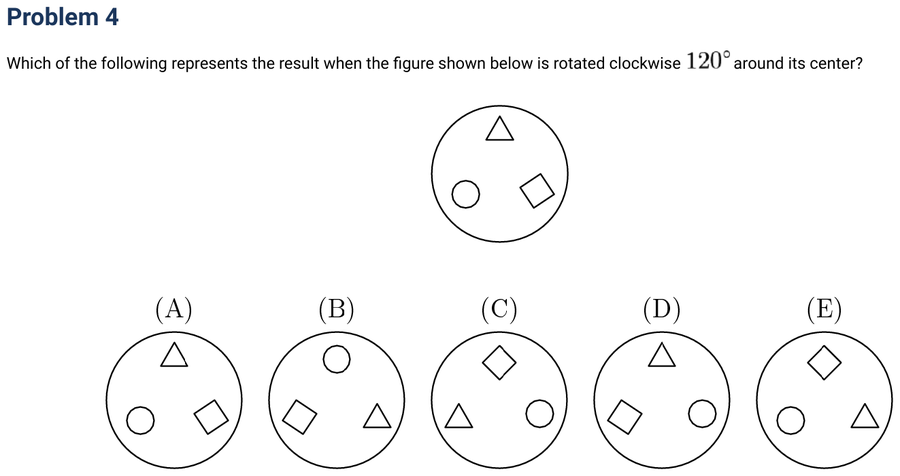
Three shapes evenly spaced means each one sits 120° from the next — so a 120° turn doesn't scramble them, it just slides each shape into the spot the next one held.
Still stuck? Show hint 2 →
Hint 2 of 2
You only need to track ONE shape to kill four of the five choices: follow where the triangle (currently at the top) ends up, then check the others line up.
Show solution
Approach: rotate each shape one position clockwise
The three positions are top, lower-right, lower-left. Turning clockwise (the direction a clock's hands move) sends top → lower-right → lower-left → back to top.
Apply it to each shape: triangle (top) → lower-right; diamond (lower-right) → lower-left; circle (lower-left) → top. So the result has circle on top, diamond at lower-left, triangle at lower-right — choice B.
Shortcut worth keeping: with evenly spaced objects, a rotation is just a 'shift everyone over by one seat.' Pin down a single object and the rest follow — you don't have to redraw the whole picture.
Given that 1 mile = 8 furlongs and 1 furlong = 40 rods, the number of rods in one mile is
Show answer
Answer: B — 320.
Show hints
Hint 1 of 2
The miles–rods jump is too big to do directly, but you have a stepping-stone (furlongs) that connects them — hop mile → furlong → rod.
Still stuck? Show hint 2 →
Hint 2 of 2
Each hop multiplies: stack the two conversion factors together. (Ignore the decoy numbers 660, 1760, 5280 — those are real mile facts but for feet/yards, not this puzzle's furlongs and rods.)
Show solution
Approach: chain the conversions
Bridge through furlongs: 1 mile is 8 furlongs, and each of those 8 furlongs is 40 rods.
So 1 mile = 8 × 40 = 320 rods.
Why multiply (not add): each furlong unpacks into 40 rods, and you have 8 furlongs, so it's 8 groups of 40 — that's multiplication. This 'chain the units' move handles any multi-step conversion.
The units digit (one's digit) of the product of any six consecutive positive whole numbers is
Show answer
Answer: A — 0.
Show hints
Hint 1 of 2
'Any six consecutive numbers' means the answer must work for EVERY such run — so look for something that's always there, no matter where you start.
Still stuck? Show hint 2 →
Hint 2 of 2
A units digit of 0 just means 'divisible by 10,' and 10 = 2 × 5. So ask: is the product always even, and always a multiple of 5?
Show solution
Approach: the product is a multiple of 10
Six numbers in a row always sweep past a multiple of 5 (you can't go five steps without hitting one) and obviously include even numbers.
So the product carries both a factor of 5 and a factor of 2 — that's a factor of 10. Anything divisible by 10 ends in 0.
Why this transfers: 'ends in 0' = 'has both a 2 and a 5 inside.' You'll use this same 2-and-5 logic to count trailing zeros in factorials and big products. Notice we never multiplied anything — spotting the guaranteed factors beats computing the giant product.
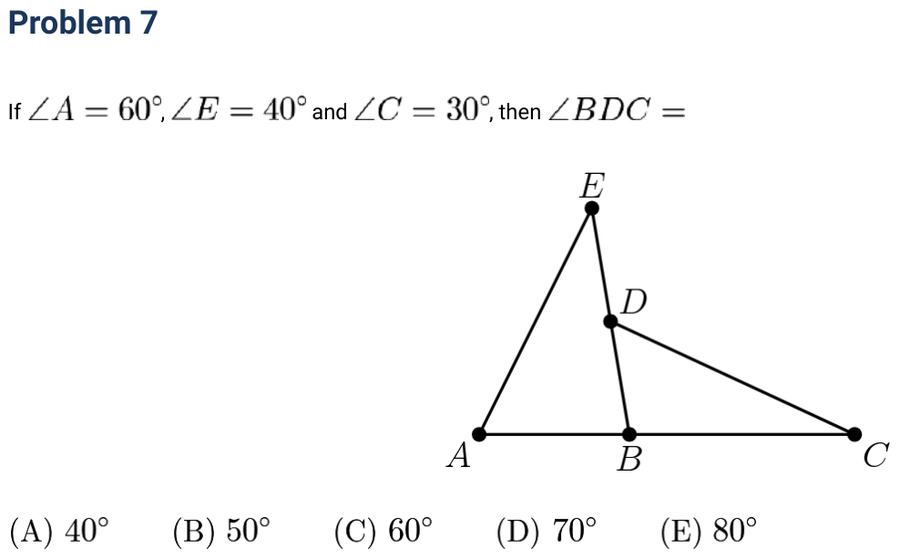
The angle you want, ∠BDC, lives in triangle BDC, where you already know ∠C = 30°. So the whole job is just finding ONE more angle of that triangle: ∠DBC.
Still stuck? Show hint 2 →
Hint 2 of 2
Look at line E–D–B: it's straight, so the angle that line makes with the baseline at B is shared by both triangles. Chase the angle at B over from the left triangle to the right one.
Show solution
Approach: angle sum, then a supplement
Left triangle ABE: angles are 60° at A, 40° at E, so the third angle ∠ABE = 180° − 60° − 40° = 80°.
A, B, C sit on one straight line, so ∠DBC and ∠ABE are supplements along that line: ∠DBC = 180° − 80° = 100°. (Ray BD is ray BE since E, D, B are collinear.)
Sanity check: 50° is a small, sharp angle — and ∠BDC does look acute in the picture, so the answer passes the eyeball test.
Another way — exterior-angle shortcut:
∠DBC is the exterior angle of triangle ABE at B (the base AB extended to C). An exterior angle equals the sum of the two FAR-AWAY interior angles, so ∠DBC = ∠A + ∠E = 60° + 40° = 100° in one step — no need to first find the 80°.
Then triangle BDC gives ∠BDC = 180° − 100° − 30° = 50°. The exterior-angle rule (an outside angle = the two opposite inside angles) is a huge time-saver in angle chases.
For how many three-digit whole numbers does the sum of the digits equal 25?
Show answer
Answer: C — 6.
Show hints
Hint 1 of 2
Counting up to 25 from scratch is messy — flip it. The biggest a digit sum can be is 9+9+9 = 27, so 25 means you only have to take away 2 from a row of nines.
Still stuck? Show hint 2 →
Hint 2 of 2
Now the question is tiny: how can you remove a total of 2 from three 9s? Find those few digit-patterns, then count how many ways each one can be arranged.
Show solution
Approach: count from the maximum 27
Start at 9,9,9 (sum 27) and remove 2. Either take 2 off one digit → 9, 9, 7; or take 1 off two digits → 9, 8, 8. Those are the only digit-bags that sum to 25 (all digits stay valid, and the lead digit is never 0).
Count arrangements of each: {9, 9, 7} places the lone 7 in 3 spots → (997), (979), (799). {9, 8, 8} places the lone 9 in 3 spots → (988), (898), (889). That's 3 + 3 = 6 numbers.
Why 'subtract from the max' wins: when a target is near the ceiling, counting the small shortfall is far easier than building up. The arrangement step — 'how many spots for the odd-one-out' — is the same idea you'll use for permutations with repeats.
A shopper buys a 100-dollar coat on sale for 20% off. An additional 5 dollars are taken off the sale price by using a discount coupon. A sales tax of 8% is paid on the final selling price. The total amount the shopper pays for the coat is
Show answer
Answer: A — 81.00 dollars.
Show hints
Hint 1 of 2
Read the order the problem hands you: the price keeps changing, and tax only lands on the FINAL selling price — so finish all the price-cutting before tax touches anything.
Still stuck? Show hint 2 →
Hint 2 of 2
Handle each cut in its own form: a percent-off means 'multiply' (or take a fraction away), but the coupon is a flat dollar amount you just subtract. Don't blend them.
Show solution
Approach: discounts first, then tax
20% off $100: 20% of 100 is 20, so the sale price is $80.
Coupon: subtract a flat $5 → $75. This is the final selling price, so tax goes here.
Add 8% tax: 8% of 75 = 6, so total = 75 + 6 = $81.00. (Tip: adding 8% in one shot is ×1.08, but '8% of 75 = 6' is the lighter mental step.)
Trap to dodge: don't add the 8% tax onto the $80 before the coupon — tax is charged after every discount, and applying it early gives the wrong (bigger) total.
For how many positive integer values of N is the expression 36N + 2 an integer?
Show answer
Answer: A — 7.
Show hints
Hint 1 of 2
A fraction 36/(something) is a whole number exactly when that 'something' divides 36 evenly. So forget N for a second — ask which numbers go into 36.
Still stuck? Show hint 2 →
Hint 2 of 2
Don't list every divisor and stop there: N has to be a positive integer (N ≥ 1), so the bottom N+2 is at least 3. Toss out any divisor smaller than 3.
Show solution
Approach: count valid divisors of 36
36/(N+2) is an integer exactly when N+2 is a divisor of 36. All divisors of 36 (pair them up): 1·36, 2·18, 3·12, 4·9, 6·6 → 1, 2, 3, 4, 6, 9, 12, 18, 36.
But N ≥ 1 forces N+2 ≥ 3, so the divisors 1 and 2 are off-limits (they'd need N = −1 or 0). Keep 3, 4, 6, 9, 12, 18, 36 — that's 7 values.
Two ideas worth keeping: list divisors in PAIRS so you never miss one, and always re-check the hidden constraint (here N ≥ 1) before counting — the smaller divisors are the classic trap that turns the right list into a wrong total.
Last summer 100 students attended basketball camp. Of those, 52 were boys and 48 were girls. Also, 40 students were from Jonas Middle School and 60 were from Clay Middle School. Twenty of the girls were from Jonas Middle School. How many of the boys were from Clay Middle School?
Show answer
Answer: B — 32.
Show hints
Hint 1 of 2
Every student is sorted two ways at once — boy/girl AND Jonas/Clay. When two labels overlap like that, a 2×2 grid (boys/girls across, Jonas/Clay down) keeps it all straight.
Still stuck? Show hint 2 →
Hint 2 of 2
You're handed the Jonas girls (20). Use a row total to fill its partner, then a column total to slide over to the answer — each blank is just 'total minus the known piece.'
Show solution
Approach: fill in a two-way table
Set up the grid. The girls' row totals 48, and 20 are from Jonas, so girls from Clay = 48 − 20 = 28.
The Clay column totals 60. Take out the 28 Clay girls: boys from Clay = 60 − 28 = 32.
Why the grid beats juggling sentences: every row and every column must hit its total, so each filled box instantly unlocks the next. Cross-check: Jonas boys = 52 − 32 = 20, and Jonas total 20 girls + 20 boys = 40 ✓ — the whole table balances.
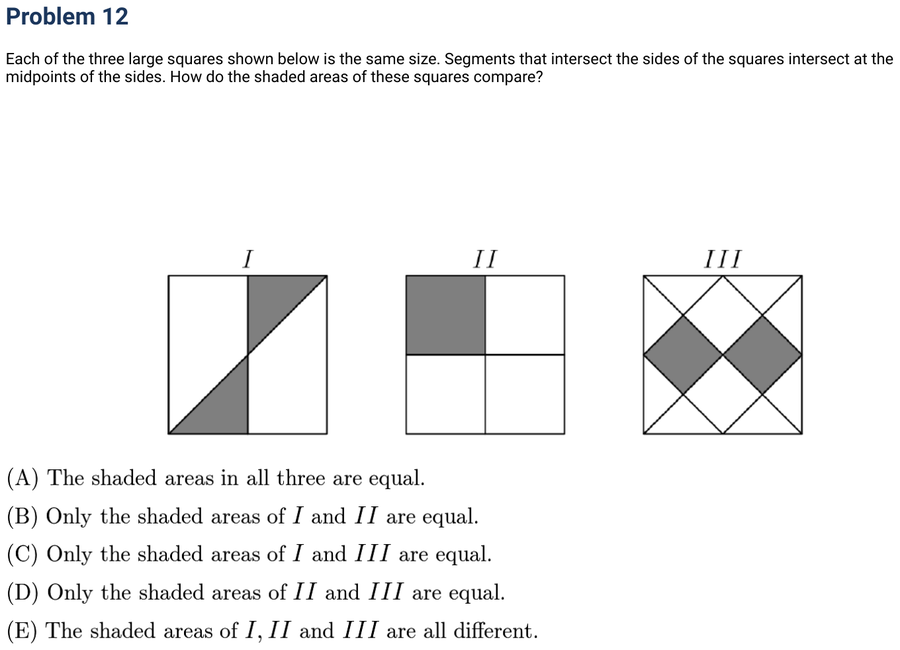
Resist computing three messy areas. Since the cuts all hit the midpoints, the shaded bits in each square are made of the same little half-of-a-quarter triangles — slide them around in your head.
Still stuck? Show hint 2 →
Hint 2 of 2
Find what fraction of ONE square is shaded, then check the other two land on the same fraction. (Picture square II: it's clearly one quarter shaded — that's your target to match.)
Show solution
Approach: cut and rearrange to compare
Square II is the easy anchor: one of the four equal quarters is shaded, so it's exactly 1/4 of the square.
Square I: the two shaded triangles each sit in a quarter of the grid and fill half of it (the midpoint cut halves them), so together they cover 1/4. Square III: the shaded diamond pieces likewise reassemble — slide the corner triangles inward — to cover 1/4.
All three are all equal (each is 1/4 of the square).
Big idea: when every cut goes through a midpoint, shapes are built from identical building-block triangles. Rearranging those blocks (instead of computing each odd shape) is the fast, error-proof way to compare areas — you'll reuse this 'cut-and-slide' trick constantly in geometry.
'Halfway between' is just the midpoint — and the midpoint of two numbers is their average. So this is an averaging problem in disguise.
Still stuck? Show hint 2 →
Hint 2 of 2
To average, add the two fractions then halve. Adding needs a common bottom (12 works for 6 and 4).
Show solution
Approach: average the two fractions
Halfway between = average = (1/6 + 1/4) ÷ 2. Add first: over 12, that's 2/12 + 3/12 = 5/12.
Now halve 5/12. Halving a fraction is doubling its bottom, so 5/12 → 5/24.
Sanity check: 1/6 ≈ 0.167 and 1/4 = 0.25, so the midpoint should be near 0.21 — and 5/24 ≈ 0.208 ✓. The answer must land BETWEEN the two given fractions, which rules out tiny choices like 1/10.
Another way — midpoint = jump halfway up the gap:
The gap from 1/4 to 1/6 is 3/12 − 2/12 = 1/12. Halfway means add half that gap to the smaller one: 2/12 + 1/24 = 4/24 + 1/24 = 5/24.
Thinking 'start + half the distance' is the same midpoint idea you use on a number line.
Two children at a time can play pairball. For 90 minutes, with only two children playing at a time, five children take turns so that each one plays the same amount of time. The number of minutes each child plays is
Show answer
Answer: E — 36.
Show hints
Hint 1 of 2
Two kids are always playing, so the game produces TWO 'player-slots' every minute — count the total slot-time first, then hand it out fairly.
Still stuck? Show hint 2 →
Hint 2 of 2
Total playing-time available = 2 slots × 90 minutes. Share that pot equally among the 5 children.
Show solution
Approach: total child-minutes, shared equally
Each minute fills 2 playing spots, and the game runs 90 minutes, so there are 2 × 90 = 180 'child-minutes' of play to give out.
Five children split it evenly: 180 ÷ 5 = 36 minutes each.
The key move is counting total work in 'person-units' (here child-minutes) before dividing — the same trick behind 'if 3 painters take 4 hours, that's 12 painter-hours of work.' Reality check: 36 < 90, which makes sense since nobody plays the whole time.
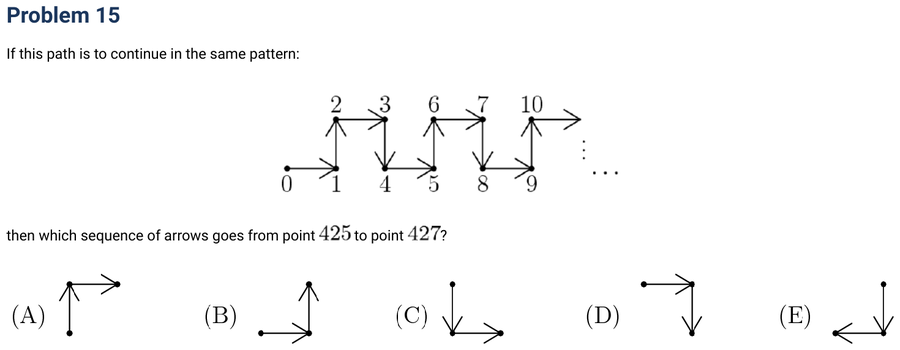
The arrows don't go on forever in new directions — watch the picture and you'll see the same 4-arrow shape (right, up, right, down) repeat over and over. A repeating loop means you only care about where 425 falls inside the loop.
Still stuck? Show hint 2 →
Hint 2 of 2
Sort each starting point by its leftover after dividing by 4: numbers ending the same way in that 4-cycle leave the same way. So point 425 behaves like the 1-leftover points (0, 4, 8 →), and 426 like the 2-leftover points.
Show solution
Approach: use the period-4 repetition
Map the loop using the first numbers: leaving 0 you go RIGHT, leaving 1 UP, leaving 2 RIGHT, leaving 3 DOWN — then it resets (4 acts like 0, going right again). So the arrow out of a point depends only on its leftover when divided by 4.
425 = 4×10⁶ + 1, so it has leftover 1 → the UP arrow takes you to 426. 426 has leftover 2 → the RIGHT arrow takes you to 427.
Up then right is choice A.
Why this works for any huge number: in a pattern that repeats every k steps, dividing by k and keeping the leftover tells you the position in the cycle. You never simulate all 425 steps — you just locate where 425 lands in one loop.
The perimeter of one square is 3 times the perimeter of another square. The area of the larger square is how many times the area of the smaller square?
Show answer
Answer: E — 9.
Show hints
Hint 1 of 2
Perimeter is just 4 sides added up, so it grows in lockstep with the side. If the perimeter tripled, the side tripled too — the '4' and the units cancel out of the ratio.
Still stuck? Show hint 2 →
Hint 2 of 2
Here's the trap the answer choices set: area does NOT triple. Length is one-dimensional, area is two-dimensional, so the area ratio is the side ratio MULTIPLIED BY ITSELF.
Show solution
Approach: area scales as the square of the side ratio
Perimeter = 4 × side, so a 3× perimeter means a 3× side. The big square's side is 3 times the small one's.
Area = side × side. Triple a side and you triple it in BOTH directions, so area becomes 3 × 3 = 9 times as big.
Picture it: lay the small square inside the big one and you fit a 3-by-3 grid of them — 9 copies. That's the whole reason answer '3' is a trap. The rule (scale length by k → area by k², volume by k³) shows up everywhere from maps to model rockets.
Pauline can shovel snow at the rate of 20 cubic yards for the first hour, 19 cubic yards for the second, 18 for the third, and so on, always shoveling one cubic yard less per hour than the previous hour. If her driveway is 4 yards wide, 10 yards long, and covered with snow 3 yards deep, then the number of hours it will take her to shovel it clean is closest to
Show answer
Answer: D — 7.
Show hints
Hint 1 of 2
Two separate jobs hide here. First, how much snow is there at all? It's a box: width × length × depth.
Still stuck? Show hint 2 →
Hint 2 of 2
Her rate drops each hour, so you can't just divide. Keep a running total — 20, then 20+19, then +18, … — and stop the moment it reaches the goal volume.
Show solution
Approach: accumulate the decreasing hourly amounts
Volume of snow = 4 × 10 × 3 = 120 cubic yards (it's a rectangular box).
Now stack up her hourly amounts and watch the running total: 20, 39, 57, 74, 90, 105, 119. After 7 hours she's cleared 119 — just 1 cubic yard short of 120, which she finishes a sliver into hour 8.
Since 119 is essentially the whole job, the time is closest to 7 hours. Don't let choice (E) 12 fool you — that's the hour her rate would hit zero (20−12+1=9... she'd actually stall), but the snow runs out long before then.
Lesson: when a rate changes step by step, accumulate term-by-term rather than dividing total by a single rate — and read the question's wording ('closest to') to know you can stop at 'almost there.'
Another way — estimate with an average rate:
Over the first several hours her rate averages roughly the middle of 20 and the low teens — about 17 yds/hr. Then 120 ÷ 17 ≈ 7, pointing straight at 7 hours without summing every term.
A quick average is a great gut-check before (or instead of) the exact running total.
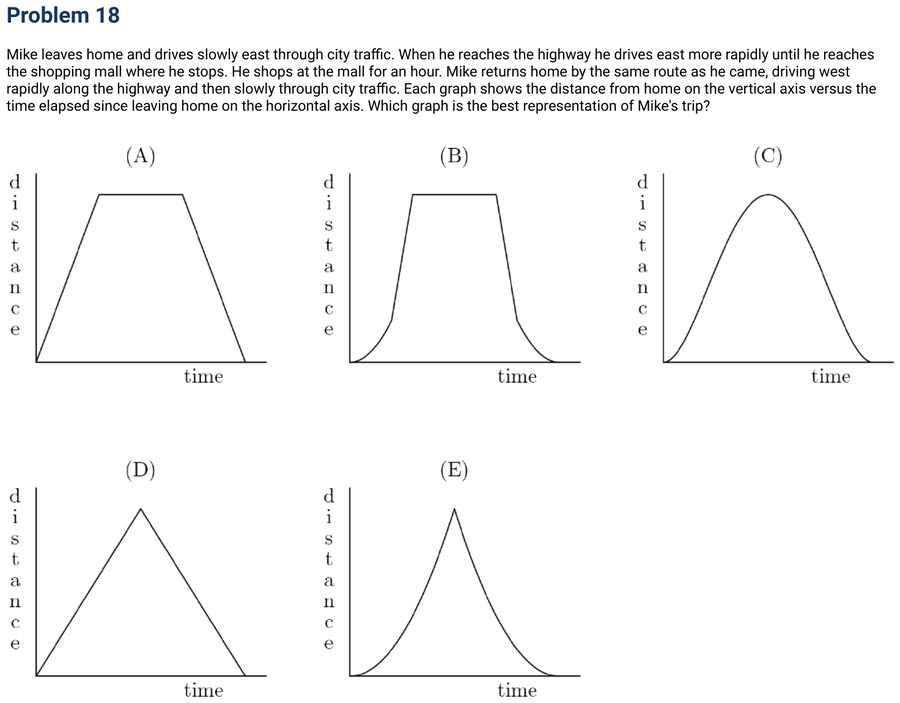
Read the SHAPE of the story, not numbers: distance-from-home goes UP while driving out, stays FLAT during the hour of shopping, then comes back DOWN. That flat top kills any graph without a level stretch (C, D, E).
Still stuck? Show hint 2 →
Hint 2 of 2
Now the tie-breaker between A and B: on a distance-vs-time graph, slope IS speed. Mike has TWO speeds each way (slow city, fast highway), so each side can't be a single straight line — its steepness must change partway.
Show solution
Approach: match each changing-speed leg to the graph's slope
First filter on the overall shape: out (rising), shop (flat), back (falling). Only graphs with a flat plateau survive — that's A and B (C, D, E have a single peak, no time spent at the mall).
Now use 'slope = speed.' Going out he's slow in the city (gentle rise) then fast on the highway (steep rise), so the outgoing side BENDS from shallow to steep — not one straight ramp. Coming home reverses: steep highway, then gentle city.
Graph B shows each side bending between two slopes; graph A's straight sides would mean one single constant speed the whole way out and back, which contradicts the city-then-highway change.
Reusable idea: on distance-time graphs, steeper = faster and flat = stopped. Treat 'match the graph' problems as a checklist — eliminate on the big features (flat? rising? falling?) first, then settle the survivors on the fine detail (straight vs. bending).
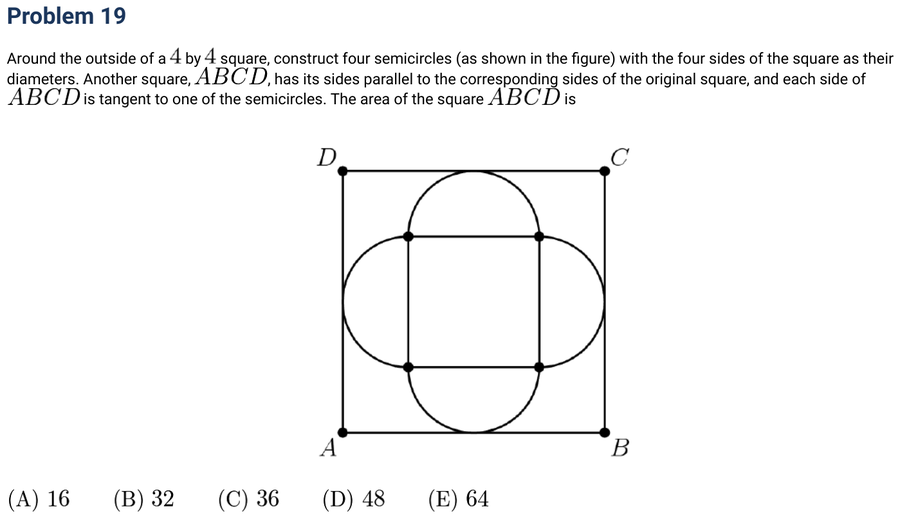
A semicircle drawn on a side of length 4 has that side as its diameter, so its radius is 2 — and the farthest it pokes out from the side is exactly that radius, 2.
Still stuck? Show hint 2 →
Hint 2 of 2
The outer square is tangent to the bulges, meaning it just kisses the top of each semicircle. So measuring straight across, the outer side = inner side + a bulge on each end. Then square it for area.
Show solution
Approach: grow the inner square by the semicircle radii
Diameter = the side = 4, so each semicircle's radius is 2. Its outermost point sticks out 2 past the inner square's edge.
Cross the figure left-to-right: outer edge, bulge (2), inner square (4), bulge (2), outer edge. So square ABCD has side 4 + 2 + 2 = 8.
Area = 8² = 64.
Sanity check that beats the trap answers: the outer square is clearly bigger than the inner one's area (16) but not absurdly so — 64 = four inner squares, which looks right in the picture. The takeaway: when a shape 'just touches' a circle (tangency), the gap it leaves equals the radius — convert tangency into a length you can add.
Let W, X, Y, and Z be four different digits selected from the set {1, 2, 3, 4, 5, 6, 7, 8, 9}.
If the sum WX + YZ is to be as small as possible, then WX + YZ must equal
Show answer
Answer: D — 25/72.
Show hints
Hint 1 of 2
A fraction shrinks when its top is small and its bottom is big. With four digits to place, send your two SMALLEST digits (1, 2) up top and your two LARGEST (8, 9) to the bottoms.
Still stuck? Show hint 2 →
Hint 2 of 2
That's not the whole answer — you still choose how to pair them. There are only two pairings of {1,2} over {8,9}, so test both. Watch out: the 'obvious' choice isn't the winner.
Show solution
Approach: smallest tops over largest bottoms, paired well
Smallest tops, largest bottoms ⇒ numerators 1 and 2, denominators 8 and 9.
Two ways to pair them, both over a common 72: (a) 1/9 + 2/8 = 8/72 + 18/72 = 26/72; (b) 1/8 + 2/9 = 9/72 + 16/72 = 25/72. Option (b) is smaller.
So the minimum sum is 25/72.
Why the better pairing puts the bigger numerator over the bigger denominator: the '2' does the most damage, so park it over the biggest bottom (9) to shrink its effect. Lesson — for these extremes, 'pick the right digits' is only half the job; how you MATCH them up is the tiebreaker, so always check the few pairings.
A gumball machine contains 9 red, 7 white, and 8 blue gumballs. The least number of gumballs a person must buy to be sure of getting four gumballs of the same color is
Show answer
Answer: C — 10.
Show hints
Hint 1 of 2
'To be SURE' means it has to work even on your unluckiest day. So picture the meanest possible streak — how long can the machine keep you from ever getting four of one color?
Still stuck? Show hint 2 →
Hint 2 of 2
The worst it can do is hand you three of every color. Count those, then take one more — that next gumball has nowhere to hide.
Show solution
Approach: worst case, then one more
Build the unluckiest run: 3 red, 3 white, 3 blue = 9 gumballs, and STILL no color has four. This is the most you can hold without a four-of-a-kind.
The very next (10th) gumball is red, white, or blue — whichever it is, that color jumps to four. So 10 guarantees it.
Notice the colors had 9, 7, 8 in stock — plenty to spare, so those numbers were a distraction; all that mattered was '3 colors.' This is the pigeonhole idea: to FORCE k of some category among c categories, survive the worst case of (k−1) in each, then add 1 → c(k−1)+1. Here 3(3)+1 = 10.
Don't list every number-pair and add them — the only thing that decides if a SUM is even is the parity (odd/even) of the two spins. Even + even or odd + odd → even; a mismatch → odd. So shrink each wheel down to just 'P(even)' and 'P(odd).'
Still stuck? Show hint 2 →
Hint 2 of 2
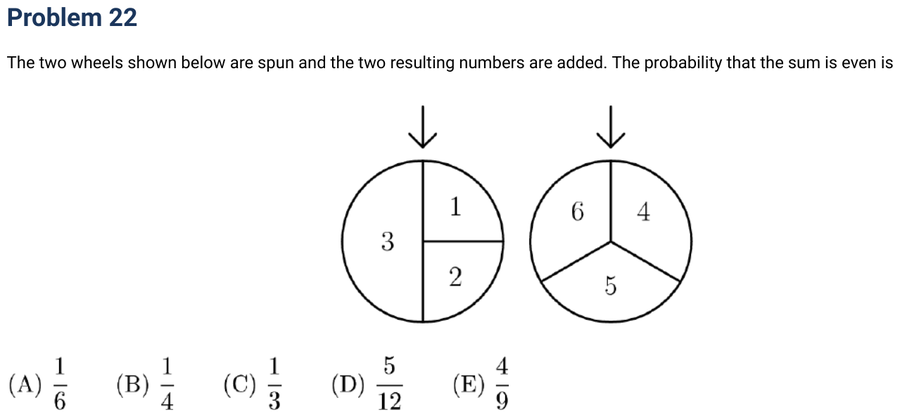
Get those chances from the AREAS, not the count of numbers. On wheel 1 the '3' fills a big half while 1 and 2 each fill a quarter; wheel 2 is split into three equal thirds.
Show solution
Approach: combine the even/odd chances of each wheel
Wheel 1 by area: the even number 2 owns 1/4, so P(even) = 1/4 and P(odd) = 3/4 (the 3 takes half, the 1 a quarter). Wheel 2 by thirds: evens 6 and 4 give P(even) = 2/3, odd 5 gives P(odd) = 1/3.
Even sum = both even OR both odd. Multiply within each case, then add: (1/4)(2/3) + (3/4)(1/3) = 2/12 + 3/12 = 5/12.
Key simplification: for an even/odd-sum question you can throw away the actual numbers and track only parity — that collapses two messy wheels into a 2-outcome problem. Quick check: P(odd sum) = 1 − 5/12 = 7/12, and the two should sum to 1 ✓.
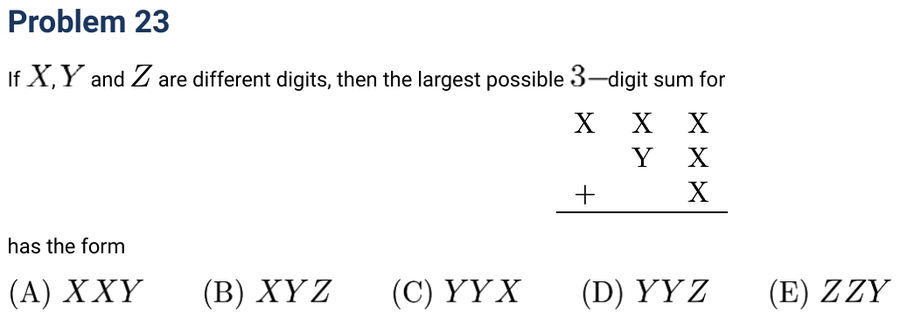
Turn the column-addition into one expression by place value: XXX is 111·X, YX is 10·Y + X, and X is X. Add them and the X's collect to 113·X, plus 10·Y.
Still stuck? Show hint 2 →
Hint 2 of 2
Two competing wants: make the sum big, but it must stay 3 digits (the question says so). X drives it hardest (the 113), so push X as high as it can go WITHOUT spilling to 4 digits, then push Y. Last step: read off the answer's digits and translate them back into X/Y/Z letters.
Show solution
Approach: express the sum, then maximize within three digits
Sum = XXX + YX + X = 113·X + 10·Y. X matters most, but 113·9 = 1017 is four digits, so the biggest legal X is 8 → 113·8 = 904.
Now max out Y: Y = 9 adds 90, giving 904 + 90 = 994. (Y can equal a different digit than X.)
Read 994 in letters: with X = 8, Y = 9, Z = 4, the digits 9, 9, 4 are Y, Y, Z. So the form is YYZ.
Why two-step greedy works: when one slot's coefficient (113) dwarfs the other's (10), maximize the heavyweight first, then the rest. The sneaky part is the question wants the FORM (pattern of letters), not the number — so always re-map the digits back to the symbols you were given.
A 2 by 2 square is divided into four 1 by 1 squares. Each small square is painted green or red. In how many ways can this be done so that no green square shares its top or right side with a red square? (There may be from zero to four green squares.)
Show answer
Answer: B — 6.
Show hints
Hint 1 of 2
Translate the wordy rule into a chain reaction: 'no green touches a red on its top or right' means the instant a square is green, its top neighbor and right neighbor are FORCED green too.
Still stuck? Show hint 2 →
Hint 2 of 2
So greenness flows up and to the right. The bottom-left square is the hardest to make green (it forces the most), and the top-right is the easiest. Think about which squares MUST come along for the ride.
Show solution
Approach: green region must be closed upward and rightward
Rephrase the constraint: green ⇒ the square above and the square to the right are green. Greenness 'climbs' toward the top-right corner.
So the top-right square is free (nothing above or right of it), and the bottom-left is most demanding (greening it forces all four green). List the legal green sets by how far the green spreads: {none}, {TR}, {TR, TL}, {TR, BR}, {TR, TL, BR}, {all four}.
That's 6 colorings. (16 total colorings exist, but the rule throws out the 10 that put a green below or left of a red.)
The transferable trick: when a rule says 'if A then B must follow,' you're really counting which START sets are self-consistent — build them in order of size (smallest spread to largest) so you can't double-count or skip one. This 'closed staircase' shape is the same idea as Pascal-style monotone regions.
where a string of 94 nines is multiplied by a string of 94 fours.
Show answer
Answer: A — 846.
Show hints
Hint 1 of 2
94 nines is far too big to multiply out — but a number THIS regular always hides a pattern. Shrink the problem: try 9×4, then 99×44, then 999×444, and watch what the digit sum does each time you add one more nine.
Still stuck? Show hint 2 →
Hint 2 of 2
This is the 'solve a tiny version first' technique: nail the rule on 1, 2, 3 nines, confirm it's growing by the same amount each step, then leap straight to 94 without ever doing the giant multiplication.
Show solution
Approach: spot the pattern from small cases, then leap to 94
Do the small versions and total the digits: 9·4 = 36 (digit sum 9), 99·44 = 4356 (sum 18), 999·444 = 443556 (sum 27). Each extra nine adds exactly 9 to the digit sum, so the rule is: digit sum = 9 × (number of nines).
With 94 nines, the digit sum is 9 × 94 = 846.
Why it grows by a steady 9: look at 999·444 = 443556 — it's a run of 4s, then a 3, then a run of 5s, then a 6. Adding one more nine lengthens the 4-run AND the 5-run by one digit each, so the digit sum climbs by 4 + 5 = 9 every time. With 94 nines the product is 93 fours, a 3, 93 fives, a 6, giving 4·93 + 3 + 5·93 + 6 = 9·94 = 846. The reusable move: when a number is too huge to compute, test the smallest cases, check the step between them is constant, then leap to the big case.
Sanity check on the pattern: the all-nines factor is a multiple of 9, so the product is too — and a multiple of 9 always has a digit sum that's a multiple of 9. Our 846 = 9 × 94 passes, while the only non-multiple-of-9 choice (1072) can be ruled out on sight. (Several choices ARE multiples of 9, so this test confirms 846 is legal but doesn't pick it alone — the small-case rule is what pins down the exact value.)
Another way — rewrite the nines as a round number minus 1:
A string of 94 nines equals 10⁹⁴ − 1, so the product is (10⁹⁴ − 1)·(444…4) = (444…4 with 94 zeros tacked on) − (444…4). Subtracting the 94-digit string of 4s from that shifted copy borrows down the line and lands on 93 fours, a 3, 93 fives, a 6 — exactly the shape the small cases predicted.
Its digit sum is 4·93 + 3 + 5·93 + 6 = 372 + 3 + 465 + 6 = 846. Turning 99…9 into 10ⁿ − 1 is the standard trick that explains WHY these repeated-digit products come out so regular.