Which pair of numbers does NOT have a product equal to 36?
Show answer
Answer: C — {1/2, −72}.
Show hints
Hint 1 of 2
You don't even have to multiply all of them — scan for anything different first. Four pairs are both-positive or both-negative; one pair has a positive and a negative.
Still stuck? Show hint 2 →
Hint 2 of 2
The sign rule decides it: a positive times a negative is always negative, so that pair can't make +36.
Show solution
Approach: spot the odd sign first, then confirm
Before multiplying, look at signs. A product is positive only when the two numbers have the same sign (both + or both −). Four of the pairs match — but {1/2, −72} is one positive, one negative, so its product must be negative.
Check it: (1/2)(−72) = −36, not 36. The odd pair is {1/2, −72}.
Why this transfers: on a 'which one is different' problem, hunt for the lone exception by a quick property (here, sign) before grinding through every computation — the outlier usually announces itself.
Another way — multiply all five:
(−4)(−9)=36, (−3)(−12)=36, (1)(36)=36, (3/2)(24)=36 — all equal 36, but (1/2)(−72)=−36. The pair that fails is {1/2, −72}.
When the fraction 4984 is expressed in simplest form, the sum of the numerator and the denominator will be
Show answer
Answer: C — 19.
Show hints
Hint 1 of 2
The numerator 49 is 7×7, and that's the clue — does 7 also divide 84? If so the fraction isn't in lowest terms yet.
Still stuck? Show hint 2 →
Hint 2 of 2
'Simplest form' means top and bottom share no common factor. Cancel the shared 7, THEN add — never add before reducing, or you'd get 49+84=133 (a trap answer).
Show solution
Approach: reduce first, then add
49 = 7×7, and 84 = 7×12, so they share a factor of 7. Divide both by 7: 49/84 = 7/12. Now 7 and 12 share nothing, so it's in simplest form.
7 + 12 = 19.
Trap to dodge: the question asks for the sum after simplifying. Adding the original 49+84 gives 133 (choice E) — that's the bait for anyone who skips the reduce step.
Which of the following numbers has the largest prime factor?
Show answer
Answer: B — 51.
Show hints
Hint 1 of 2
The question isn't 'which number is biggest' — it's 'which has the biggest prime piece.' A small-looking number can hide a large prime. Break each into its prime building blocks.
Still stuck? Show hint 2 →
Hint 2 of 2
Each of these is a product of just two primes. Find the larger prime in each pair, then compare those — that's the only number that matters per choice.
Show solution
Approach: factor each, then race the largest primes
Split each into primes: 39 = 3·13, 51 = 3·17, 77 = 7·11, 91 = 7·13, 121 = 11·11. The biggest prime inside each is 13, 17, 11, 13, 11.
The champion is 17, living inside 51 — even though 51 is far from the largest number on the list.
Why this transfers: 'largest prime factor' is about the deepest prime in the factor tree, not the size of the number. The two ideas come apart — that's exactly the surprise these problems test.
Don't multiply left-to-right — rearrange first. Multiplication lets you reorder freely, so pull the 'easy' factors (the powers of ten and the decimal) together and leave the lonely 1993 aside.
Still stuck? Show hint 2 →
Hint 2 of 2
Powers of ten and a decimal undo each other: ×1000 and ×10 push the decimal point right, and 0.1993 moves it back. Watch 0.1993 turn into a whole number.
Show solution
Approach: regroup so the powers of ten cancel the decimal
Reorder: (1000 × 10 × 0.1993) × 1993. The 1000 and 10 multiply 0.1993 by 10000, sliding the decimal point 4 places right: 0.1993 → 1993. So the bracket is just 1993.
That leaves 1993 × 1993 = (1993)².
Intuition: a decimal like 0.1993 is secretly '1993 with the point moved.' Hunting for powers of ten that snap it back to a whole number is the whole trick — and it dodges any messy long multiplication.
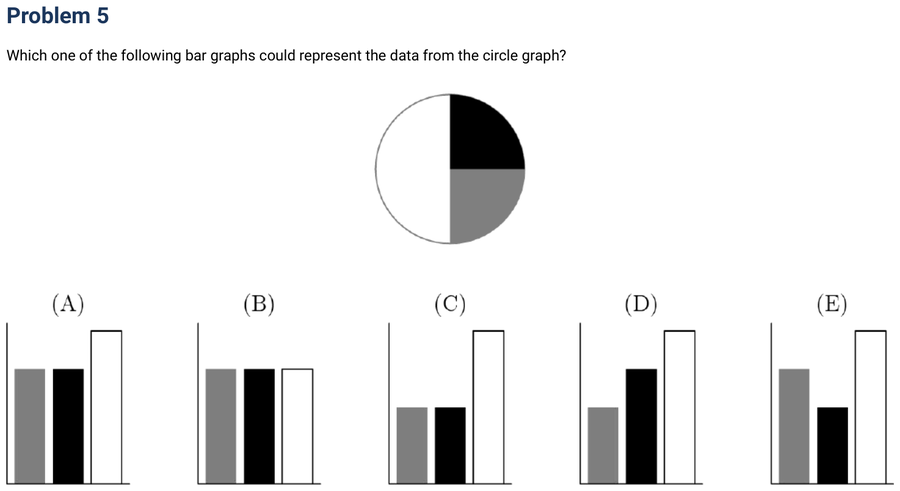
A pie chart and a bar graph are two costumes for the same numbers — the matching one keeps the proportions. So first read the pie as ratios, not exact amounts.
Still stuck? Show hint 2 →
Hint 2 of 2
Eyeball the slices: white is a half, black and gray are equal quarters. The right bar graph must echo that shape — one bar twice as tall as two equal shorter ones.
Show solution
Approach: translate the pie's proportions into bar heights
Read the circle as fractions: the white slice fills half the circle; the black and gray slices are equal quarters. So the ratio is white : black : gray = 2 : 1 : 1.
The bars must carry that same 2 : 1 : 1 shape — one bar twice as tall as two equal shorter bars. Only graph C shows two short equal bars and one tall bar at double their height.
Why this transfers: matching a pie to a bar graph is pure proportion-reading. Ignore the exact numbers and ask only 'which is biggest, and by what ratio?' — the slice that's half a circle becomes the bar that's double the others.
A can of soup can feed 3 adults or 5 children. If there are 5 cans of soup and 15 children are fed, then how many adults would the remaining soup feed?
Show answer
Answer: B — 6 adults.
Show hints
Hint 1 of 2
The cans get spent in two jobs: first feeding the kids, then feeding adults with whatever's left. So figure out the kids' share of cans before anything else.
Still stuck? Show hint 2 →
Hint 2 of 2
A can is a fixed 'unit' here — one can feeds 5 children OR 3 adults. Convert children-to-cans, subtract, then convert leftover-cans-to-adults.
Show solution
Approach: spend cans on children first, convert the leftovers
Each can feeds 5 children, so 15 children eat exactly 15 ÷ 5 = 3 cans. That leaves 5 − 3 = 2 cans untouched.
Each leftover can feeds 3 adults, so 2 cans feed 2 × 3 = 6 adults.
Watch the trap: the can is the currency, not the person. Don't try to convert children straight into adults (a can isn't '5 children = 3 adults' once it's been opened) — count whole cans used, then refill the rest with adults.
This is adding, not multiplying — and adding three identical things is just multiplying by 3. Rewrite the sum as a single product before touching exponents.
Still stuck? Show hint 2 →
Hint 2 of 2
The key principle: addition of equal powers turns into a count out front (3×3³), and the count 3 is itself 3¹. Then multiplying powers of the same base means adding the exponents.
Show solution
Approach: turn repeated addition into multiplication, then add exponents
Three copies of 3³ added together is 3 × 3³. Don't multiply the powers — when you ADD equal terms, you count them.
Now 3 × 3³ = 3¹ × 3³, and multiplying same-base powers adds exponents: 1 + 3 = 4. So the answer is 3⁴.
Trap to dodge: the tempting wrong moves all show up as choices — 9³ (adding the bases), 3⁹ (multiplying the exponents). Neither is what 'add three of them' means. Slow down on whether you're adding or multiplying.
To control her blood pressure, Jill's grandmother takes one half of a pill every other day. If one supply of medicine contains 60 pills, then the supply would last approximately
Show answer
Answer: D — 8 months.
Show hints
Hint 1 of 2
The pills last so long because of a double stretch: each dose is only half a pill, AND each dose covers two days. Both effects multiply the days, so handle them one at a time.
Still stuck? Show hint 2 →
Hint 2 of 2
Chain the units: pills → doses → days. Half-pill doses mean twice as many doses as pills; every-other-day means twice as many days as doses.
Show solution
Approach: convert pills → doses → days, step by step
Each dose is ½ a pill, so 60 pills make 60 ÷ ½ = 120 doses. (Dividing by a half doubles the count — half-size pieces means twice as many.)
Each dose covers 2 days ('every other day'), so 120 doses last 120 × 2 = 240 days. A year is 365 days and 240 ÷ 30 ≈ 8, so the supply lasts about 8 months.
Why this transfers: 'half a pill every other day' hides two doublings. Walking through one conversion at a time — and naming each unit — keeps you from accidentally cancelling them or doing only half the job.
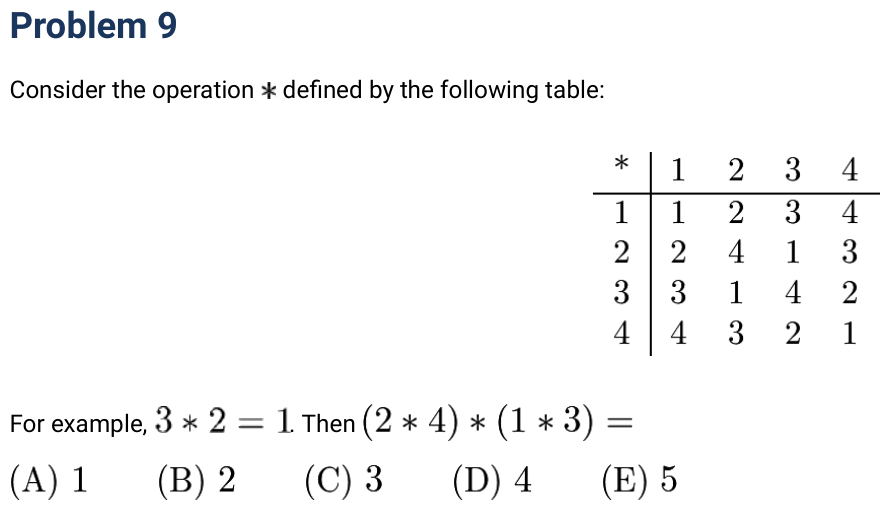
The ∗ table is just a lookup grid, like a multiplication table for a made-up operation: find the left number on the side, the right number on top, read where they meet. No rule to figure out — just look it up.
Still stuck? Show hint 2 →
Hint 2 of 2
Respect the parentheses. Evaluate each inner (a ∗ b) first to get two numbers, THEN star those two together — same as order of operations with ×.
Show solution
Approach: evaluate the parentheses by table lookup, then combine
Inner first. For 2 ∗ 4, go to row 2, column 4: that cell is 3. For 1 ∗ 3, row 1 column 3: that's 3. (Row = left number, column = right number.)
Now the expression is 3 ∗ 3. Row 3, column 3 reads 4. So (2 ∗ 4) ∗ (1 ∗ 3) = 4.
Why this transfers: a 'defined operation' problem is never about discovering a formula — it's careful reading. Lock down which input is the row and which is the column, then it's pure lookup. Don't assume the table is symmetric; always read row then column.
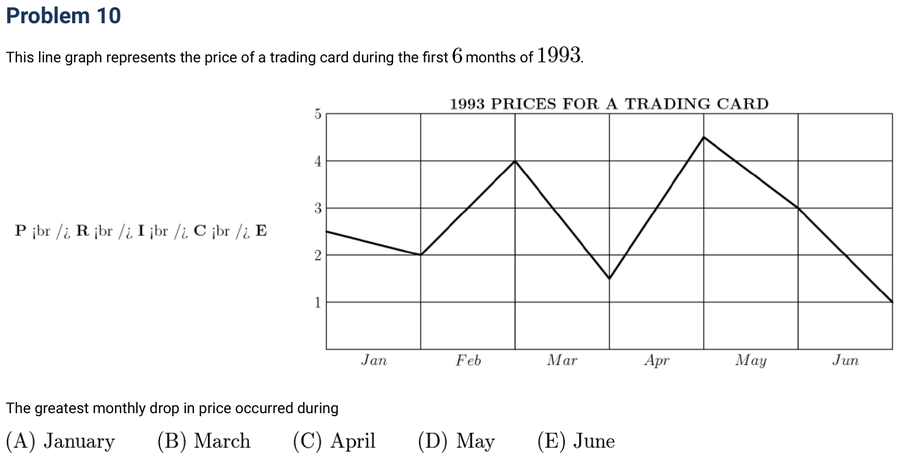
'Drop' means the line goes down — so ignore every rising segment entirely. Only the downhill segments are even candidates.
Still stuck? Show hint 2 →
Hint 2 of 2
Of the downhill segments, you want the biggest vertical fall, not the steepest-looking slant. Read each segment's start height minus end height and compare those numbers.
Show solution
Approach: compare only the downhill segments by their vertical fall
First throw out the climbs (Feb→Mar up, Apr→May up). The downhill months are March (4 down to 1.5, a fall of 2.5), May (4.5 down to 3, a fall of 1.5), and June (3 down to 1, a fall of 2).
The largest fall is 2.5, during March.
Why this transfers: on a line graph, the change for a month is the vertical gap between its two endpoints — read off the y-axis, don't eyeball the tilt. A long gentle line can fall less than a short steep one; trust the numbers, not the angle.
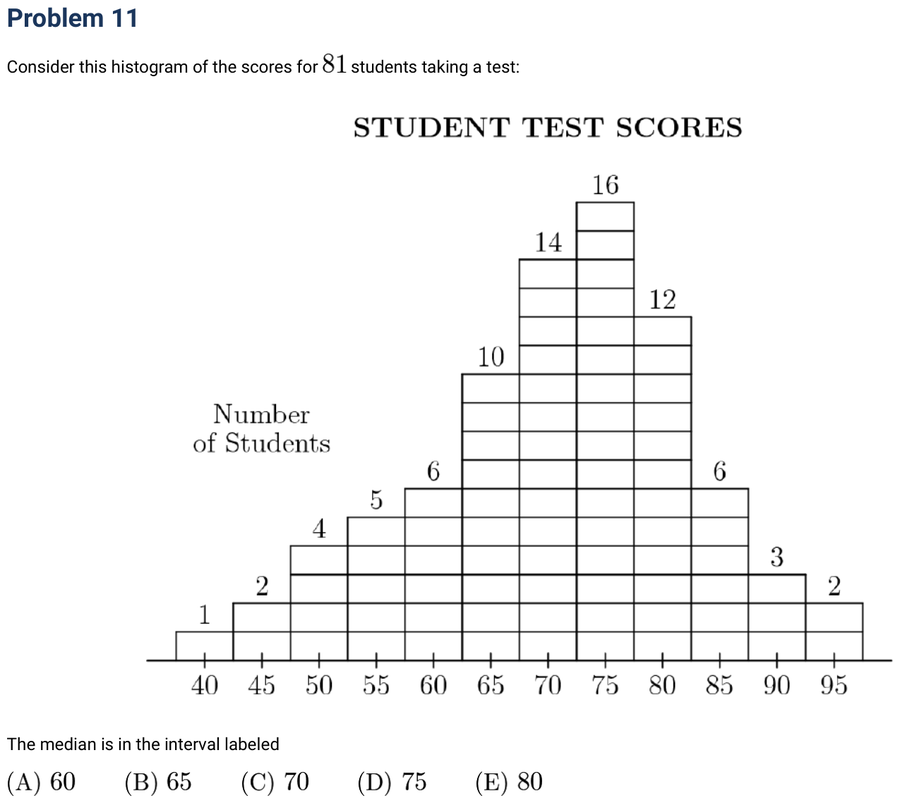
You don't need the actual scores — the median is just the middle student when everyone lines up shortest-score to tallest. With 81 students lined up, who's in the exact middle? (Hint: 81 is odd, so there's a single middle person.)
Still stuck? Show hint 2 →
Hint 2 of 2
Don't read the tallest bar — that's the most common score, not the median. Instead walk along the bars from the low end, adding heights, and stop the moment your running count reaches the middle position.
Show solution
Approach: find the middle student's position, then walk the bars
With 81 students, the middle one is the (81+1)/2 = 41st from the bottom. The median is whichever interval that 41st student falls in.
Add bar heights from the lowest interval up: 1, then 1+2=3, +4=7, +5=12, +6=18, +10=28, +14=42. The total first reaches 41 inside the bar of height 14 — the interval labeled 70.
Trap to dodge: the median is a position, not a height. The tallest bar (16, at 75) is the most frequent score, and it's tempting — but the 41st student lands one interval earlier. Counting up to the middle position is what separates median from mode.
If each of the three operation signs +, −, × is used exactly once in one of the blanks in the expression 5 __ 4 __ 6 __ 3, then the value of the result could equal
Show answer
Answer: E — 19.
Show hints
Hint 1 of 2
To reach the largest answer (19), you want multiplication to act on a big chunk — and × beats + and − no matter where it sits, so it runs first. Where should × go to grab the most?
Still stuck? Show hint 2 →
Hint 2 of 2
Put × on the biggest pair, 6 and 3, so multiplication fires first and gives 18. Then the + and − only nudge that 18 a little.
Show solution
Approach: place × to maximize, then let order of operations work
Multiplication always goes first, so think of × as picking which pair gets multiplied. To land near 19, let × hit 6 and 3: 6 × 3 = 18, a big head start.
Now slot the remaining + and − around it: 5 − 4 + 6 × 3 = 5 − 4 + 18 = 19, with each sign used exactly once.
Why this transfers: when signs are yours to place and you want the result big, give the × the largest factors and let it run first — order of operations does the heavy lifting. Want the result small instead? Multiply the smallest pair. Same lever, opposite direction.
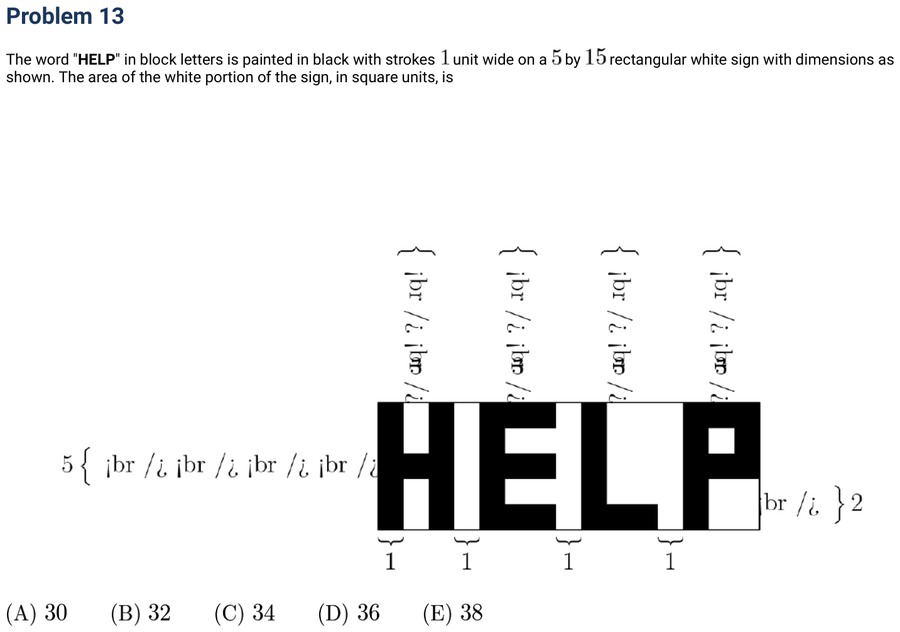
Counting the scattered white background squares directly would be a nightmare. Flip it: white = (whole sign) − (black letters). The black HELP is far easier to count.
Still stuck? Show hint 2 →
Hint 2 of 2
The strokes are exactly 1 unit wide, so each letter is just a count of unit squares. Tally H, E, L, P one letter at a time — and don't double-count squares where strokes meet.
Show solution
Approach: complementary counting — total minus the letters
The white area is hard to count directly (it's the leftover background), so subtract instead. The whole sign is 5 × 15 = 75 unit squares.
Now count the black letters (1-unit strokes), letter by letter, being careful at the junctions: the four block letters H, E, L, P cover 39 squares all together.
White = 75 − 39 = 36.
Why this transfers: when the shape you want is the messy 'everything else,' count the tidy part and subtract from the whole. This 'complementary counting' turns an ugly region into one clean subtraction — you'll reuse it constantly in area and counting problems.
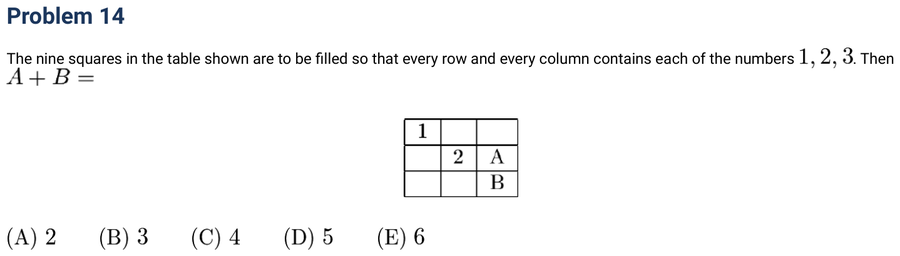
Like a mini-Sudoku: every row AND every column holds 1, 2, 3 once each. Don't guess — hunt for a cell whose value is forced because only one number is left for it.
Still stuck? Show hint 2 →
Hint 2 of 2
Chain the forcing. Once a cell is forced, it eliminates options elsewhere, which forces the next cell. Start where you already have two of the three numbers in a line.
Show solution
Approach: forced-cell deduction, one square at a time
Middle column already shows a 2. The top row has a 1, so the top-middle cell can't be 1; being in the column-with-2 it can't be 2 either — it's forced to 3. Then the top-right cell (top row, only 2 left) is 2.
Now the right column has a 2 up top, so A (middle-right) is 1 or 3; but A's row already has the 2, and we'll see its column needs a 1: the middle row reads (left, 2, A), and the only spot left for 1 in that row makes A = 1. The right column then needs its last number, 3, for B at the bottom: B = 3.
So A + B = 1 + 3 = 4.
Why this transfers: Latin-square / Sudoku logic is never trial-and-error if you look for the cell with the fewest choices. Each forced fill shrinks the puzzle — keep chasing the most-constrained square and the grid solves itself.
The arithmetic mean (average) of four numbers is 85. If the largest of these numbers is 97, then the mean of the remaining three numbers is
Show answer
Answer: A — 81.0.
Show hints
Hint 1 of 2
An average hides a total: if four numbers average 85, you instantly know their sum. Recover the sum first — that's the number you can actually take things away from.
Still stuck? Show hint 2 →
Hint 2 of 2
You can't average the leftover three until you know their total. Take the full total, subtract the 97, then divide by 3.
Show solution
Approach: average → total → adjust → average again
Mean 85 over 4 numbers means the sum is 4 × 85 = 340. (An average is the total shared equally, so total = average × count.)
Drop the largest, 97: the other three sum to 340 − 97 = 243. Their mean is 243 ÷ 3 = 81.0.
Why this transfers: almost every 'average changes when you add/remove a number' problem runs through the total. Convert average→sum, adjust the sum, then convert back. Sanity check: 97 was above the old average of 85, so pulling it out should drag the average down — and 81 < 85. ✓
A stacked fraction like this can only be untangled from the innermost piece outward — you can't simplify the top until the bottom is a single number. Start at the deepest 2 + 1/3.
Still stuck? Show hint 2 →
Hint 2 of 2
Each layer is the same two-step move: add to make one fraction, then 'take 1 over it' (flip). Repeat that move as you climb out.
Show solution
Approach: peel the continued fraction from the inside out
Deepest layer: 2 + 1/3 = 7/3. The next layer is 1 ÷ (7/3) = 3/7 — 'one over a fraction' just flips it.
Climb out: 1 + 3/7 = 10/7. Then the outermost 1 ÷ (10/7) flips again to 7/10.
Why this transfers: every continued (stacked) fraction unwinds bottom-up with the same rhythm — combine into one fraction, then flip when it's '1 over' it. Reciprocals (flipping) are the engine; reading it top-down would dead-end.
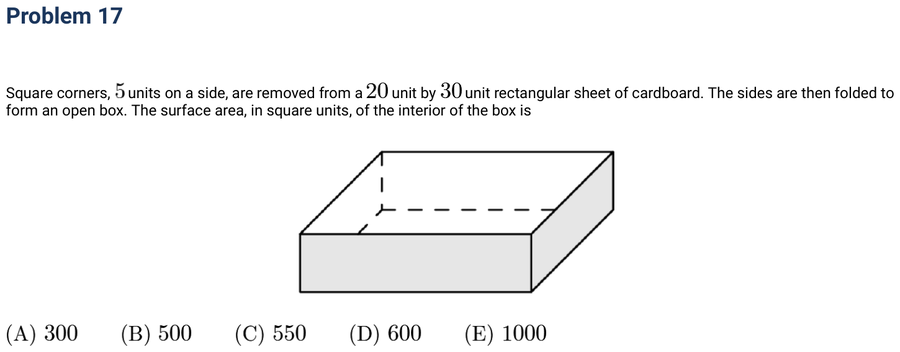
Each corner cut takes 5 off both ends of a side, so the base shrinks by 10 in each direction: 20−10 and 30−10. The 5-wide flaps that fold up become the box's height of 5.
Still stuck? Show hint 2 →
Hint 2 of 2
An open box has a bottom and 4 walls but NO lid. Add those five faces; don't include a top.
Show solution
Approach: unfold the box into bottom + four walls (no top)
Cutting a 5×5 square from each corner removes 5 from both ends of every side, so the base is (20−5−5) × (30−5−5) = 10 × 20 = 200. The flaps that fold upward are 5 tall, so the box height is 5.
Four walls: two are 10×5 and two are 20×5, totaling 2(50) + 2(100) = 300. The interior is the bottom plus those four walls (no lid): 200 + 300 = 500.
Trap to dodge: 'open box' means skip the top — count 5 faces, not 6. And remember the corner cuts subtract from both ends, so the base loses 2×5 in each direction, not just 5. Choice E (1000) is what you'd get from the full original 20×30 sheet's worth of double-counting.
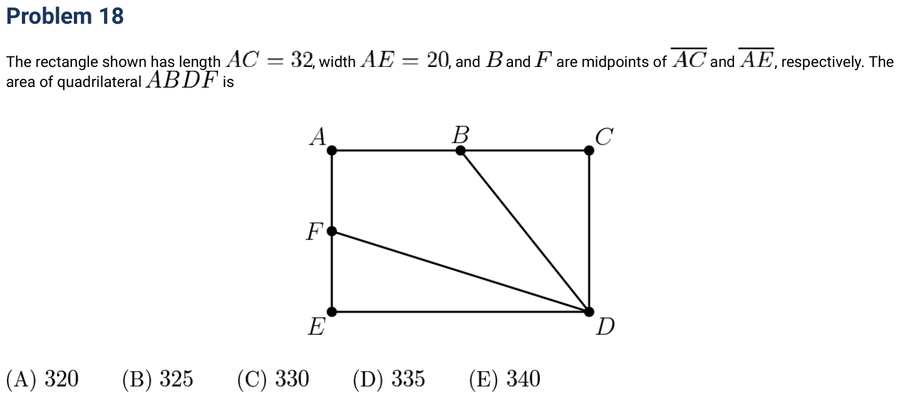
The quadrilateral ABDF is a slanted, awkward shape — but it's just the full rectangle with two corner triangles snipped off. Find the easy whole, then subtract the easy corners.
Still stuck? Show hint 2 →
Hint 2 of 2
Both snipped corners are right triangles (the rectangle's own corners C and E). Each has one leg that's a full side and one leg that's a midpoint half-side — so area = ½·base·height.
Show solution
Approach: rectangle minus two corner right triangles
Don't chase ABDF directly. Start from rectangle ACDE: area 32 × 20 = 640. ABDF is what's left after cutting the two triangles at corners C and D-side.
△BCD sits at corner C: legs BC = 16 (half of the 32 top, since B is a midpoint) and CD = 20, so its area is ½·16·20 = 160. △FED sits at corner E: legs FE = 10 (half of the 20 side, F a midpoint) and ED = 32, area ½·10·32 = 160.
ABDF = 640 − 160 − 160 = 320.
Why this transfers: a tilted polygon inside a rectangle is almost always easiest as (rectangle) − (corner triangles). The midpoints just make each triangle's legs exactly a full side and a half side — clean numbers, no slanted lengths needed.
Don't add up either giant sum. Pair them up instead: 1901 with 101, 1902 with 102, … Every top number is the same distance above its partner. What's that distance?
Still stuck? Show hint 2 →
Hint 2 of 2
Each pair differs by exactly 1901 − 101 = 1800. If you know how many pairs there are, the whole subtraction is one multiplication.
Show solution
Approach: subtract term-by-term, then multiply
Match each top term with the bottom term directly below it: 1901−101, 1902−102, …, 1993−193. Every single pair differs by 1800.
Count the pairs: from 1901 to 1993 is 1993 − 1901 + 1 = 93 terms (and likewise 101 to 193). So the answer is 93 × 1800 = 167,400.
Why this transfers: subtracting two long sums term-by-term beats computing each sum separately — the messy totals never appear. Just watch the count: 'how many numbers from a to b' is b − a + 1, the classic off-by-one to nail down.
When 1093 − 93 is expressed as a single whole number, the sum of the digits is
Show answer
Answer: D — 826.
Show hints
Hint 1 of 2
You can't write out 10⁹³ — but you don't have to. Shrink the problem: what does 10⁴ − 93 look like? Then 10⁵ − 93? A pattern will jump out, and big exponents just stretch it.
Still stuck? Show hint 2 →
Hint 2 of 2
Subtracting from 1000…0 forces a chain of borrows that turns the middle into all 9s. Find how many 9s appear (in terms of the exponent), then add the leftover digits.
Show solution
Approach: spot the borrowing pattern from a small case
Test small: 10⁴ − 93 = 10000 − 93 = 9907, and 10⁵ − 93 = 99907. The borrowing eats the zeros into a run of 9s, ending in 07. The pattern: 10ⁿ − 93 is (n − 2) nines followed by '07'.
For n = 93 that's 91 nines, then a 0 and a 7. Digit sum = 91 × 9 + 0 + 7 = 819 + 7 = 826.
Why this transfers: when an exponent is too big to compute, simulate the SAME operation on a tiny exponent, read the digit pattern, then scale it up. Numbers like 10ⁿ minus a small amount always collapse into a predictable string of 9s — borrowing is regular.
If the length of a rectangle is increased by 20% and its width is increased by 50%, then the area is increased by
Show answer
Answer: D — 80%.
Show hints
Hint 1 of 2
Percents on area don't ADD — they MULTIPLY. Length and width each scale by their own factor, and area is length × width, so the two factors multiply together. (Adding 20%+50% to get 70% is the trap.)
Still stuck? Show hint 2 →
Hint 2 of 2
Turn each increase into a multiplier: +20% means ×1.2, +50% means ×1.5. Multiply those, then see how far above 1 the result lands.
Show solution
Approach: multiply the two scale factors
+20% on length is ×1.2; +50% on width is ×1.5. Since area = length × width, the new area is 1.2 × 1.5 = 1.8 times the old.
1.8 times means 0.8 more than the original — an increase of 80%.
No-algebra check: take a 10×10 = 100 rectangle. New sides 12 and 15 give 180 — up 80 out of 100, i.e. 80%. Trap to dodge: percentage changes on a product never just add; choice C (70%) is the bait for 20+50.
Pat Peano has plenty of 0's, 1's, 3's, 4's, 5's, 6's, 7's, 8's and 9's, but he has only twenty-two 2's. How far can he number the pages of his scrapbook with these digits?
Show answer
Answer: D — 119.
Show hints
Hint 1 of 2
Every other digit is unlimited — only the 2's can run out. So ignore all other digits and just count how many 2's the page numbers eat as you climb.
Still stuck? Show hint 2 →
Hint 2 of 2
Count 2's in chunks. How many 2's appear writing pages 1–99? (Count the units-place 2's and the tens-place 2's separately.) Then continue past 99 page-by-page until the 22nd two is spent.
Show solution
Approach: count only the 2's, by place value
The 2's are the bottleneck, so tally them. In pages 1–99, a 2 lands in the units place ten times (2, 12, 22, …, 92) and in the tens place ten times (20–29): 20 twos used, leaving just 2 of them.
Past 99, the next pages needing a 2 are 102 and 112 — one 2 each. That spends the last two 2's by page 112. Pages 113–119 contain no 2, so they're free, but page 120 would demand a tens-place 2 (a 23rd) that Pat doesn't have.
So he can number all the way to 119.
Why this transfers: when one resource is scarce and the rest are free, track only the scarce one and walk forward until it's exhausted — the answer is the last page before the one that would overspend, not the page that breaks the budget.
Five runners, P, Q, R, S, T, have a race. P beats Q, P beats R, Q beats S, and T finishes after P and before Q. Who could NOT have finished third in the race?
Show answer
Answer: C — P and S.
Show hints
Hint 1 of 2
Don't try to build one full finishing order — there are many. Instead, link the clues into a chain (who-beats-whom) and ask of each runner: how many people MUST be ahead of them, and how many MUST be behind?
Still stuck? Show hint 2 →
Hint 2 of 2
To be exactly third, a runner needs room: at least 2 people forced ahead AND at least 2 forced behind. Anyone with too many forced ahead (or too many forced behind) is locked out of 3rd.
Show solution
Approach: count forced-ahead and forced-behind for each runner
Chain the clues. 'T after P and before Q' plus 'Q beats S' gives P < T < Q < S, and separately P < R. Read positions as left-to-right finishing order.
P sits ahead of T, Q, R, and S — all four others — so P is forced into 1st. With 0 people who can be ahead of it, P can never be 3rd.
S sits behind Q, which is behind both P and T, so at least P, T, Q finish ahead of S: that's 3 runners, pinning S at 4th or 5th. S can never be 3rd either.
Everyone else (Q, R, T) has enough wiggle room to land 3rd in some valid order, so the runners who could NOT be third are P and S.
Why this transfers: for ranking-with-clues, you rarely need the full order. Turn the clues into one chain, then count must-be-ahead / must-be-behind. A position is impossible for anyone whose forced-ahead count is too big (can't move up) or too small (forced even higher).
The figure below shows a triangular ‘staircase’ array of numbers. The first row has 1 number, the second row has 3, the third row has 5, and so on (the kth row has 2k−1 numbers, in order).
1
2 3 4
5 6 7 8 9
10 11 12 13 14 15 16
…
What number is directly above 142 in this array of numbers?
Show answer
Answer: C — 120.
Show hints
Hint 1 of 2
The right edge of each row is the giveaway: rows end at 1, 4, 9, 16, … — the perfect squares k². So spotting which square 142 sits just under tells you its row instantly.
Still stuck? Show hint 2 →
Hint 2 of 2
Each row is centered and 2 numbers wider than the one above (one extra on each side). So the entry above isn't in the same position — it's shifted one slot toward the left.
Show solution
Approach: locate by row, then account for the centering shift
Rows end at the squares 1, 4, 9, …, k². Since 11² = 121 and 12² = 144, the number 142 lives in row 12 (which runs 122 to 144). Its position in that row is 142 − 122 + 1 = 21st, out of 12's 23 entries.
Row 11 runs 101 to 121 — 21 entries — sitting centered above row 12. Because row 12 has one extra number on the left, row 12's 21st entry lines up under row 11's 20th entry.
Row 11's 20th entry is 101 + (20 − 1) = 120.
Why this transfers: two facts crack any centered number-triangle — the row-ending rule (here, squares) pins the row, and 'each row is 1 wider on each side' gives the alignment shift. Forgetting the shift is the classic slip; 142 is 21st, but directly above is the 20th, not the 21st.
A checkerboard consists of one-inch squares. A square card, 1.5 inches on a side, is placed on the board so that it covers part or all of the area of each of n squares. The maximum possible value of n is
Show answer
Answer: E — 12 or more.
Show hints
Hint 1 of 2
The word 'maximum' is the signal: don't settle for the obvious lined-up placement. The squares you touch are exactly the squares the card's edges cross into — so you want the card to straddle as many grid lines as possible.
Still stuck? Show hint 2 →
Hint 2 of 2
Tilt the card off the grid. Rotating it makes its corners poke past grid lines they'd otherwise stay short of, and its long diagonal (about 2.1 in) now spans more rows and columns than the 1.5-in sides did.
Show solution
Approach: tilt to cross the most grid lines
Count what the card overlaps. Lined up square-with-the-grid, a 1.5-inch card fits inside a 2×2-to-3×3 footprint — at most 9 squares (a 3×3 block when it straddles lines both ways).
Now tilt it. A rotated card sticks its sharp corners across extra grid lines, and its diagonal (≈2.12 in) reaches farther than 1.5 in did — so the card can overlap pieces of more than 9 squares. A good tilt covers parts of 12 or more squares.
Why this transfers: 'cover the most squares' really means 'cross the most grid lines,' because each crossing slices the card into another square. Aligning with the grid wastes that — tilting maximizes crossings. Whenever a 'maximum overlap' problem lets you rotate, suspect the answer comes from tilting off the axes.