Before reaching for the long addition, notice the alternating + and − signs. What happens if you group each plus-then-minus into a pair?
Still stuck? Show hint 2 →
Hint 2 of 3
Pairing adjacent terms turns a scary 10-term sum into a count of identical chunks — a trick for any alternating +/− list.
Still stuck? Show hint 3 →
Hint 3 of 3
Each pair like (10 − 9), (8 − 7), … equals exactly 1, so the top is just "how many pairs?"
Show solution
Approach: pair off the alternating signs so each pair collapses to 1
The signs alternate +, −, +, −… so group them: top = (10 − 9) + (8 − 7) + (6 − 5) + (4 − 3) + (2 − 1). Each pair is 1, and there are 5 pairs, so the top is 5.
The bottom starts with a minus: (1 − 2) + (3 − 4) + (5 − 6) + (7 − 8) + 9 = (−1)(4) + 9 = 5.
Both equal 5, so the fraction is 5 ÷ 5 = 1.
Why this transfers: any time terms alternate + and −, pairing neighbours turns the whole sum into "number of pairs × pair-value" — far safer than adding ten signed numbers one at a time.
Sanity check: top and bottom use the same digits 1–9 (the top also has a 10), so it's no surprise they land close; equal-and-equal makes the answer exactly 1, not a messy decimal.
5/4 is one whole plus a quarter. Which choices are secretly just a quarter dressed up — and which one hides a different-sized piece?
Still stuck? Show hint 2 →
Hint 2 of 3
When choices look different but might be equal, convert them all to ONE common form (a decimal, or a fraction over the same bottom number) so they line up for comparison.
Still stuck? Show hint 3 →
Hint 3 of 3
A bigger denominator means a smaller slice: 1/5 is less than 1/4, so don't be fooled into reading 1 1/5 as 1.25.
Show solution
Approach: rewrite every choice in one common form so the odd one out stands out
5/4 = 1 + 1/4 = 1.25. Now test each: 10/8 = 1.25 (just doubled top and bottom); 1 1/4 = 1.25; 1 3/12 = 1 + 1/4 = 1.25 (3/12 reduces to 1/4); 1 10/40 = 1 + 1/4 = 1.25 (10/40 reduces to 1/4).
That leaves 1 1/5. Since 1/5 = 0.2, this is 1.2, NOT 1.25 — so 1 1/5 is the one not equal.
Trap to remember: a fifth feels "close" to a quarter, but cutting something into 5 pieces gives smaller pieces than cutting into 4. The trickster choice swaps the denominator from 4 to 5 hoping you won't notice the slice shrank.
What is the largest difference that can be formed by subtracting two numbers chosen from the set {−16, −4, 0, 2, 4, 12}?
Show answer
Answer: D — 28.
Show hints
Hint 1 of 3
To make a subtraction a − b as big as possible, where should a sit on the number line, and where should b sit?
Still stuck? Show hint 2 →
Hint 2 of 3
Big difference = pick the largest possible front number and the smallest possible back number. The two extremes of the set do all the work.
Still stuck? Show hint 3 →
Hint 3 of 3
Subtracting a negative is the same as adding its positive — so the −16 actually helps you grow the answer, not shrink it.
Show solution
Approach: largest minus smallest — both extremes pull the gap wide
A difference a − b is largest when a is as big as possible and b as small as possible. The biggest number is 12, the smallest is −16.
So the largest difference is 12 − (−16). Subtracting a negative flips it to addition: 12 + 16 = 28.
Why the negative helps: on the number line, 12 and −16 are the two outermost points, and the "distance" between them is the gap you're maximizing. The minus sign turning into a plus is exactly why reaching for the negative number gives a bigger answer, not a smaller one.
During the softball season, Judy had 35 hits. Among her hits were 1 home run, 1 triple, and 5 doubles. The rest of her hits were singles. What percent of her hits were singles?
Show answer
Answer: E — 80%.
Show hints
Hint 1 of 3
The listed hits (home run, triple, doubles) are the FEW; singles are everything else. Is it easier to count the few and subtract, or count the many directly?
Still stuck? Show hint 2 →
Hint 2 of 3
When most of a group is one thing, count the small leftover pile and subtract from the total — the complement is the shortcut.
Still stuck? Show hint 3 →
Hint 3 of 3
Once you have the number of singles, "what percent" just means singles ÷ total.
Show solution
Approach: count the small pile (non-singles), subtract, then take the percent
Only a few hits are named, so count those: 1 home run + 1 triple + 5 doubles = 7 non-singles. Everything else is a single: 35 − 7 = 28 singles.
Percent of singles = 28 ÷ 35. Since 28/35 = 4/5, that's 80%.
Why this transfers: when one category dominates, it's faster to count its complement (the leftovers) and subtract than to tally the big group directly — the same move shows up in probability ("at least one" problems) all the time.
Sanity check: 7 non-singles is one-fifth of 35, so singles must be the other four-fifths — 80% — matching our answer.
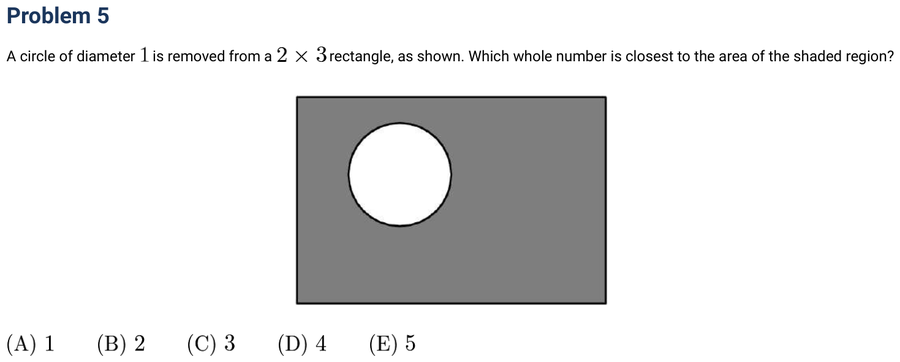
The shaded part is "what's left" after the hole is punched out. So which two areas do you compare, and which way around?
Still stuck? Show hint 2 →
Hint 2 of 3
Whenever a shape is carved out of a bigger shape, the leftover region = big area − carved-out area. This subtraction idea works for any hole.
Still stuck? Show hint 3 →
Hint 3 of 3
Watch the circle's measurement: diameter is 1, so the radius (which goes in the area formula) is only 1/2 — a tiny circle.
Show solution
Approach: shaded = rectangle − the circular hole
The shaded region is the rectangle with a circle removed, so shaded = rectangle area − circle area. Rectangle = 2 × 3 = 6.
The hole has diameter 1, so radius 1/2. Its area is π(1/2)2 = π/4 ≈ 0.8 — less than one square unit.
Shaded ≈ 6 − 0.8 = 5.2, and the closest whole number is 5.
Sanity check: the circle is small (it would fit inside a 1×1 square), so it can shave off only about ¾ of a unit — the leftover should be just under 6, and 5 is the only nearby choice.
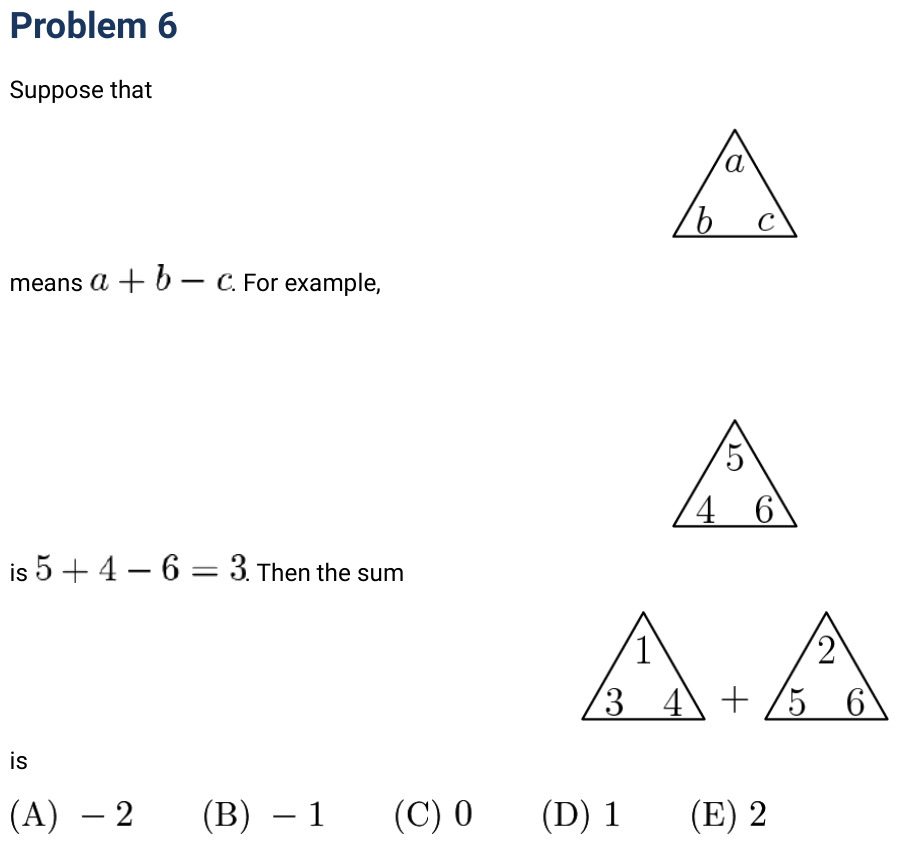
A new symbol is just a recipe. The worked example tells you the recipe is "top + bottom-left − bottom-right." Read the example to decode the rule before touching the question.
Still stuck? Show hint 2 →
Hint 2 of 3
"Made-up operation" problems are about following the given pattern exactly — match each number to its slot, don't invent your own order.
Still stuck? Show hint 3 →
Hint 3 of 3
Compute each triangle to a single number first, THEN combine; don't mix the two triangles' numbers together.
Show solution
Approach: decode the rule from the example, then apply it slot-by-slot
The example 5 + 4 − 6 = 3 tells us the rule: top + bottom-left − bottom-right.
First triangle (top 1, left 3, right 4): 1 + 3 − 4 = 0. Second triangle (top 2, left 5, right 6): 2 + 5 − 6 = 1.
Now add the two results: 0 + 1 = 1.
Why this transfers: any "define a strange symbol" problem is really a substitution exercise — the only skill is plugging each value into the right position of the given formula. No cleverness needed, just careful matching.
The digit-sum of 998 is 9 + 9 + 8 = 26. How many 3-digit whole numbers, whose digit-sum is 26, are even?
Show answer
Answer: A — 1.
Show hints
Hint 1 of 3
The biggest a 3-digit digit-sum can be is 9 + 9 + 9 = 27. A sum of 26 is only 1 short of that ceiling — so how far from all-9s can the digits stray?
Still stuck? Show hint 2 →
Hint 2 of 3
When a digit-sum is pinned near its maximum, the digits are forced to be almost as large as possible — that drastically limits the possibilities, so you can just list them.
Still stuck? Show hint 3 →
Hint 3 of 3
For a number to be even, only the LAST digit matters — it has to be even.
Show solution
Approach: the near-maximum sum forces the digits; then check the last one
The largest possible digit-sum is 9 + 9 + 9 = 27. To get 26 we must drop exactly 1 from that, so one digit becomes 8 and the rest stay 9: the digits are 9, 9, 8.
Arranged as a 3-digit number, that gives only 998, 989, 899.
Even numbers must end in an even digit. Of the three, only 998 ends in 8 (even), so the count is 1.
Why this transfers: when a sum sits right against its maximum, treat it as "how much must I subtract from the all-max case?" A tiny deficit means only a handful of arrangements — cheap enough to list and check by hand.
A store owner bought 1500 pencils at $0.10 each. If he sells them for $0.25 each, how many of them must he sell to make a profit of exactly $100.00?
Show answer
Answer: C — 1000.
Show hints
Hint 1 of 3
Profit isn't the same as money taken in. Before he earns a single cent of profit, the sales first have to cover what he already spent. How much must come back in before profit even starts?
Still stuck? Show hint 2 →
Hint 2 of 3
Profit = revenue − cost. Rearranged, the revenue he needs is cost + desired profit — pin that target number first.
Still stuck? Show hint 3 →
Hint 3 of 3
Once you know the dollars he must collect, dividing by the price-per-pencil tells you how many pencils that is.
Show solution
Approach: find the revenue target (cost + profit), then divide by price
He first has to earn back his cost: 1500 × $0.10 = $150. To then clear $100 of profit on top, his sales must total $150 + $100 = $250.
Each pencil sells for $0.25, so the number sold is $250 ÷ $0.25 = 1000 pencils.
Why this transfers: in any cost-and-profit problem, money-in must cover money-out before profit begins — so the revenue you aim for is always cost + target profit, never just the profit alone.
Trap to dodge: answer 400 comes from forgetting the cost ($100 ÷ $0.25); 600 comes from forgetting it the other way. The cost has to be repaid first.
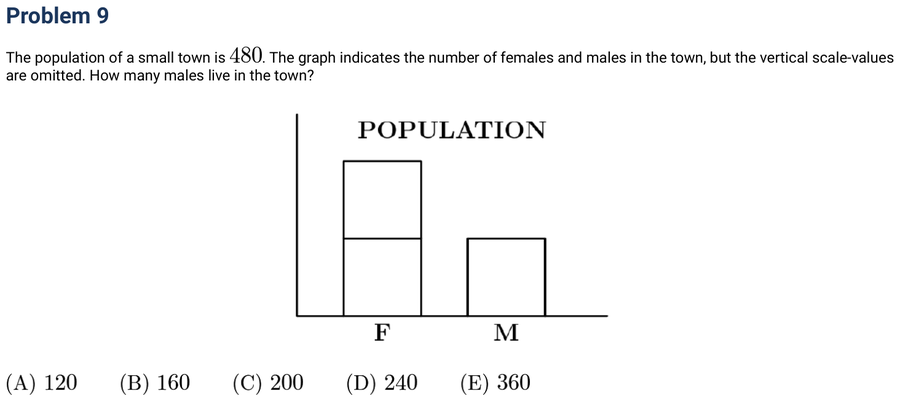
The numbers up the side are missing — but the picture still tells you something. How do the two bar HEIGHTS compare? (Look at the line drawn partway up the F bar.)
Still stuck? Show hint 2 →
Hint 2 of 3
Even with no scale, a bar graph still shows ratios: if one bar is twice as tall as another, those groups are in a 2 : 1 ratio. Turn the ratio into "equal parts" of the whole.
Still stuck? Show hint 3 →
Hint 3 of 3
Total people = female parts + male parts. Find the size of one part, then take the males' share.
Show solution
Approach: missing scale is fine — read the height ratio, then divide the total into parts
The line across the F bar marks exactly the M bar's height, showing the female bar is twice the male bar. So females : males = 2 : 1.
That's 2 parts + 1 part = 3 equal parts making up the whole town of 480. One part = 480 ÷ 3 = 160.
Males are 1 part, so there are 160 males.
Why this transfers: a bar graph without numbers is useless for amounts but perfect for ratios — comparing heights still works. Convert any ratio a : b into (a+b) equal parts of the total and you can split the whole.
Sanity check: 160 males + 320 females = 480, and 320 is indeed double 160. Fits the picture.
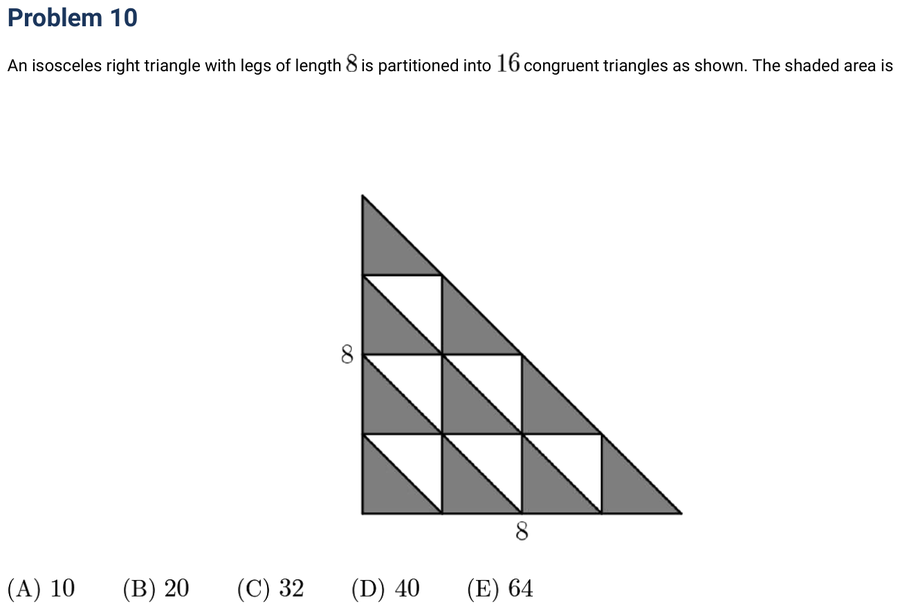
The pieces are all congruent — identical. So instead of measuring the odd-shaped shaded region directly, what one easy number unlocks the whole figure?
Still stuck? Show hint 2 →
Hint 2 of 3
When a shape is cut into equal pieces, find ONE piece's area (total ÷ number of pieces), then shaded area is just "piece area × pieces shaded." Counting beats measuring.
Still stuck? Show hint 3 →
Hint 3 of 3
Get the big triangle's area from its legs first; the small pieces each get an equal share of it.
Show solution
Approach: one equal piece's area × the number shaded
The whole triangle is a right triangle with legs 8, so its area is ½ · 8 · 8 = 32. It's split into 16 congruent pieces, so each piece has area 32 ÷ 16 = 2.
Counting the shaded little triangles in the picture gives 10 of them.
Shaded area = 10 × 2 = 20.
Why this transfers: "equal pieces" is your friend — once every piece is the same size, area becomes pure counting. You never have to compute the strange shaded outline itself, only how many unit-pieces it contains.
Sanity check: 10 of 16 pieces are shaded, a bit over half, and 20 is a bit over half of 32. Consistent.
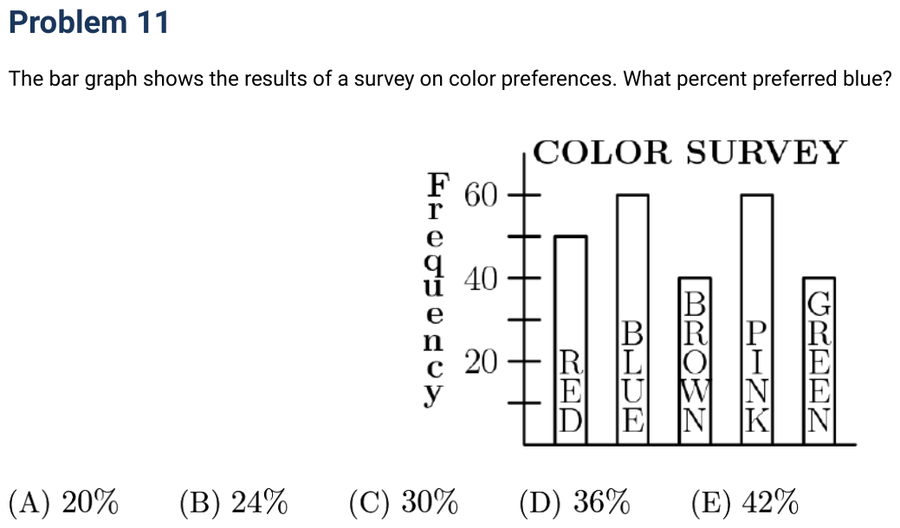
"What percent preferred blue" is blue out of EVERYONE — not blue out of the tallest bar. What's the denominator you actually need?
Still stuck? Show hint 2 →
Hint 2 of 3
A percent always needs its whole: percent = part ÷ total. Here the total is every bar added together, so read them all before dividing.
Still stuck? Show hint 3 →
Hint 3 of 3
Line up the bar tops with the frequency scale carefully — each gridline is worth 20.
Show solution
Approach: blue's count divided by the grand total of all bars
Read each bar against the scale: Red 50, Blue 60, Brown 40, Pink 60, Green 40. The total surveyed is 50 + 60 + 40 + 60 + 40 = 250.
Blue's share is 60 out of 250: 60 ÷ 250 = 0.24 = 24%.
Why this transfers: the most common percent-from-a-graph mistake is forgetting to total ALL the bars — the part means nothing without its whole. Always build the denominator first.
Sanity check: blue is one of five bars, so a fair share would be 20%. Blue is a little above average height, so a little above 20% — 24% fits.
The five tires of a car (four road tires and a full-sized spare) were rotated so that each tire was used the same number of miles during the first 30,000 miles the car traveled. For how many miles was each tire used?
Show answer
Answer: C — 24,000 miles.
Show hints
Hint 1 of 3
The car drives 30,000 miles, but how many tires are touching the road during ALL of that distance? That's the total amount of "tire wear" to share.
Still stuck? Show hint 2 →
Hint 2 of 3
Count total tire-miles (tires on the road × distance), then split that workload equally — this "total work ÷ sharers" idea is the heart of the problem.
Still stuck? Show hint 3 →
Hint 3 of 3
Five tires share the work, but only four are ever rolling at once — so the total work is 4 cars' worth of miles, not 5.
Show solution
Approach: total tire-miles of road work, shared equally among 5 tires
At every moment 4 tires are on the road, and the car covers 30,000 miles. So the total road work is 4 × 30,000 = 120,000 tire-miles of wear.
By the rotation, all 5 tires share that work equally: 120,000 ÷ 5 = 24,000 miles each.
Why this transfers: "everyone shares equally" problems all run the same way — add up the total work being done, then divide by the number of sharers. Here the work is 4-at-a-time even though there are 5 tires.
Sanity check: 24,000 is less than the 30,000 miles driven, which must be true — each tire rests for part of the trip while the spare takes a turn.
Five test scores have a mean of 90, a median of 91, and a mode of 94. The sum of the two lowest test scores is
Show answer
Answer: B — 171.
Show hints
Hint 1 of 3
You don't need each individual low score — only their SUM. What's the fastest route from "mean of all five" to "sum of the bottom two"?
Still stuck? Show hint 2 →
Hint 2 of 3
Mean unlocks the grand total (mean × count); the two lowest are then just total − (the three you can pin down). Find the known three.
Still stuck? Show hint 3 →
Hint 3 of 3
Line the 5 scores up in order. The median is the middle (3rd) one; the mode 94 must appear at least twice, and the only room for two 94's is the 4th and 5th slots (the 3rd is already 91).
Show solution
Approach: turn mean into the total, pin the top three, subtract
Mean 90 over 5 scores means they total 5 × 90 = 450. Write the scores in increasing order; the median is the 3rd = 91.
The mode is 94, so 94 must appear at least twice. The 3rd slot is already 91, so the two 94's have to be the 4th and 5th (the largest). The top three are therefore 91, 94, 94 = 279.
The two lowest are everything else: 450 − 279 = 171.
Why this transfers: when a question asks for a SUM of unknowns, don't solve for each one — get the grand total from the mean and subtract the part you can determine. The individual low scores stay unknown, yet their sum is forced.
Why not ‘not determined’: the median and mode lock all three top scores exactly, so the bottom two have no wiggle room in their total.
When four gallons are added to a tank that is one-third full, the tank is then one-half full. The capacity of the tank in gallons is
Show answer
Answer: D — 24.
Show hints
Hint 1 of 3
The 4 gallons didn't fill the tank — they just nudged the level from 1/3 up to 1/2. What single fraction of the tank does that little rise represent?
Still stuck? Show hint 2 →
Hint 2 of 3
Once you know what fraction a known amount fills, scale up: if a fraction is some gallons, the whole is that many gallons × (how many of that fraction fit in a whole).
Still stuck? Show hint 3 →
Hint 3 of 3
Subtract the two level-fractions using a common denominator to find the rise.
Show solution
Approach: find the fraction the 4 gallons fills, then scale up to the whole
The level rose from 1/3 to 1/2. The rise is 1/2 − 1/3 = 3/6 − 2/6 = 1/6 of the tank. So 1/6 of the tank = 4 gallons.
A whole tank is 6 such sixths, so capacity = 6 × 4 = 24 gallons.
Why this transfers: "x units fill a fraction — find the whole" is always the same move: figure out what fraction the known amount represents, then multiply by however many of those fractions make one whole.
Sanity check: 1/3 of 24 = 8 gallons; add 4 to get 12, which is exactly 1/2 of 24. The story holds together.
What is the 1992nd letter in the sequence ABCDEDCBAABCDEDCBAABCDEDCBA… ?
Show answer
Answer: C — C.
Show hints
Hint 1 of 3
The pattern just repeats the same chunk over and over. Find where one chunk ends and the next begins — how many letters is one full chunk?
Still stuck? Show hint 2 →
Hint 2 of 3
For a repeating pattern, only the LEFTOVER after removing whole chunks matters: chop off complete blocks, and the position you land on inside the last block is your answer.
Still stuck? Show hint 3 →
Hint 3 of 3
Divide 1992 by the block length and look at the leftover, not the quotient — the leftover tells you how far into a fresh block you are.
Show solution
Approach: strip away whole blocks; the leftover position names the letter
The repeating chunk is ABCDEDCBA, which is 9 letters long. After that it starts over.
Take away as many whole 9-letter blocks as fit in 1992: 9 × 221 = 1989, leaving 1992 − 1989 = 3 letters into the next block.
The 3rd letter of ABCDEDCBA is C.
Why this transfers: every "which item is in spot n" pattern problem works this way — the answer depends only on the leftover after removing complete cycles, never on how many cycles there were. A leftover of 0 would mean the very last letter of a block.
Sanity check: spots 1, 2, 3 are A, B, C; since 1992 is 3 past a clean block boundary, it must match spot 3 = C.
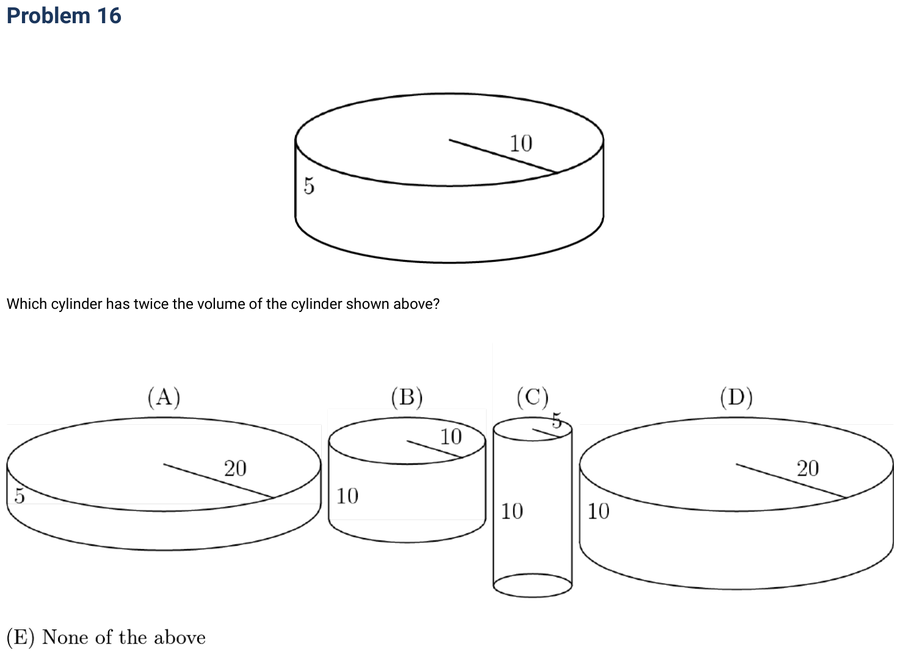
"Twice the volume" doesn't have to mean changing the radius. The volume formula has TWO knobs (radius and height) — which one could you turn to exactly double the volume most simply?
Still stuck? Show hint 2 →
Hint 2 of 3
Volume = π · radius2 · height. Height affects volume in a plain way (double height → double volume), but radius is SQUARED, so changing it has an outsized effect.
Still stuck? Show hint 3 →
Hint 3 of 3
Compute the target (twice the original), then test each choice — but watch the radius-squared: a doubled radius quadruples that part, not doubles it.
Show solution
Approach: since height scales volume directly, just double the height
Original: radius 10, height 5, so volume = π · 102 · 5 = 500π. We want twice that, 1000π.
Height multiplies volume one-for-one, so keeping radius 10 and doubling the height to 10 gives π · 102 · 10 = 1000π — exactly double. That's cylinder B.
Why the others fail: doubling the RADIUS to 20 (choices A, D) multiplies volume by 22 = 4, far past double; choice C (radius 5, height 10) actually shrinks it. The radius-squared is the trap.
Why this transfers: in any V = (something) · height formula, height is the ‘easy’ dimension — to double volume, just double the height. Squared dimensions like radius change the result much faster, so reach for the linear knob when you want a clean factor.
The sides of a triangle have lengths 6.5, 10, and s, where s is a whole number. What is the smallest possible value of s?
Show answer
Answer: B — 4.
Show hints
Hint 1 of 3
Picture the two fixed sides (6.5 and 10) hinged together. If the third side is too short, the two free ends can't reach each other to close the triangle. What's the shortest the third side can be and still connect them?
Still stuck? Show hint 2 →
Hint 2 of 3
The triangle inequality: any side must be longer than the difference of the other two (and shorter than their sum). The "smallest" question is governed by the difference.
Still stuck? Show hint 3 →
Hint 3 of 3
10 − 6.5 = 3.5 is the floor — s must be strictly more than 3.5, and it's a whole number.
Show solution
Approach: the short side must beat the gap between the other two
Imagine the sides 6.5 and 10 pinned at one end. To swing their far ends together and close a triangle, the third side must bridge at least the difference 10 − 6.5 = 3.5. If s were 3.5 or less, the triangle flattens and won't form.
So s must be greater than 3.5. The smallest whole number bigger than 3.5 is 4.
Why this transfers: for three lengths to make a real (non-flat) triangle, each side must be less than the sum AND more than the difference of the other two. When a problem asks for the smallest side, it's the difference rule that bites; for the largest, it's the sum rule.
Trap: 3 fails (3 + 6.5 = 9.5 < 10, can't reach), confirming 4 is the first that works.
On a trip, a car traveled 80 miles in an hour and a half, then was stopped in traffic for 30 minutes, then traveled 100 miles during the next 2 hours. What was the car's average speed in miles per hour for the 4-hour trip?
Show answer
Answer: A — 45.
Show hints
Hint 1 of 3
Average speed is NOT the average of the speeds. It's about the whole journey: how far in total, over how long in total — and does the clock keep ticking while the car sits in traffic?
Still stuck? Show hint 2 →
Hint 2 of 3
Average speed = total distance ÷ total time. The total time must include every minute the trip took, even the stopped half-hour.
Still stuck? Show hint 3 →
Hint 3 of 3
Add the two driving distances; add all three time chunks (including the stop) for the bottom.
Show solution
Approach: total distance ÷ total elapsed time (stop included)
Total distance driven: 80 + 100 = 180 miles. Total time elapsed: 1.5 hr driving + 0.5 hr stopped + 2 hr driving = 4 hours — the stop still counts.
Average speed = 180 ÷ 4 = 45 mph.
Why this transfers: average speed always means ‘if you'd gone one steady speed the whole time, what would it be?’ — so it's total distance over total time, never the plain average of the leg-speeds.
Trap: the leg speeds are about 53 mph and 50 mph; averaging those to ~52 ignores the half-hour of zero. Including the stop drags the true average down to 45.
The distance between the 5th and 26th exits on an interstate highway is 118 miles. If any two exits are at least 5 miles apart, then what is the largest number of miles there can be between two consecutive exits that are between the 5th and 26th exits?
Show answer
Answer: C — 18 miles.
Show hints
Hint 1 of 3
You have a fixed 118 miles to split among the gaps. To make ONE gap as long as possible, what should you do with all the OTHER gaps?
Still stuck? Show hint 2 →
Hint 2 of 3
Maximize-one-thing problems: push everything else to its limit in the opposite direction. Squeeze every other gap down to its smallest allowed size, freeing the leftover for your one big gap.
Still stuck? Show hint 3 →
Hint 3 of 3
Count the gaps carefully — from exit 5 to exit 26 there are 26 − 5 = 21 gaps, not 21 exits. The minimum each gap can be is 5 miles.
Show solution
Approach: shrink every other gap to the 5-mile minimum, leaving the rest for one
From the 5th to the 26th exit there are 26 − 5 = 21 gaps sharing the 118 miles. To stretch one gap as far as possible, make the other 20 as short as the rules allow: 5 miles each, using 20 × 5 = 100 miles.
Whatever's left goes into the one big gap: 118 − 100 = 18 miles.
Why this transfers: to maximize one quantity under a fixed total, minimize all the others to their limits — that frees up the most for the one you care about. (To minimize one instead, you'd maximize the others.)
Sanity check: 18 + 100 = 118 exactly, and 18 comfortably beats the 5-mile minimum, so this arrangement is legal.
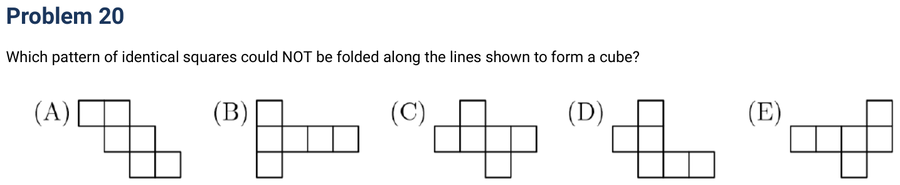
A cube has exactly 6 faces, and a folding pattern has 6 squares — so a good net must send each square to a DIFFERENT face, with none left bare. Picture folding the flaps up one at a time.
Still stuck? Show hint 2 →
Hint 2 of 3
Quick test for a cube net: pick any one square as the ‘bottom,’ fold the rest up, and check that nothing doubles up. The bad net makes two squares collide on the same face.
Still stuck? Show hint 3 →
Hint 3 of 3
A handy shortcut: a row of more than 4 squares in a straight strip can't work — a cube band is only 4 squares around, so a 5th in line wraps back and overlaps.
Show solution
Approach: fold each net in your head and look for two squares landing on the same face
Six squares must become six different faces. Imagine choosing one square as the base and folding the others upright.
Four of the patterns fold cleanly — every square reaches its own face and the cube closes up.
Pattern D doesn't: as you fold, two of its squares swing onto the SAME face, which leaves a different face uncovered. With a gap and a doubled-up face, it can't seal into a cube.
Why this transfers: the test for any cube net is ‘does every square map to a distinct face?’ Watch for a straight strip longer than 4 (it wraps around and overlaps) or two squares that fold into the same spot — either one disqualifies the net.
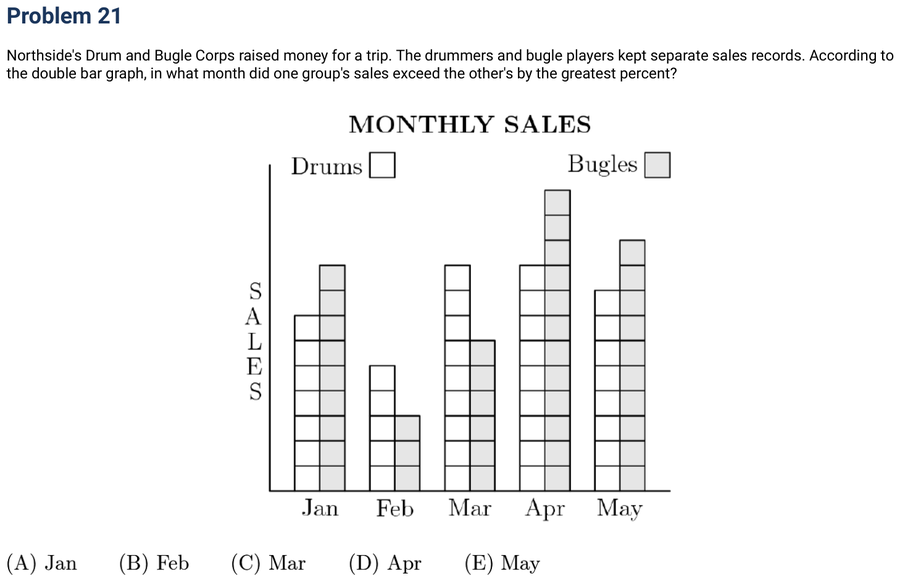
It says greatest PERCENT, not greatest amount. The same 2-unit lead is a huge deal over a tiny bar but barely noticeable over a tall one. So where should you look?
Still stuck? Show hint 2 →
Hint 2 of 3
Percent difference compares the gap to the SMALLER bar, not to the chart. The same gap looks biggest where the bars are shortest — hunt for the lowest pair.
Still stuck? Show hint 3 →
Hint 3 of 3
Find the month where one bar is a large fraction of the other, e.g. one bar is double the other.
Show solution
Approach: the same gap is a bigger PERCENT over short bars — check the smallest month
Percent difference measures how big the gap is relative to the smaller bar. So scan for the month with the shortest bars, where even a small lead is a large share.
February is by far the lowest: drums show 4 and bugles show 2. Drums exceed bugles by 2, and 2 is 100% of the bugles' 2 — the drums are double.
No other month comes close: e.g. April (drums 5, bugles 7) is only a 40% gap, March is a tie. So the greatest percent difference is in February.
Why this transfers: ‘greatest percent’ almost never means ‘tallest bars’ — it means ‘biggest ratio,’ which favors small numbers. A lead of 2 is trivial next to 50 but enormous next to 2. Always compare the gap to the smaller value.
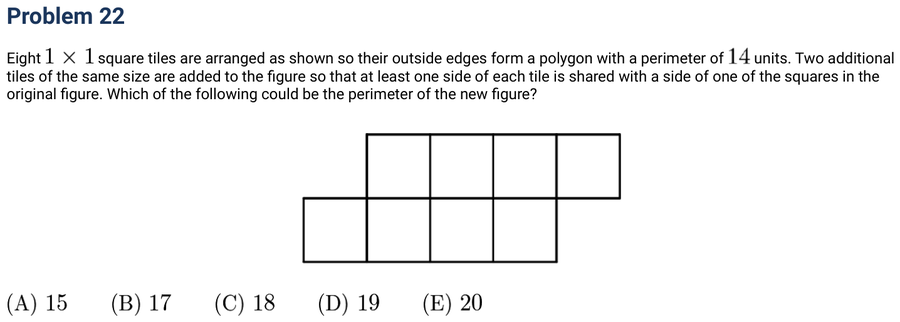
Don't recount the whole perimeter for every placement — ask instead: when I snap on ONE tile, how does the boundary CHANGE? What's the most it can grow by?
Still stuck? Show hint 2 →
Hint 2 of 3
A tile has 4 edges. Sharing one edge with the figure hides that edge AND covers an edge of the figure, so each tile that touches at exactly one edge nets +2 to the perimeter; touching more edges adds even less. Track the change, not the total.
Still stuck? Show hint 3 →
Hint 3 of 3
To make the perimeter as large as possible, let each new tile touch the figure along just a single edge, and keep the two new tiles from touching each other.
Show solution
Approach: track each tile's change to the perimeter; maximize by touching minimally
Start from perimeter 14. Snap on one tile: it brings 4 edges, but the edge it shares is now internal (hidden) and it covers one edge of the old figure too. Net change = +3 − 1 = +2 — and that's the MOST a single tile can add (sharing more edges adds even less). The change is always even.
Two tiles, each touching at just one edge and not touching each other, add +2 each: 14 + 2 + 2 = 18. That's the largest reachable perimeter, and it's actually achievable.
Why this transfers: for tiling/perimeter problems, reason about the CHANGE one piece makes, not the full recount. Sharing an edge always removes 2 from the boundary (one from each tile), so more sharing means a smaller perimeter — minimal contact maximizes perimeter.
Why the bigger choices are impossible: 19 is odd (each tile changes perimeter by an even amount, so 14 stays even), and 20 would need each tile to add +3, more than a tile can ever contribute.
If two dice are tossed, the probability that the product of the numbers showing on the tops of the dice is greater than 10 is
Show answer
Answer: B — 17/36.
Show hints
Hint 1 of 3
Two dice give 6 × 6 = 36 equally likely outcomes (treat the dice as different colors so order counts). The whole job is counting how many of those 36 have a product over 10.
Still stuck? Show hint 2 →
Hint 2 of 3
Organize the count so you don't miss any: fix the FIRST die's value, then ask which second-die values push the product past 10. March through 1, 2, 3, 4, 5, 6 one row at a time.
Still stuck? Show hint 3 →
Hint 3 of 3
Low first values barely qualify (a 1 never works, a 2 needs a 6), so the winners pile up at the high end — count carefully there.
Show solution
Approach: fix the first die, count qualifying partners, then divide by 36
There are 36 equally likely ordered outcomes. Go die-by-die and count partners giving product > 10: first die 1 → none; 2 → only 6 (gives 12), 1 way; 3 → 4, 5, 6, that's 3; 4 → 3, 4, 5, 6, that's 4; 5 → 3, 4, 5, 6, that's 4; 6 → 2, 3, 4, 5, 6, that's 5.
Total winners: 1 + 3 + 4 + 4 + 5 = 17. So the probability is 17/36.
Why count this way: sweeping through one die's values in order is a checklist that guarantees no outcome is double-counted or skipped — the safest method for ‘how many of the 36’ dice questions.
Watch the boundary: ‘greater than 10’ excludes a product of exactly 10 (like 2×5 or 5×2), so those don't count — a classic trap.
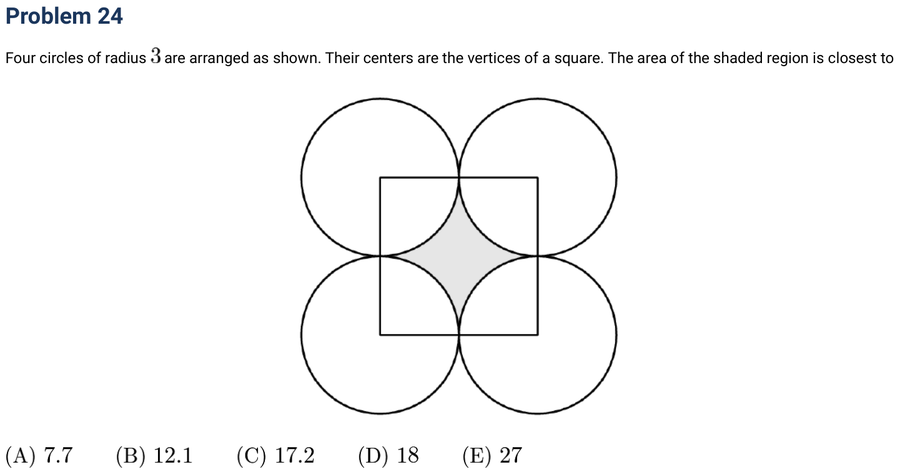
The little shaded star sits inside the square but outside all four circles. So which big shape, minus which circular bites, leaves exactly that sliver?
Still stuck? Show hint 2 →
Hint 2 of 3
Each circle is centered at a CORNER of the square, where the angle is 90° — one quarter of a full turn. So each circle pokes in only a quarter. Four corner-quarters together make one whole circle.
Still stuck? Show hint 3 →
Hint 3 of 3
First nail the square's side: neighboring circles just touch, so the distance between adjacent centers is two radii.
Show solution
Approach: shaded = square − four corner quarter-circles (which total one whole circle)
The four centers form a square. Adjacent circles touch, so the side equals two radii: 2 × 3 = 6, and the square's area is 62 = 36.
At each corner the square's 90° angle captures exactly one quarter of that circle. Four quarters make one full circle of radius 3: area π · 32 = 9π ≈ 28.3.
Shaded = square − the four corner-quarters = 36 − 28.3 ≈ 7.7.
Why this transfers: a circle centered at a polygon corner always contributes a wedge equal to (corner angle ÷ 360°) of the circle — a quarter at a square corner. So four square-corner quarters conveniently reassemble into exactly one whole circle, sparing you from adding wedges separately.
Sanity check: the circles fill most of the square, so only a thin star is left — an answer under 8 (not 17 or 27) is the believable one.
One half of the water is poured out of a full container. Then one third of the remainder is poured out. Continue the process: one fourth of the remainder for the third pouring, one fifth of the remainder for the fourth pouring, and so on. After how many pourings does exactly one tenth of the original water remain?
Show answer
Answer: D — 9.
Show hints
Hint 1 of 3
Don't track how much you POUR OUT — track what STAYS. Pouring out 1/2 leaves 1/2; pouring out 1/3 of what's left leaves 2/3 of it; pouring out 1/4 leaves 3/4. What do you multiply to chain these?
Still stuck? Show hint 2 →
Hint 2 of 3
The amount remaining is a product of survival fractions: 1/2 × 2/3 × 3/4 × …. Before multiplying it all out, look for a pattern in how the tops and bottoms line up.
Still stuck? Show hint 3 →
Hint 3 of 3
Notice each numerator matches the previous denominator — so almost everything cancels in a chain (this ‘telescoping’ collapse leaves just the first top and last bottom).
Show solution
Approach: track what survives; the fractions telescope to a tiny result
Each pouring removes a slice and leaves the rest: keep 1/2, then 2/3 of that, then 3/4, then 4/5, and so on. After k pourings the fraction left is 1/2 × 2/3 × 3/4 × … × k/(k+1).
Watch the cancellation: the 2 on top of 2/3 cancels the 2 on the bottom of 1/2, the 3 on top of 3/4 cancels the 3 below it, and so on down the chain. Everything cancels except the very first top (1) and the very last bottom (k+1), leaving 1/(k+1).
We want exactly 1/10 left, so 1/(k+1) = 1/10 means k+1 = 10, giving k = 9 pourings.
Why this transfers: when a product's numerators reuse the previous denominators, it ‘telescopes’ — the middle all cancels and only the outermost top and bottom remain. Spotting this saves you from multiplying nine fractions by hand.
Sanity check: after 1 pouring you have 1/2; the formula gives 1/(1+1) = 1/2. Good — and 1/10 is reached when the denominator hits 10, i.e. the 9th pouring.