What is the smallest sum of two 3-digit numbers that can be obtained by placing each of the six digits 4, 5, 6, 7, 8, 9 in one of the six boxes in this addition problem?
+
Show answer
Answer: C — 1047.
Show hints
Hint 1 of 2
A digit in the hundreds place is worth 100 of itself, but only 1 of itself in the units. So which digits do you most want to keep out of the hundreds?
Still stuck? Show hint 2 →
Hint 2 of 2
This is the place-value greedy rule: to make a sum small, feed your smallest digits to the most expensive seats (hundreds), and dump your biggest digits in the cheapest seats (units).
Show solution
Approach: feed small digits to the expensive place values
Don't try arrangements at random — notice that each hundreds digit costs 100× its value, each tens digit 10×, each units digit 1×. So you want the *smallest* digits sitting where the multiplier is biggest.
Smallest two digits (4, 5) go in the hundreds; next two (6, 7) in the tens; largest two (8, 9) in the units. The order *within* a place doesn't matter (4+5 hundreds is the same as 5+4).
*Why this transfers:* whenever you're placing fixed digits to minimize (or maximize) a total, sort by the place's weight — smallest values into the heaviest places to minimize, the reverse to maximize. You'll meet this again in 'arrange the digits' problems.
Which digit of .12345, when changed to 9, gives the largest number?
Show answer
Answer: A — the 1.
Show hints
Hint 1 of 2
You only get to bump ONE digit up to 9. Where would that extra jump add the most — near the front of the decimal, or near the back?
Still stuck? Show hint 2 →
Hint 2 of 2
The leftmost decimal digit is the tenths place, worth the most. The same place-value idea as making big/small numbers: changes near the front matter most.
Show solution
Approach: spend your one change on the most valuable place
Reading left to right, the places shrink fast: tenths, hundredths, thousandths… A digit's *position* decides how much changing it helps, not the digit itself.
The leftmost digit (the 1) sits in the tenths place — the most valuable spot. Bumping it to 9 turns .12345 into .92345, a jump of 0.8.
Changing any digit further right adds far less (the 2 only buys 0.07). So change the 1.
*Sanity check:* .92345 clearly beats .19345, .12945, etc. — the leading digit dominates, exactly like why 9xxx beats x9xx in whole numbers.
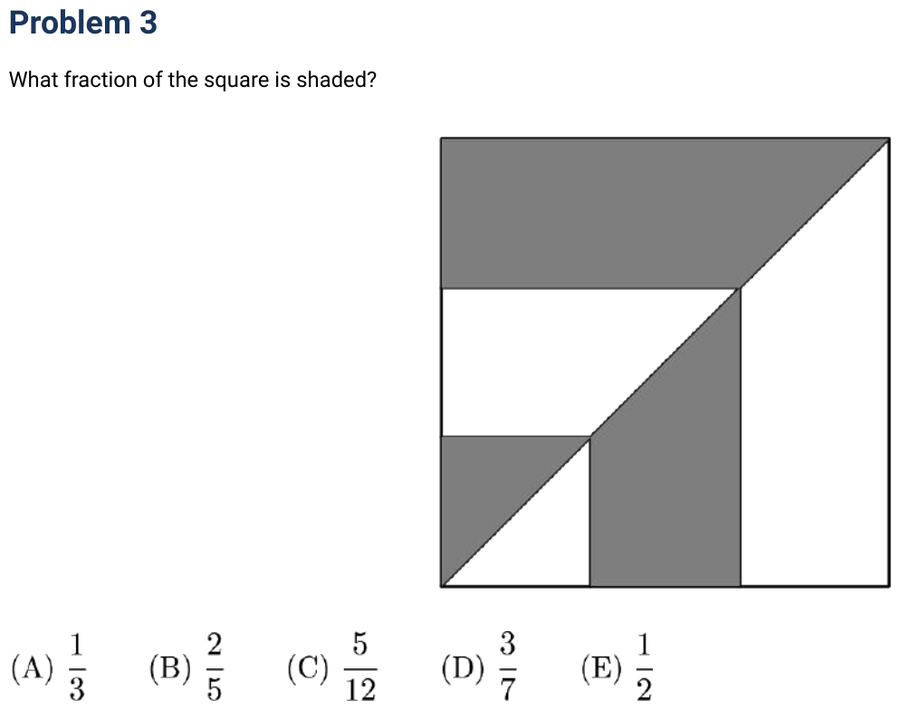
Trying to measure each shaded chunk separately is slow. Instead, look at the long diagonal running corner to corner — what does it do to the whole square?
Still stuck? Show hint 2 →
Hint 2 of 2
Use symmetry, not arithmetic: the diagonal splits the square into two equal triangles, and the figure is built so the shading on one side of the diagonal exactly mirrors the unshaded part on the other.
Show solution
Approach: let the diagonal do the work (symmetry over computing pieces)
Don't compute the little triangles and rectangle one by one. Notice the main diagonal cuts the square into two congruent triangles — each is exactly half the square.
Along that diagonal the picture is balanced: every shaded piece on one side is matched by a same-size unshaded piece on the other. Slide the shaded pieces together and they fill exactly one of the two half-triangles.
So the shaded part is one half of the square: 1/2.
*Why this transfers:* when a figure has a line of symmetry (a diagonal, a center line), look for shaded/unshaded pieces that pair up across it — the fraction is often a clean 1/2 with no measuring at all.
Which of the following could not be the units digit (one's digit) of the square of a whole number?
Show answer
Answer: E — 8.
Show hints
Hint 1 of 2
When you multiply two numbers, the last digit of the answer depends only on the last digits you multiplied. So a square's last digit only depends on the number's last digit — there are just 10 endings to try (0 through 9).
Still stuck? Show hint 2 →
Hint 2 of 2
This is the units-digit trick: to find how a number *ends*, ignore everything but the ones digits. Square 0,1,2,…,9 and collect which last digits actually appear.
Show solution
Approach: the last digit of a square depends only on the last digit squared
Key idea: the ones digit of n×n is decided entirely by the ones digit of n. So square only 0–9 and watch the endings: 0→0, 1→1, 2→4, 3→9, 4→6, 5→5, 6→6, 7→9, 8→4, 9→1.
The only endings that ever show up are 0, 1, 4, 5, 6, 9. Notice they come in mirror pairs (1&9, 2&8, 3&7, 4&6 give the same ending), which is why so few appear.
8 is not on the list, so no whole number squared can end in 8.
*Worth keeping:* a perfect square can only end in 0, 1, 4, 5, 6, or 9 — if a number ends in 2, 3, 7, or 8 it is instantly not a square.
Which of the following is closest to the product (.48017)(.48017)(.48017)?
Show answer
Answer: B — 0.110.
Show hints
Hint 1 of 2
The answer choices jump by factors of 10, so you don't need the exact value — you just need the right size. What round, friendly number is .48017 almost exactly equal to?
Still stuck? Show hint 2 →
Hint 2 of 2
Estimate, don't multiply: replace the messy .48017 with 0.5 (which is 1/2) and cube that. Multiplying out five-decimal numbers would be a waste of time.
Show solution
Approach: round to a friendly number, then estimate the size
The choices (.011, .110, 1.10, 11.0, 110) are spaced a full factor of 10 apart, so the question is really 'how big is it?', not 'what is it exactly.' That means rounding is allowed.
.48017 is just under 0.5, and 0.5 = 1/2, so the product is about (1/2)×(1/2)×(1/2) = 1/8 = 0.125.
Of the choices, 0.125 is nearest to 0.110. (The true cube is a touch smaller since .48 < .5, which nudges it down toward .110 — good agreement.)
*Why this transfers:* when answer choices differ by powers of 10, estimate with the nearest easy number instead of computing — the rounding error is far too small to push you into the wrong bucket.
Every choice starts from the same 13579. So don't compute any of them — just ask which *operation* changes that number the most.
Still stuck? Show hint 2 →
Hint 2 of 2
The trap is dividing by a fraction. Dividing by 1/2468 isn't 'making it smaller' — remember dividing by a fraction less than 1 *flips it over* and multiplies.
Show solution
Approach: compare the effect of each operation, don't compute
All five choices begin with 13579, so compare what each operation *does*. Adding or subtracting 1/2468 (a tiny bit less than half) barely nudges it; multiplying by 1/2468 shrinks it; '13579.2468' is just a hair over 13579.
The standout is ÷ (1/2468). Dividing by a fraction means multiplying by its flip: 13579 ÷ (1/2468) = 13579 × 2468 ≈ 33,000,000. That dwarfs everything else.
So the largest is 13579 ÷ (1/2468).
*Worth keeping:* dividing by a number smaller than 1 makes things *bigger*. That counterintuitive flip is exactly the trap this problem tests.
When three different numbers from the set {−3, −2, −1, 4, 5} are multiplied, the largest possible product is
Show answer
Answer: C — 30.
Show hints
Hint 1 of 2
For the product to be as big as possible it must first be *positive*. With negatives around, what makes a product positive — how many minus signs do you need?
Still stuck? Show hint 2 →
Hint 2 of 2
An even number of negatives gives a positive product. So the play is: grab TWO negatives (to cancel the signs) and make them the biggest negatives you have, then pair with the biggest positive.
Show solution
Approach: even count of negatives for a positive, then maximize size
First make sure you can even be positive. One negative would leave the product negative (a loser); using *two* negatives flips the signs to positive. So pick exactly two of the three negative numbers.
To make the positive product as large as possible, use the two with the biggest size: (−3)(−2) = 6. Then multiply by the largest positive, 5.
6 × 5 = 30. (Check the rivals: 4×5 with one negative is negative; (−3)(−2)(4)=24 < 30.)
*Why this transfers:* in any 'largest product' with negatives, the count of minus signs decides the sign first — settle the sign, *then* chase the biggest absolute values.
A dress originally priced at 80 dollars was put on sale for 25% off. If 10% tax was added to the sale price, then the total selling price (in dollars) of the dress was
Show answer
Answer: D — 66 dollars.
Show hints
Hint 1 of 2
Don't reach for percent formulas — turn the percents into the friendly fractions you know. What simple fraction is 25%? What is 10%?
Still stuck? Show hint 2 →
Hint 2 of 2
Do the steps in the order the store does: discount the price first, then charge tax on the *reduced* price (you don't pay tax on money you saved).
Show solution
Approach: turn percents into easy fractions, in order
25% is just 1/4, so 25% off means you keep 3/4. Three-quarters of $80 is 3×$20 = $60 — no calculator needed.
Tax of 10% on $60 is one-tenth of $60 = $6, added on top. So $60 + $6 = $66.
*Heads-up trap:* take the discount *before* the tax, on the lower price. (Here it happens the order wouldn't change the answer, but on many problems it does — always tax what you actually pay.)
*Worth keeping:* swapping 25%→1/4 and 10%→1/10 turns 'percent of' into one-step mental math.
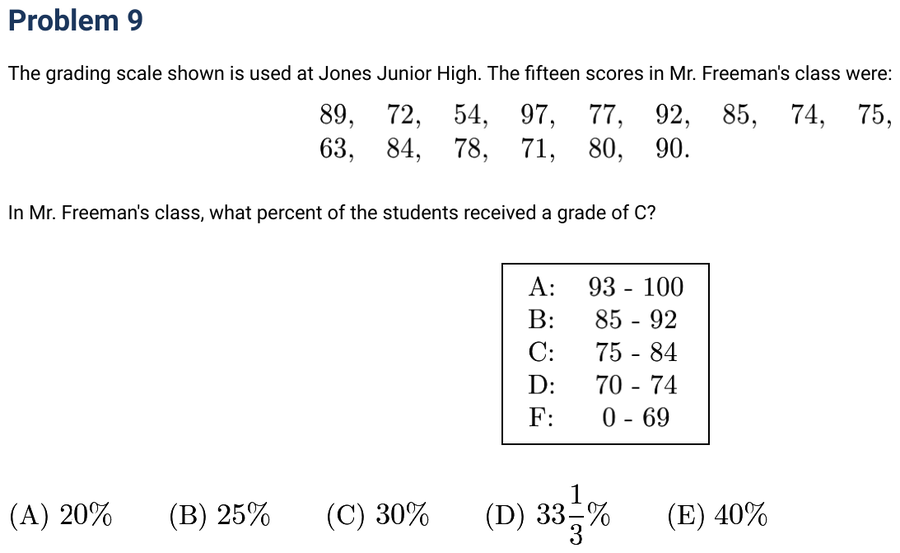
Look up what a C means on the scale first: it's a score from 75 to 84. Now you're just hunting the 15 scores for the ones that land in that window.
Still stuck? Show hint 2 →
Hint 2 of 2
Don't compute 5/15 as an ugly decimal — simplify the fraction first. The 'percent that got a C' is just (how many C's) over 15.
Show solution
Approach: count what fits the window, then simplify the fraction
Read the scale: a C is 75–84. Sweep the 15 scores and tally only those in that band: 77, 75, 84, 78, 80 — that's 5. (Watch the edges: 74 is a D, 85 is a B; 75 and 84 *do* count.)
So the C fraction is 5/15. Simplify *before* converting: 5/15 = 1/3.
One-third as a percent is 33⅓%.
*Worth keeping:* simplify a fraction before turning it into a percent — 1/3 = 33⅓% is worth memorizing, and it dodges messy long division.
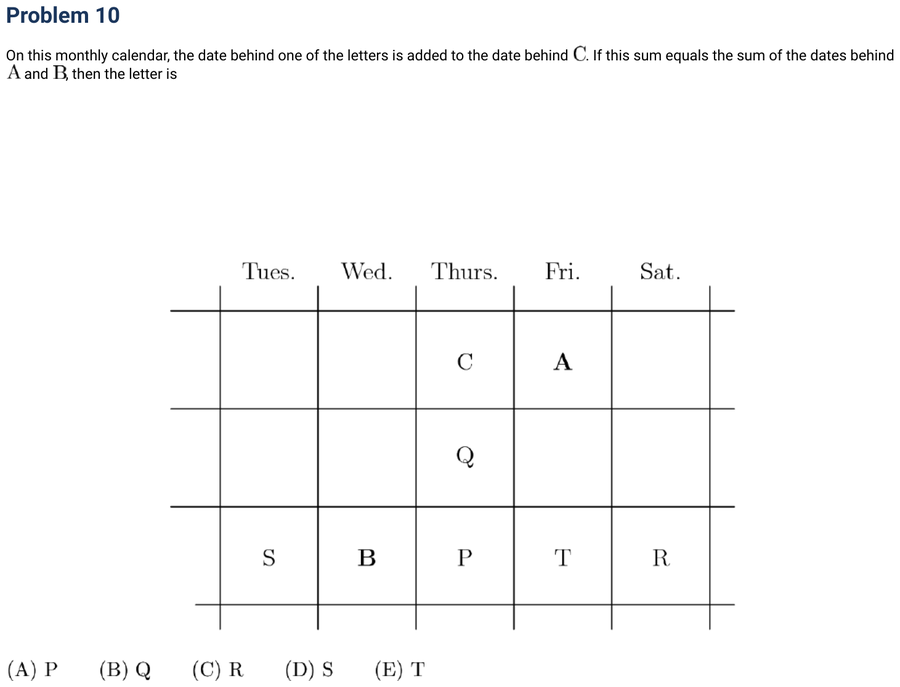
You don't need the real dates — only how the squares relate. On any calendar, the box just below a date is +7 (a week later), and the box to the right is +1 (the next day). Write every letter as 'C plus something.'
Still stuck? Show hint 2 →
Hint 2 of 2
Express each letter as an offset from C, add the ones you're told to, and just read off which letter matches the total. The actual month never matters — pick C = 0 if you like.
Show solution
Approach: label every box as an offset from C (down = +7, right = +1)
Anchor on C. Moving one box right adds 1 (next day); moving one box down adds 7 (next week). Reading the grid: A is the box right of C, so A = C + 1. B sits two rows below and one column left of C, so B = C + 14 − 1 = C + 13.
We need a letter X with X + C = A + B. The right side is (C+1) + (C+13) = 2C + 14, so X = C + 14.
C + 14 is two rows straight down from C — that box is P. (Quick check with a real month: if C = 8, A = 9, B = 21, P = 22, and 22 + 8 = 30 = 9 + 21. ✓)
*Why this transfers:* on calendar-grid puzzles, never plug in real dates — turn each cell into 'anchor ± (7×rows + 1×columns)' and the arithmetic collapses.
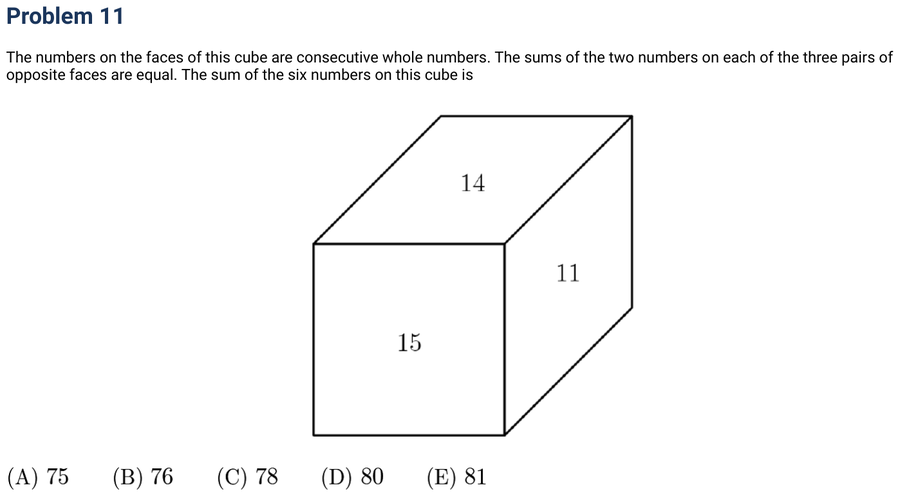
Six consecutive numbers, and you can see 11, 14, 15. Since they're consecutive, the whole set is squeezed into a tight window around those three — what six numbers in a row could contain all of 11, 14, and 15?
Still stuck? Show hint 2 →
Hint 2 of 2
The three opposite-pair sums are equal, so each pair sums to the same value — which means each pair is (smallest+largest), (2nd+2nd-largest), (middle two). That tells you the lowest and highest must add to the same total, pinning the set.
Show solution
Approach: consecutive + equal opposite-sums pins the exact six numbers
Six consecutive whole numbers containing 11, 14, and 15 can only be 11, 12, 13, 14, 15, 16 (you must reach up to 15 and you can't start above 11). That alone fixes the set — the 'equal sums' is just the consistency check.
Confirm it's consistent: pair them from the outside in — 11+16, 12+15, 13+14 — each sums to 27, so opposite faces can indeed match. Good.
Now you don't even need the answer choices for arithmetic tricks — total = 11+12+13+14+15+16. Pair from the ends: three pairs of 27 = 81.
*Worth keeping:* a run of consecutive numbers always pairs symmetrically (smallest+largest = 2nd+2nd-to-last = …), so their sum = (number of pairs) × (one pair sum) — far faster than adding one at a time.
There are twenty-four 4-digit numbers that use each of the four digits 2, 4, 5, and 7 exactly once. Listed in numerical order from smallest to largest, the number in the 17th position in the list is
Show answer
Answer: B — 5724.
Show hints
Hint 1 of 2
Listing all 24 numbers in order is slow and error-prone. Instead think in *blocks*: once you fix the first digit, the other three digits can be arranged 6 ways (3×2×1). So the smallest 6 numbers all start with 2, the next 6 start with 4, and so on.
Still stuck? Show hint 2 →
Hint 2 of 2
Walk the blocks of 6 to land on the right leading digit, then list only inside that small block. This is counting-by-blocks (place-value with permutations).
Show solution
Approach: count in blocks of 6, then order only inside the right block
Fixing the first digit leaves 3 digits to arrange = 3×2×1 = 6 numbers per block, in increasing leading digit (2, 4, 5, 7). So: positions 1–6 start with 2, 7–12 start with 4, 13–18 start with 5, 19–24 start with 7.
The 17th falls in the '5' block (13–18), and it's the 17−12 = 5th number in that block.
List just the 5-block in order (remaining digits 2,4,7): 5247, 5274, 5427, 5472, 5724, 5742. The 5th is 5724.
*Why this transfers:* to find the k-th item in an ordered list of arrangements, never write them all — divide into blocks (here 6 per leading digit), jump to the right block, and only sort the few inside it.
One proposal for new postage rates for a letter was 30 cents for the first ounce and 22 cents for each additional ounce (or fraction of an ounce). The postage for a letter weighing 4.5 ounces was
Show answer
Answer: C — 1.18 dollars.
Show hints
Hint 1 of 2
The sneaky words are 'or fraction of an ounce' — a half-ounce still costs a full extra charge. So you can't just multiply by 4.5; you have to round each leftover bit UP to a whole charge.
Still stuck? Show hint 2 →
Hint 2 of 2
Separate the bill into 'first ounce' (special price) plus 'each additional ounce' (rounded up). This round-up-to-the-next-whole rule is how taxis, parking, and shipping all charge.
Show solution
Approach: first ounce at one rate, the rest rounded up to whole ounces
The pricing has two parts: the first ounce is 30¢, flat. After that, 4.5 − 1 = 3.5 ounces remain.
Here's the trap: 'or fraction of an ounce' means that leftover 0.5 ounce is billed as a *whole* extra ounce. So 3.5 additional ounces round UP to 4 charges of 22¢.
Total = 30 + 4×22 = 30 + 88 = 118¢ = $1.18.
*Worth keeping:* whenever a rate says 'or any part thereof,' round each chunk up to the next whole unit — same idea as parking 'per hour or part of an hour.'
A bag contains only blue balls and green balls. There are 6 blue balls. If the probability of drawing a blue ball at random from this bag is 14, then the number of green balls in the bag is
Show answer
Answer: B — 18.
Show hints
Hint 1 of 2
'Probability of blue is 1/4' is just another way of saying 1 out of every 4 balls is blue. If the 6 blue balls *are* that one-quarter, how big is the whole bag?
Still stuck? Show hint 2 →
Hint 2 of 2
The trap: the answer is the GREEN count, not the total. Find the total first, then take blue away. (1/4 blue means 3/4 green — a nice shortcut.)
Show solution
Approach: fraction-to-count, then mind the question (green, not total)
Probability 1/4 blue means blue is exactly one-quarter of the bag. The 6 blue balls are that quarter, so the full bag is 4 quarters = 4×6 = 24 balls.
But the question asks for *green*, not the total. Green = 24 − 6 = 18.
*Shortcut:* if blue is 1/4 of the bag, green is the other 3/4 = 3×6 = 18 directly — the unit '6 = one quarter' lets you scale up any piece.
*Don't fall for* picking 24 (choice C) — that's the total, the most common slip here.
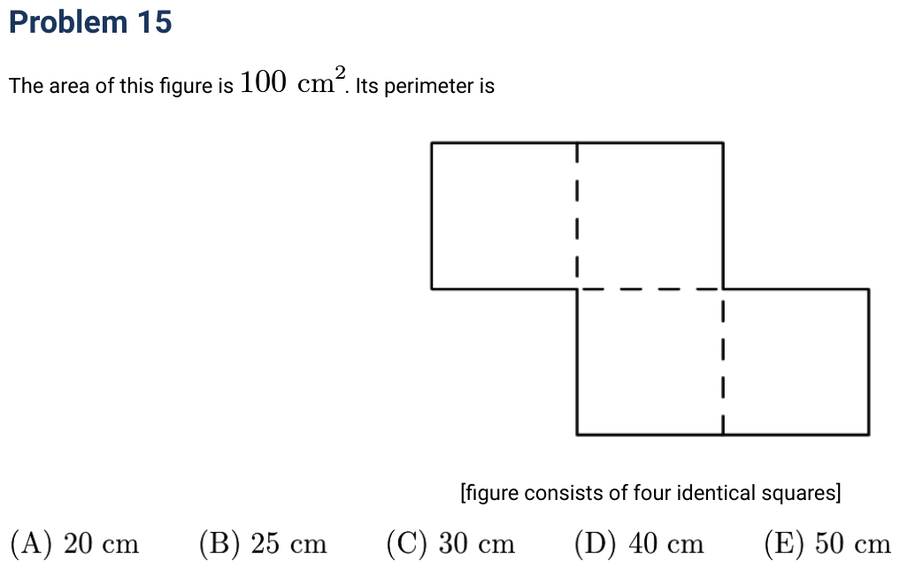
First turn the area into a length. Four equal squares share the 100 cm², so one square is 25 cm² — and 25 is a perfect square, which hands you the side instantly.
Still stuck? Show hint 2 →
Hint 2 of 2
For the perimeter, don't measure with a ruler — count how many square-sides lie on the *outside* of the S-shape. Inner edges where two squares touch are hidden and don't count.
Show solution
Approach: area → side, then count only the outer square-edges
The four squares are identical and total 100 cm², so each is 25 cm². Since 5×5 = 25, each square has side 5 cm.
Now trace the boundary of the S-shaped figure and count the side-lengths on the outside: there are 10 of them (the edges where two squares meet are interior and don't show).
Perimeter = 10 × 5 = 50 cm.
*Worth keeping:* for shapes built from equal squares, find the side from one square's area, then perimeter = (count of exposed square-edges) × side — you only ever count the *outside* edges.
The signs go +, −, +, −… so the terms beg to be grouped two at a time. What does each (big − smaller) pair come out to? They're all the same easy number.
Still stuck? Show hint 2 →
Hint 2 of 2
Group adjacent terms into +/− pairs so each becomes a constant — then it's just (how many pairs) × (that constant). Just be careful about a term left over at the end.
Show solution
Approach: group into +/− pairs so each collapses to a constant
The alternating signs let you pair: (1990−1980), (1970−1960), …, (30−20). Every pair is exactly 10 — a long sum just became 'count the pairs.'
The numbers run by tens from 20 up to 1990, that's how many pairs: the tops are 1990, 1970, …, 30 — 99 of them. So the pairs give 99 × 10 = 990.
One term is left unpaired: the final +10. Add it: 990 + 10 = 1000.
*Worth keeping:* alternating-sign sums almost always want pairing — group neighbors so each pair becomes a constant, then multiply. Always check whether one lonely term is stranded at the end.
A straight concrete sidewalk is to be 3 feet wide, 60 feet long, and 3 inches thick. How many cubic yards of concrete must a contractor order for the sidewalk if concrete must be ordered in a whole number of cubic yards?
Show answer
Answer: A — 2.
Show hints
Hint 1 of 2
The mixed units (feet and inches) are the first trap — get everything into the *same* unit before multiplying. 3 inches is what fraction of a foot?
Still stuck? Show hint 2 →
Hint 2 of 2
Two more traps after the volume: 1 cubic yard is 3×3×3 = 27 cubic feet (not 3), and 'must order a whole number' means round UP, never down — you can't buy 1.67 yards of concrete.
Show solution
Approach: match units, find volume, convert with 27, round up
Convert the odd one out: 3 inches = 3/12 = 1/4 foot. Now all three measurements are in feet: 3 ft wide, 60 ft long, 1/4 ft thick.
Volume = 3 × 60 × 1/4 = 45 cubic feet.
A cubic yard is a 3 ft cube, so it holds 3×3×3 = 27 cubic feet (the easy mistake is to divide by 3). 45 ÷ 27 ≈ 1.67 cubic yards.
You must order a *whole* number, and 1 yard isn't enough — so round up to 2 cubic yards.
*Worth keeping:* converting cubic units cubes the factor (1 yd = 3 ft, so 1 yd³ = 27 ft³), and 'order a whole number' problems always round up to cover the need.
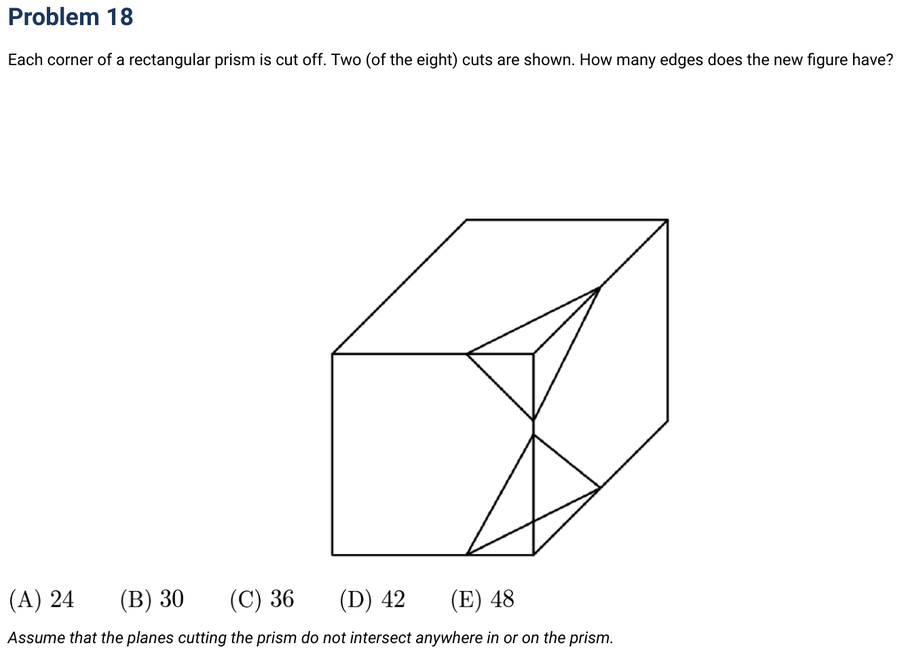
Don't try to draw the whole chopped shape and count edges off the picture. Instead account for edges in two separate groups: the ones that were already there, and the brand-new ones each cut creates.
Still stuck? Show hint 2 →
Hint 2 of 2
Track what a single slice does, then multiply by how many slices. Each corner cut slices off a little corner triangle — how many fresh edges does that one triangle add, and how many original edges get destroyed?
Show solution
Approach: count edges as 'survivors' + 'new ones per cut'
A box (rectangular prism) starts with 12 edges and 8 corners. Cutting a corner just *shortens* the three edges meeting there — it doesn't remove any, so all 12 original edges survive.
Each cut exposes a new little triangular face, and a triangle has 3 sides — so every corner adds 3 brand-new edges. Eight corners (the cuts don't touch each other) add 8 × 3 = 24 new edges.
Total edges = 12 survivors + 24 new = 36.
*Why this transfers:* for 'slice the corners' (truncation) problems, count by category — old edges that survive plus (new edges per cut) × (number of cuts). The same bookkeeping handles faces and vertices too.
There are 120 seats in a row. What is the fewest number of seats that must be occupied so the next person to be seated must sit next to someone?
Show answer
Answer: B — 40.
Show hints
Hint 1 of 2
Flip the goal around: 'the next person must sit next to someone' just means there's NO empty seat with both neighbors also empty. So you need every gap of empties to be small — what's the most empty seats you can leave in a row before a safe spot opens up?
Still stuck? Show hint 2 →
Hint 2 of 2
Think of each person as 'guarding' a block: themselves plus the seat on each side. To cover 120 seats with the fewest guards, give each person a full block of 3 and tile the row as (empty, person, empty) repeating.
Show solution
Approach: each person covers a block of 3 (the seated-spacing / covering idea)
Reframe: a newcomer is forced next to someone exactly when no seat is left with *both* neighbors empty. So we must break up the empties so that no two empty seats sit side by side… actually, more precisely, each occupied person can 'block' at most the seat on each side of them.
Picture repeating the pattern empty–person–empty, i.e. blocks of 3. One person per block of 3 means every empty seat is right next to an occupied one. That uses 120 ÷ 3 = 40 people, and it works.
Could 39 do it? 39 people can guard at most 39×3 = 117 seats, leaving a gap — somewhere two empties sit together and a newcomer could avoid everyone. So 40 is both enough and necessary: 40.
*Why this transfers:* 'fewest needed so every spot is covered' problems divide the total by how much one item covers (here 3) — and you confirm the floor by checking one fewer leaves a hole.
The annual incomes of 1,000 families range from 8200 dollars to 98,000 dollars. In error, the largest income was entered on the computer as 980,000 dollars. The difference between the mean of the incorrect data and the mean of the actual data is
Show answer
Answer: A — 882 dollars.
Show hints
Hint 1 of 2
Don't compute either mean — you can't, you don't know the other 999 incomes! Only ONE number changed, so ask: by how much did the *total* change, and how does that one change ripple into the average?
Still stuck? Show hint 2 →
Hint 2 of 2
The 999 unchanged incomes cancel out completely when you subtract the two means. The mean shifts by (size of the error) spread evenly over all 1000 families.
Show solution
Approach: subtract the means — everything cancels but the one error, spread over 1000
The two data sets differ in *one* entry: 980,000 instead of 98,000. Every other family is identical, so when you subtract (wrong mean) − (right mean), all those matching incomes cancel.
What's left is just the single error spread over everyone: the total was overstated by 980,000 − 98,000 = 882,000.
A mean is total ÷ 1000, so the mean is off by 882,000 ÷ 1000 = $882.
*Why this transfers:* changing one value in a set of n shifts the mean by (the change) ÷ n — you never need the other values, and the giant 'range 8200–98,000' detail is a red herring.
A list of 8 numbers is formed by beginning with two given numbers. Each new number in the list is the product of the two previous numbers. Find the first number if the last three numbers are 16, 64, 1024.
Show answer
Answer: B — 1/4.
Show hints
Hint 1 of 2
You're given the END of the list and asked for the START — that's a signal to run the rule *backward*. The forward rule is 'multiply the two before,' so the reverse is a division. Which two numbers do you divide?
Still stuck? Show hint 2 →
Hint 2 of 2
If a term equals (term before it) × (term two before it), then 'two before' = (this term) ÷ (the one just before). Keep peeling backward one step at a time until you reach the first number.
Show solution
Approach: work backward — undo each multiply with a divide
Label the list t₁…t₈; the rule is tₙ = tₙ₋₁ × tₙ₋₂. We know t₆=16, t₇=64, t₈=1024 (and indeed 16×64 = 1024 ✓, a good consistency check).
So the first number is 1/4. (Verify forward: 1/4, 4 → 1, 4, 4, 16, 64, 1024 ✓.)
*Why this transfers:* when a problem hands you the end of a chain, reverse the operation (multiply→divide, add→subtract) and walk back — always sanity-check by running it forward.
Several students are seated at a large circular table. They pass around a bag of 100 pieces of candy. Each person takes one piece and passes the bag to the next person. If Chris takes the first and the last piece of candy, then the number of students at the table could be
Show answer
Answer: B — 11.
Show hints
Hint 1 of 2
The bag comes back to Chris once every full lap around the table. So Chris gets pieces 1, then 1+(one lap), then 1+(two laps), … The real question is: how far apart are his pieces?
Still stuck? Show hint 2 →
Hint 2 of 2
Chris grabs the 1st piece and the 100th piece — that's a gap of 99 pieces, which must be a whole number of laps. So the number of students has to divide evenly into 99. Test the choices for who splits 99 with nothing left over.
Show solution
Approach: the gap between Chris's first and last piece must be a whole number of laps
With n students, the bag returns to Chris every n pieces (one lap). So Chris takes pieces 1, 1+n, 1+2n, … — each of his pieces is one full lap after the last.
He gets the 1st *and* the 100th piece. The distance from piece 1 to piece 100 is 100 − 1 = 99 pieces, and that must be an exact whole number of laps. So n must divide 99 with nothing left over.
Check the choices: 10, 19, 20, 25 all leave a remainder, but 99 ÷ 11 = 9 exactly. So there could be 11 students (Chris gets every 11th piece: 1, 12, 23, …, 89, 100).
*Why this transfers:* 'same person at the start and at position k' around a circle means the number of people must divide the gap (here k−1) evenly — it's really a 'which numbers go in evenly' (divisor) question in disguise.
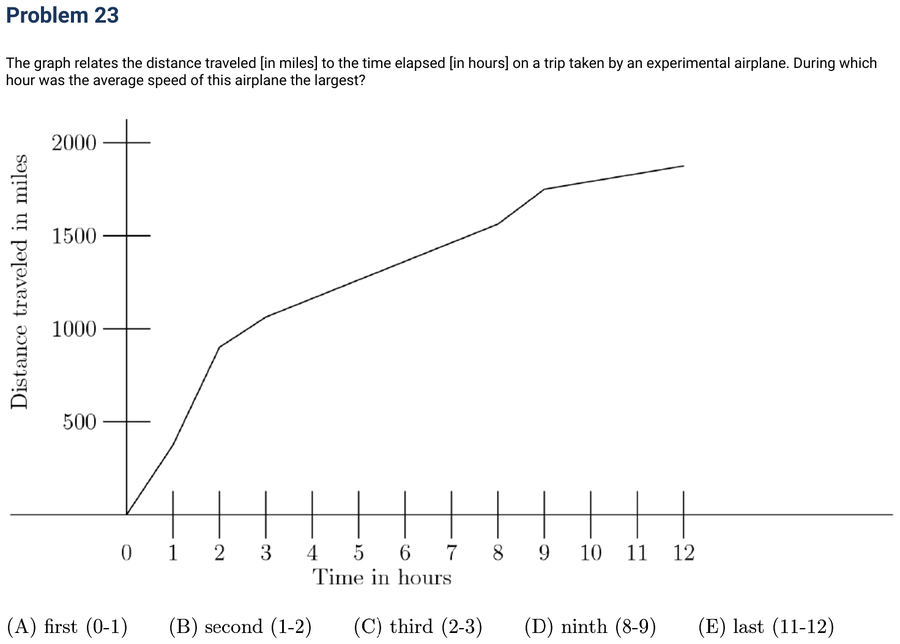
Speed = distance ÷ time, and every choice covers the same one hour. So 'fastest hour' just means 'the hour where the distance climbed the most' — you're comparing rises, not doing division.
Still stuck? Show hint 2 →
Hint 2 of 2
On a distance–time graph, the steeper the line over an hour, the faster the plane went that hour. Don't read exact numbers — just eyeball where the curve shoots up most sharply.
Show solution
Approach: steepest one-hour segment = fastest hour (read the slope by eye)
Average speed over an hour = (miles gained) ÷ (1 hour) = the miles gained that hour. Since every option is a 1-hour stretch, the fastest hour is simply the one with the biggest jump in distance — the steepest part of the graph.
Scan the curve: between hours 1 and 2 it leaps from about 400 to about 900 miles — roughly a 500-mile climb, clearly steeper than any other single hour (the later hours flatten out).
So the largest average speed is during the second hour (1-2).
*Worth keeping:* on a distance–time graph, steepness *is* speed — comparing slopes by eye beats computing every segment, and a flattening curve means slowing down.
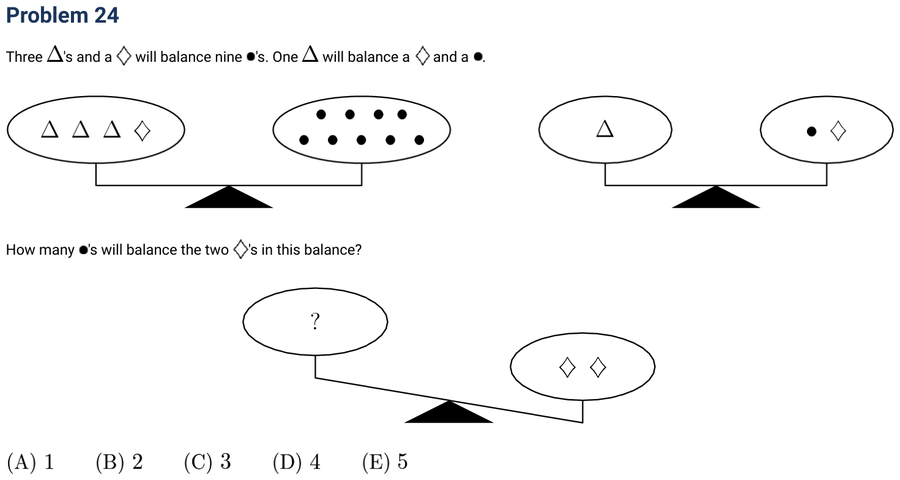
A balance scale is just an equals sign you can see. Write down what each picture says: 3 triangles + 1 diamond = 9 circles, and 1 triangle = 1 diamond + 1 circle.
Still stuck? Show hint 2 →
Hint 2 of 2
The first balance has triangles in the way, but the second tells you exactly what one triangle is *made of*. Swap every triangle for 'a diamond and a circle' — substitution — and only diamonds and circles are left.
Show solution
Approach: substitute the simpler balance to clear out the triangles
Read the scales as equations: 3T + D = 9C, and T = D + C. You want how many circles equal two diamonds (2D).
The second balance lets you replace each triangle by 'one diamond + one circle.' Swap all three triangles in the first balance: 3(D + C) + D = 9C, i.e. 4D + 3C = 9C.
Take the 3C off both sides (remove 3 circles from each pan): 4D = 6C. Cut everything in half: 2D = 3C. So two diamonds balance 3 circles.
*Why this transfers:* when one unknown is given in terms of others, substitute it in to wipe that unknown out — and on a balance you can always add or remove the same thing from both pans without tipping it.
Another way — stay concrete — double the simpler balance:
From the right scale, 1 triangle = 1 diamond + 1 circle, so 3 triangles = 3 diamonds + 3 circles.
The left scale says 3 triangles + 1 diamond = 9 circles. Replace the 3 triangles: (3 diamonds + 3 circles) + 1 diamond = 9 circles, so 4 diamonds + 3 circles = 9 circles.
Remove 3 circles from each side: 4 diamonds = 6 circles. Halve it: 2 diamonds = 3 circles — exactly the two diamonds in the question.
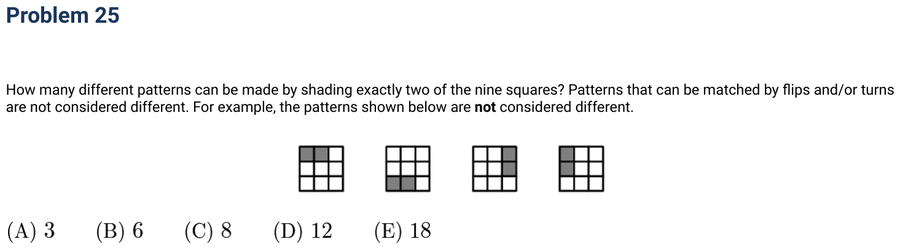
Counting all C(9,2)=36 pairs and crossing out flips/turns is a mess. First simplify the board: by symmetry the nine cells are really only THREE kinds — the 1 center, the 4 edge-middles, and the 4 corners. Any two cells of the same kind look the same after turning the grid.
Still stuck? Show hint 2 →
Hint 2 of 2
So a pattern is decided by which *kinds* of cell you pick AND how they sit relative to each other (touching? across? diagonal?). List the kind-combinations carefully — that's symmetry classification.
Show solution
Approach: classify by cell-type and relative position (count up to the square's symmetry)
The nine cells split into 3 symmetry types: center (1), edges (4 middle-of-side), corners (4). Turning or flipping the grid shuffles cells *within* a type, so what matters is which types you shade and how they're positioned.
Go through the type-pairs. Center + edge: 1 way. Center + corner: 1 way. Two edges: they're either next to each other (adjacent) or across (opposite) — 2 ways. Two corners: adjacent (same side) or diagonal — 2 ways. Corner + edge: the edge either touches that corner or is on the far side — 2 ways.
Total distinct patterns: 1 + 1 + 2 + 2 + 2 = 8. (Two center cells is impossible — there's only one center.)
*Why this transfers:* when shapes are 'the same under flips/turns,' don't count raw placements — group the spots into symmetry types first, then count combinations of types and their relative positions. That's the heart of symmetry counting.