Don't add straight down each group — look at how the two groups line up term-by-term. What do 1 and 9 have in common? 11 and 19?
Still stuck? Show hint 2 →
Hint 2 of 3
Re-grouping a sum into friendly pairs that each make a round number is far easier than adding ten messy numbers in a row.
Still stuck? Show hint 3 →
Hint 3 of 3
Each matched pair (1+9, 11+19, …) ends in 0, so you only ever add tens.
Show solution
Approach: re-pair into round tens
Notice the two groups are built from the same ten-step pattern, just shifted: 1 pairs with 9, 11 with 19, 21 with 29, and so on. Each pair adds to a number ending in 0 — that's the whole point of pairing instead of adding straight down.
The five pairs give 10 + 30 + 50 + 70 + 90 = 250.
Why this transfers: whenever a sum can be reshuffled so terms combine into round numbers, do the reshuffling first — addition is allowed in any order, and round numbers carry almost no chance of a slip.
Sanity check: ten numbers averaging about 25 should total roughly 250, which matches.
Another way — sum each group separately:
First group: 1+11+21+31+41 = 105 (five terms averaging 21). Second group: 9+19+29+39+49 = 145 (five terms averaging 29).
105 + 145 = 250. The pairing trick just avoids these two intermediate totals.
Look at the denominators 10, 100, 1000 — those ARE the names of the decimal places. What do tenths, hundredths, thousandths look like written out?
Still stuck? Show hint 2 →
Hint 2 of 3
A fraction over a power of ten is already a decimal: the bottom tells you which column the top digit lives in.
Still stuck? Show hint 3 →
Hint 3 of 3
The digits 2, 4, 6 land in three different columns, so nothing collides — no adding needed.
Show solution
Approach: read each denominator as a decimal place
The denominator names the column: /10 is the tenths place, /100 the hundredths, /1000 the thousandths. So 2/10 puts a 2 in the tenths column, 4/100 a 4 in the hundredths, 6/1000 a 6 in the thousandths.
Because each digit sits in a separate column, you just write them in order: .246 — no carrying, no lining up.
Trap to avoid: the off-answer .0246 comes from shoving all three digits one column too far right. Anchor on 2/10 = 0.2 (a 2 right after the point) and the rest follows.
Every choice starts with .9, so the tenths place is a tie. Where do the numbers first disagree?
Still stuck? Show hint 2 →
Hint 2 of 3
Compare decimals column by column from the left, like comparing words in a dictionary — the first place they differ decides it. Length does NOT decide it.
Still stuck? Show hint 3 →
Hint 3 of 3
Look at the hundredths place (second digit after the point): which choice has the biggest digit there?
Show solution
Approach: compare left-to-right, first difference wins
All five share .9 in the tenths place, so that round is a tie. Move to the next column — the hundredths. There .99 shows a 9 while every other choice shows a 0.
A bigger digit in the first column that differs settles it immediately, so .99 is largest.
Trap to avoid: more digits does NOT mean bigger. .9099 looks long but .9 then 0 makes it smaller than .99 right at the hundredths column. Lining the decimal points up vertically makes this obvious.
Estimate to determine which of the following numbers is closest to 401.205.
Show answer
Answer: E — 2000.
Show hints
Hint 1 of 3
The answer choices jump by factors of 10 (.2, 2, 20, 200, 2000). When choices are that far apart, you don't need an exact answer — a rough size estimate picks the winner.
Still stuck? Show hint 2 →
Hint 2 of 3
Replace the ugly numbers with nearby friendly ones before dividing: 401 → 400, .205 → .2.
Still stuck? Show hint 3 →
Hint 3 of 3
Dividing by .2 means asking 'how many fifths?' — and there are 5 fifths in every 1, so dividing by .2 is the same as multiplying by 5.
Show solution
Approach: round to friendly numbers, then divide
Because the choices differ by whole factors of 10, the problem literally says 'estimate' — so round the messy numbers first: 401 ≈ 400 and .205 ≈ .2.
Now 400 ÷ .2. Dividing by .2 (one-fifth) is the same as multiplying by 5, so 400 × 5 = 2000. Closest choice: 2000.
Why this transfers: when answer choices are spread far apart, estimating is faster and safer than an exact computation — and turning 'divide by .2' into 'times 5' kills the decimal entirely.
Only now does the addition happen. Starting at −15 and adding 18 walks 18 steps up the number line: −15 + 18 = 3.
Trap to avoid: reading left to right would give (−15 + 9) × … and a wrong negative answer like −12. The order of operations, not the reading order, decides what combines first.
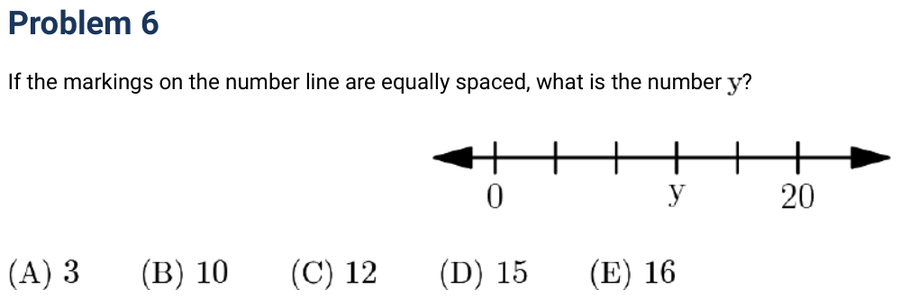
What's the same about every gap between neighboring ticks? Use the part you DO know — the stretch from 0 to 20 — to measure one gap.
Still stuck? Show hint 2 →
Hint 2 of 3
On an evenly-spaced line, find one gap's value first, then a point's value is just (number of gaps from 0) × (gap value).
Still stuck? Show hint 3 →
Hint 3 of 3
Count the gaps, not the tick marks: between 0 and 20 there are 5 gaps, and y sits 3 gaps to the right of 0.
Show solution
Approach: measure one gap, then count gaps to y
The known stretch from 0 to 20 is split into 5 equal gaps, so each gap is worth 20 ÷ 5 = 4. This is the key move: use the labeled span to calibrate a single step.
Now count gaps from 0 to y: there are 3 of them, so y = 3 × 4 = 12.
Trap to avoid: count the spaces between ticks, never the ticks themselves. Six tick marks make only 5 gaps — off-by-one here would give a wrong step size and a wrong y.
If the value of 20 quarters and 10 dimes equals the value of 10 quarters and n dimes, then n =
Show answer
Answer: D — 35.
Show hints
Hint 1 of 3
Both sides already have 10 quarters and 10 dimes in common. What's left over once you mentally cross out the shared coins?
Still stuck? Show hint 2 →
Hint 2 of 3
Cancel anything identical on both sides of an equation first — you only need to balance the difference, not the whole pile.
Still stuck? Show hint 3 →
Hint 3 of 3
After cancelling, you're left with 10 extra quarters on one side that the extra dimes must match in value.
Show solution
Approach: cancel the shared coins, balance the rest
Both sides carry 10 quarters and 10 dimes — cross those out, since identical amounts on each side don't affect the balance. The left keeps 10 extra quarters; the right keeps (n − 10) extra dimes.
So 10 quarters must equal (n − 10) dimes in value: 10 × 25¢ = 250¢, and 250 ÷ 10 = 25 extra dimes. Then n = 10 + 25 = 35.
Why this transfers: in any 'this equals that' setup, deleting whatever is common to both sides shrinks the problem to its real difference — here, 'trade 10 quarters for dimes' instead of juggling 600¢ totals.
Another way — compute both totals in cents:
Left side: 20×25 + 10×10 = 500 + 100 = 600¢.
Right side: 10×25 + n×10 = 250 + 10n. Set 250 + 10n = 600, so 10n = 350 and n = 35.
The front product is 2×3×4 = 24, and the fractions are halves, thirds, quarters. That's no accident — what happens when you hand 24 to each fraction?
Still stuck? Show hint 2 →
Hint 2 of 3
Multiplying first and distributing beats finding a common denominator: spread the outside factor across each term inside the parentheses.
Still stuck? Show hint 3 →
Hint 3 of 3
24 is a multiple of 2, 3, AND 4, so 24×½, 24×⅓, 24×¼ are all whole numbers — no fraction arithmetic survives.
Show solution
Approach: distribute 24 over each fraction
First simplify the front: 2×3×4 = 24. The denominators 2, 3, 4 are exactly the factors that built 24, so distributing 24 to each fraction clears every denominator: 24×½ = 12, 24×⅓ = 8, 24×¼ = 6.
Add the three whole numbers: 12 + 8 + 6 = 26.
Why this transfers: a number times a sum of fractions is easiest when that number is a common multiple of the denominators — distribute it inward and the fractions vanish before you ever add. Adding ½+⅓+¼ first (a clumsier 13/12) just makes more work.
There are 2 boys for every 3 girls in Ms. Johnson's math class. If there are 30 students in her class, what percent of them are boys?
Show answer
Answer: C — 40%.
Show hints
Hint 1 of 3
A ratio of 2 boys to 3 girls means the class splits into 2 + 3 = 5 equal-size groups. Boys aren't 2 out of 3 — they're 2 out of how many?
Still stuck? Show hint 2 →
Hint 2 of 3
Turn a ratio into a fraction-of-the-whole by adding the parts: boys are 2 of the 5 total parts.
Still stuck? Show hint 3 →
Hint 3 of 3
You don't even need the 30: boys are 2/5 of the class, and 2/5 is already a percent in disguise.
Show solution
Approach: add the ratio parts, then take the fraction of the whole
The ratio 2 : 3 means 2 + 3 = 5 equal parts make up the class, and boys fill 2 of them — so boys are 2/5 of everyone.
2/5 = 40/100 = 40%. (Checking with the count: 30 ÷ 5 = 6 per part, boys = 2×6 = 12, and 12/30 = 40%.)
Trap to avoid: 60% is the boys-to-girls comparison (2 is 2/3 of 3) — but the question asks boys as a slice of the whole class, which is 2/5. Always ask 'fraction of WHAT?' before converting to a percent.
What is the number of degrees in the smaller angle between the hour hand and the minute hand on a clock that reads seven o'clock?
Show answer
Answer: D — 150°.
Show hints
Hint 1 of 3
A full clock face is one full turn — 360° — divided into 12 equal hour gaps. What's one gap worth?
Still stuck? Show hint 2 →
Hint 2 of 3
Convert 'hour marks apart' into degrees by giving every hour gap a fixed value, then just count gaps.
Still stuck? Show hint 3 →
Hint 3 of 3
At 7:00 the minute hand points at 12 and the hour hand at 7. Count the hour gaps the SHORT way around between them.
Show solution
Approach: one hour gap = 30°, then count gaps
The 12 hour marks split the full 360° circle into 12 equal gaps, so each gap is 360 ÷ 12 = 30°.
At 7:00 the minute hand sits at 12 and the hour hand at 7. The short way between them spans 5 hour gaps (12→11→10→9→8→7), giving 5 × 30° = 150°.
Why this transfers: turning a clock into '30° per hour gap' converts every clock-angle question into simple counting; the long way around would be 12 − 5 = 7 gaps = 210°, and the two always add to 360°.
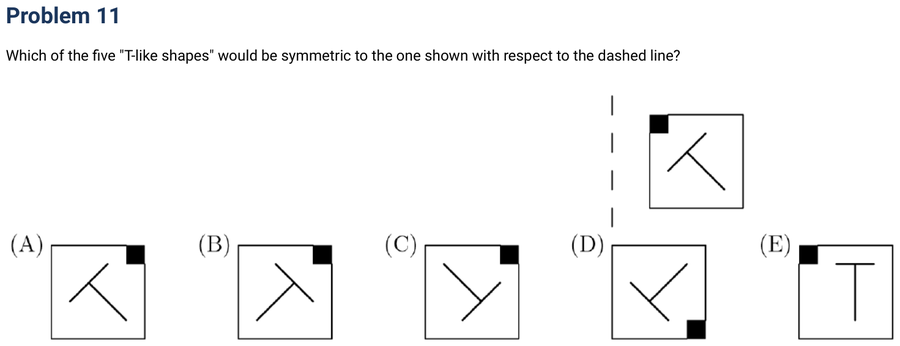
A mirror on a vertical line only swaps left and right — top stays top, bottom stays bottom. So track each feature's left/right side and leave its height alone.
Still stuck? Show hint 2 →
Hint 2 of 3
Two anchors pin down the mirror image: where the little corner square lands, and which way the slanted arms lean. Check both before choosing.
Still stuck? Show hint 3 →
Hint 3 of 3
The corner square sits at the TOP of the original, so it must stay at the top — that instantly throws out any choice with the square at the bottom, narrowing the field fast.
Show solution
Approach: swap left↔right, keep top/bottom, then match two anchors
Reflection across the vertical dashed line is a left-right flip only: every feature keeps its height but trades sides. So the corner square stays at the top and moves to the opposite side, and the slanted arms reverse their lean.
Use the corner square as the first filter — it's at the top in the original, so any choice with it at the bottom is out. Then check the arm lean against the mirror. Only B matches both anchors: square at the same top level on the flipped side, with the arms leaning the mirrored way.
Why this transfers: to test a mirror image, don't eyeball the whole picture — pick one or two distinctive features (a corner mark, a lean direction) and verify each obeys the flip. Symmetry problems crack quickly once you reduce them to a couple of checkable anchors.
A big fraction is really just 'top ÷ bottom.' Collapse the top into one fraction and the bottom into one fraction before you do anything else.
Still stuck? Show hint 2 →
Hint 2 of 3
1 − 1⁄3 means 'a whole minus one of its thirds' — picture three thirds, take one away. Same idea for 1 − 1⁄2.
Still stuck? Show hint 3 →
Hint 3 of 3
To divide by a fraction, flip it and multiply: ÷(1⁄2) becomes ×2.
Show solution
Approach: simplify top and bottom, then flip-and-multiply
Treat the bar as a division sign and clean each half first. Top: 1 − 1⁄3 = 2⁄3 (three thirds minus one third). Bottom: 1 − 1⁄2 = 1⁄2 (two halves minus one half).
Now (2⁄3) ÷ (1⁄2). Dividing by 1⁄2 asks 'how many halves fit in 2⁄3?' — and there are twice as many, so flip and multiply: (2⁄3) × 2 = 4⁄3.
Why this transfers: never wrestle a stacked fraction all at once — reduce the top to a single fraction, the bottom to a single fraction, then it's one clean division. Sanity check: the answer is more than 1, which makes sense since the top 2⁄3 is bigger than the bottom 1⁄2.
A fraction keeps its value only when the top and the bottom are shrunk (or grown) by the SAME factor — multiplying top and bottom by the same thing changes nothing.
Still stuck? Show hint 2 →
Hint 2 of 3
Look at each choice as 'what got multiplied by 0.1?' The original is 9/(7×53); track how many ×0.1's land on top versus on the bottom.
Still stuck? Show hint 3 →
Hint 3 of 3
9 → .9 is one ×0.1 on top. To stay equal you need exactly one matching ×0.1 somewhere on the bottom — and 7 → .7 supplies it while 53 stays put.
Show solution
Approach: count the ×0.1 factors on top vs. bottom
The starting fraction is 9/(7×53). Every choice turns the 9 into .9, which is one factor of 0.1 on top. For the value to be unchanged, the bottom must pick up exactly one matching factor of 0.1 too.
Choice A is .9/(.7×53): top got ×0.1, and 7→.7 is ×0.1 on the bottom while 53 is untouched. Same ×0.1 top and bottom cancels, so .9/(.7×53) = 9/(7×53). That's the match — choice A.
Every other choice puts a different amount of shrinking on the bottom: B and E shrink two bottom numbers (too much), C turns 53→5.3 (only ×0.1 but value still off because... ) — quick test: in C the bottom is .7×5.3, which is ×0.1 on the 7 AND ×0.1 on the 53, so the bottom shrank by ×0.01 total versus ×0.1 on top, changing the value.
Why this transfers: to keep a fraction's value, the ×0.1 (or ×10) factors on top and bottom must balance exactly — count them like matching pairs. This 'scale top and bottom the same' rule is the engine behind every equivalent-fraction problem.
When placing each of the digits 2, 4, 5, 6, 9 in exactly one of the boxes of this subtraction problem, what is the smallest difference that is possible?
−
Show answer
Answer: C — 149.
Show hints
Hint 1 of 3
To make a difference small, push the top number down and the bottom number up — but not all digit slots matter equally. Which single slot moves the answer the most?
Still stuck? Show hint 2 →
Hint 2 of 3
Place digits where they have the most leverage first: the hundreds place of the top number, then the tens place of the bottom number, then fill in the rest.
Still stuck? Show hint 3 →
Hint 3 of 3
The top must be 3 digits, so its hundreds digit can't be helped much — make it the smallest, 2. Then give the bottom number the biggest tens digit you can, 9.
Show solution
Approach: place the high-leverage digits first
A digit in the hundreds column is worth 100, in the tens column 10 — so the slots that swing the difference most are the top number's hundreds and the bottom number's tens. Lock those down first: top hundreds = smallest = 2; bottom tens = largest = 9.
Now fill the leftover digits {4, 5, 6} to keep the gap tight: top becomes 245 (smallest with leading 2) and bottom becomes 96 (largest with leading 9). Difference: 245 − 96 = 149.
Why this transfers: in build-the-number puzzles, assign digits to the highest place values first — that's where they count for the most. Greedily optimizing the biggest column, then the next, beats blindly trying combinations.
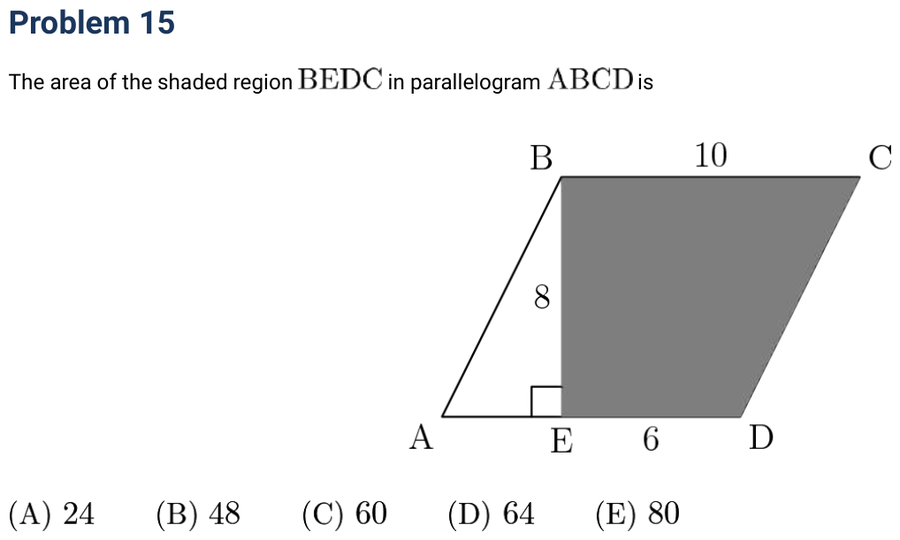
BEDC has two horizontal sides (BC on top, ED on the bottom) and the vertical BE joining them at right angles. What standard shape is that?
Still stuck? Show hint 2 →
Hint 2 of 3
It's a right trapezoid: BC and ED are the two parallel sides and BE is the height that's perpendicular to both. Use ½ × (sum of parallel sides) × height.
Still stuck? Show hint 3 →
Hint 3 of 3
You're missing BC, but the figure is a parallelogram — so BC equals the opposite side AD = 10. BE = 8 is the height.
Show solution
Approach: right-trapezoid area directly
Spot the shape: BEDC has BC parallel to ED (both horizontal) with BE perpendicular to both, so it's a right trapezoid. Its height is the perpendicular side BE = 8.
Find the missing parallel side: in parallelogram ABCD, BC equals its opposite side AD = 10. So the parallel sides are BC = 10 and ED = 6.
Area = ½(10 + 6)(8) = ½ × 16 × 8 = 64.
Another way — whole parallelogram minus the corner triangle:
The full parallelogram has base AD = 10 and height BE = 8, so its area is 10 × 8 = 80.
The unshaded part is right triangle ABE. Since AD = 10 and ED = 6, the leg AE = 10 − 6 = 4, and the other leg is BE = 8, so its area is ½ × 4 × 8 = 16.
Shaded BEDC = 80 − 16 = 64. Two routes, same answer — a reassuring check.
In how many ways can 47 be written as the sum of two primes?
Show answer
Answer: A — 0.
Show hints
Hint 1 of 3
47 is odd. Two numbers add to an odd total only when one is even and one is odd — so think about which of the two primes is the even one.
Still stuck? Show hint 2 →
Hint 2 of 3
Use parity to shrink the search: an odd sum forces one even prime, and there's only a single even prime in existence.
Still stuck? Show hint 3 →
Hint 3 of 3
The only even prime is 2, so the partner is forced to be 47 − 2 = 45. Now just check: is 45 prime?
Show solution
Approach: parity forces one prime to be 2
Two numbers add to an odd total (47) only if one is even and the other odd. Among primes, the lone even one is 2 — every other prime is odd. So if 47 splits into two primes, one of them MUST be 2.
That forces the partner to be 47 − 2 = 45. But 45 = 5 × 9 is not prime, so no valid split exists: 0 ways.
Why this transfers: a parity check often collapses a search instantly. 'Odd = even + odd' plus 'the only even prime is 2' means an odd number is a sum of two primes only if (number − 2) is itself prime — one test, done. Try it on 13: 13 − 2 = 11 is prime, so 13 = 2 + 11 works.
The number N is between 9 and 17. The average of 6, 10, and N could be
Show answer
Answer: B — 10.
Show hints
Hint 1 of 3
The word 'could be' is the clue: N isn't fixed, so the average isn't either — it lives in a range. Find the two ends of that range by trying N at its smallest and largest.
Still stuck? Show hint 2 →
Hint 2 of 3
When a quantity slides between bounds, find the smallest and largest possible results; the answer must land inside that window.
Still stuck? Show hint 3 →
Hint 3 of 3
Average = (6 + 10 + N)⁄3 = (16 + N)⁄3. As N creeps from just above 9 to just below 17, watch where this lands — then see which single choice fits.
Show solution
Approach: bound the average between its extremes
Write the average as (6 + 10 + N)⁄3 = (16 + N)⁄3. Since the average grows steadily as N grows, its smallest and largest values come from N's endpoints.
Smallest: N just above 9 gives just above 25⁄3 ≈ 8.3. Largest: N just below 17 gives just below 33⁄3 = 11. So the average can be anything between roughly 8.3 and 11.
Only 10 sits inside that window (it happens at N = 14). The why: a quantity built from a sliding input takes every value between its two extremes, so 'could be' questions are really 'is it inside the range?' questions.
Many calculators have a reciprocal key 1/x that replaces the current number displayed with its reciprocal. For example, if the display is 00004 and the 1/x key is pressed, then the display becomes 000.25. If 00032 is currently displayed, what is the fewest positive number of times you must depress the 1/x key so the display again reads 00032?
Show answer
Answer: B — 2.
Show hints
Hint 1 of 3
Don't assume it takes many presses — just do it once and see what's on the screen, then ask whether one more press undoes it.
Still stuck? Show hint 2 →
Hint 2 of 3
Flipping a fraction upside down, then flipping again, lands you exactly where you started: the reciprocal of the reciprocal is the original number.
Still stuck? Show hint 3 →
Hint 3 of 3
32 = 32⁄1; one press flips it to 1⁄32; the next press flips it back.
Show solution
Approach: the reciprocal undoes itself
Press once: 32 (which is 32⁄1) flips to 1⁄32. Press again: 1⁄32 flips back to 32. So the display returns after exactly 2 presses.
Why this works: taking a reciprocal twice cancels itself — like flipping a card over and over, every even number of presses returns the original. An operation that is its own undo is called self-inverse, and it always cycles with period 2 (unless the number is 1, which never changes).
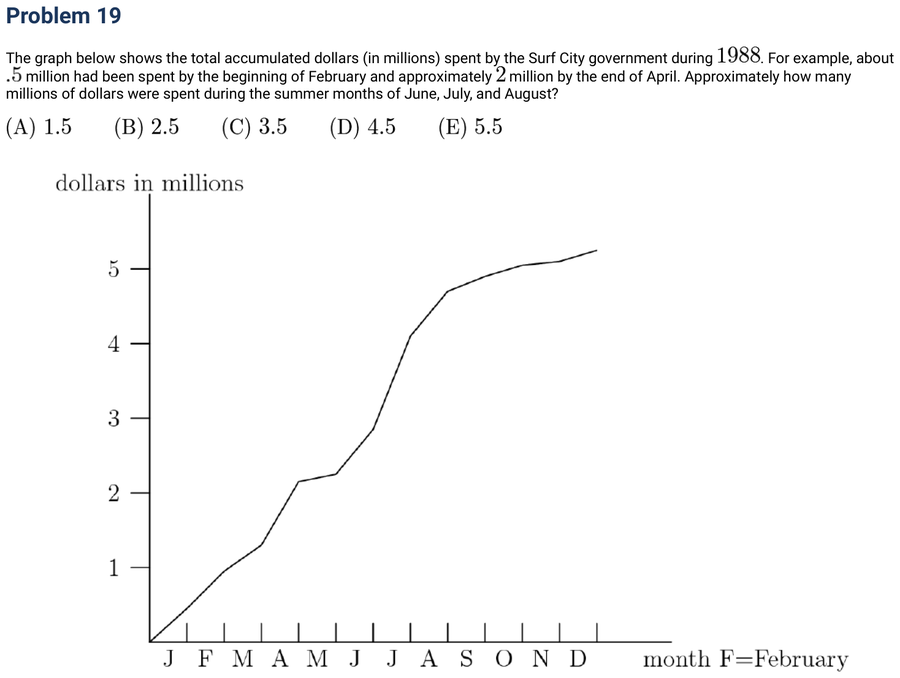
Read carefully: the graph shows TOTAL accumulated dollars, a running tally that only climbs. The height at any month is everything spent up to then — not the spending of that month alone.
Still stuck? Show hint 2 →
Hint 2 of 3
On a running-total graph, the spending during a stretch of time is how much the curve RISES across that stretch (end value minus start value), not the height itself.
Still stuck? Show hint 3 →
Hint 3 of 3
Summer is June, July, August — so it starts at the end of May and finishes at the end of August. Read the curve's height at both moments and subtract.
Show solution
Approach: rise of the running total across the window
The key is the word 'accumulated' — the curve is a running total that never goes down, so each month's height already includes all earlier months. To isolate the summer, take the rise of the curve from where summer begins to where it ends.
Summer = June + July + August, which spans from end-of-May to end-of-August. Read the curve: ≈ 2.2 million at end-of-May, ≈ 4.7 million at end-of-August.
Summer spending ≈ 4.7 − 2.2 = 2.5 million.
Trap to avoid: don't read 4.7 (the end-of-summer total) as the summer's spending — that would count the whole first half of the year too. On any cumulative graph, a period's amount is always a difference of two heights.
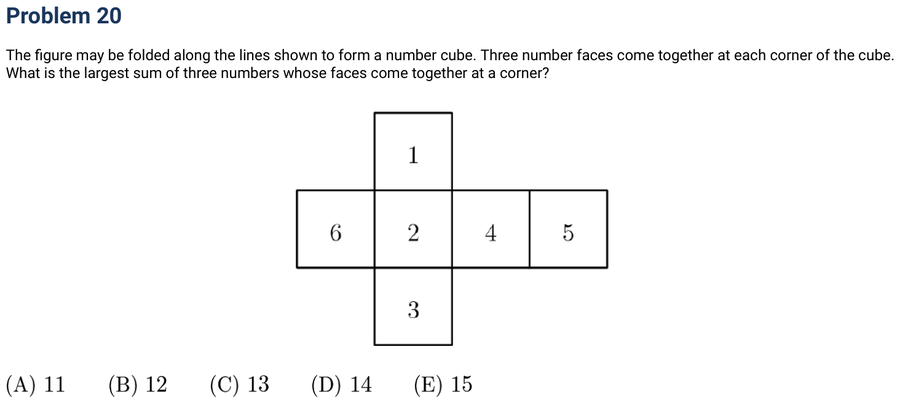
Don't fold the whole cube in your head — just find which faces end up OPPOSITE each other, because opposite faces can never touch at a corner.
Still stuck? Show hint 2 →
Hint 2 of 3
Every corner is where three faces meet, and those three are exactly one from each opposite pair. So to make a corner sum biggest, grab the larger number from each pair.
Still stuck? Show hint 3 →
Hint 3 of 3
In a straight row of the net, faces two apart are opposite. The row 6, 2, 4, 5 gives 6↔4 and 2↔5; the up-down arm gives 1↔3.
Show solution
Approach: find the three opposite pairs, take the larger of each
First pair off opposite faces. In the horizontal strip 6 – 2 – 4 – 5, faces two apart fold to opposite sides: 6↔4 and 2↔5. The vertical arm 1 – 2 – 3 gives 1↔3. So the three opposite pairs are {6, 4}, {2, 5}, {1, 3}.
A corner is made of three faces, one drawn from each opposite pair (two opposite faces can't share a corner). To maximize, take the bigger of each pair: 6, 5, and 3.
Largest corner sum = 6 + 5 + 3 = 14. And such a corner really exists, since picking one face from each pair always meets at a single vertex.
Why this transfers: cube-net problems become easy once you stop folding and instead identify the three opposite pairs — faces two apart in a row, or the ends of a T/L bend, are opposite.
Jack had a bag of 128 apples. He sold 25% of them to Jill. Next he sold 25% of those remaining to June. Of those apples still in his bag, he gave the shiniest one to his teacher. How many apples did Jack have then?
Show answer
Answer: D — 71.
Show hints
Hint 1 of 3
Instead of tracking what's sold, track what STAYS: selling 25% means 75% = 3⁄4 remains. That turns each sale into a single multiplication.
Still stuck? Show hint 2 →
Hint 2 of 3
Each '25% off the remainder' acts on whatever is left at that moment, not on the original — so multiply by 3⁄4 step after step.
Still stuck? Show hint 3 →
Hint 3 of 3
128 was chosen so the 3⁄4's come out whole: 128 → 96 → 72. Then one apple goes to the teacher.
Show solution
Approach: keep 3⁄4 each time, then subtract 1
Reframe each sale by what remains: selling 25% leaves 75% = 3⁄4. After Jill, 128 × 3⁄4 = 96 apples remain.
The second 25% is taken from the 96 now in the bag, not from the original 128: 96 × 3⁄4 = 72 remain.
Give the shiniest one to the teacher: 72 − 1 = 71.
Trap to avoid: the percents do NOT add up to '50% gone.' Each percent eats a slice of a smaller pile, so apply them one at a time, multiplying by 3⁄4 each round — successive percents multiply, they never add.
What is the number of the line on which AJHSME 1989 will appear for the first time?
Show answer
Answer: C — 12.
Show hints
Hint 1 of 3
The letters and the digits cycle on their own clocks: 6 letters need 6 steps to come home, 4 digits need 4 steps. When do BOTH come home at once?
Still stuck? Show hint 2 →
Hint 2 of 3
Two repeating cycles realign for the first time at the least common multiple of their lengths — the smallest number that's a whole count of each.
Still stuck? Show hint 3 →
Hint 3 of 3
List multiples of 6 (6, 12, 18, …) and of 4 (4, 8, 12, …) and catch the first they share.
Show solution
Approach: least common multiple of the two cycle lengths
Each part is back to its start on its own schedule: the 6 letters realign every 6 lines, the 4 digits every 4 lines. The full word AJHSME 1989 reappears only when both happen on the same line.
That first shared moment is the least common multiple: multiples of 6 are 6, 12, 18…; of 4 are 4, 8, 12…; the first match is LCM(6, 4) = 12.
Trap to avoid: it is NOT 6 × 4 = 24. Two cycles can sync up sooner than their product whenever the lengths share a factor (here both share a 2), so always use the LCM, not the plain product. Why this transfers: any 'when do two repeating things coincide' question — gears, blinking lights, planet alignments — is an LCM.
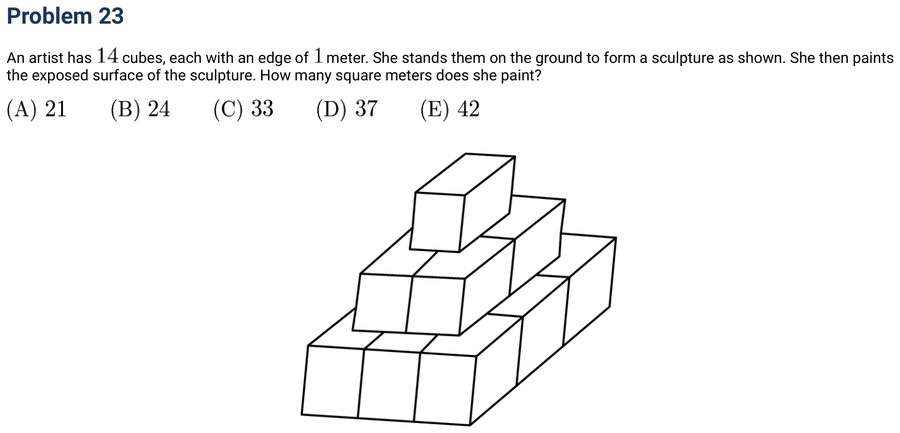
Painted area = number of EXPOSED unit faces (each 1 m²). A face is unpainted only if it touches the ground or is pressed against a neighboring cube.
Still stuck? Show hint 2 →
Hint 2 of 3
Counting one cube at a time invites double-counting. Instead sweep the whole sculpture by viewing direction — top, then each side — and tally the faces you can actually see from each.
Still stuck? Show hint 3 →
Hint 3 of 3
The bottom faces sit on the ground (never painted), so the work is: all top-visible faces plus the exposed faces on the front, back, and two sides.
Show solution
Approach: tally exposed faces by viewing direction
Only faces touching nothing get paint — faces on the ground or glued to a neighbor are skipped. So organize the count by direction instead of cube-by-cube, which avoids missing or repeating faces.
Looking straight down, 10 cube-tops are uncovered → 10. The front shows 6 exposed faces and the back another 6. The two side walls together expose 11 more.
Total painted = 10 + 6 + 6 + 11 = 33 m².
Why this transfers: for any blocky solid, painted surface = total faces (cubes × 6) minus the hidden ones (on the ground or shared between touching cubes). Counting by direction is just an organized way to do exactly that without losing track.
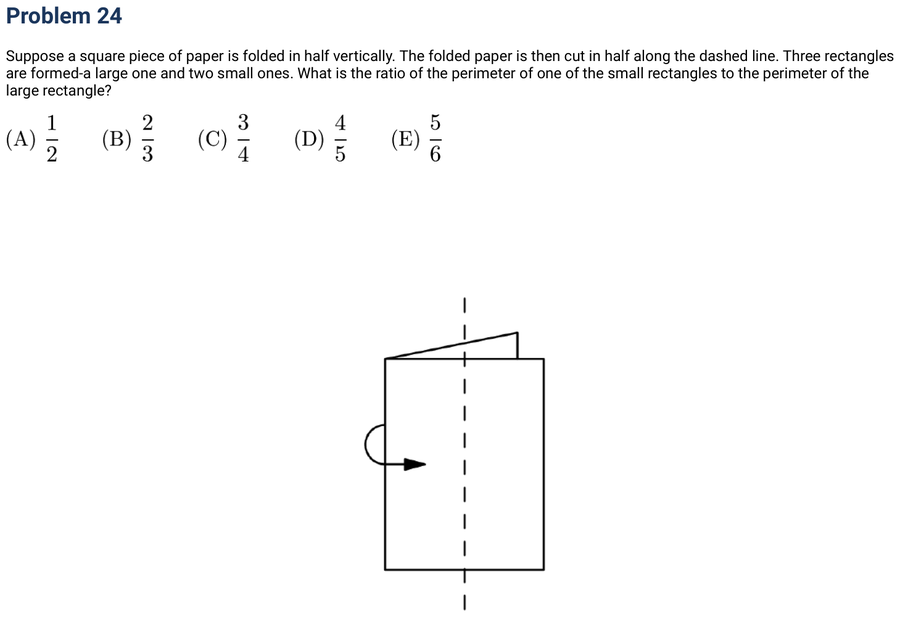
No numbers are given, so invent a friendly side length — pick 4 — so the folded and cut pieces all have whole-number sides.
Still stuck? Show hint 2 →
Hint 2 of 3
The big question is why ONE piece is large and TWO are small. Think about the layers: at the folded crease the paper is connected, but on the open edge the two layers are separate sheets.
Still stuck? Show hint 3 →
Hint 3 of 3
Fold makes a 2-wide, 4-tall double stack; cutting it in half puts the cut 1 unit from the fold. Whatever includes the fold opens into one piece; whatever is on the open side is really two loose layers.
Show solution
Approach: assign side 4, then track folded layers
Let the square be 4 × 4. Folding in half makes a double-thick stack 2 wide and 4 tall. Cutting this stack in half parallel to the fold puts the cut 1 unit from the fold, splitting it into a fold-side strip and an open-side strip, each 1 × 4 in the folded view.
Now unfold. The fold-side strip straddles the crease, so its two layers are joined — it opens into one 2 × 4 large rectangle. The open-side strip's two layers were never connected, so they fall apart into two separate 1 × 4 small rectangles. That's why there are three pieces: one big, two small.
Perimeters: small = 2(1 + 4) = 10, large = 2(2 + 4) = 12. Ratio small : large = 10 : 12 = 5⁄6.
Why this transfers: in fold-and-cut puzzles, a cut across the fold keeps a piece joined while a cut on the open side doubles into two. Picking a concrete size turns an abstract ratio into countable rectangles.
The exact numbers don't matter for an even sum — only whether each is even or odd. A sum is even exactly when the two numbers MATCH in parity: both even, or both odd.
Still stuck? Show hint 2 →
Hint 2 of 3
Strip each wheel down to its even/odd chances, then combine: P(match) = P(both even) + P(both odd).
Still stuck? Show hint 3 →
Hint 3 of 3
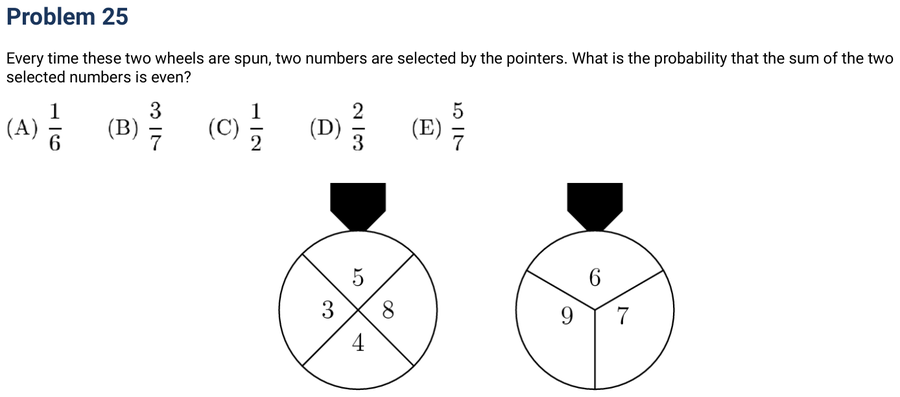
Wheel 1's four equal sectors {5, 3, 8, 4} are half even, half odd. Wheel 2's three equal sectors {6, 9, 7} are one even, two odd.
Show solution
Approach: reduce each wheel to even/odd, then match parities
An even sum needs the two numbers to share parity (even + even or odd + odd), so the actual values are irrelevant — only even-vs-odd counts. Reduce each wheel: Wheel 1 {5, 3, 8, 4} has 2 evens and 2 odds → P(even) = ½, P(odd) = ½. Wheel 2 {6, 9, 7} has 1 even and 2 odds → P(even) = ⅓, P(odd) = ⅔.
Since the wheels are independent, multiply within each case and add the two winning cases: P(both even) + P(both odd) = (½·⅓) + (½·⅔) = 1⁄6 + 2⁄6 = 1⁄2.
Why this transfers: for sum-parity questions, throw away the numbers and keep only even/odd labels — it shrinks a messy spinner into a tiny 'do the parities match?' calculation.
Another way — count all 12 equally-likely outcomes:
There are 4 × 3 = 12 equally likely (wheel1, wheel2) pairs. The sum is even when parities match.