In July 1861, 366 inches of rain fell in Cherrapunji, India. What was the average rainfall in inches per hour during that month?
Show answer
Answer: A — 366 ⁄ (31 × 24).
Show hints
Hint 1 of 2
You're asked for rain *per hour*, but the rain is given *per month*. What do you need to divide by to get from a month down to one hour?
Still stuck? Show hint 2 →
Hint 2 of 2
An average rate is always total amount ÷ total of the units you want — here, inches ÷ hours.
Show solution
Approach: average rate = total ÷ number of units
"Per hour" is the giveaway: an average rate is the total spread evenly over every hour, so it's total inches ÷ total hours. No real arithmetic needed — just assemble the right division.
How many hours in July? 31 days × 24 hours, so the answer is 366 ⁄ (31 × 24).
Sanity check on the wrong options: anything that *multiplies* by 31 or 24 makes the rain bigger, but spreading it out over more time must make the per-hour figure *smaller* — only choice A divides.
Which of the following numbers has the largest reciprocal?
Show answer
Answer: A — 1⁄3.
Show hints
Hint 1 of 2
Picture cutting a pizza: dividing 1 into *more* pieces (a bigger number on the bottom) makes each piece *smaller*. So which number gives the biggest reciprocal?
Still stuck? Show hint 2 →
Hint 2 of 2
Reciprocal flips a number over 1, and flipping reverses the order: the smallest positive number has the largest reciprocal.
Show solution
Approach: flipping reverses size order
The reciprocal of a positive number is 1 over it. Taking 1-over reverses the size order — the *smallest* number turns into the *largest* reciprocal. So you never have to compute a single reciprocal; just find the smallest number.
The smallest of the choices is 1⁄3; its reciprocal is 3, larger than the reciprocals of 1, 5, and 1986 (which are all 1 or less).
Why this transfers: whenever you flip a list of positive numbers, biggest and smallest swap places — handy for spotting the answer without arithmetic.
The smallest sum one could get by adding three different numbers from the set {7, 25, −1, 12, −3} is
Show answer
Answer: C — 3.
Show hints
Hint 1 of 2
To make a sum as *small* as possible, you want each piece you add to be as small as possible. So which three numbers should you grab?
Still stuck? Show hint 2 →
Hint 2 of 2
The smallest possible sum uses the three smallest numbers — and don't be fooled, the most negative numbers are the smallest.
Show solution
Approach: smallest sum = three smallest numbers
A sum gets smaller every time you swap in a smaller number, so the smallest total comes from the three smallest numbers in the set.
Order the set: −3, −1, 7, 12, 25. The three smallest are −3, −1, 7, giving −3 + (−1) + 7 = 3.
Watch the trap: −3 by itself is smaller than 3, but the problem forces you to add *three different* numbers — you can't stop at one or two. The smallest two would be −4, but the required third number drags it back up.
The word "closest" is permission to be lazy: you don't need the exact answer, just the right ballpark. What clean numbers are these almost equal to?
Still stuck? Show hint 2 →
Hint 2 of 2
Round each factor to something easy *before* multiplying — the tiny .07 can't matter when the choices are spread out (7, 42, 74, 84, 737).
Show solution
Approach: estimate by rounding the factors first
Because we only need the closest choice, round: 40.3 + .07 ≈ 40, and 1.8 stays. The 0.07 is far too small to move the answer, so don't waste effort on it.
1.8 × 40 = 72, and the nearest choice is 74.
Sanity check using the spread-out choices: 1.8 is between 1 and 2, so the product must be between 40 and 80 — that instantly rules out 7, 42, 84, and 737, leaving only 74.
A contest began at noon one day and ended 1000 minutes later. At what time did the contest end?
Show answer
Answer: D — 4:40 a.m.
Show hints
Hint 1 of 2
1000 loose minutes is hard to add to a clock. What unit would make adding to "noon" easy?
Still stuck? Show hint 2 →
Hint 2 of 2
Trade the minutes in for hours: how many whole hours fit in 1000 minutes, and how many minutes are left over?
Show solution
Approach: convert minutes to hours-and-minutes, then add
Clocks count in hours, so first turn 1000 minutes into hours. Since 60 minutes make an hour, 1000 ÷ 60 = 16 with 40 left over: that's 16 hours 40 minutes.
Add to noon. 16 hours past noon: noon + 12 h = midnight, then + 4 more h = 4:00 a.m.; the leftover 40 minutes makes 4:40 a.m. the next day.
Why split off the 12 first: jumping straight to midnight handles the a.m./p.m. flip cleanly, so you don't accidentally land on 4:40 p.m.
A fraction with a fraction inside it looks scary. Untangle the inside (the bottom) into one clean number before you do anything else.
Still stuck? Show hint 2 →
Hint 2 of 2
Dividing by a fraction is the same as multiplying by its flip — so dividing by 1⁄3 means multiplying by 3.
Show solution
Approach: collapse the inner fraction, then flip-and-multiply
Work from the inside out. The bottom is 1 − 2⁄3; think of 1 as 3⁄3, so 3⁄3 − 2⁄3 = 1⁄3.
Now it's just 2 ÷ 1⁄3. Dividing by 1⁄3 asks "how many thirds fit in 2?" — and 6 thirds make 2, so the answer is 6.
Sanity check on size: the bottom 1⁄3 is much smaller than 1, and dividing by something less than 1 always makes a number *bigger*, so an answer above 2 is expected (rules out every choice but 6).
You don't need the messy decimal values of √8 and √80 — you only need to know which two *whole* numbers each one is trapped between. Which perfect squares sit just below and just above 8? And around 80?
Still stuck? Show hint 2 →
Hint 2 of 2
Once each square root is pinned between two integers, just list the whole numbers caught in between (carefully decide whether the endpoints count).
Show solution
Approach: trap each root between neighboring perfect squares
√8 lives between √4 = 2 and √9 = 3, so 2 < √8 < 3. √80 lives between √64 = 8 and √81 = 9, so 8 < √80 < 9. You never compute a decimal — the perfect squares fence the roots in.
Now count the whole numbers strictly between 2.something and 8.something: 3, 4, 5, 6, 7, 8 — that's 6.
Why this works generally: to locate any √N, find the perfect squares just below and above N; that brackets the root without a calculator. Trap to watch: √8 ≈ 2.83, so 2 is *not* included, and √80 ≈ 8.94, so 8 *is*.
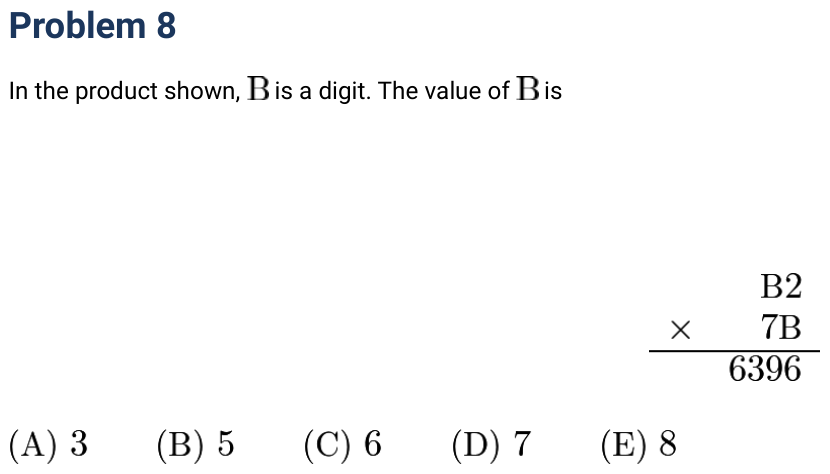
Don't try every digit 0–9. The very last digit of the answer (the 6 in 6396) is decided only by the last digits being multiplied — so look at the ones column first.
Still stuck? Show hint 2 →
Hint 2 of 3
The ones digit of B2 is 2 and of 7B is B, so the product's ones digit comes from 2 × B. For what B does 2 × B end in 6? That narrows ten guesses down to two.
Still stuck? Show hint 3 →
Hint 3 of 3
With only two candidates left, a single quick multiplication tells you which one is right.
Show solution
Approach: ones-digit filter, then verify the survivor
Attack the ones column first — it's independent of all the carrying. The ones digits being multiplied are 2 (from B2) and B (from 7B), so 2 × B must end in the product's last digit, 6.
2 × B ends in 6 only when B = 3 (gives 6) or B = 8 (gives 16). That's the whole point: a 10-way search collapses to 2.
Check the survivors: 32 × 73 = 2336 (too small), but 82 × 78 = 6396 ✓. So B = 8.
Why this transfers: in any 'find the hidden digit' puzzle, the ones digit of a product depends only on the ones digits of the factors — start there to slash your candidates before doing real arithmetic.
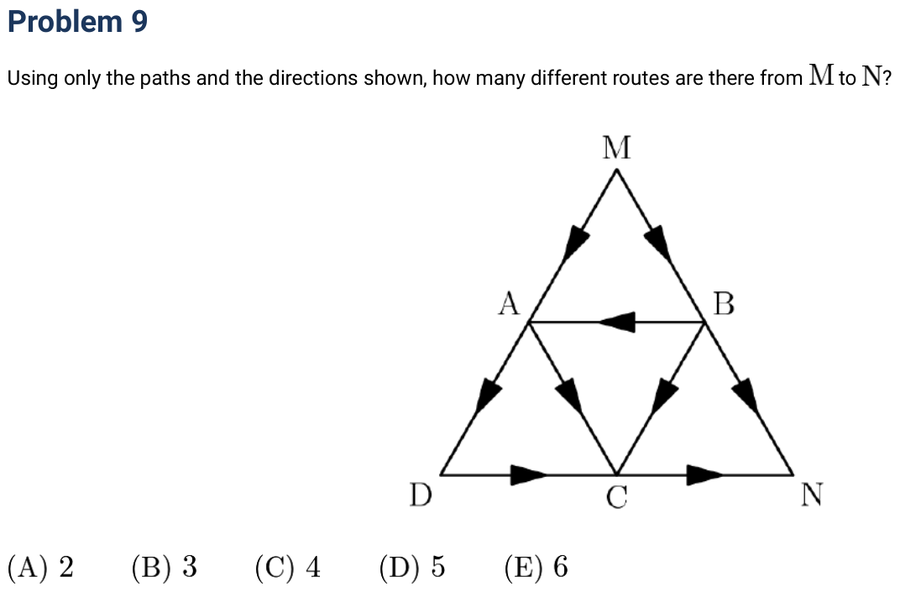
Tracing every full route by hand invites missed ones and double-counts. Notice something cleaner: the number of ways to reach a point is just the total of the ways to reach the points whose arrows feed into it.
Still stuck? Show hint 2 →
Hint 2 of 3
So label each point with a count, working outward from M (which counts as 1 way — you're already there), adding up the incoming arrows' counts as you go.
Still stuck? Show hint 3 →
Hint 3 of 3
Follow the arrows in order so every point you add up is already finished. Any point an arrow leaves *to* gets that count poured into it.
Show solution
Approach: label each point with its number of routes (build up from M)
The key idea: the number of routes into a point equals the sum of the routes into the points that arrow toward it. So you never trace a whole path — you just accumulate. Start: M = 1 (there's one way to 'be at the start').
Top region: B is fed only by M, so B = 1. A is fed by M and by B, so A = 1 + 1 = 2.
Bottom: D is fed only by A, so D = 2. C is fed by A, B, and D, so C = 2 + 1 + 2 = 5.
Finally N is fed by B and C: N = 1 + 5 = 6 routes.
Why this transfers: this 'add up the incoming counts' trick is exactly how you count lattice paths (and how Pascal's triangle is built) — it turns an explosion of routes into a handful of additions.
A picture 3 feet across is hung in the center of a wall that is 19 feet wide. How many feet from the end of the wall is the nearest edge of the picture?
Show answer
Answer: B — 8.
Show hints
Hint 1 of 2
"Centered" is the whole secret: the wall left over after the picture is shared equally by the gap on the left and the gap on the right. So how much wall is left over, and how does it split?
Still stuck? Show hint 2 →
Hint 2 of 2
Find the leftover wall, then halve it — the two margins must be equal.
Show solution
Approach: leftover wall, split in half
Because the picture is centered, the wall that isn't covered is split into two equal gaps, one on each side. So first find that leftover: 19 − 3 = 16 feet of empty wall.
Split it evenly: 16 ÷ 2 = 8 feet from each end to the nearest edge of the picture.
Sanity check: 8 + 3 (picture) + 8 = 19 ✓. Watch the trap — 9 1⁄2 is half of the *whole* wall (the center line), not the distance to the picture's edge.
The ✶ symbol is a made-up rule, not real multiplication — translate it into plain English first. "(A + B) ⁄ 2" is just the *average* of A and B.
Still stuck? Show hint 2 →
Hint 2 of 2
Like nested parentheses, do the inside first: find 3 ✶ 5, then combine that result with 8.
Show solution
Approach: decode the symbol, work inside-out
Translate ✶: A ✶ B is simply the average (midpoint) of A and B. That turns a strange symbol into something familiar.
Inside first: 3 ✶ 5 is the average of 3 and 5, which is 4. Then 4 ✶ 8 is the average of 4 and 8, which is 6.
Watch the trap: ✶ is *not* ×, so 3 ✶ 5 is 4, not 15. With custom operators, always rewrite the rule in words before computing.
Sanity check: each ✶ produces a number between its two inputs, so the final answer must sit between 4 and 8 — 6 fits, while choices like 12, 16, 30 can't.
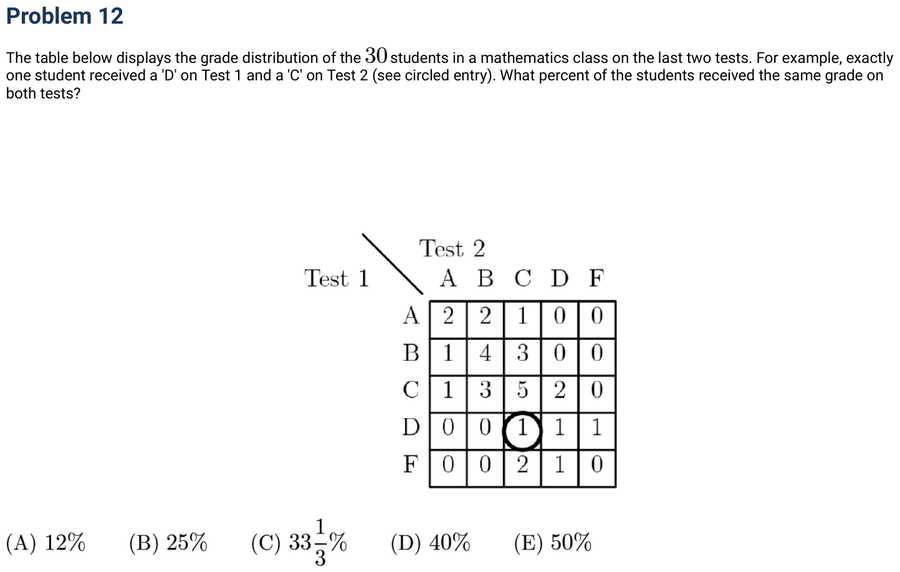
"Same grade on both tests" means Test-1 grade equals Test-2 grade. Where in a grid does the row label match the column label? Picture the path those cells trace.
Still stuck? Show hint 2 →
Hint 2 of 2
Those matching cells (A-A, B-B, C-C, D-D, F-F) run straight down the diagonal. Add just those five, then turn the count into a percent of 30.
Show solution
Approach: the matching cells form the diagonal
A student scored the same on both tests exactly when their row (Test 1) matches their column (Test 2). In the grid those equal-label cells line up on the main diagonal — so you ignore the other 20 cells entirely.
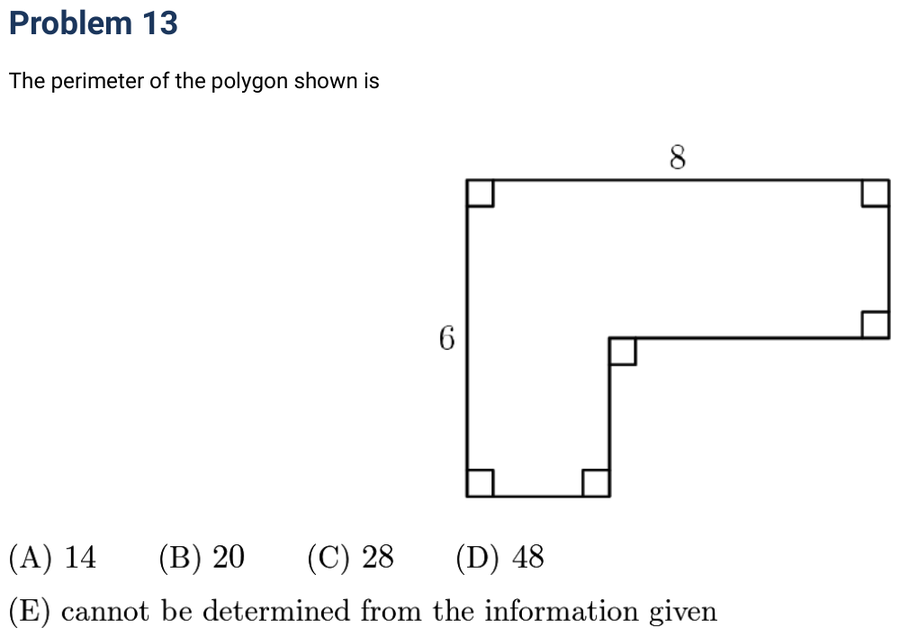
Only two lengths are labeled (8 and 6), yet the shape has six sides — so don't try to find each missing side. Instead ask: if you pushed the notched-in corner back out to make a full rectangle, would the total edge length change?
Still stuck? Show hint 2 →
Hint 2 of 3
Every horizontal piece on the staircase, added up, must still span the full width 8; every vertical piece must still span the full height 6. So the perimeter equals that of the surrounding 8-by-6 rectangle.
Still stuck? Show hint 3 →
Hint 3 of 3
Bounding rectangle: 8 wide, 6 tall — that alone fixes the perimeter even though individual side lengths are unknown.
Show solution
Approach: slide the step out — perimeter unchanged
Look at all the horizontal edges: going across, they must total the full width, 8. Same for the vertical edges: top to bottom they total the full height, 6. Sliding the inward 'step' out to the corner just rearranges those pieces without adding or removing any length.
So the perimeter is exactly that of the 8-by-6 bounding rectangle: 2(8 + 6) = 28.
This is why the answer isn't 'cannot be determined' even though the step's individual sizes are hidden — for any such rectilinear staircase shape, the perimeter depends only on the overall width and height.
Sanity check: the area would change if you moved the step, but the perimeter doesn't — a nice reminder that area and perimeter are independent.
If 200 ≤ a ≤ 400 and 600 ≤ b ≤ 1200, then the largest value of the quotient b ⁄ a is
Show answer
Answer: C — 6.
Show hints
Hint 1 of 2
A fraction grows two ways: a bigger top *or* a smaller bottom. To make b⁄a as large as it can be, push each part to its own extreme — which way for b, which way for a?
Still stuck? Show hint 2 →
Hint 2 of 2
Top as big as allowed, bottom as small as allowed: use b at its maximum and a at its minimum. The two choices don't interfere, so you can pick both extremes at once.
Show solution
Approach: push top up, bottom down
A quotient is largest when its numerator is largest and its denominator is smallest — and those two pushes are independent, so you can do both. Pick b at its top (1200) and a at its bottom (200).
b ⁄ a = 1200 ⁄ 200 = 6.
Watch the trap: it's tempting to use the two biggest numbers (1200 and 400), but a big denominator *shrinks* the fraction — 1200⁄400 = 3, smaller than 6. Smallest bottom is what matters.
Why this transfers: any 'maximize a fraction in a range' problem reduces to max-numerator-over-min-denominator (assuming everything stays positive).
Sale prices at the Ajax Outlet Store are 50% below original prices. On Saturdays an additional discount of 20% off the sale price is given. What is the Saturday price of a coat whose original price is $180?
Show answer
Answer: B — $72.
Show hints
Hint 1 of 2
The two discounts don't add up to 70% off. The 20% comes off the *already-reduced* sale price, not the original — so the discounts stack one after the other. What fraction of the price *survives* each cut?
Still stuck? Show hint 2 →
Hint 2 of 2
Track what you keep, not what you lose: after "50% off" you keep 0.5 of the price; after a further "20% off" you keep 0.8 of that. Multiply the keep-factors.
Show solution
Approach: chain the 'fraction kept' factors
Each discount is taken on the current price, so they multiply rather than add. After 50% off you keep half: $180 × 0.5 = $90 (the sale price).
On Saturday, 20% off means you keep 80% of *that*: $90 × 0.8 = $72.
Watch the trap: 50% + 20% is *not* 70% off (that would give $54). Successive discounts stack multiplicatively — keeping 0.5 then 0.8 means keeping 0.5 × 0.8 = 0.4, i.e. 40% of $180.
Why this transfers: any chain of percent changes is handled by multiplying 'fraction remaining' factors — far safer than adding or subtracting the percents.
Another way — combine the factors first:
Keep-factor overall = 0.5 × 0.8 = 0.4, so Saturday price = $180 × 0.4 = $72 in one step.
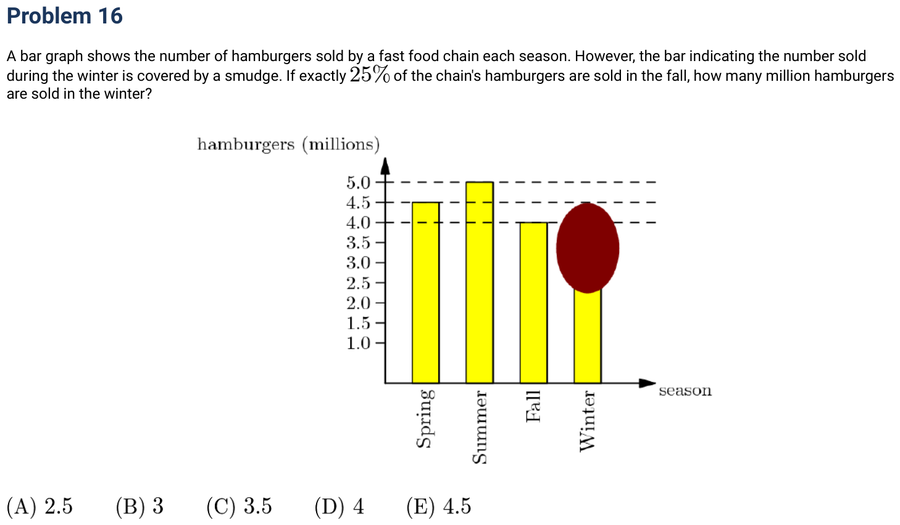
The winter bar is hidden, so you can't read it — but the other three bars *are* readable, and the 25% fact secretly tells you the grand total. What is 25% as a simple fraction, and what does that say about the total?
Still stuck? Show hint 2 →
Hint 2 of 3
25% means 'one quarter,' so Fall is a quarter of the whole year — making the total four times the Fall bar. Find the total, then subtract the three visible bars to uncover winter.
Still stuck? Show hint 3 →
Hint 3 of 3
Read the bars: Spring 4.5, Summer 5, Fall 4. The total is 4 × Fall.
Show solution
Approach: use 25% to recover the total, then subtract the visible seasons
The covered bar can't be measured, so come at it from the total instead. 25% is exactly one quarter, and Fall is that quarter, so the whole year = 4 × Fall = 4 × 4 = 16 million.
Read the three uncovered bars: Spring 4.5, Summer 5, Fall 4 (total 13.5 million).
Winter is whatever's left of the total: 16 − 13.5 = 2.5 million.
Why this works: a hidden value in a 'parts add to a whole' setup is best found as total − (everything else) — and a tidy percent like 25% is your shortcut to that total.
Let o be an odd whole number and let n be any whole number. Which of the following statements about the whole number (o² + no) is always true?
Show answer
Answer: E — it is odd only if n is even.
Show hints
Hint 1 of 3
Don't grind through cases — both terms share a common factor of o. Pulling it out turns the whole thing into a *product* of two pieces, and a product's odd/even-ness is easy to read off.
Still stuck? Show hint 2 →
Hint 2 of 3
o² + no = o(o + n). A product of whole numbers is odd only when *both* parts are odd. The first part o is already odd, so everything hinges on whether o + n is odd or even.
Still stuck? Show hint 3 →
Hint 3 of 3
o + n is odd ⟺ you added an odd and an even. Since o is odd, that needs n even.
Show solution
Approach: factor out o, then read the parity of the product
Factor the shared o: o² + no = o(o + n). Now it's one odd number (o) times another number (o + n), and a product is odd only when both factors are odd — otherwise an even factor drags the whole thing even.
The first factor o is odd no matter what. So the product is odd exactly when o + n is also odd. Adding to the odd o, you get an odd total only by adding an *even* n (odd + even = odd; odd + odd = even).
Therefore the expression is odd only if n is even — answer E.
Sanity check with numbers: o = 3, n = 2 → 9 + 6 = 15 (odd, n even ✓); o = 3, n = 1 → 9 + 3 = 12 (even, n odd ✓). The 'odd happens only with even n' pattern holds.
Why factoring first helps: turning a sum into a product lets you judge odd/even instantly, since one even factor makes the product even — a tactic worth reaching for whenever a common factor is in sight.
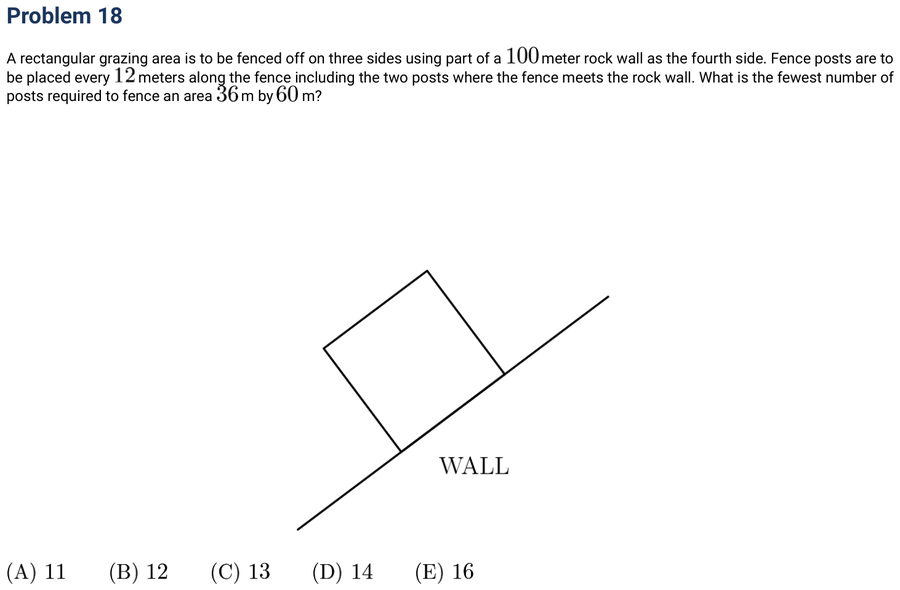
'Fewest posts' is a hint about which side to hide against the wall — the wall side needs no fence and no posts of its own, so put the *longest* side there to fence the least length.
Still stuck? Show hint 2 →
Hint 2 of 3
Now you have one straight path of fence (unrolled, it's just a line). The classic trap: a 132 m line with posts every 12 m has 132⁄12 = 11 gaps but 12 posts — one more post than gaps, because both ends get a post.
Still stuck? Show hint 3 →
Hint 3 of 3
Check the corners: at 36 m and 96 m the fence bends, but both are multiples of 12, so a post already lands there — no bonus posts needed.
To use the *fewest* posts, fence the *least* length, so press the longest side (60 m) against the wall — that side needs no fence. The remaining three sides total 36 + 60 + 36 = 132 m of fence.
Think of that 132 m as one straight run (the corners don't change its length). Posts sit every 12 m, so there are 132⁄12 = 11 gaps — but the number of posts is one more than the gaps because both endpoints get a post: 11 + 1 = 12.
Double-check the bends at 36 m and 96 m: both are multiples of 12, so posts already land exactly on the corners — nothing extra to add.
Why 'posts = gaps + 1': this is the fencepost principle — the off-by-one that bites people who just divide and forget the two endpoints. Cutting a line into n equal pieces always needs n + 1 marks.
At the beginning of a trip, the mileage odometer read 56,200 miles. The driver filled the gas tank with 6 gallons of gasoline. During the trip, the driver filled his tank again with 12 gallons of gasoline when the odometer read 56,560. At the end of the trip, the driver filled his tank again with 20 gallons of gasoline. The odometer read 57,060. To the nearest tenth, what was the car's average miles-per-gallon for the entire trip?
Show answer
Answer: D — 26.9.
Show hints
Hint 1 of 3
The numbers are designed to trip you up. MPG = miles ÷ gas *used*. The very first 6 gallons were poured in *before* any of the measured driving — so does that gas belong in 'gas used during the trip'?
Still stuck? Show hint 2 →
Hint 2 of 3
A refill replaces exactly the gas you just burned. So the gas used between the start and end odometer readings is the sum of the *later* fill-ups, not the first one.
Still stuck? Show hint 3 →
Hint 3 of 3
Miles = end odometer − start odometer; gas used = the two refills made during the trip.
Show solution
Approach: miles driven ÷ gas burned (the refills during the trip)
First the easy part: miles driven = 57,060 − 56,200 = 860 miles.
Now the trap. The opening 6 gallons just filled the tank at the start — that gas measures driving from *before* this trip, not during it. Every refill afterwards replaces exactly what was burned since, so the gas used over these 860 miles is 12 + 20 = 32 gallons.
MPG = 860 ÷ 32 = 26.875 ≈ 26.9.
Why exclude the first fill: 'miles per gallon' pairs the distance with the fuel that distance consumed. Including the initial top-off (giving 860⁄38 ≈ 22.6, choice B — the planted wrong answer) would mix in fuel for earlier miles. Match the gas to the miles it actually moved.
The value of the expression (304)⁵ ⁄ ((29.7)(399)⁴) is closest to
Show answer
Answer: D — 3.
Show hints
Hint 1 of 3
Never compute a fifth power here — the word 'closest' plus those round-ish numbers (304, 399, 29.7) is begging you to round to 300, 400, 30 first.
Still stuck? Show hint 2 →
Hint 2 of 3
After rounding, you have 300⁵ on top and 400⁴ on the bottom. Don't expand them — pair up four of the 300s with the four 400s to make (300⁄400)⁴ = (3⁄4)⁴, and you're left with one spare 300 over the 30.
Still stuck? Show hint 3 →
Hint 3 of 3
(3⁄4)⁴ is a bit under ⅓, and the leftover 300⁄30 = 10, so the product is roughly 10 × (a third).
Show solution
Approach: round, then pair the powers into (3⁄4)⁴
'Closest' means estimate, so round to friendly numbers: 304 → 300, 399 → 400, 29.7 → 30. The expression becomes 300⁵ ⁄ (30 · 400⁴).
Don't expand the powers — regroup instead. Match four 300s against the four 400s: (300⁄400)⁴ = (3⁄4)⁴. The fifth 300 pairs with the 30 to give 300⁄30 = 10.
So it's (3⁄4)⁴ · 10 = (81⁄256) · 10 ≈ 0.316 · 10 ≈ 3.16, closest to 3.
Sanity check the size: 81⁄256 is just under ⅓, and ⅓ of 10 is about 3.3 — so the answer is a small single-digit number, instantly ruling out the .003, .03, .3, and 30 options. The art is grouping powers before multiplying, not crunching huge numbers.
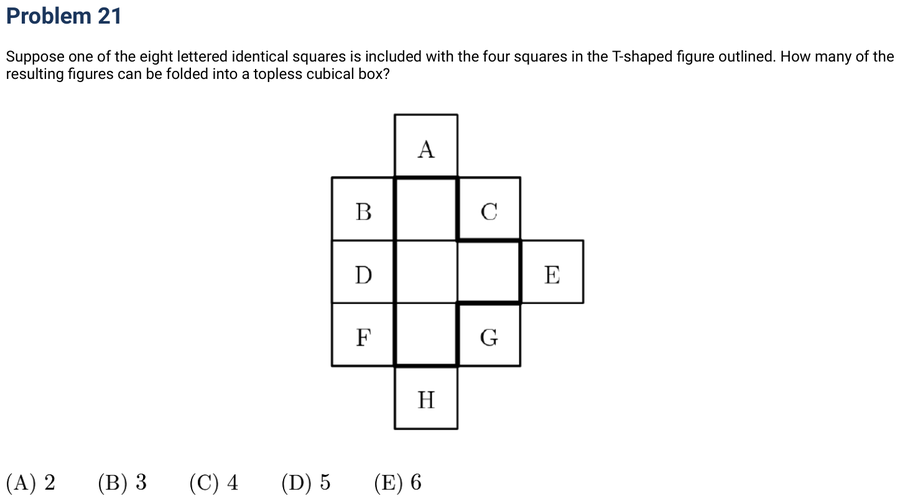
A box with no top is just 4 walls plus a floor — exactly 5 squares. The T already gives 4, so adding any one lettered square gives the right *count*; the real question is whether they fold without overlapping.
Still stuck? Show hint 2 →
Hint 2 of 3
Don't fold all eight in your head at once. Mentally fold the 4 squares of the T into an open box first, then for each lettered square just ask: does it land on an empty wall, or does it crash into a face that's already there?
Still stuck? Show hint 3 →
Hint 3 of 3
A choice fails only when, after folding, it would cover a spot another square already occupies (two faces on the same side).
Show solution
Approach: fold the T into an open box, then test each added square
A topless cube needs 5 squares (4 sides + a bottom), and the T supplies 4, so every choice has the correct number — the only way to fail is an *overlap* when folded.
Fold the T's four squares up into an open box, leaving one wall missing. Each lettered square either folds neatly into the one empty face or collides with a face that's already filled.
Going through the eight positions, only two of them fold onto an already-used face; the other 6 complete a topless cubical box.
Why count squares first: knowing a topless cube is exactly 5 faces tells you instantly that 'how many squares' is never the obstacle — the whole puzzle is purely about overlaps, so you only have to test for collisions.
Alan, Beth, Carlos, and Diana were discussing their possible grades in mathematics class this grading period. Alan said, "If I get an A, then Beth will get an A." Beth said, "If I get an A, then Carlos will get an A." Carlos said, "If I get an A, then Diana will get an A." All of these statements were true, but only two of the students received an A. Which two received A's?
Show answer
Answer: C — Carlos, Diana.
Show hints
Hint 1 of 3
Picture the three statements as falling dominoes pointing one way: Alan → Beth → Carlos → Diana. If a domino early in the line falls (gets an A), every domino after it must fall too. So who can afford to get an A without toppling too many?
Still stuck? Show hint 2 →
Hint 2 of 3
Count the dominoes that fall from each starting point. Alan's A topples 4 in all; Beth's topples 3; only starting near the *end* of the chain keeps the total at exactly 2.
Still stuck? Show hint 3 →
Hint 3 of 3
The arrows only point forward, so getting an A never forces anyone *earlier* — that's why the two A-getters must be the last links.
Show solution
Approach: follow the forward-only domino chain
Each 'if I get an A, then the next person does' is a one-way arrow: Alan → Beth → Carlos → Diana. An A anywhere knocks down everyone *after* it, but never anyone before.
Test from the front. If Alan gets an A, the chain forces Beth, Carlos, and Diana too — that's 4 A's, too many. If Beth gets an A, it forces Carlos and Diana — 3 A's, still too many. So neither Alan nor Beth can be one of the two.
That leaves the tail end. If Carlos gets an A, only Diana is forced — exactly 2 A's, and nobody else is dragged in: Carlos and Diana.
Why start from the front: because the arrows point forward, the *earlier* a person is, the more A's they trigger. To keep the count smallest, the A's must sit as far down the chain as possible — a handy rule for any 'if-then' chain problem.
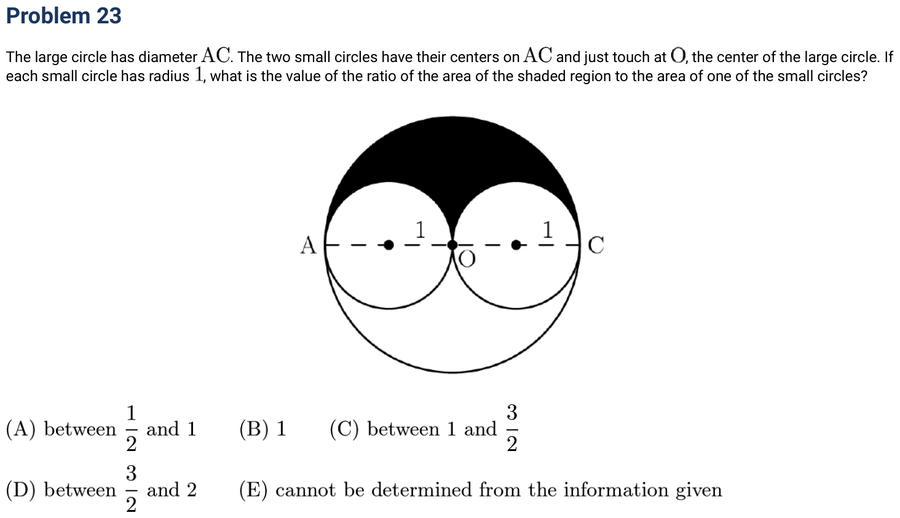
First nail down the sizes. Two small circles of radius 1 sit side by side along the diameter AC, so AC = 4, making the big circle's radius 2 — the big radius is double the small one.
Still stuck? Show hint 2 →
Hint 2 of 3
The shaded blob is the *top half* of the big circle with the *top halves* of the two small circles scooped out. Write shaded = (half the big disk) − (two half small disks) and let the π's do the work.
Still stuck? Show hint 3 →
Hint 3 of 3
Don't fear π — it will cancel when you form the final ratio, so the answer is a clean number.
Show solution
Approach: shaded = half big disk − two half small disks
Sizes first: the two radius-1 circles span AC, so AC = 4 and the big radius is 2. Doubling the radius is the key — area grows with the *square* of the radius.
The shaded region is the upper half of the big circle minus the upper halves of the two small circles: ½(π · 2²) − 2 · [½(π · 1²)] = 2π − π = π.
The question asks for the ratio of this to *one* small circle (area π · 1² = π): π ⁄ π = 1. The π cancels, leaving a tidy whole number.
Neat takeaway: even though the big circle has 4× the area of a small one, slicing everything in half and subtracting leaves the shaded piece exactly equal to a whole small circle — a reminder that 'radius doubles ⇒ area quadruples' drives these comparisons.
The 600 students at King Middle School are divided into three groups of equal size for lunch. Each group has lunch at a different time. A computer randomly assigns each student to one of three lunch groups. The probability that three friends, Al, Bob, and Carol, will be assigned to the same lunch group is approximately
Show answer
Answer: B — 1⁄9.
Show hints
Hint 1 of 3
Don't worry about *which* of the three groups they all end up in — just let Al go wherever he goes and treat his group as 'the target.' Now the only question is whether the other two follow him there.
Still stuck? Show hint 2 →
Hint 2 of 3
Each remaining friend independently lands in Al's group with chance about 1⁄3. The word 'same group' means *both* of them must match Al, so combine the two chances.
Still stuck? Show hint 3 →
Hint 3 of 3
Independent 'and' events multiply their probabilities.
Show solution
Approach: anchor on Al, then require the others to match
Anchor the problem on Al: wherever he lands becomes 'the target group,' which costs no probability — he's somewhere for sure. This sidesteps having to sum over all three groups.
Now Bob must land in Al's group (chance ≈ 1⁄3, since the three groups are equal size and the 600 students make it essentially even) and Carol must too (another ≈ 1⁄3), independently.
'Bob matches AND Carol matches' multiplies: 1⁄3 × 1⁄3 = 1⁄9.
Why anchoring helps: fixing one object as the reference removes a layer of casework — you no longer care which group, only that the rest agree with it. (The '600 students, equal groups' detail is what makes each chance a clean 1⁄3.)
Another way — count equally likely group-triples:
List the group each friend gets as a triple; there are 3 × 3 × 3 = 27 equally likely assignments. 'All same' happens in 3 of them (all-group-1, all-group-2, all-group-3), so the probability is 3⁄27 = 1⁄9.
Which of the following sets of whole numbers has the largest average?
Show answer
Answer: D — multiples of 5 between 1 and 101.
Show hints
Hint 1 of 3
You do NOT have to add up dozens of numbers. Each list is evenly spaced, so its values are perfectly balanced around their middle — the average is just the midpoint of the first and last terms.
Still stuck? Show hint 2 →
Hint 2 of 3
So for each set you only need two numbers: its smallest multiple and its largest multiple (up to 100). Average = (first + last) ⁄ 2.
Still stuck? Show hint 3 →
Hint 3 of 3
The winner will tend to be the one whose last term reaches closest to the top, 100.
Show solution
Approach: average of an evenly-spaced list = (first + last) ⁄ 2
Each set is an evenly-spaced (arithmetic) list, and such lists are symmetric about their center — every term below the middle is matched by one equally far above. So the average equals the midpoint of the first and last terms; no long addition needed.
Just grab first and last of each: 2's → (2 + 100)⁄2 = 51; 3's → (3 + 99)⁄2 = 51; 4's → (4 + 100)⁄2 = 52; 5's → (5 + 100)⁄2 = 52.5; 6's → (6 + 96)⁄2 = 51.
The largest is 52.5, from the multiples of 5.
Why 5 wins: its last multiple under 101 is 100 (hitting the ceiling) while its first term, 5, is small — so its first-and-last midpoint sits highest. Whenever you must average an evenly spaced list, reach for the (first + last)⁄2 shortcut.