Before multiplying anything out, scan the WHOLE expression as one big fraction: list every factor on top and every factor on the bottom. Notice anything?
Still stuck? Show hint 2 →
Hint 2 of 2
When every factor upstairs is matched by an identical factor downstairs, the product is forced to be 1 — you never need the actual numbers. This is the cancel-matching-factors habit: rearrange into one fraction first, then strike pairs.
Show solution
Approach: cancel matching factors
Write it as one fraction: the top has 3, 5, 7, 9, 11 and the bottom has 9, 11, 3, 5, 7 — the SAME five numbers. Every factor on top is matched by a copy on the bottom.
Matched pairs each make 1, so the whole product collapses to 1.
Why this transfers: whenever a product of fractions has identical numerators and denominators (just shuffled), the answer is 1 — spotting the matching set beats computing 945 ÷ 945.
Don't add left to right. In an evenly-spaced run, pair the smallest with the largest: 90 + 99, 91 + 98, 92 + 97… each pair makes the same total. What is that total, and how many pairs are there?
Still stuck? Show hint 2 →
Hint 2 of 2
Sum of an evenly-spaced run = (first + last)⁄2 × count — the (first+last)⁄2 is just the average, sitting right in the middle. So a long sum becomes one multiplication.
Show solution
Approach: average × count
These ten numbers climb by 1, so their average is the middle value: (90 + 99)⁄2 = 94.5. There are 10 of them.
Sum = 94.5 × 10 = 945 — the average times the count.
Sanity check: all ten numbers are in the 90s, so the total must be between 10×90 = 900 and 10×99 = 990. 945 lands right in the middle, as it should.
Another way — pair from the ends:
Pair 90+99, 91+98, 92+97, 93+96, 94+95 — five pairs, each summing to 189.
Don't divide the messy numbers head-on. Split the bottom: handle the 10⁴ against the 10⁷ separately from the 5. Dividing powers of 10 just means cancelling matching zeros.
Still stuck? Show hint 2 →
Hint 2 of 2
Powers of ten divide by subtracting exponents: 10⁷ ⁄ 10⁴ = 10⁷⁻⁴ = 10³. Peel off the 10s first, deal with the small factor (the 5) last.
Show solution
Approach: subtract powers, then divide
Group the tens: 10⁷ ⁄ 10⁴ = 10³ = 1000 (seven zeros over four zeros leaves three). Now just 1000 ÷ 5.
1000 ÷ 5 = 200.
Sanity check: the answer should be a clean number with a few zeros, which immediately rules out the decimal choices (.002, .2) — peeling the powers of 10 first tells you the size before you ever divide.
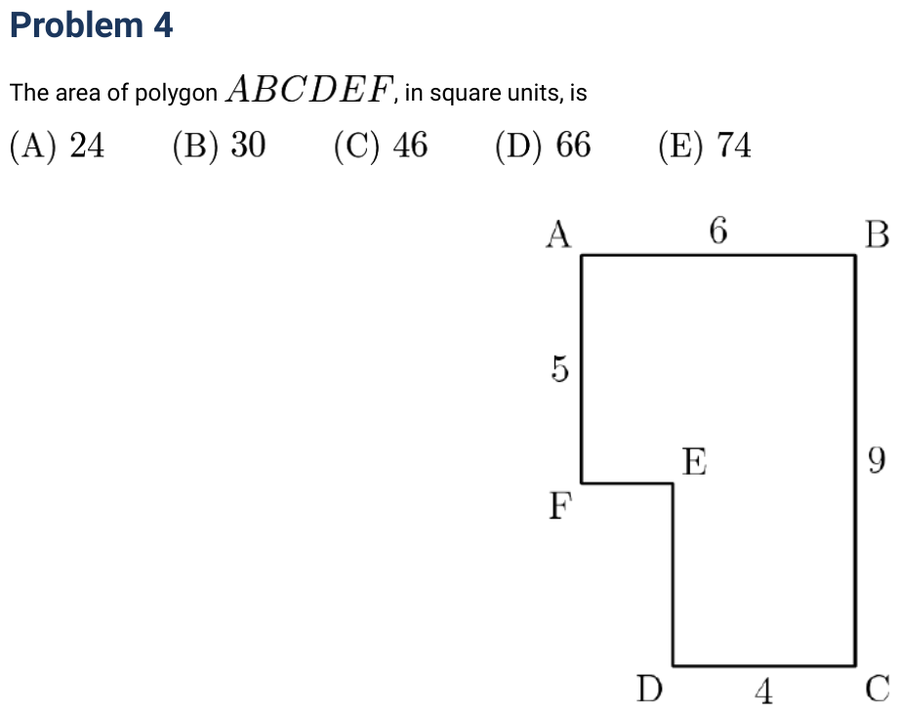
The shape has one corner pushed IN (the bite near E and F). Instead of chopping it into pieces, imagine filling that bite to make a full rectangle — then take the bite back out. What is the full rectangle?
Still stuck? Show hint 2 →
Hint 2 of 2
This is the bounding-box trick: enclose any rectilinear shape in the smallest rectangle that contains it, then subtract the rectangular pieces that aren't part of the shape. One subtraction beats slicing into several rectangles.
Show solution
Approach: bounding rectangle minus the notch
Fill the bite to complete the full rectangle: it is 6 wide (the top AB) by 9 tall (the right side BC), so its area is 6 × 9 = 54.
The bite that was removed is itself a small rectangle. Its width is 6 − 4 = 2 (top width minus bottom width DC) and its height is 9 − 5 = 4 (right side minus left side AF), so its area is 2 × 4 = 8.
Polygon = full rectangle − bite = 54 − 8 = 46.
Why this transfers: any L-shape, T-shape, or staircase is just a rectangle with rectangular bites taken out — find the missing side lengths by subtracting the parts you know, then subtract areas.
Another way — split into two rectangles:
Cut horizontally at the level of F/E. Top piece: 6 wide × 5 tall = 30. Bottom piece: 4 wide × (9 − 5) = 4 × 4 = 16.
30 + 16 = 46 — same answer, built up instead of cut down.
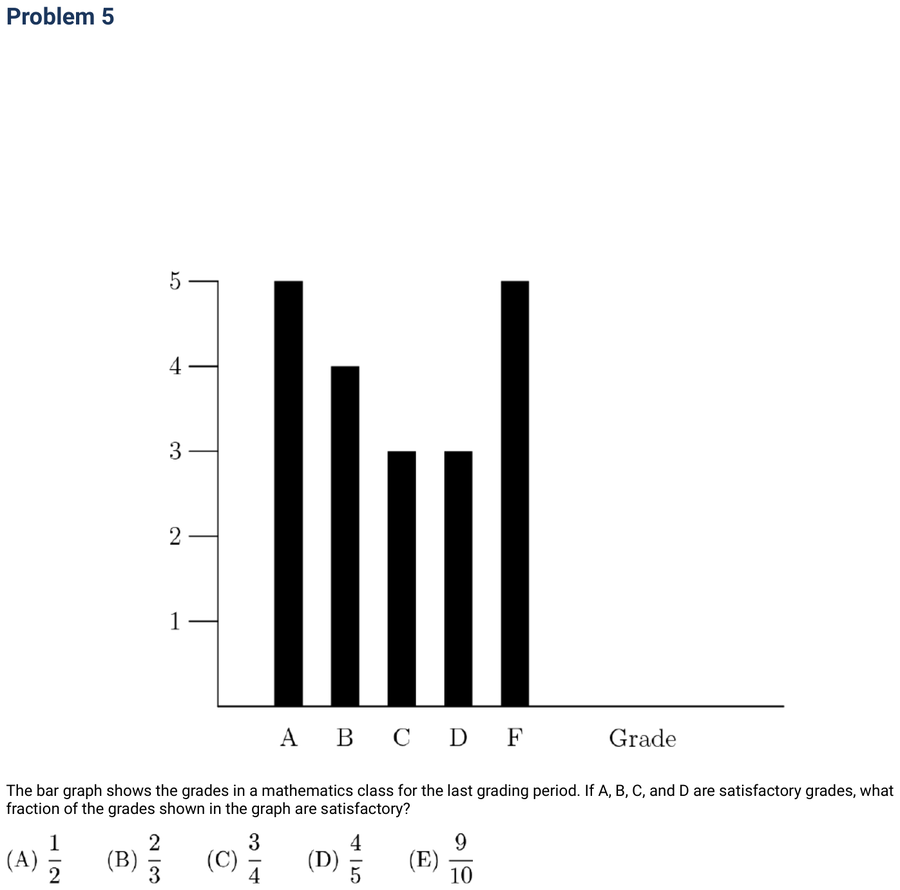
A fraction needs a top AND a bottom. The top is the satisfactory grades (A, B, C, D). The bottom is EVERY grade in the class — and the F bar still counts toward that total even though it isn't satisfactory.
Still stuck? Show hint 2 →
Hint 2 of 2
Read each bar's height off the axis, total them for the denominator, total just the satisfactory ones for the numerator, then simplify. The classic trap is leaving the F's out of the bottom.
Show solution
Approach: satisfactory ÷ total
Read the bar heights: A = 5, B = 4, C = 3, D = 3, F = 5. Satisfactory (A+B+C+D) = 5 + 4 + 3 + 3 = 15.
The whole class is the total of ALL bars including F: 15 + 5 = 20.
Fraction = 15 ⁄ 20 = 3⁄4.
Spot the trap: if you forget the 5 F's, you'd get 15⁄15 = 1, which isn't even an option — the unsatisfactory grades belong in the denominator, just not the numerator.
A stack of paper containing 500 sheets is 5 cm thick. Approximately how many sheets of this type of paper would there be in a stack 7.5 cm high?
Show answer
Answer: D — 750.
Show hints
Hint 1 of 2
Same paper means every sheet is the same thickness, so the number of sheets grows in lockstep with the height. 7.5 cm is one-and-a-half times 5 cm — what does that do to the sheet count?
Still stuck? Show hint 2 →
Hint 2 of 2
Find the 'unit rate' (sheets per single cm) and the rest is one multiplication. Unit rates turn any 'this much gives that much, so how much gives…?' question into a single step.
Show solution
Approach: scale up by the ratio of heights
500 sheets fill 5 cm, so the rate is 500 ⁄ 5 = 100 sheets per cm.
A 7.5 cm stack holds 100 × 7.5 = 750 sheets.
Sanity check: 7.5 cm is 1.5 × the 5 cm stack, so the count should be 1.5 × 500 = 750 — height and sheet count scale together because the paper is identical.
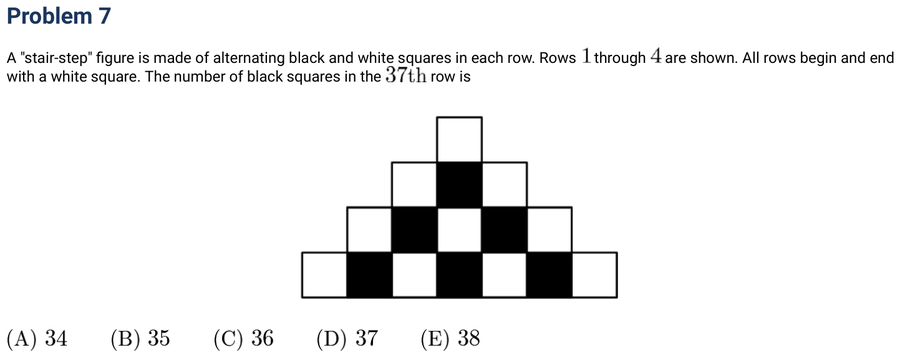
Don't picture all 37 rows — just look at how one row is built. Each row starts AND ends with white, with blacks tucked between. If the whites are like fence posts, the blacks are the gaps between them. How many gaps for a given number of posts?
Still stuck? Show hint 2 →
Hint 2 of 2
Each row reads white-black-white-black…-white. With the blacks sandwiched strictly between whites, there's always exactly one fewer black than white. Find the white count by the row number, subtract 1.
Show solution
Approach: find the row-n pattern
Count the rows shown: row 1 is 1 white, 0 black; row 2 is W B W (2 white, 1 black); row 3 is W B W B W (3 white, 2 black). Each row's white count equals its row number, and the blacks fill the gaps between whites — one fewer.
So row n has (n − 1) black squares. Row 37: 37 − 1 = 36.
Why this transfers: 'posts and gaps' shows up everywhere — n fence posts make n − 1 gaps, n trees in a row leave n − 1 spaces. Whenever items strictly alternate and the ends match, the inner kind is one fewer.
If a = −2, the largest number in the set −3a, 4a, 24⁄a, a², 1 is
Show answer
Answer: A — −3a.
Show hints
Hint 1 of 2
Before plugging in, ask: when a is NEGATIVE, which expressions come out positive? Anything that multiplies or divides a single negative a by a positive stays negative; the ones that flip to positive are your only candidates for 'largest'.
Still stuck? Show hint 2 →
Hint 2 of 2
You don't even need all five values. The biggest must be positive, and only −3a (negative times negative) and a² (a negative squared) can be positive — so just compare those two.
Show solution
Approach: substitute and pick the max
Spot the signs first: with a = −2, the expressions 4a and 24⁄a stay negative, so they can't be the largest. The candidates are −3a and a², both positive.
−3(−2) = 6 versus (−2)² = 4. The largest is 6 = −3a.
Why this transfers: sign-sorting before computing saves work — knowing what's positive, negative, or zero often eliminates most options without a single full calculation.
The product of the 9 factors (1 − 1⁄2)(1 − 1⁄3)(1 − 1⁄4) ⋯ (1 − 1⁄10) =
Show answer
Answer: A — 1⁄10.
Show hints
Hint 1 of 2
Don't multiply nine messy fractions. First simplify ONE factor: 1 − 1⁄2 = 1⁄2, 1 − 1⁄3 = 2⁄3, 1 − 1⁄4 = 3⁄4… do you see the staircase forming?
Still stuck? Show hint 2 →
Hint 2 of 2
Each factor is (n − 1)⁄n, so every numerator is the SAME number as the denominator just before it. That's telescoping — line them up and watch the inside cancel like a chain of dominoes, leaving only the very first numerator and the very last denominator.
Show solution
Approach: telescope
Each factor 1 − 1⁄n equals (n − 1)⁄n, so the product is (1⁄2)(2⁄3)(3⁄4) ⋯ (9⁄10).
Now cancel down the chain: the 2 on top of the second cancels the 2 on the bottom of the first, the 3 cancels the 3, and so on. Everything in the middle disappears, leaving the first top (1) over the last bottom (10).
= 1⁄10.
Why this transfers: when each piece of a product (or sum) hands its denominator to the next piece's numerator, only the two ends survive. Recognizing this 'telescope' turns a 9-step grind into reading off two numbers.
The fraction halfway between 1⁄5 and 1⁄3 (on the number line) is
Show answer
Answer: C — 4⁄15.
Show hints
Hint 1 of 2
'Halfway between' two points on the number line is exactly their midpoint — and the midpoint of two numbers is just their average. So this isn't a special fraction trick; it's add-and-halve.
Still stuck? Show hint 2 →
Hint 2 of 2
To average fractions, give them a common bottom first (fifteenths work for 5 and 3), add the tops, then halve. Halving is the same as dividing the answer by 2.
Show solution
Approach: average the two fractions
The midpoint is the average: add the two fractions, then halve. Common denominator 15: 1⁄5 = 3⁄15 and 1⁄3 = 5⁄15, so the sum is 8⁄15.
Halve it: 8⁄15 ÷ 2 = 8⁄30 = 4⁄15.
Sanity check: 1⁄5 = 3⁄15 and 1⁄3 = 5⁄15, and 4⁄15 sits exactly between 3⁄15 and 5⁄15 — right in the middle, as a midpoint should be.
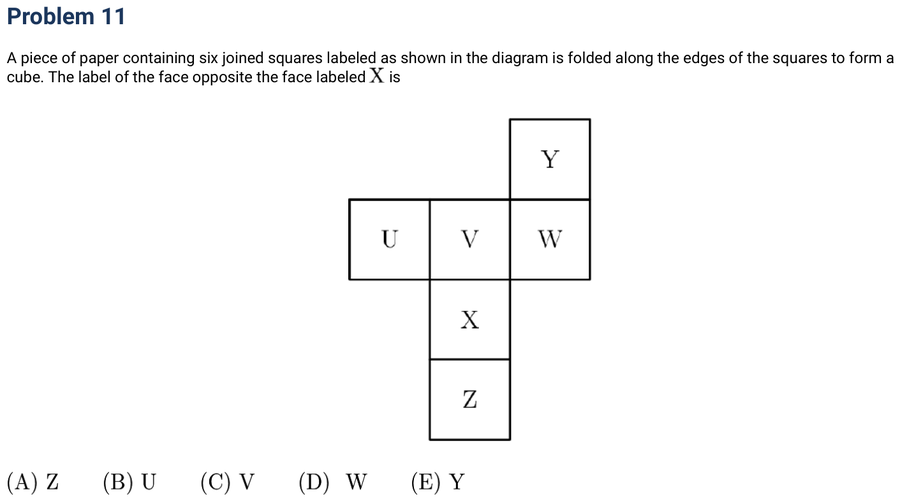
On a cube, opposite faces never share an edge. X touches V (above it) and Z (below it), so neither V nor Z can be the answer — knock those out first.
Still stuck? Show hint 2 →
Hint 2 of 3
Handy shortcut for nets: in any straight strip of THREE squares in a line, the two end squares fold to opposite faces. The vertical strip V–X–Z makes V and Z opposite — so X must pair with one of the remaining squares (U, W, or Y).
Still stuck? Show hint 3 →
Hint 3 of 3
Pick a front face and fold the rest into place. The only face left over after seating X's neighbors is the one directly across from X.
Show solution
Approach: fold around a chosen front face
Make V the front face. Its neighbors fold in: U → left, W → right, X → bottom, and Z (below X) wraps around to the back. The square Y sits above W, and since W became the right face, Y folds up to the top.
So X is the bottom and Y is the top — top is opposite bottom, so the face opposite X is Y.
Why this transfers: two quick rules crack most net problems — squares that share an edge are adjacent (never opposite), and the two ends of a straight line of three squares are always opposite. Apply those before folding anything in your head.
A square and a triangle have equal perimeters. The lengths of the three sides of the triangle are 6.2 cm, 8.3 cm, and 9.5 cm. The area of the square is
Show answer
Answer: B — 36 cm².
Show hints
Hint 1 of 2
The phrase 'equal perimeters' is the only bridge between the triangle and the square. Find the triangle's perimeter first — that number is also the square's perimeter, even though you can't see the square.
Still stuck? Show hint 2 →
Hint 2 of 2
A square's four sides are all equal, so its side is (perimeter ÷ 4). Once you have the side, the area is side². Watch the order: perimeter → side → area, not perimeter → area directly.
Show solution
Approach: perimeter → side → area
Add the triangle's three sides: 6.2 + 8.3 + 9.5 = 24 cm (the decimals were chosen to total a whole number). Equal perimeters means the square also has perimeter 24.
A square splits its perimeter into 4 equal sides: side = 24 ⁄ 4 = 6 cm. Then area = 6² = 36 cm².
Spot the trap: the answer is 6² = 36, not 6×… or 24 itself. Choices like 64 and 144 are squares of 8 and 12 — they're there to catch a wrong side length, so double-check you divided the perimeter by 4.
If you walk for 45 minutes at a rate of 4 mph and then run for 30 minutes at a rate of 10 mph, how many miles will you have gone at the end of one hour and 15 minutes?
Show answer
Answer: B — 8 miles.
Show hints
Hint 1 of 2
The speeds are in miles per HOUR, but the times are in minutes — those units must match before you multiply. Turn 45 minutes and 30 minutes into fractions of an hour first.
Still stuck? Show hint 2 →
Hint 2 of 2
Distance = rate × time, done separately for the walk and the run, then added. The total time (1 hour 15 min) is a distractor — you never use it directly; it's just the two legs combined.
Show solution
Approach: rate × time on each leg
Match the units: 45 min = 45⁄60 = 3⁄4 hour, and 30 min = 30⁄60 = 1⁄2 hour.
Walk leg: 4 mph × 3⁄4 hr = 3 miles. Run leg: 10 mph × 1⁄2 hr = 5 miles.
Total distance = 3 + 5 = 8 miles.
Spot the trap: the choice '480 miles' comes from multiplying speed by minutes (10 × 30 + …) without converting to hours. Always make the time unit match the speed's unit before multiplying.
The difference between a 6.5% sales tax and a 6% sales tax on an item priced at $20 before tax is
Show answer
Answer: B — $.10.
Show hints
Hint 1 of 2
You don't have to compute both taxes and subtract. Both are a percent of the SAME $20, so the difference in dollars is just the difference in rates, applied once. What is 6.5% − 6%?
Still stuck? Show hint 2 →
Hint 2 of 2
When two percentages act on the same amount, subtract the rates first, then take that single percent of the amount. Here the gap is only 0.5% — half of one percent.
Show solution
Approach: take the percent difference of the price
The two taxes differ by 6.5% − 6% = 0.5%, and both apply to the same $20, so the extra cost is just 0.5% of $20.
0.5% = 0.005, and 0.005 × 20 = $0.10.
Why this transfers: 'percent of the same base' problems collapse to one calculation — combine the rates before multiplying, instead of computing each piece and subtracting. (Sanity check: 1% of $20 is 20¢, so half a percent is 10¢.)
How many whole numbers between 100 and 400 contain the digit 2?
Show answer
Answer: C — 138.
Show hints
Hint 1 of 2
Counting numbers that contain a 2 directly is messy — a 2 might be in the hundreds, tens, or units place, and numbers like 220 or 282 would get counted twice. When 'at least one' is hard, count the OPPOSITE.
Still stuck? Show hint 2 →
Hint 2 of 2
Count how many numbers have NO 2 at all, then subtract from the total. 'Total − (none) = (at least one)' sidesteps all the double-counting. The numbers run 100 to 399, so there are 300 of them.
Show solution
Approach: complement count
There are 300 whole numbers from 100 to 399. Instead of counting those that contain a 2, count those that contain NO 2 (much cleaner — no overlaps).
No-2 count: the hundreds digit can be 1 or 3 (2 ways, since 2 is banned and a 3-digit number can't start with 0), and each of the tens and units can be any digit except 2 (9 ways each): 2 × 9 × 9 = 162.
Contains a 2 = total − none = 300 − 162 = 138.
Why this transfers: whenever you want 'at least one' of something, counting the cases with NONE and subtracting is almost always easier — it turns an overlapping mess into one clean multiplication.
The ratio of boys to girls in Mr. Brown's math class is 2 : 3. If there are 30 students in the class, how many more girls than boys are in the class?
Show answer
Answer: D — 6.
Show hints
Hint 1 of 2
Think of the ratio 2 : 3 as dividing the class into equal-size 'parts' — 2 parts of boys and 3 parts of girls. How many parts is that all together, and how big is each one?
Still stuck? Show hint 2 →
Hint 2 of 2
Add the ratio numbers to get the total parts (2 + 3 = 5), divide the class by that to size one part, then read off whatever the question asks. Here 'how many more girls' is just the part-difference (3 − 2 = 1 part).
Show solution
Approach: size of one part times the difference of parts
The ratio splits the class into 2 + 3 = 5 equal parts, so each part = 30 ⁄ 5 = 6 students.
Girls (3 parts) outnumber boys (2 parts) by exactly 1 part: extra girls = 1 × 6 = 6.
Spot the trap: '6' is the difference of parts (3 − 2 = 1 part), NOT the count of girls (which is 18) or 2 parts (which is 10, a tempting wrong answer). Always match the question to the right number of parts.
If your average score on your first six mathematics tests was 84 and your average score on your first seven mathematics tests was 85, then your score on the seventh test was
Show answer
Answer: D — 91.
Show hints
Hint 1 of 2
An average is a disguised total: average × count = sum. The seventh test is the only difference between the two groups, so it must be the gap between the two totals.
Still stuck? Show hint 2 →
Hint 2 of 2
Turn each average into a running total (7 × 85 and 6 × 84), then subtract — what's left over is the one extra test.
Show solution
Approach: difference of totals
Recover the sums: first 7 tests total 7 × 85 = 595; first 6 tests total 6 × 84 = 504.
The seventh test is the difference: 595 − 504 = 91.
Intuition: adding the 7th test pulled the average UP by 1 point across all 7 tests. So the 7th score had to be the old average 84 plus enough to lift all seven by 1 — that's 84 + 7 = 91. (Quick check: 84 + 7×1 = 91 ✓.)
Nine copies of a certain pamphlet cost less than $10.00 while ten copies of the same pamphlet (at the same price) cost more than $11.00. How much does one copy of this pamphlet cost?
Show answer
Answer: E — $1.11.
Show hints
Hint 1 of 2
Each clue gives a boundary on the single-copy price: '9 copies under $10' caps it from above, '10 copies over $11' lifts it from below. Together they squeeze the price into a narrow window — then just see which choice fits.
Still stuck? Show hint 2 →
Hint 2 of 2
Translate words to bounds: 9p < 10 means p is below 10⁄9; 10p > 11 means p is above 11⁄10. The answer is the only listed price caught between the two.
Show solution
Approach: bracket p from both inequalities
Upper bound: 9 copies cost less than $10, so p < 10⁄9 ≈ $1.111.
Lower bound: 10 copies cost more than $11, so p > 11⁄10 = $1.10.
Price is trapped in 1.10 < p < 1.111. The only choice in that sliver is $1.11.
Sanity check: at $1.11, nine copies cost $9.99 (under $10 ✓) and ten copies cost $11.10 (over $11 ✓). The window is barely a penny wide, which is exactly why only one option survives.
If the length and width of a rectangle are each increased by 10%, then the perimeter of the rectangle is increased by
Show answer
Answer: B — 10%.
Show hints
Hint 1 of 2
Don't reach for length and width numbers — none are given, which is a clue the answer doesn't depend on them. If every side gets 10% longer, what happens to the total of the sides?
Still stuck? Show hint 2 →
Hint 2 of 2
Perimeter is just the sum of lengths. Stretch every length by the same factor and the sum stretches by that same factor — so a 10% increase on each side is a 10% increase on the whole perimeter. (Area is different: it would grow by 1.10 × 1.10.)
Multiplying by 1.10 is a 10% increase — the length/width values cancel out, which is why none were needed.
Spot the trap: 21% (choice D) is the AREA increase (1.10 × 1.10 = 1.21). Length-type quantities like perimeter scale by the factor itself; area-type quantities scale by the factor squared. Knowing which is which beats plugging in numbers.
Another way — try a concrete rectangle:
Take a 10 × 20 rectangle: perimeter = 60. Grow sides to 11 × 22: new perimeter = 66.
66 ÷ 60 = 1.10, a 10% increase — and the same ratio comes out for any starting rectangle.
In a certain year, January had exactly four Tuesdays and four Saturdays. On what day did January 1 fall that year?
Show answer
Answer: C — Wednesday.
Show hints
Hint 1 of 3
January has 31 days, and 31 = 4 weeks + 3 leftover days. That means SOME weekdays squeeze in a 5th time. Which ones? The first three days of the month — they're the extras.
Still stuck? Show hint 2 →
Hint 2 of 3
So exactly three weekdays appear 5 times (the day Jan 1 lands on, plus the next two), and the other four appear only 4 times. The problem wants Tuesday AND Saturday to be among the rare (4-time) ones.
Still stuck? Show hint 3 →
Hint 3 of 3
For both Tuesday and Saturday to appear only 4 times, neither can be in the 'first three days' trio. Test each possible starting day and see whose trio of three consecutive weekdays misses both Tue and Sat.
Show solution
Approach: find which start makes Tue and Sat both rare
31 days = 4 full weeks (28 days) + 3 extra days. Every weekday shows up 4 times for the 28, and the 3 extras — Jan 1, 2, 3's weekdays — get a 5th appearance. So three consecutive weekdays appear 5 times; the rest appear 4.
We need Tuesday and Saturday to both be 4-time days, i.e. NOT in that trio of three-in-a-row starting at Jan 1. List the trios: a Monday start gives Mon-Tue-Wed (hits Tue ✗); a Tuesday start hits Tue ✗; a Wednesday start gives Wed-Thu-Fri — misses both Tue and Sat ✓.
So January 1 fell on Wednesday.
Why this transfers: in any month, take the day count mod 7 to find how many 'extra' days there are; those extras (counting from the 1st) are exactly the weekdays that occur one more time than the others.
Mr. Green receives a 10% raise every year. His salary after four such raises has gone up by what percent?
Show answer
Answer: E — more than 45%.
Show hints
Hint 1 of 2
A raise is a MULTIPLY, not an add. Each year the salary becomes 1.10 times the year before — so four raises means ×1.10 four times over, not +10% four times. Those give different answers.
Still stuck? Show hint 2 →
Hint 2 of 2
Because every raise also raises the previous raises, the total beats the naive 4 × 10% = 40%. The question is whether the extra 'raise-on-raise' pushes past 45% — so you only need a rough size, not the exact figure.
Show solution
Approach: compound the raises step by step
Start at 1.00 and multiply by 1.10 each year: after year 1, 1.10; year 2, 1.21; year 3, 1.331; year 4, ≈ 1.4641.
That's about a 46% increase — more than 45%, so the answer is more than 45%.
Why it beats 40%: simply adding 10% four times ignores that later raises act on an already-bigger salary. After two years alone you're at 1.21 (a 21% gain, not 20%) — that extra 1% snowballs, landing you past 45% by year four. This 'interest on interest' is the heart of compounding.
Another way — eyeball without exact arithmetic:
Two 10% raises multiply to 1.10 × 1.10 = 1.21. Four raises = (1.21)² = 1.21 × 1.21.
1.21 × 1.21 is clearly above 1.21 × 1.20 = 1.452, so the gain exceeds 45% — answer is more than 45% without ever finishing the multiplication.
Assume every 7-digit whole number is a possible telephone number except those that begin with 0 or 1. What fraction of telephone numbers begin with 9 and end with 0?
Show answer
Answer: B — 1⁄80.
Show hints
Hint 1 of 2
A 'what fraction' question is (favorable count) ⁄ (total count). Build both counts digit-by-digit, position by position. The first digit is special (it can't be 0 or 1), and the favorable case also pins the first and last digits.
Still stuck? Show hint 2 →
Hint 2 of 2
Here's the shortcut: the five middle digits are totally free in BOTH counts, so they contribute the same factor on top and bottom — they cancel. Only the constrained positions (first and last digit) actually decide the fraction.
Show solution
Approach: count and take the ratio
Total valid numbers: first digit has 8 choices (2 through 9, since 0 and 1 are banned), the other six digits have 10 each → 8 · 10⁶.
Favorable (start 9, end 0): first digit forced to 9 (1 way), last digit forced to 0 (1 way), five middle digits free (10⁵).
Ratio = 10⁵ ⁄ (8 · 10⁶) = 1⁄80.
Why this transfers: in a fraction of counts, any position with the same freedom on top and bottom cancels — so you can think of just the constrained spots: 1-in-8 for the first digit being 9, times 1-in-10 for the last being 0, gives 1⁄80 directly.
King Middle School has 1200 students. Each pupil takes 5 classes a day. Each teacher teaches 4 classes. Each class has 30 students and 1 teacher. How many teachers are there at King Middle School?
Show answer
Answer: E — 50.
Show hints
Hint 1 of 2
You can't jump straight from students to teachers — but both connect to the same middle thing: CLASSES. Find the number of classes first, then convert classes to teachers.
Still stuck? Show hint 2 →
Hint 2 of 2
Count one quantity two different ways. The total 'student-seats' (a student sitting in a class) equals 1200 × 5 counted from the students' side, and also equals (number of classes) × 30 counted from the classes' side. Setting those equal unlocks the class count.
Show solution
Approach: count student-class slots two ways
Count total enrollments (one student in one class) two ways. From students: 1200 × 5 = 6000 seats. From classes: each class has 30 students, so (# classes) × 30 = 6000, giving 6000 ⁄ 30 = 200 classes.
Each teacher covers 4 classes, so teachers = 200 ⁄ 4 = 50.
Why this transfers: 'counting the same thing two ways' is a powerhouse — pick a quantity both groups touch (here, class enrollments), tally it from each side, and set them equal. It chains students → classes → teachers without ever needing a direct student-to-teacher link.
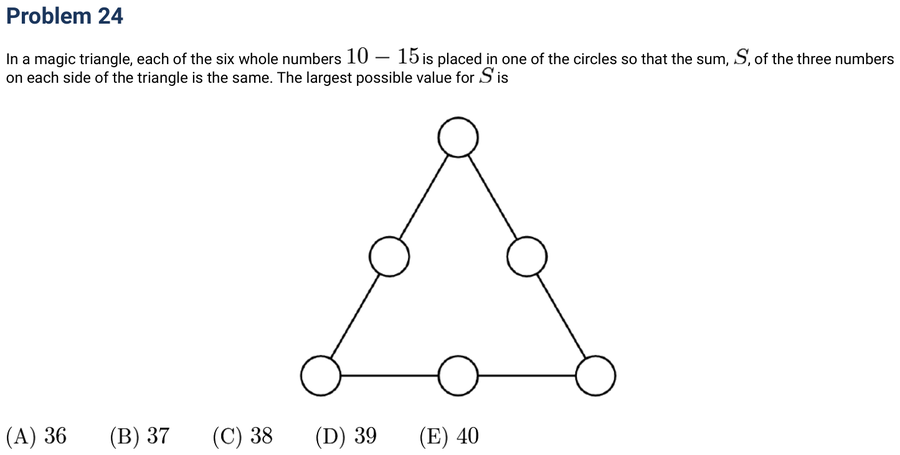
The three corner circles are each shared by TWO sides, while each middle circle belongs to just one side. So when you add up all three side-sums, the corners get counted twice and the middles once. That imbalance is the key — which numbers do you want in the doubly-counted corners?
Still stuck? Show hint 2 →
Hint 2 of 3
Add the three side-sums together: that total is (every number once) + (each corner one extra time) = 75 + (corner sum). To make S as big as possible, load the corners with the three largest numbers so the corner sum is largest.
Still stuck? Show hint 3 →
Hint 3 of 3
Once you decide the corners, double-check it's actually buildable: each side must hit the SAME S, so the leftover numbers have to land as the right middles.
Show solution
Approach: double-count the corner contributions
All six numbers total 10 + 11 + ⋯ + 15 = 75. Adding the three side-sums counts each corner twice and each middle once, so 3S = 75 + (corner sum). Bigger corners → bigger S, so put the three largest at the corners: 13 + 14 + 15 = 42.
Then 3S = 75 + 42 = 117, so S = 39.
Confirm it's achievable: corner pairs sum to 27, 28, 29, and each side needs the middle to fill up to 39 — that's middles 12, 11, 10 (= the three leftover numbers, perfectly). So S = 39 really works.
Why this transfers: in 'shared-vertex' sum puzzles, add ALL the line-sums first — the shared spots get over-counted, and steering the big (or small) values into the over-counted spots is how you maximize (or minimize) the common total.
Logic & Word Problemscontrapositivefind-counterexample
Five cards are lying on a table as shown.
PQ
346
Each card has a letter on one side and a whole number on the other side. Jane said, “If a vowel is on one side of any card, then an even number is on the other side.” Mary showed Jane was wrong by turning over one card. Which card did Mary turn over?
Show answer
Answer: A — 3.
Show hints
Hint 1 of 3
The rule is one-directional: 'vowel → even'. The ONLY way to break it is to find a single card that is a vowel on one side and an ODD number on the other. So ask: which visible faces could possibly be hiding that forbidden pairing?
Still stuck? Show hint 2 →
Hint 2 of 3
Sort the five visible faces. P and Q are consonants — the rule says nothing about consonants, so flipping them proves nothing. 4 and 6 are even — even is exactly what the rule allows, so they're safe too. That leaves only the odd-numbered face.
Still stuck? Show hint 3 →
Hint 3 of 3
To catch a violation, flip the card whose visible side is ODD: if a vowel is hiding behind it, the rule is busted. Which card is that?
Show solution
Approach: test only the cards that could falsify the implication
Breaking 'vowel → even' requires a card that's a vowel paired with an odd number. Check what flipping each face could reveal: P, Q (consonants) — the rule doesn't restrict consonants, useless to flip; 4, 6 (even) — the rule permits any letter behind an even number, also useless; 3 (odd) — if a vowel hides behind it, that's a vowel with an odd number, a direct contradiction.
Only the odd-numbered card can expose the forbidden vowel-with-odd combination, so Mary turned over 3.
Why this transfers: to test an 'if A then B' rule, you only ever check the A-cases (is B true?) and the not-B-cases (is A false behind it?). Cases that are already not-A or already B can never disprove it — a sharp filter that saves you from flipping every card.